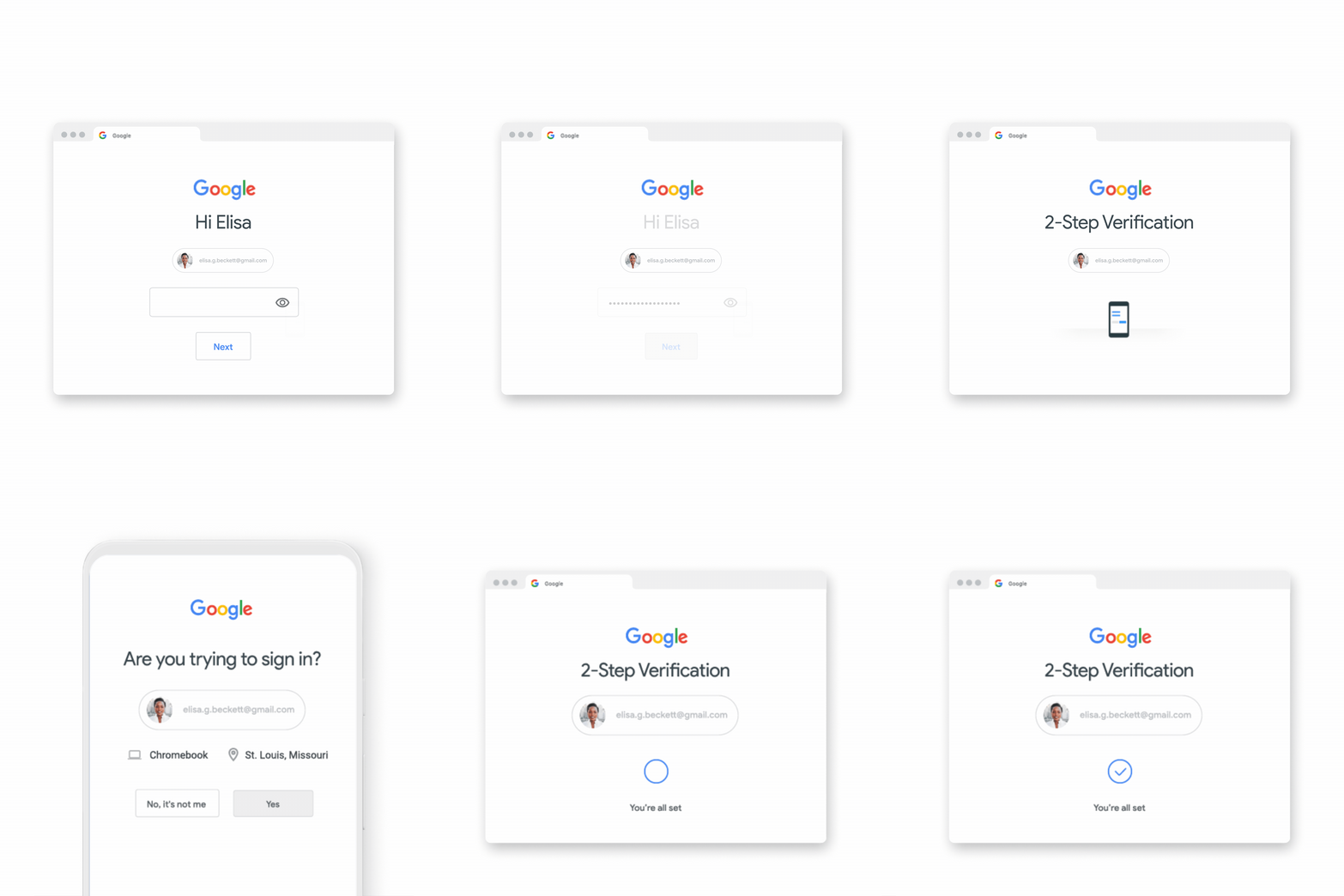
A simpler and safer future — without passwords
You may not realize it, but passwords are the single biggest threat to your online security – they’re easy to steal, they’re hard to remember, and managing them is tedious. Many people believe that a password should be as long and complicated as possible – but in many cases, this can actually increase the security risk. Complicated passwords tempt users into using them for more than one account; in fact, 66% of Americans admit to using the same password across multiple sites, which makes all those accounts vulnerable if any one falls.
In 2020, searches for “how strong is my password” increased by 300%. Unfortunately, even the strongest passwords can be compromised and used by an attacker – that’s why we invested in security controls that prevent you from using weak or compromised passwords.
At Google, keeping you safe online is our top priority, so we continuously invest in new tools and features to keep your personal information safe, including your passwords.
On World Password Day, we’re sharing how we are already making password management easier and safer, and we’re providing a sneak peek at how our continued innovation is creating a future where one day you won’t need a password at all.
Keeping Your Google Sign In Safer
One of the best ways to protect your account from a breached or bad password is by having a second form of verification in place – another way for your account to confirm it is really you logging in. Google has been doing this for years, ensuring that your Google Account is protected by multiple layers of verification.
Today we ask people who have enrolled in two-step verification (2SV) to confirm it’s really them with a simple tap via a Google prompt on their phone whenever they sign in. Soon we’ll start automatically enrolling users in 2SV if their accounts are appropriately configured. (You can check the status of your account in our Security Checkup). Using their mobile device to sign in gives people a safer and more secure authentication experience than passwords alone.
We are also building advanced security technologies into devices to make this multi-factor authentication seamless and even more secure than a password. For example, we’ve built our security keys directly into Android devices, and launched our Google Smart Lock app for iOS, so now people can use their phones as their secondary form of authentication.

OPPO Find X3 Pro: com’è fatta la lente a microscopio che ingrandisce fino a 60x?
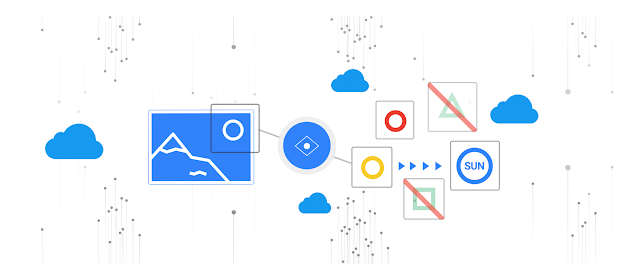
L’app Woolaroo usa Vision AI per aiutare a preservare le lingue
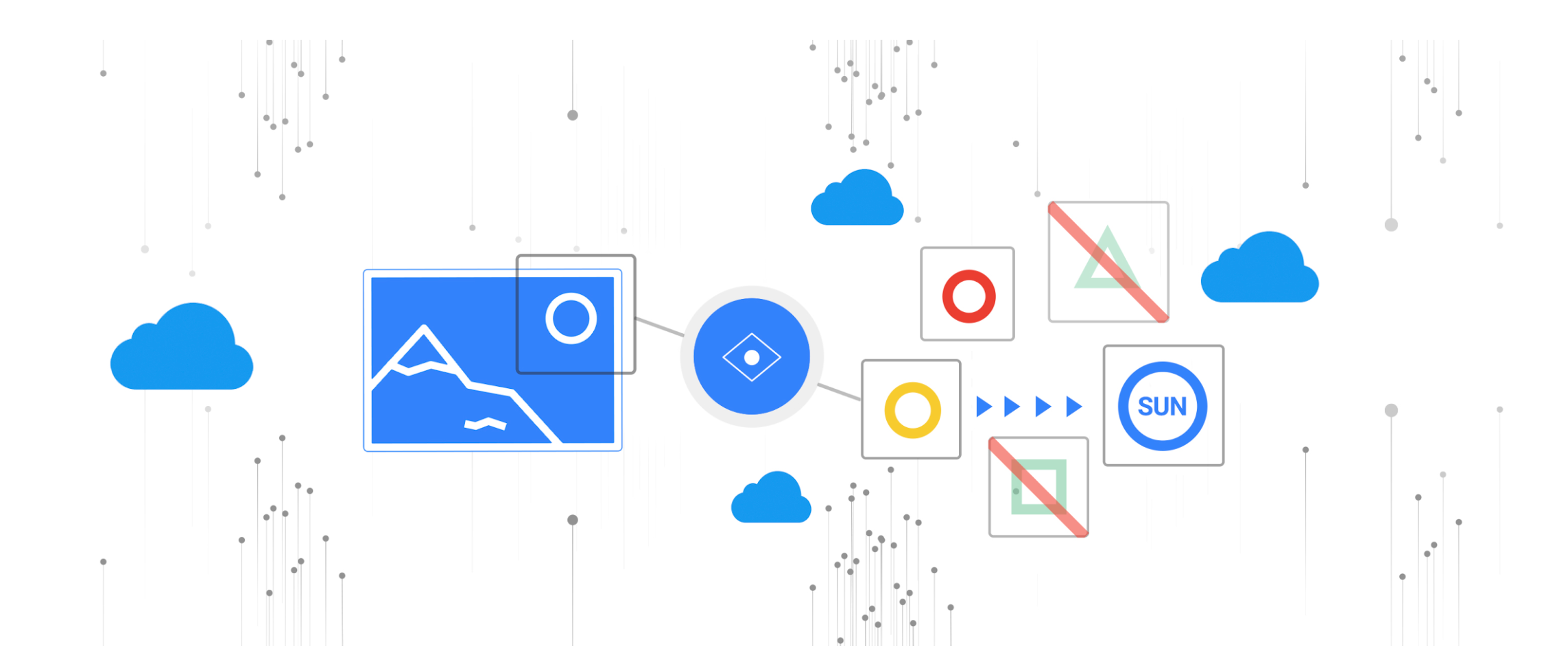
Purtroppo, delle oltre 7.000 lingue parlate nel mondo, quasi 3.000 sono a rischio di estinzione. In media si stima che, ogni quattordici giorni, una lingua si estingua. Google Arts & Culture, attraverso soluzioni tecnologiche creative e il supporto delle organizzazioni linguistiche, contribuisce alla creazione di uno strumento interattivo ed educativo per promuovere le lingue.
Woolaroo è una piattaforma open-source di foto-traduzione alimentata dal machine learning e dal riconoscimento delle immagini. L’applicazione è stata costruita su Google Cloud per incoraggiare gli utenti a scoprire di più sulle lingue in via di estinzione in tutto il mondo. Gli utenti, scattando una foto di un oggetto, potranno scoprire, tramite l’applicazione, la parola nella lingua selezionata con la relativa pronuncia.
Woolaroo nasce dall’idea che l’apprendimento delle lingue possa essere migliorato attraverso il coinvolgimento e il contesto. Vedere un oggetto nel suo ambiente rende più facile la memorizzazione dell’informazione e il conseguente utilizzo, in modo più naturale, in una conversazione.
Con l’aiuto dei team di Google, Woolaroo è stato lanciato in 10 lingue, tra cui il greco-calabro, il siciliano, il creolo della Louisiana, il maori e lo yiddish. Durante la fase di sviluppo dell’applicazione, i team di Partner Innovation e Google Arts & Culture hanno lanciato un appello a Google per scoprire quali erano lingue meno conosciute parlate dai dipendenti. Grazie al supporto delle persone madrelingua sono stati creati vocabolari rivisti dalle istituzioni partner per garantire che le traduzioni fossero corrette e coerenti.
Woolaroo utilizza Google Cloud Vision API, che ottiene informazioni dalle immagini attraverso AutoML o modelli pre-addestrati per classificare rapidamente le immagini in milioni di categorie predefinite. Questo rende l’AI accessibile e utile a più persone, poiché AutoML automatizza l’addestramento di questi modelli di machine learning.
Il nostro team di Google Arts and Culture crea esperienze coinvolgenti per far conoscere l’arte, la storia, la cultura e molto altro ancora. L’obiettivo è quello di sostenere la conservazione del patrimonio e dei punti di riferimento culturali – compresa la lingua parlata – attraverso l’uso della tecnologia moderna. Woolaroo è open source, quindi qualsiasi persona e organizzazione può utilizzarlo per supportare una lingua in via di estinzione. Per scoprire di più sulle iniziative Google Arts & Culture, potete scaricare l’app Google Arts & Culture o visitare il blog.
Scritto da: Ian Pattison, Head of Customer Engineering, Retail, CPG & Travel, UK&I

Mass Effect Legendary Edition, online decine di bonus gratuiti
In attesa dell’imminente lancio di Mass Effect Legendary Edition, che arriverà nei negozi il 14 maggio prossimo su PC, tramite Origin e Steam, PlayStation 4 e Xbox One con compatibilità futura su PlayStation 5 e Xbox Series X|S, BioWare ha rilasciato diversi contenuti per i fan, tra cui un mega-cut della colonna sonora di Mass Effect, un’esperienza unica per creare key art personalizzate e un download gratuito di contenuti bonus.
TikTok e Technology Coalition, insieme per proteggere i minori
TikTok è uno dei social network più attivi negli ultimi tempi in termini di impegni per assicurare la massima tutela e protezione ai suoi utenti, specie i più giovani. La nota piattaforma, tra le preferite dagli italiani, infatti, dopo essersi adeguata alle normative italiane volute dal Garante per la Privacy sulle limitazioni di accesso ai suoi servizi agli utenti di età inferiore ai 13 anni, ha annunciato di aver aderito alla Technology Coalition, un’organizzazione che lavora per proteggere i minori dallo sfruttamento e dagli abusi sessuali online.

Facebook conferma il ban, e Trump lancia la sua piattaforma
Il comitato di supervisione di Facebook ha preso la sua decisione sul bando di Donald Trump dalla nota piattaforma social: come vi abbiamo segnalato ieri, per il momento gli account ufficiali dell’ex presidente degli Stati Uniti d’America resteranno sospesi su Facebook e Instagram. Almeno fino a quando non verrà presa una decisione definitiva nei prossimi mesi, quando il comitato avrà avuto modo di analizzare meglio il caso dopo che Facebook gli avrà fornito ulteriore materiale e spiegazioni.
AMP: un Google Update anticipa l’addio

SpaceX stavolta ce l’ha fatta: la Starship SN15 è atterrata intera

La versione SN15 del veicolo sperimentale Starship di SpaceX è partita verticalmente, si è arrampicata fino a circa 10 chilometri, ha effettuato la discesa in “spanciata”, si è raddrizzata ed è scesa fino a terra, sostenuta soltanto dai suoi motori, appoggiandosi dolcemente al suolo invece di esplodere o schiantarsi come gli esemplari precedenti.
A parte un principio d’incendio dopo l’atterraggio, domato dai sistemi antincendio, e una copertura nuvolosa che ha intralciato la visuale, con alcune interruzioni delle immagini video in diretta dal veicolo, tutto è andato bene. Un altro passo avanti nello sviluppo iterativo rapido di Starship. Il prossimo passo è rendere tutto questo normale e abituale.
Questo articolo vi arriva gratuitamente e senza pubblicità grazie alle donazioni dei lettori. Se vi è piaciuto, potete incoraggiarmi a scrivere ancora facendo una donazione anche voi, tramite Paypal (paypal.me/disinformatico) o altri metodi.
A hybrid approach to work
Sundar sent the following email to Google employees earlier today.
Hi Googlers,
We’ve spent the last year focused on supporting employees during the pandemic. I hope the extra benefits such as Carer’s Leave, the work-from-home allowance, the extra reset days, and the ability to work from wherever you need have been helpful in getting through this tough time.
And we’re not through it yet. It’s heartbreaking to see COVID surging in places like India, Brazil, and many others around the world. If you live in one of these places, please focus on taking care of yourselves and your loved ones right now. We are here to support however we can.
In other areas, conditions are less dire and people are beginning to open up their lives and think about returning to the office. In fact, in places where we’ve been able to reopen Google offices in a voluntary capacity, we’ve seen nearly 60% of Googlers choosing to come back to the office.
For more than 20 years, our employees have been coming to the office to solve interesting problems — in a cafe, around a whiteboard, or during a pickup game of beach volleyball or cricket. Our campuses have been at the heart of our Google community and the majority of our employees still want to be on campus some of the time. Yet many of us would also enjoy the flexibility of working from home a couple days of week, spending time in another city for part of the year, or even moving there permanently. Google’s future workplace will have room for all of these possibilities.
Over the last year, a team within REWS has been reimagining a hybrid workplace to help us collaborate effectively across many work environments. They’re testing new multi-purpose offices and private workspaces, and working with teams to develop advanced video technology that creates greater equity between employees in the office and those joining virtually. All of these efforts will help us work with greater flexibility and choice once we’re able to return to our offices globally.
That flexibility will come in a few different forms — and your product areas and functions will share more details on all of these changes by mid-June. Here are the key principles:
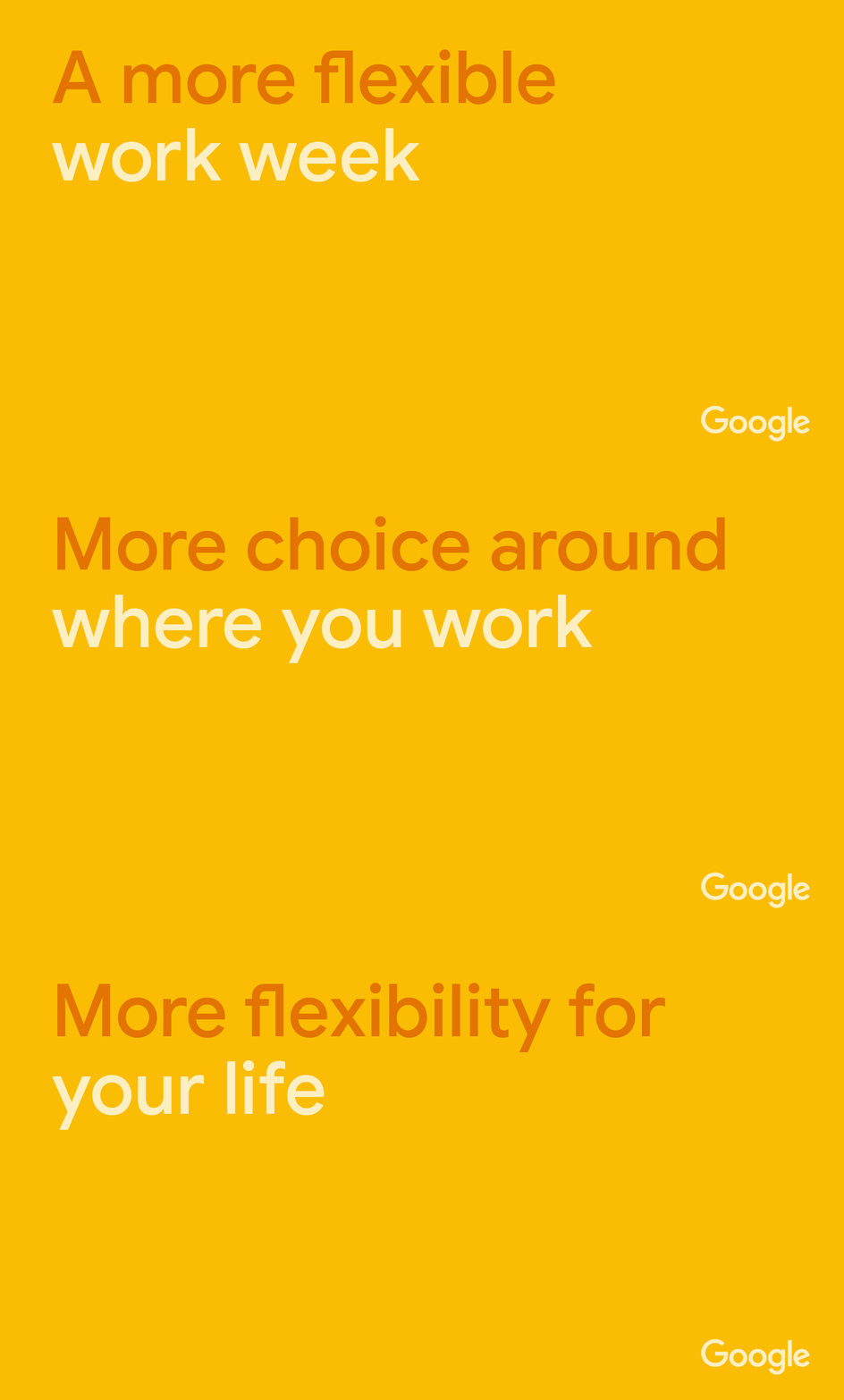
A more flexible work week:
-
We’ll move to a hybrid work week where most Googlers spend approximately three days in the office and two days wherever they work best. Since in-office time will be focused on collaboration, your product areas and functions will help decide which days teams will come together in the office. There will also be roles that may need to be on site more than three days a week due to the nature of the work.
More choice around where you work:
-
More locations globally: One of Google’s biggest advantages is our global footprint. We are investing in many great communities globally — which creates more opportunity for employees to move around throughout their careers. By mid-June your PAs and functions will come back with a process by which you can apply to move to another office. In granting approvals, they’ll take into account whether business goals can be met in the new location and whether your team has the right infrastructure in the site to support your work.
-
Remote work: We’ll also offer opportunities for you to apply for completely remote work (away from your team or office) based on your role and team needs. Before the pandemic, we had thousands of people working in locations separate from their core teams. I fully expect those numbers to increase in the coming months as we develop more remote roles, including fully all-remote sub teams. You’ll be able to apply for remote work within your product area or function. As with location transfers, your leads will evaluate whether remote work can support the goals of the team and business. Whether you choose to transfer to a different office or opt for completely remote work, your compensation will be adjusted according to your new location.
-
Taken together these changes will result in a workforce where around 60% of Googlers are coming together in the office a few days a week, another 20% are working in new office locations, and 20% are working from home.
More flexibility for your life:
-
Work-from-anywhere weeks: Going forward, Googlers will be able to temporarily work from a location other than their main office for up to 4 weeks per year (with manager approval). The goal here is to give everyone more flexibility around summer and holiday travel.
-
Focus time: Product areas and functions will also offer focus hours so we limit internal meetings during times when people need to be heads down on projects.
-
Reset days: We’ll continue offering extra “reset” days to help employees recharge during the pandemic in 2021. Our next global day off will be on Friday, May 28 (or the following work day if you’re already not working on the 28th). Please enjoy it!
Woolaroo: a new tool for exploring indigenous languages
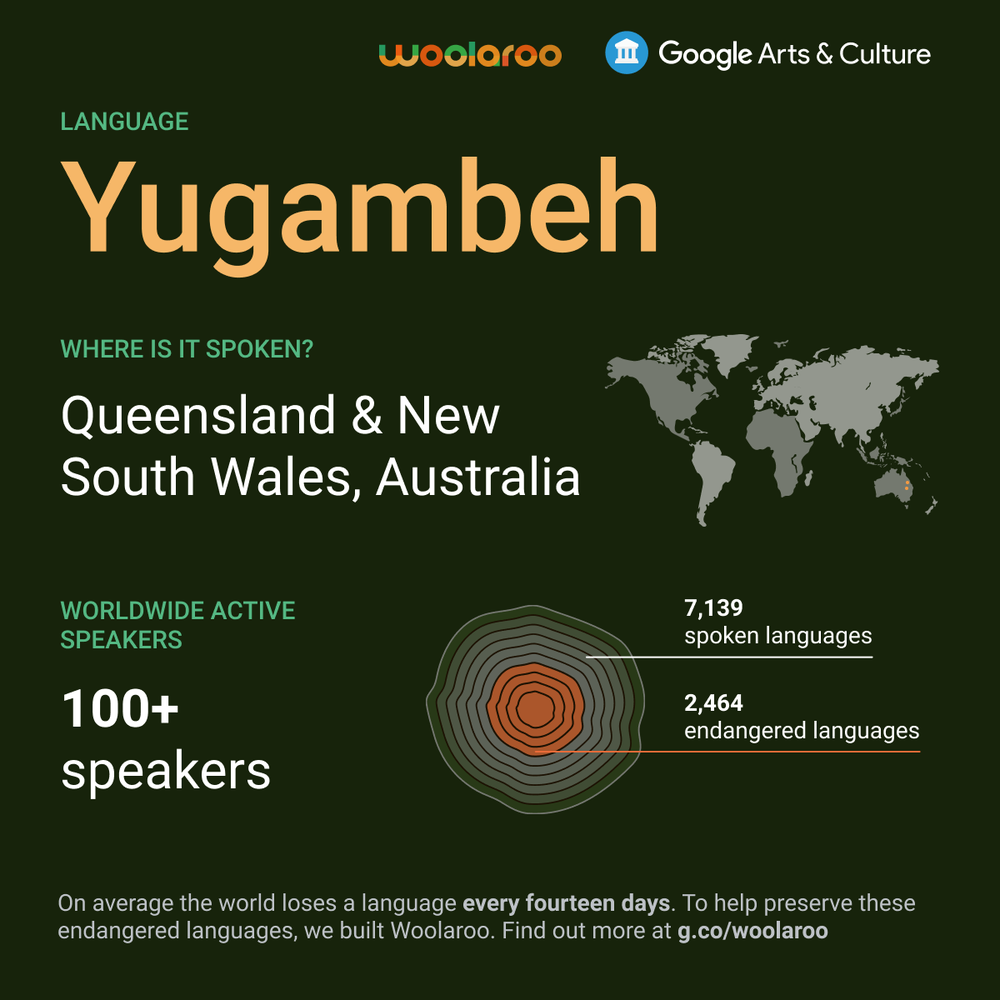
“Our dictionary doesn’t have a word for shoe” my Uncle Allan Lena said, so when kids ask him what to call it in Yugambeh, he’ll say “jinung gulli” – a foot thing.
Uncle Allan Lena is a frontline worker in the battle to reteach the Yugambeh Aboriginal language to the children of southeast Queensland, Australia, where it hasn’t been spoken fluently for decades and thus is – like many other languages around the world – in danger of disappearing.
For the younger generation, even general language can be a challenge to understand, but it can be especially difficult to try to describe modern items using Indigenous languages like Yugambeh. For example in the Australian outdoors, it’s easy to teach children the words for trees and animals, but around the house it becomes harder. Traditional language didn’t have a word for a fridge – so we say waring bin – a cold place. The same with a telephone – we call it a gulgun biral – voice thrower.
However, today’s technology can help provide an educational and interactive way to promote language learning and preservation. I’m particularly proud for Yugambeh to be the first Australian Aboriginal language to be featured on Woolaroo, a new Google Arts & Culture experiment using the Cloud Vision API.
The team behind the Yugambeh Museum has been working for three decades to help gather local language and cultural stories. Given the importance of Aboriginal language to Australian culture we have the incentive to record the known but in particular new words our community members are using as the world evolves bringing us new technology we didn’t have before.

POCO F3: sembra un top di gamma, ma costa 350 euro. La recensione

Facebook conferma il ban dell’account di Donald Trump
Sono passati quattro mesi dal ban degli account dell’ormai ex Presidente degli Stati Uniti d’America Donald Trump da tutte le principali piattaforme social dopo il plateale incitamento ai rivoltosi che hanno assaltato Capitol Hill il 6 gennaio scorso per contestare il risultato delle elezioni presidenziali. Facebook era stata l’azienda che aveva preso la decisione più drastica: sospendere gli account ufficiali di Trump su Facebook ed Instagram a tempo indeterminato, riservandosi una nuova valutazione periodica su quella decisione.
Blast off into Entertainment Space on your Android tablet
Tablets are the perfect device to stay entertained, whether you’re watching a movie from your bed, playing games on your daily commute or reading a book while you travel. The screen is bigger than your phone, but more portable than your TV. In fact, over the last year, we’ve seen over 30 percent more people start using Android tablets compared to the prior year.
As a versatile device with many different capabilities, whole families often share the same tablet. Last year, we introduced Kids Space as a way for your kids under 9 to learn and have fun with recommended apps, books and videos on Android tablets. And for the rest of the family members, we’re now bringing you a new Android tablet experience that places the entertainment content you love front and center.
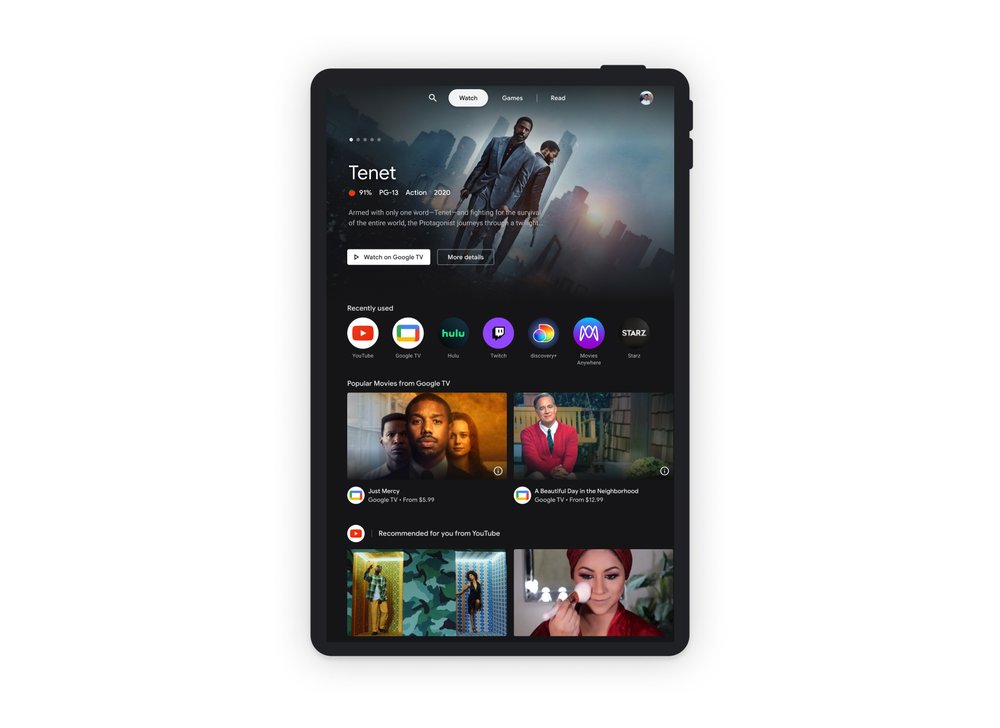
Entertainment Space is a one-stop, personalized home for all your favorite movies, shows, videos, games and books. You’ll save time and avoid having to hop between apps to try to figure out what to do, whether it’s to watch, play or read. Once you sign in to your subscription apps, Entertainment Space will show you your content in one place and tailored for you. And if you want to share your tablet, everyone in the family can have their own personalized profile.
Hit play on the latest movies, TV shows and YouTube videos
In the Watch tab, you can move between your streaming services, find movies and TV shows to watch, rent or buy from Google TV and view recommended videos from YouTube. With the Continue Watching row, you can also easily hop back into a show you were watching last night. And, if you’re not sure what to watch next, Entertainment Space will surface your personalized and trending recommendation rows from Google TV, Twitch, Hulu and many additional services.
B2B Marketing Poll Sentiment: 15+ Eye-Opening Insights To Fuel Summer Success
What can poll results tell B2B marketers about a year unlike any other, and how can this valuable audience data help us enhance our marketing strategy as we head towards 2022?
For more than two years we’ve run weekly social media polls on our Twitter profile, and for over a year we’ve simultaneously placed a weekly user poll on our LinkedIn* page.
Occasionally we like to share some of the fascinating insights you have given us in the form of results from our polls, in order to see the B2B marketing trends that have emerged during this unprecedented year.
Let’s take a look at a wide variety of marketing trends, how and why marketing is changing in 2021, and the growing effectiveness of B2B influencer marketing, all through a lens of poll-derived feedback from our B2B marketing audience.
Building on the insights we shared in “Show Me The Numbers: 20 B2B Marketing Insights From Audience Poll Data,” our most recent poll numbers paint a sometimes-surprising picture of B2B marketing sentiment in 2021.
Eye-Opener #1 — Remote Work
How has the pandemic changed your views about the long-term feasibility of remote work?
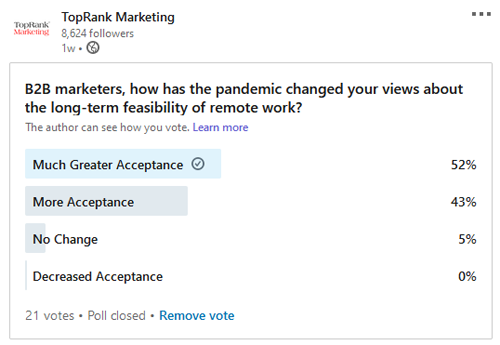
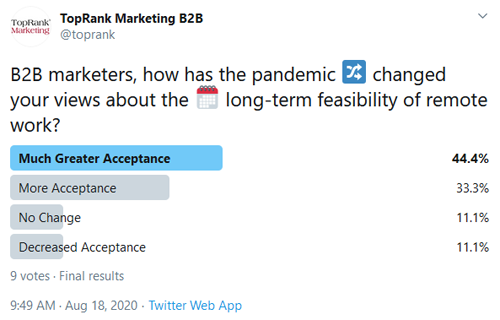
Most B2B marketers now have much greater acceptance when it comes to the long-term feasibility of remote work than they did before the pandemic.
Our poll backs this notion, with over three quarters of respondents on both our LinkedIn and Twitter polls saying that they have either more acceptance or much greater acceptance of remote work as a long-term practice.
Hybrid work scenarios are also very much a part of conversations about the future of work, as I recently explored in “Hybrid & Remote Work Trends That Will Alter The Future Of B2B Marketing.”
Eye-Opener #2 — LinkedIn Live
Have you created LinkedIn Live content yet?
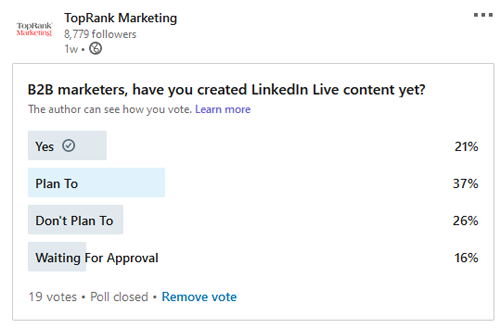
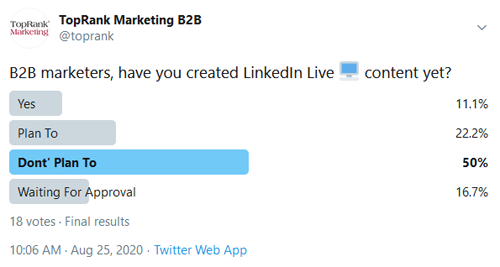
Among our LinkedIn poll respondents, some 58 percent said that they have either created content using LinkedIn Live or planned to do so.
Looking to see how brands are utilizing LinkedIn Live?
Check out our “Livestream Marketing: 5 B2B Brands Rocking LinkedIn Live” for examples from JPMorgan Chase, CompTIA, Microsoft, NASA, SAP* and others.
Eye-Opener #3 — Post-Pandemic Marketing
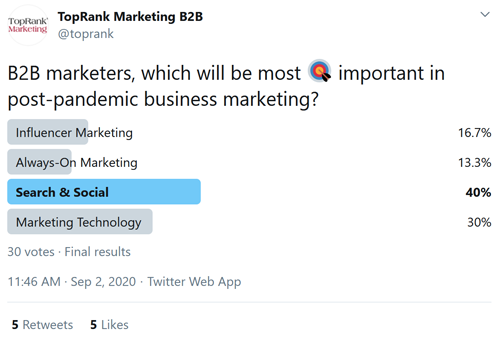
What will be the most important type of B2B marketing what the pandemic is over?
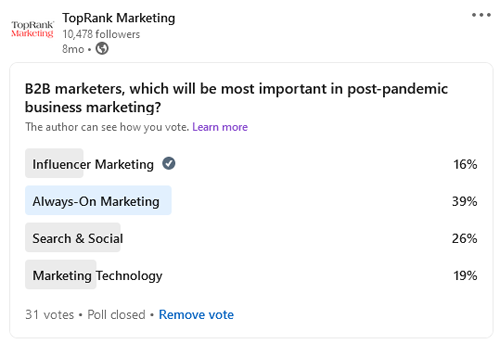
39 percent of our LinkedIn poll takers said that always-on marketing would be the most important type of post-pandemic marketing, followed by 26 percent who said search and social, 19 percent who picked marketing technology, and 16 percent who chose influencer marketing.
40 percent of our Twitter poll respondents said that search and social will be most important, 30 percent said marketing technology, 16.7 percent picking influencer marketing, and 13.3 percent for always-on marketing.
The results point to the mixed viewpoints and uncertainly surrounding just what will be the most important when the global health crisis subsides.
Our own Nick Nelson recently explored the topic, in “Brave New World: The Model for B2B Marketing Success, Post-Pandemic.” Optimizing our B2B marketing strategy for a post-pandemic world requires understanding where the key shifts have occurred, and how to adapt. From executive thought leadership to rethinking marketing experiences, Nick’s article explores five ways B2B marketers can smartly adapt and thrive in a reshaped environment.
Eye-Opener #4 — Short-Form Video Platforms
Which short-form vertical video creation and sharing platform are you most likely to use?
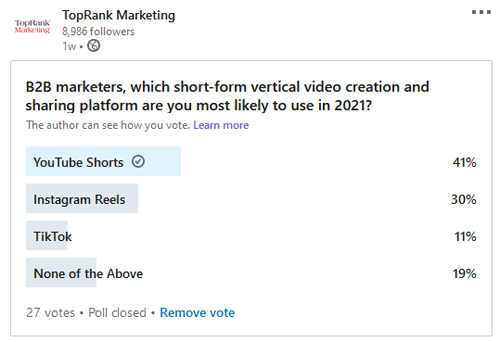
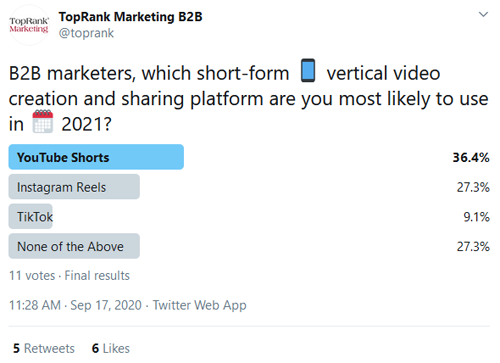
YouTube Shorts was the top vote-getter when it came to short-term video platforms for B2B marketing content, with Instagram Reels coming in as the second most likely to be used among those taking our polls. 27.3 percent of our Twitter poll-takers said that they didn’t plan to use either of the two, or TikTok.
Eye-Opener #5 — LinkedIn Stories
Do you plan to incorporate LinkedIn Stories content into your marketing efforts?
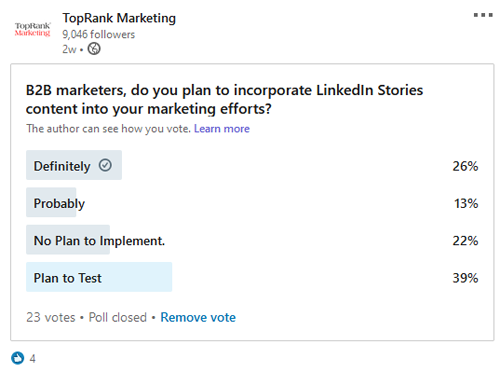
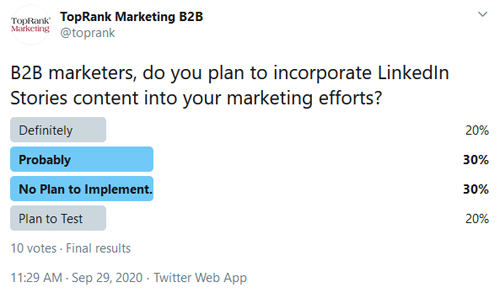
As LinkedIn Stories rolled out, 39 percent of our LinkedIn poll-takers said that they planned to test the format, while 26 percent noted that they definitely planned to incorporate the feature into their marketing efforts. 22 percent said they had no plans to implement LinkedIn Stories, while 13 percent noted that they would probably implement the feature.
On Twitter, 50 percent noted that they would either probably or definitely utilize LinkedIn Stories in marketing efforts, with 20 percent planning to test the feature and the 30 percent noting they didn’t plan to use the format.
Eye-Opener #6 — B2B Influence
Which area of your B2B influencer marketing program has seen the greatest success during the pandemic?
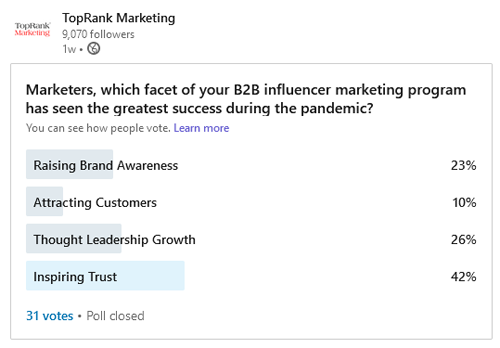
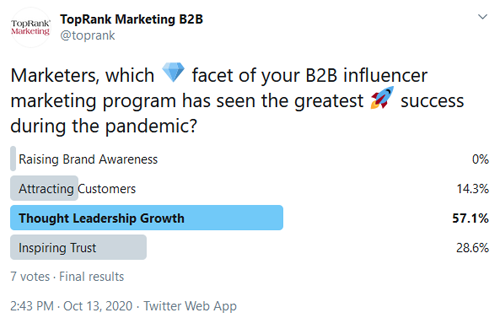
42 percent of our LinkedIn poll-takers said that inspiring trust was the facet of their B2B influencer marketing program that had seen the greatest success during the pandemic, followed by thought leadership growth, raising brand awareness, and attracting customers.
Among our Twitter poll-takers thought leadership growth was the top vote-getter, followed by inspiring trust and attracting customers.
Eye-Opener #7 — Scaling For Success With Influence
What is the top factor in successfully scaling a B2B influencer marketing program?
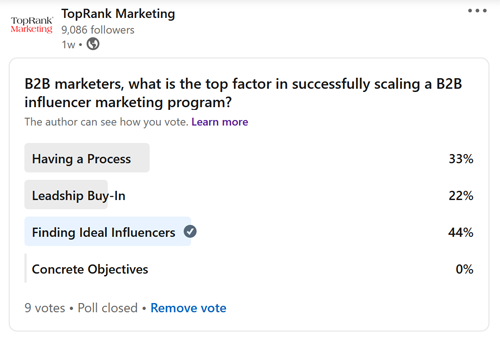
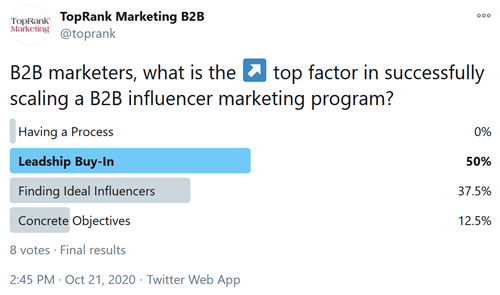
When it comes to scaling B2B influencer marketing programs, the leading factor among our LinkedIn voters was finding ideal influencers, followed by having a process and leadership buy-in.
Our Twitter voters selected leadership buy-in as the top factor to successful B2B influencer marketing scaling, followed by finding ideal influencers and having concrete objectives.
Eye-Opener #8 — Top Fears
What is your biggest fear in marketing?
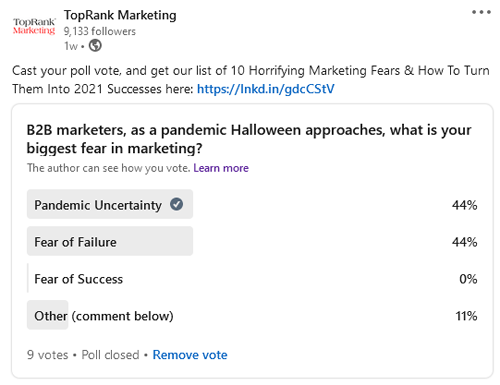
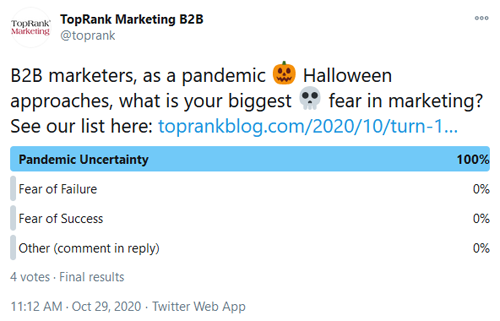
When fall rolled around, we were curious about some of your top marketing fears.
On both LinkedIn and Twitter the leading fear was the uncertainty of the pandemic, with some also choosing fear of failure.
I expanded on turning fear into success in an article to accompany our poll, in “10 Horrifying Marketing Fears & How To Turn Them Into 2021 Successes.”
Eye-Opener #9 — SME, Expert, of Influencer?
Which terminology do you prefer for a professional who holds sway over a target audience?
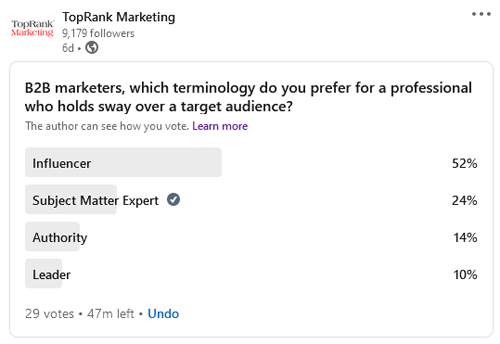
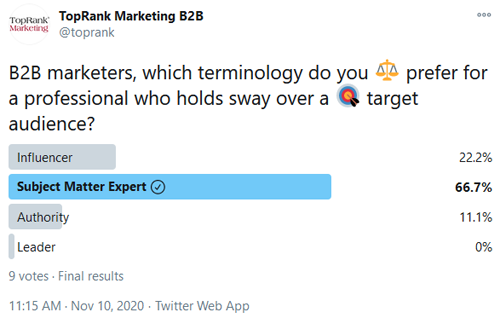
B2B marketers differ when it comes to use of the term influencer.
52 percent of our LinkedIn poll-takers said that they preferred the term influencer for a professional who holds sway over a target audience, followed by 24 percent who favored subject matter expert, 14 percent picking the term authority, and 10 percent who chose the term leader.
Our Twitter poll-takers predominantly preferred subject matter expert, following by influencer and then authority.
No matter which terminology use prefer or use, the power of influence is key in today’s B2B marketing, as our CEO Lee Odden recently shared in “Brandfluence – Why Growing Executive Influence is Essential for B2B Marketing.”
Eye-Opener #10 — The Benefits of Digital Tools
Which area has benefited the most from the increased use of digital tools the pandemic has brought about?
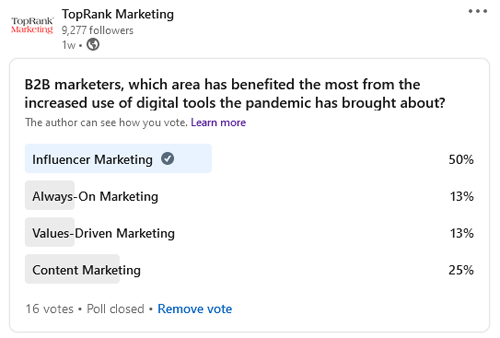
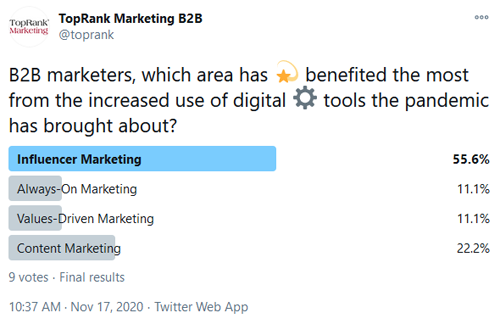
Influencer marketing was seen by both our LinkedIn and Twitter poll-takers as the top beneficiary when it comes to areas that have grown during the pandemic. Content marketing was the second choice, followed by always-on and values-driven marketing.
Eye-Opener #11 — What B2B Marketers Are Looking Forward To
What are B2B marketers most looking forward to in 2021?
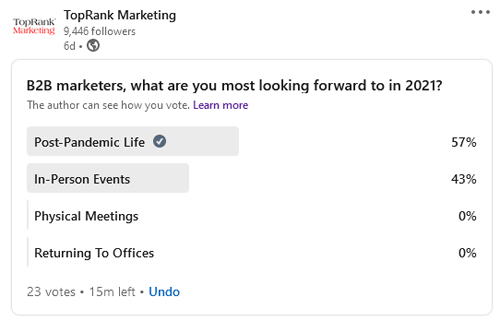
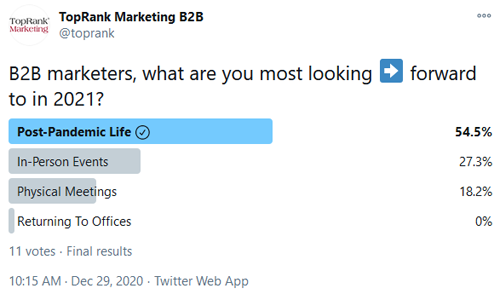
Post-pandemic life was by far the top choice of both our Twitter and LinkedIn poll-takers, followed by in-person events and physical meetings.
How can B2B marketers help prepare for post-pandemic success? Nick Nelson explored this question in detail, with “Brave New World: The Model for B2B Marketing Success, Post-Pandemic.”
Eye-Opener #12 — B2B Tactic Optimism
Which business marketing tactic are B2B marketers most optimistic about in 2021?
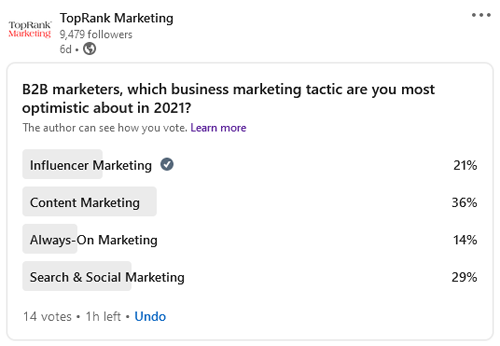
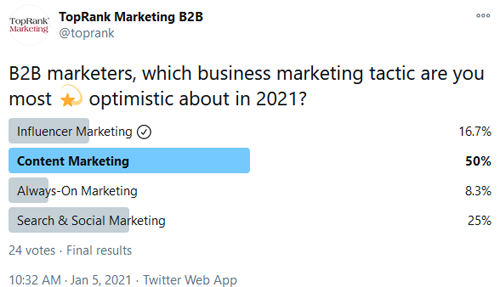
When we asked which business marketing tactic poll-takers were most optimistic about, on LinkedIn 36 percent chose content marketing, 29 percent search and social, 21 percent influencer marketing, and 14 percent who chose always-on marketing.
Among our Twitter poll-takers some 50 chose content marketing, 25 percent search and social, followed by 16.7 percent who picked influencer marketing, and 8.3 percent who chose always-on marketing.
Eye-Opener #13 — Why Do We Follow Brands?
What is the primary reason you follow a B2B brand on social media?
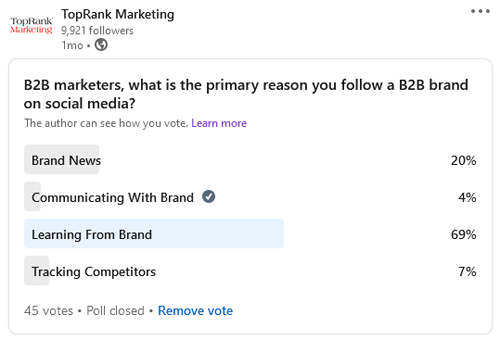
69 percent of our LinkedIn poll-takers said the top reason they follow brands on social media is to learn from the brand, with 20 percent choosing brand news, 7 percent for tracking competitors, and 4 percent for communicating with a brand.
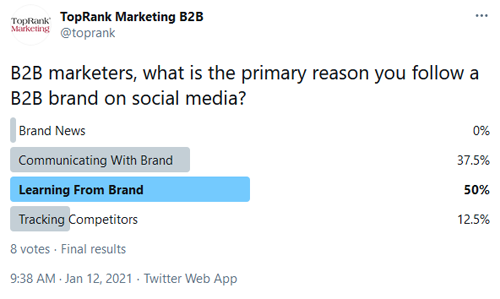
50 percent of our Twitter poll-takers picked learning from a brand, 37.5 percent communicating with the brand, and 12.5 percent who picked tracking competitors.
Eye-Opener #14 — Brand Storytelling
What is the top factor when it comes to creating successful B2B brand storytelling?
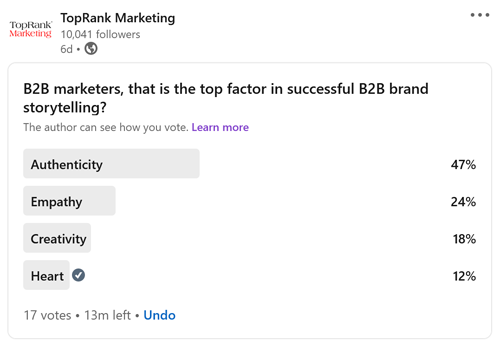
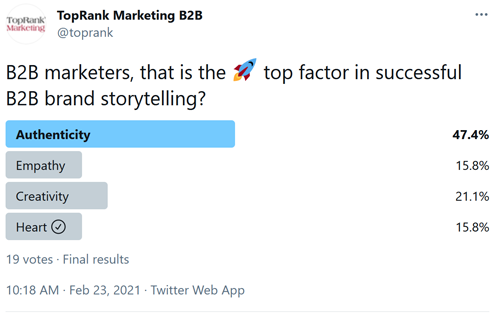
47 percent of B2B marketers taking our LinkedIn poll said that authenticity was the top factor in successful B2B brand storytelling efforts, followed by 24 percent who picked empathy, 18 percent who chose creativity, and 12 percent who said that heart was the leading success factor.
47.4 percent of our Twitter poll-takers also chose authenticity, followed by 21.1 percent for creativity, and 15.8 percent for both empathy and heart.
Eye-Opener #15 — The B2B Clubhouse?
How important is Clubhouse in your 2021 B2B marketing strategy?
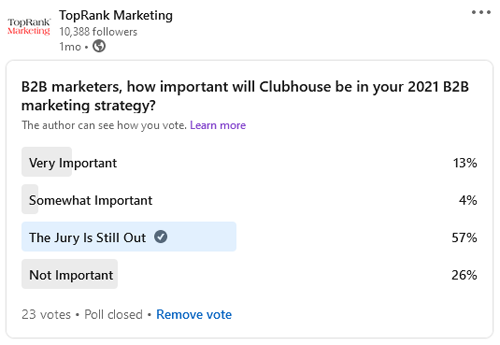
As Clubhouse gained traction among B2B marketers, we asked how important it will be in 2021 marketing strategy, and among our LinkedIn poll-takers 57 percent said that the jury was still out, followed by 26 percent who said that it’s not important, 13 percent who said it was very important, and 4 percent who said that Clubhouse would be somewhat important in their 2021 strategy.
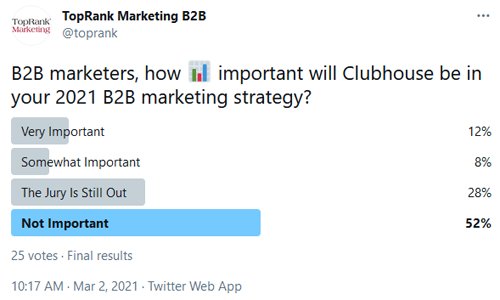
52 percent of our Twitter respondents said Clubhouse was not important, followed by 28 percent who noted the jury was still out, 12 percent who considered it very important, and 8 percent who said that it was someone important.
Learn more about how audio-based social platforms can work for B2B brands, in Lee Odden’s “How B2B Brands Can Boost Confidence in Livestream Video, Podcast and Clubhouse Marketing,” and “How B2B Marketing Influencers Are Finding Success On New Social Channels,” by our senior influencer marketing strategist Debbie Friez.
Eye-Opener #16 — Social Media Manager Qualities in 2021
What’s the top quality you look for when hiring a social media manager?
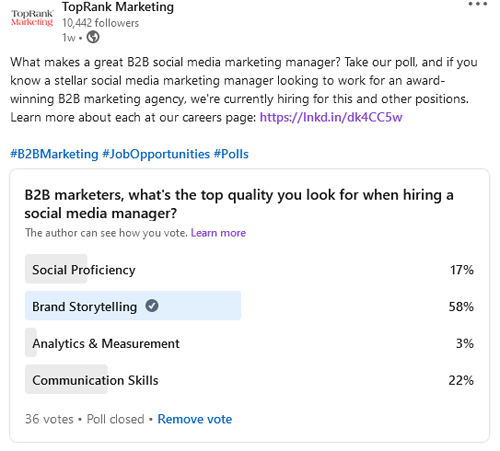
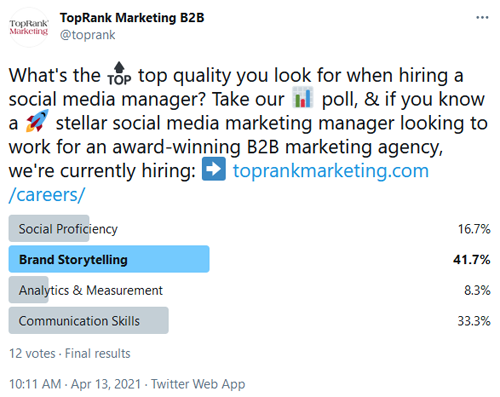
When we asked our audience what was the top quality they look for when hiring a social media marketing manager, brand storytelling was the top choice both on LinkedIn and Twitter.
Storytelling’s importance in creating memorable B2B marketing experiences is explored in details in my “Microsoft’s Miri Rodriguez on How B2B Marketers Are Embracing Empathy For Better Customer Storytelling #B2BMX,” and Nick Nelson’s “Your Guide to Effective Storytelling in B2B Content Marketing.”
Open Your Eyes To Your Audience & Take Action
Keeping your eyes open to the pulse of your audience — whether it’s from poll results, questionnaires, surveys or other types of feedback — can go a long way when it comes to making your B2B marketing efforts more authentic, and also helps ensure your communication is a two-way street and not just a publish-and-forget effort.
We hope you’ve found this eye-opening peek into some of our own poll results helpful as you navigate the uncertain marketing landscape 2021 has given us. Let us know your thoughts by voting in our current weekly poll about what qualities make a great B2B influencer marketing specialist — you’ll find it on LinkedIn here and on Twitter here.
Learn even more about poll data, statistics, and how to utilize audience feedback in every form by taking a look are some of the related articles we’ve written on the subject, such as the six listed here:
- Show Me The Numbers: 20 B2B Marketing Insights From Audience Poll Data
- Social Media Polls For Marketers: 6 B2B Brands Winning With LinkedIn Polls
- 17 Revealing B2B Marketing Insights From Poll Data
- The Power of Social Media Polls: The Drill-Down on 3 Platforms + 5 General Best Practices
- 24 Essential B2B Influencer Marketing Statistics
- Hungry for More: What B2B Marketers Need to Know About Episodic Content
* SAP and LinkedIn are TopRank Marketing clients.
The post B2B Marketing Poll Sentiment: 15+ Eye-Opening Insights To Fuel Summer Success appeared first on B2B Marketing Blog – TopRank®.
Discord, quanto costa l’app in arrivo su PlayStation
Di recente è stato annunciato da Sony che Discord arriverà su PlayStation 5. La celebre chat pensata per il gaming potrà dunque essere utilizzata dai possessori della console per migliorare la propria esperienza di gioco. Ma di preciso a cosa serve? E quanto costa? Ecco i dettagli.