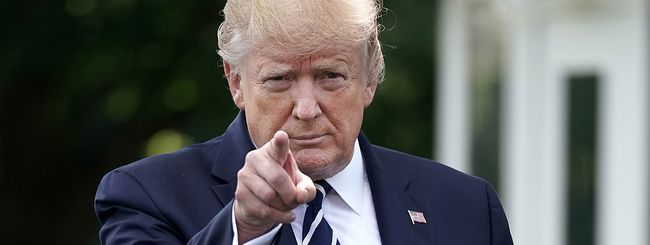
Facebook conferma il ban dell’account di Donald Trump
Sono passati quattro mesi dal ban degli account dell’ormai ex Presidente degli Stati Uniti d’America Donald Trump da tutte le principali piattaforme social dopo il plateale incitamento ai rivoltosi che hanno assaltato Capitol Hill il 6 gennaio scorso per contestare il risultato delle elezioni presidenziali. Facebook era stata l’azienda che aveva preso la decisione più drastica: sospendere gli account ufficiali di Trump su Facebook ed Instagram a tempo indeterminato, riservandosi una nuova valutazione periodica su quella decisione.
Blast off into Entertainment Space on your Android tablet
Tablets are the perfect device to stay entertained, whether you’re watching a movie from your bed, playing games on your daily commute or reading a book while you travel. The screen is bigger than your phone, but more portable than your TV. In fact, over the last year, we’ve seen over 30 percent more people start using Android tablets compared to the prior year.
As a versatile device with many different capabilities, whole families often share the same tablet. Last year, we introduced Kids Space as a way for your kids under 9 to learn and have fun with recommended apps, books and videos on Android tablets. And for the rest of the family members, we’re now bringing you a new Android tablet experience that places the entertainment content you love front and center.
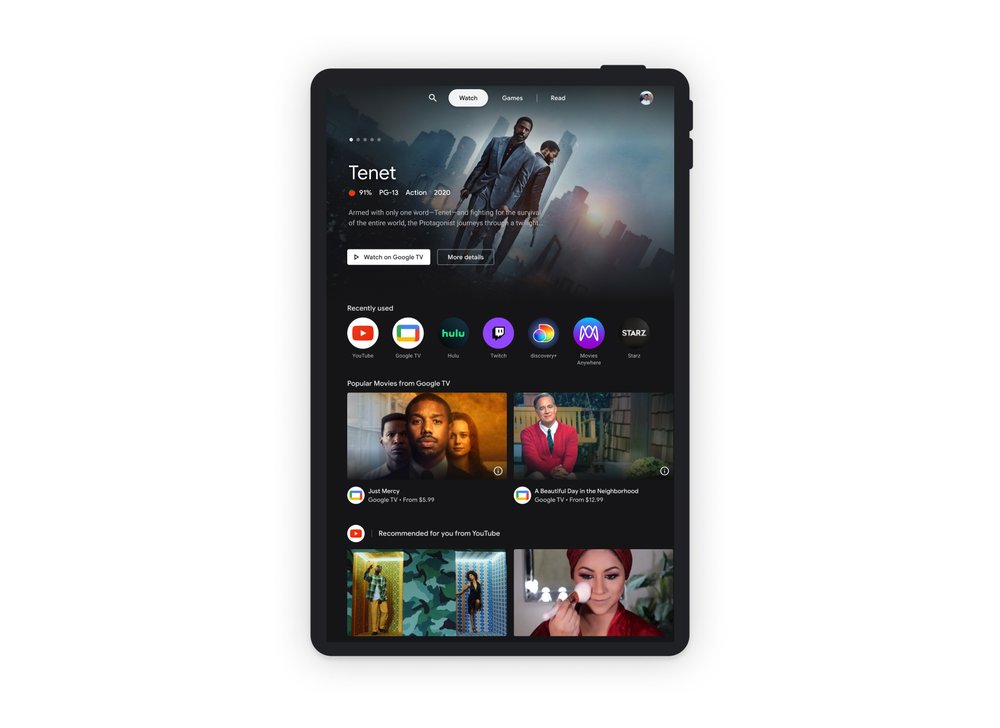
Entertainment Space is a one-stop, personalized home for all your favorite movies, shows, videos, games and books. You’ll save time and avoid having to hop between apps to try to figure out what to do, whether it’s to watch, play or read. Once you sign in to your subscription apps, Entertainment Space will show you your content in one place and tailored for you. And if you want to share your tablet, everyone in the family can have their own personalized profile.
Hit play on the latest movies, TV shows and YouTube videos
In the Watch tab, you can move between your streaming services, find movies and TV shows to watch, rent or buy from Google TV and view recommended videos from YouTube. With the Continue Watching row, you can also easily hop back into a show you were watching last night. And, if you’re not sure what to watch next, Entertainment Space will surface your personalized and trending recommendation rows from Google TV, Twitch, Hulu and many additional services.
B2B Marketing Poll Sentiment: 15+ Eye-Opening Insights To Fuel Summer Success
What can poll results tell B2B marketers about a year unlike any other, and how can this valuable audience data help us enhance our marketing strategy as we head towards 2022?
For more than two years we’ve run weekly social media polls on our Twitter profile, and for over a year we’ve simultaneously placed a weekly user poll on our LinkedIn* page.
Occasionally we like to share some of the fascinating insights you have given us in the form of results from our polls, in order to see the B2B marketing trends that have emerged during this unprecedented year.
Let’s take a look at a wide variety of marketing trends, how and why marketing is changing in 2021, and the growing effectiveness of B2B influencer marketing, all through a lens of poll-derived feedback from our B2B marketing audience.
Building on the insights we shared in “Show Me The Numbers: 20 B2B Marketing Insights From Audience Poll Data,” our most recent poll numbers paint a sometimes-surprising picture of B2B marketing sentiment in 2021.
Eye-Opener #1 — Remote Work
How has the pandemic changed your views about the long-term feasibility of remote work?
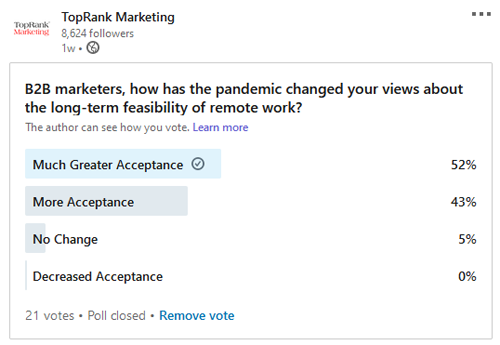
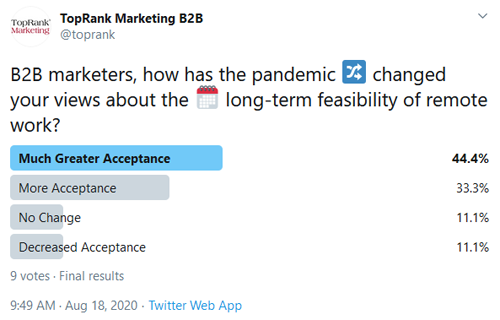
Most B2B marketers now have much greater acceptance when it comes to the long-term feasibility of remote work than they did before the pandemic.
Our poll backs this notion, with over three quarters of respondents on both our LinkedIn and Twitter polls saying that they have either more acceptance or much greater acceptance of remote work as a long-term practice.
Hybrid work scenarios are also very much a part of conversations about the future of work, as I recently explored in “Hybrid & Remote Work Trends That Will Alter The Future Of B2B Marketing.”
Eye-Opener #2 — LinkedIn Live
Have you created LinkedIn Live content yet?
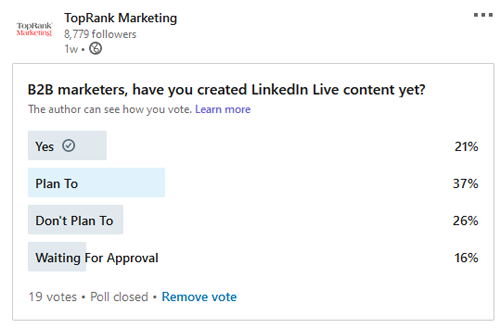
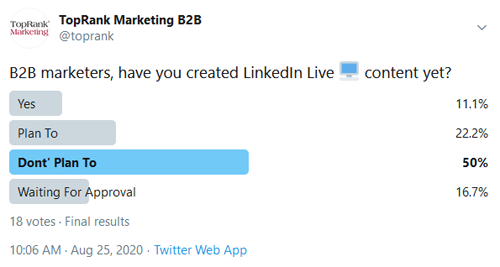
Among our LinkedIn poll respondents, some 58 percent said that they have either created content using LinkedIn Live or planned to do so.
Looking to see how brands are utilizing LinkedIn Live?
Check out our “Livestream Marketing: 5 B2B Brands Rocking LinkedIn Live” for examples from JPMorgan Chase, CompTIA, Microsoft, NASA, SAP* and others.
Eye-Opener #3 — Post-Pandemic Marketing
What will be the most important type of B2B marketing what the pandemic is over?
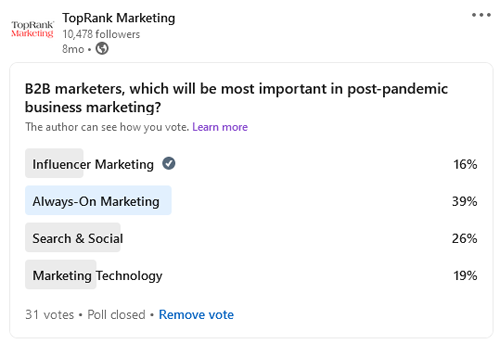
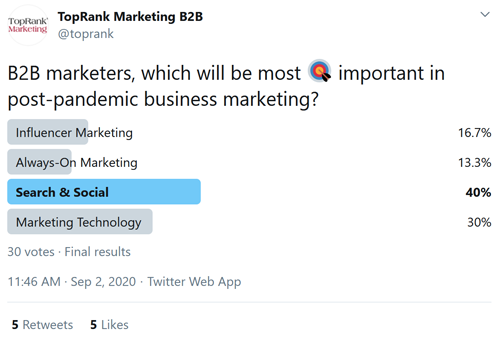
39 percent of our LinkedIn poll takers said that always-on marketing would be the most important type of post-pandemic marketing, followed by 26 percent who said search and social, 19 percent who picked marketing technology, and 16 percent who chose influencer marketing.
40 percent of our Twitter poll respondents said that search and social will be most important, 30 percent said marketing technology, 16.7 percent picking influencer marketing, and 13.3 percent for always-on marketing.
The results point to the mixed viewpoints and uncertainly surrounding just what will be the most important when the global health crisis subsides.
Our own Nick Nelson recently explored the topic, in “Brave New World: The Model for B2B Marketing Success, Post-Pandemic.” Optimizing our B2B marketing strategy for a post-pandemic world requires understanding where the key shifts have occurred, and how to adapt. From executive thought leadership to rethinking marketing experiences, Nick’s article explores five ways B2B marketers can smartly adapt and thrive in a reshaped environment.
Eye-Opener #4 — Short-Form Video Platforms
Which short-form vertical video creation and sharing platform are you most likely to use?
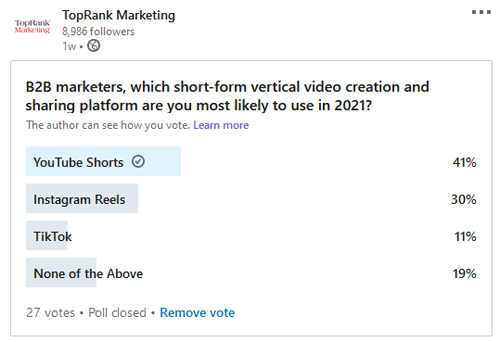
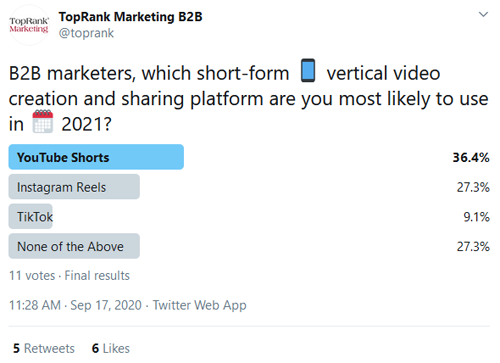
YouTube Shorts was the top vote-getter when it came to short-term video platforms for B2B marketing content, with Instagram Reels coming in as the second most likely to be used among those taking our polls. 27.3 percent of our Twitter poll-takers said that they didn’t plan to use either of the two, or TikTok.
Eye-Opener #5 — LinkedIn Stories
Do you plan to incorporate LinkedIn Stories content into your marketing efforts?
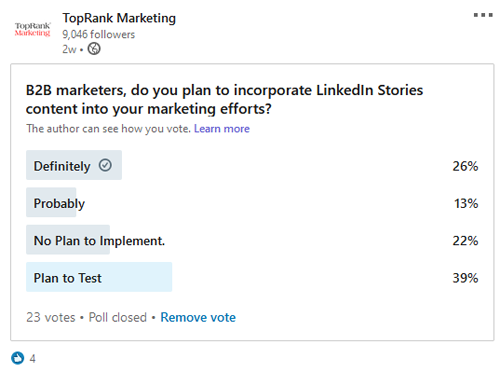
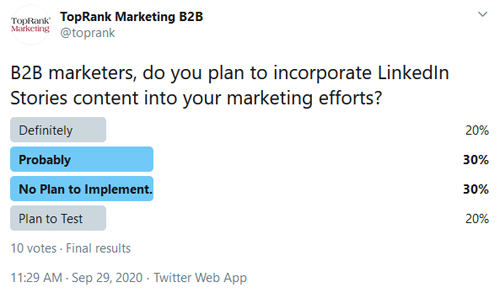
As LinkedIn Stories rolled out, 39 percent of our LinkedIn poll-takers said that they planned to test the format, while 26 percent noted that they definitely planned to incorporate the feature into their marketing efforts. 22 percent said they had no plans to implement LinkedIn Stories, while 13 percent noted that they would probably implement the feature.
On Twitter, 50 percent noted that they would either probably or definitely utilize LinkedIn Stories in marketing efforts, with 20 percent planning to test the feature and the 30 percent noting they didn’t plan to use the format.
Eye-Opener #6 — B2B Influence
Which area of your B2B influencer marketing program has seen the greatest success during the pandemic?
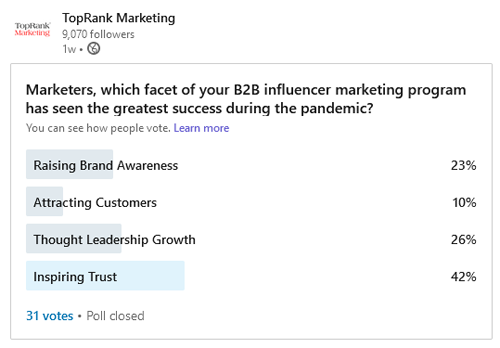
42 percent of our LinkedIn poll-takers said that inspiring trust was the facet of their B2B influencer marketing program that had seen the greatest success during the pandemic, followed by thought leadership growth, raising brand awareness, and attracting customers.
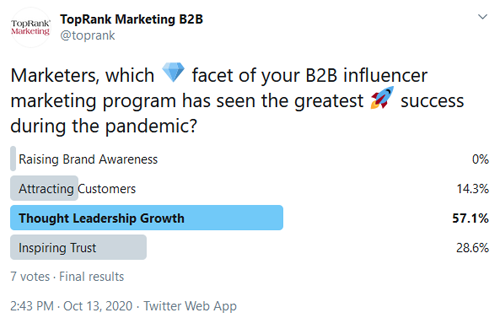
Among our Twitter poll-takers thought leadership growth was the top vote-getter, followed by inspiring trust and attracting customers.
Eye-Opener #7 — Scaling For Success With Influence
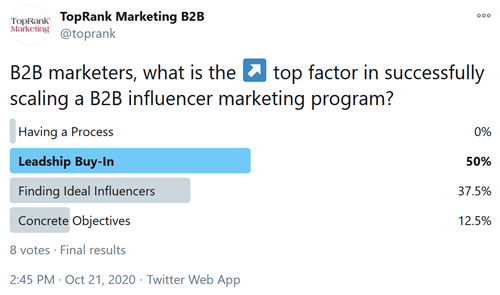
What is the top factor in successfully scaling a B2B influencer marketing program?
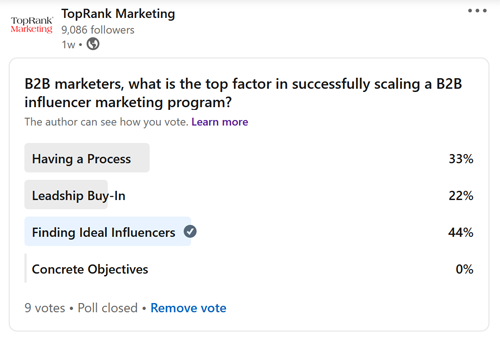
When it comes to scaling B2B influencer marketing programs, the leading factor among our LinkedIn voters was finding ideal influencers, followed by having a process and leadership buy-in.
Our Twitter voters selected leadership buy-in as the top factor to successful B2B influencer marketing scaling, followed by finding ideal influencers and having concrete objectives.
Eye-Opener #8 — Top Fears
What is your biggest fear in marketing?
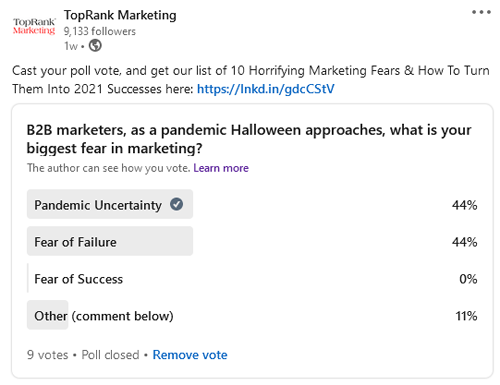
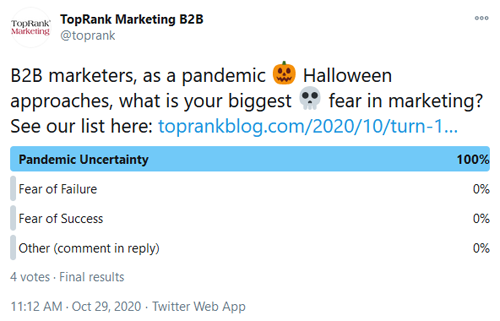
When fall rolled around, we were curious about some of your top marketing fears.
On both LinkedIn and Twitter the leading fear was the uncertainty of the pandemic, with some also choosing fear of failure.
I expanded on turning fear into success in an article to accompany our poll, in “10 Horrifying Marketing Fears & How To Turn Them Into 2021 Successes.”
Eye-Opener #9 — SME, Expert, of Influencer?
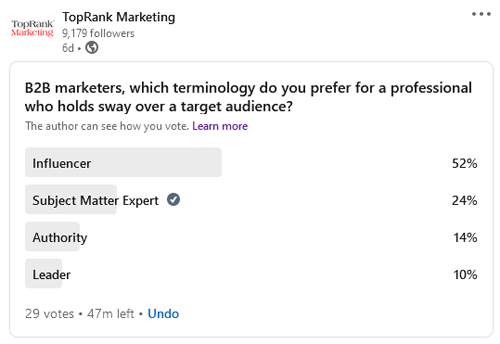
Which terminology do you prefer for a professional who holds sway over a target audience?
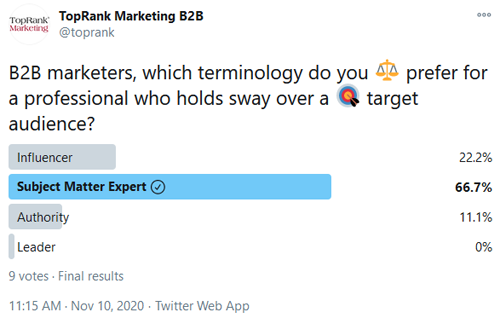
B2B marketers differ when it comes to use of the term influencer.
52 percent of our LinkedIn poll-takers said that they preferred the term influencer for a professional who holds sway over a target audience, followed by 24 percent who favored subject matter expert, 14 percent picking the term authority, and 10 percent who chose the term leader.
Our Twitter poll-takers predominantly preferred subject matter expert, following by influencer and then authority.
No matter which terminology use prefer or use, the power of influence is key in today’s B2B marketing, as our CEO Lee Odden recently shared in “Brandfluence – Why Growing Executive Influence is Essential for B2B Marketing.”
Eye-Opener #10 — The Benefits of Digital Tools
Which area has benefited the most from the increased use of digital tools the pandemic has brought about?
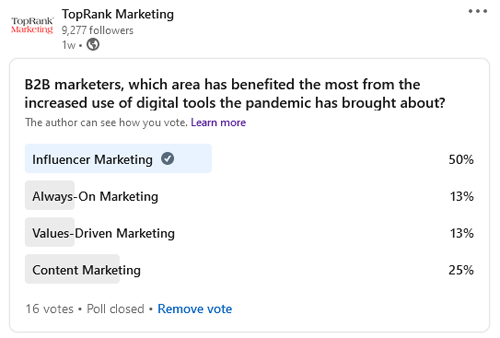
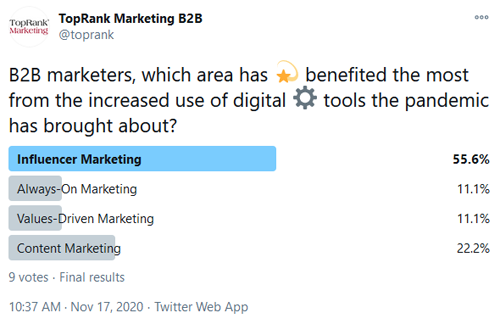
Influencer marketing was seen by both our LinkedIn and Twitter poll-takers as the top beneficiary when it comes to areas that have grown during the pandemic. Content marketing was the second choice, followed by always-on and values-driven marketing.
Eye-Opener #11 — What B2B Marketers Are Looking Forward To
What are B2B marketers most looking forward to in 2021?
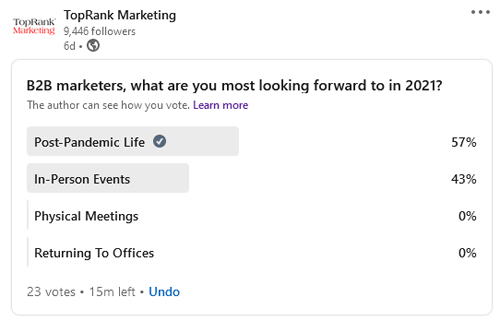
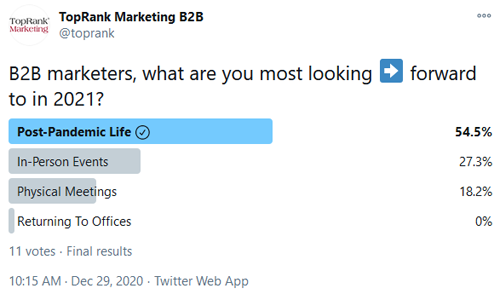
Post-pandemic life was by far the top choice of both our Twitter and LinkedIn poll-takers, followed by in-person events and physical meetings.
How can B2B marketers help prepare for post-pandemic success? Nick Nelson explored this question in detail, with “Brave New World: The Model for B2B Marketing Success, Post-Pandemic.”
Eye-Opener #12 — B2B Tactic Optimism
Which business marketing tactic are B2B marketers most optimistic about in 2021?
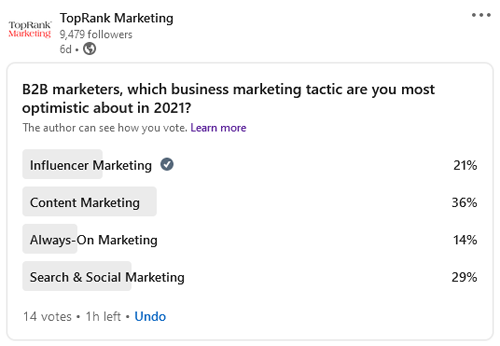
When we asked which business marketing tactic poll-takers were most optimistic about, on LinkedIn 36 percent chose content marketing, 29 percent search and social, 21 percent influencer marketing, and 14 percent who chose always-on marketing.
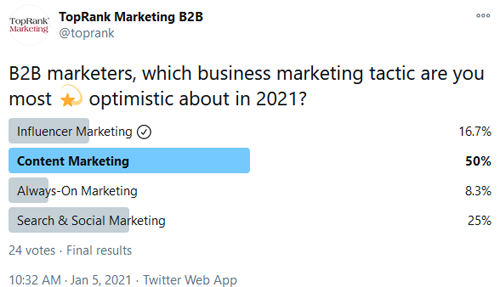
Among our Twitter poll-takers some 50 chose content marketing, 25 percent search and social, followed by 16.7 percent who picked influencer marketing, and 8.3 percent who chose always-on marketing.
Eye-Opener #13 — Why Do We Follow Brands?
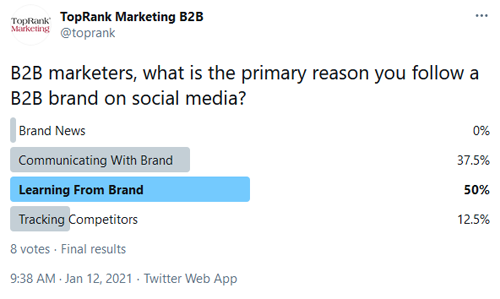
What is the primary reason you follow a B2B brand on social media?
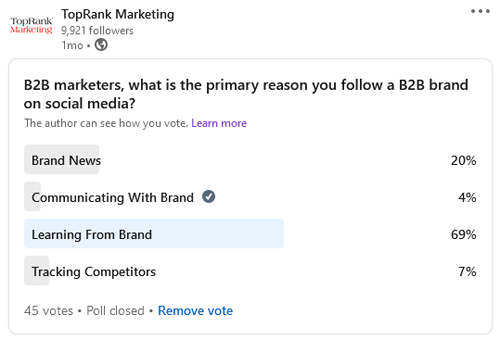
69 percent of our LinkedIn poll-takers said the top reason they follow brands on social media is to learn from the brand, with 20 percent choosing brand news, 7 percent for tracking competitors, and 4 percent for communicating with a brand.
50 percent of our Twitter poll-takers picked learning from a brand, 37.5 percent communicating with the brand, and 12.5 percent who picked tracking competitors.
Eye-Opener #14 — Brand Storytelling
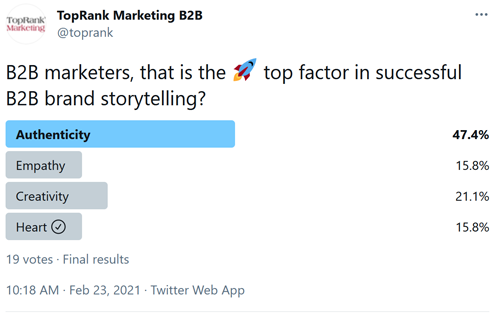
What is the top factor when it comes to creating successful B2B brand storytelling?
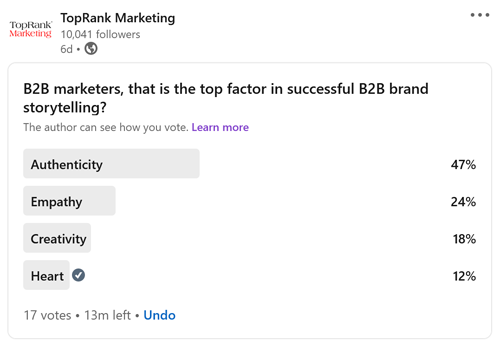
47 percent of B2B marketers taking our LinkedIn poll said that authenticity was the top factor in successful B2B brand storytelling efforts, followed by 24 percent who picked empathy, 18 percent who chose creativity, and 12 percent who said that heart was the leading success factor.
47.4 percent of our Twitter poll-takers also chose authenticity, followed by 21.1 percent for creativity, and 15.8 percent for both empathy and heart.
Eye-Opener #15 — The B2B Clubhouse?
How important is Clubhouse in your 2021 B2B marketing strategy?
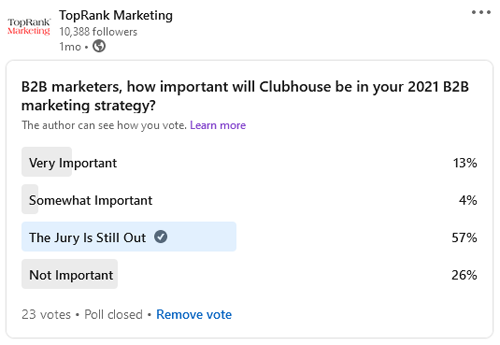
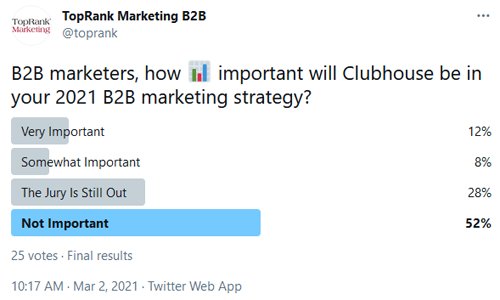
As Clubhouse gained traction among B2B marketers, we asked how important it will be in 2021 marketing strategy, and among our LinkedIn poll-takers 57 percent said that the jury was still out, followed by 26 percent who said that it’s not important, 13 percent who said it was very important, and 4 percent who said that Clubhouse would be somewhat important in their 2021 strategy.
52 percent of our Twitter respondents said Clubhouse was not important, followed by 28 percent who noted the jury was still out, 12 percent who considered it very important, and 8 percent who said that it was someone important.
Learn more about how audio-based social platforms can work for B2B brands, in Lee Odden’s “How B2B Brands Can Boost Confidence in Livestream Video, Podcast and Clubhouse Marketing,” and “How B2B Marketing Influencers Are Finding Success On New Social Channels,” by our senior influencer marketing strategist Debbie Friez.
Eye-Opener #16 — Social Media Manager Qualities in 2021
What’s the top quality you look for when hiring a social media manager?
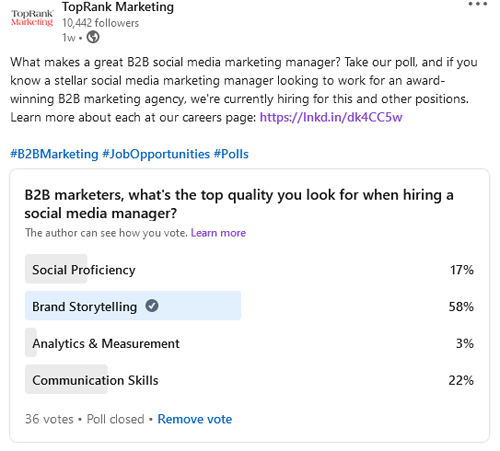
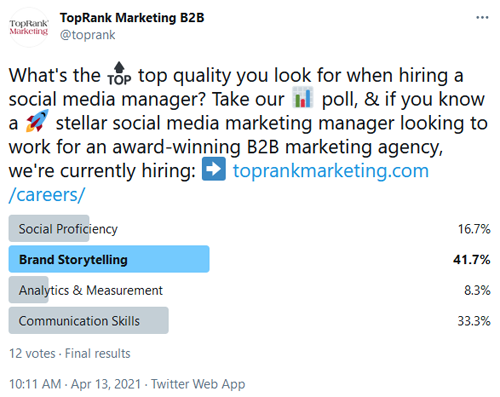
When we asked our audience what was the top quality they look for when hiring a social media marketing manager, brand storytelling was the top choice both on LinkedIn and Twitter.
Storytelling’s importance in creating memorable B2B marketing experiences is explored in details in my “Microsoft’s Miri Rodriguez on How B2B Marketers Are Embracing Empathy For Better Customer Storytelling #B2BMX,” and Nick Nelson’s “Your Guide to Effective Storytelling in B2B Content Marketing.”
Open Your Eyes To Your Audience & Take Action
Keeping your eyes open to the pulse of your audience — whether it’s from poll results, questionnaires, surveys or other types of feedback — can go a long way when it comes to making your B2B marketing efforts more authentic, and also helps ensure your communication is a two-way street and not just a publish-and-forget effort.
We hope you’ve found this eye-opening peek into some of our own poll results helpful as you navigate the uncertain marketing landscape 2021 has given us. Let us know your thoughts by voting in our current weekly poll about what qualities make a great B2B influencer marketing specialist — you’ll find it on LinkedIn here and on Twitter here.
Learn even more about poll data, statistics, and how to utilize audience feedback in every form by taking a look are some of the related articles we’ve written on the subject, such as the six listed here:
- Show Me The Numbers: 20 B2B Marketing Insights From Audience Poll Data
- Social Media Polls For Marketers: 6 B2B Brands Winning With LinkedIn Polls
- 17 Revealing B2B Marketing Insights From Poll Data
- The Power of Social Media Polls: The Drill-Down on 3 Platforms + 5 General Best Practices
- 24 Essential B2B Influencer Marketing Statistics
- Hungry for More: What B2B Marketers Need to Know About Episodic Content
* SAP and LinkedIn are TopRank Marketing clients.
The post B2B Marketing Poll Sentiment: 15+ Eye-Opening Insights To Fuel Summer Success appeared first on B2B Marketing Blog – TopRank®.
Discord, quanto costa l’app in arrivo su PlayStation
Di recente è stato annunciato da Sony che Discord arriverà su PlayStation 5. La celebre chat pensata per il gaming potrà dunque essere utilizzata dai possessori della console per migliorare la propria esperienza di gioco. Ma di preciso a cosa serve? E quanto costa? Ecco i dettagli.

Sotheby’s inzia ad accettare Cryptovalute con un famoso lavoro di Banksy
Sotheby’s è diventata la prima grande casa d’aste a introdurre le criptovalute come metodo di pagamento per le opere d’arte fisiche, dopo le sue precedenti vendite con arte digitale NFT il mese scorso. “Love is in the Air” (2003), uno dei lavori più riconoscibili dell’artista di strada Banksy, è il primo pezzo che Sotheby’s renderà idoneo per l’acquisto tramite Bitcoin o Ether. Si stima che venga venduto per $ 3 milioni a $ 5 milioni…
L’articolo Sotheby’s inzia ad accettare Cryptovalute con un famoso lavoro di Banksy scritto da Michele Ficara Manganelli ✿ proviene da Assodigitale.
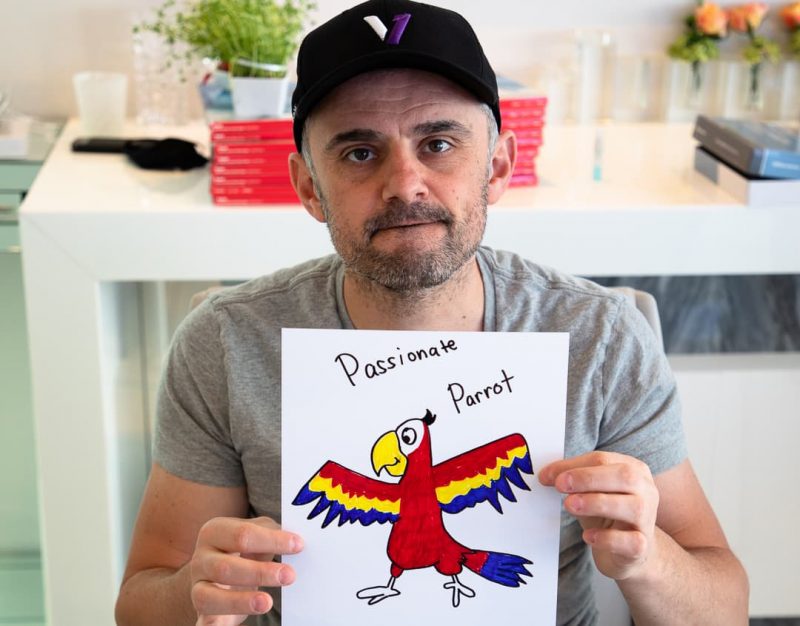
Gary Vaynerchuk sta lanciando Artwork NFT
Gary Vaynerchuk detiene un token “VeeFriends”, che fa parte della sua prima collezione NFT. Dopo settimane di stuzzicare i suoi disegni su Twitter, l’imprenditore Gary Vaynerchuk ha annunciato mercoledì che sta lanciando la sua prima collezione NFT, “VeeFriends”, una serie di 10.255 token di caratteri disponibili per l’acquisto tramite la criptovaluta ethereum . I token non fungibili sono un tipo di risorsa digitale creata per tracciare la proprietà di un oggetto virtuale utilizzando la tecnologia…
L’articolo Gary Vaynerchuk sta lanciando Artwork NFT scritto da Michele Ficara Manganelli ✿ proviene da Assodigitale.
Why creating inclusive classrooms matters
Editor’s note: In honor of Teacher Appreciation Week, Google.org is working with DonorsChoose to continue their support for more inclusive classrooms through the #ISeeMe campaign. Mr. Andy Yung, a classroom teacher from New York City, shares the power of affirming identities in his classroom.
I grew up in Flushing, New York — the same community in Queens where I now teach. I’m honored and grateful to teach students who remind me of my younger self and to interact with their parents who remind me of my own. Because of our shared lived experiences, I identify with my students and their families in a way that is not easily learned.
As a student, I often felt most connected to the teachers who looked like me and understood my background. But many students never have that experience: less than 10% of New York City’s teachers are men of color, and Asian men represent just 1.5% of New York City’s teachers. Trends are similar nationwide, with less than 2% of US teachers identifying as Asian.
When my students see characters who look like us in the books we read, their faces light up because the experiences portrayed reflect their own. But creating these opportunities isn’t easy: in 2015, just 3.3% of children’s books published included Asians, and there is no standard curriculum that teaches Asian American history.
That’s why I’m excited to see Google.org team up with DonorsChoose to match donations for inclusive classroom projects through the #ISeeMe campaign — and there’s even an additional donation match for projects from male educators of color like me. #ISeeMe has already helped more than 25,000 educators — including me — fund inclusive classroom projects.
The funding helped me fill my classroom library with books that serve as both windows and mirrors: windows to observe other people and cultures, and mirrors that reflect and validate our own experiences. When my students see themselves in our reading materials, they know that they belong, what they can aspire to be, and they see that they can use their voices to share their own powerful stories.
Thanks to the campaign, I also fulfilled an idea to help students connect to other cultures and express themselves through food — an important aspect of their identities. I received funding for a cooking cart, and now I regularly invite families into our classroom to make and share their favorite foods from home.
Classrooms need to be places where every student feels supported and encouraged to share their personal experiences, especially as students return to school this year. The #ISeeMe campaign has made it that place for my students, and I am excited to see more educators and students receive this same opportunity. Starting today, Google.org is matching donations up to $500,000 — dollar for dollar — for projects created by teachers of color as well as projects from all teachers requesting culturally responsive and antiracist resources (such as books, posters and more) for their classrooms. Additionally, every dollar donated to projects created by male educators of color — a group historically underrepresented in the field — will receive a two-dollar match from Google.org. Learn more about #ISeeMe, setting up a campaign or supporting a classroom on the DonorsChoose website.

La pandemia spinge gli italiani sempre più su Internet
Ad oltre un anno dall’inizio della pandemia, gli italiani trascorrono in media tre ore al giorno su Internet. È quanto riferisce la società di analisi Comscore. Inevitabilmente il virus ha cambiato le abitudini di tutti noi, perché le misure restrittive ci hanno costretto ad usare nuovi mezzi per comunicare, riunirsi, lavorare e studiare a distanza. Non è un caso che le piattaforme come Meet, Teams e Zoom abbiano registrato un vero e proprio boom, ovvero che gli ecommerce abbiano registrato record di vendite. Le attività commerciali chiuse hanno inevitabilmente spinto in alto gli acquisti online, con Amazon è andato addirittura oltre le previsioni degli analisti.

Tom Clancy’s Rainbow Six Siege, arriva nuovo evento a tempo
Ubisoft ha annunciato Apocalypse, un nuovo evento a tempo limitato per la Stagione 1 di Anno 6 di Tom Clancy’s Rainbow Six Siege: da domani e per due settimane, sino al 18 maggio. Apocalypse introduce una versione post-apocalittica dell’Outback, in un contesto nel quale i giocatori dovranno combattere per il proprio clan, per la libertà e la speranza e per il ritorno alla vita. Nel mondo di Apocalypse, la dipendenza dell’umanità dall’energia nucleare ha portato alla caduta della civiltà e alla nascita di due clan, i Keepers e i Warband. Questi guerrieri e cacciatori cercano l’ultima pianta sulla Terra, capace di riportare la vita sul pianeta.
Titoli imbecilli e irresponsabili per il rientro di uno stadio di un razzo cinese: i fatti
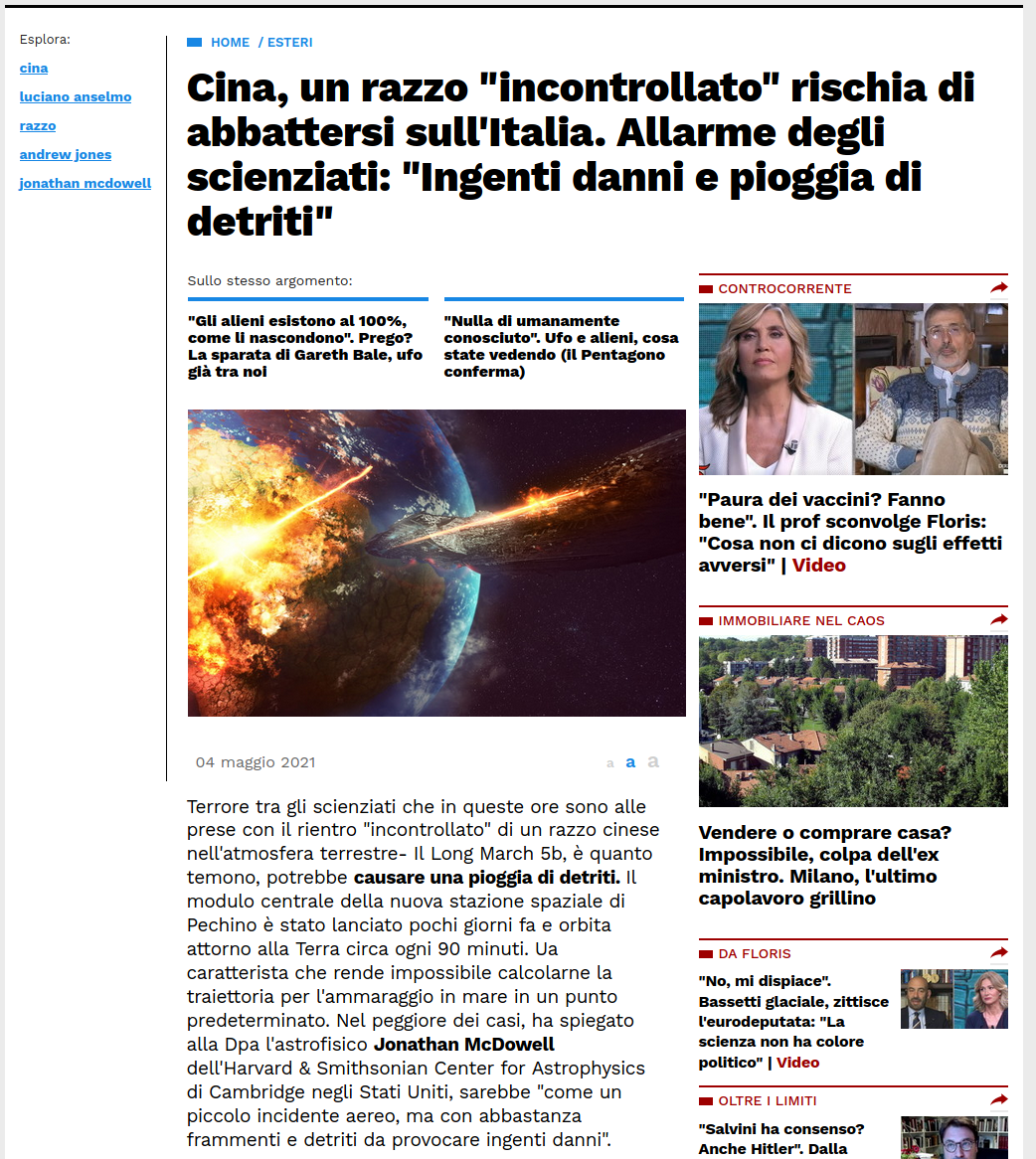
Come al solito, la stampa, quella che si vanta di difenderci contro le fake news, non riesce a resistere alla tentazione acchiappaclic di disseminare notizie false quando c’è di mezzo la tecnologia e in particolare lo spazio.
Non c’è nessun pericolo significativo: la storia è una patetica montatura costruita da ciarlatani e incompetenti.
I fatti sono questi: uno stadio di un vettore cinese, quello che pochi giorni fa ha portato nello spazio il primo componente della stazione spaziale di questo paese, rientrerà nell’atmosfera nei prossimi giorni.
Per ora nessuno sa né quando né dove ricadrà. Chiunque dica che rischia di cadere in un luogo preciso sta dicendo una scemenza. La Terra è enormemente vasta, per cui le probabilità che questo oggetto rientri in uno specifico punto sono le stesse che avete di sentirvi suonare il citofono e scoprire che c’è Beyoncé sotto casa vostra che vuole farvi una serenata. Mettetevi il cuore in pace e pensate ai rischi ben più concreti che correte ogni giorno. Tipo quello di leggere fesserie sul giornale.
Se volete conoscere i dati tecnici, li trovate su Aerospace.org, che pubblica il ground track, ossia la traccia delle zone man mano sorvolate dallo stadio, che cambiano in continuazione per via della rotazione terrestre. Questa traccia stabilisce dei limiti massimi e minimi di latitudine: al di fuori di questi limiti il vettore non può ricadere, punto e basta. Per cui se state a Parigi o a Milano è fisicamente impossibile che ricada dalle vostre parti.

Le agenzie spaziali civili e militari di tutto il mondo stanno monitorando l’evoluzione dello stadio in ricaduta, che ha ampi margini di incertezza dovuti alla densità variabile dell’atmosfera che lo sta man mano frenando e ad altri fattori. Se ci saranno notizie, saranno loro a darle, senza catastrofismi.
Se volete saperne di più, Space-track.org pubblica i dati tecnici costantemente aggiornati (anche su Twitter). In sintesi: per ora si stima che lo stadio ricadrà intorno all’8 maggio o poco dopo. Probabilmente finirà nel Pacifico, semplicemente perché il Pacifico è immenso e copre gran parte della Terra. E gran parte delle 22 tonnellate di materiale che lo compongono si frammenterà nel calore del rientro. Tutto qui.
Questo articolo vi arriva gratuitamente e senza pubblicità grazie alle donazioni dei lettori. Se vi è piaciuto, potete incoraggiarmi a scrivere ancora facendo una donazione anche voi, tramite Paypal (paypal.me/disinformatico) o altri metodi.
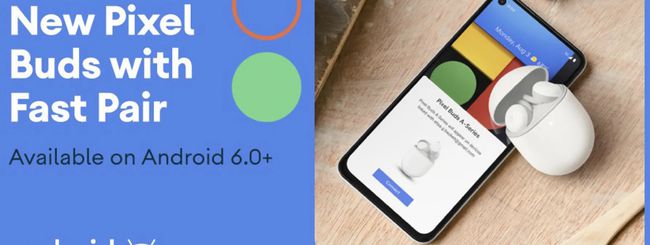
Google annuncia per errore gli auricolari Pixel Buds A
Quando non sono i leaker a rompere le uova nel paniere alle grandi aziende tech, sono le stesse aziende a non riuscire a mantenere il segreto. È il caso di Google, che a due settimane dall’evento Google I/O 2021, fissato per il 18 maggio, ha svelato per errore i nuovi auricolari in-ear Pixel Buds A.

Video: spada laser con lama realmente retrattile. Non è un effetto digitale
Non è un effetto aggiunto in post-produzione. Questa spada laser è così dal vivo. Se volete saperne di più, dopo che vi siete ripresi, spiego qui come funziona (o perlomeno le congetture documentate su come potrebbe funzionare).
Facebook, ogni utente vale 16 dollari
Secondo uno studio realizzato dal sito chartr.co, che si occupa di statistiche, in base agli ultimi dati della trimestrale del colosso dei social network diffusi pochi giorni fa, per Facebook il valore medio di ogni suo utente è di circa 16 dollari al mese, con riferimento a Stati Uniti e Canada. Come riportato anche dall’ANSA, l’azienda americana ha riportato 26 miliardi di dollari di entrate in un solo trimestre, e grazie alla pubblicità mirata nei primi tre mesi del 2021 ha incassato più di 48 dollari per iscritto al social cioè, appunto, circa 16 dollari al mese.
WhatsApp permette a chiunque di sapere se sei online e con chi stai comunicando

WhatsApp lo dice chiaro e tondo nelle FAQ: “non è possibile nascondere o disattivare il proprio stato online o sta scrivendo”. Inoltre tutti gli utenti di WhatsApp possono vedere le conferme di lettura e l’ultimo accesso effettuato.
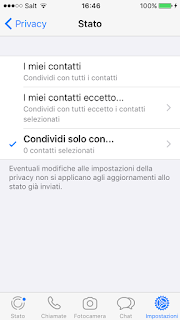
Questo vale anche se si imposta lo stato come visibile a nessuno contatto in Impostazioni – Account – Privacy – Stato e si imposta la visibilità di Ultimo accesso a Nessuno (in Impostazioni – Account – Privacy). In altre parole, quest’impostazione è totalmente ingannevole.
Di conseguenza, esistono siti che consentono di verificare se un utente è online sapendone soltanto il numero di telefonino e permettono persino di confrontare lo stato di due utenti per dedurre se stanno comunicando tra loro.
Lo ha segnalato Lorenzo Franceschi-Bicchierai su Vice.com, citando l’esistenza di varie app (che non nomina e che non mi sembra opportuno nominare qui) che si vantano pubblicamente di poter sapere con precisione quando qualcuno si è collegato a WhatsApp, con che probabilità due utenti hanno chattato nel corso della giornata, quando un utente è andato a dormire, quando si è svegliato e con quanti contatti hanno chattato. Si può anche sapere quanto tempo un utente ha trascorso online per ciascuna sessione di chat e si possono ricevere notifiche per essere avvisati quando quell’utente torna online.
In termini tecnici questo è cyberstalking, ed è una funzione integrata in WhatsApp. Non è un difetto o un bug: WhatsApp è proprio progettato così.
Ho provato uno di questi servizi su uno dei miei numeri, sul quale ho attivato WhatsApp, ed è decisamente impressionante. Ha rilevato correttamente i miei orari di attività in WhatsApp.

Ho poi creato una rubrica di numeri da monitorare e il servizio mi ha offerto informazioni non solo sulle ultime 24 ore ma anche su date passate. Ha identificato correttamente gli orari nei quali ho scambiato messaggi su WhatsApp:

È andata un po’ meno bene con il tracciamento delle chat: il sito non ha registrato il fatto che avevo chattato su WhatsApp con un altro dei miei numeri. In effetti il sito parla di probabilità di chat, per cui non garantisce nulla, ma il problema di questi errori è che l’utente che usa siti come questi per fare cyberstalking rischia di prendere dei granchi e accusare per esempio un partner di chattare con qualcuno quando non è vero oppure viceversa. In ogni caso il confronto delle attività online è notevole:

Se per caso pensavate che le promesse di crittografia end-to-end di un’azienda che dipende dai dati personali degli utenti per guadagnare possano essere una garanzia di riservatezza, forse vi conviene pensare di nuovo.
Questo articolo vi arriva gratuitamente e senza pubblicità grazie alle donazioni dei lettori. Se vi è piaciuto, potete incoraggiarmi a scrivere ancora facendo una donazione anche voi, tramite Paypal (paypal.me/disinformatico) o altri metodi.
Aumentano le domande di finanziamento delle aziende
Il rallentamento del ciclo economico provocato dalla pandemia ha decisamente condizionato nell’ultimo anno l’evoluzione dei flussi di cassa delle aziende e quindi anche l’andamento delle richieste di credito cresciute, secondo gli ultimi dati, del +16%. Il 18% circa delle nostre imprese si è trovata a fronteggiare lo shock causato dal Coronavirus partendo da situazioni di liquidità poco consistenti. Il 22% circa delle aziende disponeva di liquidità in grado di coprire solo il 40% circa dei debiti…
L’articolo Aumentano le domande di finanziamento delle aziende scritto da Paolo Brambilla proviene da Assodigitale.