
OnePlus Nord CE 5G in arrivo il 10 giugno in Europa e India
Costruire il futuro per aiutarvi ad affrontarlo al meglio
La combinazione dei nostri prodotti automatizzati crea un effetto moltiplicativo per guidare la crescita, a partire da parole chiave, offerte e creatività
Poiché l’automazione sta portando grandi risultati agli inserzionisti, vogliamo aiutarvi ad usarla anche in altre situazioni. Oggi, infatti, più dell’80% degli inserzionisti usa le offerte automatiche per definire le offerte senza doversi più basare sulle ipotesi e per raggiungere i propri obiettivi di rendimento. Gli inserzionisti che vogliono ad esempio ottimizzare le loro campagne in base al ritorno sulla spesa pubblicitaria usano le strategie di Smart Bidding di ritorno sulla spesa pubblicitaria target (ROAS Target) per ottimizzare le offerte in maniera automatica e massimizzare le entrate. Attualmente stiamo espandendo ROAS Target in modo che funzioni su ancora più canali Google, tra cui annunci Discovery e campagne video per azione.
Dimostrazione di un feed del prodotto aggiunto alle campagne video per azione
Forniamo a più inserzionisti l’automazione e tutto il suo potenziale
Lo scorso anno abbiamo parlato dei test che stavamo eseguendo su un nuovo tipo di campagna chiamata Performance Max, che racchiude il meglio dell’automazione di Google per aiutare gli inserzionisti ad ottenere risultati migliori su tutti i canali Google: YouTube, Display, Ricerca, Discover e molti altri. A partire da oggi, le campagne Performance Max si estenderanno a migliaia di altri inserzionisti, diventando disponibili a livello generale entro la fine dell’anno (per maggiori dettagli sulla versione beta potete consultare il Centro assistenza Google Ads, mentre se siete interessati a partecipare al programma beta potete compilare questo modulo di interesse).
Inoltre, stiamo aggiungendo l’assistenza per le campagne Performance Max nella pagina Approfondimenti. Abbiamo tenuto conto delle richieste dei beta tester per una maggiore trasparenza su come l’automazione funzioni e su cosa influisca nelle variazioni del rendimento. Grazie a questo aggiornamento, potrete avere accesso ad informazioni come i segmenti di pubblico che stanno generando conversioni, la creatività con il rendimento migliore, approfondimenti sulle aste e le categorie di ricerca di tendenza. Potrete anche vedere in anteprima come i vostri annunci migliori vengano mostrati su ciascun canale.
Screenshot di Insights Page in Google Ads
Durante le prime fasi di beta test abbiamo riscontrato ottimi risultati. Vodafone Turchia ad esempio, parte del gruppo Vodafone, un’azienda leader di telecomunicazioni in Europa e Africa, ha adottato Performance Max con l’obiettivo di scalare la generazione di lead per i suoi piani di telefonia su tutti i canali Google per raggiungere più potenziali clienti. Durante i test, le campagne Performance Max hanno generato un aumento dei lead del 18% ad un costo per acquisizione inferiore del 70% rispetto alle campagne sulla rete di ricerca. Vodafone Turchia ha quindi adottato le campagne Performance Max come campagne principali per la generazione di lead preferendole a quelle standard sulla rete di ricerca basate su parole chiave. Per leggere altre storie di successo delle campagne Performance Max da aziende come Neo4j e MoneyMe, potete consultare l’Advertising Solutions Centers.
“Siamo sempre propensi ad adottare nuove tecnologie pubblicitarie che possano aumentare le vendite e ridurre i costi. Performance Max si allinea perfettamente ai nostri obiettivi commerciali, e ci aiuta ad acquisire nuovi clienti senza cannibalizzare le vendite tra le campagne.” Ugur Sennaroglu, Marketing Director di Vodafone
Sedetevi (virtualmente) in prima fila al prossimo Google Marketing Livestream
Per migliorare i prodotti Google, continuiamo ad ascoltarvi e a imparare da voi.
Unitevi al Google Marketing Livestream oggi stesso alle ore 17:00 per scoprire di più su tutte queste novità e molto altro ancora.
Vi ringraziamo per aver scelto di collaborare con noi, vi aspettiamo al Google Marketing Livestream.
Scritto da: Jerry Dischler, Vice President / General Manager, Ads

Sky Go passa all’alta definizione: film e serie in HD

AL PARCO SEMPIONE DI MILANO RIAPRE TORRE BRANCA, CON LA SUA STUPENDA TERRAZZA PANORAMICA
UNA DELLE PIÙ BELLE TRADIZIONI MILANESI RIPRENDE VITA DOPO IL LOCKDOWN. COSTRUITA NEL 1933 SU PROGETTO DI GIÒ PONTI, PERMETTE UNA VISIONE MOZZAFIATO DELLA CITTÀ Il lockdown finalmente sembrerebbe finito,…
L’articolo AL PARCO SEMPIONE DI MILANO RIAPRE TORRE BRANCA, CON LA SUA STUPENDA TERRAZZA PANORAMICA scritto da Paolo Brambilla proviene da Assodigitale.

Twitter, la funzione Spaces arriva sul web
Research shows work profile delivers satisfaction and balance
By 2024, mobile workers (employees who use mobile devices like smartphones and tablets for work) will account for over 60% of the total U.S. workforce, according to research from IDC. A large percentage of the mobile workforce will continue to work from home even as the mandatory COVID-19 pandemic restrictions and closures are lifted.
With the increase of workers at home, and a large number of companies announcing hybrid work plans, employees are increasingly juggling work and personal life on a single device. Many are struggling to find the right balance between creating separation of work-life balance and maintaining privacy.
As researchers on the Android Enterprise team, we are always curious about the various needs and expectations of mobile employees who use their smartphones for both work and personal purposes. So we began a research project to understand the elements that comprise the ideal smartphone experience.
Our qualitative research shed light on the importance of work-life balance, privacy and wellbeing. We partnered with experience management firm Qualtrics to assess and quantify the qualitative findings through a study with more than 3,000 smartphone users around the world.
Managing work and personal life on a single smartphone
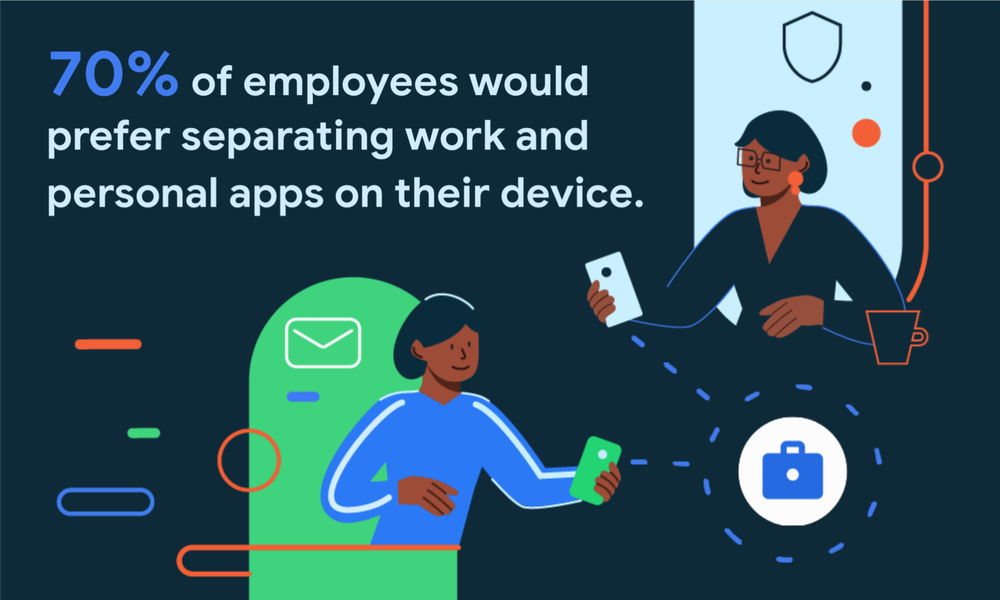
The study revealed that 68% of employees use one smartphone for both work and personal purposes, while 32% use two smartphones, though not always simply one for work and one for personal use. Looking across the two groups, 85% of employees use at least one smartphone for both work and personal use.
To get a bird’s-eye view on the needs of people who use a single smartphone for both work and personal use, the team surveyed both users of the Android work profile — a dedicated space on Android devices where work apps are kept separate from personal apps and data — and non-work profile users, including those on other mobile operating systems.

Powering digital transformation for global publishers
Since the Google News Initiative was created in 2018, we have strived to meet publishers wherever they are in their digital evolution. We’ve worked with thousands of publishers on specific business challenges, like digital subscriptions and advertising revenue, and provided tools like News Consumer Insights to help publishers grow their online audiences. In 2020, we launched the GNI Digital Growth Program, a free initiative aimed at empowering small and mid-sized global news publishers to grow their businesses online.
We’ve learned over the years that the shift to digital doesn’t happen overnight, so we shaped the Digital Growth Program to provide multiple entry points to support publishers’ digital transformation, wherever they may be in the process. This includes live workshops and expert panels where participants can learn from various subject-matter experts and ask questions, interactive exercises that provide personalized recommendations, playbooks that dive deep into business topics relevant to news organizations, and collaborative Labs that tackle specific business problems with like-minded participants and experts.
To date, more than 8,600 participants from more than 130 countries have been trained through the Digital Growth Program, across topics like reader revenue and audience development. This spans live and on-demand sessions in English, Korean, Japanese, Spanish, Portuguese, Indonesian, French, German, Polish, Italian and Czech.
We’re continuing to expand the program to new topics and regions, including on June 1, launching the advertising revenue workshops and playbook(register here). To date, the program has resulted in publishers all over the world showing measurable growth in their digital businesses.
La Prensa in Panama took part in our Subscriptions Lab and increased digital subscribers fivefold. A core pillar of their strategy was to make their subscription product more accurately reflect their brand, ultimately moving business-related content behind their paywall to increase revenue. The publisher’s participation in the Lab gave them more confidence to make strategic decisions based on sound analysis and effective tools.
The Telegraph Herald in the United States ran a number of experiments as part of our Subscriptions Lab, including launching targeted email pushes, implementing a new pricing model and testing higher rates. As a result of the Lab, they experienced a 25% increase in digital subscriptions, a 28% increase in newsletter subscribers and a 19% increase in subscriptions conversion rate. The Telegraph Herald gained a newfound confidence and ability to advance experimentation and revenue growth as a result of their participation.
The Vermont Digger leveraged the GNI Sponsorships Lab to understand the power of virtual events. The Digger team ran a lively, three month virtual event series that successfully brought in one large sponsor to support the full series. As a result of their participation in the Lab, Vermont Digger grew their annual sponsorships revenue by 71% and increased average client revenue by 61%. They did all of that despite the impact and stress of the COVID-19 pandemic.
Attending the GNI Digital Growth Program workshops helped Italian publishersIVG.it and Genova24.it refine their offering to readers and increase the number of paying members. Through participation in the same program, La Cronica in Spain was able to better analyze reader engagement and grow revenue.
Business Insider Japan, a participant in the GNI Subscriptions Lab in Asia Pacific, aligned its organization’s thinking around digital subscriptions, using new benchmarks and key metrics that the business had not previously considered. Due to the program, the organization was able to grow digital subscription revenue and month-end digital subscribers by nearly 25% each.
In the past two weeks, we have kicked off newAudience Development Labs in North America and South America in partnership with INMA and News Revenue Hub, with another set to launch in Asia in July 2021. And in Europe, we will be launching new programs throughout the year in partnership with FT Strategies.

Facebook nel mirino dell’antitrust dell’Unione Europea

Non è un social (solo) per giovani: TikTok piace anche ai grandi

Domenica 13 giugno inizia l’Xbox & Bethesda Games Showcase
Lezione straordinaria di Jill Tarter (SETI), 1 giugno 2021 alle 21; ascoltabile in italiano

Jill Tarter, l’astrofisica che per anni ha diretto il centro SETI, dedicato alla ricerca scientifica di indicatori astronomici di tecnologie non terrestri, terrà una conferenza pubblica su Zoom l’1 giugno 2021 alle 21 (ora italiana), intitolata Searching for aliens, finding ourselves (Cercare gli alieni, trovare noi stessi).
Se il suo nome vi suona familiare, è perché il suo lavoro nella ricerca di indicatori di civiltà extraterrestri ha ispirato il personaggio di Ellie Arroway nel film Contact di Bob Zemeckis (1997), tratto dall’omonimo romanzo dell’astronomo Carl Sagan.
L’evento è gratuito e organizzato da ASIMOF (Associazione Italiana Modelli Fedeli) in collaborazione con AstroTeam Le Pleiadi. Sarà in lingua inglese, con la possibilità di avere la traduzione simultanea in italiano (di cui mi occuperò io). Per ascoltare l’audio tradotto si dovrà semplicemente cliccare in Zoom su Interpretazione e poi scegliere il canale italiano. Il pubblico potrà inviare domande a Jill Tarter usando la chat di Zoom.
Ci sono 500 posti disponibili. Il link è https://us02web.zoom.us/j/83605811653. Consiglio di collegarsi qualche minuto prima delle 21 per verificare le impostazioni audio, se volete ascoltare la traduzione, e di usare l’app Zoom invece della versione web.

Bilancio del primo anno senza fare benzina
Piccola nota personale: un anno fa, il 26 maggio 2020, ho fatto rifornimento di carburante per auto per l’ultima volta. Da un anno viaggio usando soltanto elettricità.
Oggi ho fatto benzina per l’ultima volta. Selfie commemorativo, così si capisce perché non faccio mai selfie :-) pic.twitter.com/OoPyZXE6cv
— Paolo Attivissimo (@disinformatico) May 26, 2020
In quest’anno puramente elettrico ho percorso circa 16.000 chilometri, nonostante il lockdown da pandemia. Ne avevo già fatti circa altri 16.000 senza consumare carburante quando avevo sia una piccola auto elettrica (Peugeot iOn usata, che ora ha 10 anni), sia un’auto a benzina (che usavo solo per i viaggi lunghi). In tutto, da febbraio 2018, quando ho iniziato l’esperimento della mobilità elettrica, ho risparmiato circa 2500 euro rispetto a quello che avrei speso in carburante. E ho ancora 5800 km di ricarica gratuita presso qualunque colonnina Tesla, grazie ai referral di chi compra un’auto di questa marca citando il mio codice (https://ts.la/paolo49861).
Bilancio dopo un anno: non tornerei indietro. Viaggio nel silenzio e senza gas di scarico, risparmiando e divertendomi. Faccio il “pieno” parcheggiando l’auto in garage. E 350 chilometri di autonomia a velocità autostradale, con una cinquantina di minuti per rifare il “pieno” (con una Tesla Model S di seconda mano), sono decisamente sufficienti per le mie esigenze.
Unico difetto: la Model S è enorme e usarla in città è scomodo. Per questo ho tenuto la iOn, che uso tantissimo per i viaggi brevi locali: tanto è ormai pagata e mi costa soltanto 46 euro l’anno di assicurazione e 13 euro l’anno di tassa di circolazione.
So che l’auto elettrica non è una possibilità per tutti, ma lo è per molti. Se avete un posto auto dove potete mettere una presa elettrica, fateci un pensierino. Se volete saperne di più, i dettagli sono su Fuoriditesla.ch.

TAG Bulletin: Q2 2021
This bulletin includes coordinated influence operation campaigns terminated on our platforms in Q2 2021. It was last updated on May 26, 2021.
April
- We terminated 3 YouTube channels as part of our investigation into coordinated influence operations linked to El Salvador. This campaign uploaded content in Spanish focusing on a mayoral race in the Santa Tecla municipality. Our findings are similar to findings reported by Facebook.
- We terminated 43 YouTube channels as part of our investigation into coordinated influence operations linked to Albania. This campaign uploaded content in Farsi that was critical of Iran’s government and supportive of Mojahedin-e Khalq. Our findings are similar to findings reported by Facebook.
- We terminated 728 YouTube channels as part of our ongoing investigation into coordinated influence operations linked to China. These channels mostly uploaded spammy content in Chinese about music, entertainment, and lifestyle. A very small subset uploaded content in Chinese and English about protests in Hong Kong and criticism of the U.S. response to the COVID-19 pandemic. These findings are consistent with our previous reports.

Instagram, da oggi ufficiale il controllo della visibilità dei Like
Create your own journaling app without writing code
Studies show that regularly writing down your thoughts and feelings can improve your mental, emotional and physical health. Despite all of journaling’s benefits, it can feel like an insurmountable challenge.
While writing by hand is therapeutic for some, many may find it uncomfortable and tiring. Others may find an inventive way to leverage Google Doc, Keep, or Sheets to log their thoughts, but these tools are not optimized for the struggling journaler. In reality, the challenge may not be journaling itself but creating and customizing a routine that helps you get into a rhythm and document your day in the ways most useful to you.
A few months ago, I decided to put this theory to the test by building my own journaling app in AppSheet, Google Cloud’s no-code application development platform. It lets me customize my journaling experience the way I want, I was able to build the app without writing any code, and it’s been extremely useful.
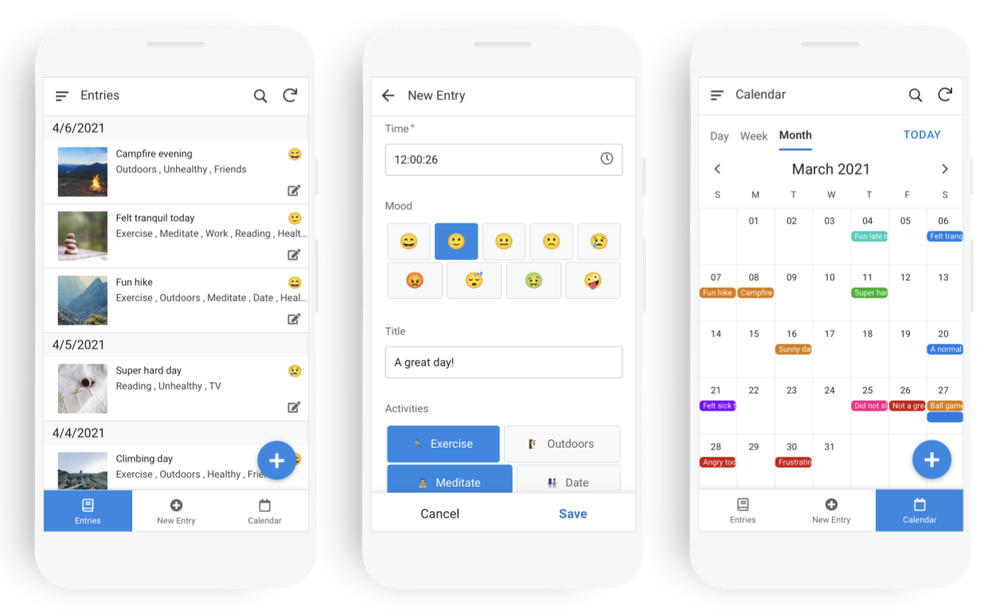
The journaling app, built with AppSheet, has a form that makes it easy for me to log my moods and activities, write a few notes, and add photos. I’ve also added a list and a calendar view so I can read through previous entries.
With AppSheet, anyone can create their own custom apps, connected directly to their data in Sheets — no technical background needed. To help you create your own journaling app, without writing a single line of code, I’ve made a tutorial video.

And that’s just a starting point. From there, try adding your own customizations, like your own activities, notification and text message reminders and charts to show trends over time.
AppSheet lets you build and use your own personal apps for free. For example, you can build a custom workout app to help track your progress at the gym or you can build an inventory management app to keep track of inventory at your local community events. These are just a few ideas, but feel free to explore our app templates library or start with your own ideas.
Hopefully creating a custom journaling app inspires you to start writing — and dive into no-code app building at the same time.
Ready to use AppSheet? Get started now.