
WhatsApp sta per sbarcare anche su iPad

These researchers are bringing AI to farmers
“Farmers feed the entire world — so how might we support them to be resilient and build sustainable systems that also support global food security?” It’s a question that Diana Akrong found herself asking last year. Diana is a UX researcher based in Accra, Ghana, and the founding member of Google’s Accra UX team.
Across the world, her manager Dr. Courtney Heldreth, was equally interested in answering this question. Courtney is a social psychologist and a staff UX researcher based in Seattle, and both women work as part of Google’s People + Artificial Intelligence Research (PAIR) group. “Looking back on history, we can see how the industrial revolution played a significant role in creating global inequality,” she says. “It set most of Western Europe onto a path of economic dominance that was then followed by both military and political dominance.” Courtney and Diana teamed up on an exploratory effort focused on how AI can help better the lives of small, local farming communities in the Global South. They and their team want to understand what farmers need, their practices, value systems, what their social lives are like — and make sure that Google products reflect these dynamics.
One result of their work is a recently published research paper. The paper — written alongside their colleagues Dr. Jess Holbrook at Google and Dr. Norman Makoto Su of Indiana University and published in the ACM Interactions trade journal — dives into why we need farmer-centered AI research, and what it could mean not just for farmers, but for everyone they feed. I recently took some time to learn more about their work.
How would you explain your job to someone who isn’t in tech?
Courtney: I would say I’m a researcher trying to understand underserved and historically marginalized users’ lives and needs so we can create products that work better for them.
Diana: I’m a researcher who looks at how people interact with technology. My superpower is my curiosity and it’s my mission to understand and advocate for user needs, explore business opportunities and share knowledge.
What’s something on your mind right now?
Diana: Because of COVID-19, there’s the threat of a major food crisis in India and elsewhere. We’re wondering how we can work with small farms as well as local consumers, policymakers, agricultural workers, agribusiness owners and NGOs to solve this problem.
Agriculture is very close to my heart, personally. Prior to joining Google, I spent a lot of time learning from smallholder farmers across my country and helping design concepts to address their needs.
“Farmers feed the entire world — so how might we support them to be resilient and build sustainable systems that also support global food security?”
Courtney: I’ve been thinking about how AI can be seen as this magical, heroic thing, but there are also many risks to using it in places where there aren’t laws to protect people. When I think about Google’s AI Principles — be socially beneficial, be accountable to people, avoid reinforcing bias, prioritize safety — those things define what projects I want to work on. It’s also why my colleague Tabitha Yong and I developed a set of best practices for designing more equitable AI products.
Can you tell me more about your paper, “What Does AI Mean for Smallholder Farmers? A Proposal for Farmer-Centered AI Research,” recently published in ACM Interactions?
Courtney: The impact and failures of AI are often very western and U.S.-centric. We’re trying to think about how to make this more fair and inclusive for communities with different needs around the globe. For example, in our farmer-centered AI research, we know that most existing AI solutions are designed for large farms in the developed world. However, many farmers in the Global South live and work in rural areas, which trail behind urban areas in terms of connectivity and digital adoption. By focusing on the daily realities of these farmers, we can better understand different perspectives, especially those of people who don’t live in the U.S. and Europe, so that Google’s products work for everyone, everywhere.
Why did you want to work at Google?
Diana: I see Google as home to teams with diverse experiences and skills who work collaboratively to tackle complex, important issues that change real people’s lives. I’ve thrived here because I get to work on projects I care about and play a critical role in growing the UX community here in Ghana.
Courtney: I chose Google because we work on the world’s hardest problems. Googlers are fearless and the reach of Google’s products and services is unprecedented. As someone who comes from an underrepresented group, I never thought I would work here. To be here at this moment is so important to me, my community and my family. When I look at issues I care about the most — marginalized and underrepresented communities — the work we do plays a critical role in preventing algorithmic bias, bridging the digital divide and lessening these inequalities.
How have you seen your research help real people?
Courtney: In 2018, we worked with Titi Akinsanmi, Google’s Policy and Government Relations Lead for West and Francophone Africa, and PAIR Co-lead and Principal Research Scientist Fernanda Viegas on the report for AI in Nigeria. Since then, the Ministry of Technology and Science reached out to Google to help form a strategy around AI. We’ve seen government bodies in sub-Saharan Africa use this paper as a roadmap to develop their own responsible AI policies.
How should aspiring AI thinkers and future technologists prepare for a career in this field?
Diana: My main advice? Start with people and their needs. A digital solution or AI may not be necessary to solve every problem. The PAIR Guidebook is a great reference for best practices and examples for designing with AI.
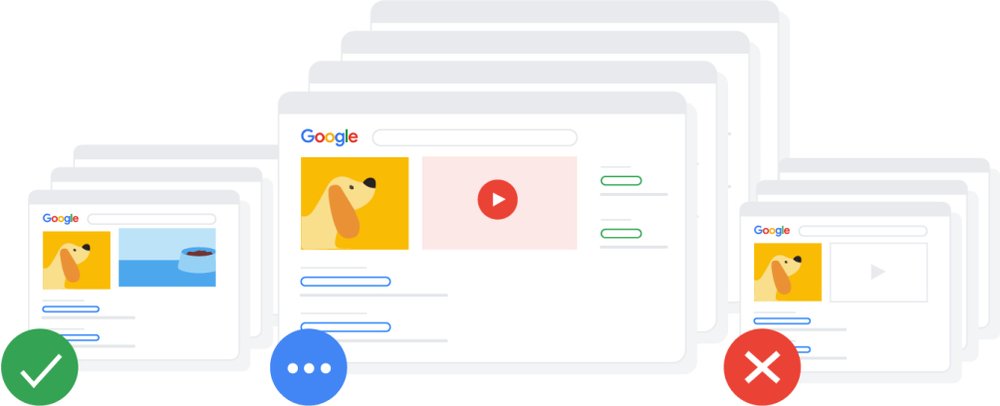
Helping people and businesses learn how Search works
Every day, billions of people come to Google to search for questions big and small. Whether it’s finding a recipe, looking for a local coffee shop or searching for information on complex topics like health, civics or finance, Google Search helps you get the information you need — when you need it.
But part of accomplishing our mission also means making information open and accessible about how Google Search, itself, works. That’s why we’re transparent about how we design Search, how we improve it and how it works to get you the information you’re looking for.
Like many of the topics you might search for on Google, Search can seem complicated — but we make it easy to learn about. Here are a few ways you can get a better understanding of how Google Search works:
A one-stop shop
Today, we’re launching a fully-redesigned How Search Works website that explains the ins and outs of Search — how we approach the big, philosophical questions, along with the nitty-gritty details about how it all works.
We first launched this website in 2016, and since then, millions of people have used it to discover more about how Search works. Now, we’ve updated the site with fresh information, made it easier to navigate and bookmark sections and added links to additional resources that share how Search works and answer common questions.
The website gives you a window into what happens from the moment you start typing in the search bar to the moment you get your search results. It gives an overview of the technology and work that goes into organizing the world’s information, understanding what you’re looking for and then connecting you with the most relevant, helpful information.
On the site, you can find details about how Google’s ranking systems sort through hundreds of billions of web pages and other content in our Search index — looking at factors like meaning, relevance, quality, usability and context — to present the most relevant, useful results in a fraction of a second. And you can learn about how we go about making improvements to Search. (There have been 4,500 such improvements in 2020 alone!) As you’ll read about, we rigorously test these changes with the help of thousands of Search Quality Raters all around the world — people who are highly trained using our extensive guidelines. These rater guidelines are publicly available, and they describe in great detail how Search works to surface great content.
We’re always testing changes to Search to provide you with the most helpful results.
Watch and learn
You also can watch our How Search Works video series, a set of easy-to-understand explainers about how Search connects you to helpful, relevant information. Here, you’ll find the answers to common questions like how Autocomplete works (no, it’s not mind-reading), how Google keeps you safe on Search, how ads appear in Search and more.
And if you’re really in the mood to learn all about Search — and the real people behind the scenes who are working hard to make it better every single day — you can watch our “home movie,” “Trillions of Questions, No Easy Answers.” Grab your popcorn!
Trending worldwide
It’s also easy for you to get a view into what people are searching for around the world using Google Trends. For more than 15 years, we’ve made this tool publicly accessible for anyone to gain more insight into how people are using Search to find information. Google Trends is the largest publicly available data set, using anonymized search interest across different geographies to highlight trending topics, questions and societal shifts. You can think of it as a window into what the world is searching for on the web.
Transparency for website creators
When it comes to the open web, we also invest heavily in helping site owners, publishers, businesses, creators and others succeed and get discovered on Search. At Google Search Central, creators can get expert advice from experienced webmasters, view over 1000+ educational videos, learn best practices for web development and discover many more tips to maximize their reach on Search.
Every day, we make changes to make Search work better — some small, some large. We work hard to give site owners and content producers ample notice and advice about changes where there’s actionable information they can use. While we strive to provide as much information as we can, we also have a responsibility to protect the integrity of our results and keep results as clean as possible from search spam. That’s why, although we share a lot of information about Search updates, we can’t share every detail. Otherwise, bad actors would have the information they need to evade the protections we’ve put in place against deceptive, low-quality content.
Over the last two decades, Google Search has evolved tremendously, but one thing remains core to how we operate: transparency about our approach and commitment to providing universally accessible information to all. Explore our newly refreshed website to discover more as we continue to evolve.
Finding belonging in Google’s Aboriginal and Indigenous Network
In 2013, the Google Earth Outreach team reached out to me with a request. They had been invited to partner on a mapping project in western Canada, and were looking for a Googler who could contribute an Indigenous perspective on cultural protocol. They asked if I would be interested in helping. “Absolutely!” was my immediate response. I’m Kanien’kehá ka, (Mohawk) and there have been times in my life and my workplace where it felt like there wasn’t space for me to be Indigenous. This was a great opportunity to lean in. There was also pressure: I could bring my perspective from my community but Indigenous communities are incredibly diverse. I hoped my Indigenous Studies degree would help me.
But the experience was a success and led to more participation in projects in the Indigenous space at Google. Since 2015, I’ve been one of the five people who lead Google’s Aboriginal and Indigenous Network (GAIN), an employee-run group that gives Indigenous Googlers a safe place to nurture our communities.
Finding belonging in a workplace with a large, diverse population can be difficult. We often bend and mould ourselves to fit others’ expectations. It’s hard to be authentic. It’s hard to hold to our core values, and what truly makes us who we are. But I found this in GAIN.
GAIN is a place where we can grow and support one another. But it’s more than that. This group ensures that our communities outside of Google thrive, too. GAIN understands that the individual, family and community are all connected. No one thrives in isolation, and that’s what powers GAIN.
This work was about self-determination, and starting the process of decolonization through community empowerment.
Some work GAIN has done that we’re proudest of involves creating and launching initiatives in areas like hiring, recruiting, retention, wellness, cultural events and internet connectivity in Indigenous communities. We work to shed light on the Missing and Murdered Indigenous Women and Girls campaigns , support Indigenous small businesses, and promote racial equity and justice initiatives. GAIN has also helped highlight educational tools such as training with ComIT, online STEMprogramming and Grow with Google, which worked with elementary school students in their local library and makerspace in Iqaluit.
We’re also working to make space for the Indigenous community internally. We have film screenings of independent Indigenous films, and have invited film makers from Wapikoni to host a discussion. Bob Joseph spoke to Googlers about what we may not know about the Indian Act, and the Cloud Sales team purchased his book for their entire team. More than 80 people in the Canadian offices are attending the University of Alberta’s free course on Indigenous Canada together.
But it was with that original Google Maps project that I found a true home. The purpose of this work is to identify Indigenous territories on Google Maps, and recognizing Indigenous independent sovereignties in the same way as other governments do on Google Maps. We also encourage Indigenous populations to take ownership of how their bands and cultures are presented online through StreetView, Earth and Maps.
When the Firelight Group (an Indigenous-owned consulting group) founded the Indigenous Mapping Workshop in 2014, they invited Google Earth Outreach as a partner and I was a member of the inaugural planning committee. We brought together 100 participants from Indigenous communities to teach them the tools needed to map out the locations their families rely on for hunting, gathering, trapping and fishing. In these workshops, we taught them how to put their own stories on their own maps, and encouraged them to take what they learned back to their communities. Maps are incredibly powerful tools in the hands of Indigenous communities, especially when they allow for our Indigenous worldview, and our Indigenous stories to be told.
This work was about self-determination, and starting the process of decolonization through community empowerment. We’ve supported Indigenous Mapping Workshops throughout Canada each year since 2014. Last year, the Indigenous Mapping Workshop went virtual and had more than 400 attendees. We expect more than 500 virtual attendees at this year’s conference, with over 100 training sessions. We’ve supported Indigenous Mapping Workshops in Australia and New Zealand as well.
This opportunity was amazing. It is an honour to spend time with other First Nations, Elders and community members. Being welcomed into communities and sharing their stories is not a gift I’ll soon forget. I am so humbled to be able to help bring these tools, stories and Indigenous voices together.

Prime Video, 5 serie TV originali da vedere nell’estate 2021

Dogecoin, una delle criptomonete più singolari
Dogecoin: la criptovaluta che sta facendo abbaiare internet È difficile guardare Dogecoin e non vedere il cane emblematico che la rappresenta. E quando pensiamo a una delle criptovalute più uniche,…
L’articolo Dogecoin, una delle criptomonete più singolari scritto da YOUR_DIGITAL_VOICE! proviene da Assodigitale.
Villa Food, Filare Italia, Venfri: la distribuzione alimentare oggi
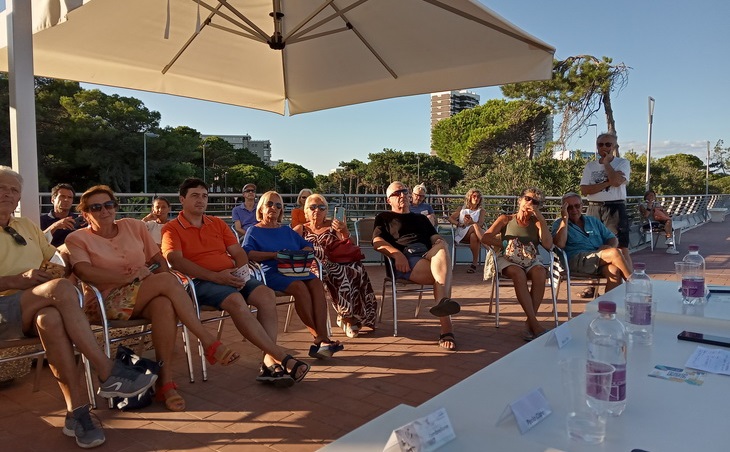
La distribuzione alimentare fra locale e globale. A Lignano Sabbiadoro la rassegna “Economia sotto l’ombrellone”. Gli interventi di Villa Food, Filare Italia, Venfri di Renato Gandini – Redazione Trendiest Nel settore…
L’articolo Villa Food, Filare Italia, Venfri: la distribuzione alimentare oggi scritto da Paolo Brambilla proviene da Assodigitale.
Three Use Cases That Connect the Dots Between Influence and B2B Marketing Results
Last week I talked about where B2B Marketers are seeing the most impact from influencer marketing efforts based on the research done with hundreds of marketers for the State of B2B Influencer Marketing Report. Three of those specific areas where influence can help B2B brands optimize for greater marketing impact include brand, growing the influence of key executives and driving leads / sales.
While just about everyone in B2B Marketing is aware of how working with influencers can add relevance, reach and engagement to content, not everyone makes the connection between their particular business problem and the influence solution. Here are three examples from many that can help you connect the dots.
Build Credible Awareness of Your Brand with Customers
Business Problem: The industry is not aware of your brand, solution or your category.
This is a situation many start-ups, new products or services, re-brands and challenger brands experience in the industry. These awareness issues are also especially present in situations where the target audience is not aware of the problem your company solves. Whether your company or solution is new, your business is in a crowded marketplace or your market isn’t aware of the problem you solve in the first place, credible awareness is essential for getting on the radar and even considered for modern B2B buyers.
B2B Influence Solution: Engage top category influencers to drive conversations about the need for solutions like yours.
There are multiple centers of influence for every business professional including industry publications, professional relationships with peers, industry experts, or special interest groups and associations. Building credible awareness of your solution and/or brand can be expedited in an authentic way by identifying trusted voices in your industry on the topic and finding ways to partner with them.
The outputs of those activations can include any format that matters to your customers from text (white papers, reports, blog posts, articles) to audio (podcasts, social audio), to video (recorded episodes of an ongoing “show”, livestream video, webinars, virtual events).
B2B Marketing Impact: With more credible awareness of the need for your type of solution and your brand, the warmer the market will be to your solutions. While the description of this impact is simple, execution and achievement of it is not.
Grow Thought Leadership of Your People and Brand
Business Problem: Customers value thought leadership from the brands they buy from but do not see your brand as a thought leader.
Even if buyers are aware of your brand and solution, they may not consider it seriously if you are not demonstrating leadership in the strategic direction of the category. Buyers want to know they are working with the best, not just today, but in the future. Thought Leadership for a brand means an active demonstration of strategy that is validated by credible third parties.
B2B Influence Solution: Identify and engage industry experts that already actively publish and promote thought leadership content in your category and partner with them. Find common ground and goals and use content like a research project or a visionary content asset to attract their participation.
B2B Marketing Impact: What better way to become a thought leader than to partner with industry experts that are already thought leaders in your industry? Trusted experts that co-create strategic content with brands builds the authority of those they partner with by association. Influencers can also provide the third party validation of brand thought leadership as they cross publish collaborated content on their own websites, in industry publications, newsletters and in presentations. Customers that see the resulting collaborative thought leadership content will see the brand as a thought leader as well.
Optimize E.A.T. of B2B Content with Influencers
Business Problem: Your content is well optimized and even ranks well but does not get great click through or engagement from organic search.
B2B Influence Solution: What good is ranking well in search if customers do not trust what they find? Google has articulated through their Quality Rater Guidelines, the value of E.A.T. (expertise, authoritativeness, trustworthiness) when it comes to content that deserves to be the best answer in search results.
B2B brands can optimize the E.A.T. of their content that is already optimized for search by building expertise, authority and trust by collaborating with industry influencers for target topics/keywords. Experts that publish well-read industry articles, research, and useful content on the topics that the brand is trying to be the best answer for, can be quoted, provide guest posts, or may even decide on their own to cite and link to your brand from their channels.
B2B Marketing Impact: Optimizing content with keywords as well as industry expert quotes and contributions can give brand content the kinds of signals that E.A.T. guidelines are used for to identify content that should have the best ranking in search engines. Content that is more trustworthy can rank better and also inspire more clickthroughs.
Once you make the important connection between a key business problem and where working with influencers can help optimize your efforts, what process can you follow to ensure the best results? From a content marketing perspective, there is a basic architecture for influencers and B2B content collaboration that has delivered efficient and effective marketing performance again and again.
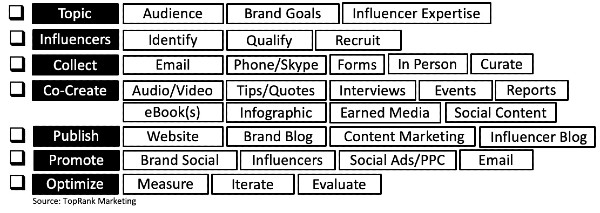
This B2B influencer content checklist is something we’ve covered here extensively and that I’ve presented on numerous times at B2B marketing industry conferences and workshops. The exact implementation of a campaign asset like this really depends on specific goals and the organization of the effort. Of course, content marketing campaigns that involve influencers on their own are not nearly as effective as an Always-On Influencer Marketing program that combines influencer relationship building with content activations.
If you need help connecting the dots between your business and marketing problem and where B2B influencer engagement (especially in the technology space) makes the most sense, be sure to reach out. We have nearly 10 years of B2B influencer marketing experience at TopRank Marketing and have a huge library of insights and experience to leverage for just about any B2B marketing situation.
The post Three Use Cases That Connect the Dots Between Influence and B2B Marketing Results appeared first on B2B Marketing Blog – TopRank®.

Clubhouse rimuove per sicurezza le info personali degli afgani

Sconto da 4 euro su Amazon a chi acquista un Buono Regalo

Countdown: Inspiration4 Mission to Space, primo trailer
Expert help needed to decode a rare piece of space history: the Lunokhod data tapes
A trove of lost Lunokhod data may have been found.
Between 1970 and 1973, the Soviet space program achieved an amazing feat: landing and driving the first remote-controlled roving robots on the Moon. These two vehicles were called Lunokhod-1 and -2, and they gathered invaluable scientific data as well as images of the surface of the Moon during their unprecedented, and still unrivaled, total of 52 kilometers of remotely controlled lunar
How can you help?
The format of the video images and of the science data is currently unknown and it is unclear what the tapes actually contain. This provides three main avenues of investigation:
- gathering information on how these tapes were recorded and how the data was encoded;
- transcribing and translating what the voice says;
- physically extracting the data and images from the tapes and presenting them in usable form.
If you have experience in these fields and are willing to help, please contact me.
I am compiling a list of potentially useful technical references:
- Soviet report on Lunokhod-2 (1973, via Roscosmos)
- Lunokhod-1 Soviet Lunar Surface Vehicle (1971, RAND/ARPA); page 4 specifically discusses telemetry data types
- Lunokhod-1 data available at NASA
- Lunokhod-2 – A Retrospective Glance after 30 Years (Bogatchev and Koutcherenko)
- Lunokhod-1 and Lunokhod-2 at the Department of Lunar and Planetary Research, Moscow University
- Lunokhod images and technical description of image formatting and transmission modes
- Russian information on “remote control lunokhods and planetrovers”
- Soviet space cameras by Don P. Mitchell
Full disclosure: I am not financially involved in this matter in any way. I am publishing this article and doing research on the subject purely out of historical interest.

Adobe Photoshop si aggiorna: le novità

La definizione garbata di chi parla con certezza di cose di cui in realtà non sa nulla: trasgressore epistemico
Grazie a una segnalazione di Stefano Zanero su Twitter, posso proporvi un termine tecnico, usabile anche come elegantissimo insulto, che definisce “chi ha la competenza o esperienza atta a dare giudizi in un campo ma si sposta in un altro campo nel quale non ha competenza ed esprime lo stesso giudizi”.
We finally have a word for people who are experts in AI, immunology, and Afghanistan all at once. https://t.co/AySVaNX9hG pic.twitter.com/kOZeliKQ8r
— Delip Rao (@deliprao) August 21, 2021
Il virgolettato proviene da un articolo di Nathan Ballantyne, della Fordham University, che si intitola Epistemic Trespassing ed è stato pubblicato in Mind di aprile 2019.
Il termine al quale mi riferisco deriva proprio dal titolo dell’articolo, ed è epistemic trespasser, che in italiano si potrebbe tradurre come “trasgressore epistemico”.
La prossima volta che vedete qualcuno parlare di cose di cui non sa niente, ditegli con tono neutro che sta compiendo una interessante trasgressione epistemica. Poi aspettate la sua reazione.