
Netflix, stop anche in Italia alla pratica degli account condivisi
Battlefield 2042, online il cortometraggio Exodus
Where B2B Marketers See the Most Impact from Influencer Marketing
Sophisticated B2B marketers understand that the effectiveness of a given strategy or set of tactics is tied to goals.
When it comes to influence, there are applications across the customer lifecycle from increasing reach and attention from hard to connect with audiences to creating more credible and authentic content experiences to improving trust and inspiring decision making.
Of course, working with external influencers and improving the influence of internal experts is not a silver bullet across all marketing goals. However, in our research on influencer marketing for B2B brands, there are some outcomes where marketers are seeing greater impact.
Rather than simply provide a laundry list of the highest impact marketing outcomes, I’ve clustered similar goals together to provide more category level insight into where B2B marketers have seen the most success when working with influencers.
B2B Influence and Brand Impact
Brand Awareness 84%, Brand Reputation 58% and Brand Advocacy 32% were each well-represented in our research by B2B marketers seeking to create impact from their influencer marketing efforts. The bottom line with creating brand impact is that it is an investment which pays dividends across the customer lifecycle.
With brand trust, distractions and loyalty at stake, optimizing marketing efforts to reach interested customers with credibility and the impact of trusted endorsements is more valuable than ever. Intelligent B2B influencer activations that match relevant experts with content collaborations and promotion can help lesser known brands and challenger brands alike become more credible, trusted and inspire advocacy.
For example, a B2B employee engagement software platform implemented an influencer content campaign that involved a mix of influencers from business celebrities to industry professionals to employee and customer subject matter experts to reach and build trust with customers in a way that resulted in 80% of names captured were new to the brand.
B2B Influence Drives Leads and Sales
It is understood by most B2B marketers that a relationship driven strategy like working with influencers doesn’t yield a lift in sales automatically. And yet it is still possible when the right marketing program architecture aligns influencers with customer engagement opportunities.
With 69% of B2B marketers say Lead Generation is an area of impact and 20% cite an increase in Sales / Revenue from influencer marketing, there is a distinct opportunity for B2B brands to add trusted voices their customers are listening to into marketing programs.
For example, an ITSM software brand did the homework to align very specific audience segment insights to a content marketing program including the right influencers in the right way that drove 20% of annual sales pipeline from a single campaign.
External Influence Drives Employee Influence
While only 15% of B2B marketers cited Improved Staff Reputation as a top impact area from their influencer marketing efforts, we’ve seen substantial growth in this area since the survey data was captured last year. An increasing number of B2B brands of all sizes are investing in the influence of the brand through building up key executives and subject matter experts through social engagement and content collaborations with relevant B2B industry influencers.
For example, brands that range from an international travel platform that worked to build thought leadership with the CEO by posting content on LinkedIn in collaboration with industry influencers to ongoing social engagement for key executives at a large telecommunications giant have resulted in growth of social networks, reach, engagement and quality of interactions with customers and prospects.
Creating B2B Marketing Impact with Influence
As I’ve talked with B2B marketing professionals in 2021 about marketing trends and how our agency is doing, many have remarked how the shift in B2B to digital first and elevated the opportunities for working with influencers. They’re right – the pandemic and all the changes in business and the way customers have shifted their behaviors has indeed created new opportunities for B2B brands to accelerate marketing impact by partnering with industry experts to drive brand outcomes, impact leads and sales and grow thought leadership by partnering key executives with industry experts on social and content marketing efforts.
If you have experience working with influencers in your B2B business, be sure to share your insights in our 2021 B2B Influencer Marketing Survey. You can also check out the State of B2B Influencer Marketing Report which includes key trends, statistics, case studies and predictions for the future. Or you can reach out to our team and talk about how to take your influencer engagement efforts to the next level.
The post Where B2B Marketers See the Most Impact from Influencer Marketing appeared first on B2B Marketing Blog – TopRank®.

Come proteggere la casa col sistema Ring Alarm
Computer quantistici, il CNR crea un modello migliore di Google

Anime anni ’70 su Prime Video: 5 serie da non perdere

L’ennesima figuraccia del giornalismo: la foto falsa della bandiera su Kabul spacciata per vera
Ho perso la pazienza. La gente disperata muore a Kabul, e coloro che dovrebbero informarci su questa tragedia fanno ancora una volta i cialtroni totali.
Gli anni passano e i giornalisti non imparano nulla. Nemmeno un concetto semplicissimo come controllare le fonti. E il suo corollario: non pubblicare la prima foto che trovi in giro. Le basi, insomma.
Dieci anni fa, i giornali italiani abboccarono in massa ai palesi fotomontaggi che ritraevano il cadavere di Osama bin Laden e li pubblicarono senza il benché minimo controllo. Poteva essere una buona occasione per imparare la lezione, scusarsi pubblicamente e fare in modo che non accadesse mai più, istituendo una semplice regolina: non si pubblicano foto di cui non è garantita la fonte. E magari aggiungendole un corollario: prima di pubblicare una foto, di qualunque fonte, chiediti se è almeno vagamente plausibile; nel dubbio, non pubblicarla.
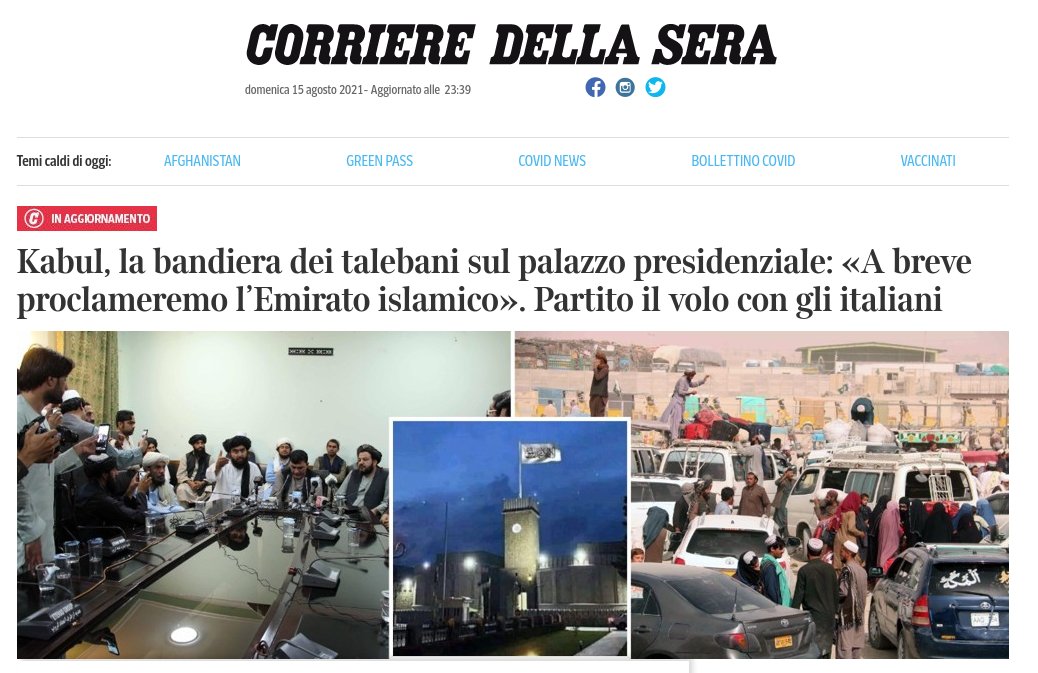
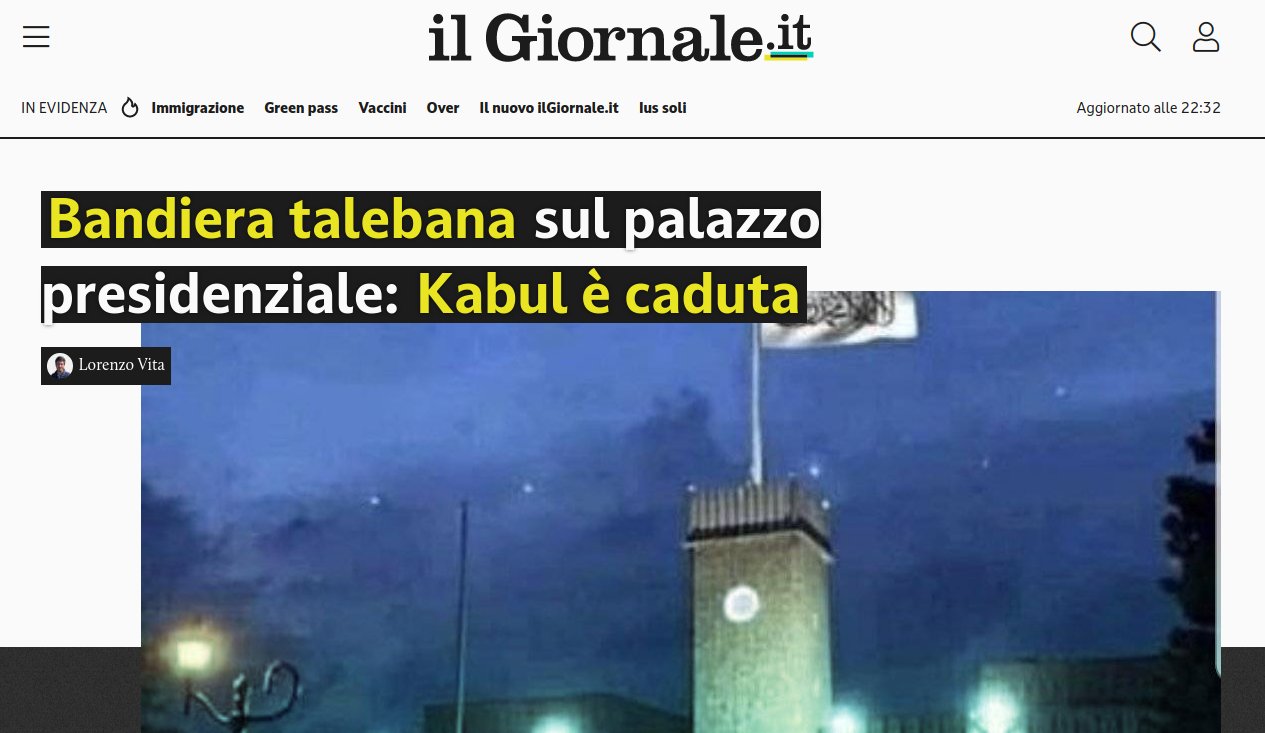
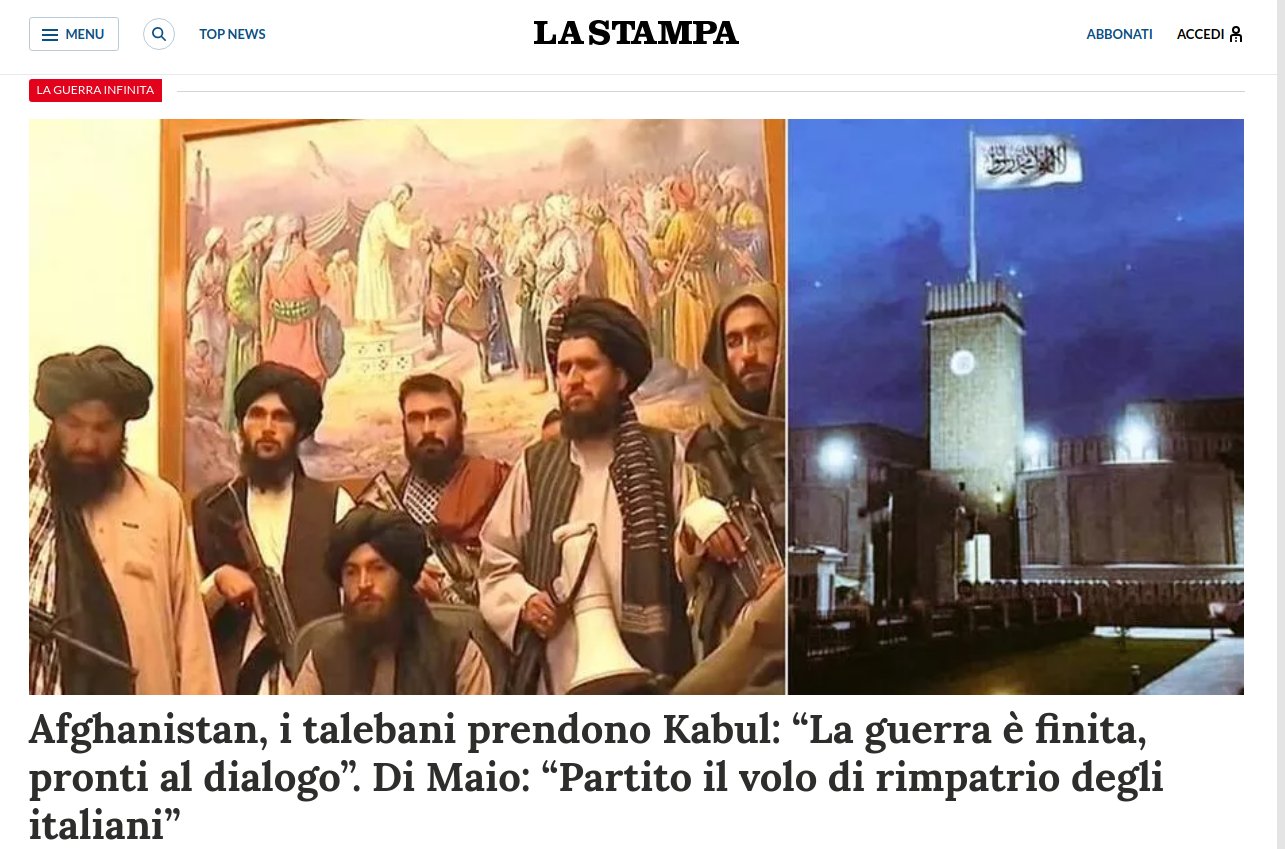
E invece no. Tantissimi giornali e telegiornali italiani stanno pubblicando in queste ore un palese fotomontaggio che mostra una bandiera attribuita ai Talebani che hanno riconquistato Kabul.
A parte la natura dilettantesca del fotomontaggio, che dovrebbe rivelare immediatamente a chiunque che la foto è un falso, basterebbe considerare che quella bandiera dovrebbe avere dimensioni enormi e che per sventolare così dritta dovrebbe essere investita da un vento da uragano. Macché, al Vero Giornalista queste semplici osservazioni non interessano.
Questo è Gianni Riotta (copia permanente):
For twenty years leaders media and the public opinion in the USA and Europe sneered on #Afghanistan . Now they will pay attention. History is indeed a stern teacher. pic.twitter.com/kKkWzWcbVP
— Gianni Riotta (@riotta) August 15, 2021
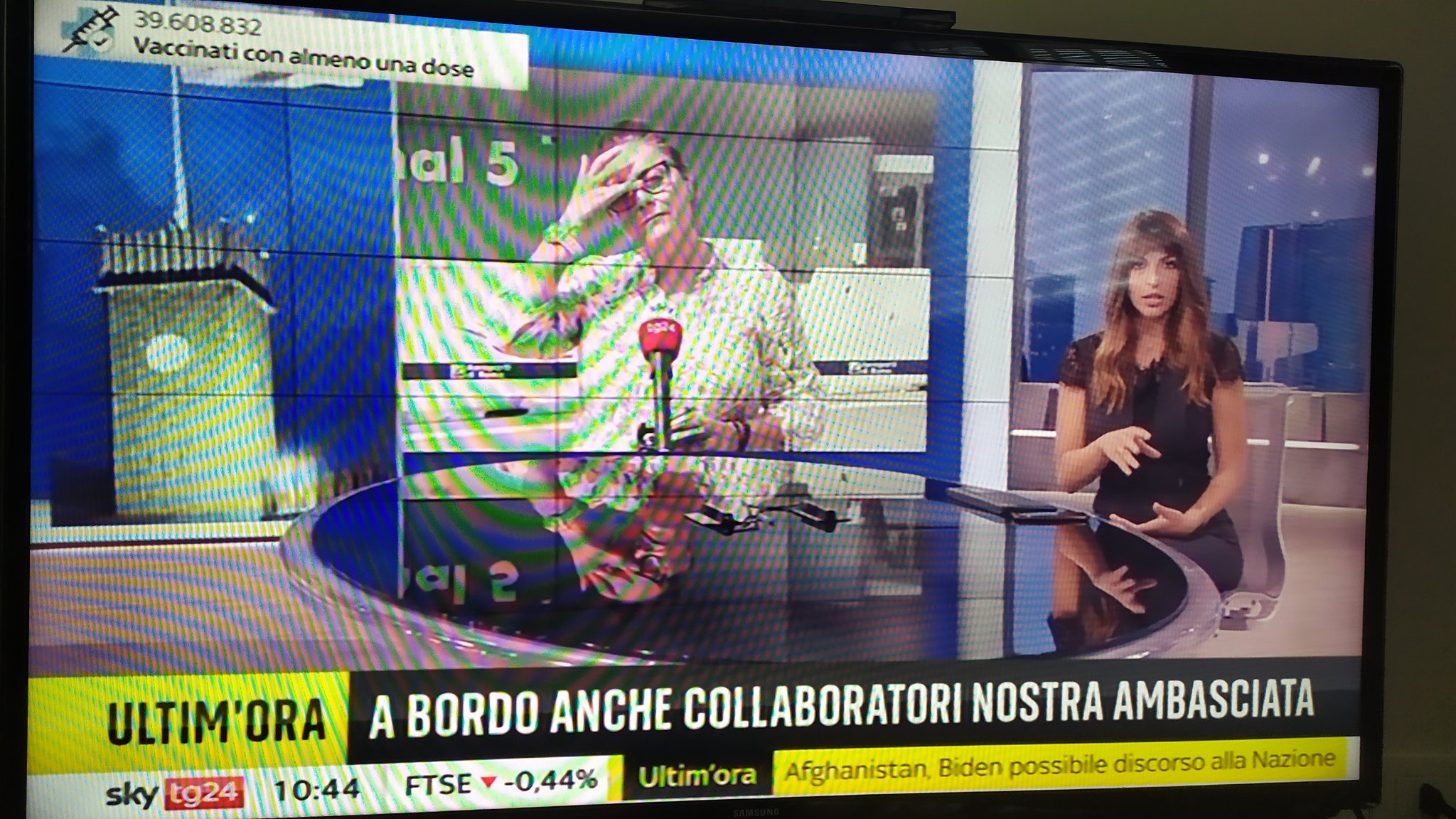
mi permetto di aggiungere anche @TG5 (https://t.co/v5mhzkGaAT) delle 08.00 ed anche nella versione PrimaPagina dalle 06.00 alle 07.50 (https://t.co/CAr27gVZ51) pic.twitter.com/7GfWurQAvK
— scinti (@nonsocosafaccio) August 16, 2021
Afghanistan, Kabul è nelle mani dei talebani. Dopo 20 anni torna Emirato islamico https://t.co/skqXNUAbNq pic.twitter.com/10rj1M77vL
— ItaliaOggi (@ItaliaOggi) August 16, 2021
Arrivano segnalazioni di pubblicazione o messa in onda da parte di TGLa7, TG2, SkyTG24, ItaliaOggi, Il Giornale, La Stampa, Corriere della Sera, TG5. Questo non è giornalismo, questo è dilettantismo puro. O è la furberia di chi non gliene frega niente del proprio dovere di informare il lettore. E non mi si venga a dire “eh, ma l’abbiamo tolta”. No: una porcheria simile non andava pubblicata in partenza. Non avrebbe dovuto superare i controlli redazionali e quelli di chiunque avesse due neuroni da sfregare l’uno contro l’altro.
Questo articolo vi arriva gratuitamente e senza pubblicità grazie alle donazioni dei lettori. Se vi è piaciuto, potete incoraggiarmi a scrivere ancora facendo una donazione anche voi, tramite Paypal (paypal.me/disinformatico) o altri metodi.
Fashionably Fitbit: New smartwatch designer accessories
Fitbit launched its first designer accessory collection in 2014, infusing high fashion into technology to help with the widespread adoption of wearables. Over the years, we’ve launched a variety of collections from designers like gorjana, Kim Shui, Pendleton, PH5, Public School, Tory Burch and Vera Wang, that give you different ways to stay active, personalize your device and show off your style at the same time.
Now, we’re pushing the boundaries between fashion and fitness even further. This fall we’re introducing two new stylish Designer Collections, plus more new Fitbit accessory choices, for Fitbit Sense and Versa 3 smartwatches.
Brother Vellies brings bold designs to Fitbit
Fitbit’s latest Designer Collection features styles from Brother Vellies, a luxury accessory brand built on the ideal of uplifting artisan communities and cultures through design. The Brother Vellies collection is brought to life through a longtime partnership with the Council of Fashion Designers of America (CFDA), which creates unique opportunities for Fitbit to partner with emerging designers who blend fashion with innovation.
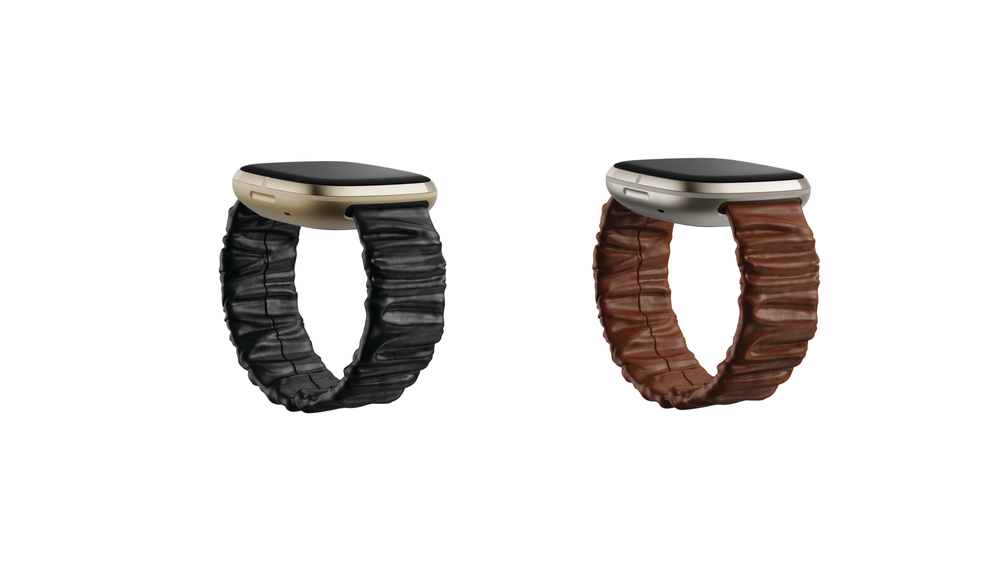
The collection takes a high-fashion twist on the iconic scrunchie, made with Horween leather. The lightweight leather bands are handcrafted with premium oils and dyes, and tanned through traditional techniques so they mold to your wrist and develop an aged patina finish over time.
The Brother Vellies for Fitbit Sense and Versa 3 collection is available in black and oak for $54.95 each, only on fitbit.com.
QuakeCon 2021: il programma completo dell’evento

Catturare un razzo orbitale a mezz’aria: i piani di SpaceX per Starship
È ormai chiaro che la Starship di SpaceX è innovativa, ma forse non è chiaro quanto sia innovativo anche tutto il contorno del progetto di questo razzo orbitale interamente riutilizzabile e del suo vettore Super Heavy, che si apprestano a fare il loro debutto, entro fine anno, con un volo quasi orbitale intorno alla Terra.
Ho descritto piano generale di questo volo in questo articolo, ma ora sono emerse conferme di altri dettagli decisamente originali del progetto Starship/Super Heavy che riguardano i suoi voli successivi. Per esempio, si prevede che una volta a regime, il booster gigante Super Heavy verrà catturato a mezz’aria dalla torre di lancio.
Sì, avete capito bene.
Dopo aver portato verso l’orbita terrestre la Starship, il vettore Super Heavy tornerà alla torre di lancio, alla quale si avvicinerà sorretta dal getto dei propri motori, e poi due enormi bracci scorrevoli lo cattureranno, reggendolo tramite due punti rinforzati di sostegno situati poco sotto le grid fin.
I bracci sposteranno poi il vettore per collocarlo sulla piattaforma di lancio e poi prenderanno la Starship, la solleveranno e la piazzeranno sopra il vettore. I due veicoli accoppiati verranno riforniti di propellente e preparati per la ripartenza.
Questa animazione amatoriale mostra schematicamente quello che dovrebbe accadere:
Mechazilla <1 Hour Turnaround.#SpaceX #Starship @elonmusk pic.twitter.com/0hUWHj1BKe
— Erc X (@ErcXspace) August 13, 2021
La dinamica generale dell’animazione è stata confermata personalmente da Elon Musk, precisando che il vettore e i bracci si muoveranno più rapidamente di quanto mostrato nell’animazione e che anche la Starship verrà catturata dai bracci della torre di lancio (denominata Mechazilla), permettendo di fare a meno delle complesse e pesanti zampe di atterraggio, sia sul vettore sia sulla Starship (“Pretty close. Booster & arms will move faster. QD arm will steady booster for ship mate.”; “And ship will be caught by Mechazilla too. As with booster, no landing legs. Those are only needed for moon & Mars until there is local infrastructure.”).
Questa è un’animazione approssimativa della cattura di una Starship di ritorno:
#StarshipCatching #SpaceX @elonmusk @ErcXspace
Animation of what catching starship via Mechazilla might look like! pic.twitter.com/QTihSdluFY— TijnM_3DAnimations (@m_tijn) August 13, 2021
“QD arm” indica il “quick disconnect arm”, il braccio a sgancio rapido simile a quelli utilizzati dalle rampe di lancio “classiche”, come quelle del Saturn V. Questo braccio viene usato normalmente per il rabbocco del propellente fino a pochi istanti prima del decollo e in questo caso verrà utilizzato anche per stabilizzare la Starship per l’accoppiamento con il vettore.
I piani di SpaceX, se funzioneranno, otterranno una semplificazione enorme: non solo i due veicoli non avranno la zavorra e le complessità delle zampe di atterraggio, con tutti i loro problemi di stabilizzazione e di ammortizzazione, ma verrà anche eliminato il problema delle onde d’urto e dello spostamento di detriti che si manifestano quando il veicolo è librato a pochi metri da terra e quindi l’energia sprigionata dai suoi motori viene in gran parte riflessa dal suolo verso il veicolo, causando violentissime sollecitazioni e risonanze che sono estremamente difficili da gestire.
Lo “sgabello” sul quale poggia il razzo per la partenza, inoltre, farà a meno delle enormi e costose trincee di deviazione delle fiamme che sono state costruite finora per i vettori giganti.
Notate inoltre la dichiarazione di Musk: le zampe serviranno per la Luna o per Marte solo fino a quando non “ci sarà infrastruttura locale”. Il che significa che SpaceX vorrebbe costruire torri di lancio giganti anche sulla Luna e su Marte. L’ambizione, insomma, non scarseggia.
Il tallone d’Achille di questo approccio, tuttavia, è che l’atterraggio avviene accanto alla torre di lancio, con il rischio di danneggiarla fortemente in caso di manovra imprecisa o incontrollata della Starship o del Super Heavy.
Decisamente SpaceX sta ripensando ogni aspetto del volo spaziale. Vedremo presto se la sua filosofia progettuale sarà valida.
Questo articolo vi arriva gratuitamente e senza pubblicità grazie alle donazioni dei lettori. Se vi è piaciuto, potete incoraggiarmi a scrivere ancora facendo una donazione anche voi, tramite Paypal (paypal.me/disinformatico) o altri metodi.

WhatsApp, attiva la migrazione delle chat da iOS a Android

TikTok, nuove misure protezione utenti 13-17 anni

Firefox 91: HTTPS di default in Private Browsing

Apple iMac 24 M1: tanta sostanza in un look sbarazzino
Why this engineer says you only need to be 80% ready
When she was a student at the University of Colorado, Bhavna Chhabra was invited to be a research assistant on a project — and it ended up changing her life. “I was supposed to go back to India and get married,” says Bhavna. “I wasn’t going to pursue computer science.” But the professor who asked her to participate in the project had shown her an article about Arati Prabhakar, who’d recently been appointed the head of NIST (National Institute of Standards and Technology).
“This completely changed my mindset. She was originally from Delhi, India, my hometown, and that spoke to me. I saw myself in her. Twenty-five years later, here I am.” (Fun fact: That professor? His name is Mike Schwartz, and he’s also a Googler.) Bhavna, who’s an engineering director, is always happy to share her story — and here are three important lessons she learned.
The most challenging times can lead to the best things.
In 2010, Bhavna was diagnosed with cancer. “I had no idea how I would fight this thing while continuing to show up as a mother,” she says. “I had two kids at the time, ages 6 and 8.” Bhavna tackled her frustration with the situation by giving herself the gift of trying new things. “My kids and I decided to learn to ski, climb and backpack,” she says. “We did it all!” Not only did Bhavna beat cancer, but she was promoted at the company where she worked at the time a year after her diagnosis — and her kids say it brought them closer as a family.
Share your passion.
In addition to mentoring women at Google who work all over the world, Bhavna also helps guide women in her community. “I use my megaphone in my public role as the overall manager of the Google Boulder office to reach out to women and girls at Colorado universities and high schools, participating in panels, speaking in small groups and classrooms and mentoring,” she says. Bhavna hopes that by sharing her non-traditional journey to Google, other women will consider pursuing STEM careers, too.
Don’t wait until you’re “ready.”
Something Bhavna’s learned is that there’s no such thing as the perfect time. “Just dive in when you think you are 80% ready,” she says. “And chances are, you’ll succeed.” Earlier in her career, Bhavna tried to plan things five or even 10 years in the future — but that rigid structure didn’t work. “Over time, I’ve learned to think about roles I want and be open to opportunities that arise that could help me get to that end goal.”