
Buon compleanno Xbox: il marchio quest’anno compie 20 anni

Amazon assolta: non dovrà pagare 250mln di tasse al Lussemburgo
Tesla non accetterà BitCoin: l’annuncio di Musk e le conseguenze

PlayStation 5, Sony aumenterà la produzione in estate
Investing in Black-led startups and investment firms
My venture capital job places me at the intersection of burgeoning technologies and funding new businesses. As general counsel of Alphabet’s CapitalG, I’m responsible for our fund’s legal work, and I work with the growth team to help our portfolio companies accelerate the growth of their businesses.
I’ve also had the privilege to lead an Alphabet-wide team focused on investing in Black-led VC funds, startups and organizations supporting Black entrepreneurs. As racial equity is inextricably linked to economic opportunity, last year, Google committed to making an investment to promote increased capital access and wealth generation in the Black community.
My team is responsible for allocating these funds among the many well-deserving potential recipients. This cross-Alphabet team, including people from Google, CapitalG and GV, met with numerous Black-led venture capital firms and Black entrepreneurs to identify recipients of the funds and better understand their needs.
Through this process, it was apparent that funding alone isn’t enough. So teams across Google and Alphabet have come together to provide the identified Black-led VC firms and their portfolio companies access to Alphabet’s people, network and technologies, as well.
Helping Black entrepreneurs get access to capital
To date, we have committed $60 million of capital to Black-led organizations and we’ll provide access to a suite of support for them and for their portfolio companies. Teams from across Alphabet will continue to work together to identify and invest in additional Black-led organizations, and Google will invest an additional $40 million in Black-led startups and investment firms by the end of the year.
We hope Google’s commitments prompt more investments from the industry and create a larger pool of capital to put dollars in the hands of Black founders. For example, since we announced the U.S. recipients of the $5 million Google for Startups Black Founders Fund in October, these founders have collectively raised over $25 million in capital from investors outside of Google.
Here are the organizations to which we have committed $60 million in capital to date:
Black-led venture capital firms:
-
Collab Capital:an Atlanta-based fund for Black founders seeking capital, who value profitability, ownership and optionality.
-
Concrete Rose:a Bay Area-based investment fund focused on using financial and social capital to build exceptional early-stage companies and close gaps for underrepresented talent.
-
Noemis Ventures:a New York-based fund focused on early-stage companies in the fintech, marketplace and AI sectors.
-
Plexo Capital: a Bay Area-based investment firm which makes direct investments in diverse startups.
-
Reign Ventures: a New York and Miami-based early-stage venture capital firm that focuses on investments in consumer tech and software companies founded by women and people of color.
-
Slauson & Company:a Los Angeles-based fund set up to invest in the next generation of entrepreneurs driving economic inclusion.
Black-led startups:
-
CityBlock Health: a New York-based startup focusing on providing care to Medicaid and dual-eligible patients.
-
Translation / UnitedMasters: a New York-based creative brand advertising agency focused on the intersection of brands with music, sports and popular culture.
Access to Alphabet’s people, network and technologies
Beyond funding, we’re providing these recipients with access to Alphabet training and advising sessions to help them grow their businesses. CapitalG uses a very similar approach to help hyper-growth stage companies overcome the biggest challenges as they get bigger. Along with leaders across Alphabet, Google for Startups, Cloud for Startups and Partnership Solutions, we have put together a suite of offerings that include Google Ads and Cloud support, weekly office hours and one-on-one advising with Alphabet leaders.
Other initiatives include Google-facilitated training programs focused on founder development, access to Google’s machine-learning training program taught by Google engineers and sales training. In addition to tactical support, each of these organizations is taking part in our speaker series and virtual social events to foster connections between fund managers, portfolio companies and the Alphabet family.
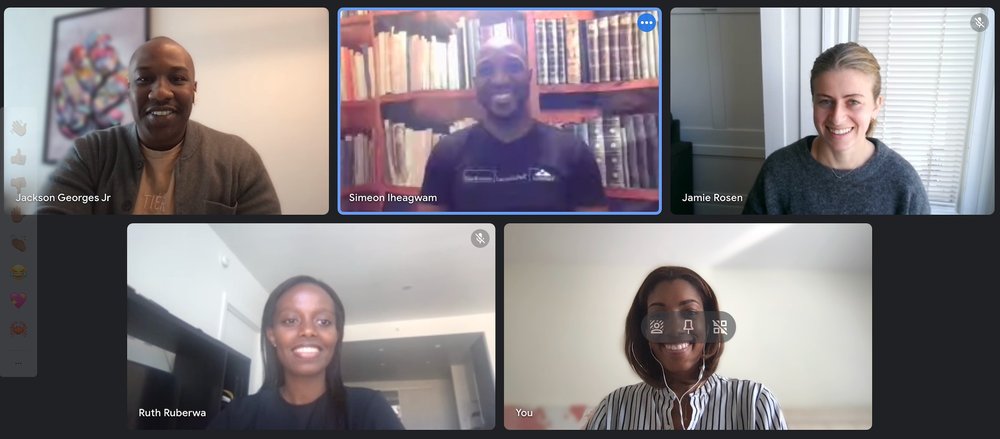
Jackson Georges Jr and Jamie Rosen from CapitalG, along with Ruth Ruberwa and Kristin Sills from Google, kick off our partnership with Simeon Iheagwam, Founder and Managing Partner of Noemis Ventures.
Together, we hope these new investments and access to Alphabet’s knowledge and network will help Black founders and Black-led VC firms grow their businesses and create sustained economic impact for their communities and the world at large.
More support for the COVID-19 crisis in Latin America
The COVID-19 pandemic has hit Latin America especially hard. Even as vaccines begin to slowly become available around the region, infection and death rates remain alarmingly high and several countries are grappling with a severe humanitarian crisis.
As the situation has taken a turn for the worse, we at Google have asked ourselves what more we can do as a company to help COVID-19 relief efforts throughout Latin America. Whether it’s ensuring that people get the reliable information they need to keep their families healthy and safe, or providing financial support for the hardest-hit communities, we know there is always more we can do.
Today we’re announcing that Google is providing $33 million in new funding for Latin America, including $3 million in grants from Google.org, our philanthropic arm. The first is a $1.5 million grant for UNICEF, to support the urgent needs in Argentina, Chile, Colombia, Mexico and Peru for more than 580,000 people through health, nutrition and water, hygiene and sanitation programs. The second is a $1 million grant for Amigos do Bem in Brazil to help get food supplies and clean drinking water to more than 8,500 families in need. In addition, we’re distributing $500,000 among other nonprofits across Latin America to get aid to communities in need.
Today’s announcement also includes increased Ad Grants support for public health information campaigns in Latin America. We’re making available an additional $30 million in Ad Grants to the Pan American Health Organization through the WHO, local health authorities and nonprofits to help spread accurate and useful information on vaccines and how to stay safe.
This support builds on over $6 million in Google.org grants for education, economic recovery and relief efforts across Latin America since the pandemic began, including a recent $1 million grant for Gerando Falcões in Brazil to provide families in need with food supplies. More than 1,000 Googlers have also contributed over $380,000 in donations and company match to support the Gerando Falcões initiative.
We know that one of the biggest ways we can help is through our core information products like Search, Maps and YouTube. Our COVID-19 information panels on Search and YouTube are available throughout Latin America in Spanish and Portuguese, providing reliable and timely content for our users. We also recently announced vaccination sites in Search and Maps in Brazil, Chile and Mexico, and we’re working to do the same in other countries in the region as well.
On YouTube, we’re taking steps to raise up authoritative information and reduce coronavirus misinformation, while also teaming up with creators and health experts to clarify facts and dispel myths about COVID-19. And throughout the pandemic Google for Education has provided online education solutions to some 37 million monthly active teachers and students in Latin America.
Google will continue to work with local governments, partners and communities to give everyone the tools they need to stay healthy and safe, and fight for a better tomorrow. We’re inspired by these organizations on the front lines, and are grateful for the opportunity to contribute to their efforts.

Resident Evil Village: pregi e difetti della versione PC
Google, sanzione da oltre 100 milioni dall’Antitrust

TikTok rimuove 500mila account italiani di minori di 13 anni

How The FA used tech to get the ball rolling
For millions of football fans across the U.K. and around the world, the return of live matches in the English Premier League was a long-awaited milestone in the recovery from the COVID-19 pandemic.
Enter Project Restart: the nickname given to the Premier League’s attempts to resume the season while ensuring the safety of players and fans. But with self-distancing as one of the key preventive measures against COVID-19, how could the safety of players be ensured when they’re interacting on the pitch? We at The Football Association (FA) were proud to have partnered with the Premier League to help in this aspect of the project.
A critical area addresses the challenge of ensuring players can interact at peak levels while observing the self-distancing norms still recommended by health authorities. To do this, we created a new analysis of thousands of hours of match play, and used machine learning technology to tell us about contact risk during a 90-minute football match.
We looked at all 380 games from the 2018/19 Premier League season, and the 288 pre-lockdown games from the 2019/20 Premier League season. Incredibly, this showed us over 40 billion interactions between players, captured in 100 million video frames which collectively made up 10 terabytes of data. Even the longtime players, coaches, and fans among us were staggered by how much goes on, even in one game.
Our system tracked players on the field at a rate of four-one hundreths of every second, ensuring we could analyse every interaction for concern about possible exposure. We employed the Exponential Model, developed by Danish public health academics, which at the time was considered the most accurate modelling of virus transmission during a football match.
The model focuses on the 1.5 metre radius around each player, paying strict attention to the two second rate of decay, or half life, that COVID particles typically have in infecting a person in certain environmental conditions. Staying on the safe side, we employed a simplified model, which considered a player that is within two metres of an infected player during the half-life of the virus to be 100% exposed.
As you may have guessed, all of this work involved gathering and analysing a tremendous amount of data from multiple sources, on some of the most advanced computing available. Working with Google Cloud, we used Google BigQuery to store the data and run a built-in machine learning model based on the simplified Model. BigQuery looked at an average of 145,000 rows of data per game analysed, examining every frame of tracking data for distance between all pairs of players on the pitch throughout an entire match. This fast and powerful toolset was critical to our success.
What we concluded was good news: During a 90-minute football match, players spent on average a total of 90 seconds within a two-metre proximity of each other. Include goalkeepers into the calculation, and the average time decreases to 70 seconds.
In other words: the risk factor of exposure to players was considered low, and we therefore determined that it was safe to keep the ball rolling. To be sure, players continue to be tested for symptoms of COVID infection before games, but this interaction data provides us with a critical level of reassurance.
It’s great news, but it also reminds us that vigilant awareness and rigorous analytic insight help ensure not just a successful return to play, but a broader sense of confidence about the future of Premier League Football. We’re building on a proud heritage of innovation, camaraderie and looking out for each other — the true heart of sport.
GomorraSQL: SQL in dialetto napoletano

Gowan-Isagro. Closing dell’operazione venerdì 14 maggio 2021
Gowan Company, LLC e Crop Demetra Limited Avveramento di tutte le condizioni sospensive al closing dell’acquisizione delle partecipazioni di maggioranza di Piemme Il closing dell’operazione avverrà il 14 maggio 2021Facendo seguito al comunicato stampa pubblicato in data 7 marzo 2021 da Isagro S.p.A. (“Isagro”) con cui è stato reso noto che, in data 6 marzo 2021, Giorgio Basile e altri soci, da una parte, e Gowan Company, LLC (“Gowan”), dall’altra, hanno stipulato un accordo…
L’articolo Gowan-Isagro. Closing dell’operazione venerdì 14 maggio 2021 scritto da Paolo Brambilla proviene da Assodigitale.

Ancora pochi, tra i giovani, quelli che investono
– – di Francesco Megna – Trendiest Media – – In Italia i giovani (25/35 anni) manifestano una forte predisposizione al risparmio, ma vorrebbero essere più agevolati dagli operatori finanziari attraverso strumenti come carte di credito e app dedicate all’investimento. La maggioranza privilegia pagamenti digitali e la metà risparmia almeno il 25% del proprio reddito. Ancora pochi, tra i giovani, quelli che investono. Solo il 20% impiega il risparmio attraverso strumenti finanziari e oltre il…
L’articolo Ancora pochi, tra i giovani, quelli che investono scritto da Paolo Brambilla proviene da Assodigitale.

Il nuovo realme 8 in offerta di lancio su Amazon