
Cloud Covered: What was new in June on Google Cloud
June was full of news about new products, technologies and information from Google Cloud to help people connect, build and explore. Here’s a recap of June’s most popular posts on the Google Cloud blog.
New subsea cable will connect the US and South America
Last month we announced that Google is building a new, open subsea cable that will run from the East Coast of the United States to points in South America that include Argentina, Brazil and Uruguay. Named after Maria Firmina dos Reis, Brazil’s first novelist, the resilient Firmina cable will be the longest of its kind in the world that can run entirely from a single power source at one end of the cable if its other power source(s) become temporarily unavailable. As one of 16 subsea cables Google has invested in around the world, Firmina will improve access for South American users to Google products likeSearch, Gmail and YouTube, as well as Google Cloud services.
A powerful family of virtual machines say hello
In June we also announced a new virtual machine (VM) family type coming to Google Cloud, our Tau VMs. VMs are just like an actual computer, complete with an entire operating system, that is run in a separate window on a host computer or a remote server in a data center. They make it easier and faster for developers to build and run software in the cloud. Tau VMs will offer enterprises market-leading performance improvements and cost savings for their software applications. Learn more about Tau VMs’ performance versus competitors and read testimonials from companies like Snap and Twitter who’ve already benefited from this new offering.
A new dataset lets you do more with top Google Search terms
Trends in the top Google Search terms can tell people and businesses a lot about what’s on consumers’ minds. To expand access to this data and make it easier for enterprises to analyze these trends, we announced preview availability of a new public dataset for Google Trends. This will bring Google-owned Search data into Google Cloud Datasets for convenient analysis through favorite business tools like BigQuery, Google Cloud’s multicloud data warehouse. The dataset will allow you to gauge interest in specific topics or search terms across Google Search, from around the United States, down to the city level. This new public dataset is just the beginning of our process to make Google’s first-party data more accessible to businesses and enhance their data analysis projects.
Google gets one step closer to 24/7 carbon-free data centers
One of last month’s top announcements focused on Google data centers and sustainability. In 2020, we announced an ambitious sustainability goal to operate everywhere on 24/7 carbon-free energy by 2030. Last month, in the spirit of transparency, we released our updated carbon-free energy percentages (CFE%) for all Google data centers in 2020, as well as overall progress on our 2030 goal. The blog post details how we achieved 67% 24/7 carbon-free energy across all our data centers, up from 61% in 2019. This means that of all the energy used by Google data centers last year, two-thirds of it was matched with local, carbon-free sources on an hourly basis. You can check out an animation that explores events that helped us achieve these numbers. Decarbonizing the world’s power grids quickly will help prevent the worst impacts of climate change. Google is committed to clearing a path for others and encouraging collective action to achieve this goal. Let’s move, together, toward a carbon-free future.

Blue Origin porta brevemente nello spazio i primi passeggeri
Poco fa il veicolo suborbitale New Shepard dell’azienda privata statunitense Blue Origin ha effettuato il suo primo volo spaziale con passeggeri. Il vettore riutilizzabile è partito da una base privata dell’azienda in Texas e ha trasportato alla quota di oltre 100 km, quindi a tutti gli effetti nello spazio, i suoi quattro passeggeri: Jeff Bezos (fondatore di Blue Origin e di Amazon e attualmente uomo più ricco del mondo), Mark Bezos (fratello di Jeff), Oliver Daemen (18 anni) e Wally Funk (82 anni).
Daemen è diventata la persona più giovane della storia ad andare nello spazio, grazie al biglietto pagato dalla famiglia: il record precedente spettava al russo Gherman Titov, che nel 1961 fece un volo spaziale (ma orbitale) all’età di 25 anni.
Wally Funk è diventata invece la persona più anziana a superare i 100 km di quota, battendo il primato detenuto da John Glenn, che nel 1998 fece un volo orbitale a bordo dello Shuttle all’età di 77 anni. Funk, pilota d’aereo professionista, è una delle Mercury Thirteen, le donne che negli anni Sessanta furono sottoposte, senza l’avallo ufficiale della NASA, agli stessi test fisici e attitudinali previsti per gli astronauti statunitensi e li superarono, dimostrandosi in alcuni casi candidate migliori degli uomini. Si offrirono come potenziali astronaute, ma la politica americana dell’epoca vietò loro di partecipare a missioni spaziali. I russi, invece, fecero volare nello spazio una donna, Valentina Tereshkova, già nel 1963.
Se volete saperne di più su Wally Funk, consiglio questo video:
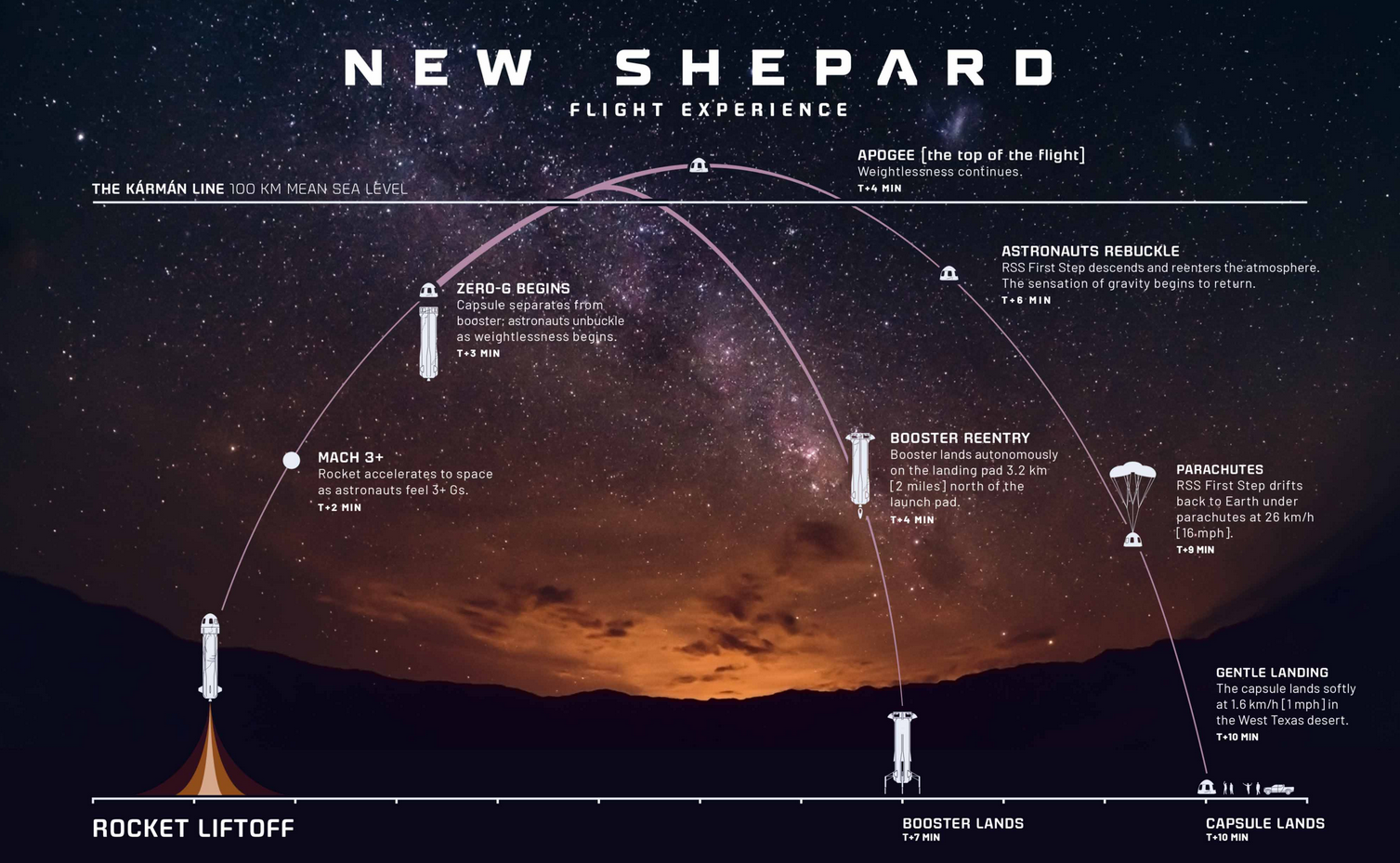
Va notato che questo volo commerciale è, appunto, suborbitale e quindi non ha raggiunto le altissime velocità necessarie per restare in orbita come nei voli spaziali normali (per esempio quelli degli astronauti professionisti che raggiungono la Stazione Spaziale Internazionale), ed è durato poco più di dieci minuti, di cui circa quattro trascorsi in assenza di peso. Ê arrivato a poco più di 100 km di quota e 3500 km/h, mentre la Stazione Spaziale Internazionale sta a 400 km e vola a 28.000 km/h. Inoltre gli occupanti della capsula (battezzata RSS First Step, dove RSS sta per Reusable Space Ship) sono stati puri passeggeri, privi di qualunque possibilità di pilotaggio, e tutto questo ha ridotto enormemente i requisiti fisici e di addestramento.
Non si tratta insomma di un volo particolarmente innovativo in termini tecnologici, dato che ricalca in piccolo i voli suborbitali già fatti negli anni Sessanta (per esempio da Alan Shepard), ma è una tappa significativa nella commercializzazione del volo spaziale.
I parametri ufficiali del volo sono i seguenti: la capsula con i passeggeri ha raggiunto la quota massima di 107 km sul livello medio del mare; il vettore è arrivato a 106 km; il volo è durato in tutto 10 minuti e 10 secondi; la velocità massima di salita è stata di 3.595 km/h.

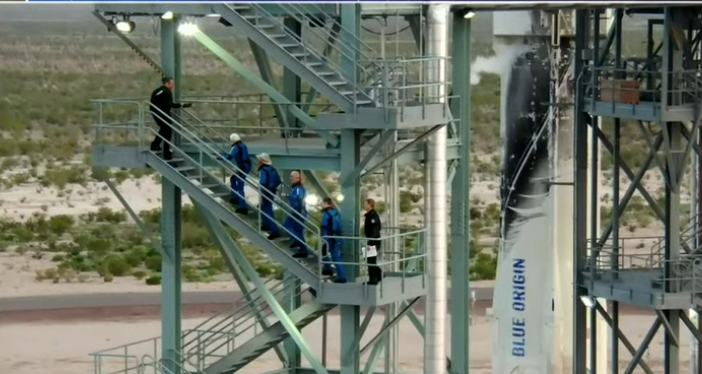



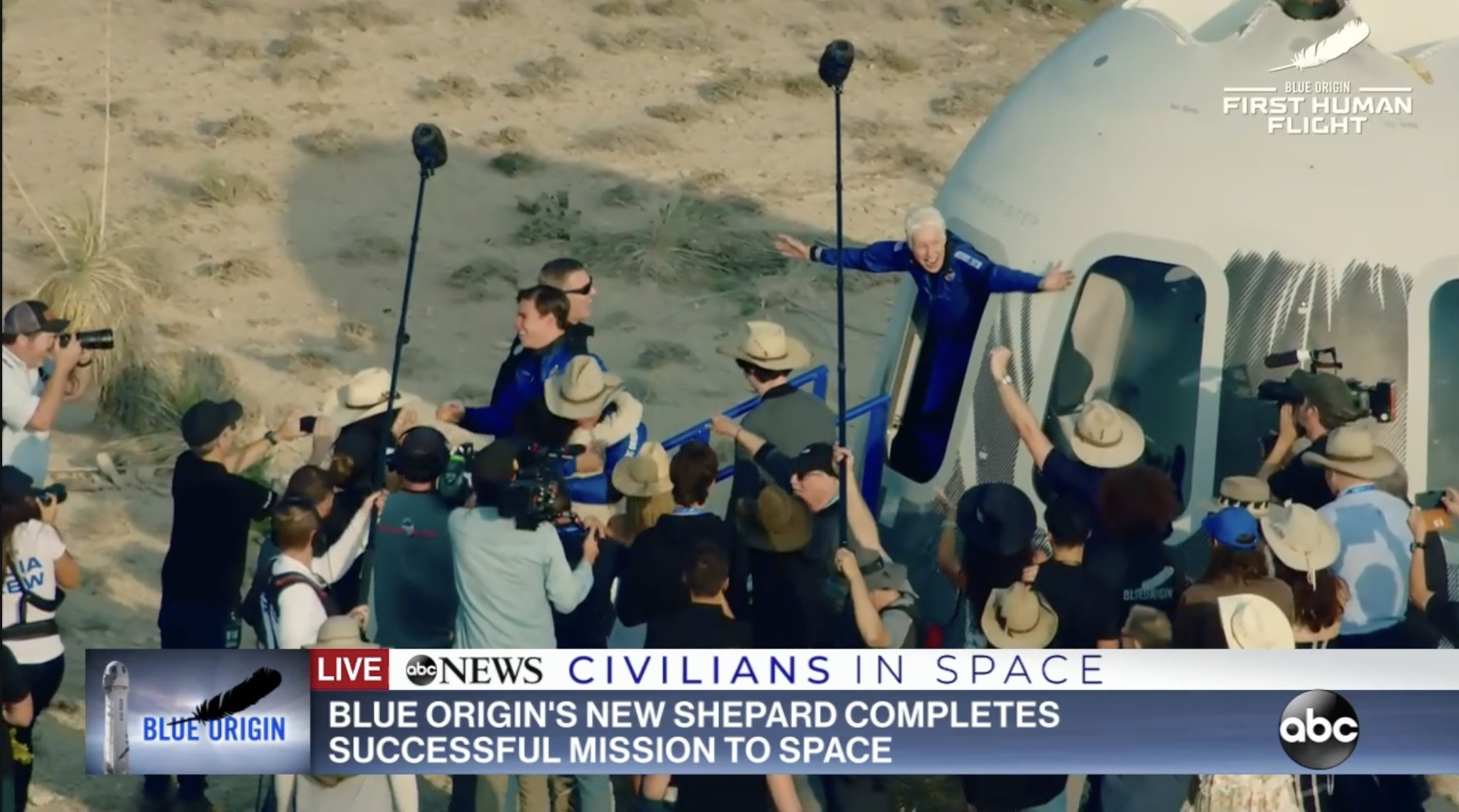
Questo volo è il primo ad avere quattro persone a bordo che vanno nello spazio per la prima volta.
Questo articolo vi arriva gratuitamente e senza pubblicità grazie alle donazioni dei lettori. Se vi è piaciuto, potete incoraggiarmi a scrivere ancora facendo una donazione anche voi, tramite Paypal (paypal.me/disinformatico) o altri metodi.
Write from the Heart for More Memorable B2B Content Marketing
B2B marketers have been pushing for personalized content for a good long while. Now we’re also trying to humanize content — to make the case that B2B buyers are human beings who want to connect with other humans on an emotional level.
Isn’t it remarkable that we still have to make that argument?
But I’m not here to write another 1000 words about humanizing content. I want us to take it a step further, beyond personalization, humanization, personality and empathy.
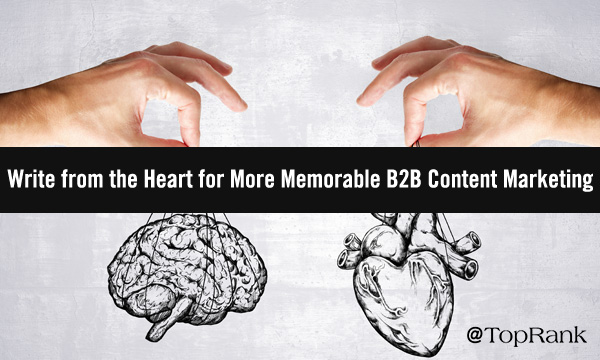
B2B content marketing needs to come from the heart.
True, genuine heart is the last frontier in content. Every brand has an Instagram with behind-the-scenes content to boost authenticity. Every brand is striving to give at least the appearance of sincerity, personality and transparency.
A lot of it is about as deep as the checkout clerk telling you to “have a nice day.” To stand out now, B2B content needs to hit on a more fundamental level.
Why Write from the Heart?
Even as we talk about “human to human” or “B2Me” marketing, we still tend to think that B2B content needs to be head-driven, mostly logic and reasoning, with a thin gloss of personality and emotion on top to “humanize.”
The truth is, of course, that humans are inherently emotional creatures who seek connection with each other. We most often decide with our hearts first, then apply logic in retrospect.
B2B content with heart seeks to make a connection first, then supply value, then finally ask for a next step. It has to be in that order.
So, what does it mean to write from the heart?
1. Upgrade Personality to Passion
I am not passionate about, say, a software-as-a-service platform that collects customer data for marketers. And I’m not sure I want to meet the person who is.
But I am passionate about less intrusive marketing, about people getting connected with solutions that meet their needs, and about a future where marketing is helpful and productive, not annoying. So I can lead with the passion, the why that drove us to create this solution, and then I can talk about the product’s capabilities.
2. Upgrade Empathy to Compassion
Let’s face it: The marketing term ‘empathy’ sometimes has little to do with what the word actually means. While we may strive for truly feeling someone else’s hopes and fears, it tends to be in the service of persuasion, rather than connection.
Compassion is more than just walking a mile in someone’s shoes. It’s sincerely desiring to help them — to ease suffering, bring joy, and help them be successful. Do you care if the people you’re marketing to get promoted, get to spend more time with their kids, can finally afford to buy a starter home, and so on?
If you can show that you have true compassion for your audience, beyond the solution you’re offering, you’re far more likely to make a connection.
3. Upgrade Authenticity to Vulnerability
Here’s a hard one. Very few brands want to seem vulnerable or fallible. Even with behind-the-scenes content, they tend to present a highly sanitized version of the business. If you admit a fault, or share an obstacle you had to struggle to overcome, will you lose people’s trust and confidence in your brand?
Absolutely not. You’re writing to people who experience hardships and make mistakes. You’ll make a better connection if you show that your brand is made up of fallible human beings, too.
There’s nothing more authentic and transparent than a warts-and-all look at the problems your company faces and the ways in which you try, fail and ultimately succeed.
4. Upgrade Thought Leadership to Humility
What’s the fastest way to make a connection with a stranger? Ask them to do you a favor. Ask for help. Most salespeople are familiar with this phenomenon, sometimes called the “Ben Franklin Effect.” The idea is that if someone does you a favor, they’re demonstrably more likely to do a second one, and to regard you more kindly than if you had done a favor for them.
I think the same is true with content marketing. Thought leadership content tends to lack the notion of humility — it usually focuses on establishing knowledge and authority, of the author as an inerrant source of truth.
The problem is, no one really likes a know-it-all. A hefty dose of humility can make thought leadership content much more engaging, and much more likely to start a conversation.
Imagine a blog post that goes, “I’ve seen success in my business with x, y, and z. But I’m still not sure how to best go about a, b, and c. What are your experiences? What do you do in this situation?”
The thought leader in this case is adding value by sharing their own experience and success, but also allowing others to share their expertise as well. The result can be a conversation that benefits everyone involved – author, audience, and brand.
Your Heart Will Go On
As Maya Angelou famously said, people may forget what you say, but they will never forget the way you made them feel. And the best way to engage someone’s emotions is to share your own. We can’t settle for the shallow marketing equivalents of passion, compassion, vulnerability, and humility.
We need to embrace the difficult but rewarding task of bringing our whole hearts to what we’re creating.
How do you create content with heart? Let me know in the comments.
And take our B2B Influencer Marketing Survey to share your opinions.
The post Write from the Heart for More Memorable B2B Content Marketing appeared first on B2B Marketing Blog – TopRank®.
Jeff Bezos oggi nello spazio. Come seguire il lancio in diretta

Ubisoft annuncia Tom Clancy’s XDefiant con un trailer

WhatsApp consente di partecipare alle chiamate di gruppo in corso

Exchange, intelligence conferma: l’attacco proveniva dalla Cina
Give it up for the woman who helps Googlers give back
Over the past month, Googlers around the world have virtually volunteered in their communities — from mentoring students to reviewing resumes for job seekers. It’s all a part of GoogleServe, our month-long campaign that encourages Googlers to lend their time and expertise to others. GoogleServe is just one of many opportunities employees have to give back, and one of the projects that Megan Colla Wheeler is responsible for running.
As the lead for Google.org’s global employee giving and volunteering campaigns, Megan’s role is to create and run programs like GoogleServe and connect the nearly 150,000 Googlers around the world to them. Ultimately, her job is to help Googlers dedicate their time, money or expertise to their communities. How’s that for paying it forward?
With more than ten years of experience at Google, we wanted to hear more about how she ended up in this job, her advice to others and all the ways volunteering at Google has changed — particularly this past year.
How do you explain your job to friends?
My goal is to create meaningful ways for Googlers to contribute to their communities — by offering their time, expertise or money — and help connect them to those opportunities.
When did you realize you were interested in philanthropy and volunteering?
I was a Kinesiology major in college. Toward the end of my sophomore year, I took a course on social justice and it struck a chord in me. Though I loved sports, I realized I wanted my career to be about something bigger, something meaningful. I wanted to lend my skills for good. So even though I graduated with a kinesiology major, I focused my job search on the nonprofit sector and got a job working for a nonprofit legal organization.
How did you go from there to leading volunteer programs for Google.org?
I never knew that the job I have now was even possible. I left my nonprofit job to become a recruiting coordinator at Google. My plan was to do it for a year, diversify my skills, then go back to the nonprofit world.
I remember going to my first GoogleServe event. We helped paint and organize a senior citizen community center — all during the workday! It blew me away that Google placed such an importance on volunteering. Coming from the nonprofit world, it felt meaningful seeing a company that cares deeply about these things and encourages employees to get involved. So I stayed at Google and kept finding ways to work on these programs.
Fast forward 10 years and you’re one of the masterminds behind these events. How has employee volunteering and giving at Google changed over the years?
So many of the things that Google has created, like Gmail, came out of grassroots ideas that then grew as the company did. The same is true of our work to help Googlers get involved in their communities.
Take GoogleServe for example. In 2008, a Googler came up with the idea to create a company day of service. Over a decade later that campaign has gone from a day-long event to a month of service that encourages over 25,000 employees to volunteer in over 90 offices around the world. And it all started with one Googler saying, “This would be a cool idea.” Along the way, more Googlers have come up with ideas to get involved in the communities where we live and work through giving and volunteering. Although the programs have grown and evolved over the years, we’ve maintained the sentiment that inspired those campaigns in the first place.
We’ve also been focused on connecting Googlers to opportunities that use their distinct skills, like coding or data analysis. For example, a team of Googlers – including software engineers, program managers, and UX designers – are currently working with the City of Detroit to help build a mobile-friendly search tool to help people find affordable housing.
How has it changed in the past year?
At the core, these programs are about giving back, but they’re also culturally iconic moments at Google. They’re a chance for teams to connect and do something together that’s more than just your average team-building activity. You’re building a shared experience and meeting people from completely different roles and departments. They’re also a chance for teams to learn and grow from people outside of Google and to bring that perspective back to their job.
Over the past year, people have felt generally disconnected. So even though our volunteering has become virtual, it’s still a chance to interact and contribute. Virtual or not, it really does create a positive work culture.
What advice would you give to people who have a day job in one area and a passion in another?
Be willing to work hard and get your core job done and carve out time to keep doing what you’re passionate about. When you are working on projects that you love, it keeps you engaged in a really special way. And you never know when those passion projects will intersect with your core work, or when they’ll turn into something bigger.
Explore the undeciphered writing of the Incas
Issac Newton once said, “If I have seen further it is by standing on the shoulders of giants.” By adopting this age-old phrase, he acknowledged that all “new” discoveries depend on all that preceded them.
At Google, we firmly believe that history has much to teach us. For me personally, as a Latin American, I have no doubt that the native peoples who inhabited our beautiful, diverse and inspiring region left us countless treasures — many of which still patiently wait to be discovered.
The MALI Collection on Google Arts & Culture
That is why I am so pleased and proud to present the new online exhibition The Khipu Keepers on Google Arts & Culture.
“Khipus,” which means “knots” in the Quechua language, are the colorful, intricate cords made by the Incas, who inhabited some parts of South America before the Spanish colonization of the Americas. These knotted strings are still an enigma waiting to be unraveled. What secrets are hidden in these colorful knots dating back centuries? What messages from the Incas echo in these intricate cords? Could the ancestral knowledge they hold inform us about our future?
Currently, there are about 1,400 surviving khipus in private collections and museums around the world. While approximately 85% of these contain knots representing numbers, the remaining 15% are believed to be an ancient form of writing without written words on paper or stone. Researchers are still working to decipher the meanings of these coded messages.
With the exhibition launching online today, the Lima Art Museum (MALI) and Google Arts & Culture are opening a window into one of the greatest mysteries the Inca people left behind.
By putting the centuries-old khipus on display online for the first time, this exhibition will let people from across the world engage with the fantastic legacy of the Inca civilization. Yet even more importantly, by creating a digital record of these enigmatic treasures that still have stories to tell, we are also preserving them forever. In this sense, The Khipu Keepers is also a first step of a promising journey for researchers to find new opportunities thanks to the power of technologies such as digitization.
Track down the history of khipus to Latin America’s first empire in the words of anthropologist Dr. Sabine Hyland, and listen to St. Andrews researcher Manny Medrano as he answers the most pressing questions about what we know of khipus. Watch an intro to the basic components of a khipu and what experts have discovered so far, or explore the Attendance Board that provides a rare connection between words and cords. Zoom into a large double khipu and learn about what it takes to conserve the khipus from the Temple Radicati collection.
Seven interesting facts about the enigmatic khipus
- The Quechua word “khipu” means knot.
- The pre-Columbian khipus were made of camelid hair or cotton fiber.
- The Incas used three types of knots: single, long and figure-eight.
- The colors of the khipu cords have different meanings.
- The distance between the knots also has a meaning and conveys a message.
- A cord without knots represents the number zero.
- Of all the known khipus, 85% convey numerical values and the remaining 15% are believed to tell stories.
From Latin America to the world
For the “The Khipu Keepers,” researchers are once again the ones entrusted with “untangling” this chapter of our past and providing us with answers. They now know that they are not alone in this endeavor and that Google technologies can help them delve deeper into elements of history.

Fake news: WhatsApp blocca due milioni di account in India

G20: Tavola Rotonda Italia-Canada sull’attuazione delle strategie sull’idrogeno
L’Ambasciata del Canada in Italia, in collaborazione con la Camera di Commercio Internazionale (ICC) – Comitato Italiano, il Centro Studi Italia-Canada (CSIC) e lo Studio Legale Nctm, ospita una tavola…
L’articolo G20: Tavola Rotonda Italia-Canada sull’attuazione delle strategie sull’idrogeno scritto da MercurPress proviene da Assodigitale.

Cybersecurity: Mediatech per Milano Serravalle – Milano Tangenziali
Il Gruppo Relatech con Mediatech si aggiudica la gara in ambito cybersecurity indetta da Milano Serravalle – Milano Tangenziali spa Relatech S.p.A., Digital Enabler Solution knowledge (D.E.S.K.) e PMI innovativa…
L’articolo Cybersecurity: Mediatech per Milano Serravalle – Milano Tangenziali scritto da Paolo Brambilla proviene da Assodigitale.

ASUS ROG Zephyrus M16 è il notebook gaming dallo schermo molto particolare
Share Your Expertise in the 2021 State of B2B Influencer Marketing Survey
The past year or more has taught B2B marketer many lessons, especially the importance of creating digital first experiences that are credible, authentic and relevant to specific buyers. As part of the digital transformation of marketing, many B2B companies have adjusted their go-to-market approach to satisfy the changing customer expectations that have evolved during the pandemic.
One of those adjustments in B2B marketing has been the increasing role of influence in delivering credible, authentic and relevant digital experiences. Our initial B2B Influencer Marketing research from 2020 showed that going into the pandemic, confidence in working with B2B influencers was very high as were expectations of outcomes.
Despite the growing confidence in working with B2B influencers over the past year, today there are important questions to be answered as more B2B brands enter the realm of influence and grow more sophisticated with the practice.
Much of B2B influencer marketing has emphasized working with industry experts external to the organization, but what about growing influence from within? How does influencer marketing work across departments? How do employee advocacy, growing executive influence and working with industry influencers intersect to deliver better customer experiences and marketing performance?
At TopRank Marketing we are proud to work on influencer content marketing and executive social programs for some of the biggest B2B brands in the world. We also know that our blog community represent a wealth and depth of B2B marketing experience. We invite you to share that expertise in our 2021 State of B2B Influencer Marketing Survey.
Your insights will help elevate the practice of B2B Influencer Marketing and help the industry see what’s working, what’s not and where the future of influence is in 2021 and beyond.
For the 2021 report, we’ll be collecting data on all aspects of influencer marketing for B2B brands as well as insights from practitioners like you.
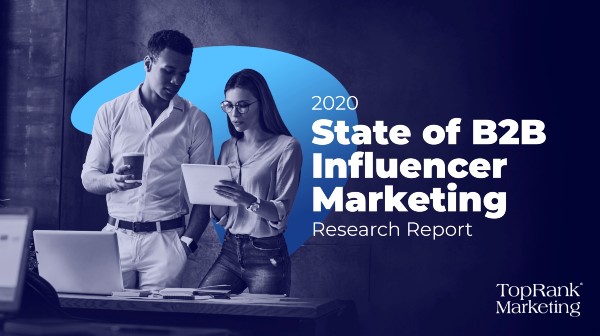
In the 45 page 2020 report we featured key findings and statistics about strategy, tactics, budgets and measurement as well as B2B influencer marketing case studies from SAP, LinkedIn, Cherwell Software and Monday.com. We also highlighted influencer marketing insights from B2B executives at Adobe, AT&T Business, IBM, MarketingProfs, Salesforce, SAP, Traackr, Treasure Data and more.
For the 2021 report, we’ll be sharing insights on growing marketing momentum with influence, the next level of Always-On influence, new best practices, budgets, technology and measurement plus all new case studies and insights from B2B marketing professionals. We’ve also been working on a fresh list of the most influential voices in the B2B world on the topic of influence in marketing and their predictions for the future.
If you have worked with influencers in the past year, then you’ll have valuable insights to share. You can also enter our giveaway of five $100 Amazon gift cards and early access to the findings of the report.
The survey takes just a few minutes and that investment in time will go a long way towards helping answer some of the key questions about working with internal and external influencers.
Optimizing marketing experiences with influence represents one of the most important digital growth strategies in 2021 and beyond. Take the 2021 survey today and join us in helping B2B marketers at all levels of influencer marketing experience level up their strategy, best practices and operations to build momentum in 2021 and beyond.
The post Share Your Expertise in the 2021 State of B2B Influencer Marketing Survey appeared first on B2B Marketing Blog – TopRank®.