A decade in deep learning, and what’s next
Twenty years ago, Google started using machine learning, and 10 years ago, it helped spur rapid progress in AI using deep learning. Jeff Dean and Marian Croak of Google Research take a look at how we’ve innovated on these techniques and applied them in helpful ways, and look ahead to a responsible and inclusive path forward.
Jeff Dean
From research demos to AI that really works
I was first introduced to neural networks — computer systems that roughly imitate how biological brains accomplish tasks — as an undergrad in 1990. I did my senior thesis on using parallel computation to train neural networks. In those early days, I thought if we could 32X more compute power (using 32 processors at the time!), we could get neural networks to do impressive things. I was way off. It turns out we would need about 1 million times as much computational power before neural networks could scale to real-world problems.
A decade later, as an early employee at Google, I became reacquainted with machine learning when the company was still just a startup. In 2001 we used a simpler version of machine learning, statistical ML, to detect spam and suggest better spellings for people’s web searches. But it would be another decade before we had enough computing power to revive a more computationally-intensive machine learning approach called deep learning. Deep learning uses neural networks with multiple layers (thus the “deep”), so it can learn not just simple statistical patterns, but can learn subtler patterns of patterns — such as what’s in an image or what word was spoken in some audio. One of our first publications in 2012 was on a system that could find patterns among millions of frames from YouTube videos. That meant, of course, that it learned to recognize cats.
To get to the helpful features you use every day — searchable photo albums, suggestions on email replies, language translation, flood alerts, and so on — we needed to make years of breakthroughs on top of breakthroughs, tapping into the best of Google Research in collaboration with the broader research community. Let me give you just a couple examples of how we’ve done this.
A big moment for image recognition
In 2012, a paper wowed the research world for making a huge jump in accuracy on image recognition using deep neural networks, leading to a series of rapid advances by researchers outside and within Google. Further advances led to applications like Google Photos in 2015, letting you search photos by what’s in them. We then developed other deep learning models to help you find addresses in Google Maps, make sense of videos on YouTube, and explore the world around you using Google Lens. Beyond our products, we applied these approaches to health-related problems, such as detecting diabetic retinopathy in 2016, and then cancerous cells in 2017, and breast cancer in 2020. Better understanding of aerial imagery through deep learning let us launch flood forecasting in 2018, now expanded to cover more than 360 million people in 2021. It’s been encouraging to see how helpful these advances in image recognition have been.
Similarly, we’ve used deep learning to accelerate language understanding. With sequence-to-sequence learning in 2014, we began looking at how to understand strings of text using deep learning. This led to neural machine translation in Google Translate in 2016, which was a massive leap in quality, particularly for less prevalent languages. We developed neural language models further for Smart Reply in Gmail in 2017, which made it easier and faster for you to knock through your email, especially on mobile. That same year, Google invented Transformers, leading to BERT in 2018, then T5, and in 2021 MUM, which lets you ask Google much more nuanced questions. And with “sparse” models like GShard, we can dramatically improve on tasks like translation while using less energy.
We’ve driven a similar arc in understanding speech. In 2012, Google used deep neural networks to make major improvements to speech recognition on Android. We kept advancing the state of the art with higher-quality, faster, more efficient speech recognition systems. By 2019, we were able to put the entire neural network on-device so you could get accurate speech recognition even without a connection. And in 2021, we launched Live Translate on the Pixel 6 phone, letting you speak and be translated in 48 languages — all on-device, while you’re traveling with no Internet.
More invention ahead
As our research goes forward, we’re balancing more immediately applied research with more exploratory fundamental research. So we’re looking at how, for example, AI can aid scientific discovery, with a project like mapping the brain of a fly, which could one day help better understand and treat mental illness in people. We’re also pursuing quantum computing, which will likely take a decade or longer to reach wide-scale applications. This is why we publish nearly1000 papers a year, including around 200 related to responsible AI, and we’ve given over 6500 grants to external researchers over the past decade and a half.
Looking ahead from 2021 to 2031, I’m excited about the next-generation AI systems we can build, and how much more helpful they’ll be. We’re planting the seeds today with new architectures like Pathways, with more to come.
Marian Croak
Minding the gap(s)
As we develop these lines of research and turn them into useful technologies, we’re mindful of the broader societal impact of AI, and especially that technology has not always had an equitable impact. This is personal for me — I care deeply about ensuring that people from all different backgrounds and circumstances have a good experience.
So we’re increasing the depth and rigor of how we review and evaluate our research to ensure we’re developing it responsibly. We’re also scaling up what we learn by inventing new tools to understand and calibrate critical AI systems across Google’s products. We’re growing our organization to 200 experts in Responsible AI and Human Centered Technology, and working with hundreds of partners in product, privacy, security, and other teams across Google.
As one example of our work on responsible AI, Google Research began exploring the nascent field of ML fairness in 2016. The teams realized that on top of publishing papers, they could have a greater impact by teaching ML practitioners how to build with fairness in mind, as with the course we launched in 2018. We also started building interactive tools that coders and researchers could use, from the What-If Tool in 2018 to the 2019 launch of our Fairness Indicators tool, all the way to Know Your Data in 2021. All of these are concrete ways that AI developers can test their datasets and models to see what kind of biases and gaps there are, and start to work on mitigations to prevent unfair outcomes.
A principled approach
In fact, fairness is one of the key tenets of our AI Principles. We developed these principles in 2017 and published them in 2018, announcing not only the Principles themselves but a set of responsible AI practices with practical organizational and technical advice from what we’ve learned along the way. I was proud to be involved in the AI Principles review process from early on — I’ve seen firsthand how rigorous the teams at Google are on evaluating the technology we’re developing and deciding how best to deploy it in the real world.
Indeed, there are paths we’ve chosen not to go down — the AI Principles describe a number of areas we avoid. In line with our principles, we’ve taken a very cautious approach on face recognition. We recognize how fraught this area is not only in terms of privacy and surveillance concerns, but also its potential for unfair bias and impacts on historically marginalized groups. I’m glad that we’re taking this so thoughtfully and carefully.
We’re also developing technologies that help engineers apply the AI Principles directly — for example, incorporating privacy design principles. We invented Federated Learning in 2017 as a way to train ML models without your personal data leaving your phone. In 2018 we showed how well this works on Gboard, the free keyboard you can download for your phone — it learns to provide you more useful suggestions, while keeping what you type private on your device.
If you’re curious, you can learn more about all these veins of research, product impact, processes, and external engagement in our 2021 AI Principles Progress Update.
AI by everyone, for everyone
As we look to the decade ahead, it’s incredibly important that AI be built in a way that works well for everyone. That means building as inclusive a team as we can ourselves at Google. It also means ensuring the field as a whole increasingly represents the people whose lives it aims to improve.
I’m proud to lead the Black Leadership Advisory Group (BLAG) at Google. We helped craft and drive programs included in Google’s recent update on racial equity work. For example, we paired up new director-level hires with BLAG members, and the feedback has been really positive, with 80% of respondents saying they’d recommend the program. We’re looking at extending this to other groups, including for Lantinx+ and Asian+ Googlers. We’re holding ourselves accountable as leaders too — we now evaluate all VPs and above at Google on progress on diversity, equity, and inclusion. This is crucial if we’re going to have a more representative set of researchers and engineers building future technologies.
For the broader research and computer science communities, we’re providing a wide variety of grants, programs, and collaborations that we hope will welcome a more representative range of researchers. Our Research Scholar Program, begun in 2021, gave grants to more than 50 universities in 15+ countries — and 43% of the principal investigators identify as part of a group that’s been historically marginalized in tech. Similarly, our exploreCSR and CS Research Mentorship programs support thousands of undergrads from marginalized groups. And we’re partnering with groups like the National Science Foundation on their new Institute for Human-AI Collaborations.
We’re doing everything we can to make AI work well for all people. We’ll not only help ensure products across Google are using the latest practices in responsible AI — we’ll also encourage new products and features that serve those who’ve historically missed out on helpful new technologies. One example is Project Relate, which uses machine learning to help people with speech impairments communicate and use technology more easily. Another is Real Tone, which helps our imaging products like our Pixel phone camera and Google Photos more accurately and beautifully represent a diverse range of skin tones. These are just the start.
We’re excited for what’s ahead in AI, for everyone.
Find food and give back with Google
In Google’s early days, around this time every year, a group of us would run to Costco and buy supplies to take to Bay Area food banks and pantries. It was a grassroots effort that was scrappy and meaningful — and it introduced a lot of Googlers to how rewarding giving back can be. It made me want to learn what more we could do to have an even bigger impact.
Inspired by our small and mighty food donation operation, I became a passionate supporter of Second Harvest Food Bank in Silicon Valley. And with guidance from food assistance experts, we established a dedicated team at Google in 2020 to work on tackling issues of food waste and food insecurity. Too many families are having to make difficult decisions no one should be forced to make: paying rent, bills, healthcare costs — or keeping food on their table. These challenges have only been compounded by the COVID-19 crisis, which has left more than 54 million working Americans struggling to find a meal. That’s nearly 16% of the country.
Google co-founder Larry Page once said “people are starving in the world not because we don’t have enough food. It’s because we’re not yet organized to solve that problem.” The United Nations Food and Agriculture Organization (UNFAO) reports that the world produces more than we need to feed every person on this planet. This isn’t a problem of supply, it’s a problem of distribution. And while solving this issue will require work from government, businesses, nonprofits and individuals working together, one way Google can help is to give people easy access to the information they need, when they need it.
Helping people find food pantries
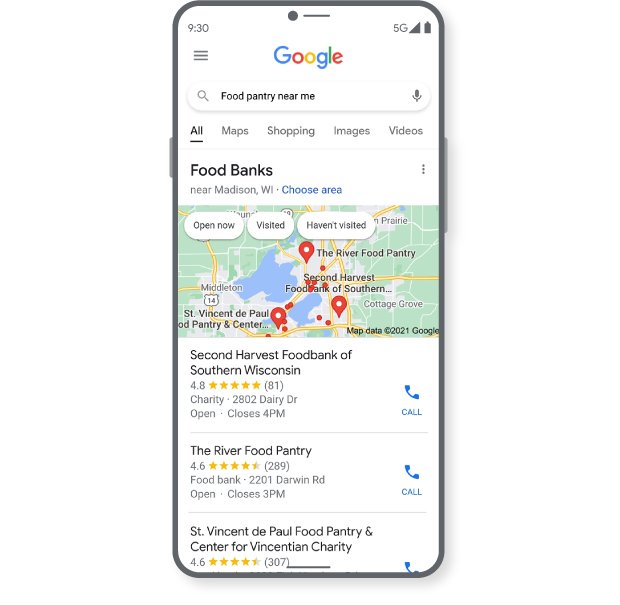
When you look at Google Search trends, you can see that searches for “food bank” and “food pantry” spike during the month of November.
Food banks have always been critical to making sure people have regular access to nutritious food, but the ongoing pandemic has drastically increased their role as a crucial lifeline in so many communities. With the need for their services doubling or even tripling in some areas, we want to make sure that the people who need them most can find them.
That’s why we’ve launched a new initiative to expand the information about food banks and pantries in Google Search and Maps. We’ve augmented existing coverage with data from two initial nonprofit partners: WhyHunger and Hunger Free America, and we’ve added information to make sure people searching for food support can find what they need. These changes are being made directly in Google Maps so food banks, food pantries and soup kitchens can focus on what matters most — getting people food.
Still, some of these locations don’t yet have websites or phone numbers available on Google. So over the last two months, we’ve worked to update this information in Search and Maps, making 85,000 plus calls to verify local food banks and pantries. These efforts will continue through the holidays.
We’ve also developed new Google Business Profile features specifically for food banks, pantries and soup kitchens. They can now provide details on their profile, like whether an appointment is needed, if there are eligibility requirements to receive food and what languages are spoken. They can also add information about their services, like whether prepared meals are available or if grocery delivery is an option. Additionally, pantries can specify whether they’re accepting new volunteers or soliciting food or monetary donations.
Helping people access benefits
Beyond working with food pantries, we’re also helping people use Search to find out how to get and use food assistance benefits.
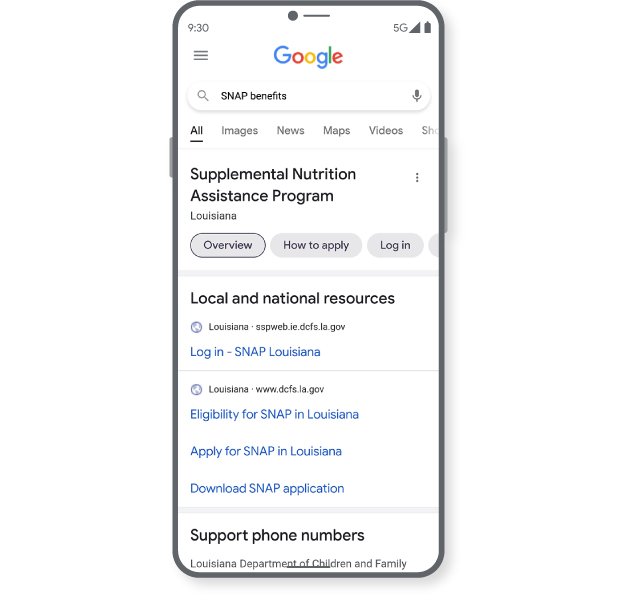
Federal programs like the Supplemental Nutrition and Assistance Program (SNAP) feed more than 40 million Americans each year. We heard from users that information about these programs is often hard to find, especially for people who are using them for the first time. Today, if you search on Google for “SNAP benefits,” or the name of your local SNAP program, you’ll find direct links to each state’s eligibility guidelines and application process, including contact information for local food assistance agencies.
Once approved, many people use Electronic Benefits Transfer cards (also known as EBT) to pay for their groceries. Now, if you search for “grocery stores that accept EBT” you can easily find USDA-approved stores that accept this form of payment — saving time and potential confusion.
Supporting hunger relief organizations – and the communities they serve
I’m also proud to announce that we’re contributing financial support as well. Since the COVID-19 crisis began, Googlers have stepped up – giving more than $22 million in personal donations and company-match to hunger relief organizations in the U.S. Today, Google is contributing an additional $2 million in support ($1 million in cash funding and $1 million in donated ads from Google.org) to 20 food banks, pantries and innovative hunger relief organizations across the country.
There is no easy solution to these large-scale challenges that face our communities, but I’m hopeful that increasing access to information about local food support programs and services can help. Our teams are hard at work and committed to building new tools and features that support economic recovery in the U.S. – and around the world – as we weather the COVID-19 crisis. And I personally am really looking forward to getting back to sorting and distributing food with my family at our local food bank.
You can make an impact by volunteering your time, making a donation, using your voice, or a combination of each — there are a number of ways we can all give back. If you need a place to start, you can donate to the largest national network of food banks, Feeding America. Or you can get involved locally: just search for your nearest food pantry on Google and contact them to see what they need. And if you know someone who might need food assistance, you can simply help by sharing resources. Spreading the word not only about what you’re doing to help, but why can make a huge difference.
Helping nonprofits fundraise this season of giving
In 2020, people in the U.S. donated an estimated $2.5 billion on Giving Tuesday alone. To help connect nonprofits with people who are searching for ways to give their time and resources, Google.org will donate $25 million in ads to nonprofits around the world.
These grants are incremental to the baseline $10,000 per month Ad Grant offering and will go to nonprofits focused on humanitarian response, food insecurity and economic recovery. For example, organizations like Direct Relief may use the incremental Ad Grants to attract more donors who are searching on Google for ways to help vulnerable populations, while SCORE may use the grants to connect people looking for ways to volunteer on Google with an opportunity to sign up to be a small business mentor.
Google.org awards over $1 billion in Ad Grants annually to qualifying nonprofits. Last Giving Season, many organizations that received incremental Ad Grants, like Houston Food Bank, more than doubled the donations they raised as compared to similar organizations receiving the baseline Ad Grant. After receiving incremental Ad Grants in 2020, Houston Food Bank saw a fourfold increase in total donations from their campaigns — raising $130,000 in donations in a single month.
“We’ve had to work with quickness and efficiency to reach out to those who need us most,” said Jessica Dominguez, Annual Giving Manager at Houston Food Bank.“The easiest way for people to donate and find their closest food location is to turn to the web. The Ad Grant gave us the opportunity to reach these people and provide them with the right information.”
In addition to these incremental grants, all eligible organizations may sign up to receive $10,000 per month in Ad Grants and apply for pro bono account support through Google’s Nonprofit Marketing Immersion.
Happy giving!
These Googlers stepped it up for Walktober
Yousuf Fauzan’s mother knew she’d be on the phone a lot this October. Every day during the month, she’d talk to her son for hours as he paced around his home in California. “She would get irritated, she would disconnect the call, then I’d call again 15 minutes later.”
Calling his mom — and pretty much everyone he knows — was how Yousuf, a YouTube software engineer, passed the time while getting his steps in for “Walktober,” Google’s annual employee walking competition. “I don’t talk to people on the phone often, but during October, I call anyone and everyone I’ve ever known.” After spending his workday walking during meetings, Yousuf would lap around the inside of his condo from 7:00 p.m. until 4:00 a.m. to hold his top spot on the leaderboard. By the end of the month, he’d accumulated more than two million steps.
Planning lead Tiffany Bartish-Katz says this is the kind of “fierce but friendly” competition that Walktober attracts. Started in 2011 as a local effort in Google’s Cambridge, Massachusetts office, Walktober quickly went global: This year, more than 26,000 employees across 190 offices joined the competition, putting in over five billion steps. “I’m always a little awestruck by the number of people who engage in this very simple, friendly, fun, grassroots project,” Tiffany says. And the planning team works hard to make sure everyone gets in the spirit — from ultra walkers like Yousuf, to those who are adding just a few more thousand steps to their routines.
Some Walktober participants decided to put their step counts towards a good cause. Last year, Greg Kroleski, a Google Cloud Product Manager, walked for 24 hours straight. As he considered doing another 24-hour challenge this year, a coworker suggested tying it to a fundraiser. “A lot of people paid attention last year. I wanted to direct that attention to something good.” Greg dedicated this year’s challenge, and his team’s entire Walktober effort, to raise awareness for myalgic encephalomyelitis/chronic fatigue syndrome (ME/CF), a chronic disease that causes overwhelming fatigue. He and his colleagues ended up raising $14,000. As for the 24-hour challenge? Greg logged over 204,000 steps that day, breaking a Google Walktober record…for a few hours, at least. “Unfortunately, the next day, someone else broke my record.” All the more reason to give it another go next year. “You might see me again,” he says.
Ziad Reslan, a Product Policy Advisor at Google, also channeled his team’s Walktober efforts towards something good. “I wanted to spend the entire last day of Walktober walking as an ode to the journeys of millions of refugees who have no choice but to walk to get to safety,” he says. To raise awareness for LGBTQ+ refugees in the Middle East in particular, Ziad organized a walk from Google’s San Francisco office to its Mountain View headquarters — a familiar 38.8-mile route for California commuters. He received over $25,000 in pledged donations from fellow Googlers, with a handful joining him throughout the day.
When Ziad and his colleagues reached the Mountain View campus that evening, he was overwhelmed: “I teared up remembering the first time I had ever been [to Mountain View] wishing to become a Googler,” he says. “And now here I was, walking to it surrounded by other Googlers for a good cause.”

PREMIO GIORNALISTICO ROSSELLA MINOTTI 2021 per giornalisti under 35
candidature entro il 30 novembre Possono partecipare giornalisti under 35, professionisti pubblicisti e praticanti, iscritti al sindacato. Tre le sezioni in concorso: carta stampata, quotidiani e periodici; radio e televisioni;…
L’articolo PREMIO GIORNALISTICO ROSSELLA MINOTTI 2021 per giornalisti under 35 scritto da Paolo Brambilla proviene da Assodigitale.

I dispositivi Fire TV di Amazon in offerta fino al 43%
Guardians of the Galaxy, quando la grafica è la ciliegina sulla torta

SEO & Contenuti Di Qualità: Cosa Sono e Come Ottenerli

Chrome 96: novità per utenti e developer

Strumenti e competenze digitali per superare le disuguaglianze e per crescere
Strumenti e competenze digitali per superare le disuguaglianze
L’accentuazione delle disuguaglianze era già preoccupante prima della diffusione del COVID-19, ma la pandemia ha ampliato ulteriormente il divario esistente. La conseguente crisi economica ha colpito soprattutto le donne, chi ha un reddito basso, i giovani, le persone con disabilità, le minoranze etniche. Come se non bastasse, i dati mostrano che la ripresa di questi gruppi è più lenta rispetto a quella di altri.
Strumenti e competenze digitali per crescere
Come raccontavamo, il progetto Italia in Digitale è nato nel 2020 in un contesto di difficoltà per le imprese e per le persone causato dalla pandemia, e affonda le sue radici nelle altre iniziative di Google in Italia che negli ultimi anni hanno aiutato le persone a ottenere le competenze digitali necessarie per rilanciare un’attività o migliorare la propria carriera lavorativa.
I principali programmi di formazione sulle competenze digitali offerti negli ultimi anni da Google in Italia sono Crescere in Digitale e Google Digital Training, entrambi senza costi. Crescere in Digitale è rivolto ai giovani in cerca di occupazione e alle imprese che hanno bisogno di supporto operativo, con l’obiettivo di fornire formazione specifica sulle competenze digitali per favorire l’inserimento lavorativo dei giovani in cerca di occupazione (NEET), e allo stesso tempo offrire alle imprese italiane nuove risorse e competenze.
Abbiamo inoltre investito in nuove forme di apprendimento, come i nostri
Con Italia in Digitale quest’anno abbiamo raggiunto un importante obiettivo, ma c’è ancora molto da fare. Il McKinsey Global Institute ha stimato che in Europa oltre il 50% dei lavoratori con un salario basso avrà bisogno di cercare un’occupazione con una retribuzione maggiore dopo la pandemia, attingendo a tutta una serie di competenze nuove e differenti. In totale, più di 100 milioni di lavoratori in Europa dovranno trovare un nuovo lavoro entro il 2030.*
La riqualificazione digitale è un percorso molto complesso ed è per questo che ci impegniamo a collaborare con legislatori, accademici, gruppi di settore e cittadini per assicurarci che il nostro contributo sia il più mirato e utile possibile. Se uniamo le forze, abbiamo un’occasione generazionale unica di creare con maggiori probabilità un futuro digitale e inclusivo alla portata di tutti. Noi di Google ci crediamo e siamo qui per continuare a dare il nostro contributo.
Scritto da: Il Team di Google in Italia

Motorola sfida la fascia media e lancia la nuova famiglia g

Motorola lancia g200 5G, il suo nuovo top di gamma. Info e prezzi

Xbox Cloud Gaming disponibile su Xbox Series X|S e One
The News Minute turns fans into members
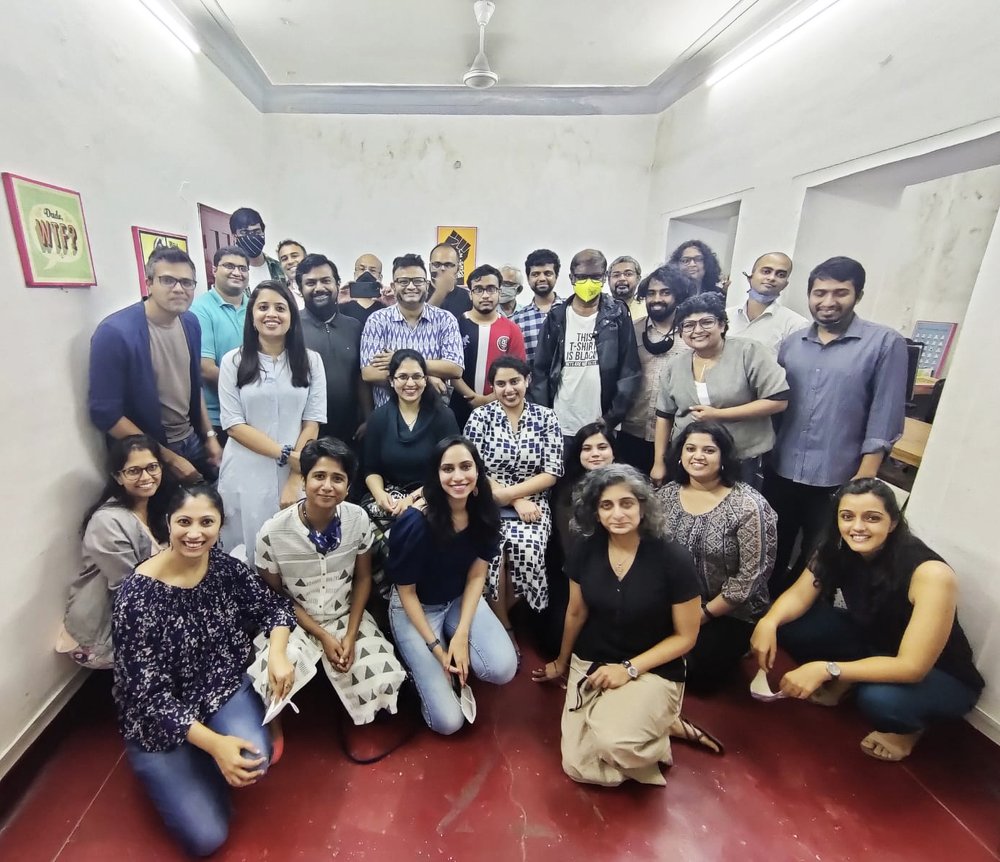
The News Minute team meet up in the office.
A note from Ludovic Blecher, Head of Google News Initiative Innovation: The GNI Innovation Challengeprogram is designed to stimulate forward-thinking ideas for the news industry. The story below by Ragamalika Karthikeyan, Editor Special Projects & Experimentsat The News Minute, is part of an innovator seriessharing inspiring stories and learnings from funded projects.
It was 2018, and the south Indian state of Kerala was reeling from the worst floods in a century. The floods hit on August 15 — India’s Independence Day. The media’s attention was focused on the holiday, and even as the crisis in Kerala became more and more critical, the floods relegated to a small feature on the national news. In a country as large and diverse as India, it’s difficult to represent everything happening on any given day. This is what motivated us to launch The News Minute (TNM) in 2014. From its beginnings, TNM has been a media platform reporting from, and about, South India, often for an out-of-country audience. It has also emerged as a strong feminist voice in Indian media, setting the standards for sensitive and on-the-ground coverage of issues related to children and women.
Turning readers into subscribers
Through support from the Google News Initiative, we at TNM have been able to identify a new, sustainable revenue stream that supplements our existing advertising revenue model. Analyzing data around user behavior helped us realize that our ardent readers were ready to pay us to support our journalism, so we decided to launch a membership program, which quickly gained members – around 50% of our members came on board within the first five months. After that, our numbers have been slowly but steadily increasing. It’s been about a year and a half since we launched the project, and we’ve hit 3,000 subscribers.
Building a platform for subscribers
During the GNI project, we were able to identify what we wanted our membership program to look like. The main components we built were the membership offerings and pricing, the legal and financial infrastructure, the technical infrastructure and the organizational capability.
There were surprises and challenges along the way: we had to adjust membership offerings based on early learnings, and processing payments was something we had to spend some time thinking about. We also wanted to make sure that the membership experience was worthwhile. Thanks to the collective wisdom of both our reader community and GNI, we were able to improve and adjust to create the best product possible.
Poised for growth
When we shift to a model where our audience is paying for our journalism, the focus automatically shifts to more community-driven, in-depth journalism that serves the public good. And this also aligns with our mission at TNM. When members of the public pay directly for independent journalism, it strengthens our ability to remain independent.
This launch taught us two really important things. One, we’re on the right track! Even though we had to make several pivots, we’re well-poised to grow the membership program, not just with the Indian diaspora, but with resident Indians as well. Two, we want to keep offering our readers other ways to support our work.
The GNI project put us on the road to a sustainable revenue model that is incredibly different from our traditional advertising-driven model. We’re looking forward to growing this new effort, and seeing how it can benefit our goal to provide our community with independent journalism.
Shop Black-owned with the #BlackOwnedFriday shoppable film
When I founded Nappy Boy Entertainment in 2005, I had no idea all the directions it would go. What started as a record label now includes a podcast, gaming and a book — I’m proud of this business. Along the way, I’ve developed a true passion for small businesses and I admire the hard work it takes to make them successful. I love doing whatever I can to support them.
So I was thrilled when Google reached out about the second annual Black-owned Friday. Last year, Google partnered with the U.S. Black Chambers, Inc. to reimagine Black Friday as “Black-owned Friday” — a day to celebrate and support Black-owned businesses. This year, I’m proud to join Google and the U.S. Black Chambers, Inc. for another year of encouraging shoppers to support Black-owned businesses.
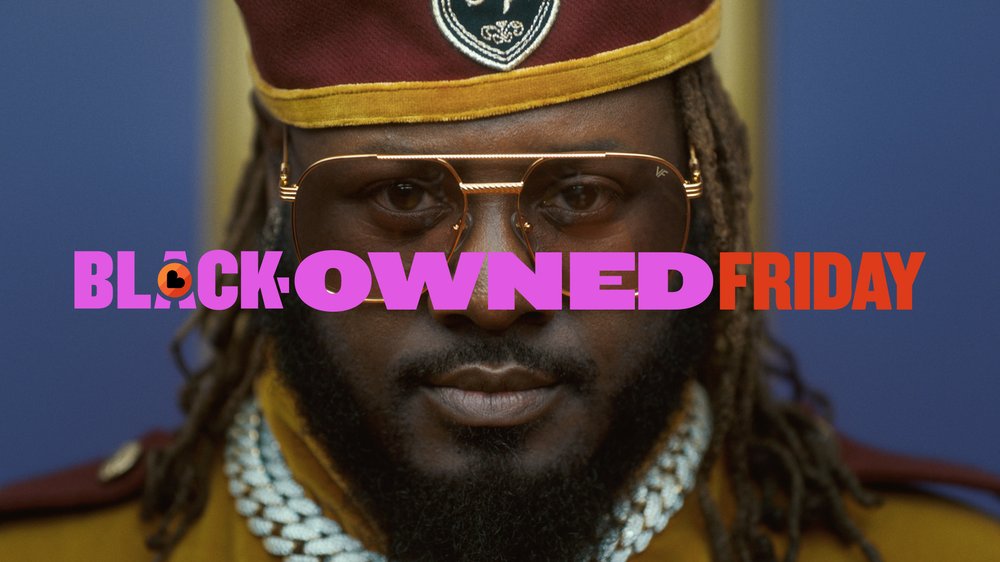
And I was especially excited to write a new track to celebrate Black-owned businesses. We brought the track to life with a film directed by Daps, featuring me, Normani, Desi Banks, Tanerélle and actual business owners. The best part? The video is shoppable with more than 100 products from more than 50 Black-owned businesses. Check it out at g.co/blackownedfriday.
An important way to support Black-owned businesses this holiday season is to help make sure people can find them — and digital tools can help. According to a consumer survey that Google and the U.S. Black Chambers, Inc. commissioned, 66% of consumers who actively support Black-owned businesses say they use digital tools to find them. If you own a business, one way to be sure you’re showing up for searches like “Black-owned shops near me” or “Black-owned restaurants near me” is to add the Black-owned business badge on Google Search, Maps and Shopping.
This holiday season — and throughout the year — search, shop and support Black-owned.