B2B Marketing News: B2B Content Consumption Data, Digital Ad Revenue Sizzles, In-Person Events & Advertisers, & YouTube’s New Time-Savers
Almost 90% of B2B Content Consumption Said to Take Place Outside the C-Suite
Nearly 90 percent of B2B content consumption involves those outside corporate executive-level management, with some 21 percent being consumer by individual contributors, according to recently-released B2B buyer breakdown by job titles survey data. MarketingCharts
Podcasts start coming to Facebook next week
Facebook will begin rolling out a new podcast feature on June 22, offering podcast creators a new distribution channel, with features such as one minute promotional clips — to appear in a forthcoming podcasts tab — the social media giant recently announced. The Verge
TikTok Owner ByteDance’s Annual Revenue Jumps to $34.3 Billion
TikTok parent ByteDance saw a 93 percent jump in gross profit during 2020, with revenue more than doubling to $30 billion, the popular short-form social video platform that has seen increasing business interest recently announced in annual employee financial performance data. Wall Street Journal
Google Launches Search Console Insights
Google has launched a new feature to its Search Console product that presents audience data from Google Analytics combined with Search Console insights, to offer an expanded look at customer audiences, the search giant recently announced. Search Engine Journal
YouTube Will Now Enable Creators To Add Midrolls, End Screens and Captions While Their Video Is Processing
Google-owned YouTube has released a new time-saving feature in its YouTube Studio that will smooth workflow for marketers by allowing users to perform more tasks while the initial video uploading process is underway, the firm recently reported. Social Media Today
More Advertisers Envision Return to In-Person Events
17 percent of advertisers plan to resume sponsoring in-person events in the final quarter of 2021, while 16 percent say they plan to do so in the first quarter of 2022, according to newly-released survey data. The survey also showed that some 10 percent of advertisers say that they have no plans to resume sponsoring in-person event. MarketingCharts
Augmented Reality Market to Hit $175B by 2026: ABI Research
The global augmented reality (AR) and mixed reality (MR) market will top $175 billion by 2026, with almost 28 million smart glasses expected to ship by then, according to recently-released forecast data of interest to digital marketers. AV Network
Spotify launches its live audio app and Clubhouse rival, Spotify Greenroom
Spotify has begun launching Greenhouse, its Clubhouse-life mobile app offering with features that can also turn live audio conversations into podcasts on the Spotify platform, the firm recently disclosed. Spotify also plans to eventually infuse targeting recommendations and additional Spotify-specific functionality into Greenhouse. TechCrunch
LinkedIn bets on remote events, investing in $5 billion-plus virtual platform company Hopin
Microsoft-owned LinkedIn (client) has invested in virtual conference technology firm Hopin, in a push to allow customers to extend the reach of their live events onto LinkedIn with new immersive experiences, Hopin recently announced. CNBC
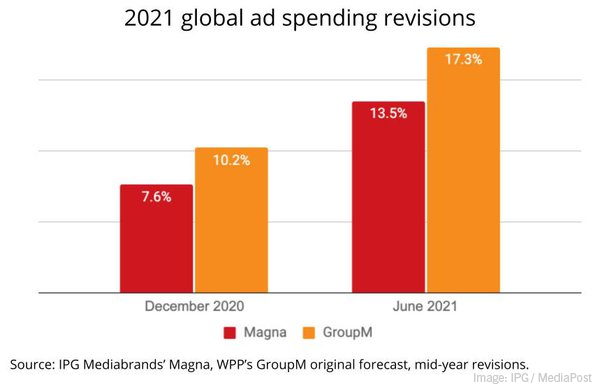
Global Ad Growth Consensus Lifted To 10.6% In 2021, 8.2% In 2022
Advertising spending worldwide in 2021 is expected to jump by 10.6 percent, with an 8.2 percent increase forecast for 2022, according to recently-released global ad spend forecast data of interest to online marketers. The figures represent a strong rebound from the 5.2 percent decrease seen in 2020. MediaPost
ON THE LIGHTER SIDE:
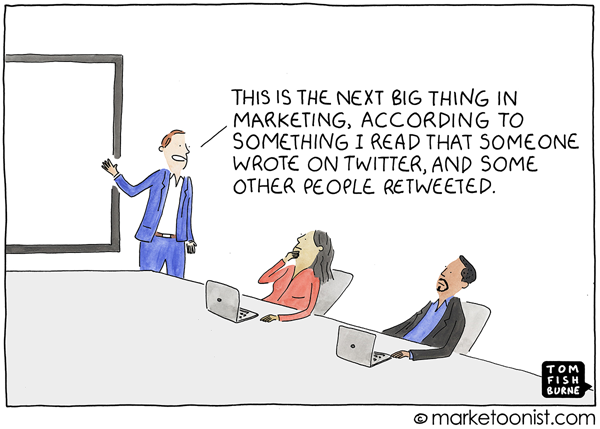
A lighthearted look at the “the next big thing in marketing” by Marketoonist Tom Fishburne — Marketoonist
Microsoft’s best Cannes Lions-winning ads and campaigns — AdAge
TOPRANK MARKETING & CLIENTS IN THE NEWS:
- Lee Odden — B2B Influencer Marketing with Lee Odden [Podcast] — Pam Didner
- Lee Odden — What’s Trending: Innovations in B2B Marketing — LinkedIn (client)
Have you found your own top B2B marketing article from the past week of industry news? Please drop us a line in the comments below.
Thanks for taking the time to join us for the TopRank Marketing B2B marketing news, and we hope that you’ll come back again next Friday for more of the week’s most relevant B2B and digital marketing industry news. In the meantime, you can follow us at @toprank on Twitter for even more timely daily news.
The post B2B Marketing News: B2B Content Consumption Data, Digital Ad Revenue Sizzles, In-Person Events & Advertisers, & YouTube’s New Time-Savers appeared first on B2B Marketing Blog – TopRank®.

Tamagotchi fa ritorno, stavolta come smartwatch

Huawei MateBook X Pro 2021 in sconto di 450 euro su Amazon!

Connettività domestica sempre più indispensabile per gli italiani

Green Pass, Draghi firma il decreto. Saranno validi in tutta l’UE

Il nuovo WWW: un supporto per accelerare la ripresa del retail
Durante il lockdown, il web si è rivelato un’ importante ancora di salvezza. Gli strumenti digitali ci hanno aiutato a rimanere in contatto: famiglie tra loro, insegnanti con studenti e aziende con clienti. La tecnologia si è rivelata utilissima per persone, comunità e paesi interi come mai prima d’ora.
Non sorprende che a seguito della pandemia il nostro uso della tecnologia abbia avuto una grande accelerazione, che si riflette anche sulle tendenze che stavamo già sperimentando in diversi settori, tra questi quello del retail.
Trend: il nuovo WWW
Anche nel momento in cui visitare fisicamente i negozi non è più stato possibile, le persone non hanno mai smesso di cercare l’ispirazione su cosa acquistare. Da fisiche, le vetrine da osservare per cercare ispirazione sono diventate virtuali. Le ricerche di “idee” sono aumentate sia su google.com, sia su Google Immagini, con gli acquirenti che cercavano ispirazione quando non avevano in mente un prodotto specifico da acquistare. In questo senso, per i rivenditori al dettaglio essere visibili online è fondamentale per intercettare potenziali clienti: oltre il 60% degli acquirenti che abbiamo intervistato ha affermato di aver ordinato da un brand dopo averlo visto su YouTube.
La crescente necessità di acquistare online ha portato allo stesso tempo una convergenza tra acquisti online e offline. Le persone cercano la stessa ispirazione e gli stessi consigli che potrebbero ricevere in negozio, con l’unica differenza che ora desiderano riceverli anche direttamente a casa. E i clienti chiedono di più quando fanno acquisti. Le ricerche di parole come “migliore” e “codice promozionale” continuano ad aumentare e le persone si aspettano un servizio di consegna a domicilio in un numero sempre maggiore di categorie. “WWW” non sta più solo per world wide web: ora è “What, When, Where”: quello che vogliamo, quando e dove lo vogliamo.
Infine, sappiamo che gli acquirenti di oggi desiderano che sia mantenuta la loro privacy. Vogliono avere il controllo dei propri dati e devono sapere come vengono utilizzati.
In Google, stiamo lavorando con i retailer per garantire che ogni interazione online diventi un’opportunità. Il rapporto online può essere prezioso quanto quello di persona per costruire relazioni dirette con i clienti, rafforzare la fiducia e costruire la fedeltà. I retailer devono solo utilizzare le giuste informazioni e gli strumenti corretti per raggiungerli.
L’importanza di strumenti e competenze digitali
Anche prima della pandemia, molti rivenditori, grandi e piccoli, avevano abbracciato il digitale per trovare nuove opportunità. Consideriamo per esempio le ricerche su Google: da marzo 2020, le ricerche legate allo shopping online e a come acquistare online sono raddoppiate in tutto il mondo, anche in Italia, dove l’interesse di ricerca relativo a “shopping online” è cresciuto del 50% (fonte: Google Trends). Allo stesso tempo, costruire la propria presenza online può aiutare le piccole e medie imprese anche a beneficio dell’esperienza offline. Secondo uno studio di Euromonitor, per il 2024 si prevede infatti che per la maggior parte degli acquisti, il 78%, continuerà ad avvenire offline; allo stesso tempo, prendendo in considerazione il settore del commercio al dettaglio nello specifico, si stima che il 54% delle entrate generate dal retail andrà a quegli esercizi che avranno integrato il digitale nei loro business model.
Per cogliere le opportunità del digitale, strumenti e competenze digitali sono fondamentali e il piano Italia in Digitale avviato da Google in Italia nel luglio 2020 va proprio in questa direzione: un progetto per accelerare la ripresa economica del Paese attraverso una serie di momenti di formazione, strumenti e partnership a supporto delle imprese e delle persone. Dall’avvio di Italia in Digitale sono oltre 300.000 le persone e le piccole e medie imprese che Google ha aiutato a digitalizzarsi.
Un esempio è quello della Libreria Verso di Milano, che a causa della pandemia si è trovata a riorganizzare la propria attività, ripensando al ruolo dell’online divenuto determinante, anche a supporto dell’offline: “Grazie al digitale e a Google My Business oggi abbiamo una nuova comunità di lettori provenienti da tutta Italia che ci segue e ci sostiene con grande affetto. Una risorsa inaspettata, che coltiveremo anche quando sarà possibile tornare a incontrarci di persona in libreria: sono due binari che possono convivere e alimentarsi a vicenda.” Antonio, Libraio e Specialista della Comunicazione, Libreria Verso

Nell’ottica di aiutare le persone a cogliere le opportunità del digitale per le proprie attività, tra le novità più recenti c’è anche La Mia Impresa Online, la nuova Action sull’Assistente Google pensata per portare online la propria attività in modo facile, immediato e senza costi. In questo modo, per valorizzare la propria attività online non sarà necessario possedere delle competenza digitali specifiche: per far trovare il proprio business sulla Ricerca Google e su Google Maps basterà soltanto utilizzare la propria voce.
Fare la nostra parte
Sappiamo che tenere il passo dell’accelerazione tecnologica a cui abbiamo assistito può essere sfidante e continueremo a lavorare duramente per aiutare e sostenere la ripresa del settore retail in Italia. Nessuno di noi sa esattamente cosa accadrà nei prossimi mesi, ma una cosa è certa: la determinazione e la creatività dimostrate delle piccole e medie imprese nell’ultimo anno meritano di essere celebrate.

Google Fuchsia usa un microkernel. Qual è la differenza e perché è rilevante

A conversation between two changemakers uplifting women
Editor’s note: This is the first in a three-part series of interviews between expert panelists for the Google.org Impact Challenge for Women and Girls.
As the President and CEO of Vital Voices Global Partnership, I lead an organization that invests in women leaders solving the world’s greatest challenges — from gender-based violence to the climate crisis to economic inequities.
Saskia Niño De Rivera is one of those leaders. She’s the co-founder of Reinserta, a nonprofit that supports mothers and their infants born in prison and helps adolescents who have committed crimes to reduce the cycle of crime and improve the prison system in Mexico.Saskia and her team at Reinserta work directly with those in the prison system to uncover underlying problems and advocate for the most effective solutions. Through doing so, they’ve impacted 2,600 people in prison.
Saskia and I are expert panelists for the Google.org Impact Challenge for Women and Girls, which will give a total of $25 million to organizations around the world that are working toward economic empowerment for women and girls. As expert panelists, we’ll help evaluate applications from the thousands of organizations that sent in ideas. Economic empowerment is crucial to achieving gender equity for women everywhere, but it’s a broad term that takes many shapes and touches different aspects of life across the world. To learn more about what economic empowerment means for women in Mexico, I spoke to Saskia about her path, her work with at-risk communities, and her advice for future changemakers.
How were you called to do this work?
When I was a teenager, my uncle was kidnapped which shaped how I see the world. It made me think: Why do these kidnappers exist? What have we done wrong as a society that people think it’s okay to take someone’s life into their hands and trade them for money? It was an “aha moment” that changed how I look at social justice.
Since then I’ve had the privilege — and it’s definitely a privilege — to have the time to find my passion. I work in what I love, which is a huge part of being good at what I do.
From there, you went to work for the police — first as a negotiator and then in the anti-kidnapping division. What did that teach you?
It taught me a lot of compassion. I visited 138 prisons and walked the halls myself. I learned that no one is born an aggressor or violent person. No one is born a criminal.
I would never justify a crime, but it’s interesting to learn about the background of the people in prison — the circumstances that led them to commit a crime. Justice has to do with a co-responsibility where no one is left behind, starting with victims and survivors and following with aggressors. We have to recognize people who commit crimes as a societal failure, and we are all a part of that failure.
I work in what I love, which is a huge part of being good at what I do.
Talk to us about the mission of Reinserta and how it has changed.
The main objective of Reinserta was to change the prison system to better the security of Mexico. But when you go into the system, there are problems everywhere — so many special interests, so much corruption. So my partner Mercedes and I asked ourselves, “Where can we make a difference? What is urgent?”
This year we adapted the mission to work with children and teenagers that are in contact with the criminal justice system, starting with children who are born in prison. Reinserta is constantly adapting because we’re inside the prisons, inside the justice system, creating models based on what really happens in the prisons.

ADOTTA IL TUO FIUME. SALVIAMO LE ACQUE DALLA PLASTICA
Il Rotary organizza a Roma dal 18 al 20 giugno l’evento “Expo Plastic Free”: tecniche ed iniziative per rigenerare gli ecosistemi Di Paolo Brambilla – Trendiest Media Salvare fiumi e mari:…
L’articolo ADOTTA IL TUO FIUME. SALVIAMO LE ACQUE DALLA PLASTICA scritto da Paolo Brambilla proviene da Assodigitale.

Our racial equity commitments, one year later
One year ago today, we announced commitments to build sustainable equity for Google’s Black community and beyond, and make our products and programs more helpful to Black users. Since then, we’ve been working to translate our commitments into lasting meaningful change. Today we’re sharing more updates on our progress.
We’re announcing a $50 million grant to Historically Black Colleges and Universities to broaden access to opportunities for underrepresented groups in STEM, and an update on the more than $320 million we’ve committed to organizations working to address racial inequities over the past year. In our own workplace, we’re sharing progress on how we’re hiring in key growth sites like Atlanta and D.C., and our new onboarding pilot for Black Googlers. And in our products, we’re launching a new Marketing Toolkit and making improvements to our Pixel camera to ensure the Black community is represented in our work.
Creating equity in our workplace
2020 was our largest year ever for hiring Black+ Googlers in the U.S. — both overall, and in tech roles. We’re on track to meet our goals to improve leadership representation of underrepresented groups by 30 percent by 2025 and more than double the number of Black Googlers at all other levels by 2025.
We’re also investing in growing Atlanta, Chicago, New York and DC — locations that we’ve heard from our Black+ Googlers contribute to a high quality of life. In 2021 so far, we’ve grown these sites by more than 650 employees. We’re on track to meet our goals of 1,000 in 2021 and 10,000 by the end of 2025.
We continue to invest in programming that helps Googlers grow and thrive at Google. This month we launched a new onboarding pilot, which offers tailored content to support Black employees as they begin their Google career. We plan to roll the program out globally by the end of the year.
Working in close consultation with our Black employees, last year we introduced a student loan repayment program to help Googlers build more financial stability over the long term, since we know that student loan debt disproportionately affects women and communities of color. To date, we’ve paid out $3 million in student loan repayment matches.
Work related to education
We’re proud to partner with Historically Black Colleges and Universities to broaden access to higher education and opportunities in tech. Today we’re announcing a new $50 million unrestricted grant to 10 HBCUs that will help them support scholarships, invest in technology for classrooms, and develop curriculum and career readiness. Each institution will receive a one-time unrestricted financial grant of $5 million, providing institutions with the flexibility to invest in their communities and the future workforce as they see fit.
This commitment builds on our Pathways to Tech initiative, which is designed to build equity for HBCU computing education, help job seekers find tech roles, and ensure that Black employees have growth opportunities and feel included at work.
Building products and tools for change
As a part of our ongoing commitment to product inclusion, we’re working to make technology more accessible and equitable. Over the last year we’ve launched a number of important features including a Black-owned business attribute on Maps, Assistant responses on Black Lives Matter, and ways marketers can support Black-owned publishers in Display & Video 360.
Another example is our recent efforts to build a more equitable camera, where we partnered with 17 professional image makers to make changes to our computational photo algorithms to address long-standing issues with how digital cameras represent Black people in photos. This includes auto balance adjustments to bring out natural brown tones and prevent over-brightening and desaturation of darker skin tones. We’re working to bring these changes to Google Pixel later this year.
And earlier today, we made our inclusive marketing toolkit available to all marketers. This toolkit has helped us make improvements to how the Black community is represented in our work, and we’re excited to share what we’ve learned with the industry.
Helping create economic opportunity and furthering social justice
Over the past year, we’ve committed more than $320 million to organizations working to address racial inequities. This includes grants to racial and social justice organizations, and support for job skilling initiatives, small business and startups. Here are some examples of what we’ve done so far:
-
Met our $50 million commitment to Opportunity Finance Network to support Black-owned businesses through the Grow with Google Small Business Fund.
-
Granted $12 million in Google.org grants to nonprofit organizations working to address racial inequities.
-
Granted $25 million in Google Ad Grants to racial justice organizations.
-
Deployed $15 million in training, through partners like the National Urban League, to help Black jobseekers grow their skills.
-
Invested over $60 million of our $100 million commitment to help Black entrepreneurs access capital.
To continue the work, we recently launched a second $5 million Google for Startups Black Founders Fund in the U.S. and announced the 30 founders who would be receiving up to $100,000 in non-dilutive funding from Google for Startup’s $2 million Europe focused fund.
We also support Black media and creators. For example, in 2020, we advertised across more than 60 Black-owned media properties as part of our U.S. media spend and will increase our spend on Black-owned media by 4X this year. Here’s a sample of some other initiatives from the last year:
- The Google News Initiative (GNI) launched the Ad Transformation Lab: a multi-month program to help Black and Latino news publishers in the U.S. and Canada advance their advertising strategies and grow digital revenue, in partnership with Dr. Benjamin Chavis Jr., President and CEO of the National Newspaper Publishers Association (NNPA) as well as the Association of Alternative Newsmedia (AAN) and the National Association of Hispanic Publications (NAHP). Learning from the success stories of the Ad Transformation Lab, we’ll continue to collaborate with AAN, NAHP and NNPA to launch new business-oriented Labs in coming months.
-
In May 2021, we created the Google News Initiative Student Fellowship program to help develop and support diverse, up-and-coming news and media talent that are interested in careers at the intersection of technology, media and journalism. Applications for the Fellowship are open until June 21, 2021.
-
Last October, we announced the $100 million #YouTubeBlackVoices Fund, which has provided funding, training and support from YouTube to help 132 creators and artists from around the world to help grow their audience and build thriving businesses. We’ll open up applications for the Class of 2022 on June 21, 2021.
We know there’s more to be done, so we’ll continue to make sure our workplace and products are equitable and representative. I look forward to sharing more updates as this important work moves forward.

$50 million for HBCUs to address the diversity gap in tech
Historically Black Colleges and Universities (HBCUs) have stood as pillars of excellence for more than 180 years and continue to serve as havens for Black students in pursuit of higher education. Founded to provide Black Americans with a fundamental human right — the access to a full education, they have grown to produce some of the greatest leaders, thinkers and cultural influencers of our time. These institutions are actively shaping the next generation of Black leaders and are helping build a more diverse workforce across all industries, including tech. In fact, 25% of African American graduates with STEM degrees come from HBCUs.
Despite the success of HBCUs, Black professionals continue to be underrepresented across the tech industry. We want to do our part to support these institutions as we work to help close the gap, together. Today, I’m proud to announce a $50 million grant to 10 HBCUs that will help support scholarships, invest in technical infrastructure for in-class and remote learning, and develop curriculum and career support programs.
Here’s a look at what our HBCU partners had to say about the grant and how it will help them:
This financial commitment is our largest to date for HBCUs. Each institution will receive a one-time unrestricted financial grant of $5 million, providing institutions with the flexibility to invest in their communities and the future workforce as they see fit.
Today’s grant follows a lot of work in the last several years to support HBCUs, including our Pathways to Tech initiative. These initiatives are designed to build equity for HBCU computing education, help job seekers find tech roles, and provide opportunities to accelerate their careers.

Greenroom, in arrivo la risposta di Spotify a Clubhouse

Cristian Raggi e Michele Biolghini AL PREMIO “Arte, Scienza e Coscienza”
Doppio riconoscimento internazionale per Raggi Lampadari e Piazza Lombardia protagoniste a Genova a Palazzo Tursi durante la consegna del Premio Internazionale “Arte, Scienza e Coscienza” alla presenza del sindaco della…
L’articolo Cristian Raggi e Michele Biolghini AL PREMIO “Arte, Scienza e Coscienza” scritto da Paolo Brambilla proviene da Assodigitale.

Come ottenere la certificazione verde COVID-19. Tutti i dettagli

iTEG, grande successo per il turismo enogastronomico
Un risultato estremamente positivo: cala oggi, al termine di giornate di grande soddisfaziione per i presenti, il sipario dell’Oasi Quattro Colonne a Santa Maria al Bagno (LE) sui lavori di…
L’articolo iTEG, grande successo per il turismo enogastronomico scritto da Paolo Brambilla proviene da Assodigitale.