What Pandemic Poll Data Reveals About The Future of B2B Marketing
Forever altered by the pandemic, which new directions is B2B marketing going, and what’s in store for marketers in 2022 and beyond?
To help answer these questions and others, we’ve tapped into our poll data to see how the pandemic has affected how B2B marketers work, their outlook for the future, and what we’ve collectively lost and gained over the past year and a half.
Audience poll data offers a valuable gauge on the pulse of B2B marketers, and for over two years we’ve run weekly social media polls on our Twitter and LinkedIn* pages.
The insight you’ve shared with us during the pandemic gives us insight into what’s changed, what’s gone for good, and what may come back stronger than ever in B2B marketing.
We’ll use our own poll data to take a look at the B2B marketing trends that have emerged during this unprecedented year and a half.
Building on the insights we shared in “B2B Marketing Poll Sentiment: 15+ Eye-Opening Insights To Fuel Summer Success,” our most recent poll numbers paint a sometimes-surprising picture of B2B marketing sentiment in 2021.
Let’s jump right in and take a look.
Pandemic Poll #1 — Work Volume
The first pandemic related poll we conducted was on April 14, 2020, when we asked B2B marketers how the volume of work they’ve done with influencers had changed during the first few months of the global health crisis.
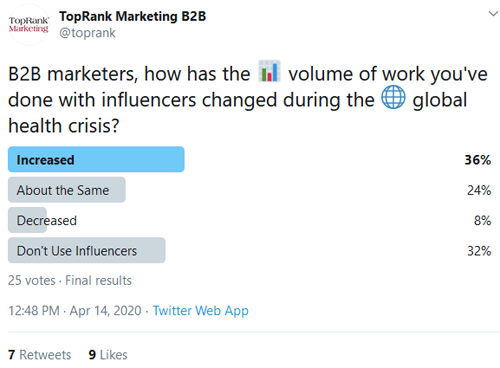
At that point relatively early in the pandemic, 36 percent of our respondents noted an increase in their use of influencers in marketing efforts.
Pandemic Poll #2 — Learning New Skills
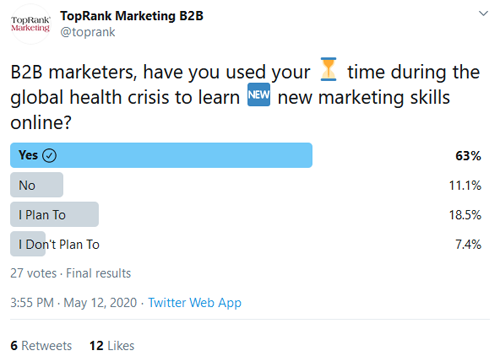
A month later on May 12, 2020, our second pandemic-related poll asked B2B marketers whether they had used their time during quarantine to learn new marketing skills online.
A sizable 63 percent of respondents said that they had indeed learned new skills online while isolating.
Pandemic Poll #3 — Pain Points
As the pandemic moved into summer, on July 7, 2020 we were curious about the pain points B2B marketers were being faced with.
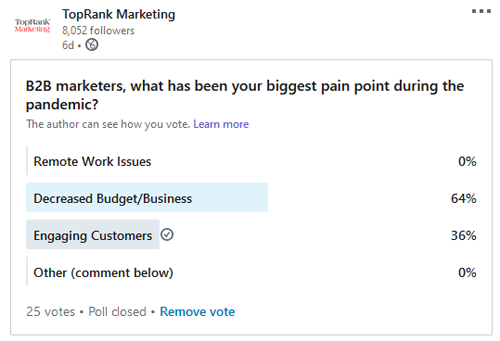
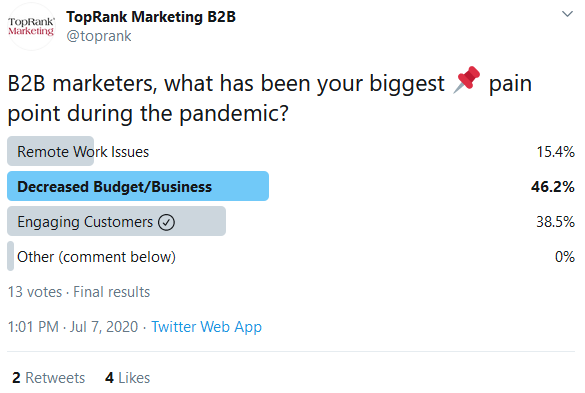
Decreasing business or budgets was the top concern, with 64 percent of our Twitter poll respondents saying that was their biggest pandemic pain point, a sentiment shared by 46.2 percent of our LinkedIn respondents.
Pandemic Poll #4 — The Rise of Virtual Events
As the summer wore on, virtual marketing event options began to appear as alternatives to long-standing in-person events, and on July 20 we wondered how many such events B2B marketers were planning to attend during the second half of 2020.
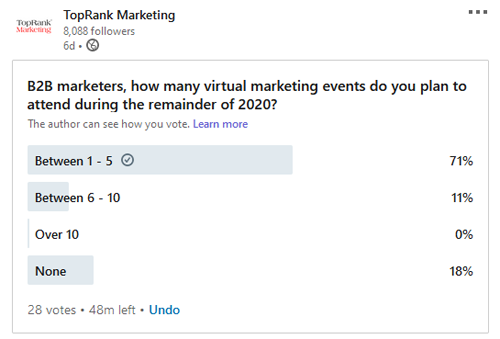
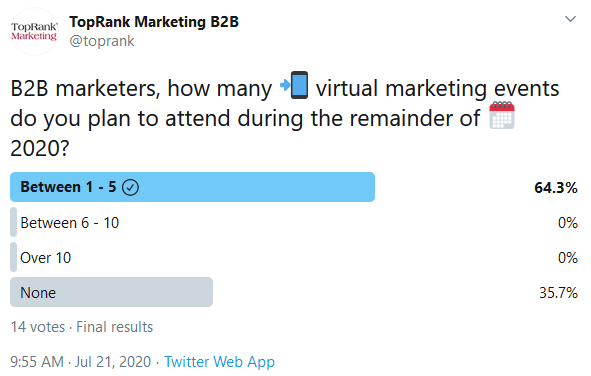
Most B2B marketers planned to attend between one and five virtual events before the end of 2020, with 11 percent noting they would attend between six and ten online events.
Pandemic Poll #5 — Long-Term Remote Work Feasibility
On August 18, 2020 we wanted to learn more about how B2B marketers were feeling about the long-term feasibility of remote work.
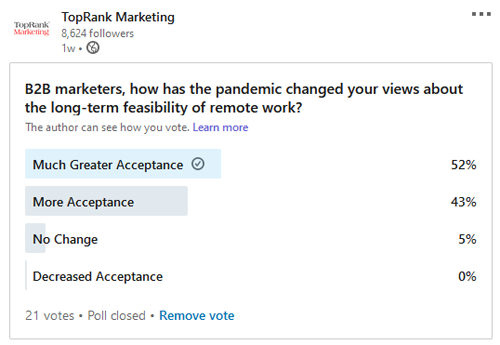
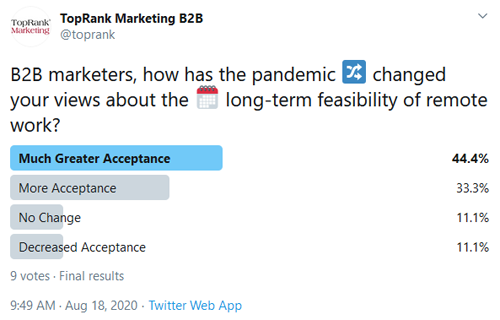
By this time, most B2B marketers had much greater acceptance when it came to the long-term feasibility of remote work than they did before the pandemic.
This poll backed this notion, with over three quarters of respondents on both our LinkedIn and Twitter polls saying that they had either more acceptance or much greater acceptance of remote work as a long-term practice.
Hybrid work scenarios are also very much a part of continuing conversations about the future of work, as I recently explored in “Hybrid & Remote Work Trends That Will Alter The Future Of B2B Marketing.”
Pandemic Poll #6 — Post-Pandemic Marketing Predictions
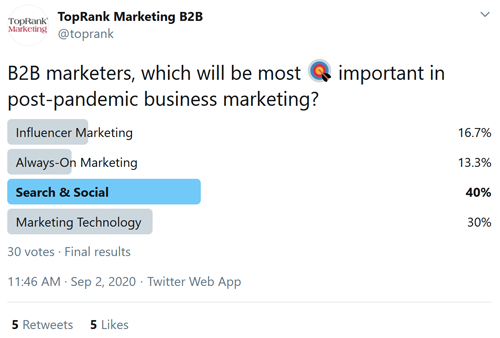
When autumn rolled around, on September 2, 2020 we asked B2B marketers which category of marketing they believed would be the most important in post-pandemic business marketing.
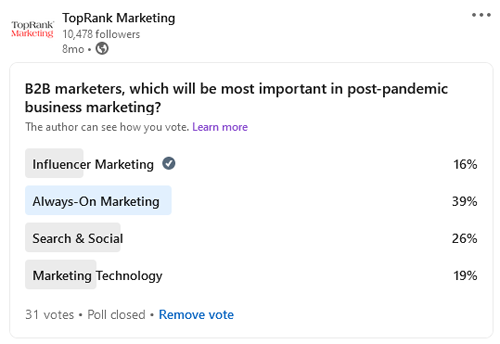
39 percent of our LinkedIn poll takers said that always-on marketing would be the most important type of post-pandemic marketing, followed by 26 percent who said search and social, 19 percent who picked marketing technology, and 16 percent who picked influencer marketing.
40 percent of our Twitter poll respondents said that search and social will be most important, 30 percent said marketing technology, 16.7 percent picking influencer marketing, and 13.3 percent for always-on marketing.
The results point to the mixed viewpoints and uncertainly surrounding just what will be the most important when the dust from the pandemic fully settles.
Our own Nick Nelson explored the topic, in “Brave New World: The Model for B2B Marketing Success, Post-Pandemic.” Optimizing our B2B marketing strategy for a post-pandemic world requires understanding where the key shifts have occurred, and how to adapt. From executive thought leadership to rethinking marketing experiences, Nick’s article explores five ways that B2B marketers can smartly adapt and thrive in our reshaped environment.
Pandemic Poll #7 — Where Influence Has Helped The Most
On October 13, 2020 we asked marketers which facet of their B2B influencer marketing program had seen the greatest success during the pandemic.
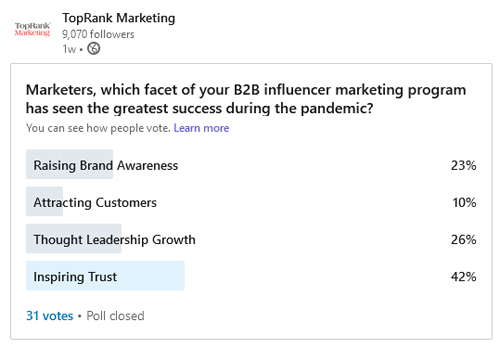
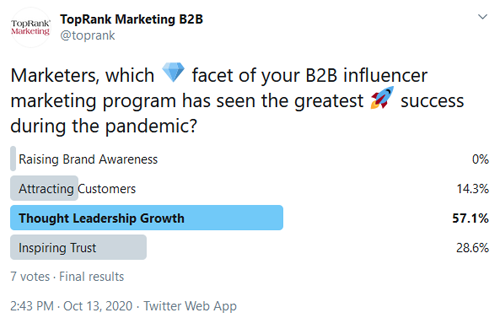
42 percent of our LinkedIn poll-takers said that inspiring trust was the area of their B2B influencer marketing program that had seen the greatest success during the pandemic, followed by thought leadership growth, raising brand awareness, and attracting customers.
Among our Twitter poll-takers thought leadership growth was the top choice, followed by inspiring trust and attracting customers.
Pandemic Poll #8 — Top Marketing Fears
As a pandemic Halloween approached, on October 29, 2020 we wanted to know what B2B marketers saw as their biggest fears in marketing.
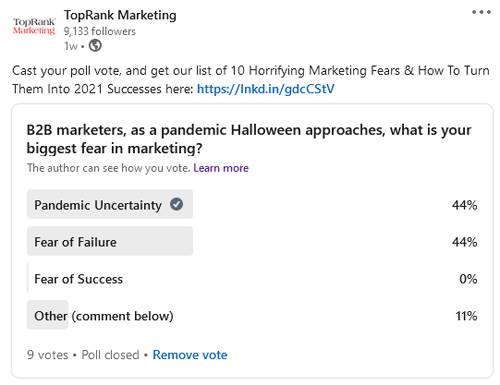
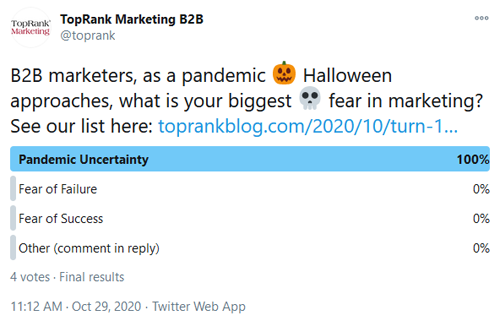
On both LinkedIn and Twitter the biggest fear was the uncertainty of the pandemic, with some also choosing the powerful fear of failure.
I expanded on turning fear into success in a full article to accompany our poll, in “10 Horrifying Marketing Fears & How To Turn Them Into 2021 Successes.”
Pandemic Poll #9 — Success Stories
On November 17, 2020 we asked marketers which areas had benefited the most from the increased use of digital tools the pandemic had brought about.
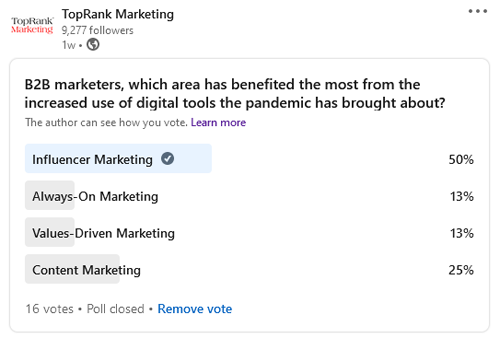
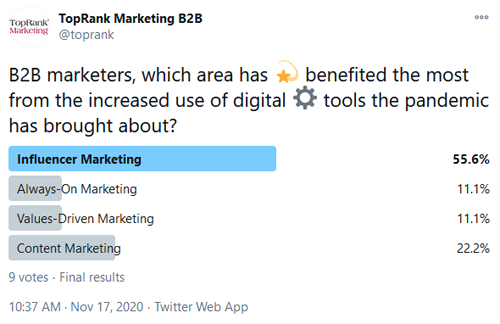
Influencer marketing was seen by both our LinkedIn and Twitter poll-takers as the greatest beneficiary when it came to areas that grew during the pandemic. Content marketing was the second choice, followed by always-on and then values-driven marketing.
Pandemic Poll #10 — What Marketers Look Forward To
As 2020 wound to a close, with glimmers of post-pandemic hope starting to form, we wondered what B2B marketers were most looking forward to in 2021.
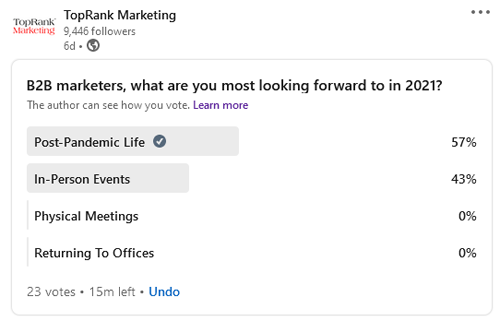
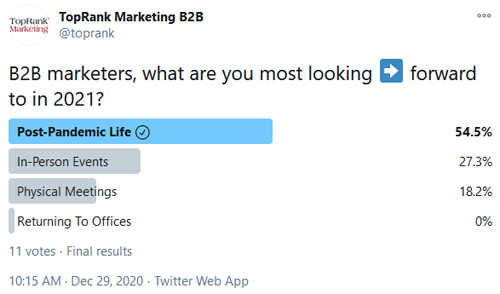
What were B2B marketers most looking forward to in 2021?
Post-pandemic life was by far the top choice of both our Twitter and LinkedIn poll-takers, followed by in-person events and physical meetings.
Pandemic Poll #11 — Top Tactics For 2021
Our first poll of 2021 on January 5 asked B2B marketers which business marketing tactic they were the most optimistic about for the year ahead.
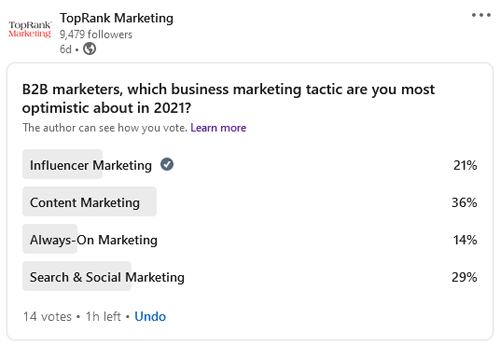
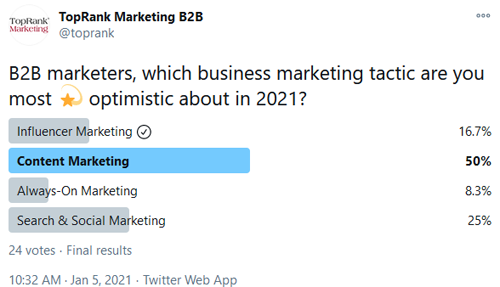
When we asked which business marketing tactic poll-takers were most optimistic about, on LinkedIn 36 percent chose content marketing, 29 percent search and social, 21 percent influencer marketing, and 14 percent who selected always-on marketing.
Among our Twitter poll-takers some 50 percent chose content marketing, 25 percent search and social, followed by 16.7 percent who picked influencer marketing, and 8.3 percent who chose always-on marketing.
Pandemic Poll #12 — Permanent Remote & Hybrid Work
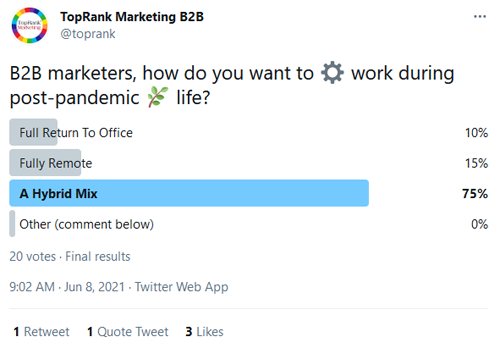
Our latest completed pandemic-related poll, on June 8 asked simply how do B2B marketers want to work during post-pandemic life.
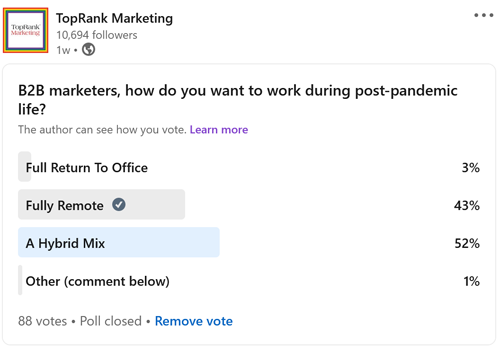
Among 88 poll takers on LinkedIn, 52 percent said that wanted a hybrid mix of remote and office work types, 43 percent wanted fully remote work, and just 3 percent a full return to office work.
On Twitter, 75 percent of B2B marketers preferred a hybrid scenario, 15 percent fully remote, and 10 percent a full return to the office.
Pandemic Poll #13 — Returning To In-Person Marketing Events
Our newest poll asks, “B2B marketers, do you plan to attend an in-person marketing event during the second half of 2021?”
You can share your input by voting on either our TopRank Marketing LinkedIn or Twitter pages — or on both.
A Bright Future For B2B Marketers
Keeping your eyes open to the pulse of your audience — whether it’s from poll results, questionnaires, surveys or other types of feedback — can go a long way indeed when it comes to making your B2B marketing efforts more grounded and authentic. It can also help make your communication more of a two-way street, and not only a publish-and-forget effort.
We hope you’ve found this peek into some of our own poll results eye-opening as you navigate the uncertain marketing landscape 2021 has given us, as we forge ahead towards a post-pandemic world.
To learn more from poll data insight, not limited solely to the pandemic, check out our “B2B Marketing Poll Sentiment: 15+ Eye-Opening Insights To Fuel Summer Success,” and “Show Me The Numbers: 20 B2B Marketing Insights From Audience Poll Data.”
Creating award-winning B2B marketing with an artful mixture of influence takes considerable time and effort, which is why many firms choose to work with a top digital marketing agency such as TopRank Marketing. Contact us today and let us know how we can help, as we’ve done for businesses ranging from LinkedIn, Dell and 3M to Adobe, Oracle, monday.com and others.
* LinkedIn is a TopRank Marketing client.
The post What Pandemic Poll Data Reveals About The Future of B2B Marketing appeared first on B2B Marketing Blog – TopRank®.

SoundBed, il letto da 2mila dollari che rilassa con l’Audio Spaziale

IKEA lancia un nuovo diffusore audio che sembra un quadro
Funding Black founders with capital and community
In 2016, I met an inspiring entrepreneur named Jasmine Crowe who was looking for ways to expand her startup, Goodr, which helps eliminate food waste and food insecurity. Through my business relationships with the city, I helped her secure a contract with the Atlanta International Airport, a deal that was huge for her business’s growth and a big win for Georgia’s startup ecosystem. Since then, I’ve met with over 2,500 underrepresented entrepreneurs around the country and made it my life’s mission and the mission of my nonprofit, Goodie Nation, to help them succeed.
As part of a series of racial equity commitments Google made last year, Goodie Nation was tapped to provide community support for the 76 recipients of their inaugural $5 million Google for Startups Black Founders Fund. The Black Founders Fund was created to spur economic opportunity for Black entrepreneurs who are consistently locked out of access to capital. The results have exceeded my expectations. Within six months of distributing these awards, Google has seen the Black Founders Fund help Black led startups create more jobs, raise more capital and increase revenues. Here are some of our findings along with what the fund’s recipients had to say about the impact of these awards on their startups:
-
82% of recipients have used the awards to hire new employees
-
81% of recipients reported that these awards have directly helped their ability to accelerate conversations with investors.
-
Founders have reported that they have gone on to raise $38M+ post-award.
-
78% of recipients report the fund has immediately helped grow their revenues
Now, Goodie Nation is teaming up with Google again to support the launch of the second $5 million Google for Startups Black Founders Fund in the U.S., providing $100,000 in non-dilutive funding to startups from Google for Startups U.S. programs and partner communities or through nominations from past Black Founders Fund recipients. In addition to the unrestricted funding, selected founders will receive up to $120,000 in Google Ads credits and as much as $100,000 in Google Cloud credits. Google for Startups will also continue to connect recipients to tools and teams across Google, providing technical and business mentorship.
As we’ve done over the past six months with the 2020 Black Founders Fund recipients, Goodie Nation will offer 2021 recipients ongoing support through weekly small group check-ins. Our advisors will be there to discuss business pain points with the founders, offer introductions to customers and investors and provide regular therapy sessions and forums to support recipients emotionally and professionally. I asked our first class of founders to share how the award impacted them and their businesses:
I’ve always felt that if we could fill the relationship and financial gaps that exist for entrepreneurs of color, we could not only bring about great businesses, but also catalyze job creation and wealth generation for entire communities. The work doesn’t stop here. Google will continue to invest in the Black Founders Fund abroad in Brazil, Europe and more locations soon to be announced.

I migliori hard disk esterni per PS4 e PS4 Pro

Se è sul web, perché non riesco a trovarlo?

La Ricerca Google è lo strumento che molte persone utilizzano ogni giorno per rispondere istantaneamente a qualsiasi domanda possa sorgere: in una frazione di secondo il motore di ricerc è in grado di scansire triliardi di pagine web per trovare i risultati più utili e rilevanti. Anche così, il modo più veloce per trovare esattamente quello che state cercando non è sempre ovvio e, a volte, le persone trovano risultati di ricerca che non erano quelli che si aspettavano. Come mai?
- Limitarsi a una sola ricerca: è consigliabile effettuare almeno due o tre ricerche, soprattutto se si tratta di un argomento complesso. In questo modo possiamo godere di una prospettiva più ampia sul tema e individuare fonti il più possibile credibili.
- Dimenticare di controllare la credibilità delle fonti: assicuratevi che i siti a cui vi rivolgete siano la migliore fonte di informazioni per quello che state cercando. E’ importante trovare informazioni affidabili e credibili, soprattutto in momenti come quello attuale a causa dell’emergenza sanitaria.
- Non definire a priori i termini di ricerca: le parole chiave sono la più importante delle domande che vengono poste al motore di ricerca, quindi prima è meglio definire bene quali parole usare. Un modo utile per farlo è “navigare in parallelo”, cioè provare diverse varianti della ricerca in diverse schede del browser e confrontare i risultati ottenuti.
- Limitarsi alle ricerche per parola: oltre alla ricerca per parole chiave, Google permette anche di cercare attraverso le immagini e i video. Può essere utile utilizzare le altre funzionalità di Ricerca, oltre alla semplice ricerca sul Web, soprattutto quando si desidera trovare contenuti intrinsecamente visivi.
- Evitare i risultati di ricerca con parole che non riconoscete: se un risultato di ricerca che sembra promettente include termini con cui non avete familiarità, è consigliabile non saltarlo. Questo perché così facendo potreste perdere informazioni preziose che potrebbero includere le risposte che state cercando. Invece di ignorarlo, provate un’altra ricerca su Google per le parole non riconosciute.
- Il simbolo @ per cercare sui social media: usate il simbolo @ davanti a una parola per cercare sui social media. Ad esempio: @twitter.
- Le virgolette per cercare una corrispondenza esatta: l’inserimento di virgolette nella parola o nella frase limiterà la ricerca a ciò che vi interessa davvero. Ad esempio: “edificio più alto”
- I trattini per escludere parole dalla ricerca l’aggiunta di trattini prima di una parola esclude quel termine dai risultati visualizzati. Ad esempio: velocità automobili -formula 1
- L’operatore di barra per abbinare le ricerche: inserendo una barra verticale – come questa “|” – tra i termini di ricerca, verranno visualizzati i siti Web che contengono alcuni o tutti i termini poiché l’operatore di barra verticale significa sostanzialmente “oppure” per Google. Ad esempio: maratona|gara
- Due puntini per cercare con un intervallo di numeri: sul motore di ricerca è possibile cercare con un intervallo numerico, basta inserire due puntini tra i numeri e verranno visualizzati i risultati all’interno di tali intervalli. Ad esempio: fotocamera €50..€100
Windows 11, un leak rivela l’interfaccia, il menu Start e altro
Cosa facciamo per mantenere la Ricerca pertinente e utile
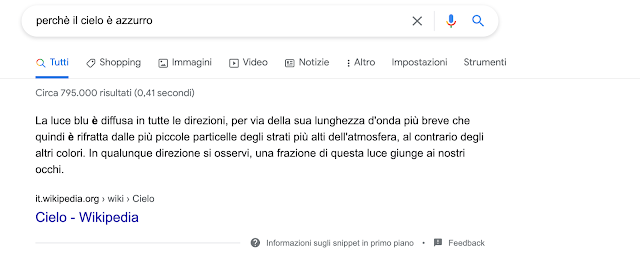
Gli snippet in primo piano
 |
| Un esempio di snippet in primo piano |
Le schede informative
 |
| Un esempio di scheda informativa |
Funzionalità predittive
Risultati Web
Protezioni antispam
Rimozioni legali e basate sulle norme

Quando (e perché) rimuoviamo contenuti dai risultati di ricerca Google
Rispetto della legge
Norme per la rimozione volontaria
Risoluzione dei problemi su vasta scala
Un Web in evoluzione

5 modi in cui rendiamo più sicura la Ricerca con Google
1. Lotta allo spam

2. Crittografia delle ricerche
3. Più informazioni sui risultati prima di fare clic
4. Esplorare in sicurezza
5. Protezione da annunci ingannevoli
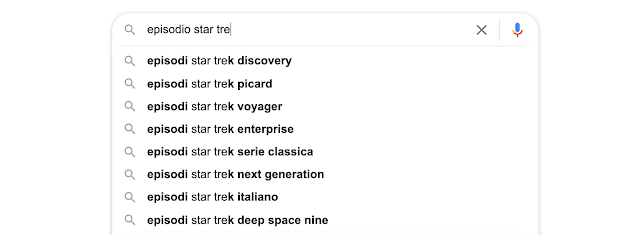
Come funziona il completamento automatico nella Ricerca Google
Da dove vengono le previsioni del completamento automatico
In che modo Google fornisce informazioni affidabili nella Ricerca
- In primo luogo, progettiamo i nostri sistemi di classificazione proprio per identificare le informazioni che le persone probabilmente troveranno utili e affidabili.
- Perché questo abbia un senso, abbiamo anche sviluppato una serie di funzioni di Ricerca che non solo vi aiutano a dare un senso a tutte le informazioni che vedete online, ma che forniscono anche accesso diretto alle informazioni fornite da fonti autorevoli, come organizzazioni sanitarie o enti governativi.
- Infine, abbiamo delle norme per ciò che può essere visualizzato nelle funzioni di ricerca per assicurarci di mostrare contenuti utili e di alta qualità.
Basare i nostri sistemi di classificazione sulla qualità
Informazioni fornite da esperti, direttamente nella Ricerca
Vi aiutiamo a capire le informazioni in vostro possesso
Proteggiamo le funzionalità della Ricerca tramite norme

Organizzare le informazioni del mondo: come è cominciato tutto?
Conoscenza comune e fonti di dati pubbliche
Licenze e partnership
Informazioni fornite da persone e attività commerciali
Informazioni e dati generati da Google
Organizzare le informazioni e renderle accessibili e utili
Come Google organizza le informazioni per aiutarvi a trovare ciò che cercate
Organizzare le informazioni in modi utili e versatili
Un aiuto per approfondire un argomento
Come determiniamo il ranking per funzionalità e risultati
Continuiamo ad investire per un’esperienza di qualità

Vi siete mai chiesti come funziona la Ricerca Google?
- Come Google organizza le informazioni per farvi trovare ciò che cercate
- Organizzare le informazioni del mondo: come è cominciato tutto?
- In che modo Google fornisce informazioni affidabili nella Ricerca
- Come funziona il completamento automatico nella Ricerca
- 5 modi in cui rendiamo Google il modo più sicuro per fare una ricerca
- Quando (e perché) rimuoviamo contenuti dai risultati di ricerca di Google
- Come manteniamo la ricerca pertinente e utile