Offerte esclusive Prime:gli hard disk portatili più economici in offerta
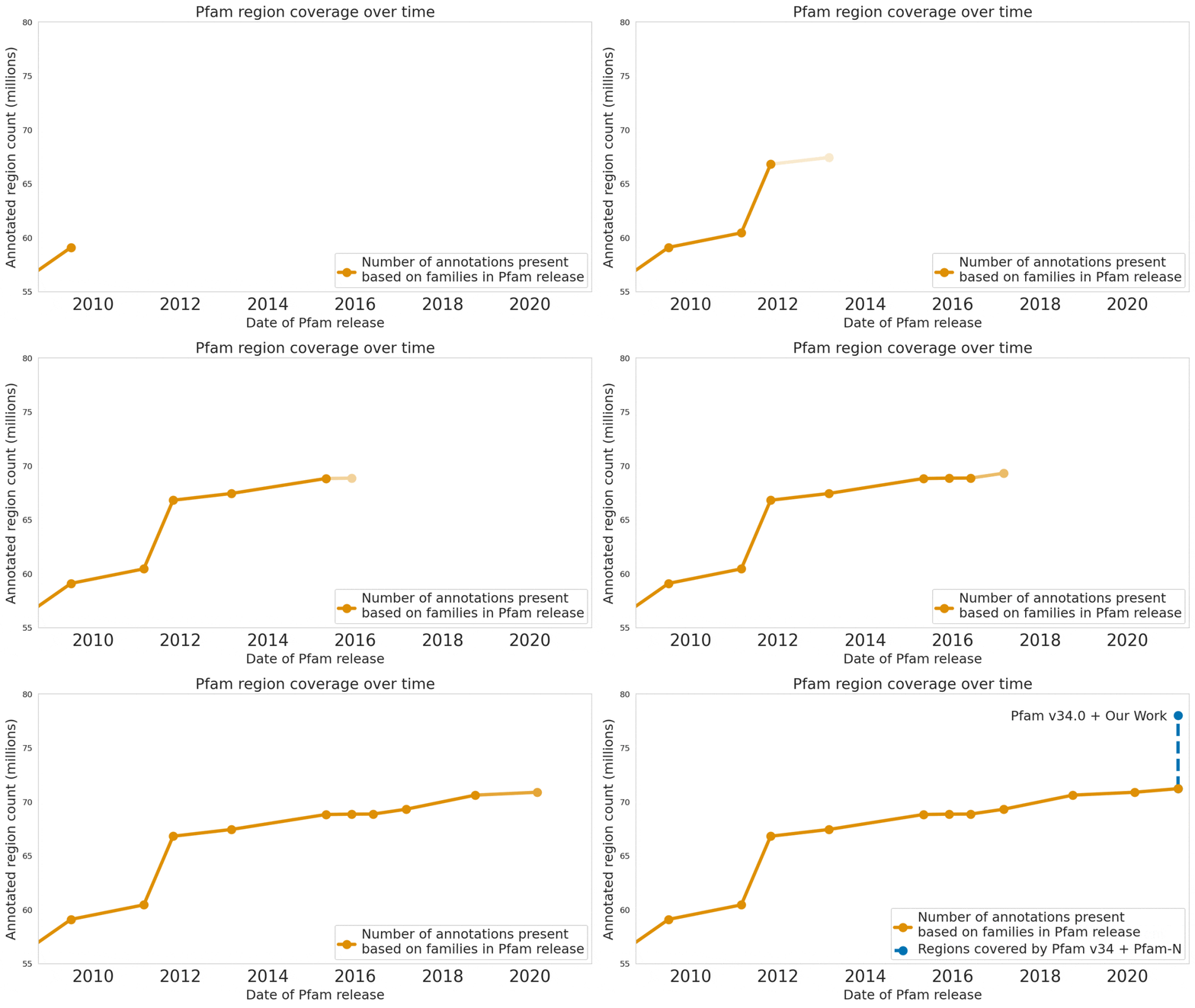
How we’re using machine learning to understand proteins
When most people think of proteins, their mind typically goes to protein-rich foods such as steak or tofu. But proteins are so much more. They’re essential to how living things operate and thrive, and studying them can help improve lives. For example, insulin treatments are life-changing for people with diabetes that are based on years of studying proteins.
There is a world of information yet to discover when it comes to proteins — from helping people get the healthcare they need to finding ways to protect plant species. Teams at Google are focused on studying proteins so we can realize Google Health’s mission to help billions of people live healthier lives.
Back in March, we published apost about a model we developed at Google that predicts protein function and a tool that allows scientists to use this model. Since then, the protein function team has accomplished more work in this space. We chatted with software engineer Max Bileschi to find out more about studying proteins and the work Google is doing.
Can you give us a quick crash course in proteins?
Proteins dictate so much of what happens in and around us, like how we and other organisms function.
Two things determine what a protein does: its chemical formula and its environment. For example, we know that human hemoglobin, a protein inside your blood, carries oxygen to your organs. We also know that if there are particular tiny changes to the chemical formula of hemoglobin in your body, it can trigger sickle cell anemia. Further, we know that blood behaves differently at different temperatures because proteins behave differently at higher temperatures.
So why did a team at Google start studying proteins?
We have the opportunity to look at how machine learning can help various scientific fields. Proteins are an obvious choice because of the amazing breadth of functions they have in our bodies and in the world. There is an enormous amount of public data, and while individual researchers have done excellent work studying specific proteins, we know that we’ve just scratched the surface of fully understanding the protein universe. It’s highly aligned to Google’s mission of organizing information and making it accessible and useful.
This sounds exciting! Tell us more about the use of machine learning in identifying what proteins do and how it improves upon the status quo.
Only around 1% of proteins have been studied in a laboratory setting. We want to see how machine learning can help us learn about the other 99%.
It’s difficult work. There are at least a billion proteins in the world, and they’ve evolved throughout history and have been shaped by the same forces of natural selection we normally think of as acting on DNA. It’s useful to understand this evolutionary relatedness among proteins. The presence of a similar protein in two or more distantly related organisms (say humans and zebrafish) can be indicative that it’s useful for survival. Proteins that are closely related can have similar functions but with small differences, like encouraging the same chemical reaction but doing so at different temperatures. Sometimes it’s easy to determine that two proteins are closely related, but other times it’s difficult. This was the first problem in protein function annotation that we tackled with machine learning.
Machine learning helps best when it truly helps, not replaces, current techniques. For example, we demonstrated that about 300 previously-uncharacterized proteins are related to “phage capsid” proteins. These capsid proteins can help us deliver medicines to the cells that really need them. We worked with a trusted protein database, Pfam, to confirm our hypothesis, and now these proteins are listed as being related to phage capsid proteins — for all the public to see — including researchers.
Back up a bit. Can you explain what the protein family database Pfam is? How has your team contributed to this database?
A community of scientists built a number of tools and databases, over decades, to help classify what each different protein does. Pfam is one of the most-used databases, and it classifies proteins into about 20,000 types of proteins.
This work of classifying proteins requires both computer models and experts (called curators) to validate and improve the computer models.
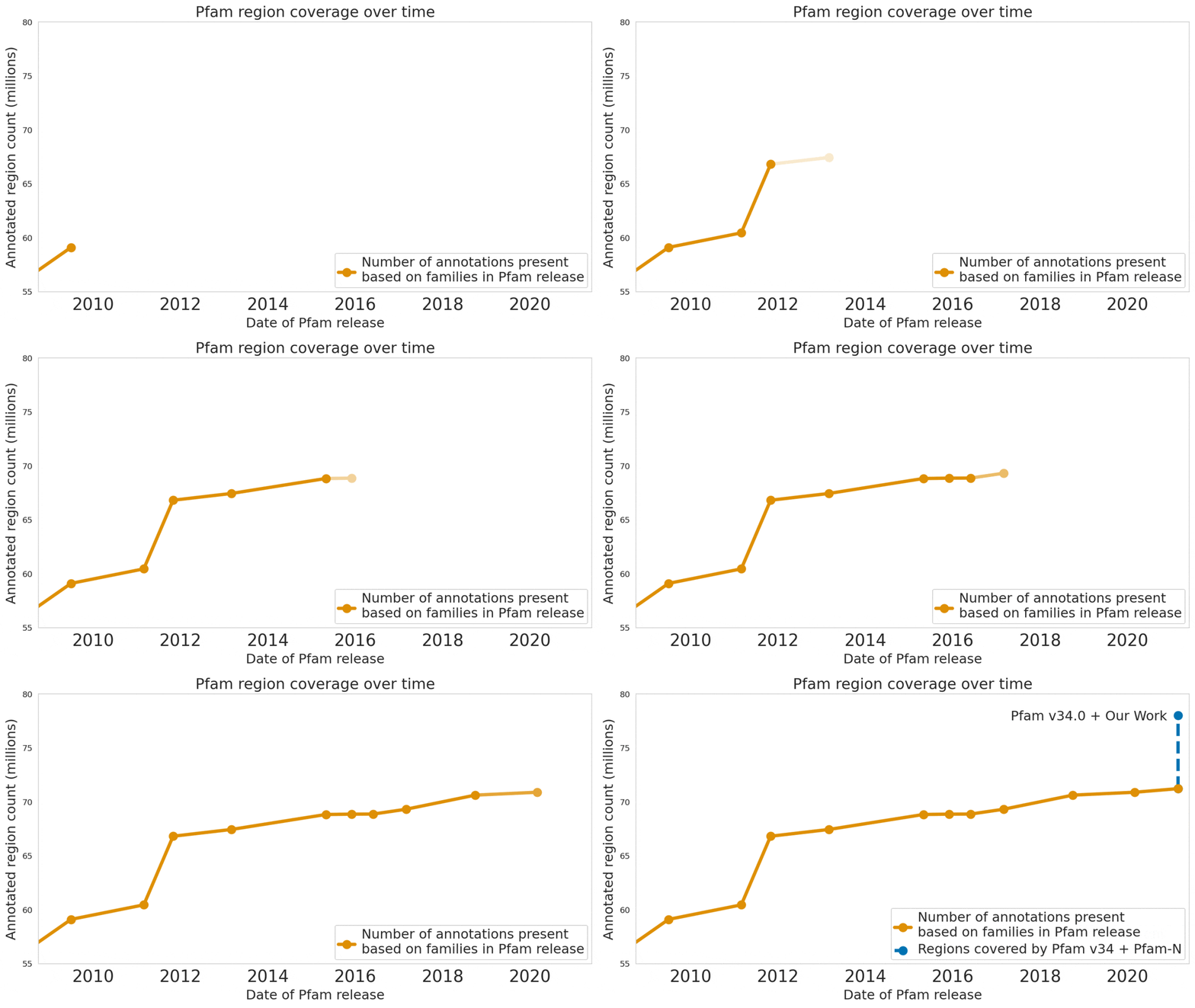
We used machine learning to add classifications for human proteins that previously lacked Pfam classifications — helping grow the database and adding several years of progress.
Since the publication of your paper ‘Using deep learning to annotate the protein universe’ in June, what has your team been up to?
We’re focused on identifying more proteins and sharing that knowledge with the science and research community. And we’re soon making Pfam data and MGnify data, another database that catalogs microbiome data, available on Google Cloud Platform so more people can have access to it. Later this year, we’ll launch an initiative with UniProt, a prominent database in our field, to use language models to name uncharacterized proteins in UniProt. We’re excited about the progress we’re making and how sharing this data can help solve challenging problems.
Amazon Prime Day: scheda video EVGA GeForce RTX 3080 Ti ad un prezzo mai visto prima d’ora
Motorola Moto E32: offerta mai vista prima su Amazon
Amazon Prime Day: PREZZO FOLLE, EVGA GeForce RTX 3090 Ti FTW3 Ultra in sconto del 54%
Approfitta ora di uno sconto senza precedenti: EVGA GeForce RTX 3090 Ti in offerta speciale: ora al 54% in meno rispetto al prezzo di listino
Leggi Amazon Prime Day: PREZZO FOLLE, EVGA GeForce RTX 3090 Ti FTW3 Ultra in sconto del 54%
iRobot Roomba 971: robot aspirapolvere 3-in-1 a prezzo REGALO (-40%)
Spazio esaurito su telefono? 128 GB in più con questa chiavetta USB
Oral-B Sensitive Clean: 12 testine di ricambio REGALATE da Amazon (23€)
Project Starline expands testing through an early access program
As hybrid work expands its footprint, how we work and collaborate continues to evolve. We’re continuing to explore ways to bring teams together and facilitate employee connection from afar through technology. That’s why last year we announced Project Starline, a technology project that enables coworkers to feel like they are together, even when they are cities apart.
The technology works like a magic window, where users can talk, gesture and make eye contact with another person, life-size and in three dimensions. It is made possible through major research advances across machine learning, computer vision, spatial audio and light field display systems.
Today, Project Starline prototypes are found in Google offices across the U.S., with employees using the technology every day for meetings, employee onboarding and building rapport between colleagues. Results show Project Starline can increase employee presence, attentiveness, and productivity compared to traditional video calling solutions. People have described the experience as a natural interaction — expressing how connected they felt to the other person sitting across from them.
Beyond Google employees, we’ve also invited more than 100 enterprise partners in areas like media, healthcare and retail to participate in demos at Google’s offices and provide us with feedback on the experience and applications to their businesses. We see many ways Project Starline can add business value across a number of industries, and we remain focused on making it more accessible.
“The proliferation of hybrid work models is creating new opportunities to fundamentally rethink how we collaborate in the workplace,” says Scott Morey, president of technology & innovation at WeWork. “Project Starline is at the forefront of this shift, providing an incredible user experience that bridges the gap between our physical and virtual worlds. At WeWork, we believe this technology has the potential to enrich the employee experience – making connections more intentional and meaningful.”
Today, we are expanding our testing efforts through an early access program with enterprise partners such as Salesforce, WeWork, T-Mobile and Hackensack Meridian Health
“In today’s digital-first world, companies need to provide the technology and tools to help employees be more productive and effective at work,” Andy White, SVP of Business Technology at Salesforce, tells us. “At Salesforce, we’re constantly exploring new ways to deliver incredible experiences to our employees and customers around the world. Project Starline has the potential to drive deeper connections between people by bridging in-person and virtual experiences.”
As we build the future of hybrid work together with our enterprise partners, we look forward to seeing how Project Starline can help employees form strong ties with one another, doctors form meaningful bonds with their patients, and salespeople make deeper connections with their clients and customers. Whether you’re presenting to a colleague or just sitting down for a coffee chat, we want the Project Starline experience to feel natural, as if the person is sitting in the same room as you. More broadly, we are eager to enable workforces to feel energized and productive when collaborating from afar. We look forward to sharing more about what we learn from our early access program next year.
3 things to look forward to at Google Play Live
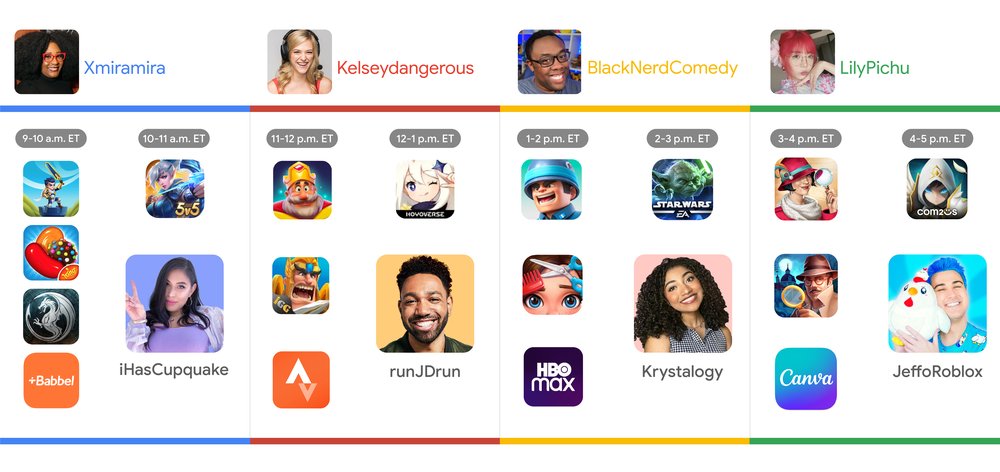
Since 2012, Google Play has helped people around the world discover their favorite apps, games and digital content. And now, we’re bringing YouTube creators to Google Play for our first-ever live show in the United States. The show starts at 9 a.m. Eastern time on October 12, and you can watch it live on Google Play or by visiting our official YouTube channel.
Here are three things to look forward to at the show.
1. Play alongside YouTube creators
Creators will introduce their favorite games and apps, and will play them live on stage — sometimes with anyone else who wants to join. Jaron Meyers & Tim Stone, Lizzy Capri, Mari Takahashi and Preacher Lawson will host the show. And their friends and surprise guests will also join the livestream to play alongside the audience and participate in fun challenges.
2. Choose your adventure
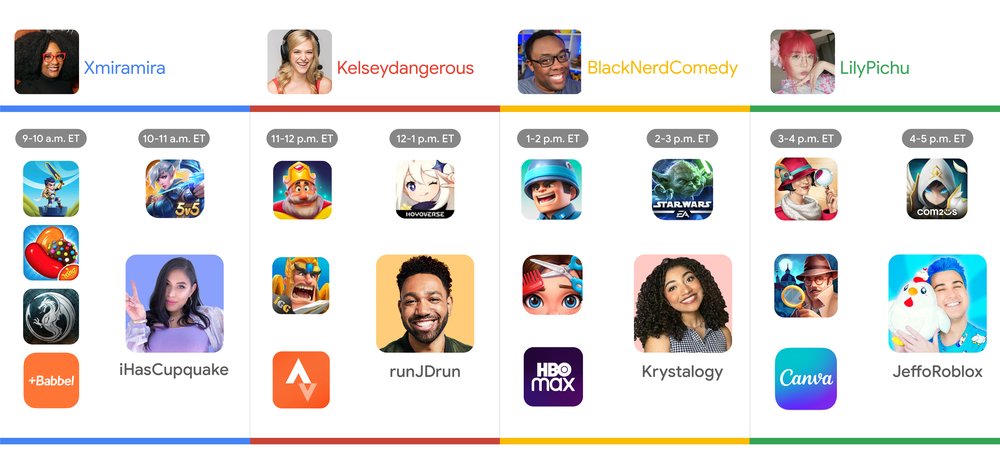
Audience participation is a huge part of the event — you’ll have a chance to influence what’s happening live on set through things like polls and a live chat. Here’s a look at what you can expect.
3. Nab last-chance deals on apps and games
We’ve partnered with developers of some of the top apps and games on Google Play like HBO Max, Candy Crush Saga and Genshin Impact, so you can get special deals in the apps and games the YouTube creators will be playing live. Visit Google Play to see all the deals on gold bars, special bundles, boosters and more. You’ll also get 3x Play Points when you buy in-app and in-game items through October 12
Tune in at 9 a.m. Eastern time on October 12 to watch the show live.
Logitech Pebble, mouse wireless con prezzo che PRECIPITA (-38%)
Stampante HP Envy ad un PREZZO ASSURDO
OPPO Enco Air W32, a questo prezzo sono imperdibili: col Prime Day costano la metà
Offerte esclusive Prime, sconti FOLLI Su questi 9 prodotti BOMBA
Kotlin Multiplatform Mobile: App multipiattaforma con Kotlin
JetBrains presenta Kotlin Multiplatform Mobile, framework per sviluppare App Android e iOS con Kotlin
Leggi Kotlin Multiplatform Mobile: App multipiattaforma con Kotlin