Smart TV Samsung UHD 4K 43″: un SOGNO a occhi aperti (-33% su Amazon)
eero Pro 6, ECCELLENTE sistema mesh Wi-Fi 6 a prezzo SHOCK (-47%)
Offerte esclusive Prime: gli hard disk portatili più economici in offerta
Ultimo giorno per il Prime Day di Amazon: approfitta ora di questi sconti incredibili e acquista uno degli Hard Disk in promo
Leggi Offerte esclusive Prime: gli hard disk portatili più economici in offerta
Offerta BOLLENTE Amazon, preservativi Durex in super sconto: dura sex, sed sex
Prime Day da SOGNO: OPPO Enco W12, prezzo in picchiata costano la metà
Cloud Workstations: sviluppare su Cloud con VSCode
Google presenta Cloud Workstations, soluzioni per il Cloud ibrido per sviluppare con Visual Studio Code
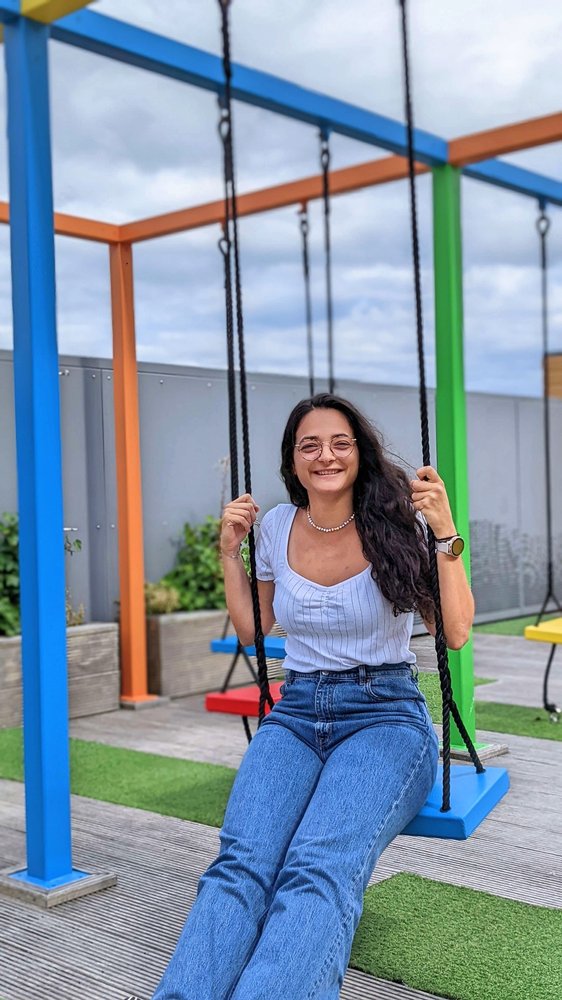
A Google Ads expert uses her skills to support nonprofits
Lauriane Giuranna is a Google Ads specialist, working with advertisers to make the best out of Google’s digital marketing tools. When she had the chance to use her skills to help gender equity nonprofits boost their visibility online, she immediately raised her hand. As part of a Google’s rotation program (an opportunity for employees to take a temporary role within a different team), Lauriane worked full-time for three months providing digital marketing support to select nonprofits. We chatted with her to hear more about the experience.
Tell us a little bit more about yourself.
In September 2019 — just after college — I joined Google in Dublin, Ireland as a Google Ads Specialist for the French Market. Outside of work, social impact has always been close to my heart. Before moving to Ireland I was volunteering to provide services to homeless and underserved communities in my hometown, Paris.
How have you used your role at Google to continue focusing on social impact?
One of the reasons I joined Google was its intrinsic commitment to social impact. Still, it surprised me to see the amount of opportunities I had to get involved in side projects that mattered to me and to have managers encouraging me to take them on. When the pandemic hit and domestic abuse reached new heights, I started supporting a French nonprofit that assists gender-based violence victims with their Google Ad Grants account, a program that donates ads on Google Search to eligible nonprofits.
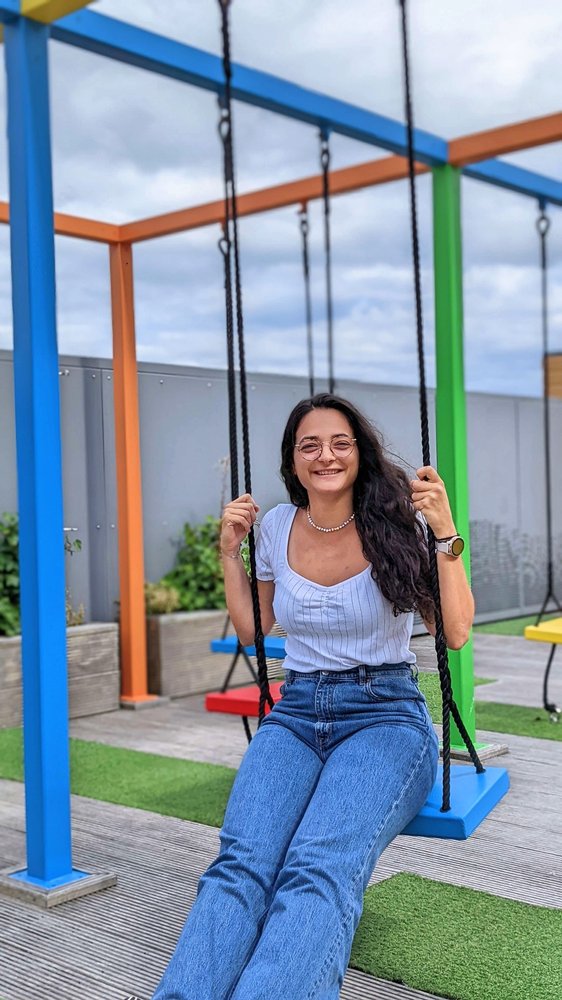
Lauriane at the Google office in Dublin
Tell us more about the 3-month rotation and why it was focused on gender equity.
Gender equity is a matter of human rights and global prosperity and over time, we’ve seen a growing interest in the topic on Google Search. Last year, Google.org announced the 34 recipients of the $25 million Google.org Impact Challenge for Women and Girls. Google realized the need to help gender equality organizations promote online content and boost their visibility to help people in need find trusted information. Google.org worked with a few select Impact Challenge recipients to provide additional support on Google Ad Grants.
What was your day-to-day work like during the rotation?
I focused on 10 women and girls organizations. I set up campaigns and looked into metrics to improve and optimize performances. I also hosted office hours and delivered more than 15 hours of product training for 20 nonprofits professionals to use Google Ad Grants. I wanted to make sure the nonprofits could continue to use the product successfully.
Can you share an example?
I worked with Girls Inc. of NYC, an Impact Challenge recipient on a mission to deliver life transforming programs so that girls and women can thrive. When I first met with Lily Chang, chief development officer, we defined the marketing plan and set some measurable goals, like increasing newsletter sign-ups. Girls Inc. of NYC had never used Ad Grants before and leveraged our Google technical team to implement conversion tracking. We then built and tested several campaigns to reach more supporters across the U.S. The impact is tangible — the website traffic has doubled and almost 20% of newsletter sign-ups and 9% of donations now come after a click on an ad.
You accomplished a lot in three months! What was the personal impact on you?
I developed skills that gave me a good steer on my career growth. I would love to continue working with nonprofits and I now feel much more prepared.
To learn more about Google’s product giving and Google.org, visit google.com/nonprofits and google.org.
<div>Bringing more of Google’s productivity apps to Glass Enterprise</div>
Imagine translating instructions into a colleague’s native language in real-time. Or instantly crossing off daily tasks as you complete them. That’s part of our vision for augmented reality (AR), which has the potential to transform how companies and their frontline workers access information and make informed decisions while collaborating with their teams. We’re working to create a more natural and intuitive way to seek, interact with, and use information in the real world through AR.
Today, we are revealing a new early access program focused on bringing more of Google’s productivity apps and collaboration tools to the Glass Enterprise platform. Companies interested in Glass Enterprise most often request AR features that help people communicate and complete tasks. Starting today, we’re introducing the opportunity for Google Workspace enterprise customers to partner with us in testing features focused on task completion, communication, and collaboration.
A more connected and efficient workforce with Glass Enterprise
Since 2017, Glass Enterprise has helped companies utilize AR to help employees work smarter, faster and hands-free. Working with software publishers that create bespoke solutions for companies, Glass Enterprise has helped customers like DB Schenker increase warehouse efficiency by 10%. Wendy’s used Glass Enterprise to support food safety, quality practices and oversight of suppliers and distribution centers, as well as remote training and education for restaurant team members.
In 2020, we announced Google Meet on Glass Enterprise to give teams a first-person view of the wearer’s perspective — enabling real-time collaboration and problem solving. Since we launched Meet on Glass, remote team members have stayed connected for more than 750,000 minutes. Meet on Glass is generally available to anyone with Glass Enterprise.
Testing new features within our early access program
As part of this program, we’re expanding our productivity and collaboration offerings to include three new features across Google Tasks, language capabilities and photos:
- See step-by-step instructions: Tasks capabilities on Glass Enterprise provide hands-free access to step-by-step instructions to ensure accuracy and efficiency. Using any supported device, a warehouse manager can create a workflow on Tasks and share it directly to a teammate preparing a shipment, who can see and cross-off tasks in real-time on the Glass Enterprise display.
- Enable natural communication: Language capabilities like translation and transcription on Glass Enterprise help a global workforce understand, train and collaborate, regardless of language. This feature currently supports 15 languages with plans to add more in the near future. With Glass Enterprise, an employee who doesn’t share a common language with their manager can see direct translations in their line-of-sight.
- Collaborate securely: Glass Enterprise can now save images directly to your Pixel phone so you can seamlessly capture photos and share them across teams with Google Photos. Wearers can easily back up and share images and videos to check inventory, audit for quality, or diagnose and review equipment while being hands-free.
These capabilities are made possible by a new phone-enabled platform that uses the computing power of Google Tensor silicon on Pixel. This platform delivers more powerful and unique AR graphics and features on the Glass Enterprise display. It’s controlled by the Glass Enterprise Companion App, making it easier for workers to set up and manage settings out of the box.
We look forward to expanding access as we learn alongside our partners in the coming months, and to the release of more helpful AR features in upcoming programs.
If you are a current Workspace customer interested in testing how these new AR tools can benefit your team, apply to join our Glass Enterprise early access program.
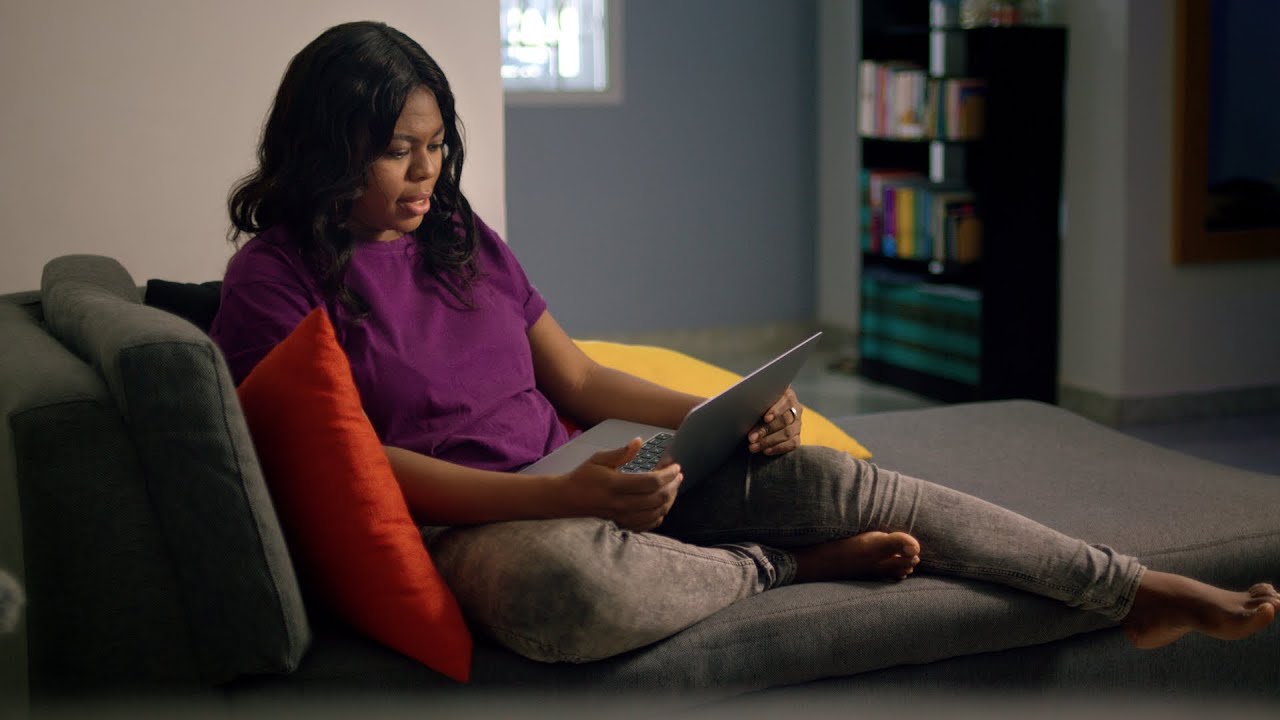
How AI is helping African communities and businesses
Editor’s note: Last week Google hosted the annual Google For Africa eventas part of our commitment to make the internet more useful in Africa, and to support the communities and businesses that will power Africa’s economic growth. This commitment includes our investment in research. Since announcing the Google AI Research Center in Accra, Ghanain 2018, we have made great strides in our mission to use AI for societal impact. In May we made several exciting announcements aimed at expanding these commitments.
Yossi Matias, VP of Engineering and Research, who oversees research in Africa, spoke with Jeff Dean, SVP of Google Research, who championed the opening of the AI Research Center, about the potential of AI in Africa.
Jeff: It’s remarkable how far we’ve come since we opened the center in Accra. I was excited then about the talented pool of researchers in Africa. I believed that by bringing together leading researchers and engineers, and collaborating with universities and the wider research community, we could push the boundaries of AI to solve critical challenges on the continent. It’s great to see progress on many fronts, from healthcare and education to agriculture and the climate crisis.
As part of Google For Africa last week, I spoke with Googlers across the continent about recent research and met several who studied at African universities we partner with. Yossi, from your perspective, how does our Research Center in Accra support the wider research ecosystem and benefit from it?
Yossi: I believe that nurturing local talent and working together with the community are critical to our mission. We’ve signed research agreements with five universities in Africa to conduct joint research, and I was fortunate to participate in the inauguration of the African Master of Machine Intelligence (AMMI) program, of which Google is a founding partner. Many AMMI graduates have continued their studies or taken positions in industry, including at our Accra Research Center where we offer an AI residency program. We’ve had three cohorts of AI residents to date.
Our researchers in Africa, and the partners and organizations we collaborate with, understand the local challenges best and can build and implement solutions that are helpful for their communities.
Jeff: For me, the Open Buildings initiative to map Africa’s built environment is a great example of that kind of collaborative solution. Can you share more about this?
Yossi: Absolutely. The Accra team used satellite imagery and machine learning to detect more than half a billion distinct structures and made the dataset available for public use. UN organizations, governments, non-profits, and startups have used the data for various applications, such as understanding energy needs for urban planning and managing the humanitarian response after a crisis. I’m very proud that we are now scaling this technology to countries outside of Africa as well.
Jeff: That’s a great achievement. It’s important to remember that the solutions we build in Africa can be scalable and useful globally. Africa has the world’s youngest population, so it’s essential that we continue to nurture the next generation of tech talent.
We must also keep working to make information accessible for this growing, diverse population. I’m proud of our efforts to use machine translation breakthroughs to bring more African languages online. Several languages were added to Google translate this year, including Bambara, Luganda, Oromo and Sepedi, which are spoken by a combined 85 million people. My mom spoke fluent Lugbara from our time living in Uganda when I was five—Lugbara didn’t make the set of languages added in this round, but we’re working on it!
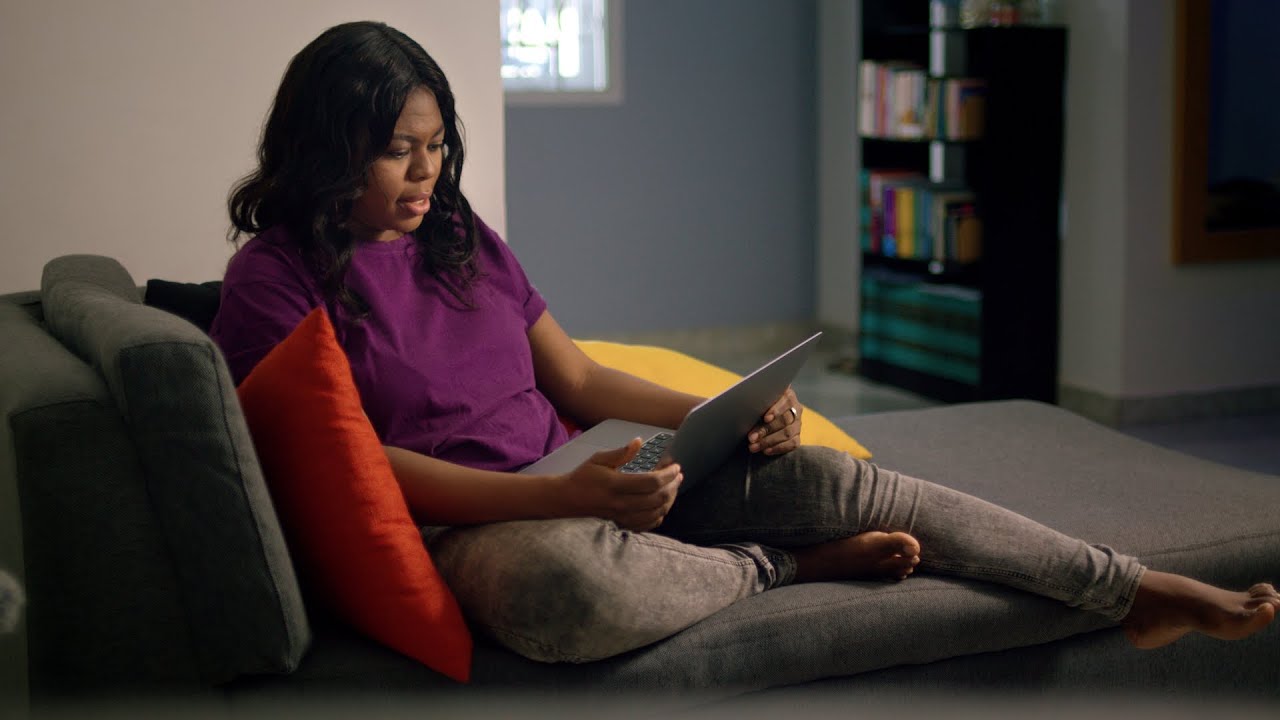
Yossi: That’s just the start. Conversational technologies also have exciting educational applications that could help students and businesses. We recently collaborated with job seekers to build the Interview Warmup Tool, featured at the Google For Africa event, which uses machine learning and large language models to help job seekers prepare for interviews.
Jeff: Yossi, what’s something that your team is focused on now that you believe will have a profound impact on African society going forward?
Yossi: Climate and sustainability is a big focus and technology has a significant role to play. For example, our AI prediction models can accurately forecast floods, one of the deadliest natural disasters. We’re collaborating with several countries and organizations across the continent to scale this technology so that we can alert people in harm’s way.
We’re also working with local partners and startups on sustainability projects including reducing carbon emissions at traffic lights and improving food security by detecting locust outbreaks, which threaten the food supply and livelihoods of millions of people. I look forward to seeing many initiatives scale as more communities and countries get on board.
Jeff: I’m always inspired by the sense of opportunity in Africa. I’d like to thank our teams and partners for their innovation and collaboration. Of course, there’s much more to do, and together we can continue to make a difference.
Offerte esclusive Prime: le migliori offerte sui Chromebook ora su Amazon
Ecco la lista dei Chromebook in offerta su Amazon durante il Prime Day che si è svolto in questi due giorni di sconti
Leggi Offerte esclusive Prime: le migliori offerte sui Chromebook ora su Amazon
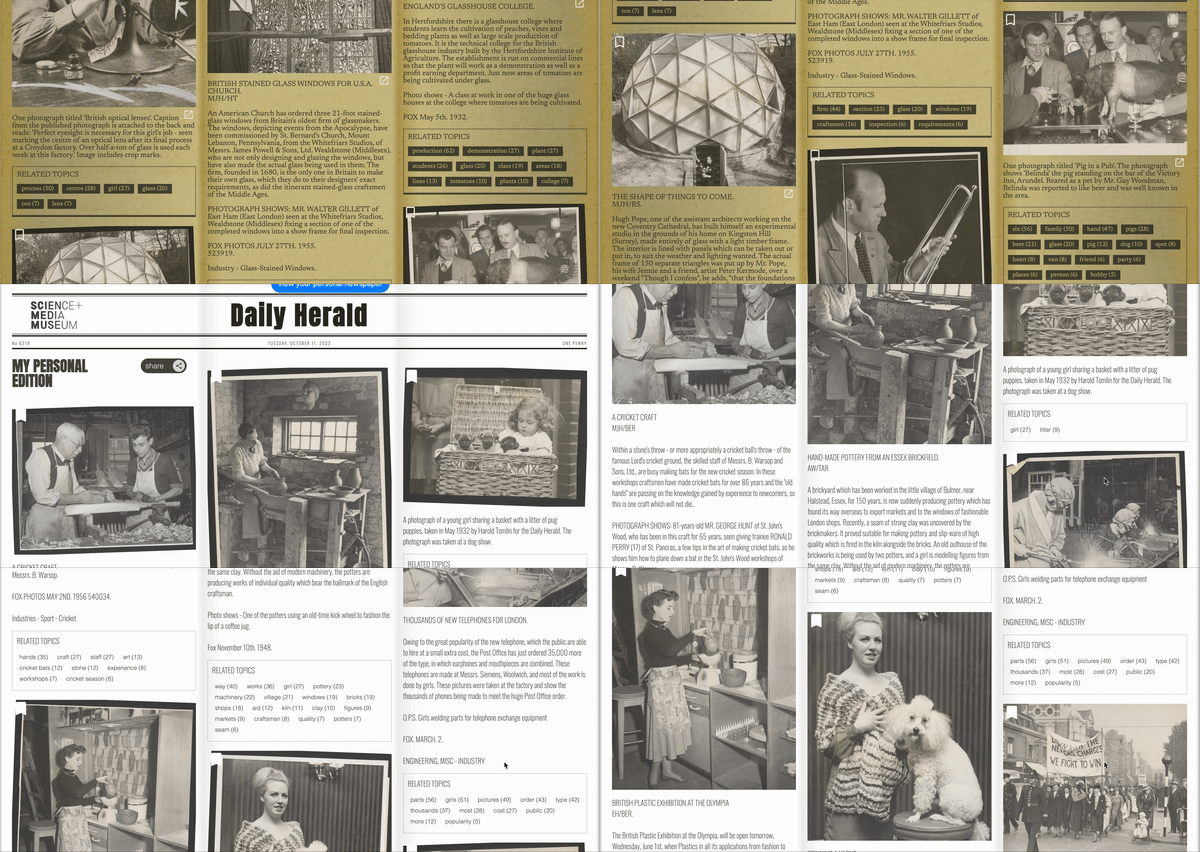
Bringing British history to life through images
In the words of the American writer Susan Sontag, “To collect photographs is to collect the world.” And to see the world as it was, from dramatic historical events to the quirks of everyday life, there’s no better place to begin than a photo archive. Newspapers – whose photojournalists capture everything from grand state ceremonies to dog-grooming competitions – provide us with some of our most important archives.
The Daily Herald Archive has more than three million photographs of life in Britain during the 20th century. Founded in 1912, the Daily Herald was in print for 52 years, spanning two World Wars, the postwar era and the swinging ‘60s. Today, the archive provides a unique portrait of a country undergoing great change, while also documenting local eccentricities and everyday life. Now held at the National Science Media Museum in Bradford, the Daily Herald Archive is the Science Museum Group’s largest collection.
Today, Google Arts & Culture is launching a new digital hub that showcases this incredible archive of more than 70,000 digitized artifacts, along with a new AI-powered experiment that allows you to explore and create your very own edition of the Daily Herald.
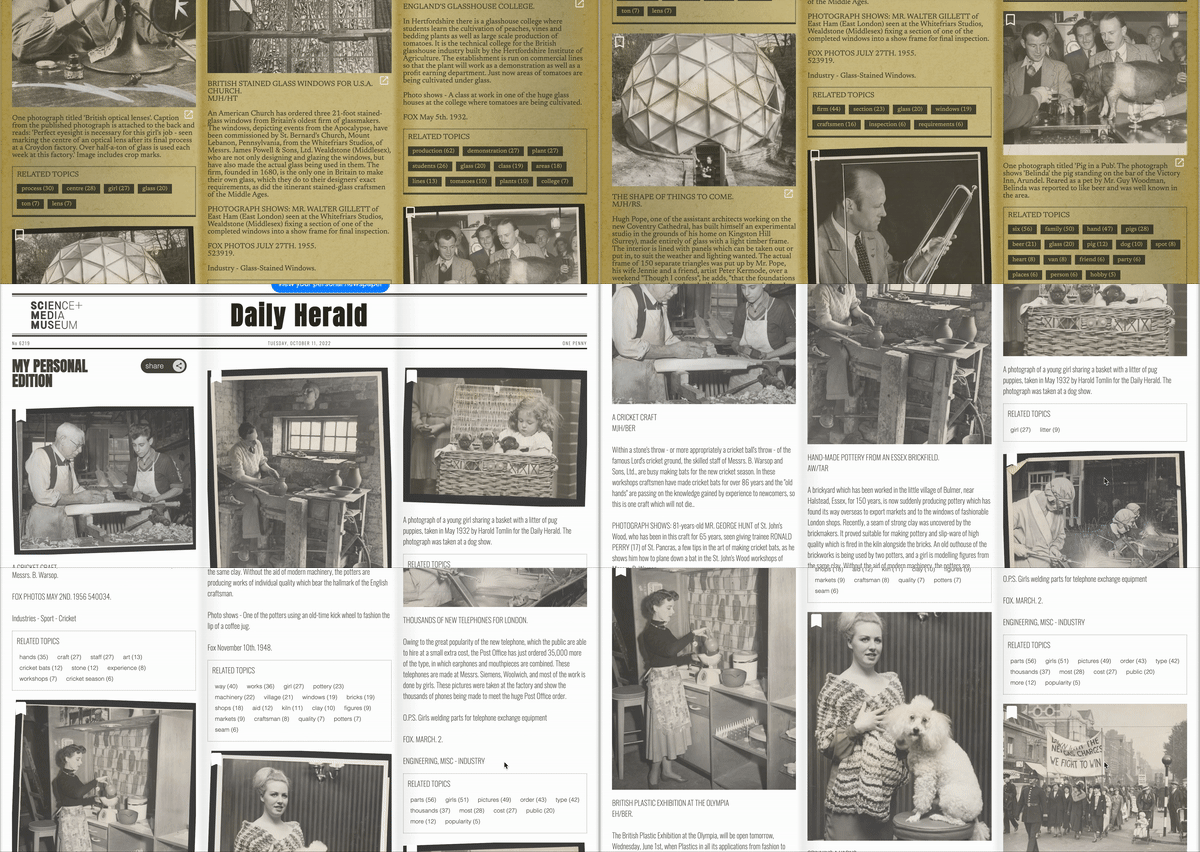
Did you know…? The Daily Herald was once the UK’s most popular newspaper.
The Daily Herald became the first paper to achieve two million daily net sales back in June 1933. Founded in 1912 by members of the British labor movement, the newspaper was known for its anti-establishment stance, its socialist politics and innovative use of photojournalism.
The archive provides a vivid snapshot of British life
The Daily Herald Archive contains pivotal moments in global history alongside day-to-day activities of Britons across the country. Fromdog shows to gymnastics, users can enjoy an authentic portrait of 20th-century Britain.
It contains bonafide masterpieces
Many of the photos in the Daily Herald Archive – taken by press agencies, freelance photographers as well as by Daily Herald photographers – are real masterpieces of photographic art and composition. Check out this image of fountain swimming and this one of awoman making light bulbs.
Alfred Hitchcock!
In 1928, The Daily Herald openeda contest for the public to submit photographs or ‘snaps’ of their holidays. The rules stipulated that no professional photographs would be considered. The competition proved exceedingly popular, with none other than cinematic great Alfred Hitchcock joining the panel of judges in 1936.
The Daily Herald’s story was nearly over before it had begun
The Daily Herald had a very uncertain start to life – it actually stopped publishing after its first four months. The newspaper began as a strike sheet for the London printing unions, but once the fight for better working conditions was won, the Herald closed its doors on 28 April 1911. However, as it had proved so popular, the paper relaunched the next year.
How to enjoy the collection
Now, you can explore the Daily Herald Archive from anywhere in the world.
The new experiment on Google Arts & Culture, My Daily Herald, allows you to create an AI-powered personalized newspaper that takes the first edition of the Daily Herald as its starting point, and invites you to create your own bespoke version. The experiment uses Optical Character Recognition and Natural Language Processing to create the metadata and imagine what an edition of the Daily Herald might look like today.
The hub draws all this together alongside explanatory stories authored by the National Science and Media Museum archive and curatorial team. These explore key topics and themes such as: the history of Kodak photography, Women in radio and A history of the Ideal Home Show.
So jump right in and discover this extraordinary archive: goo.gle/dailyheraldarchive
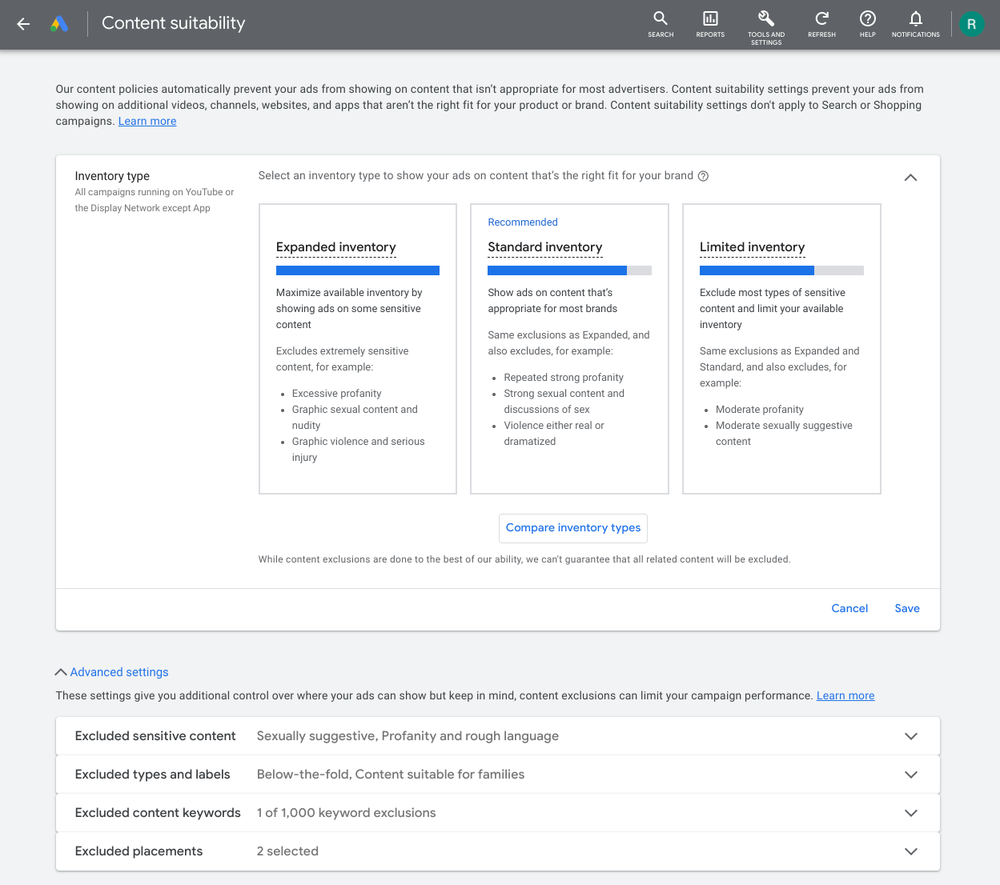
Easier ways for brands to manage suitability across Google
With the rise of streaming, content creation is more diverse than ever before and consumers have more choice than ever on what to watch. In a content-rich world, we want to make it easier for advertisers to feel confident in the environments where their brands appear, to reach new consumers and grow their businesses. That’s why we’re excited to launch a new content suitability center in Google Ads, bringing together everything you need to manage our best-in-class suitability settings, for all campaigns on YouTube and the Google Display Network.
Evolving with your brand suitability needs
Teams across YouTube and Google spent the past two years working directly with brands to better understand their needs and preferences as it relates to suitability. We consistently found that when advertisers knew how to better navigate suitability controls, they experienced performance benefits — ranging from increased reach and view-through rates to decreased cost-per-view. We’ve used this information to further advance our suitability offering.
Through streamlined controls, the new content suitability center will take out the guesswork for brands in curating the environments that align with their values.
Streamlining how you manage controls
Previously, managing suitability settings was done in multiple, segregated sections of Google Ads and the experience differed across Google platforms. This led to a time-consuming and cumbersome implementation process, along with misconceptions and misuse of the controls. While exclusions can be helpful tools, brands also want to be mindful of the types of content they choose to exclude. Over-exclusion can negatively impact your cost and reach. It can also unintentionally exclude great, brand-safe content or content relevant to diverse communities.
Now, you’ll find all suitability controls under a single point-of-entry, making it faster and easier to set your preferences.
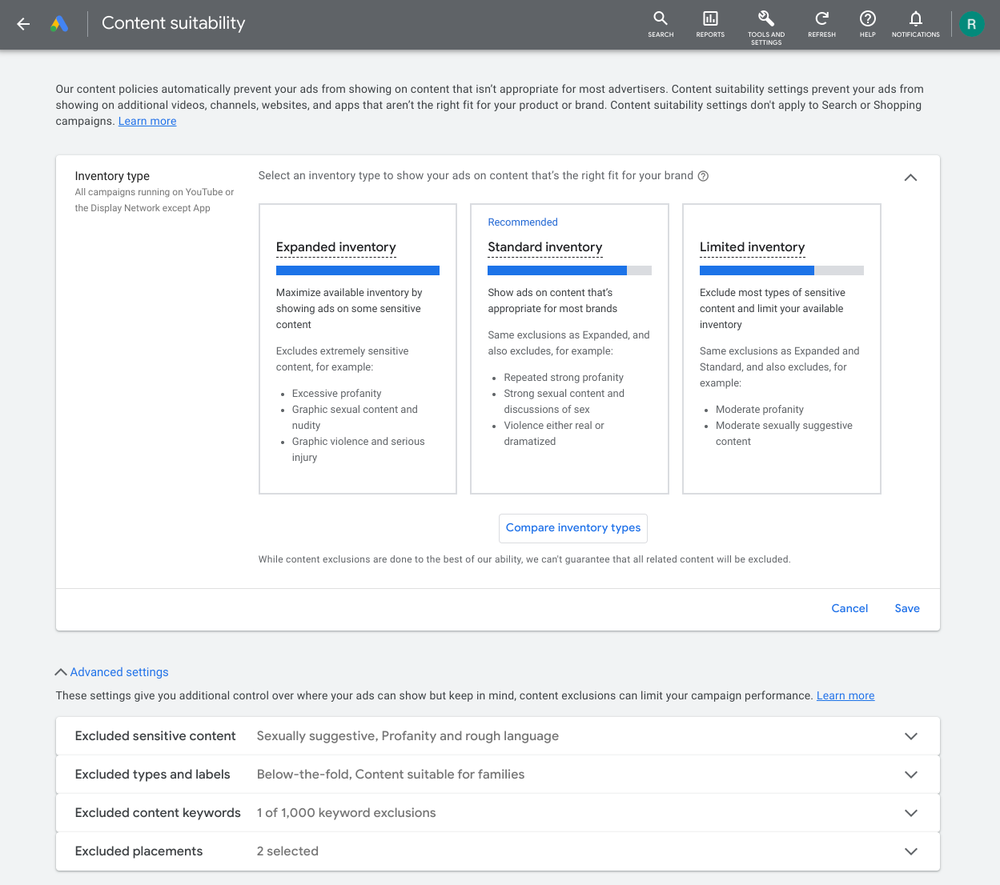
Use the content suitability center to easily set your suitability preferences for inventory modes and exclusions across YouTube and the Google Display Network
When you enter the suitability center, you may select one of the three inventory modes that’s right for your brand. Inventory modes cater to your preferences for various sensitive themes, such as profanity, sexual suggestiveness and violence.
From there, if you have more nuanced needs, you can fine-tune additional exclusions. For example, a body-positive brand may prefer to exclude diet regimens or weight-loss content, while a luxury brand may prefer not to appear alongside content about sales or bargain hauls.
Once you have designated your preferences at the account level, Google Ads will now automatically apply these settings to your future campaigns. It removes the need to repeat the process for each new campaign. This update is designed to reduce human error when launching campaigns.
Bringing increased efficiency across Google
Our multi-year investments in policies, advertiser guidelines and product features are based on our commitment to protect our viewers, creators and advertisers. When YouTube became the first digital platform to receive content-level brand safety accreditation from the Media Rating Council (MRC), it was a testament to the investments we’ve made in responsibility, YouTube’s top priority.
We have ensured that YouTube advertising meets 99% effectiveness for brand safety across in-stream, livestream, Shorts and Watch Next & Home feed content.
Suitability settings work on top of our brand safety systems to give you more control over the content surrounding your ads — content that, while in compliance with our policies, may not resonate with your unique brand values.
“Giving advertisers and agencies control over where their ads show up has been a tangible goal for all of us in GARM (the Global Alliance for Responsible Media),” says Robert Rakowitz, Initiative Lead, GARM. “These new first-party features really help ad buyers in that they are aligned with industry standards, they bring in more formats across all of Google, and make suitability control management easier to manage across markets and brands. We’re excited to see the broader Google organization introduce these new features which add increased transparency and control.”
The content suitability center is the first of many improvements to come, allowing advertisers to more easily control the environments they want to be in and to reap the benefits of improved campaign performance. We’ll have more to share in the coming months to help you continue to align with what works best for your brand identity and navigate the growing landscape of content.
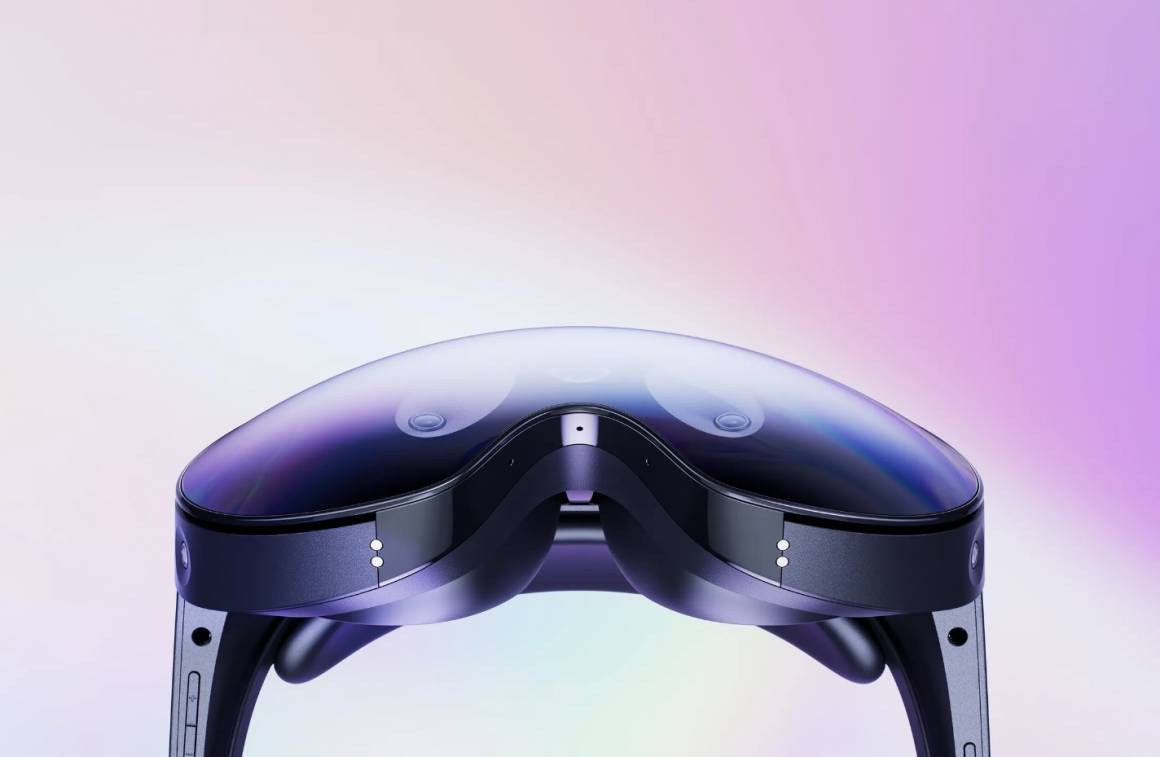
META QUEST PRO A $ 1500 il nuovo visore VR dedicato al metaverse: cosa c’è di nuovo
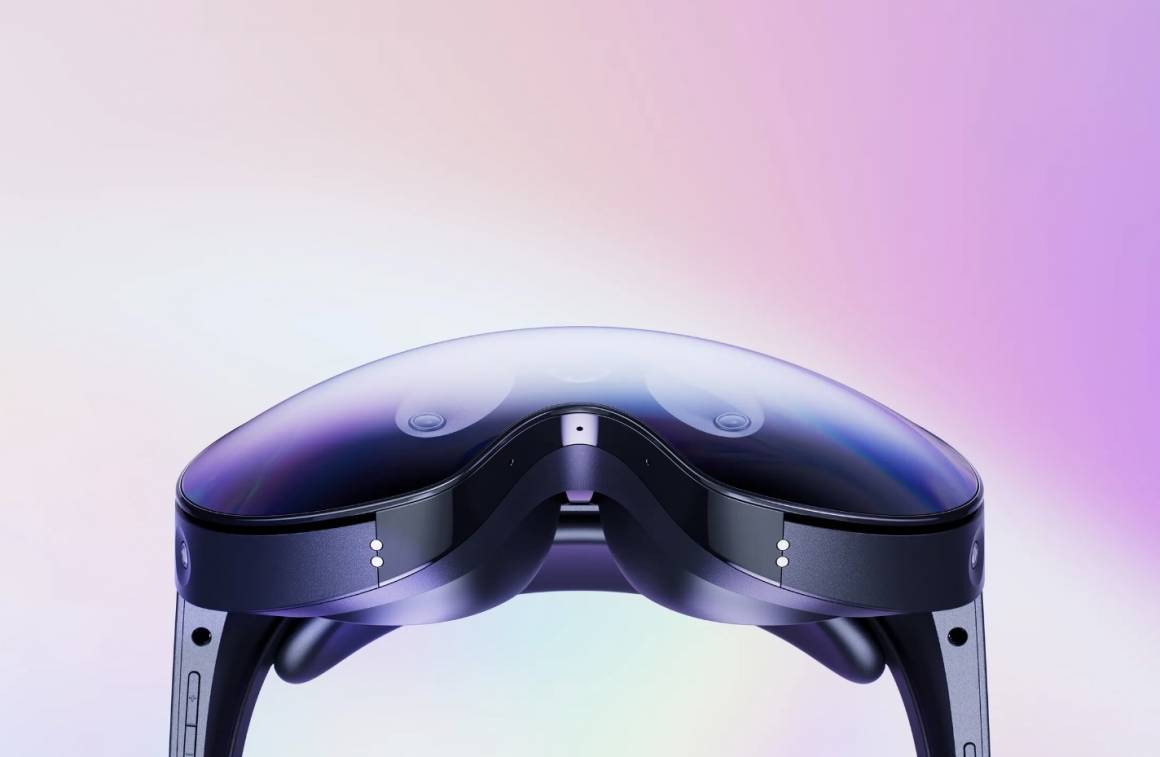 La società madre di Facebook, Meta il 12 ottobre ha presentato il visore per realtà virtuale Meta Quest Pro. Con un prezzo di $ 1500, questo auricolare di fascia alta…
VMware: la falla di vCenter Server è ancora da correggere
VMware non ha ancora provveduto a rilasciare una patch idonea per correggere una falla di vCenter Server risalente a novembre del 2021.
Leggi VMware: la falla di vCenter Server è ancora da correggere