Webcam Logitech C920 HD Pro ad un PREZZO FOLLE
Scheda di Memoria Micro SD Lexar da 1 TB ad un PREZZO ASSURDO
Lenovo IdeaPad Duet Chromebook 2-in-1, con lo sconto di 160€ sta andando a ruba
GeForce RTX 4090 recensione: la nuova scheda video NVIDIA fa impallidire persino la RTX 3090 Ti
<div>Ada Lovelace, scopriamo le novità dell’architettura alla base delle GeForce RTX 4000</div>
3 new ways to help attraction and tour operators reach more travelers
Traveling can be a source of joy and excitement, especially when meaningful experiences are involved. In the last year, we’ve seen searches for “fun activities” reach an all-time high in the U.S. That’s why we’re continuing to make it easier for people to discover things to do on Google, and for businesses to connect with these new potential customers as they plan their trips.
Compare ticket prices on Google Maps
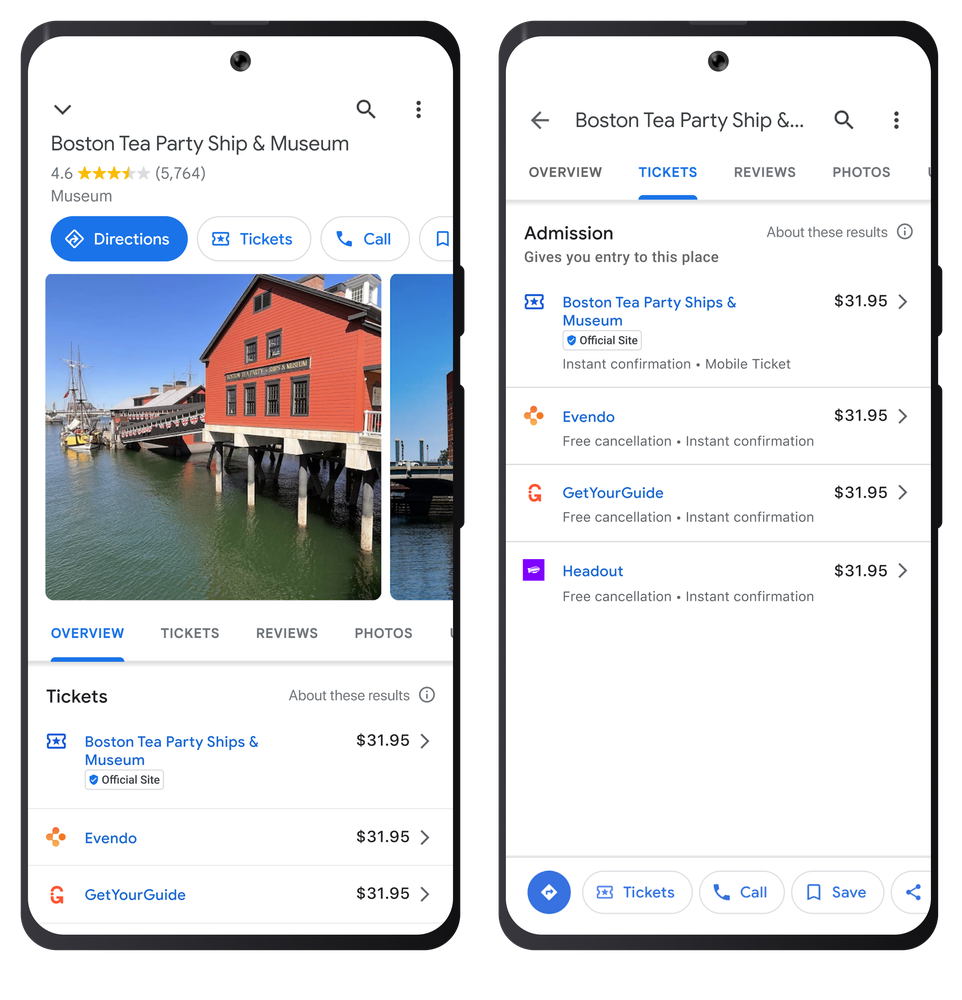
Last year, we began showing ticket booking links on Search when people look for attractions, like the Boston Tea Party Museum, to help them quickly compare admissions prices across different partners. Now, this ticket information is available on Google Maps as well, where travelers often plan their itinerary for the day.
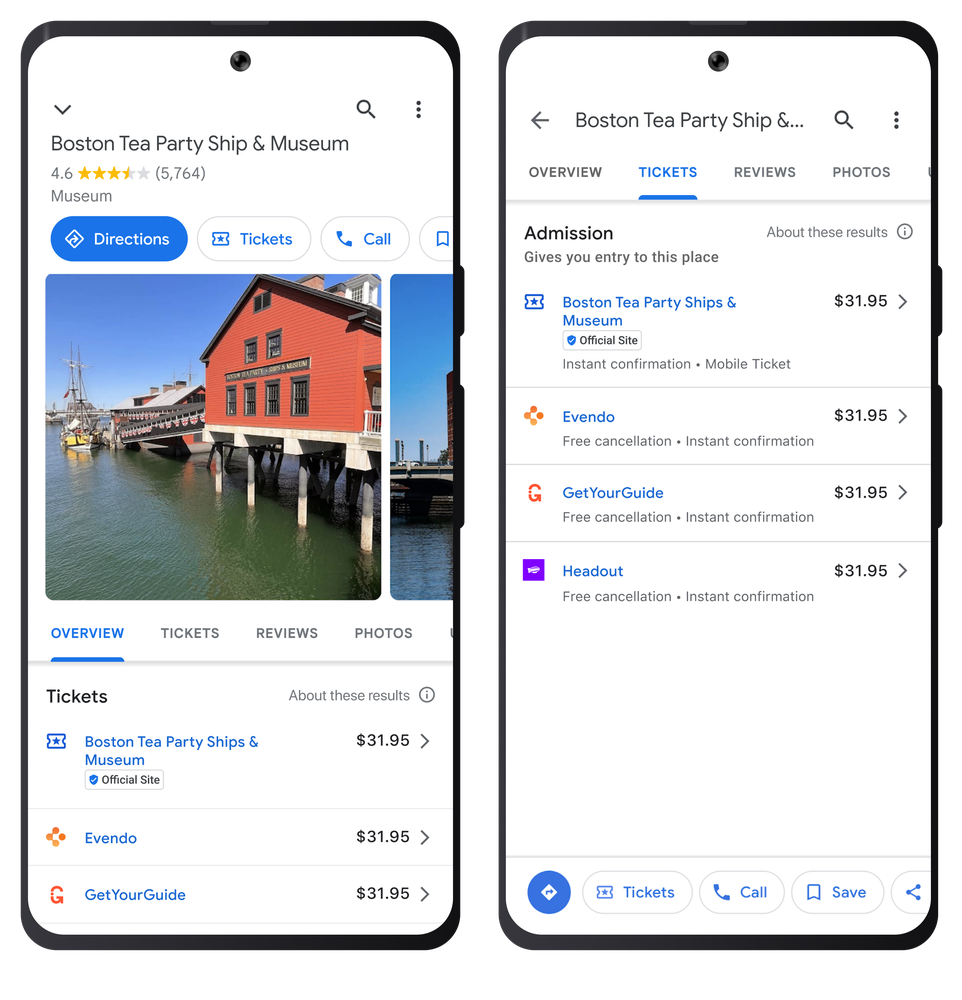
Compare ticket prices right in Google Maps.
We’re also starting to show booking links for experiences connected to a particular attraction, like a combined Statue of Liberty and Ellis Island tour. This feature is currently available on Search and will also be available soon on Maps.
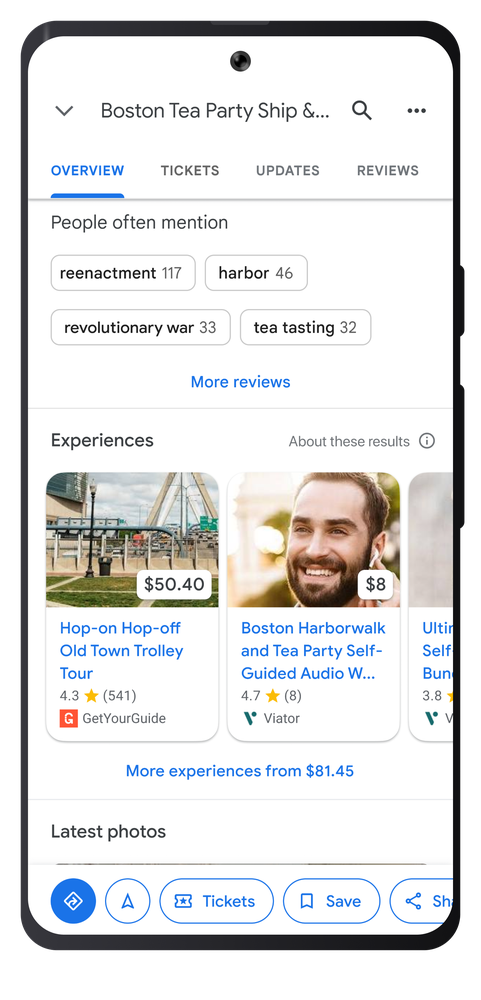
We are also starting to show booking links for experiences connected to a particular attraction.
In the near future, we’ll also begin displaying booking links for tour and activity operators on their Search and Maps listings when people query their business name, like “John’s London Bike Tours.”
Edit ticket prices directly through Google Business Profile
Attraction, tour, and activity operators can work with an approved connectivity partner to provide travelers with the most up-to-date pricing information through a feed integration. Beginning today, attraction owners can also directly edit their ticket prices on Search and Maps through their Business Profile, and this functionality will soon be available for tour and activity operators as well.
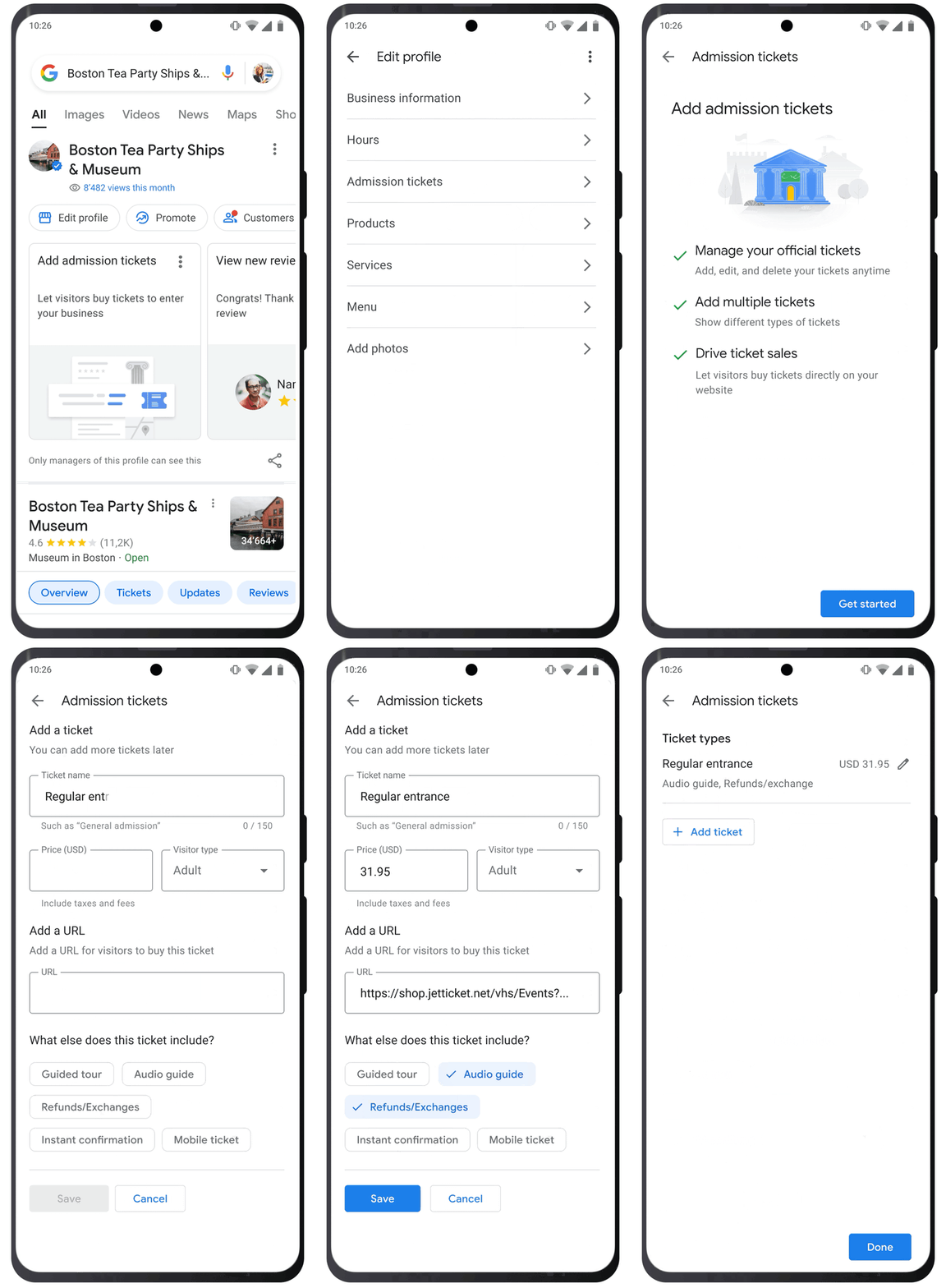
Attraction owners can directly edit their ticket prices through their Business Profile.
Help even more customers find you
Last year we introduced a new ad format on Search that helps advertisers stand out and drive more revenue by showing details like pricing, images and reviews when people search for things to do. Now, this ad unit has expanded coverage to include more countries and languages and is eligible to appear on individual attraction listings on mobile Search. These ads can be set up using the same data feeds that power the free ticket booking links on Search and Maps, so it’s easy to get started.
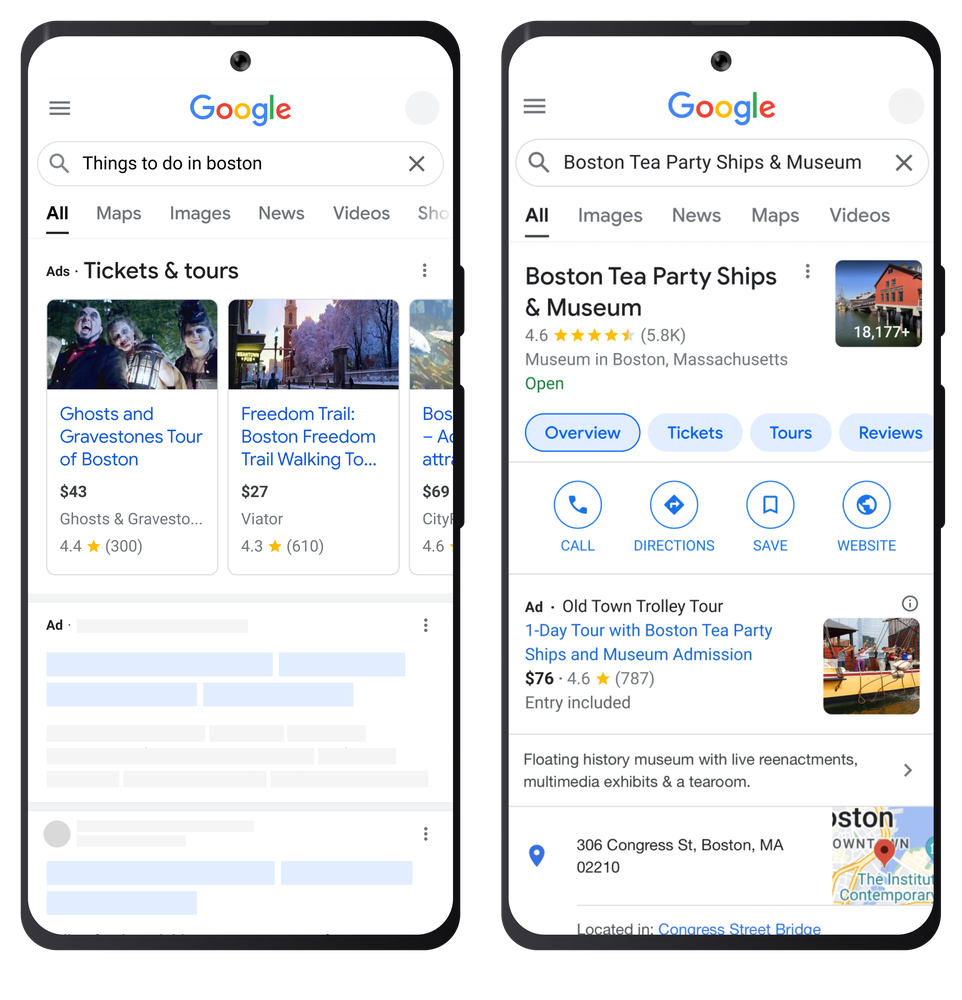
Ads expanded coverage to appear on even more search results.
Register here for our Travel on Air Webinar to learn about these new tools and more to help you connect with potential customers.
Simplifying privacy-safe ads personalization
With many browsers blocking the use of third-party cookies, first-party cookies offer a privacy-first way for publishers and advertisers to create more relevant and engaging experiences for people who engage with their sites or apps. Large publishers with signed-in user bases and dedicated resources often use these identifiers to personalize people’s content and ads. However, not all publishers have these capabilities. That’s why in November, we’ll expand the functionality of publisher first-party cookies from Google Ad Manager and AdSense beyond frequency management, fraud prevention and creative rotation to support ads personalization. This update will help publishers of all sizes easily serve personalized ads and potentially increase the value of their inventory in browsers where third-party cookies aren’t available — all while protecting people’s privacy.
Publisher first-party cookies for ads personalization
Next month, publishers who have first-party cookies enabled will be able to serve personalized ads with minimal technical effort. Here’s how it works. When a publisher allows, Google uses publisher first-party cookies to improve ad relevance on that specific publisher’s website by using information from ad interactions users took on the same site. These first party cookies are used by Google Ads and Display & Video 360 to create aggregated audiences to help advertisers reach their desired customers in browsers where third-party cookies aren’t available.
Publisher first-party cookies cannot be used to track users across the web. They are scoped per publisher, are not shared with other publishers, can’t be joined with any other identifiers and are subject to user consent. When publisher first-party cookies are enabled for ads personalization, ads are shown based exclusively on people’s behavior on a single publisher’s website. Publisher first-party cookies also respect people’s ads personalization preferences as indicated through the AdChoices controls.
As digital ads evolve to meet people’s changing privacy expectations, we’re working on new ways to make it easier for publishers and content creators of all sizes to continue to thrive. For more information or to get started with publisher first-party cookies visit the Google Ad Manager and AdSense product support centers.
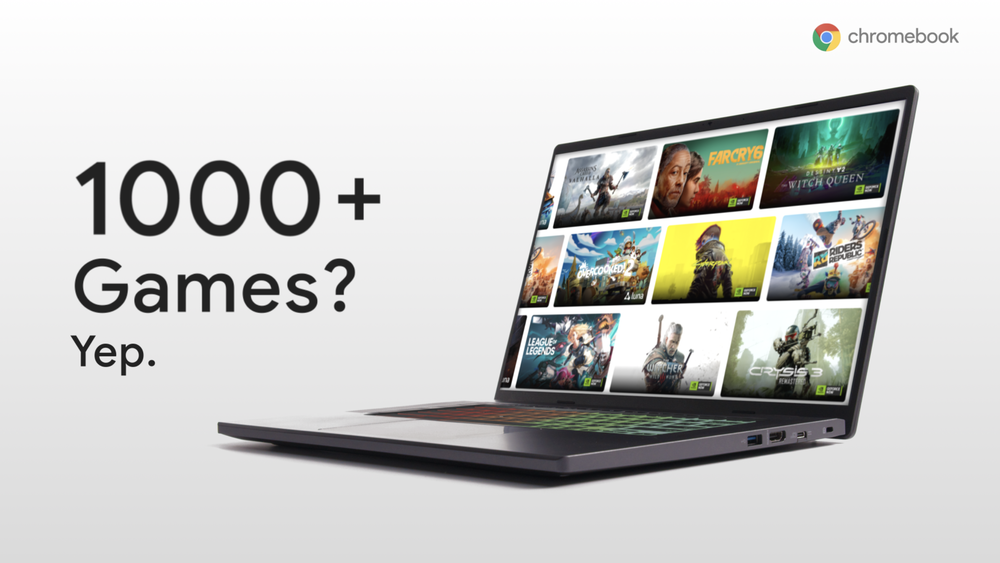
Introducing the world’s first laptops built for cloud gaming
Chromebooks have always been known for being fast, secure and easy-to-use devices. Since their launch more than a decade ago, we’ve improved their capabilities and expanded the variety of devices for people to choose.
Today, we’re taking that effort a step further, by introducing the world’s first laptops built for cloud gaming along with our partners Acer, ASUS and Lenovo. These new Chromebooks bring together gaming hardware features, access to the latest games with cutting edge graphics through the cloud, and software designed to make gaming fast and easy.
A lineup of gaming Chromebooks, powered by the cloud
We are announcing three new Chromebooks today: Acer Chromebook 516 GE, ASUS Chromebook Vibe CX55 Flip and Ideapad Gaming Chromebook from Lenovo. These laptops come loaded with features that are great for gaming, including 120Hz+ high resolution screens for crystal clear visuals, RGB gaming keyboards (on select models) with anti-ghosting capabilities for added speed and excitement, WiFi 6 or 6E for seamless connectivity and immersive audio to draw you into your game.
All cloud gaming Chromebooks have been independently tested and verified by leading game performance measurement platform, GameBench, to consistently deliver a smooth, responsive gaming experience with 120 frames per second and console-class input latency of under 85ms1.
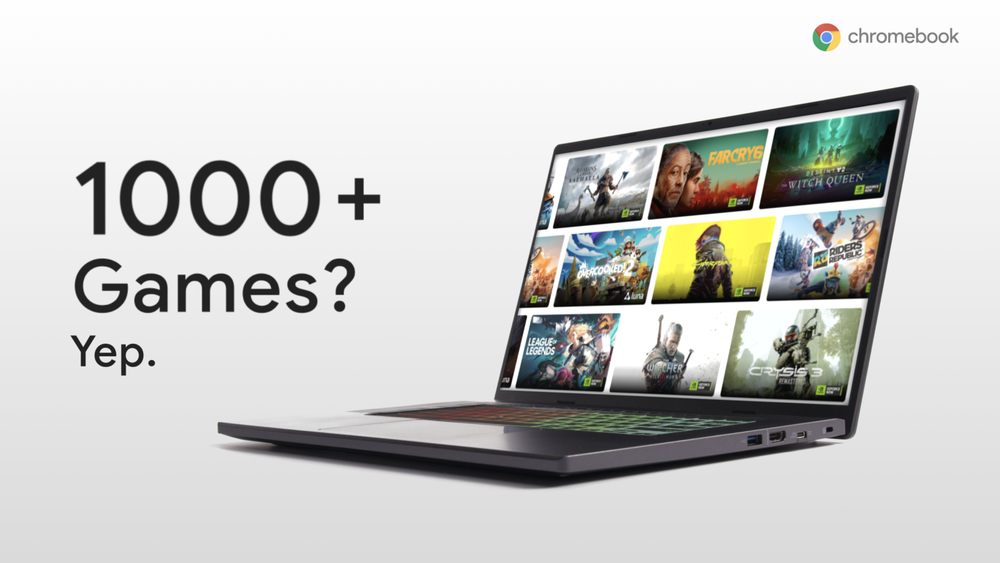
Adding more games and capabilities to Chromebooks
We’ve teamed up with NVIDIA to bring support for GeForce NOW’s highest performance RTX 3080 tier to cloud gaming Chromebooks, so you can stream titles like Fortnite, Cyberpunk 2077, Crysis 3 Remastered and more at up to 1600p resolution and 120 frames per second, taking full advantage of the 120Hz+ high-resolution displays.
The RTX 3080 membership also boosts your gameplay with features like ray tracing, which simulates how light behaves in the real world to make visuals hyper-realistic. The GeForce NOW app will come preinstalled on gaming Chromebooks, so getting to your favorite game will be even easier.
We’ve also worked with Microsoft to bring Xbox Cloud Gaming (Beta) to Chromebook through an installable web app. You can access and install this app by visiting xbox.com/play. Xbox brings a library of hundreds of games including Forza Horizon 5, Grounded and Microsoft Flight Simulator, accessible through an Xbox Game Pass Ultimate subscription.
Easy access to more than 1500 PC and console games
Chromebooks will now support three leading cloud gaming platforms — Xbox Cloud Gaming (Beta), NVIDIA GeForce NOW and Amazon Luna2 — bringing with them full PC and console games straight from the cloud.
Plus, the new cloud gaming Chromebooks make it easier than ever for gamers to find the games they love and start playing them in an instant. Just tap the Everything button, find your game on your platform of choice, then launch the game. No installs. No downloads. No hassle.
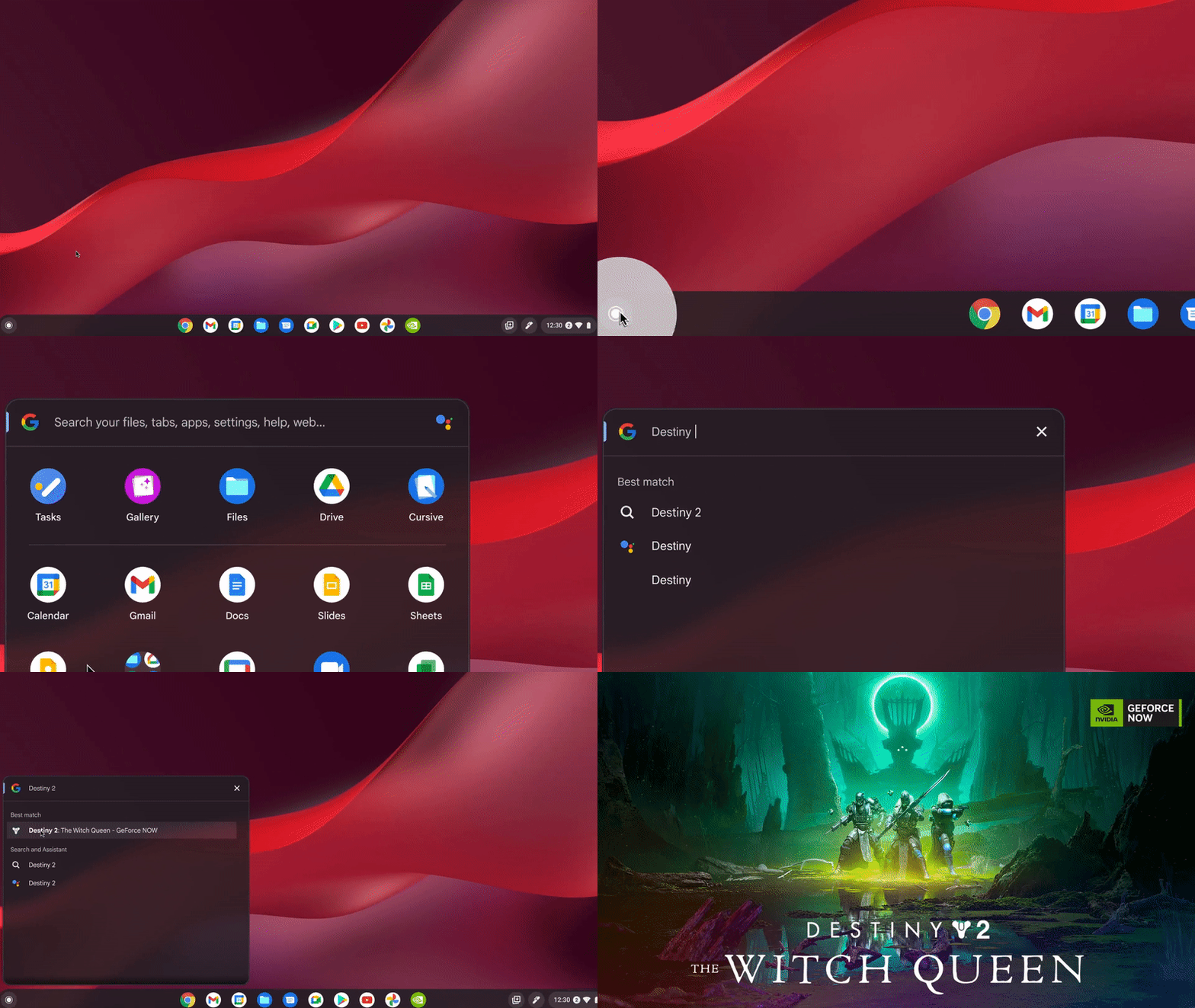
A GeForce NOW and Google Play using the Chromebook’s Everything Button (3)
This search functionality will include games on NVIDIA GeForce NOW and Google Play at launch. We are seeking to include other cloud gaming platforms in the future.
Level up your gaming experience with new accessories
We know gamers love to enhance their gaming experience with accessories, so we’re partnering with leading peripheral manufacturers like Acer, Corsair, HyperX, Lenovo and SteelSeries to ensure their popular mice, headsets and controllers are tested and certified as part of the Works With Chromebook program.
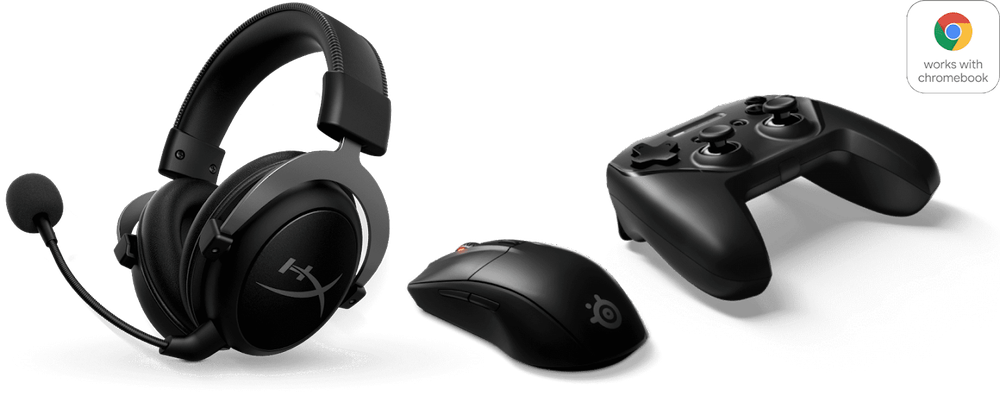
From left to right: HyperX Cloud II Gaming Headset, SteelSeries Rival 3 wireless mouse and SteelSeries Stratus+ controller, all of which are Works With Chromebook certified
Special offers to get you gaming
Cloud gaming Chromebooks will come with new offers that get you gaming right out of the box. New cloud gaming Chromebooks come with a three-month trial to Amazon Luna+ and NVIDIA GeForce NOW’s RTX3080 tier.4
With these offers, you can play nearly 200 of the 1500+ titles available on Chromebook at no cost, including games like Control Ultimate Edition, Overcooked 2, Fortnite and League of Legends.
Visit chromebook.com/perks from your new cloud gaming Chromebook for more details on these offers.
The perfect flexible device for “undercover” gamers
As we launch the first Chromebooks designed for cloud gaming, we understand that, today, Chromebooks are not necessarily known for being gaming laptops. A lot of people know our devices best for productivity (work, school, documents, presentations and spreadsheets) or online streaming (movies, television and music videos).

But the new cloud gaming Chromebooks can actually be the perfect devices for gamers who aren’t always seen as gamers — “undercover” gamers, if you will. We’ve worked with actor Winston Duke, as well as Jackson State University head football coach Deion Sanders and his sons, Shilo and Shedeur, to show how easy it is to game on a Chromebook, while of course getting everything else done that you need to as well. It is the ultimate cloud gaming machine, disguised as a Chromebook.
Starting this October, you can order the new Acer Chromebook 516 GE, the ASUS Chromebook Vibe CX55 Flip and the Ideapad Gaming Chromebook from Lenovo. Learn more about these devices and their features by visiting chromebook.com.
Disclaimers:
1Tested at 1080p when plugged in to power while playing Fortnite and Destiny 2 using early access test accounts on NVIDIA GeForce NOW.
2Luna is available in the mainland US only.
3Sequence sped up for illustrative purposes.
4Limited time offer. Terms and conditions apply.
Microsoft Edge: ora si può ridimensionare la barra laterale
Microsoft Edge Canary introduce la possibilità di ridimensionare a piacere la barra del browser, eccezion fatta per alcuni elementi.
Leggi Microsoft Edge: ora si può ridimensionare la barra laterale
In Trust we trust: webcam Tyro Full HD con microfono e treppiede: OFFERTA WOW (-71%)
VirtualBox 7: disponibile per il download con supporto TPM 2.0
È stata resa disponibile la relase 7 di VirtualBox, ora è possibile usare Windows 11 grazie al supporto per il chip TPM e Secure Boot.
Leggi VirtualBox 7: disponibile per il download con supporto TPM 2.0
4 Googlers on coming out at work — and in life
Every year, National Coming Out Day (NCOD) is on October 11. We’ve made enormous strides for equality and acceptance since the inception of NCOD 34 years ago. Yet even in 2022, sharing one’s sexuality and gender identity can be a challenge for many members of the LGBTQ+ global community for a variety of cultural, political, religious and personal reasons. In many parts of the world, coming out continues to be a deeply courageous act of LGBTQ+ activism.
Be it in one’s community or in the workplace, coming out is the first step to living authentically and having pride in one’s identity. Google is committed to creating a culture of inclusion that supports all of our employees around the world, including members of the LGBTQ+ community – no matter how they identify.
A key part of creating a workplace that recognizes and celebrates diversity is offering a platform where people can share stories about their personal experiences and truths. We want to extend an enormous thanks to the four Googlers who have opened up to share their stories for this year’s National Coming Out Day. These stories represent just a small fraction of Google’s diverse and vibrant LGBTQ+ community.
“Coming in” before coming out
Jean Illyria (she/her), who works in our Singapore office with Google Customer Solutions, says she first used technology to come out as a trans woman. “If you’ve ever played a role-playing game, you’d know how it feels to experience the world through this third-person view, responding to events and making decisions for your virtual character based on a story you’ve crafted for them,” she says. “The experiences you have are real, the emotions you feel may be real, but it’s all very much unreal. My life felt like a game, so naturally, I first came out while chatting in a game. The anonymity and the appearance of my virtual person seemed to make it much easier.”
Ever since surrounding herself with people who accept and support her, Jean has been able to focus on living life to the fullest. “Coming out may seem like a huge milestone and a rite of passage for LGBT folks, but don’t come out just for the sake of coming out,” she says. “Instead, focus on what coming out would do for you, and consider the costs and benefits of doing so for your individual situation. Start by prioritizing what’s been dubbed as ‘coming in’: Learn to accept, embrace and celebrate your identity for yourself.”
I’m a better employee, teammate, and manager because I can be my authentic self at work.
Coming out at work
California-based Googler Marnie Florin (any gender-neutral pronouns, such as they/them and ze/zir), who works in people operations, first came out as queer and then as nonbinary. Because Marnie uses gender-neutral pronouns, they need to come out to every new person they meet to avoid being misgendered. For Marnie and many nonbinary people, being misgendered is painful; it pulls them out from what they’re doing and creates feelings of disconnection and rejection simply because of who they are. This is especially taxing when working at a large company, which is just one example of why allyship is so important.
It took two months for Marnie to come out when they joined Google in 2014. “I agonized over how to do it: Should I tell everyone in person, should I have my manager do it, should I let people find out organically? Ultimately, I decided to send an email to my larger team and the responses were so incredible,” they say. “It was so freeing to stop hiding such a significant part of my identity. I’m a better employee, teammate, and manager because I can be my authentic self at work.”
Deciding when the time is right
Working in London, Nayem Chowdhury (he/him) is from a traditional Muslim immigrant family and worried about coming out. He says he spent so much energy hiding his true self — energy he believed he could otherwise spend enjoying life.
“It’s particularly hard to manage different levels of authenticity at work and in your personal life, so it was very liberating to come out at Google,” he says. “In fact, I was out at work first. It’s given me access to so many amazing people and opportunities through LGBTQ+ employee resource groups, and it gave me the confidence to come out to my parents.”
Nayem says it’s crucial people come out only when the time is right for them, and not feel pressured to do so. “Go at your own pace and do it your own way,” he says. “I regret not coming out to my parents sooner as I thought I had to do it face-to-face, but I kept putting it off. I eventually did it over email, which suited me much better.”
Learn to accept, embrace and celebrate your identity for yourself.
Being an example to others
Googler Guilherme Saconatto (he/him), who works in Brazil as an account executive, said he didn’t know just how much he yearned for community and felt like he was compartmentalizing his identity before coming out. “Before coming out, you don’t realize how lonely you are with your secret,” he says. But when he came out to his close friends and they were supportive, he says, “It felt like being welcomed into a new world.”
Guilherme says coming out doesn’t just affect an individual — it impacts the LGBTQ+ community around the world. “There is nothing more freeing and rewarding than being able to remain faithful to ourselves at all times,” he says. “The queer community needs our heroes and role models visible to allow ourselves to aspire to reach higher. Visibility is still one of the most powerful tools in changing society.”
How mapping the world’s buildings makes a difference
In Lamwo district, in northern Uganda, providing access to electricity is a challenge. In a country where only about 24% of the population has a power supply to their home from the national grid, the rate in Lamwo is even lower. This is partly due to lack of information: The government doesn’t have precise data about where settlements are located, what types of buildings there are, and what the buildings’ electricity needs might be. And canvassing the area isn’t practical, because the roads require four-wheel-drive vehicles and are impassable in the rain.
Ernest Mwebaze leads Sunbird AI, a Ugandan nonprofit that uses data technology for social good. They’re assessing areas in Lamwo district to support planning at the Ministry of Energy in Uganda. “There are large areas to plan for,” explains Ernest. “Even when you’re there on the ground, it’s difficult to get an overall sense of where all the buildings are and what is the size of each settlement. Currently people have to walk long distances just to charge their phones.”
To help with their analysis, Ernest’s team have been using Google’s Open Buildings. An open-access dataset project based on satellite imagery pinpointing the locations and geometry of buildings across Africa, Open Buildings allows the team to study the electrification needs, and potential solutions, at a level of detail that was previously impossible.
Our research center in Ghana led the development of the Open Buildings project to support policy planning for the areas in the world with the biggest information gaps. We created it by applying artificial intelligence methods to satellite imagery to identify the locations and outlines of buildings.
Since we released the data, we’ve heard from many organizations — including UN agencies, nonprofits and academics — who have been using it:
- The UN Refugee Agency, UNHCR, has been using Open Buildings for survey sampling. It’s common to do household surveys in regions where people have been displaced, in order to know what people need. But UNHCR needs to first have an assessment of where the households actually are, which is where the Open Buildings project has been useful.
- UN Habitat is using Open Buildings to study urbanization across the African continent. Having detail on the way that cities are laid out enables them to make recommendations on urban planning.
- The International Energy Agency is using Open Buildings to estimate energy needs. With data about individual buildings, they can assess the needs of communities at a new level of precision and know how much energy is needed for cooking, lighting and for operating machinery. This will help with planning sustainable energy policy.
We’re excited to make this information available in more countries and to assist more organizations in their essential work. As Ernest says, “By providing decision makers with better data, they can make better decisions. Geographical data is particularly important for providing an unbiased source of information for planning basic services, and we need more of it.”