Immersive view coming soon to Maps — plus more updates
Google Maps helps over one billion people navigate and explore. And over the past few years, our investments in AI have supercharged the ability to bring you the most helpful information about the real world, including when a business is open and how crowded your bus is. Today at Google I/O, we announced new ways the latest advancements in AI are transforming Google Maps — helping you explore with an all-new immersive view of the world, find the most fuel-efficient route, and use the magic of Live View in your favorite third-party apps.
A more immersive, intuitive map
Google Maps first launched to help people navigate to their destinations. Since then, it’s evolved to become much more — it’s a handy companion when you need to find the perfect restaurant or get information about a local business. Today — thanks to advances in computer vision and AI that allow us to fuse together billions of Street View and aerial images to create a rich, digital model of the world — we’re introducing a whole new way to explore with Maps. With our new immersive view, you’ll be able to experience what a neighborhood, landmark, restaurant or popular venue is like — and even feel like you’re right there before you ever set foot inside. So whether you’re traveling somewhere new or scoping out hidden local gems, immersive view will help you make the most informed decisions before you go.
Say you’re planning a trip to London and want to figure out the best sights to see and places to eat. With a quick search, you can virtually soar over Westminster to see the neighborhood and stunning architecture of places, like Big Ben, up close. With Google Maps’ helpful information layered on top, you can use the time slider to check out what the area looks like at different times of day and in various weather conditions, and see where the busy spots are. Looking for a spot for lunch? Glide down to street level to explore nearby restaurants and see helpful information, like live busyness and nearby traffic. You can even look inside them to quickly get a feel for the vibe of the place before you book your reservation.
The best part? Immersive view will work on just about any phone and device. It starts rolling out in Los Angeles, London, New York, San Francisco and Tokyo later this year with more cities coming soon.
Immersive view lets you explore and understand the vibe of a place before you go
An update on eco-friendly routing
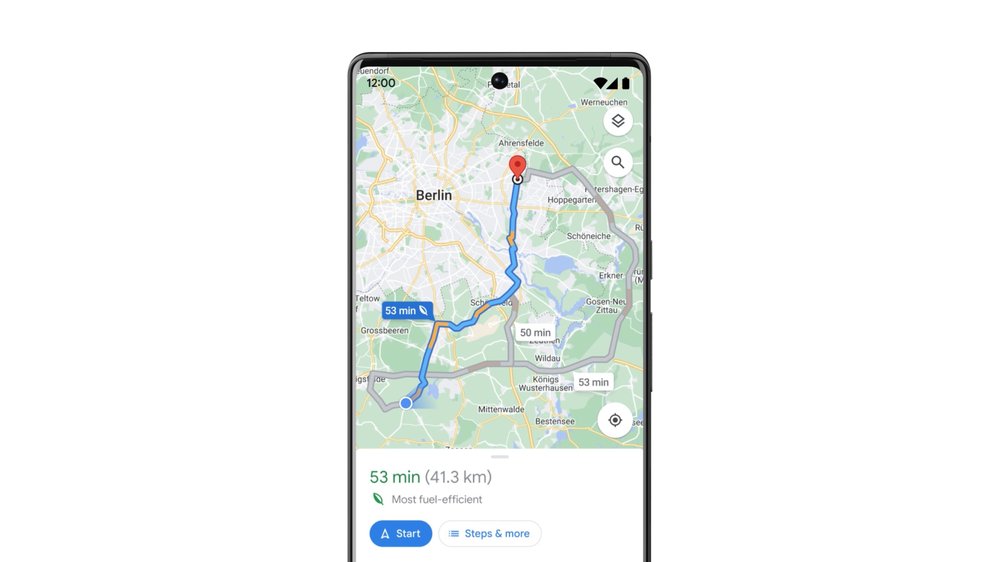
In addition to making places easier to explore, we want to help you get there more sustainably. We recently launched eco-friendly routing in the U.S. and Canada, which lets you see and choose the most fuel-efficient route when looking for driving directions — helping you save money on gas. Since then, people have used it to travel 86 billion miles, saving more than an estimated half a million metric tons of carbon emissions — equivalent to taking 100,000 cars off the road. We’re on track to double this amount as we expand to more places, like Europe.
Eco-friendly routing has helped save more than an estimated half a million metric tons of carbon emissions
The magic of Live View — now in your favorite apps
Live View helps you find your way when walking around, using AR to display helpful arrows and directions right on top of your world. It’s especially helpful when navigating tricky indoor areas, like airports, malls and train stations. Thanks to our AI-based technology called global localization, Google Maps can point you where you need to go in a matter of seconds. As part of our efforts to bring the helpfulness of Google Maps to more places, we’re now making this technology available to developers at no cost with the new ARCore Geospatial API.
Developers are already using the API to make apps that are even more useful and provide an easy way to interact with both the digital and physical worlds at once. Shared electric vehicle company Lime is piloting the API in London, Paris, Tel Aviv, Madrid, San Diego, and Bordeaux to help riders park their e-bikes and e-scooters responsibly and out of pedestrians’ right of way. Telstra and Accenture are using it to help sports fans and concertgoers find their seats, concession stands and restrooms at Marvel Stadium in Melbourne. DOCOMO and Curiosity are building a new game that lets you fend off virtual dragons with robot companions in front of iconic Tokyo landmarks, like the Tokyo Tower. The new Geospatial API is available now to ARCore developers, wherever Street View is available.
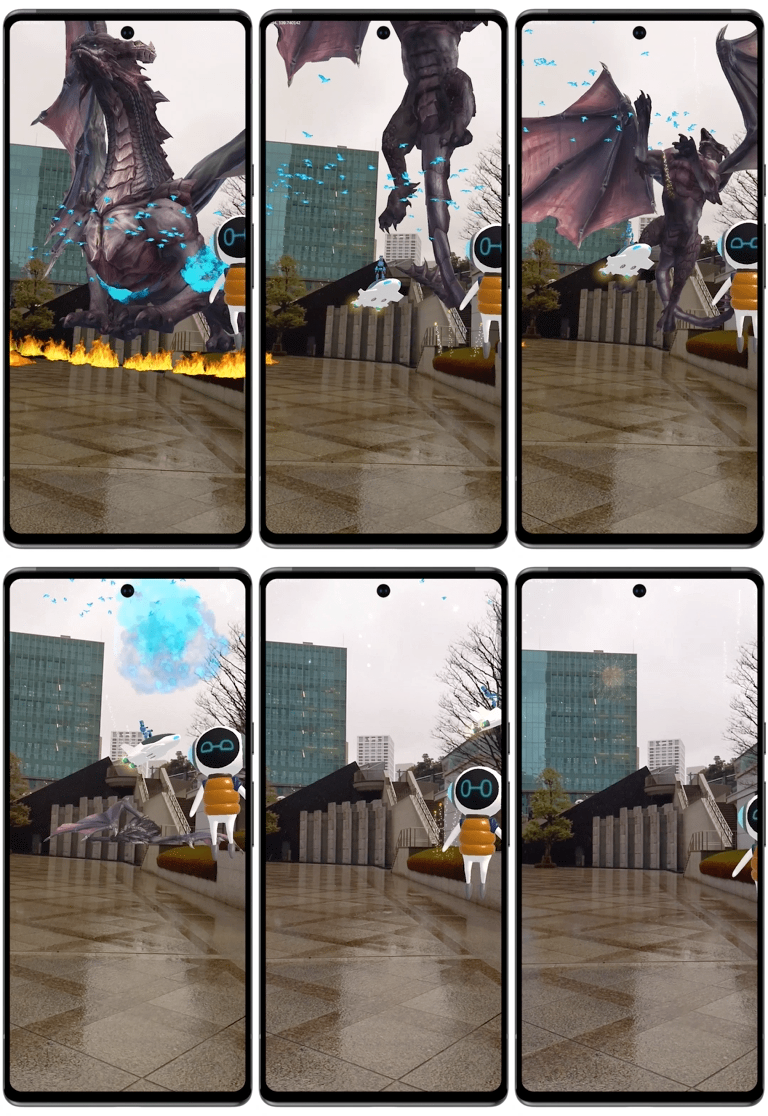
Live View technology is now available to ARCore developers around the world
AI will continue to play a critical role in making Google Maps the most comprehensive and helpful map possible for people everywhere.
7 ways AI is making Google Workspace better
Hybrid work life is…well, one of our many “new normals.” Over the last two years, many of us have gone through various versions of what the office looks like, and these changes have been a significant motivation behind some of our recent updates to Google Workspace.
With some people in the office and others at home, the amount of emails, chats, and meetings in our inboxes and on our calendars has increased — so we’ve been working on finding more ways to use machine learning to fight information overload and keep you feeling productive. Here are seven upcoming features — most made possible by AI — on their way to Google Workspace:
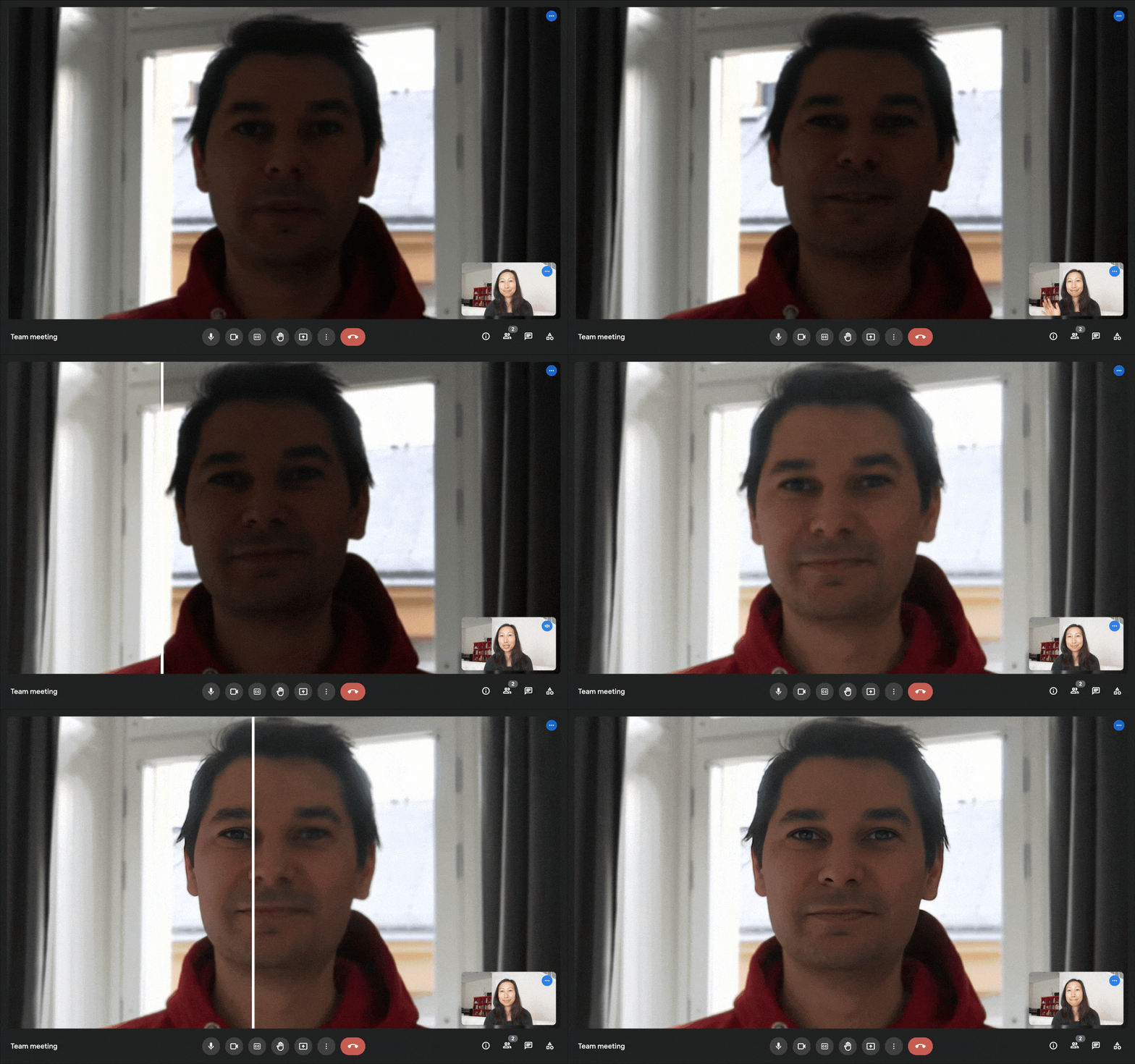
- Portrait restore uses Google AI technology to improve video quality, so even if you’re using Google Meet in a dimly lit room using an old webcam — or maybe you’ve got a bad WiFi connection — your video will be automatically enhanced.
Portrait restore improves video quality using Google AI.
2. We’re also introducing portrait light: This feature uses machine learning to simulate studio-quality lighting in your video feed, and you can even adjust the lighting position and brightness.
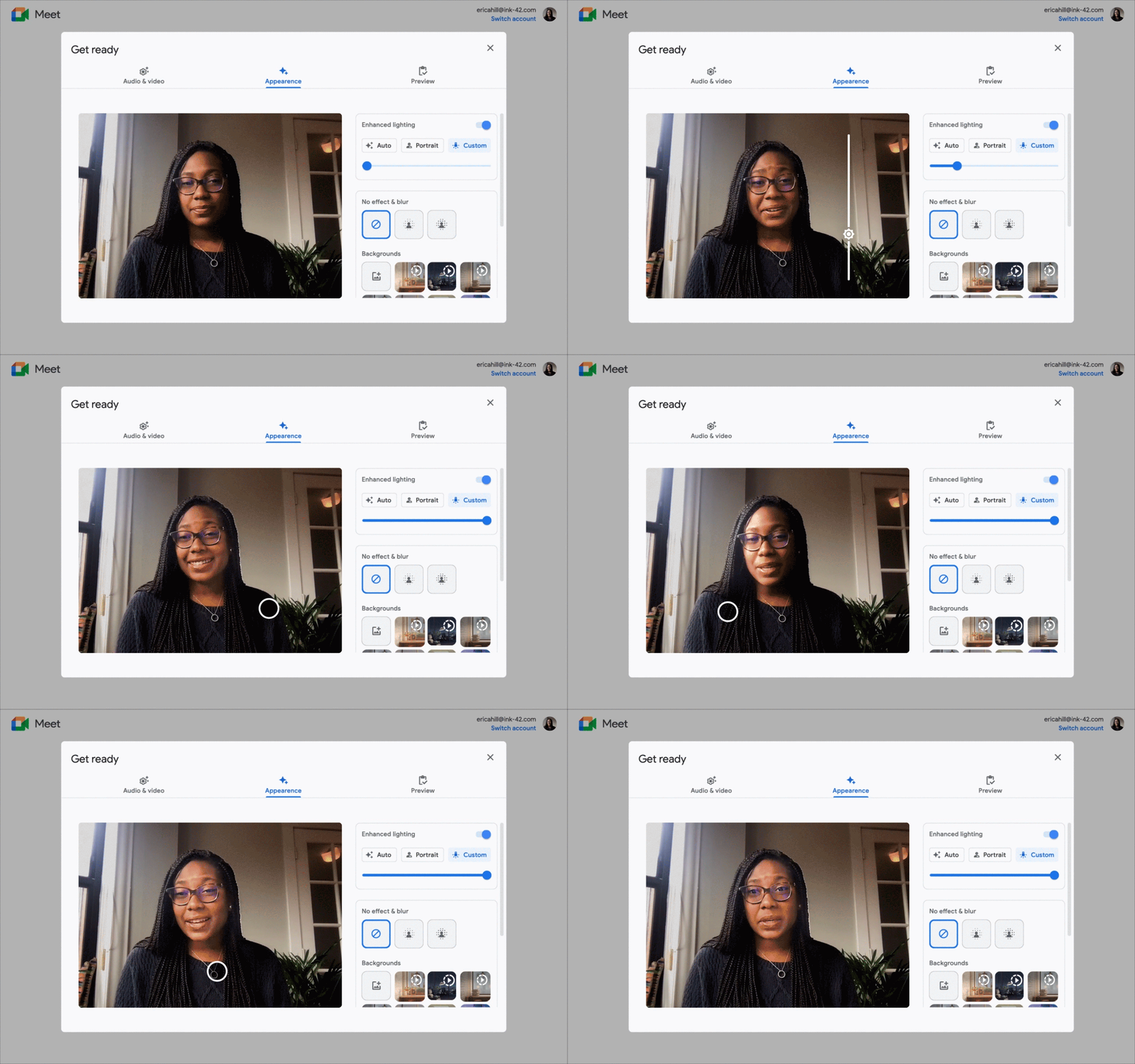
Portrait light brings studio-quality lighting effects to Google Meet.
3. We’re adding de-reverberation, which filters out echoes in spaces with hard surfaces, so it sounds like you’re in a mic-ed up conference room…even if you’re in your basement.
4. Live sharing will sync content that’s being shared in a Google Meet call and allow participants to control the media. Whether you’re at the office or at home, the person sharing the content or viewing it, participants will see and hear what’s going on at the same time. Our partners and developers can use our live sharing APIs today to start integrating Meet into their apps.
5. Earlier this year, we introduced automated built-in summaries for Google Docs. Now we’re extending auto-summaries to Spaces so you get a helpful digest of conversations you missed.
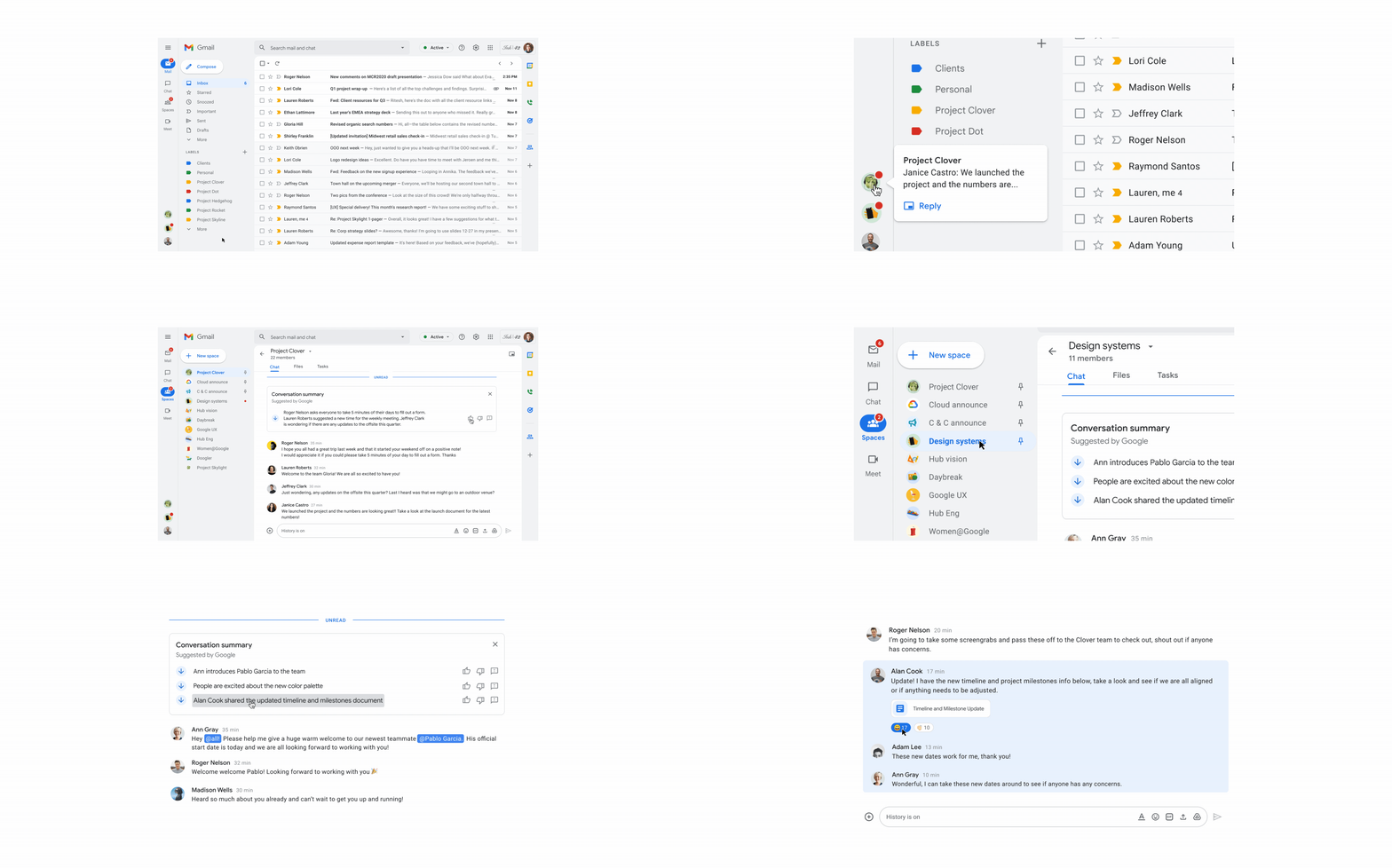
Summaries in Spaces help you catch up quickly on conversations.
6. Later this year, we’re bringingautomated transcriptions of Google Meet meetings to Google Workspace, so people can catch up quickly on meetings they couldn’t attend.
7. Many of the security protections that we use for Gmail are coming to Google Slides, Docs and Sheets. For example, if a Doc you’re about to open contains phishing links or malware, you’ll get an automatic alert.
For a deeper dive into all the new AI capabilities coming to Google Workspace, head over to the Cloud blog for more details.
Google Translate learns 24 new languages
For years, Google Translate has helped break down language barriers and connect communities all over the world. And we want to make this possible for even more people — especially those whose languages aren’t represented in most technology. So today we’ve added 24 languages to Translate, now supporting a total of 133 used around the globe.
Over 300 million people speak these newly added languages — like Mizo, used by around 800,000 people in the far northeast of India, and Lingala, used by over 45 million people across Central Africa. As part of this update, Indigenous languages of the Americas (Quechua, Guarani and Aymara) and an English dialect (Sierra Leonean Krio) have also been added to Translate for the first time.
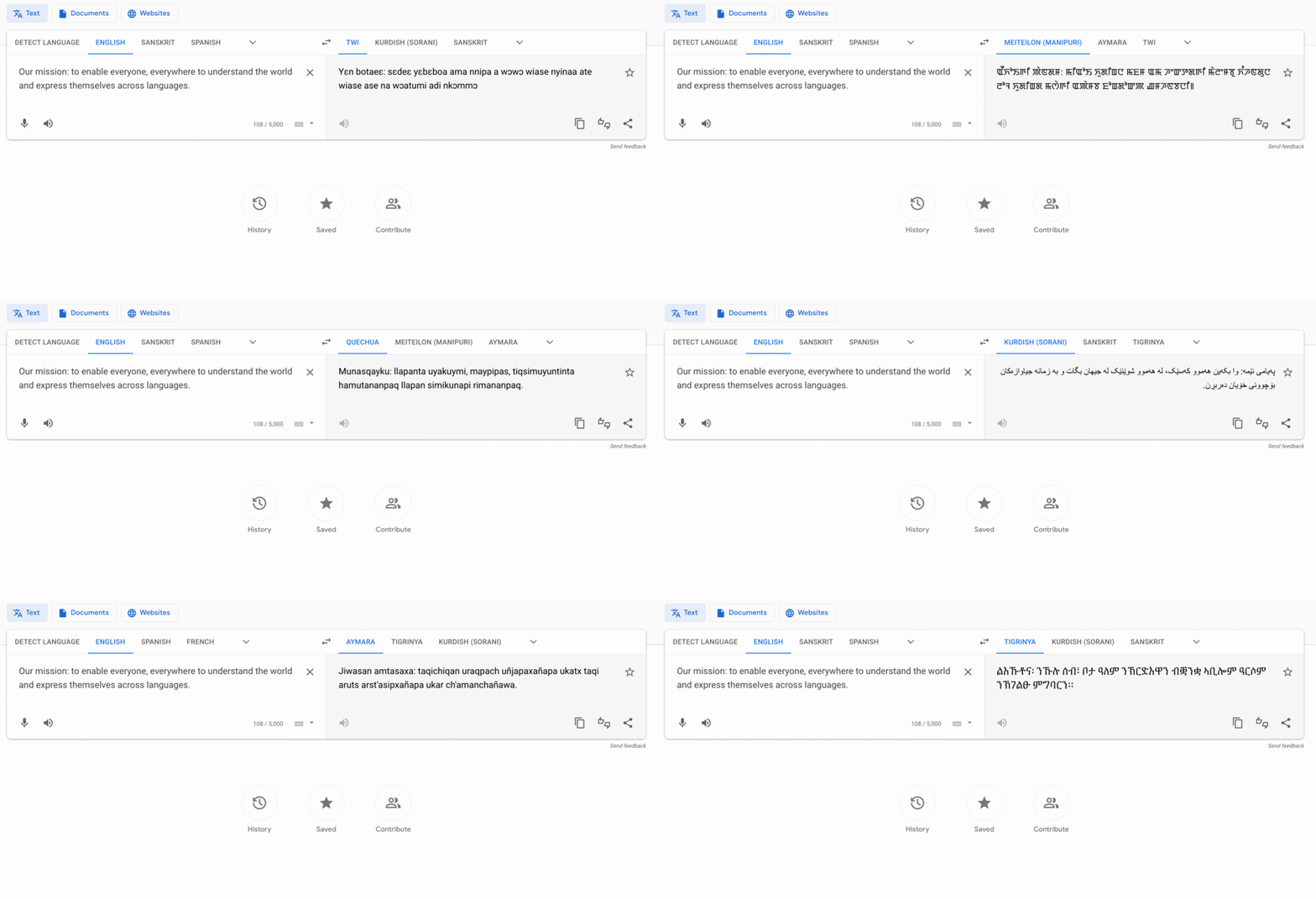
Translate’s mission translated into some of our newly added languages
Here’s a complete list of the new languages now available in Google Translate:
- Assamese, used by about 25 million people in Northeast India
- Aymara, used by about two million people in Bolivia, Chile and Peru
- Bambara, used by about 14 million people in Mali
- Bhojpuri, used by about 50 million people in northern India, Nepal and Fiji
- Dhivehi, used by about 300,000 people in the Maldives
- Dogri, used by about three million people in northern India
- Ewe, used by about seven million people in Ghana and Togo
- Guarani, used by about seven million people in Paraguay and Bolivia, Argentina and Brazil
- Ilocano, used by about 10 million people in northern Philippines
- Konkani, used by about two million people in Central India
- Krio, used by about four million people in Sierra Leone
- Kurdish (Sorani), used by about eight million people, mostly in Iraq
- Lingala, used by about 45 million people in the Democratic Republic of the Congo, Republic of the Congo, Central African Republic, Angola and the Republic of South Sudan
- Luganda, used by about 20 million people in Uganda and Rwanda
- Maithili, used by about 34 million people in northern India
- Meiteilon (Manipuri), used by about two million people in Northeast India
- Mizo, used by about 830,000 people in Northeast India
- Oromo, used by about 37 million people in Ethiopia and Kenya
- Quechua, used by about 10 million people in Peru, Bolivia, Ecuador and surrounding countries
- Sanskrit, used by about 20,000 people in India
- Sepedi, used by about 14 million people in South Africa
- Tigrinya, used by about eight million people in Eritrea and Ethiopia
- Tsonga, used by about seven million people in Eswatini, Mozambique, South Africa and Zimbabwe
- Twi, used by about 11 million people in Ghana
This is also a technical milestone for Google Translate. These are the first languages we’ve added using Zero-Shot Machine Translation, where a machine learning model only sees monolingual text — meaning, it learns to translate into another language without ever seeing an example. While this technology is impressive, it isn’t perfect. And we’ll keep improving these models to deliver the same experience you’re used to with a Spanish or German translation, for example. If you want to dig into the technical details, check out our Google AI blog post and research paper.
We’re grateful to the many native speakers, professors and linguists who worked with us on this latest update and kept us inspired with their passion and enthusiasm. If you want to help us support your language in a future update, contribute evaluations or translations through Translate Contribute.
Xiaomi Mi Band 6 NFC, Amazon sgancia la BOMBA: soli 39€

Inmotion Hosting: offerta imperdibile per gli hosting condivisi

CROLLO di prezzo su Amazon per questo ottimo Mini PC: appena 129€
Mini PC B2S N4000: la potenza è nella botte piccola e costa solo 129€
POS Easy PAX A910: sconto sull’acquisto del POS a zero canone
Windows 11: corretta una falla 0-Day già sfruttata
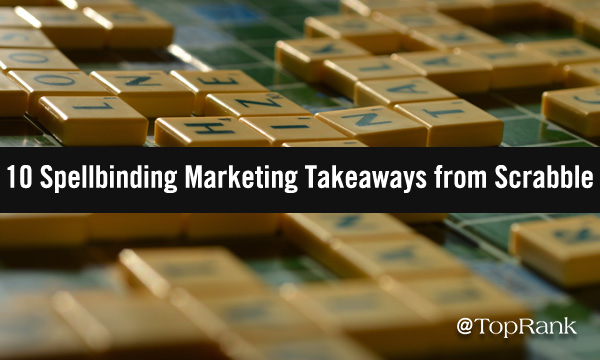
Triple Word Score: 10 Spellbinding B2B Marketing Takeaways from Scrabble
What strategic lessons can today’s B2B marketers gain from taking a new look at the original classic word game Scrabble?
With word games more popular than ever thanks to the runaway success of Wordle and its offshoots, it’s the perfect time to reach into the bag of letters and uncover some of the important marketing insights we can learn from the venerable game of Scrabble.
Let’s hop right in and start exploring 10 marketing takeaways that we can learn from Scrabble and begin applying to our own efforts.
1 — Prioritize Your Marketing Bonus Squares
The top B2B marketers and Scrabble aficionados are both keenly aware of the sweet spots — those force multipliers that can take a standard effort and double or triple its cumulative effectiveness.
In Scrabble, strategic placement of key letters on double or triple letter bonus squares is a major part of a winning effort, along with the even more powerful double and triple word squares, which multiply the scoring of every letter in whatever word is played.
B2B marketing also has its own bonus squares, in the form of working with influencers and subject matter experts, who are able to multiply the impact and reach of great content. Our CEO Lee Odden recently shared insight into getting started in B2B influencer marketing, with “How the Most Successful B2B Marketers Work with Influencer Marketing Agencies.”
Through targeted distribution to their dedicated social media following, B2B influencers can expose new content to relevant fans who are truly interested in the topics the influencer specializes in.
The pinnacle of Scrabble comes in the form of rare double-doubles and triple-triples, achieved when a long word is played that manages to cover either two double or triple word bonus squares. When this happens, a player’s word value is doubled and then doubled again, or tripled twice in the case of the elusive triple-triple.
In B2B marketing, such rare content exposure and engagement multipliers come when working with influencers leads to an effort that snowballs into global recognition and genuine content stardom — more frequent in B2C efforts, yet still achievable for B2B marketers.
2 — Maximize Exposure By Building In Multiple Directions
Journeyman Scrabble players tend to add their words to the board building in just one direction, or perhaps two on a good day. Top players, on the other hand, regularly build in three, four, or even more directions during a single play — cramming in letters that form not only their primary word, but which create often-obscure shorter words in multiple other directions. It’s not an easy task, however with each extra word formed, more points are accumulated during every turn.
In B2B marketing, cross-platform content sharing allows top marketers to build in multiple directions, and gain the advantages of increased exposure and engagement.
3 — Expand Brand Possibilities By Boosting Your Vocabulary
When I was heavily into Scrabble for a few years back in the 1980s, I studied the official Scrabble Players Dictionary and read all of the Scrabble-related books I could find, and spent hours memorizing lists of all the acceptable two and three letter words, everything playable with an “X,” “Q,” “Z,” or “J,” and also spend endless time trying to memorize as much of the dictionary as possible.
In B2B marketing, ongoing education is similarly important to rack up top scoring brand efforts that can achieve award-winning success. One way to keep your professional learning up-to-date it by attending marketing industry events, such as those we outlined recently in “Conference Collection: Top B2B Marketing Events To Learn From In 2022.” Keeping up with new marketing books is another good way, such as those we covered in “Read It & Reap: 11 Top New Marketing Books To Savor On #NationalBookLoversDay.”
Additionally, online courses are a great way to hone existing skills and pick up new ones, as we’ve covered in such pieces as “Supercharge Your B2B Marketing With High-Octane Online Courses,” and “5 Free Online Courses to Sharpen Your B2B Marketing Skills.”
4 — Grow Consistency With The Secret Seven-Letter Word
In Scrabble, playing all seven of your letters at once is called a bingo, and results in a hefty extra 50 points being tacked onto the top of whatever your word receives on the board. Many top Scrabble players specialize in centering their game around playing bingos — a strategy that can lead to feast or famine turns in the game, as players sometimes skip their turn or simply turn in a few letters in order to have the best shot at playing a bingo on their subsequent turn.
If a player gets lucky letter draws throughout a game, they can sometimes put down four or more bingos in a game, each with its own 50 point bonus. I tend to play primarily for bingos, and have always arranged my tile rack to have as many of the letters of the word “SATIRE” as possible. It’s the word from which the most seven-letter words can be built — a not-so-secret base word that can help your Scrabble game immensely.
In B2B marketing, it’s an always-on strategy that offers a similar advantage, especially in today’s digital-first marketing landscape where potential customers are always seeking answers to their top questions. You can learn more about the advantages of an always-on marketing strategy, and how to implement one, from the following helpful articles we’ve published on the increasingly-important topic:
- Inside Influence 2: Garnor Morantes from LinkedIn on the Power of Always-On Influence
- How to Elevate B2B Marketing with Always-On Influence
- How To Move From A Pilot B2B Influencer Marketing Program to Always-On Success
- Always On Influence: Costs Less and Better ROI – Here’s Why
5 — Break Out Of The Usual By Inventing Creative New Rules
My friends Jay and Mary long ago set aside Scrabble’s official rules and made up their own set that makes the game more rewarding for them. They don’t play on a board — any table or flat surface will do — and they don’t keep score. Their changes shift the game’s focus to the pure satisfaction of forming and connecting words, without the constraints of fitting onto a rigidly-defined board, and forgoes any worry about point values or competition between players.
In B2B marketing, sometimes the best efforts come from marketers who also set aside some of the existing rules and come up with something truly innovative.
Creativity and innovation are the name of the game in top B2B marketing efforts, whether it’s in the form of visual design as we explored in “Visual Focus: The Digital Designs Propelling B2B Brand Success In 2022,” diversity, equity, and inclusion — as we looked at in “Why Diversity, Equity & Inclusion Matter More than Ever for B2B Marketing,” or through making innovative marketing technology changes, as we dug into with “Break Free B2B Marketing: Tamara McCleary of Thulium on Visions of the Future and Doing No Harm.”
6 — Get Long-Lasting Marketing Results By Going Short
In Scrabble top players often get big points with short words, especially when a high-value letter is played on a triple-word score in two directions, which triples the letter in each direction.
The nine-point “X” used to be the top example of this effect, however this changed in 2006, when the controversial word “qi” — which is a form of energy in some Eastern systems of medical treatment — was among over 3,000 new words added to the official Scrabble Players Dictionary.
Since then, it’s been theoretically possible to play the two-letter “qi” in two directions on a triple-word score and rack up 60 points from the 10-point “Q” alone.
In B2B marketing, learning where not to focus your energy can be an important discovery, along with the subtle power of brevity.
In today’s short attention span digital-first world, a finely-tuned short message more often than not significantly outperforms a comprehensive missive or manifesto, especially when it comes to content shared on social media platforms. I wrote more about this phenomenon in “You Have 8 Seconds – GO! Brand Messaging Secrets With Debra Jasper.”
[bctt tweet=”“In B2B marketing, learning where not to focus your energy can be an important discovery, along with the subtle power of brevity.” — Lane R. Ellis @lanerellis” username=”toprank”]7 — Know When To Skip A Turn & Jettison Poor Performers
Knowing when it’s wise to skip a turn in Scrabble is another tactic top players learn. Sometimes you’ll have a seven-letter word on your rack with no spot on the board to play it, and skipping your turn allows your opponent to play a word that may provide the opening you need to play it.
Other times you’ll want to skip a turn to exchange a few bad letters, such as when you have only or mostly vowels, or if you’ve got a “Q” when every “U” has been played and it’s nearing the end of a game.
Disposing of poor performers certainly comes at a cost, however in the long run it can sometimes pay off.
The same is the case in B2B marketing, where cutting your losses on a poorly performing content initiative and moving on can ultimately be the wisest decision.
8 — Embrace The Ever-Changing Marketing Tactic Dictionary
As we saw with the addition of “qi” to the Scrabble Players Dictionary in 2006, and as digital marketers observe almost daily with so much new terminology and online slang being used, our language is an ever-evolving and living thing.
I grew up using the original 1978 version of the Official Scrabble Players Dictionary, and although it’s my personal favorite, the many thousands of new words that have entered the Scrabble lexicon up through 2018’s sixth edition have undoubtedly brought new opportunities that keep the game alive in new ways, and for new and future audiences.
In B2B marketing, digital tactics change every bit as quickly as new words are formed, and savvy marketers embrace these changes. We often look at new B2B marketing tactical shifts here on the TopRank Marketing blog, such as in these recent examples:
- Virtual Vision: 5 New LinkedIn Features & How B2B Marketers Can Use Them To Succeed
- Traffic’s Black Hole: What B2B Marketers Need To Know About Dark Social
- New Google Search Updates & How B2B Marketers Can Use Them To Elevate Efforts
- How B2B Brands Can Boost Confidence in Livestream Video, Podcast and Clubhouse Marketing
9 — Take It To The Tournament & Marketing Awards Level
At the highest level of Scrabble are players who regularly compete in tournaments around the world, pushing their own boundaries to the limit.
In marketing, the best professionals often produce content so successful that it wins awards, whether in the form of B2B industry trade events or even all the way to an Academy Award.
Earning an Academy Award for a campaign is a rarity. But that’s just what Jonathan Retseck, founder of New York-based, sports-focused firm RXR Sports, accomplished with the wildly popular “Free Solo” film for National Geographic Documentary Film’s. The film, about rock climber Alex Honnold‘s ropeless ascent of El Capitan, won the Oscar for Best Documentary in 2019.
While the film isn’t a B2B marketing campaign, the elements Retseck and his team brought to “Free Solo” feature components that could bring some much-needed drama and adventure to B2B advertising endeavors.
[bctt tweet=”“My comfort zone is like a little bubble around me, and I’ve pushed it in different directions and made it bigger and bigger until these objectives that seemed totally crazy eventually fall within the realm of the possible.” @AlexHonnold” username=”toprank”]10 — Be A Good Sport In B2B Marketing & Life
As with any endeavor, learning to be a good sport and to make the most out of whatever draw of letters you may pull from the bag is a valuable life lesson.
When your Scrabble rack is filled with an unfortunate assemblage of letters such as “O, O, O, A, A, U, U,” being able to focus on what you can do and now on what you have no control over goes a long way, as does being able to laugh at the humor of the situation.
The same is also true in B2B marketing, where making the most of the elements you’ve got to work with is a hallmark of the most successful marketers. We’ve looked at how to keep the bigger picture in mind, and how to find better work-life balance — especially during the past few challenging years — in articles we’ve published such as:
- Two Years In: How B2B Marketers Are Optimizing & Elevating Remote Work Experiences
- Elevate B2B: 10+ Mentoring & Volunteering Opportunities For B2B Marketers
- Equilibrium: 10 Tips to Balance Creativity and Process in B2B Content Marketing
- Why Empathy Matters More than Ever in B2B Content Marketing (And How to Get It Right)
Triumph By Solving Your B2B Marketing Puzzles
By prioritizing force multipliers, building out in multiple directions, boosting vocabulary skills, knowing when to skip a turn, embracing new tactics, and taking it all to the next level, smart B2B marketers can elevate their content creation efforts.
We hope that you’ve found at least a few helpful B2B marketing insights from the venerable 1948 game Scrabble that can be applied to your own marketing efforts.
In today’s digital-first landscape, creating triple-word-score B2B marketing requires considerable time and effort, which is why more firms than ever are choosing to work with a top digital marketing agency such as TopRank Marketing. Contact us to learn how we can help, as we’ve done for over 20 years for businesses ranging from LinkedIn, Dell and 3M to Adobe, Oracle, monday.com and others.
The post Triple Word Score: 10 Spellbinding B2B Marketing Takeaways from Scrabble appeared first on B2B Marketing Blog – TopRank®.

L’affare del giorno su Amazon: casse Bluetooth JBL con 57€ di sconto
Ecco Xperia 1 IV, lo smartphone Sony col primo vero zoom ottico al mondo

Mantieni sani e puliti i tuoi denti con Oral-B Pro, in super offerta su Amazon a 25€

Igiene orale sempre al top con Oral-B Pro, a META’ PREZZO su Amazon (25€)