Avventurette in auto elettrica: a Losanna per vedere gli astronauti lunari
Venerdì e sabato sarò con la Dama del Maniero a Losanna per incontrare gli astronauti Apollo Dave Scott e Charlie Duke insieme a tutti gli altri ospiti spaziali dell’evento
Per cui proveremo l’ebbrezza del treno (elettrico) che trasporta l’auto (elettrica) e ci fa riposare e risparmiare strada. Il piano è questo:
- Partenza dal Maniero con il 100% di carica (fatta a casa, di notte).
- Lugano-Iselle (stazione), 105 km, 1h43m previsti. Nessuna tappa di ricarica necessaria (l’auto, una Tesla Model S con batteria da 70 kWh, ha circa 330 km di autonomia reale). Poca autostrada, probabilmente molto pittoresca da percorrere.
- Salita sul treno-navetta e transito fino a Brig (circa 20 minuti; ne parte uno ogni 90 minuti), restando a bordo a riposare al calduccio (essendo elettrica, possiamo tenere acceso il riscaldamento).
- Brig-Losanna (163 km, 1h 46). Nessuna tappa di ricarica necessaria, ma lungo il percorso la mappa dei Supercharger Tesla (che per noi sono gratuiti) ci dice che possiamo caricare lungo l’autostrada (o nelle sue adiacenze) a Steg-Hohtenn, Martigny e Bussigny (vicinissimo a Losanna).
Per la ricarica sul posto, mentre assistiamo all’evento, Nextcharge mi dice c’è un’ampia rete di colonnine lente, una delle quali è adiacente al SwissTech Convention Center nel quale ci sarà il raduno spaziale.
Dovremmo quindi poter ripartire con il 100% di carica e quindi ripetere il viaggio a ritroso senza nessuna sosta dedicata alla ricarica. Vi aggiornerò sull’esito dell’avventuretta nei prossimi giorni.

SanDisk Ultra Flair 256GB: spazio e sicurezza ad un prezzo incredibile

Mouse wireless RICARICABILE: un 2 in 1 di cui hai bisogno (11€)

Soundbar da 50W con Bluetooth e non solo a 40€, prendila subito

Proiettore mini da INVIDIA: trasformi il salotto in CINEMA

Snagit: 15% di sconto immediato con il coupon
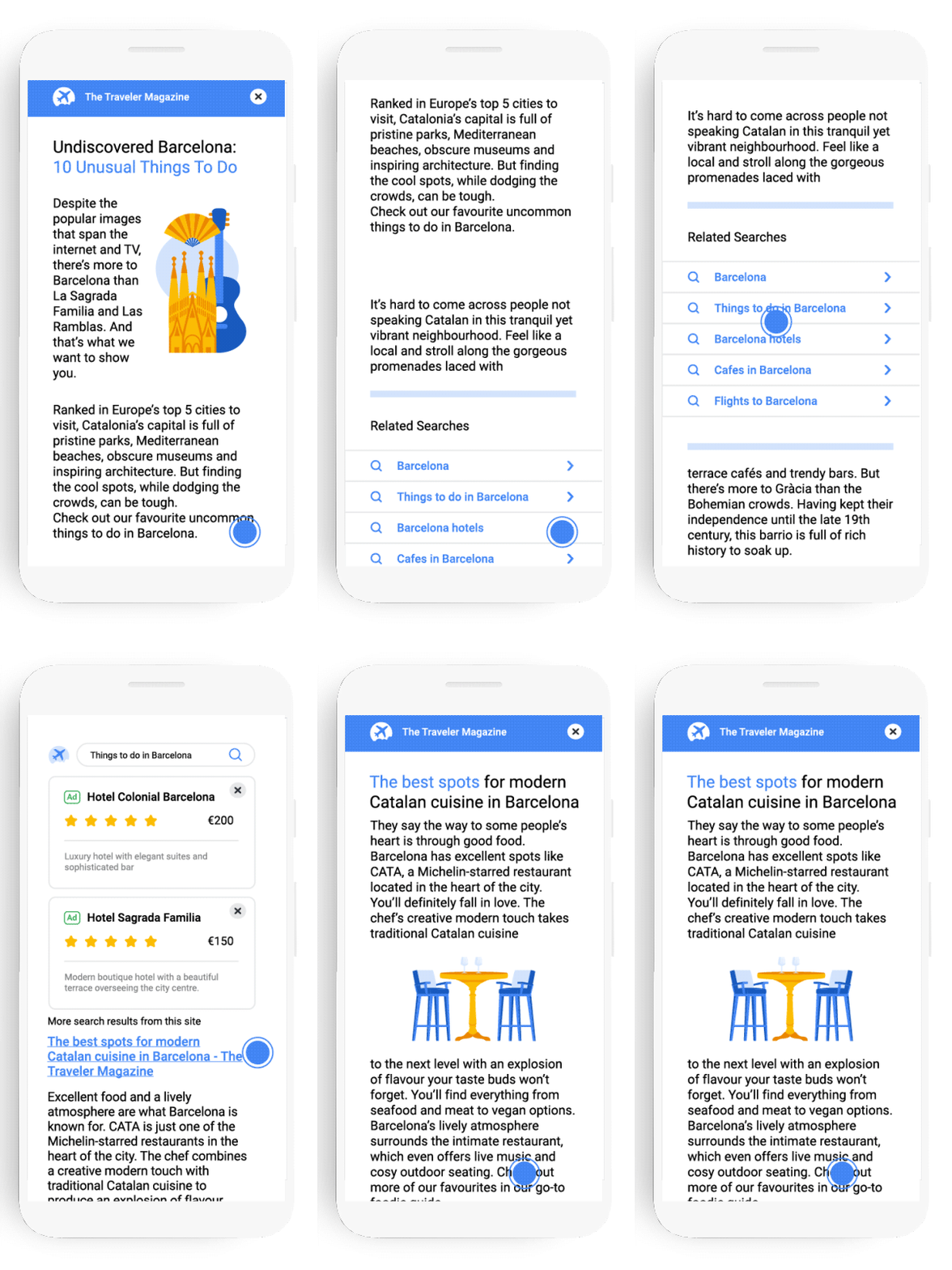
Introducing Related search for content pages
We’re always looking for ways to help publishers make more money through high-quality ads. AdSense for search already plays an important role by allowing publishers to monetize search results on their own website or mobile app. And today, we’re introducing Related search for content in AdSense for search, a new feature for publishers to create even more useful search experiences on their sites.
Related search for content is a contextual navigation unit that shows users search terms related to the page they’re viewing on a publisher’s website. When they click a search term, they’re taken to a search results page on the publisher’s site where they can explore other relevant topics, including search ads. As a result, Related search for content can help publishers increase site engagement — including site traffic, pageviews and ad impressions — and drive incremental revenue.
As a contextual unit, Related search for content is a privacy-preserving solution. It uses page content, instead of user data, to deliver relevant search terms. Meanwhile, ads on the search page target the search term the user clicked on, rather than actual user data.
If you’re interested in using Related search for content, please contact your account manager to activate AdSense for search for your AdSense account.
For more information and future updates, check out our help page.

Black Founders Fund: Meet the UK Founders
From the internet to the world’s first vaccine, the United Kingdom has long been home to groundbreaking ideas that have changed the world. Great ideas come from everywhere, but in most cases, an idea alone isn’t enough to bring an invention or a business to life. Funding plays a key role in turning a brainstorm into a business venture.
Unfortunately, startup founders do not have equal access to funding. In 2020, less than 0.25% of venture capital (VC) funding went to Black-led startups in the U.K. and only 38 Black founders received venture capital funding in the last 10 years. Black founders are disproportionately over-mentored, yet underfunded, and in many cases not being given access to the resources needed to turn great ideas into great businesses.
Nobody wins in this cycle of underrepresentation. Black founders miss out on opportunities to bring their vision to life, investors miss out on opportunities for worthwhile returns, and society as a whole misses out on innovative solutions that were never given the opportunity to grow as they should.
That’s why in 2021 we launched the firstBlack Founders Fund in Europe to help tackle the inequality in venture capital, and today we’re launching a new fund, twice the size, and inviting Black-led startups to apply for a total of $4 million worth of non-dilutive cash awards.
Some say there’s a pipeline problem when it comes to funding black startups, but we know this isn’t true: last year we received almost 800 applications from across Europe. Some of the exceptional British startups that received last year’s funding range from Axela’s data-enhanced healthcare solutions to Kami’s virtual support systems for parents.
Our teams partnered with ITV, WPP, Allen & Overy and Soho House to offer last year’s 20 U.K.-based founders free advertising opportunities, legal support and co-working space, in addition to Google Cloud grants and ads support. This gave the founders the time and resources needed to grow their businesses, and the results speak for themselves: last year’s group raised over $63 million (approx £48 million) in subsequent funding and increased their staff headcount by 21%!
In the video above, two UK-based founders, Rachael Corson, founder of haircare line Afrocenchix, and Ismail Jeilani, founder of education influencer platform Scoodle, discuss the fund’s impact on their businesses and explain why more Black founders should apply for this year’s fund.

Google Domains: fuori dalla beta con un codice sconto

Top news from the Google for Games Developer Summit
This week, we hosted the Google for Games Developer Summit, a free digital event for developers, publishers and advertisers to discuss what’s new in games. And with over three billion global players across platforms, there was plenty of ground to cover. From Android Game Development Kit updates to the new Immersive Stream for Games, we shared the latest tools to help you build your next adventure, find new players and take your game to the next level.
Missed the summit? Here’s a quick recap of the top announcements. For more details, catch the keynote and developer sessions available on demand.
Reach more devices through new tools and platforms
We’re committed to supporting developers of all sizes who are building high-quality Android games. Updates to the Android Game Development Kit simplify the development process, while new data insights in Play Console can help you make smarter business decisions. We’re also enabling games on new screens and devices, including the Google Play Games for PC Beta, so you can meet players wherever they are.
Improve your game growth strategy with ads
Advertisers can now improve target return on ad spend (tROAS) performance with App campaigns by integrating AdMob and third-party ad revenue data into Google Analytics for bid optimization. Publishers can get more visibility into return on investment with impression-level lifetime value in AdMob, also available for app attribution platforms Adjust, AppsFlyer and Singular. Learn more about these product announcements in our recent Google Ads blog post.
Create safe, inclusive gaming experiences with Google Cloud
In partnership with game creators and the open source community, we want to ensure games are social, enjoyable and inclusive for players everywhere. With Clean Chat, a new open source AI framework for games, studios can now proactively detect negative dialogue in both text and voice chat.
Build a direct-to-consumer business with Immersive Stream for Games
Developers and publishers interested in building a direct-to-consumer business can now deliver their titles directly to players with Immersive Stream for Games. Developed by the Stadia team in partnership with Google Cloud, Immersive Stream for Games combines advanced streaming technology with cheaper and easier game porting, powerful discovery features and analytics. Whether you want to offer game trials, full games, subscription bundles or even power an entire storefront, Immersive Stream for Games can help.
Thanks for joining us at this year’s Google for Games Developer Summit — remember to check out the on-demand sessions, and stay tuned for more gaming updates soon. We’re here to help you keep building and innovating your games for players everywhere.

Let’s get personal: Adaptive learning tech and education
Twelve years ago, Shantanu Sinha left his job to join his long-time friend Sal Khan’s new venture. At the time, Sal was spending his days making educational YouTube videos. It was an unusual career choice for both of them. But they saw what was possible when students had more agency over their learning and how technology could play a role. Together they started the online education platform Khan Academy, and Shantanu worked there for five years.
Today, Shantanu is the head of Google for Education. His team works to improve teaching and learning with technology, and one promising area is their work with adaptive learning technology. This emerging, AI-driven technology supports tailored learning experiences for students and helps amplify teacher instruction.
To get a crash course on adaptive learning technology and what it means for students and teachers, we talked to Shantanu.
What exactly is adaptive learning technology?
The concept of adaptive learning has been around for decades. It refers to a type of learning where students are given customized resources and activities to address their unique learning needs. For example, if a student struggles with adding fractions, a teacher might offer 1:1 tutoring or additional practice problems. You can see the concept of adaptive learning play out in gaming. When I was a kid I remember playing Carmen Sandiego and noticing how the system was tailored to me and changed whenever I got something wrong.
What’s new is applying recent AI advances to this concept, which opens up a whole new set of possibilities to transform the future of school into a personal learning experience.
Can you share an example of what this might look like?
Imagine you’re a student stuck on a math problem. With 25 other students in your class, you can’t always get immediate help, leaving you frustrated and diminishing your confidence to complete future problems. Now imagine a different scenario. You’re stuck on a problem, but instead of growing frustrated, you receive a helpful hint or video that gives you exactly what you need to unblock you. You realize what you need to do differently, complete the math problem correctly and feel more confident in your ability to learn.
Early attempts at adaptive learning worked only for very specific content and curricula. With recent AI advances in language models and video understanding, we can now apply adaptive learning technology to almost any type of class assignment or lesson at an unprecedented scale. When students receive individualized, in-the-moment support, the results can be magical.
Tell us about the magic.
We recently talked to an educator who is testing out a new adaptive learning feature that we’re developing called practice sets in Google Classroom. The feature allows teachers to create interactive assignments and provides students with real-time feedback. He said the instant feedback that kids received was like having a teaching assistant in the classroom at all times. The technology helped give students 1:1 attention and validation — so they knew right away whether they got a problem correct or incorrect — and drove students’ intrinsic motivation and engagement through the roof.
I saw a similar phenomenon back when I was part of Khan Academy. Over time, students not only became more proficient with subject matter content, but also in their ability to learn new material. They learned how to learn.
How does adaptive learning technology help teachers?
Adaptive learning technology saves teachers time and provides data to help them understand students’ learning processes and patterns. For example, with practice sets, teachers can quickly see a student’s attempts at a given problem, so they know where a student got stuck and can identify areas for improvement. Since assignments are auto-graded, teachers can devote more time to making sure that each student gets the instruction and practice they need to succeed.
So is the future of education more personal?
Learning is inherently personal. Education should feel personal too, but there are time and resource constraints. As we build toward a more personal future for education, adaptive learning technology can help us get there faster. Our goal is to power the pursuit of personal potential — for both teachers and students — in and out of the classroom.
Over these past two years, technology has influenced where people can learn, but has it changed the way people learn?
When I look back to the start of my career and where the world is now, it’s clear that having immediate access to information has fundamentally transformed how, when and where we learn. Today, learning is a muscle we flex easily and often. At Google, we see this play out each day: 85% of U.S. YouTube viewers surveyed say they learn or improve their skills on the platform1 and more than a billion people turn to Search each day to discover something new.
As we think about the evolution of learning, what role can Google play?
We aim to be a learning company — for school, for work and for life. Last year, we launched a site all about our ongoing commitment to help everyone in the world learn anything in the world. Learning is personal. I’m excited to continue working with our partners to build toward a more personal future of education. When we apply the right technology to the process of teaching and learning, exciting things start to happen.
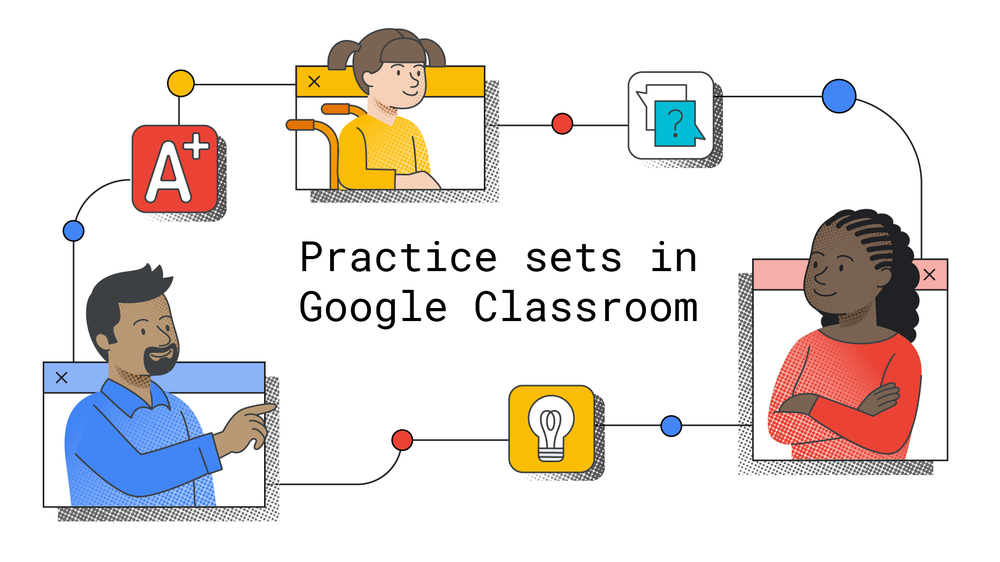
Practice sets: a more personal path to learning
Everyone learns in their own way — but we do share a few patterns in common. We all learn more effectively when we practice, and even more so when we get specific feedback.
But with large classes of students at different skill levels, teachers can have trouble supporting individual journeys and learning styles. So we spoke with educators around the world to see how we could help them become more effective in the classroom. Time and again, they said they wanted to spend less time on tedious tasks like grading, and more time focused on their students’ unique needs.
So today, we’re announcing an upcoming feature in Google Classroom to help them do just that. Practice sets will give teachers the time and tools to better support their students — from more interactive lessons to faster and more personal feedback.
Supercharge teaching content and get class insights
With practice sets, educators can easily transform their own teaching content into interactive assignments and use the autograding tool to cut down on manual grading time. Practice sets also help teachers figure out which concepts need more instruction time and who could use extra support, giving them quick performance insights to shape future lesson plans.
Boost student confidence and celebrate their progress
Students get real-time feedback as they complete practice sets, so they know whether they’re on the right track. When they’re struggling to solve a problem, they can get hints through visual explainers and videos. And when they get an answer correct, practice sets will celebrate their success with fun animations and confetti.
One fifth-grade teacher, who used practice sets in a recent trial, saw the benefits in action: “The kids were calling it ‘Google magic’ because of the hints, pop-ups and instant feedback they received. That’s what makes practice sets a real game changer for their learning experience.” They also liked the focused support: “Practice sets also helped meet students’ needs when I couldn’t meet with them at that moment.”
Get ready for practice sets
We’re actively testing practice sets with some schools in anticipation of our beta launch in the coming months. Practice sets will be available within Google Classroom for any educator using the Teaching and Learning Upgrade, or any institution using Google Workspace for Education Plus. If you’re interested in participating in the beta, get in touch with us.
To learn more about adaptive learning technology and its potential impact on the future of education, read our latest blog post.

Attenzione alle telefonate da Tunisia, Kosovo e Moldavia

iMac 24″: potente e BELLISSIMO, oggi è IN SCONTO su Amazon