Prime Video, i migliori film originali usciti nell’estate 2021
Trent’anni fa nasceva Linux, il papà del software libero

Guida per principianti: come comprare azioni nel 2021
Se sei un investitore principiante, allora questo post fa per te. Ti guiderò attraverso il processo di acquisto di azioni nel 2021 e come assicurarti di investire con saggezza. Darò…
L’articolo Guida per principianti: come comprare azioni nel 2021 scritto da YOUR_DIGITAL_VOICE! proviene da Assodigitale.

GitHub Copilot: rischi di sicurezza nel 40% dei casi
A new model for inclusive computer science education
The lack of diversity in the computing education pipeline has been a remarkably persistent problem. Something that’s stalled progress in addressing disparities is that there’s largely been a focus on individuals, such as teachers and students, rather than on how equity plays out across multiple levels of the computer science (CS) education ecosystem. This is why our work at the University of Texas since 2014 focuses on understanding the root causes of inequities in the CS education pipeline and how every level of the system influences equity.
With the support of a CS-ER (computer science education research) grant from Google, my colleague Jayce Warner and I developed a framework for thinking about equity across the CS education ecosystem. We began this work after digging into data in Texas in 2014 and finding that only about a quarter of Texas high schools offered any kind of CS course and fewer than 3% of Texas students were taking a CS course each year. The students enrolled in CS courses were also not reflective of the student population in our diverse state. We launched what became the WeTeach_CS professional development program, with the ultimate objective of seeing equitable enrollment in CS courses in Texas. To achieve this goal, we first had to improve access to CS courses and increase the number of CS-certified teachers in the state.
At the time, we thought equity had to wait until we had solved the capacity, access and participation challenges. But as we began thinking more deeply about this model and asking our colleagues in the Expanding Computing Education Pathways (ECEP) Alliance for feedback, we realized several things:
True Equity is about more than just diversity in the classroom, and just because something is available to everyone doesn’t mean that everyone can or will benefit. Also, education is very complex and the things we can easily measure (such as AP class participation) may not be the best indicators of change or success.
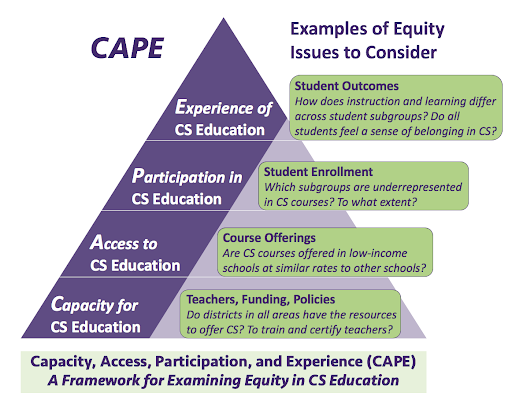
We developed a new framework that reflects how things connect at different levels of CS education. Most importantly, this model helps us better understand how equity plays out at each level. We’ve called it the CAPE framework and it consists of four interdependent components: capacity for CS education, access to CS education, participation in CS education and experience of CS education.
Each level affects the next. For example, if we want students to have equitable experiences in CS, we first need to make sure they’re participating equitably. Equitable participation relies on equitable access and equitable access relies on equitable capacity.
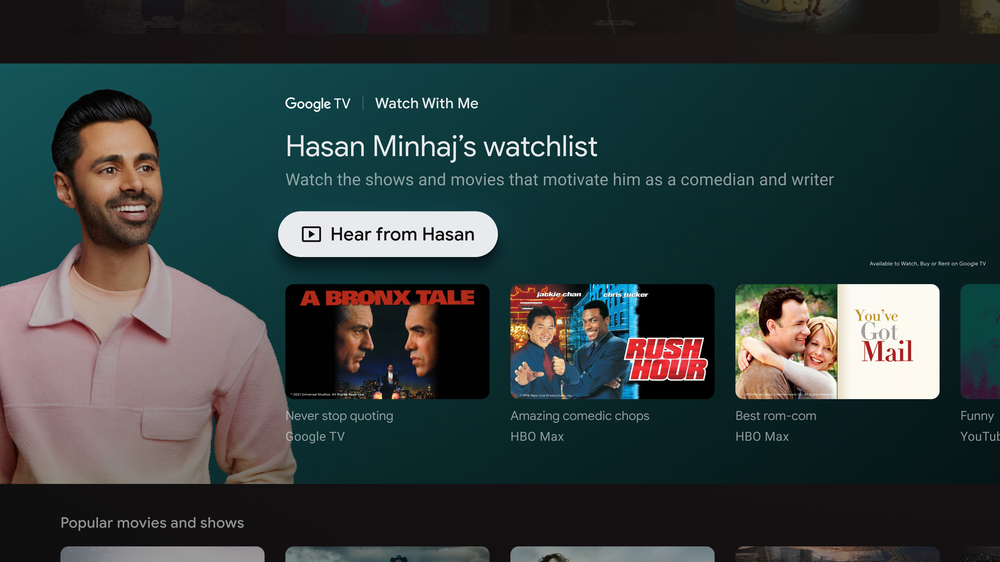
Watch With Me on Google TV: Hasan Minhaj’s watchlist
Movies and TV can make us laugh, cry and even shape who we are. Our watchlists can be surprisingly revealing. We’re teaming up with entertainers, artists and cultural icons on a new ongoing Watch With Me series on Google TV to share their top picks and give you a behind-the-scenes look at the TV and movies that inspired them.
Writer, comedian, producer and TV host Hasan Minhaj is best known for his sharp, earnest political commentary. When he isn’t on screen tackling any number of current issues, he’s happy to sit back and rewatch one of his favorite films.
“Movies and TV shows are an opportunity to watch something with loved ones,” Hasan says. “Whether they make you laugh or feel something deep. Or they can be a source of respite, or help you realize how big the world is.”
We sat down with Hasan to learn more about his own Google TV watchlist and discover any hidden gems he has on repeat. “To me, rewatchability is everything. So my watchlist is everything that I can watch over and over, whether it’s with my wife, dad or kids. That’s what’s on my watchlist: Comfort food in the form of movies.”

Epson EB-FH06, proiettore a lampada da 3310 lumen (misurati) per l’ufficio e l’intrattenimento

NC DESIGN GROUP con tutta la sua “non convenzionalità” alla Milano Design Week
NC Design group® è un brand giovane, dal respiro internazionale, che realizza complementi decorativi d’arredo. Questi elementi di design rispondono alle necessità del mercato attuale facendo leva sulla finezza estetica, tipicamente pulita…
L’articolo NC DESIGN GROUP con tutta la sua “non convenzionalità” alla Milano Design Week scritto da Paolo Brambilla proviene da Assodigitale.
Windows 11 verrà rilasciato il prossimo 20 ottobre?
Valanga di sconti sui Surface di Microsoft: fino a 500 euro di risparmio

WhatsApp, in arrivo altre novità per i messaggi vocali e scritti

Android, torna la possibilità di registrare le chiamate via app
From startup founder to product manager in Nairobi
Welcome to the latest edition of “My Path to Google,” where we talk to Googlers, interns and alumni about how they got to Google, what their roles are like and even some tips on how to prepare for interviews.
This week we spoke with Andrew Kamau, a Noogler — new Googler — who recently joined as a Product Manager in Nairobi. Learn how Andrew’s career took him from startups in Kenya to creating products at Google.
What do you do at Google?
I’m a product manager working on the Privacy team for Chrome Browser. Product management typically involves wearing multiple hats, but I can summarize it as supporting my team in ensuring that we are delivering product features that help our users stay and feel safe while using Chrome to access the web.
I work closely with a team of engineers, designers, product managers and other cross-functional roles to anticipate our users’ needs such as easy-to-use privacy controls and protection from online threats. We then design product strategy that meets those needs. This usually involves weaving together inputs from our users and colleagues across different teams and then making product decisions that align with the company’s mission.
How would you describe your path to Google?
I’ve had a somewhat unusual path compared to most folks in my position. My career background is largely in tech startups. I live in Nairobi, which has a thriving community of creative talent from which I’ve benefited from and to which I’ve contributed. My time as an entrepreneur working on financial technology exposed me to opportunities that helped diversify my experiences and build up the empathy and skill set that is extremely invaluable as a product manager.
Coming from a startup background, I was — on one hand — nervous about moving to a global corporation. I worried that I might not fit into the culture, having not worked at any organization with more than 40 people in the entirety of my career before this. On the other hand, the interesting thing about working at Google is that I’m still able to channel my scrappy, entrepreneurial approach to experimenting and building products. The difference is that I now have access to world-class technology and talent to support me every step of the way and the impact of my work has increased exponentially.
What’s the one thing that surprised you about the interview process?
Considering that I went through the entire process in the midst of the pandemic and working from home, I was pleased to find that everyone involved was gracious enough to accommodate my preferences, so I didn’t have to worry about awkward situations like my son barging in on our video calls.
I did have some preconceived notions about what the recruiting process would look like. One that took me by surprise was how helpful and supportive my recruiter was. She helped make the process less jarring and more rewarding; even going so far as to set up calls with product managers and engineers who work at roles similar to the one I was interviewing for. They voluntarily provided guidance and advice, which helped me be better prepared for the technical interviews.
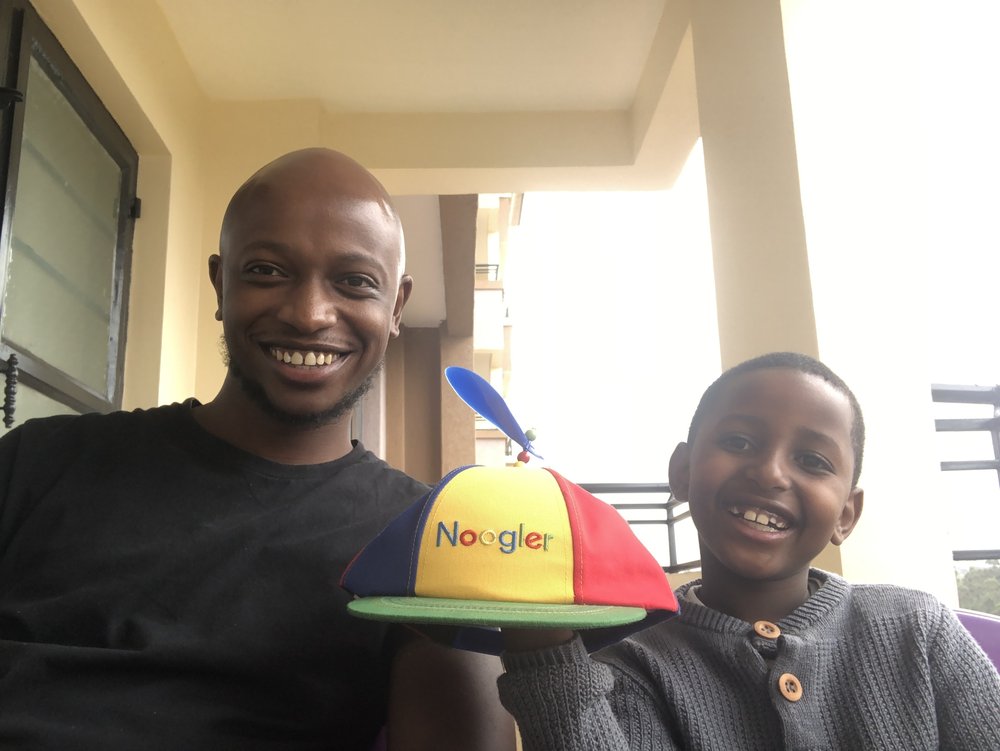
Andrew and his son
What gets you most excited in your role?
Chrome is used on over three billion devices across the world to access the web. Building and maintaining safe and reliable product experiences for our users at this scale is a huge responsibility and source of motivation for me. I enjoy working on technical solutions to advance our mission and deliver value to our users. I’m particularly fortunate to work with incredibly smart engineers and designers on our teams.
In my role, every day is different. Some days are spent largely on meetings, chat and email with my colleagues brainstorming and planning, while others are heads-down working on synthesizing feedback from users and developing product requirements.
I regularly carve out time on my weekly calendar for virtual coffees and lunches where I get to meet folks in the company based in Munich, London, Dublin, and other locations globally. Due to the diversity of backgrounds and experiences in the company, there’s always something fun and interesting to learn from others.
Any tips for aspiring Googlers in Africa?
First and foremost, focus on being great at your craft while maintaining a low ego. I strongly believe that confidence, ambition and humility can co-exist.
Having mostly worked in the African tech industry, I’m constantly blown away by the talent and creativity that I encounter. I’d encourage anyone who aspires to make the jump not to doubt themselves and apply. You don’t need to know anybody (I didn’t!) or pull any strings.
It’s also important to take time to find a role and team that is an ideal match. For example, I had to delay my process for a few months until I found the role and team that best matched my interests. Eventually, I ended up interviewing for a different role from the one I was invited to apply for — and it worked out great.

OnlyFans ritratta: per ora non vieterà contenuti porno