
La Cina inizia la costruzione della sua prima stazione spaziale modulare
Ieri (29 aprile) la Cina ha collocato in orbita intorno alla Terra Tianhe, il primo elemento della sua prima stazione spaziale modulare della serie Tiangong. La serie era stata inaugurata negli anni scorsi con “mini-stazioni” composte da un singolo elemento portato nello spazio con un unico lancio, sulla falsariga delle stazioni Salyut e Skylab di Russia e Stati Uniti; ora il programma spaziale cinese passa a una stazione da assemblare progressivamente tramite lanci multipli.
Tianhe ha una massa di circa 22 tonnellate, contiene alloggi e supporto vitale per tre astronauti e fornirà il controllo di guida, navigazione e orientamento dell’intera stazione, che sarà realizzata aggiungendo i futuri moduli Wentian e Mengtian per raggiungere una massa complessiva di circa 80-100 tonnellate, leggermente inferiore a quella della defunta stazione russa Mir e circa un sesto di quella dell’attuale Stazione Spaziale Internazionale. La tabella di marcia per l’assemblaggio della stazione cinese è piuttosto rapida: si prevede il completamento nel giro di pochi anni.
A questa stazione attraccheranno i veicoli cargo Tianzhou e le capsule per equipaggi Shenzhou; non sono previste visite di veicoli di altri paesi. Il lancio è avvenuto dal poligono di Wenchang mediante un vettore Lunga Marcia 5B progettato e costruito interamente in Cina.
Il lancio di Tianhe è un segno molto chiaro delle ambizioni spaziali della Cina, che è esclusa per motivi politici dalla collaborazione con la Stazione Spaziale Internazionale e quindi ha deciso di agire autonomamente. Sarà una competizione molto interessante.


La configurazione generale di Tianhe è ispirata a quella dei moduli della stazione russa Mir (a sua volta basata sulla configurazione delle stazioni militari russe Almaz e Salyut), con dimensioni leggermente maggiorate; gli interni sono simili a quelli della Stazione Spaziale Internazionale.

Fonti: China Manned Space; China Science; SSA.
Questo articolo vi arriva gratuitamente e senza pubblicità grazie alle donazioni dei lettori. Se vi è piaciuto, potete incoraggiarmi a scrivere ancora facendo una donazione anche voi, tramite Paypal (paypal.me/disinformatico) o altri metodi.

Rehappy: l’importanza degli smartphone ricondizionati
Il brand sostenibile Redevice si trasforma in Rehappy: l’importanza degli smartphone ricondizionati per l’economia circolare Il brand siciliano di smartphone ricondizionati Redevice del giovane imprenditore Giuseppe Sammartano, si trasforma in Rehappy, un’evoluzione nata dal forte desiderio del suo fondatore di contribuire a rendere tutti più felici, in un momento storico estremamente complicato. Giuseppe Sammartano Alla domanda più specifica su chi intende rendere più felice Rehappy, Sammartano dichiara: “Rehappy vuole essere un modo per renderci consapevoli…
L’articolo Rehappy: l’importanza degli smartphone ricondizionati scritto da Paolo Brambilla proviene da Assodigitale.

Android Enterprise security delivers for flexible work
As many companies integrate return to the office plans with existing work-from-home strategies, a key component is building a device management and security strategy centered on remote access. In this era of hybrid work, mobility is the critical link for workers who need the ability to connect to company resources from anywhere.
A recent Forrester report highlights why IT administrators should use on-device security and enterprise management features to build a powerful and adaptive security strategy, noting how remote access is now paramount for business continuity. Organizations can enable the multilayered protections and management features in Android Enterprise to help their teams thrive in this hybrid world, giving teams powerful built-in security without layers of complexity.
Security built in as a foundation
In its research, Forrester found that 78% of IT admins surveyed are planning to increase their use of on-device security in the next year. When it comes to anti-malware defense, securely configuring devices and managing mobile applications, Android offers enterprise-grade security solutions that meet the needs of today’s organizations.
Forrester recommends that operating system platform security be the key foundation to a device security strategy. With Android Enterprise, organizations benefit from on-device protection that is built to help secure data, protect employee privacy and equip IT admins with a rich set of management features. The report calls out how Android makes use of the anti-malware protections in Google Play Protect to provide an ongoing defense against potentially harmful apps. In doing so, an IT security team can rely heavily on such built-in features to achieve the security posture that businesses of all sizes require to defend against complex attacks.
Our recently updated Android Enterprise Security Paper provides a comprehensive review of the hardware and software security features available in Android which can be trusted for accessing critical and sensitive information.
Security admins need, privacy employees require
Android provides a depth of security features that are built to provide automatic defenses against many layers of threats. Google Play Protect uses machine learning to adapt to changing security threats, providing organizations a built-in solution at no cost.
The Android work profile gives organizations flexibility to securely enroll personal devices and provide greater privacy on corporate-owned smartphones and tablets. In its report, Forrester notes Android comes with strong data isolation and protection features with the Android work profile. By separating personal and work apps on devices with distinct encryption keys for each profile, Android gives admins a built-in solution to provide employees with secure access that aligns to their work styles without sharing any access to data from personal apps on devices with IT.
Managed Google Play lets admins specify which public or internal apps can be installed in the work profile. The granular levels of security available to admins from Android Enterprise APIs and the built-in security through services like Google Play Protect serve as a strong foundation for mounting a robust threat defense. In addition, the SafetyNet Attestation API integrates with partner Enterprise Mobility Management (EMM) solutions to verify that devices have not been compromised. This now includes hardware-backed evaluations as an indicator of a stronger device integrity evaluation.
No matter where your teams are working, you can have confidence in the platform and management security features found in Android Enterprise. Learn more about building an on-device strategy from the Forrester report, and go in-depth on integrating features with our security paper.

Trash to treasure: How Google thinks about deconstruction
For Lauren Sparandara, stepping onto a construction site transports her to the scrappy dollhouses of her childhood.
“I would scavenge styrofoam from the household trash and use it to build these elaborate cityscapes for my dolls,” she laughs. “I see a similar opportunity when I look at buildings that are about to be demolished: What could we make with those?”
At Google, Lauren looks for ways to reuse materials in Google’s design and construction process — like salvaging perfectly good doors and hardware, cabinets, furniture, and lockers from existing buildings to reuse them in Google’s spaces or donate to local organizations in need.
I sat down with Lauren to talk about what she envisions for future Google construction projects, and how it relates to the circular economy.
First things first: What is deconstruction?
Typically, heavy machinery demolishes existing structures on a construction site, which means usable materials are often sent to the landfill.
The alternative is deconstruction, where a building is systematically dismantled from the outside in. To the greatest extent possible, building components — like interior doors or wood components — are kept intact and salvaged for reuse, creating a more circular system. Deconstruction also increases the recyclability of materials that can’t be reused.
Existing buildings should be viewed as resources rather than something to be disposed of.
Why does deconstruction interest you?
Existing buildings should be viewed as resources rather than something to be disposed of. Construction and demolition activities account for nearly two-thirds of all waste generated annually in the U.S.
While traditional demolition is certainly time and cost-efficient, there’s a huge missed opportunity when salvageable materials are landfilled. Deconstruction can shrink the environmental impact of construction and expand green job opportunities — within both the construction industry and salvaged and refurbished materials market.
Can you give us an example of deconstruction put into practice at Google?
We’ve salvaged materials from small-scale interior refreshes since 2012 and have diverted over 1,000 tons of materials from landfills in the Bay Area in the process — that’s roughly the weight of five Boeing 747s. When designing new office spaces, we look for opportunities to repurpose existing buildings. Our Spruce Goose office in the Los Angeles area is a converted airplane hangar, and our Fulton Market office in Chicago was a cold-storage warehouse. In Munich, we’ve started converting the Arnulfpost — a 1930s modernist-style postal distribution facility — into an inspiring workplace with public spaces for the community.
In addition to all of that, we want to spread awareness and advance research on circularity in buildings. In 2019, we partnered with the Ellen MacArthur Foundation, Building Product Ecosystems, and Ackerstein Sustainability to publish a whitepaper on commercial deconstruction and reuse, with the hopes of driving the wider building industry toward more circular practices.
Where do you see this work going in the future?
There’s the potential to think big about what we can do with our existing building stock, and reframe our thinking to view existing buildings as amazing resources rather than waste. Unfortunately, most deconstruction examples are historic residential properties, so we’re asking: “How can we create circular material flows from a suburban office building built in the 1980s? How do we prevent any usable materials from going to the landfill?’
We’re starting to answer these questions as we work on new development projects. At the Caribbean office development in Sunnyvale, California, we salvaged 35 tons of material to donate to California charities and nonprofits. And at the Charleston East development project in Mountain View, California we’re incorporating over 30 types of salvaged materials.

Finding the intersection of social justice and tech
Welcome to the latest installment of our series, “My Path to Google.” These are real stories from Googlers, interns, and alumni highlighting how they got to Google, what their roles are like and even some tips on how to prepare for interviews.
Today’s post is all about Xiomara Contreras (pictured above with her mother), a product marketing manager in our San Francisco office. Xiomara’s passion for social impact is deeply rooted in her work, both in her core role of supporting small businesses and in building community for underrepresented groups both in and out of Google.
How would you describe your role at Google?
I’m a product marketing manager working on Google My Business. Specifically, my team is dedicated to supporting small-business owners. Google My Business is a free tool that allows users to promote their Business Profile on Google Search and Maps, allowing them to respond to reviews, post photos of products or special offers and add or edit their business details so they can connect with customers.
My role focuses on core product marketing, meaning I work with product managers and engineers to determine who our users are, what they need and how to align our product with those needs. As a product marketing manager, I show the value of our product to small business owners. Additionally, I recently contributed to the creation and launch of the Black-owned business attribute to support Black-owned businesses.
What made you decide to apply to Google?
When I initially started thinking about a career, I thought I would be in the nonprofit sector because most of my previous experience was in that space. Also, I studied Communication Studies and Latina/o Studies at Northwestern and I wasn’t aware of the breadth of opportunities available to “non-technical” students in tech.
Then I learned about Google’sBOLD Internship Program through Management Leadership for Tomorrow (MLT), an organization that prepares and connects university students from underrepresented backgrounds to internships and full-time careers. Through the support and encouragement of the organization, I applied to the internship. Once I was an intern at Google I was able to see how my passion for social justice issues, education and youth mentorship intersect with tech, and I knew I wanted to work at Google full time.

TikTok Introduce La Lead Generation

Cos’è il network slicing, la tecnologia che cambia le regole delle reti cellulari

Five ways we’re making Google the safer way to search
The web is home to a lot of great things. But it is also a place where bad actors can try to take advantage of you or access your personal information. That’s why we’re always working to keep you safe while you search, and also to give you the tools to take control of your Search experience.
Here are five ways we’re making Google the safer way to search:
1. Fighting spam

Chrome 91 semplificherà la possibilità di allegare file alle email
New ways to save, commute and manage money with Google Pay
Last year, we launched a reimagined Google Pay to be a safe, simple and helpful way to pay and manage your finances. The app is full of ways to pay friends and businesses, save with offers and rewards and stay on top of your money. Today, we are announcing three ways to help you save money on groceries, pay for transit fares in more cities and better understand your spending.
Save at the grocery store
Small expenses add up, but finding ways to save on everyday items like groceries is one way to keep your budget in check. However, it can be a cumbersome task. Taking the time to look through coupons, finding the right offer, remembering to bring them with you or tracking down that promo code you saw online (where was it again?) can be tedious.
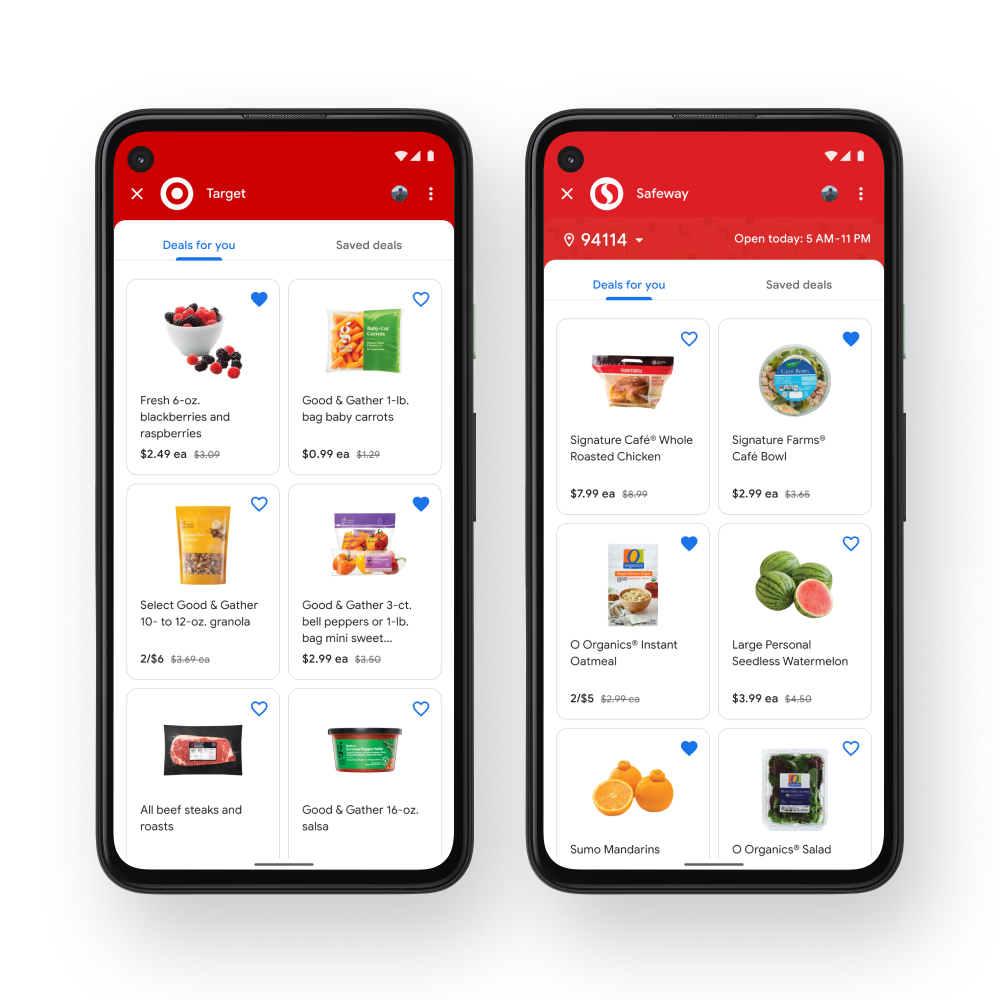
We teamed up with Safeway to make it easy to find weekly grocery deals from the Google Pay app. You can find deals on thousands of items across more than 500 Safeway stores nationwide. You can also discover similar deals at Target stores nationwide.
Find weekly deals on groceries at Safeway and Target stores in the Google Pay app.
To find the latest grocery deals, search for Safeway or Target in the Google Pay app and tap “View Weekly Deals.” If you’ve turned on location in Google Pay, soon the app will notify you of the weekly deals at Safeway and Target stores when you’re nearby.
Pay for transit with Google Pay in more cities
Google Pay already supports buying and using mobile transit tickets in more than 80 cities and towns across the United States. Starting soon, we are adding Chicago and the San Francisco Bay Area to the list. In order to bring mobile ticketing to more people, we continue to expand not only to large cities, but also to dozens of smaller towns across the country through our integration with Token Transit.
Soon, Google Pay users on Android will be able to access transit tickets from the app’s home screen. Tap the “Ride transit” shortcut and you will be able to purchase or add a transit card, top up the balance and pay for your fare. Once you purchase a transit card, there’s no need to unlock your phone. Just hold it to the reader and go. In cities without readers, commuters can simply show their visual tickets on their mobile devices.
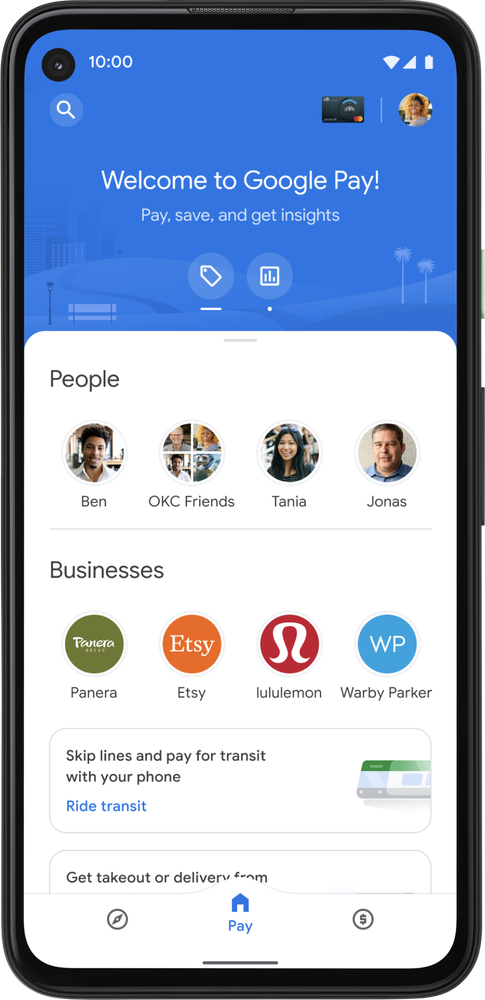
Soon, you can access transit tickets through a new “Ride transit” shortcut.
See your monthly spending in just a few taps
The new Google Pay app was designed to help you stay on top of your money by providing a full view of your finances. Navigate over to the “Insights” tab for a view of your account balances and helpful insights on your spending, like upcoming bill reminders, weekly spend summaries or alerts when large transactions are made.
As interest in social activities ramps back up, we are making it easy to keep a close eye on your spending. We recently added a fast way to see your spending by category or business. For example, if you search for “food,” you will see the amount you have spent on food this month as well as a list of all your transactions related to food. You can get even more specific, for example searching for “burgers” or for a specific business like “Burger King.” You don’t have to worry about the tedious task of categorizing or totaling your expenses; Google Pay does that for you.
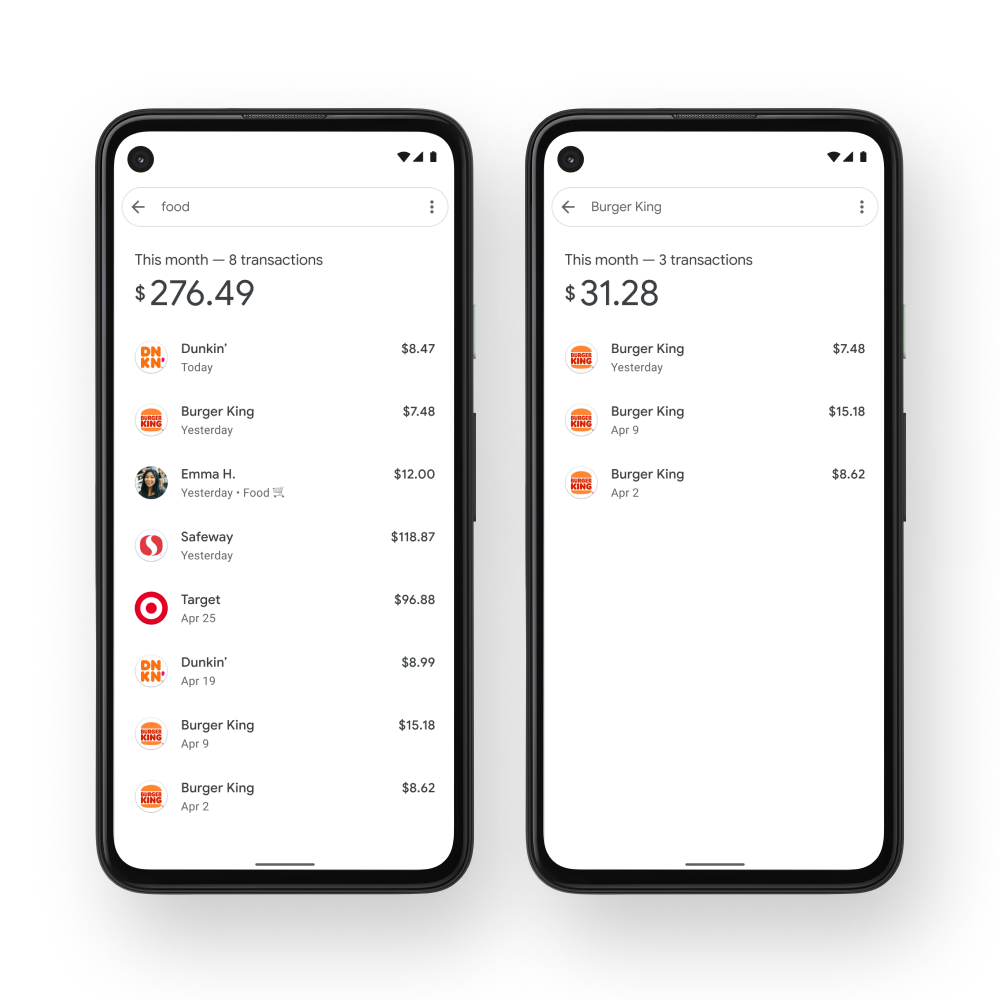
Quickly see your monthly spending by category or business.
With features like saving on groceries, paying for transit and keeping an eye on your spending patterns all in one spot, Google Pay keeps helping you manage your everyday money tasks.

Bringing digital skills to previously incarcerated jobseekers
When I was in federal prison, I witnessed firsthand how incarceration affects people’s lives — even long after they’re released. After my own release in 2015, I created The Ladies of Hope Ministries (The LOHM), which helps previously incarcerated women transition back into society through education, entrepreneurship, spiritual empowerment and advocacy.
In the U.S., more than 600,000 people make the transition from prisons to the community each year. While many are ready to start working, they often face systemic barriers to entering the workforce. The unemployment rate for people impacted by incarceration is five times the national average. Because of systemic racism in the justice system, this disproportionately impacts the Black community, who also experiences higher unemployment rates than any other racial group. Additionally, 82% of middle-skill jobs in the U.S. require digital proficiency, but many incarcerated individuals lack digital literacy after being removed from technology in prison. The research is clear: Ensuring people have jobs is key to helping them stay out of prison and contributes to our country’s economic health.
Everyone should have access to economic opportunity. That’s why my nonprofit, along with the Center for Employment Opportunities, Defy Ventures, Fortune Society and The Last Mile, is partnering with Google on the Grow with Google Career Readiness for Reentry program. This program will train more than 10,000 people who have been impacted by incarceration on digital skills they can use to get a job or start businesses. This initiative builds upon Google’s existing criminal justice work — which includes more than $40 million in Google.org grants to organizations advancing reform in the U.S. justice system over the last six years — and is part of Google’s racial equity commitment to help Black job seekers grow their digital skills.
The Grow with Google Career Readiness for Reentry program provides free training on digital fundamentals — like how to search and apply for jobs online, how to make a resume using web-based tools and how to send professional emails — as well as more advanced topics like including entrepreneurship and using spreadsheets to make a budget for your business. Several partners will also provide job placement support or help place learners into paid apprenticeships and entrepreneur-in-residence programs.
Partnering organizations like mine have worked with Google to develop the curriculum, designed as an easy-to-use guide to help community organizations deliver digital skills training to people returning from incarceration. Any nonprofit organization offering training to the reentry population can also join the Grow with Google Partner Program and access resources, workshop materials and hands-on help, completely free of cost.
We can’t change the past, but we can build toward a better tomorrow. The ability to secure a job or start a business can pave the way for a brighter future, and I’m thrilled to work with Google to give others like me the opportunity for a fresh start.

Google Maps si aggiorna per informare meglio i vacanzieri
In vista dell’estate, Google Maps si aggiorna per implementare dei nuovi avvisi relativi al Covid-19 all’interno delle mappe e dei risultati di ricerca. In questo modo, quando un utente cerca voli, hotel o attività specifiche di un determinato posto, la ricerca gli mostrerà una serie di informazioni utili relative alle misure anti-contagio adottate in quel Paese o in quella cittadina di suo interesse.

Un blackout informatico molto, molto canadese

Ci sono tante ragioni che possono portare a un’interruzione di servizio di Internet. Quella che viene segnalata da Ars Technica è… decisamente canadese.
Circa 900 utenti della località di Tumbler Ridge, nella Columbia Britannica, la provincia più occidentale del Canada, sono rimasti senza Internet per ben 36 ore a causa del tranciamento di un cavo dati in fibra ottica dell’operatore di telecomunicazioni locale, Telus.
Il cavo è stato infatti tranciato da un gruppo di castori, che hanno scavato una buca profonda circa 90 centimetri, hanno masticato la condotta protettiva del cavo, spessa dodici centimetri, e poi anche il cavo stesso. I castori hanno usato pezzi del cavo per costruire una delle loro tipiche dighe.
Il lavoro dei roditori ha interrotto anche il servizio telefonico cellulare e i canali TV per un numero limitato di utenti. Secondo i tecnici, si è trattato di un guasto unico nel suo genere perché i castori hanno tranciato il cavo in più punti, rendendo molto difficili le operazioni di riparazione, anche perché il suolo che ricopre la condotta è gelato.
Se vi serve una giustificazione originale per un ritardo nella consegna di un lavoro o per non partecipare a una riunione o a una sessione di didattica a distanza, provate con i castori, se ce ne sono dalle vostre parti. Qui in Canton Ticino si potrebbe provare con le martore, note per la loro abitudine di masticare i cavi elettrici delle automobili.

Jeff Bezos e Elon Musk: tra i due miliardari sono Guerre Stellari
Jeff Bezos e Elon Musk, è scontro tra Titani. Secondo quanto riportato dal sito Spacenews, Blue Origin, la società di servizi di volo spaziale suborbitale con sede a Kent, Washington, del proprietario di Amazon, ha presentato un reclamo di cinquanta pagine contro la decisione della NASA di assegnare a SpaceX un contratto per la costruzione di un veicolo spaziale per il ritorno degli astronauti americani sulla Luna.
Microsoft, Windows 10 fa il record di utenti
Sono oltre 1,3 miliardi gli utenti attivi quotidiani di Windows 10. Lo ha rivelato Microsoft in occasione del suo ultimo rapporto finanziario. Secondo i dati forniti dal colosso di Redmond, in poco più di un anno si sono aggiunti 300 milioni di nuovi utenti a quelli già attivi. Un vero e proprio boom, dunque, che lascia presagire un ulteriore e importante incremento entro fine anno.