9 apps to help kids sharpen their coding skills
Coding is a skill that’s now part of just about every discipline — and what’s more, it’s fun for kids to learn, and easy for parents and teachers to add to lessons at home or school. As kids get ready to go back to school and Chromebooks are once again on desks at home and in the classroom, it’s a good time to boost students’ coding knowledge. At Google, we believe every student deserves the chance to explore, advance and succeed in computer science. Practical computer science skills can help students learn and create, and bring more relevance to nearly any subject, from history to literature to current events.
Thanks to the devices and apps below, students of all ages can be engaged while learning to code. Fortunately, there are coding apps for just about every grade and skill level. Here are our suggestions for apps and devices to check out this fall, whether you’re in a classroom or at home with learners.
Coding apps to try in the classroom and at home
Whether it’s creating a video game as an assignment in science class, or building a website for a side project (lemonade stand, anyone?), there are coding apps for the whole family and the whole class. Families can find all of these apps on the Google Play Store, and schools can find out more information on the Chromebook App Hub.
Beginning to code
-
Cloud Stop Motion (Play Store) is a fun stop-motion and animation movie creator. Cloud Stop Motion enables kids to work with animations on a zoomable, scrollable timeline. Sound effects, music, titles, credits and speech bubbles can be added before rendering to an MP4 movie. An extensive library of audio, backgrounds and styles included, this app is great for students and parents alike.
-
Grasshopper(Web app) is a coding app for beginning learners that uses games to build skills with JavaScript. Learners can move up through progressively challenging levels to refine their coding prowess.
-
Scratch Jr(Play Store) is tailor-made for younger learners. Scratch Jr is actually based on a programming language that teaches kids how to program by creating their own interactive stories and games.
-
Tynker Jr (Play Store) is perfect for children just learning to read. Children ages 5-7 can learn the fundamentals of coding by connecting picture blocks to move their characters.
More advanced coders
-
Bloxels (Play Store, App Hub) lets anyone build a video game with their own characters and art. Game worlds are quick to build with built-in logic, triggers and actions.
-
Codecademy(Play Store) Codecademy creates an engaging, flexible, and accessible way to learn to code online, making it possible for anyone to gain skills for employability and build something meaningful with technology. Access hundreds of courses in subjects like web development and data science, as well as in-demand languages like Python, CSS, and JavaScript.
-
Piper Make (Play Store, App Hub) is a drag-and-drop coding platform for the Pico, the newest microcontroller board from Raspberry Pi. Using Piper’s hardware packages available online, the Piper Make portal offers new narrative-based tutorials, projects, and ways to start building and coding technology.
-
Replit(Play Store, App Hub) is a simple, yet powerful online coding platform. It’s perfect for beginners, who are coding for the first time, but also scales to the needs of teachers and professional programmers with decades of experience. Replit supports all programming languages, including Python, Java, Javascript + HTML/CSS, and C/C++, and runs on every device, including Chromebooks. It combines an IDE (integrated development environment) with a debugger, built-in testing/autograding, and hosting tools to build websites and applications.
-
Tynker(Play Store, App Hub) features block-based coding challenges that help learners move on to more complex skills like Python coding and advanced computer science. It even offers AP Computer Science courses.
Devices for coding, creating and anything in between
With new devices for learning anywhere or advanced use, students and families can find devices for more robust needs such as content creation and editing, coding, and running apps in virtualized environments simultaneously with large video calls.
There’s a device for everyone in the family or classroom. This includes devices like the Lenovo 500e Gen 3, which works in both laptop and tablet mode and has a rear-facing camera and built-in stylus. It also includes the spill-resistant HP Chromebook x360 11 G4 EE, the Acer Chromebook Spin 512, or the Lenovo 300e Gen 3 with its 3:2 ratio, ideal for reading and working on Docs more comfortably, an Always Connected LTE enabled device with dual cameras. You can find all the latest in this handy guide for schools, or on chromebook.com.
To learn more about Google’s commitment to closing equity gaps in computer science education and discover lessons, research, scholarship opportunities and more, visit our Code with Google page. Educators can also find CS resources on our website and on the Chromebook App Hub. And for more resources for families, with guidance on everything from classroom tools to screen time best practices, visit families.google.com, and sign up for Family Link for parents to help set digital ground rules on their school or personal device.

Sniper Ghost Warrior Contracts 2, nei negozi l’edizione PS5

Joomla 4.0: tutte le novità della nuova versione
Experience the Tokyo 2020 Paralympics with Google and YouTube
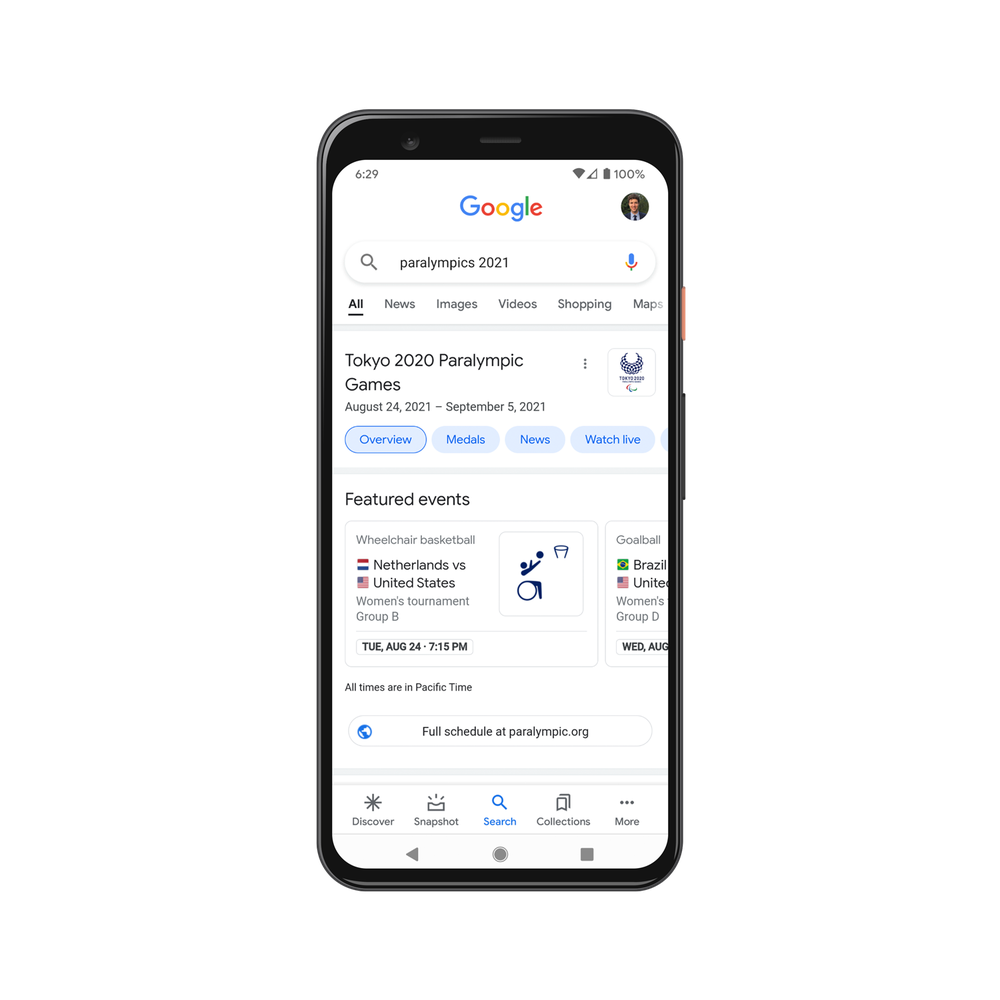
While some of the Tokyo 2020 Games are over, others are just beginning: The Tokyo 2020 Paralympic Games are right around the corner. And just like earlier this summer, there are few ways you can enjoy the action from home.
1. Watch livestreams and highlights on YouTube
Starting August 24, catch livestreams as well as clips and highlights from 13 official Paralympic broadcasters around the world on their YouTube channels. The Paralympic Games channel will also be streaming over 1,300 hours of live sports across 219 countries and territories, as well as sharing highlights, athlete interviews and behind-the-scenes videos with automatic captions available in 13 languages. Livestreams will also be accessible with automatic captions in English.
2. Stay up to speed with Google Search
Find the latest information on your favorite team and Paralympians, and even see where your country ranks in the race for gold. If you can’t tune into the Paralympics live, don’t worry — you can watch a daily recap video, check out the top news related to the events and with Google Images, even see photo galleries of some of the best photos of the day. For data lovers, check out our Trends page to see fun Search stats on your favorite sports. And, for a limited time only, keep an eye out for a fun surprise when searching for the Paralympics — I can’t say too much, I wouldn’t want to spoil the fun!

Facebook, video e chiamate anche senza Messenger?

BAMBINI ED EDUCAZIONE FINANZIARIA: QUANDO INIZIARE?
Per Alfio Bardolla 4 genitori su 5 non sanno come gestire l’educazione finanziaria dei propri figli Ci sono molte sfide quando si tratta di educare i bambini, e una di…
L’articolo BAMBINI ED EDUCAZIONE FINANZIARIA: QUANDO INIZIARE? scritto da Paolo Brambilla proviene da Assodigitale.

Ask a Techspert: How do Nest Cams know people from pets?
The other day when I was sitting in my home office, I got an alert from my Nest Doorbell that a package had been delivered — and right from my phone, I could see it sitting on the porch. Moments later, my neighbor dropped by to return a piece of mail that had accidentally gone to her — and again, my Doorbell alerted me. But this time, it alerted me that someone (rather than something) was at the door.
When I opened my door and saw my neighbor standing next to the package, I wondered…how does that little camera understand the world around it?
For an answer, I turned to Yoni Ben-Meshulam, a Staff Software Engineer who works on the Nest team.
Before I ask you how the camera knows what’s a person and what’s a vehicle, first I want to get into how they detect anything at all?
Our cameras run something called a perception algorithm which looks at objects (people, animals, vehicles, and packages) that show up in the live video stream. For example, if a package is delivered within one of your Activity Zones, like your porch, the camera will track the movement of the delivery person and the package, and analyze all of this to give you a package delivery notification. If you have Familiar Face Alerts on and the camera detects a face, it analyzes the face on-device and checks whether it matches anyone you have identified as a Familiar Face. And the camera recognizes new faces as you identify and label them.
The camera also learns what its surroundings look like. For example, if you have a Nest Cam in your living room, the camera runs an algorithm that can identify where there is likely a TV, so that the camera won’t think the people on the screen are in your home.
Perception algorithms sound a little like machine learning. Is ML involved in this process?
Yes — Nest cameras actually have multiple machine learning models running inside of them. One is an object detector that takes in video frames and outputs a bounding box around objects of interest, like a package or vehicle. This object detector was trained to solve a problem using millions of examples.

TIM, possibile data breach? Rubati i dati di alcuni utenti

Bitcoin, per la prima volta in tre mesi sopra i 50.000 dollari

Mascherine, togliamo l’elastico dopo l’uso, aiutiamo la fauna
Parte una campagna su Whatsapp per evitare di inquinare terra e mare e di danneggiare la fauna Su Whatsapp molte persone attente all’ambiente stanno facendo circolare un messaggio per sensibilizzare…
L’articolo Mascherine, togliamo l’elastico dopo l’uso, aiutiamo la fauna scritto da Paolo Brambilla proviene da Assodigitale.

Bonus rottamazione TV, Mise pronto a chiedere altra copertura
WhatsApp sta per sbarcare anche su iPad

These researchers are bringing AI to farmers
“Farmers feed the entire world — so how might we support them to be resilient and build sustainable systems that also support global food security?” It’s a question that Diana Akrong found herself asking last year. Diana is a UX researcher based in Accra, Ghana, and the founding member of Google’s Accra UX team.
Across the world, her manager Dr. Courtney Heldreth, was equally interested in answering this question. Courtney is a social psychologist and a staff UX researcher based in Seattle, and both women work as part of Google’s People + Artificial Intelligence Research (PAIR) group. “Looking back on history, we can see how the industrial revolution played a significant role in creating global inequality,” she says. “It set most of Western Europe onto a path of economic dominance that was then followed by both military and political dominance.” Courtney and Diana teamed up on an exploratory effort focused on how AI can help better the lives of small, local farming communities in the Global South. They and their team want to understand what farmers need, their practices, value systems, what their social lives are like — and make sure that Google products reflect these dynamics.
One result of their work is a recently published research paper. The paper — written alongside their colleagues Dr. Jess Holbrook at Google and Dr. Norman Makoto Su of Indiana University and published in the ACM Interactions trade journal — dives into why we need farmer-centered AI research, and what it could mean not just for farmers, but for everyone they feed. I recently took some time to learn more about their work.
How would you explain your job to someone who isn’t in tech?
Courtney: I would say I’m a researcher trying to understand underserved and historically marginalized users’ lives and needs so we can create products that work better for them.
Diana: I’m a researcher who looks at how people interact with technology. My superpower is my curiosity and it’s my mission to understand and advocate for user needs, explore business opportunities and share knowledge.
What’s something on your mind right now?
Diana: Because of COVID-19, there’s the threat of a major food crisis in India and elsewhere. We’re wondering how we can work with small farms as well as local consumers, policymakers, agricultural workers, agribusiness owners and NGOs to solve this problem.
Agriculture is very close to my heart, personally. Prior to joining Google, I spent a lot of time learning from smallholder farmers across my country and helping design concepts to address their needs.
“Farmers feed the entire world — so how might we support them to be resilient and build sustainable systems that also support global food security?”
Courtney: I’ve been thinking about how AI can be seen as this magical, heroic thing, but there are also many risks to using it in places where there aren’t laws to protect people. When I think about Google’s AI Principles — be socially beneficial, be accountable to people, avoid reinforcing bias, prioritize safety — those things define what projects I want to work on. It’s also why my colleague Tabitha Yong and I developed a set of best practices for designing more equitable AI products.
Can you tell me more about your paper, “What Does AI Mean for Smallholder Farmers? A Proposal for Farmer-Centered AI Research,” recently published in ACM Interactions?
Courtney: The impact and failures of AI are often very western and U.S.-centric. We’re trying to think about how to make this more fair and inclusive for communities with different needs around the globe. For example, in our farmer-centered AI research, we know that most existing AI solutions are designed for large farms in the developed world. However, many farmers in the Global South live and work in rural areas, which trail behind urban areas in terms of connectivity and digital adoption. By focusing on the daily realities of these farmers, we can better understand different perspectives, especially those of people who don’t live in the U.S. and Europe, so that Google’s products work for everyone, everywhere.
Why did you want to work at Google?
Diana: I see Google as home to teams with diverse experiences and skills who work collaboratively to tackle complex, important issues that change real people’s lives. I’ve thrived here because I get to work on projects I care about and play a critical role in growing the UX community here in Ghana.
Courtney: I chose Google because we work on the world’s hardest problems. Googlers are fearless and the reach of Google’s products and services is unprecedented. As someone who comes from an underrepresented group, I never thought I would work here. To be here at this moment is so important to me, my community and my family. When I look at issues I care about the most — marginalized and underrepresented communities — the work we do plays a critical role in preventing algorithmic bias, bridging the digital divide and lessening these inequalities.
How have you seen your research help real people?
Courtney: In 2018, we worked with Titi Akinsanmi, Google’s Policy and Government Relations Lead for West and Francophone Africa, and PAIR Co-lead and Principal Research Scientist Fernanda Viegas on the report for AI in Nigeria. Since then, the Ministry of Technology and Science reached out to Google to help form a strategy around AI. We’ve seen government bodies in sub-Saharan Africa use this paper as a roadmap to develop their own responsible AI policies.
How should aspiring AI thinkers and future technologists prepare for a career in this field?
Diana: My main advice? Start with people and their needs. A digital solution or AI may not be necessary to solve every problem. The PAIR Guidebook is a great reference for best practices and examples for designing with AI.
Finding belonging in Google’s Aboriginal and Indigenous Network
In 2013, the Google Earth Outreach team reached out to me with a request. They had been invited to partner on a mapping project in western Canada, and were looking for a Googler who could contribute an Indigenous perspective on cultural protocol. They asked if I would be interested in helping. “Absolutely!” was my immediate response. I’m Kanien’kehá ka, (Mohawk) and there have been times in my life and my workplace where it felt like there wasn’t space for me to be Indigenous. This was a great opportunity to lean in. There was also pressure: I could bring my perspective from my community but Indigenous communities are incredibly diverse. I hoped my Indigenous Studies degree would help me.
But the experience was a success and led to more participation in projects in the Indigenous space at Google. Since 2015, I’ve been one of the five people who lead Google’s Aboriginal and Indigenous Network (GAIN), an employee-run group that gives Indigenous Googlers a safe place to nurture our communities.
Finding belonging in a workplace with a large, diverse population can be difficult. We often bend and mould ourselves to fit others’ expectations. It’s hard to be authentic. It’s hard to hold to our core values, and what truly makes us who we are. But I found this in GAIN.
GAIN is a place where we can grow and support one another. But it’s more than that. This group ensures that our communities outside of Google thrive, too. GAIN understands that the individual, family and community are all connected. No one thrives in isolation, and that’s what powers GAIN.
This work was about self-determination, and starting the process of decolonization through community empowerment.
Some work GAIN has done that we’re proudest of involves creating and launching initiatives in areas like hiring, recruiting, retention, wellness, cultural events and internet connectivity in Indigenous communities. We work to shed light on the Missing and Murdered Indigenous Women and Girls campaigns , support Indigenous small businesses, and promote racial equity and justice initiatives. GAIN has also helped highlight educational tools such as training with ComIT, online STEMprogramming and Grow with Google, which worked with elementary school students in their local library and makerspace in Iqaluit.
We’re also working to make space for the Indigenous community internally. We have film screenings of independent Indigenous films, and have invited film makers from Wapikoni to host a discussion. Bob Joseph spoke to Googlers about what we may not know about the Indian Act, and the Cloud Sales team purchased his book for their entire team. More than 80 people in the Canadian offices are attending the University of Alberta’s free course on Indigenous Canada together.
But it was with that original Google Maps project that I found a true home. The purpose of this work is to identify Indigenous territories on Google Maps, and recognizing Indigenous independent sovereignties in the same way as other governments do on Google Maps. We also encourage Indigenous populations to take ownership of how their bands and cultures are presented online through StreetView, Earth and Maps.
When the Firelight Group (an Indigenous-owned consulting group) founded the Indigenous Mapping Workshop in 2014, they invited Google Earth Outreach as a partner and I was a member of the inaugural planning committee. We brought together 100 participants from Indigenous communities to teach them the tools needed to map out the locations their families rely on for hunting, gathering, trapping and fishing. In these workshops, we taught them how to put their own stories on their own maps, and encouraged them to take what they learned back to their communities. Maps are incredibly powerful tools in the hands of Indigenous communities, especially when they allow for our Indigenous worldview, and our Indigenous stories to be told.
This work was about self-determination, and starting the process of decolonization through community empowerment. We’ve supported Indigenous Mapping Workshops throughout Canada each year since 2014. Last year, the Indigenous Mapping Workshop went virtual and had more than 400 attendees. We expect more than 500 virtual attendees at this year’s conference, with over 100 training sessions. We’ve supported Indigenous Mapping Workshops in Australia and New Zealand as well.
This opportunity was amazing. It is an honour to spend time with other First Nations, Elders and community members. Being welcomed into communities and sharing their stories is not a gift I’ll soon forget. I am so humbled to be able to help bring these tools, stories and Indigenous voices together.
Helping people and businesses learn how Search works
Every day, billions of people come to Google to search for questions big and small. Whether it’s finding a recipe, looking for a local coffee shop or searching for information on complex topics like health, civics or finance, Google Search helps you get the information you need — when you need it.
But part of accomplishing our mission also means making information open and accessible about how Google Search, itself, works. That’s why we’re transparent about how we design Search, how we improve it and how it works to get you the information you’re looking for.
Like many of the topics you might search for on Google, Search can seem complicated — but we make it easy to learn about. Here are a few ways you can get a better understanding of how Google Search works:
A one-stop shop
Today, we’re launching a fully-redesigned How Search Works website that explains the ins and outs of Search — how we approach the big, philosophical questions, along with the nitty-gritty details about how it all works.
We first launched this website in 2016, and since then, millions of people have used it to discover more about how Search works. Now, we’ve updated the site with fresh information, made it easier to navigate and bookmark sections and added links to additional resources that share how Search works and answer common questions.
The website gives you a window into what happens from the moment you start typing in the search bar to the moment you get your search results. It gives an overview of the technology and work that goes into organizing the world’s information, understanding what you’re looking for and then connecting you with the most relevant, helpful information.
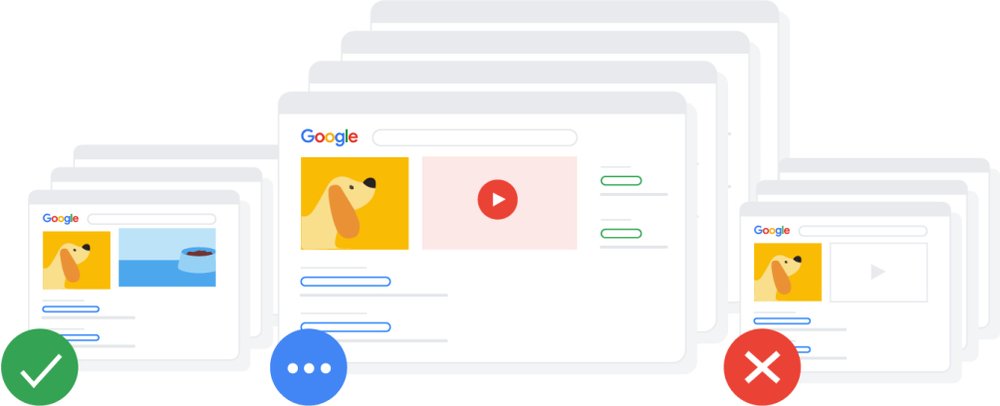
On the site, you can find details about how Google’s ranking systems sort through hundreds of billions of web pages and other content in our Search index — looking at factors like meaning, relevance, quality, usability and context — to present the most relevant, useful results in a fraction of a second. And you can learn about how we go about making improvements to Search. (There have been 4,500 such improvements in 2020 alone!) As you’ll read about, we rigorously test these changes with the help of thousands of Search Quality Raters all around the world — people who are highly trained using our extensive guidelines. These rater guidelines are publicly available, and they describe in great detail how Search works to surface great content.
We’re always testing changes to Search to provide you with the most helpful results.
Watch and learn
You also can watch our How Search Works video series, a set of easy-to-understand explainers about how Search connects you to helpful, relevant information. Here, you’ll find the answers to common questions like how Autocomplete works (no, it’s not mind-reading), how Google keeps you safe on Search, how ads appear in Search and more.
And if you’re really in the mood to learn all about Search — and the real people behind the scenes who are working hard to make it better every single day — you can watch our “home movie,” “Trillions of Questions, No Easy Answers.” Grab your popcorn!
Trending worldwide
It’s also easy for you to get a view into what people are searching for around the world using Google Trends. For more than 15 years, we’ve made this tool publicly accessible for anyone to gain more insight into how people are using Search to find information. Google Trends is the largest publicly available data set, using anonymized search interest across different geographies to highlight trending topics, questions and societal shifts. You can think of it as a window into what the world is searching for on the web.
Transparency for website creators
When it comes to the open web, we also invest heavily in helping site owners, publishers, businesses, creators and others succeed and get discovered on Search. At Google Search Central, creators can get expert advice from experienced webmasters, view over 1000+ educational videos, learn best practices for web development and discover many more tips to maximize their reach on Search.
Every day, we make changes to make Search work better — some small, some large. We work hard to give site owners and content producers ample notice and advice about changes where there’s actionable information they can use. While we strive to provide as much information as we can, we also have a responsibility to protect the integrity of our results and keep results as clean as possible from search spam. That’s why, although we share a lot of information about Search updates, we can’t share every detail. Otherwise, bad actors would have the information they need to evade the protections we’ve put in place against deceptive, low-quality content.
Over the last two decades, Google Search has evolved tremendously, but one thing remains core to how we operate: transparency about our approach and commitment to providing universally accessible information to all. Explore our newly refreshed website to discover more as we continue to evolve.