Using artificial intelligence in breast cancer screening
Every year, approximately 40 million women undergo breast-cancer screening in the U.S. using a procedure called mammography. For some, this can be a nerve-wracking experience; many wait days or weeks before a radiologist can review their scan and provide initial screening results. Between 10 and 15 percent of women must return for a second visit and undergo more scans before receiving a final diagnostic assessment – drawing out the process further.
Together with Northwestern Medicine, Google Health is working on a new clinical research study to explore whether artificial intelligence (AI) models can help reduce the time to diagnosis, narrowing the assessment gap and improving the patient experience.
Women who choose to take part in the study may have their mammograms reviewed by an investigational AI model that flags scans for immediate review by a radiologist if they show a higher likelihood of breast cancer. If a radiologist determines that further imaging is required, the woman will have the option to undergo this imaging on the same day. This study will evaluate whether this prioritization could reduce the amount of time that women spend waiting for a diagnostic assessment. Women whose mammograms are not flagged will continue to have their images reviewed within regular timeframes.
“Through this study, Northwestern Medicine aims to improve the excellent care we deliver to our patients every day. With the use of artificial intelligence, we hope to expedite the process to diagnosis of breast cancer by identifying suspicious findings on patients’ screening examinations earlier than the standard of care,” says study principal investigator Dr. Sarah Friedewald, chief of breast imaging at Northwestern Medicine and vice chair for women’s imaging in radiology at Northwestern University’s Feinberg School of Medicine. “Every patient in the study will continue to have their mammograms interpreted by a radiologist, but the artificial intelligence will flag and prioritize patients that need additional imaging, facilitating the flow of care.”
This research study with Northwestern Medicine builds on previous research which demonstrated the potential of AI models to analyze de-identified retrospectively collected screening mammograms with similar or better accuracy than clinicians.
Artificial intelligence has shown great potential to improve health care outcomes; the next challenge is to demonstrate how AI can be applied in the real-world. At Google Health, we’re committed to working with clinicians, patients and others to harness advances in research and ultimately bring about better and more accessible care.

Let’s finalize an international tax deal
For several years, governments around the world have been meeting at the OECD to reform the international corporate tax system. Not surprisingly, success hasn’t come quickly. This isn’t an easy task – but it remains a critical one. As the world economy seeks to recover from the global pandemic and governments face new fiscal pressures, an agreed solution is needed now more than ever to ensure a durable framework for cross-border trade and investment.
Tomorrow’s meeting of G20 finance ministers represents an important opportunity to give this process new momentum. For the new Biden Administration, the meeting represents a chance to underscore its commitment to the OECD-led multilateral process and to fair, comprehensive, and coordinated changes to corporate tax policies. And it represents an equally important opportunity for finance ministers from France, the UK, India, Indonesia, and other leading economies to commit to end the headlong rush to discriminatory tax measures that we’ve seen in recent years and work with the U.S. on a durable agreement.
The central question is less about how much corporate income tax companies pay than where they pay it. For Google’s part, our effective tax rate over the past decade has exceeded 20% of our profits, in line with average statutory tax rates. While we’re one of the largest corporate taxpayers in the world, roughly 80% of our corporate income tax has been due in the United States, where Google was founded and where most of our products are developed. The concentration of our tax obligations in our home market mirrors many other multinational companies spanning various industries and countries; foreign firms operating in the U.S. and other countries, for example, also pay the majority of their corporate income taxes in their home countries.
These tax practices are the product of international rules – specifically, international tax treaties that historically have attributed a smaller share of profits to the countries where products and services are consumed, leaving the bulk of taxing rights to the countries where products and services are created.
We have long supported efforts to update international tax rules to arrive at a system where more taxing rights are shifted to countries where products and services are consumed. So, U.S. exports, including a range of technologies, might incur more income tax abroad, while foreign companies exporting to the U.S. would pay more to the U.S. public purse. Like any good agreement, this will require a healthy amount of give-and-take.
Unfortunately, in the absence of multilateral consensus, the world has seen the growth in recent years of taxes targeted at foreign companies. Most prominently, we have seen the growth of so-called “digital services taxes” that aim to raise revenue from a small subset of firms, narrowly defined by revenue thresholds and business models. This selective approach has sparked tensions between the U.S. and some of its allies, pushing countries toward trade disputes that could further damage fragile economies.
Some of the countries imposing these targeted taxes claim they help build momentum for broader international tax reform. But these digital services taxes are complicating efforts to reach a balanced agreement that works for all countries – they’re simply laying claim to income that would otherwise be taxed in the U.S. We encourage these governments to roll back what are essentially tariffs or, at a minimum, suspend them while negotiations continue.
The next few months will test commitments countries have made to reinvigorate international cooperation. Left on the current trajectory, tax discord could quickly yield beggar-thy-neighbor protectionism that would weaken cooperation on many issues. But serious steps forward – starting with the rescission or suspension of existing unilateral taxes – could create new momentum for multilateralism, supporting collaboration on many other important fronts. We urge countries to work together on this critical project, building a firmer foundation for international cooperation in the 21st Century.

IATA Travel Pass, un passaporto digitale per tornare a volare
L’attuale situazione pandemica ha creato non pochi problemi anche alle compagnie aeree, mettendo letteralmente in ginocchio l’intero settore. Di fatto, non si viaggia più, e coloro che sono costretti a farlo sono pochissimi rispetto ovviamente ai flussi normali di viaggiatori del periodo precedente alla diffusione del Coronavirus.

Spazio alla Bellezza. La Triennale Milano e il carcere di San Vittore
— – di Greta V. Galimberti – Trendiest News – – – Segui l’evento su YouTube o questa pagina. – – – Un incontro per raccontare l’avanzamento del concorso d’idee San Vittore, spazio alla bellezza promosso a dicembre 2020 da Triennale Milano e dalla Casa Circondariale Francesco di Cataldo – San Vittore, con il coinvolgimento di Fondazione Maimeri e con il supporto di Shifton e dell’Associazione Amici della Nave. Stefano Boeri, Presidente Triennale Milano, Giacinto Siciliano, Direttore della Casa…
L’articolo Spazio alla Bellezza. La Triennale Milano e il carcere di San Vittore scritto da REDAZIONE TRENDIEST proviene da Assodigitale.

South Africa is an explorer’s paradise
Nelson Mandela once described South Africa as the most beautiful place on earth, with its breathtaking scenery, wildlife safaris, active adventures, vibrant culture and friendly people. I’m thrilled to announce that, starting today, you can explore what makes the country so spectacular through our new online exhibition — South Africa: an explorer’s paradise. Through over 500 high-resolution photographs and videos, 20 expertly-curated stories and 55 Street Views, you can join a safari to meet lions and elephants, or feel the rhythm of the cities and visit ancient geological sites. Step inside the oldest caves in the world and zoom into vast savannas, lush forests and sparkling oceans.
Here are four places to start:

Telegram, chiusi 329 canali per violazione legge diritto d’autore
La Guardia di Finanza di Bari, su un’ordinanza emessa dalla Procura del capoluogo pugliese, ha operato il sequestro preventivo di urgenza di dieci siti internet pirata, e la chiusura di circa 329 canali e gruppi di utenti Telegram. Attraverso Internet e il famoso social, infatti, venivano diffusi illegalmente copie in Pdf di giornali, riviste e ebook.

Total Cookie Protection in Firefox

3 things we learned from the second season of ‘Founded’
Last year, Google’s Women Techmakers launched “Founded,” a podcast celebrating the real, honest stories of women leaders in the tech industry and their journeys to entrepreneurship. Now, we’re back with a second season that will follow six women in tech with a common goal: to build a successful business.
We’ll hear from women like Hana Hassan, who’s working to diversify tech companies’ hiring practices, and Laura Rodriguez O’Dwyer, CEO of a startup that’s demystifying certain parts of learning languages.
As the host of “Founded,” I’ve learned so much from these incredibly driven women. So to give you a sneak peek to the season, here are three lessons you’ll hear throughout the episodes:
- Just start. In the interviews, you’ll hear that most of the founders we spoke to didn’t have the “perfect” financial or social circumstances to launch a tech startup. What they did have was ambition and drive; the moment they put their foot to the pedal, their ideas took off. Sometimes this take-off was very slow, and sometimes it was fast. What mattered is that they began their journeys and made their ideas a reality.
- Be bold in your ask. You can’t build a company on your own. You’ll need a team, and you’ll probably need other people’s money. These people are investing in you and your vision. To get that investment, you have to make “the ask.” The initial ask might be challenging, but you need to grow your resources and knowledge base if you want to build a company beyond one person and one idea. We heard from people who demonstrated how one relationship, one investor, one supporter could transform a startup’s direction. So never miss that opportunity!
- Stay rooted in a clear sense of purpose. From ensuring financial stability to building and nurturing a team, founding and running a startup is hard work. But a common thread between these founders was they always reminded themselves of why they started their businesses in the first place. What makes them get up in the morning is the same drive that helps them overcome obstacles.
Season two of “Founded” is available now, and you can find it on Google Podcasts or wherever you listen.

Architettura Zen 3: tutte le novità dei Ryzen 5000 su desktop e mobile

PlayStation VR, Sony lavora alla versione per PS5
Sono passati già cinque anni dalla prima commercializzazione di PlayStation VR, il visore per la realtà virtuale targato Sony, e con l’arrivo della nuova e quasi introvabile PlayStation 5 è giunto il momento anche di una versione aggiornata di quella tecnologia ormai vecchia di 5 anni. La buona notizia è che Sony ha confermato di essere già al lavoro sul nuovo PSVR. La cattiva notizia è che non sarà pronto per questo 2021.

Gran Turismo 7 slitta al 2022 a causa del COVID-19
Brutte notizie per i milioni di videogiocatori in attesa del nuovo capitolo della saga di Gran Turismo. La lavorazione di Gran Turismo 7, previsto per questo 2021, è stata rallentata dalla pandemia da COVID-19 e il gioco non arriverà sugli scaffali e negli store digitali prima del 2022.
Our efforts to fight child sexual abuse online
Across Google and YouTube, we are always working to protect our users from harmful content, especially the kind of horrific, illegal content referred to as child sexual abuse material (CSAM). Since our earliest days, we’ve been committed to fighting online child sexual exploitation and abuse both on our platforms and in the broader online ecosystem. We have invested in the teams, tools, and resources to deter, remove, and report this kind of content, and to help other companies do so. But we know this issue cannot be solved by any one company alone, and we’re committed to tackling it with others in our industry and partners who are dedicated to protecting children around the world. Today, we’re sharing more information about our work, including new efforts to combat this abuse, and how we’re supporting organizations that are committed to protecting kids online.
How we identify and remove CSAM
We identify and report CSAM with a combination of specialized, trained teams of people and cutting-edge technology. We use both hash-matching software like CSAI Match (a technology developed by YouTube engineers to identify re-uploads of previously identified child sexual abuse in videos) and machine learning classifiers that can identify never-before-seen CSAM imagery. These tools allow us to proactively scan our platforms for potential CSAM and identify potentially abusive content so that it can be removed and reported — and the corresponding accounts disabled — as quickly as possible. A crucial part of our efforts to tackle this kind of abuse is working with the National Center for Missing and Exploited Children (NCMEC), the U.S.-based reporting center for CSAM. NCMEC tracks reports from platforms and individuals and then sends those reports to law enforcement agencies around the world.
New insights into our work to fight CSAM
We recently launched a new transparency report on Google’s Efforts to Combat Online Child Sexual Abuse Material, where we detail the number of reports we made to NCMEC in the first and second half of 2020. The report also provides data around our efforts on YouTube, how we detect and remove CSAM results from Google Search, and how many accounts are disabled for CSAM violations across our services. We also include information on the number of “hashes” of newly identified CSAM we share with NCMEC. These hashes (unique digital fingerprints) help other platforms identify CSAM automatically at scale. Contributing to the NCMEC hash database is one of the most important ways we, and others in the industry, can help in the effort to combat CSAM because it helps reduce the recirculation of this material and the associated re-victimization of children who have been abused.
Working to combat CSAM across the internet
Because CSAM is an issue that spans beyond any one platform, in 2018 we developed and launched the Content Safety API. Using AI classifiers we built for our own products, the API helps organizations classify and prioritize the most likely CSAM content for review. Today, the API is being used by NGOs like SaferNet Brazil and companies including Facebook and Yubo. Along with CSAI Match, these tools are offered free-of-charge for qualifying organizations and companies. In 2020, the Content Safety API was used by our partners to classify more than 2 billion images, helping them identify the small fraction of violative content faster and with more precision. We encourage organizations who are interested to apply to use CSAI Match or Content Safety API.
For many years, we’ve had dedicated teams working to prevent access to CSAM on google.com by de-indexing and reporting illegal sites and filtering autocompletes for search terms associated with CSAM. Last summer, we redesigned and expanded a feature we’ve been running since 2013 where users who enter CSAM-related queries are shown a prominent message that CSAM is illegal and instructions on how to report this content to their local authorities. We also provide information about local resources to connect users with NGOs that support children or families who may have been victims of abuse. We’re already seeing an impact from these efforts: hundreds of thousands of users each month are clicking through to the reporting hotlines we surface, including the Internet Watch Foundation in the UK, the Canadian Center for Child Protection and Te Protejo in Colombia. And, crucially, we’ve seen when these warning boxes are shown, we’re less likely to see follow-up searches seeking similar material. We will be expanding this feature over the course of this year.
Supporting organizations to fight CSAM globally
The scale and complexity of fighting CSAM online means we must take a global and multi-stakeholder approach. That’s why we’re working together across industry and with leading child safety organizations like the WeProtect Global Alliance, Thorn, the Global Partnership to End Violence Against Children. And we continue to work to empower and support organizations that are creating real and lasting change for children. For example, we’ve funded a three-year Google Fellow at NCMEC to modernize and integrate their systems. We’ve also extended our Ad Grants program to qualifying child protection nonprofits during the pandemic, providing funding and campaign help for organizations like the INHOPE hotline network and ECPAT International. Since 2003, we’ve given almost $90 million in Ad Grants to global child protection organizations. We also supported the Five Country Ministerial Forum Voluntary Principles to Counter Child Sexual Exploitation and Abuse and collaborated across industry to produce a practical guide for companies considering applying these principles. This builds on our work on Project Protect as part of the Technology Coalition.
Working together, we can make meaningful progress in the global fight against CSAM.

Super Cashback: verso la sospensione a causa dei furbetti
A causa dei furbetti che stanno effettuando molteplici transazioni di pochi euro per l’acquisto di uno stesso bene, il governo Draghi è pronto a sospendere il Super Cashback. A parte il rimborso del 10% fino ad un massimo di 150 euro per chi effettua in sei mesi 50 pagamenti elettronici, il provvedimento approvato dal precedente governo Conte prevede anche un extra bonus di 1.500 euro per 100.000 italiani che si distinguono per numero di transazioni. E proprio in questi giorni il nuovo esecutivo si sta occupando proprio dell’assegnazione di questo premio, perché inchieste giornalistiche hanno dimostrato che è al centro di pratiche scorrette.
Microsoft’s Miri Rodriguez on How B2B Marketers Are Embracing Empathy For Better Customer Storytelling #B2BMX
How do B2B marketers who fully embrace empathy build stronger relationships?
Miri Rodriguez, storyteller and internship program head at Microsoft, recently presented the opening keynote at the 2021 B2B Marketing Exchange Experience virtual conference, and asked this important question.
Although this pandemic year at #B2BMX won’t see B2B marketers gathered in the event’s usual sunny Scottsdale, Arizona location, plenty of new attendee opportunities were on tap virtually.
Refresh, renew, remix has been the conference’s theme this year, and to help ease the lack of physical networking #B2BMX included a Spotify music playlist, live music performances, and even various charitable elements.
Miri began by looking back at the history of empathy in B2B marketing, to when empathy was new to the B2B space, especially the practice of considering it a leading component of the digital experience.
Storytelling Uses Empathy to Move Past Numbers and Facts
Storytelling is not just the telling of stories, Miri explained, it’s also a design approach to stories that work on the human-to-human level of business marketing.
Telling stories in such compelling and connected ways that your messages are then also easily and willingly transmitted to your audience’s customers is a goal of B2B marketing that infuses genuine empathy, Miri said, and then began exploring empathy’s important role in brand storytelling.
Miri explained how in her role at Microsoft she began an examination of empathy by looking at what storytelling is not, asking industry brand professionals at many different levels for their insight.
Storytelling isn’t so much information, data, facts, or numbers, but the emotional transfer of that information using memorable characters, plots, and conclusions which all foster empathy, she noted.
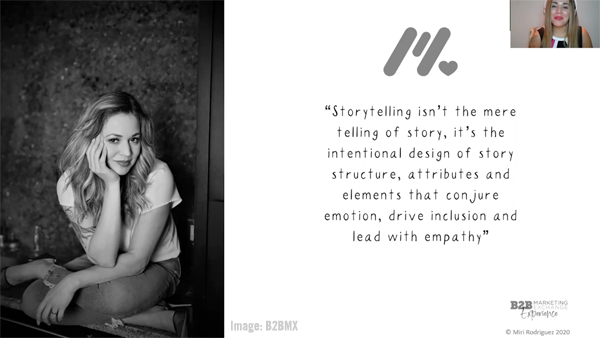
The emotional transaction is the glue that binds customers to a brand’s message, making them feel connected at the most human level, Miri explained, and mentioned LinkedIn’s January 2020 report which found that empathy was the platform’s top 2019 theme — one that offers strength to both brands and customers.
“Brands want to transact with people who are showing high levels of empathy,” Miri noted.
[bctt tweet=”“Brands want to transact with people who are showing high levels of empathy.” — Miri Rodriguez @MiriRod #B2BMX” username=”toprank”]Since the pandemic began, empathy has only increased in its importance for B2B brands, and increasingly employees want to work for brands that include high levels of empathy, she noted.
How can you begin leading with empathy?
Miri mentioned the oft-used Bill Gates “content is king” adage as a jumping off point for all that exists beyond content for today’s B2B marketers seeking to infuse greater empathy in their brand storytelling efforts.
One key is finding a universal truth, especially when it’s an actionable emotion that your brand lives by, and Miri suggested that these types of truths often derive from a brand’s mission statement.
What Feeling Is Your Brand Story Sparking?
During her #B2BMX opening keynote Miri also put out the question, “What feeling is my brand story seeking to spark?”
Sometimes examining or even rethinking a brand’s mission can help B2B marketers find these key feelings, she suggested.
In her example from Microsoft, Miri shared how the firm came up with empowerment as its new mission several years back — a feeling that CEO Satya Nadella and the organization have embraced in many ways since.
Miri then asked, “Is your brand leading with a feeling that they can share with their customers?”
She urged B2B marketers to make brand stories easy to consume, which in turn will make them convenient for customers to pass on to their own associates and customers.
Miri also explored cognitive empathy, and the importance of seeing your customer first and foremost as a human. She urged B2B marketers to always keep in mind that there is a human on the other side of the screen, the other side of every email, in a physical room, or wherever you communicate with a customer.
It’s important for B2B marketers to allow themselves to recognize the type of emotional empathy that reaches out and makes connections on a more human level, and Miri shared how marketers can benefit when they retrain their brain to think about your humans instead of your customers.
Having conversations that go beyond the mere facts about a product or service and its features, to instead form deeper and more empathetic connections, will build the kind of trust that makes business transaction elements more meaningful, Miri observed.
She also looked at the type of compassionate empathy that can begin when B2B marketers take the time to assess themselves introspectively, examining personal vulnerabilities.
Empathize by being cognizant of the experiences your customers are going through, and recognize that especially those in the GenZ and millennial demographics frequently make connections that are more on the emotional side with the brands they do business with, Miri noted, and explained that these younger customers also aren’t necessarily buying a product merely for the product alone.
Often they are looking at a brand’s mission before deciding to do business with them, and some will even refuse to work with a brand that defaults to having no public mission or stance on social and other important issues, she said.
Seeing The Humans Behind The Brand
Miri spoke about the importance of allowing B2B customers to see the humans behind the brand, and urged marketers to pay attention to who they’re delivering a B2B brand’s story to, being mindful of the fact that an audience isn’t just your customer in B2B, but also the audiences of those customers.
Miri then asked several key questions:
- Why should your end-user care about your story?
- What insight does your content include?
- Does it educate and otherwise help your customers, beyond simply helping with a particular feature of a product or service?
For every B2B marketing story you set out to tell, Miri recommends first asking yourself who the story is dedicated to, how it can help them, and how it will hopefully make them feel, especially when the story is tied in to one of your brand’s universal truths.
Showing the origin of your brand’s story is important, Miri said, as is reminding your customer why your brand is important to them.
An ideation phase includes finding the solutions your customers want in the formats they prefer, and Miri shared an example from Microsoft in which customers pointed out that they preferred blog content written not so much by marketers but by people directly involved a particular area of expertise.
Low-cost and low-effort story prototyping can also be a great way to test a variety of creative concepts, Miri noted, before moving on to the testing and implementation stages.
Making Genuine Audience Connections That Evoke Emotion
Are your brand storytelling efforts evoking the type of emotion you want to foster with your content? Miri explained that reach and engagement are both helpful in determining which efforts are making genuine connections with your audience.
Miri concluded her insightful and energetic #B2BMX keynote presentation by reinforcing the notion that genuine B2B brand stories always contain a character, plot, story, and conclusion, and that powerful storytelling only happens in the B2B space when marketers tell their stories for their audiences, and not to them — ideally with empathy, creativity, authenticity, and heart.
Empathy in B2B marketing is a topic near and dear to our team at TopRank Marketing, and to learn more about bringing it to life in your own marketing efforts, contact us, and check out the following five recent resources we’ve published:
- 5 Ways to Humanize Your B2B Content Marketing – And Why It Matters
- 28 B2B Marketing Insights To Energize & Humanize Your 2021
- Boosting and Deepening Engagement through Empathy in B2B Marketing
- 5 Ways to Humanize B2B Content Marketing
- Your Guide to Effective Storytelling in B2B Content Marketing
The post Microsoft’s Miri Rodriguez on How B2B Marketers Are Embracing Empathy For Better Customer Storytelling #B2BMX appeared first on B2B Marketing Blog – TopRank®.

Facebook, nuovi tool per tutelare i bambini
Facebook afferma che sta testando diversi strumenti per impedire alle persone di condividere contenuti molesti con raffiguranti i bambini. Uno è un pop-up che dovrebbe apparire alle persone che utilizzano termini di ricerca collegati ai minori, e descriverà in dettaglio le conseguenze della visualizzazione di tali contenuti.