B2B Marketing News: Trust Tops Brand Marketer Study, Top Email Engagement Day Shifts, YouTube’s New Comparative Data, & Ad Prices Rise
Brand marketers stick to trust-building strategies forged in 2020’s fires, study finds
91 percent of brand marketers will keep focusing on the strategies aimed at building trust they developed in 2020 as a response to the pandemic, according to recently-released survey data of interest to digital marketers. Marketing Dive
Ad Prices Forecast To Inflate 3% This Year
Digital display ad price inflation for 2021 is expected to be 3.4 percent, with digital video slightly higher at 3.6 percent, while this year is expected to hold some recovery from the impact of the pandemic in 2020, according to newly-released forecast data. MediaPost
In Engagement Shift, Friday Proves Top Day for Email Response Rates in 2020
With an 18.9 percent click-to-open (CTO) rate, marketing emails sent on Friday lead the way when it comes to engagement levels, according to recently-released survey data, with Saturday coming in as having the lowest engagement rates. MarketingCharts
YouTube Adds New Comparative Data Tools in YouTube Studio, and Info on Other Channels Your Audience Watches
Google’s YouTube platform has launched new features that allow digital marketers to compare the performance of their video content from between 24 hours up to 28 days, offering a new glimpse into a variety of performance metrics, the video giant recently announced. Social Media Today
Nielsen Launches Identity Sync, New Global Attribution System
Nielsen has rolled out a new global attribution system, Identity Sync, the firm’s identity-backed solution to the loss of cookie-based tracking systems, the firm recently announced. MediaPost
LinkedIn’s Developing a New Freelance Marketplace Platform to Facilitate New Opportunities
LinkedIn has been testing features which could expand on the platform’s existing ProFinder tool, adding enhanced professional freelancer connection functionality, according to an industry report. Social Media Today
How IT Buyers’ Researching Behaviors Changed in 2020
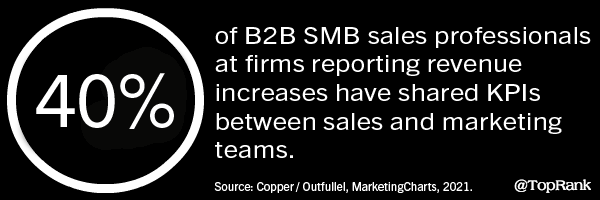
More than 54 percent of information technology buyers spent more time researching solutions during the second half of 2020, with some 24 percent reporting research time staying flat — two of several findings of interest to digital marketers in recently-released survey data. MarketingProfs
3 Steps to Better Virtual Meetings
A clear definition of the behaviors an organization is trying to encourage will help forge more productive virtual meetings, as will finding and overcoming behavioral blockers, according to The Harvard Business Review, which recently took a look at how to make today’s online meetings more collaborative and engaging. Harvard Business Review
The Most Important Email Marketing Optimizations [Survey]
43 percent of marketers consider personalization the top characteristic to improve when it comes to email optimization, followed by data quality at 39 percent and email design at 34 percent, according to recently-released survey data. MarketingProfs
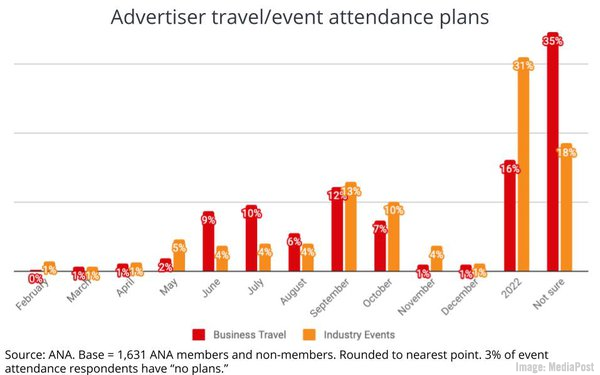
ANA Finds Half Of Ad Execs Have No Plans To Travel/Attend In-Person Events In 2021
Just 2.5 percent of advertising executives have said that they’re willing to fly for business in 2021, according to newly-released Association of National Advertisers (ANA) survey data of interest to online marketers. MediaPost
ON THE LIGHTER SIDE:
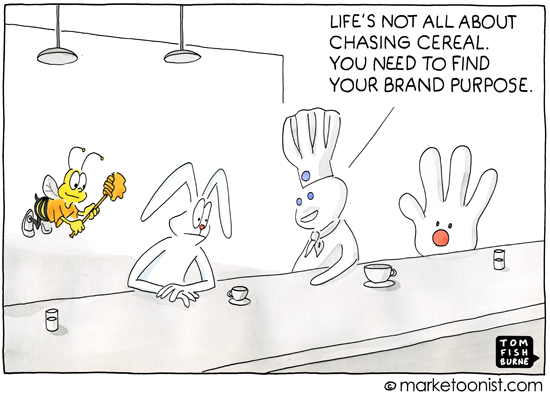
A lighthearted look at “finding your brand purpose” by Marketoonist Tom Fishburne — Marketoonist
YouTube Reveals 2020 US Bumper Ads Leaderboard of Top 6-Second Ads — Adweek
TOPRANK MARKETING & CLIENTS IN THE NEWS:
- Lee Odden — What’s Trending: Revamping Content Marketing — LinkedIn (client)
- LinkedIn / TopRank Marketing — Debunking Full-Funnel Myths that Send Marketing Strategies Off Course — LinkedIn (client)
- Joshua Nite — What Should Be Your First Steps When Starting a Business? Consider These 10 Tips — Small Business Trends
- Lee Odden — 50 Quotes That Will Change The Way You Do SEO — SERPed
Have you found your own key B2B marketing story from the past week of industry news? Please let us know in the comments below.
Thanks for joining us for the weekly TopRank Marketing B2B marketing news, and we hope that you will return next Friday for more of the most relevant B2B and digital marketing industry news. In the meantime, you can follow us at @toprank on Twitter for even more timely daily news.
The post B2B Marketing News: Trust Tops Brand Marketer Study, Top Email Engagement Day Shifts, YouTube’s New Comparative Data, & Ad Prices Rise appeared first on B2B Marketing Blog – TopRank®.

A Matter of Impact: February updates from Google.org
Editor’s note: Welcome to A Matter of Impact, Google.org’s monthly digest, where we highlight what the team’s been up to and spotlight some of the incredible nonprofits and Google.org Fellows helping solve some of society’s biggest challenges through technology and innovation.
It didn’t take long for the effects of COVID-19 to reveal a devastating, but predictable, truth: the pandemic has had an outsized impact on marginalized groups, especially people of color. At Google.org, we aim to bring the best of Google to support underserved communities. So when we made a $100 million grant and 50,000 pro bono hour commitment to support COVID-19 relief, we focused our efforts on addressing the compounding racial and social inequities of this crisis.
As we join forces to fight this pandemic, we must put equity at the center of our response and lift up our most vulnerable communities. Here you’ll find updates about our work that’s at the intersection of COVID-19 relief and equity and two themes that remain top priorities for us.
Equitable distribution of vaccines and health information
Data shows that COVID-19 affects people of color at much higher rates: about 71% percent of Black Americans and 61% of Hispanic Americans know someone who has died or been hospitalized from the virus compared to 48% of white Americans. Yet data also shows that Black Americans are getting vaccinated at lower rates than their peers. That’s why we have a team of Google.org Fellows working full-time with the Satcher Health Leadership Institute at Morehouse School of Medicine to help create a Health Equity Tracker to map and contextualize COVID-19 health disparities in communities of color throughout the U.S. We’re also committing $5 million in grants to organizations addressing racial and geographic disparities in COVID-19 vaccinations.
Support for minority-owned small businesses
Turning to the economy, reports have shown that 41% of Black-owned businesses — about 440,000 businesses — have shuttered due to COVID-19 compared to 17% of businesses owned by white people. To support minority business owners through the pandemic, we’ve supported Common Future with grant funding to provide capital and technical assistance to 2,000 women and minority small-business entrepreneurs in the U.S. We’ll also provide opportunities for Google volunteers to assist them with skill-based coaching and mentoring.
Read the rest of our Google.org updates below.
In case you missed it
Yesterday, leading academic organizations with support from a team of Google.org Fellows, shared the launch of Global.health, a data platform that helps model the trajectory of COVID-19 and future disease. Last month, we launched a Google.org Impact Challenge to help bridge the digital divide in Central and Eastern Europe, and announced $3 million in grants to help underserved communities in Kenya during a virtual summit with Sundar Pichai, CEO of Google and Alphabet, and H.E. Uhuru Kenyatta, President of the Republic of Kenya.

Twitter Super Follows: presto contenuti a pagamento?
Twitter vuole monetizzare starebbe pensando a un servizio in abbonamento che sostanzialmente porterebbe gli utenti a dover pagare per leggere i contenuti “speciali” condivisi da account ritenuti di “alto profilo”. Insomma, da microblogging a vero e proprio editore, il passo potrebbe essere breve per la piattaforma di cinguettii. Il nuovo servizio dal nome in codice Super Follows sarebbe stato presentato durante l’incontro annuale con gli investitori, sottolineando che l’obiettivo sia quelli di puntare a 315 milioni di utenti entro il 2023.

Telegram, autoeliminazione dei massaggi in tutte le chat
Le chat di Telegram stanno per diventare ancora più effimere, a patto che l’utente sia d’accordo. Negli stessi giorni in cui Whatsapp sta affrontando un calo negli utenti, complice l’introduzione dei discussi nuovi termini del servizio, Telegram sta raccogliendo insieme a Signal gli utenti che hanno deciso di dire addio al servizio di messaggistica istantanea di Facebook.

PS5, tutti gli annunci dall’evento State of Play
I prossimi mesi saranno intensi sul fronte PlayStation 5. Se è vero che la nuova console di casa Sony continua ad essere introvabile – e così sarà per tutta la prima metà di questo 2021 – i videogiochi in arrivo non soltanto per l’ultima arrivata, ma anche per PlayStation 4, saranno tantissimi. Ieri, nel corso dell’evento State Of Play, Sony ci ha dato un bell’assaggio di quello che ci aspetta.
La “truffa alla nigeriana” è un classico. Un classico dell’Ottocento
Se avete un indirizzo di mail avete ricevuto almeno una volta nella vita un messaggio contenente la classica “truffa alla nigeriana”: uno sconosciuto si presenta dicendo di essere un membro di una famiglia nobile vittima di una persecuzione e aggiungendo di avere un’ingente somma di denaro, alcuni milioni di dollari, che può recuperare soltanto con il vostro aiuto.
Il vostro nome gli è stato raccomandato da un amico che avete in comune ma che non viene nominato per prudenza. In cambio della vostra assistenza è disposto a darvi una percentuale molto consistente di quei milioni. Per avviare la procedura di recupero, però, ha bisogno che gli anticipiate una piccola somma.
La truffa è diventata particolarmente popolare in Nigeria, dove operano molti dei truffatori che la praticano. Da questa diffusione nel paese è nato il soprannome di “truffa alla nigeriana”, e dal numero della sezione pertinente del codice penale nigeriano è nato il nome alternativo di questo raggiro, ossia 419 scam.
Ma questa truffa non è affatto nata con Internet, come molti pensano.
Atlas Obscura segnala che il New York Times del 1898 (sì, milleottocento) parlava già della faccenda dicendo che era una truffa “comune” e “vecchia” che stava riemergendo. Ovviamente non c’era Internet nel 1898, per cui i truffatori comunicavano per posta cartacea.
Scrive il NYT:
“L’autore della lettera è sempre in carcere a causa di qualche reato politico. Ha sempre una grossa somma di denaro nascosta, ed è immancabilmente ansioso che venga recuperata e usata affinché qualche uomo onesto possa prendersi cura della figlia giovane e indifesa. È al corrente della prudenza e del buon carattere del destinatario della lettera tramite un amico comune, che non nomina per cautela, e gli chiede aiuto in un momento di grande difficoltà.”
In cambio, spiega il giornale, il mittente “è disposto a dare un terzo del tesoro nascosto all’uomo che lo recupererà”. Ma prima ha bisogno di ricevere una piccola somma di denaro.
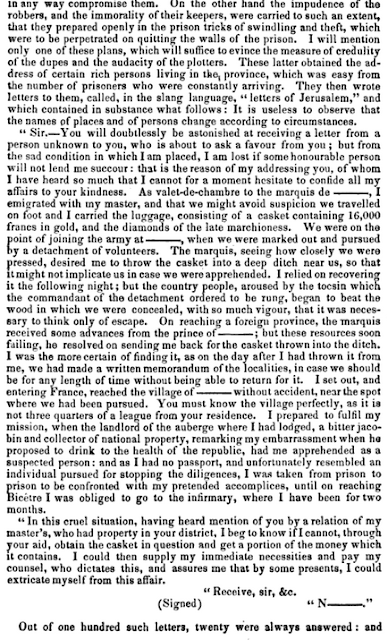
Gli ingredienti di oltre centoventi anni fa, insomma, sono gli stessi di oggi. Ma si può andare ancora più indietro nel tempo, ai primi dell’Ottocento. Eugène François Vidocq (1775-1875), uno dei padri della criminologia, racconta nelle sue memorie di quando fu condannato a otto anni di carcere per “falso in conti pubblici ed autentici”, nel 1797. In prigione vide che i carcerati scrivevano le cosiddette “lettere di Gerusalemme”, con la complicità dei carcerieri, e ne descrisse il contenuto:
Signore,
Indubbiamente lei sarà stupito nel ricevere una lettera da una persona che non conosce, che sta per chiederle un favore; ma dalla triste condizione nella quale mi trovo, sono perduto se una persona d’onore non mi presterà soccorso: questa è la ragione per la quale mi rivolgo a lei, di cui ho sentito così tante cose che non posso esitare un istante nel confidare tutti i miei affari alla sua cortesia….
La lettera standard prosegue spiegando che lo scrivente diceva sempre di essere il cameriere personale di un noto marchese che aveva dovuto abbandonare il proprio tesoro in un luogo ben occultato per evitare che finisse nelle mani dei malfattori. Il luogo era nelle vicinanze del destinatario della lettera. L‘autore della lettera spiegava che in cambio di un piccola somma si sarebbe potuto liberare dal carcere e avrebbe potuto così condurre il destinatario al tesoro per dividerselo.
Questa è la spiegazione, tratta dalla traduzione in inglese di Les Mémoires authentiques de Vidocq; non trovo online il testo dell’originale in francese.

Vidocq spiega tutto: di cento lettere di questo tipo, venti ricevevano sempre risposta. I carcerati si procuravano gli indirizzi delle persone ricche della provincia dai nuovi prigionieri. I ricchi abboccavano a questa storia improbabile, mandando a volte fino a 1500 franchi dell’epoca. E non c’era verso di far capire alle vittime che erano state raggirate: Vidocq racconta del “mercante di stoffe della Rue des Prouvaires, che fu colto a scavare sotto un arco del Pont Neuf [a Parigi], dove si aspettava di trovare i diamanti della duchessa di Bouillon”.
I secoli passano, le tecnologie cambiano, ma le debolezze umane sono sempre le stesse.

Come difendersi da un robot di Boston Dynamics
Uno dei tormentoni di Internet è recuperare un post o un tweet di qualche tempo fa che faceva una previsione rivelatasi poi sbagliata e citarlo commentando che “non è invecchiato bene”. Se la previsione si rivela obsoleta molto rapidamente, allora la si commenta dicendo che il post “è invecchiato in fretta.”
Ecco un esempio di affermazione che purtroppo non è invecchiata bene (Kayleigh McEnany è stata la portavoce dell’ex presidente statunitense Donald Trump):
One year ago today, Kayleigh McEnany made a really bad COVID prediction, but what’s really special is how she also made a bad terrorism prediction in the same sentence pic.twitter.com/yIjgHFMm3K
— The Daily Show (@TheDailyShow) February 25, 2021
Però di solito l’invecchiamento si misura almeno in giorni, se non in mesi o anni. Invece oggi ho fatto un commento che è invecchiato (non so se bene o male) nel giro di poche ore.
Un utente su Twitter ha pubblicato le istruzioni per disabilitare immediatamente un robot quadrupede della Boston Dynamics in caso di aggressione o altro pericolo: si tira la maniglia di sgancio del pacco batterie, situata sulla “pancia” del robot, e così si interrompe tutta l’alimentazione.

Ho commentato definendola una cosa utile da sapere in un prossimo futuro.
Cose utili da sapere in un prossimo futuro. https://t.co/NYLfJGWJ2g
— Paolo Attivissimo (@disinformatico) February 25, 2021
Il guaio è che quel “prossimo futuro” era già arrivato, come documenta la notizia che proprio uno di questi robot quadrupedi viene usato dalla polizia di New York per pattugliare le strade del Bronx.
Video shows NYPD’s new robotic dog in action in the Bronx https://t.co/4PwuA7gjDk pic.twitter.com/RkMCSoGRUV
— New York Post (@nypost) February 23, 2021
Il robot viene impiegato per entrare in ambienti dove c’è pericolo per gli agenti, per esempio in caso di persone armate e barricate in scantinati, ed è dotato di luci e telecamere per consentirgli di perlustrare gli spazi circostanti.
Ma è fin troppo ovvio che c’è una forte tentazione di fare il passo logico successivo, che è quello di dotare il robot di armi. Invece di mettere in pericolo la vita di un agente o di un soldato, perché non mandare un robot?
A questo proposito, un collettivo online denominato MSCHF ha montato su uno di questi robot un fucile da paintball e l’ha fatto girare in una stanza nella quale sparava a statue e pupazzi. Il messaggio è chiaro.

Forse è il caso di cominciare a discutere di come usare e regolamentare queste tecnologie.

Le parole di Internet: necroposting

Il gergo di Internet ha una definizione per tutto. Avete presente quando qualcuno ripesca un commento fatto online anni fa e lo ripresenta, facendo ripartire la discussione e magari anche il bisticcio?
Questo si chiama necroposting: il gesto di prendere un post o un commento passato, quindi “morto” secondo gli standard di frettolosità di Internet e soprattutto dei social network, e ridargli nuova vita, a volte senza che gli altri si rendano conto che stanno dibattendo in realtà su una vicenda vecchia ed esaurita.
È considerata una pratica da dilettanti, perché non ha alcun senso ribattere a qualcuno mesi o anni dopo che è avvenuta la discussione e tutti l’hanno abbandonata, per cui la replica non verrà vista da nessuno. Di conseguenza, viene spesso bandita in molti forum.
Ecco un esempio di necroposting tratto da questo blog:

Il termine esiste almeno dal 2004, secondo KnowYourMeme (da cui ho tratto l’illustrazione in testa all’articolo).

Find, Engage and Close: Demandbase’s Jon Miller on Recasting the B2B Marketing Automation Journey #B2BMX
How can B2B marketers recast the marketing automation journey to meet today’s challenges and be ready for those to come?
Jon Miller, chief marketing officer at Demandbase, recently presented a session at the 2021 B2B Marketing Exchange Experience virtual conference, and explored new account-based marketing best practices.
Although this pandemic year at #B2BMX won’t see B2B marketers gathered in the event’s usual sunny Scottsdale, Arizona location, many new attendee opportunities were on tap virtually.
Refresh, renew, remix has been the conference’s theme this year, and to help ease the lack of physical networking, #B2BMX included a Spotify music playlist, live music performances, and even various charitable elements.
Jon began by looking back at his journey starting Marketo — acquired by Adobe in 2018 for $4.75 billion — nearly 15 years ago, when marketers had a need to capture and manage online leads, a need that the company’s service met, allowing marketers to communicate and send leads to the appropriate departments.
Marketo’s efforts during this era helped marketing build credibility and respect, Jon noted, as marketers became a part of their firms’ revenue engines.
Today however, the world is changing and marketing automation tools aren’t necessarily keeping pace.
We’ve reached the end of the era of traditional demand generation, which has become shipwrecked, Jon explained.
The General Data Protection Regulation (GDPR) and other global data protection efforts have made it more challenging for marketers to send emails in the way they were once able to, while in some instances sales teams are sending greater amounts of email now than marketers.
“Marketers lost the keys to being the sole owners of communications,” Jon said, and noted that today’s larger buying committees also present challenges when trying to hold one-on-one interactions. This is where marketing can play a larger role, he noted.
Firms today are often generating more revenue after the sale in the form of recurring revenue and a focus on expansion, Jon observed.
There’s a strong bias in marketing automation tools against net-new business, while at the same time increasing revenue is being generated after the sale, which led Jon to share some of the limitations of traditional lead-based approaches:
- It doesn’t make sense for marketers to be looking at leads while salespeople look at accounts
- Buyers have become harder than ever to reach, and have a greater reluctance to filling out forms than ever before
- Greater quantities of research that once took place on a business’ website are now done elsewhere, making the tools that track on-site activities less effective
- Buyer intent signals are hidden to traditional marketing automation software, as the digital body language has moved to third-party sites
Jon also pointed out a number of other factors that have contributed to the shipwreck that traditional demand generation has found itself in, including:
- Missed pipeline goals
- Poor alignment between marketing and sales
- Obstacles to moving upmarket
- Sluggish expansion revenue
- Inefficient complexity and wasted time
Jon then explored how B2B marketers can move from this to a dynamic process where sales and marketing work as a team, each able to access relevant information from today’s more complex buyer journey.
Leaving behind the traditional marketing technology built more than a decade ago is a key step, Jon noted.
Jon then asked, “So what’s next, and how do we move forward?”
Modern Sales & Marketing Alignment: Find, Engage, and Close
1 — Finding The Most Valuable Accounts
The first step in adapting to the new realities of B2B marketing and sales alignment is to find, by focusing efforts on locating the most valuable accounts, Jon explained.
“When it comes to finding target accounts, one size does not fit all,” Jon said, and marketers should do deep-dive one-to-one level account research, using highly-customized programs for each major strategic account — a process that is often a significant investment.
Another segment, one-to-few, focuses on moderately personalized deep cluster research — using micro-clusters of accounts focused on similar business issues, Jon explained.
An additional level with a broader scope is the one-to-many level, which is where many account-based programs exist, with a basic level of light personalization and much less investment per account, Jon noted.
The one-to-many level often benefits from greater use of technology such as intent data, making it more scalable.
The broadest category of all is the targeted demand generation segment, Jon explained, usually using traditional marketing tactics to go after specific accounts.
When considering which of these four levels to use for your business, the key is to find which one is truly the best fit for your selling style, Jon noted, and encouraged organizations to get creative and use custom level names such as tiers.
Jon urged businesses to find their entitlements — the contract of how marketing and sales agree to treat each account and what each department will do — in order to learn how many accounts your organization can handle.
Entitlements can be evergreen — offering continuing qualities that persist — or of the triggered and in-market variety, such as when an account is in an active buying process or has a new corporate executive, Jon explained.
Businesses often place greater focus on these triggered entitlements. The process of finding your firm’s entitlements is a great way to bring sales and marketing teams together, Jon noted.
Once the number of entitlements have been determined and you know how many accounts you can have, you can begin to use science and technology to focus on the key ones, and Jon shared the F.I.R.E. acronym:
- (F)it — how close is this account to your ideal customer profile
- (I)ntent — the interest accounts have in your products or those of your competitors
- (R)elationship — is this an account your salespeople are already talking with
- (E)ngagement — is this account coming to you and spending time on your website or attending your firm’s events
Combined, these form what Jon refers to as pipeline prediction, used to determine which accounts should be moved up to the next level, and find the accounts that really matter.
[bctt tweet=”“When it comes to finding target accounts, one size does not fit all.” — Jon Miller @jonmiller” username=”toprank”]2 — Engaging Identified Accounts
The second step in utilizing the new realities of B2B marketing and sales alignment is engagement, where the identified accounts are engaged, aligning your interactions with the buyer’s journey, Jon explained.
Jon noted how in the past he has likened the use of ABM processes to fishing with spears for the big fish, while demand generation is more like fishing with a net. An overlooked issue when using those ABM spears, however, is that “Getting poked by a spear doesn’t feel very good,” Jon said.
Smart ABM processes can overcome the reluctance and pain traditional methods often generate, by understanding where a buyer is on their journey and aligning all interactions appropriately, Jon explained.
Jon then shared Gartner’s “Six Buying Jobs,” that all accounts ought to go through, to ensure that everyone on the buying team is working together.
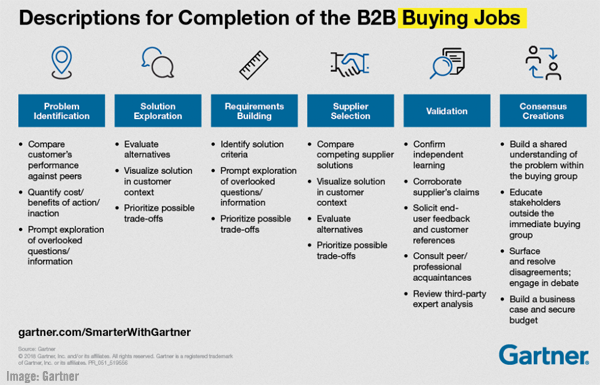
It’s important to have content that’s aligned to each of these six buying jobs, Jon noted, and also suggested keeping in mind that buyers don’t travel on their journey in an orderly or linear fashion, instead bouncing around in typically unpredictable and even chaotic directions.
In the non-linear buying process Jon suggested using a football field’s yard line grid to determine how close to the scoring or buying point a buyer is, and considering the path that a football takes as it moves in many directions on the playing field.
The buyer’s yard-lines tell us where in the journey they are, as well as the likelihood of an imminent score or purchase, Jon noted, and they can also inform our decisions as to which plays or plan of business approach we should execute.
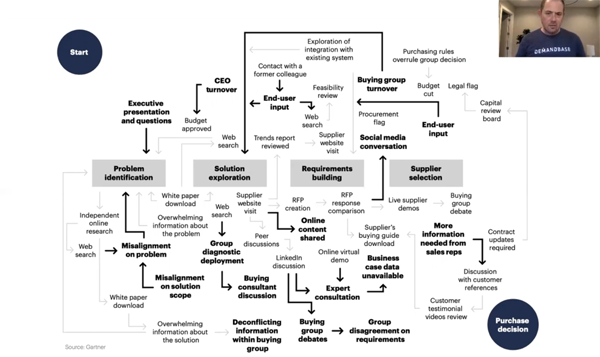
Businesses should create their own buyer journey definitions, and Jon shared how Demandbase organizes theirs, with:
- Qualified — ideal customer profiles
- Awareness — showing awareness and intent for our category, especially on third-party sites
- Engaged — engaging with our website, events, and programs
- MQA — Marketing Qualified Account, using intent data and the pipeline prediction process to know whether an account is in-market or in a buying cycle
- Opportunity
- Customer — A closed/won opportunity
- Post-Sale — Adoption and expansion
At this point sales and marketing teams can align their interactions to the buyer’s journey, such as building brand trust early in the journey in the “qualified” stage, to thought leadership in the middle stages, all the way through enhancing the post-sale experience by finding expansion opportunities, Jon noted.
The MQA stage is especially well-suited for utilizing a multi-channel approach, Jon suggested, from customer relationship management (CRM) and marketing automation to ad platforms, direct mail, account-based chat, and sales engagement, among several other channel opportunities.
[bctt tweet=”“The explosion of digital noise means that traditional marketing channels like ads are becoming less and less effective. What marketers need to think about is, how do I orchestrate multiple channels together?” — Jon Miller @jonmiller” username=”toprank”]3 — Closing As An Orchestrated Team
The third major strategy Jon shared during his insightful and energetic #B2BMX presentation was the closing element, with a focus on working as an orchestrated team and not merely the outdated hand-off of the account baton.
How can businesses have sales and marketing work together in a new way?
With today’s B2B buyer journey being so complicated, the baton hand-off approach doesn’t work, Jon observed, and encouraged a team approach more like the way a soccer team functions, passing customer engagement back and forth as needed, in a coordinated way.
Comprised of three levels, the type of marketing and sales alignment that Jon spoke about can be broken down into:
- Aligning data — Assuring that sales and marketing teams are looking at the same data
- Sharing insights — Teams proactively alerting each other about relevant insights
- Coordinating interactions — Working together as an orchestrated team
Jon then shared a favorite tip, which he called a secret weapon for marketing and sales alignment — account standups.
In these deceivingly simple account standup events, every few weeks the marketing and sales account teams meet without any executives or managers present, and talk about what’s happening and strategize. Jon explained that account standups are one of the best and simplest ways to move ahead with quality coordinated ABM strategies and tactics.
Jon then shared the TOPO account-based technology stack, with its intent, account, and contact data all the way through to the processes of execution, measurement, infrastructure, and application workflow.
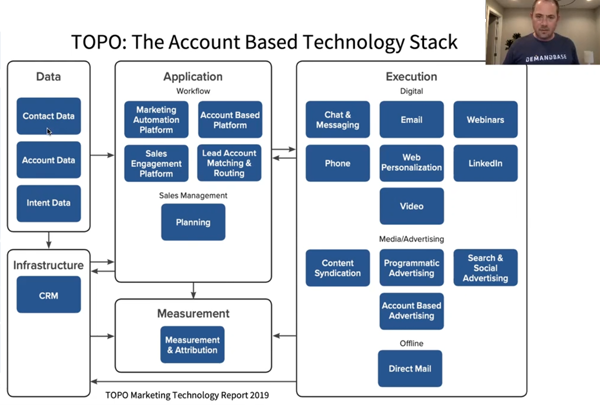
Jon shared how the execution stage features many channels, which typically won’t all be used but each serve a specific purpose, and the overall chart is helpful for determining where to focus time and energy, he explained.
Jon concluded his session by reiterating that account automation tools were built for a different time than the more complicated B2B buying landscape that we face today, which is much better met using the orchestrated methods he dug into during his presentation.
It’s time to start thinking about new processes and technologies, especially those in the F.I.R.E. strategy, and to define your business’ entitlements and tiers, Jon urged.
Learn more from Jon by watching our Break Free B2B Marketing video interview, and be sure to connect with him on Twitter and LinkedIn.
Creating award-winning B2B marketing takes considerable time and effort, which is why many firms choose to work with a top digital marketing agency such as TopRank Marketing. Contact us today and let us know how we can help, as we’ve done for businesses ranging from LinkedIn, Dell and 3M to Adobe, Oracle, monday.com and others.
The post Find, Engage and Close: Demandbase’s Jon Miller on Recasting the B2B Marketing Automation Journey #B2BMX appeared first on B2B Marketing Blog – TopRank®.

A proposito di Byoblu demonetizzato
Vedo che Giorgia Meloni protesta per la demonetizzazione di Byoblu: “YouTube ha revocato al canale di @byoblu le pubblicità e ha sospeso tutti gli abbonamenti. Un inaccettabile atto discriminatorio contro una testata giornalistica libera e indipendente. FDI esprime solidarietà alla redazione e presenterà un’interrogazione parlamentare sul caso”.
Faccio fatica a capire perché si debba esprimere solidarietà con un sito che fa soldi su bugie e notizie false e pericolose. Tipo questa (copia permanente):

Per chi volesse sapere la storia di quell’articolo, i dettagli sono qui.
Non è neanche la prima volta che Byoblu viene demonetizzato. Ricordo che avvenne nel 2017.
Giusto per chiarezza: Byblu è ancora perfettamente in grado di pubblicare le proprie opinioni. Semplicemente non può monetizzarle. L’articolo 21 della Costituzione italiana parla di libertà d’espressione, non di diritto di farci soldi. Tutto qui.
Questo articolo vi arriva gratuitamente e senza pubblicità grazie alle donazioni dei lettori. Se vi è piaciuto, potete incoraggiarmi a scrivere ancora facendo una donazione anche voi, tramite Paypal (paypal.me/disinformatico), Bitcoin (3AN7DscEZN1x6CLR57e1fSA1LC3yQ387Pv) o altri metodi.
“STORIE A PIEDI NUDI”. L’iniziativa di AITD Onlus e Angoli di luce
RIPRENDE IL CAMMINO DI “STORIE A PIEDI NUDI”: LA RASSEGNA TEATRALE ONLINE CONTRO LA VIOLENZA DI GENERE – – di Greta V. Galimberti – Trendiest News – — L’iniziativa, promossa da AITD Onlus e Angoli di luce, muoverà i primi passi sul web per poi andare in scena attraverso una rappresentazione teatrale e nelle righe di un testo che intende proseguire il lungo cammino “a piedi nudi” intrapreso nel 2019 L’Associazione Internazionale Tutela Diritti – AITD Onlus – e il…
L’articolo “STORIE A PIEDI NUDI”. L’iniziativa di AITD Onlus e Angoli di luce scritto da REDAZIONE TRENDIEST proviene da Assodigitale.
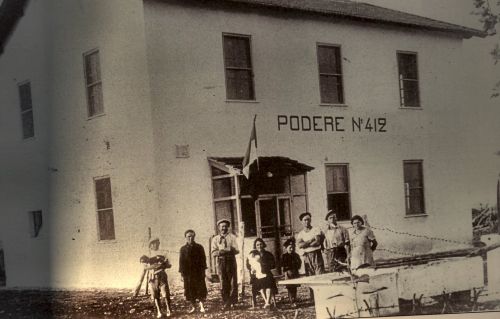
Al via la web serie sulle Paludi Pontine
Una web serie per riscoprire la storia e la cultura di un territorio con un’identità ancora in parte inesplorata. – – di Greta V. Galimberti – Trendiest News – — Il testimonial di “La Bonifica della Paludi Pontine, tra storia e identità” è il Premio Strega Antonio Pennacchi– Quello intrapreso dalle ragazze e dai ragazzi di quattro istituti scolastici di Latina è un video progetto in cui gli alunni saranno seguiti da professori e tecnici…
L’articolo Al via la web serie sulle Paludi Pontine scritto da REDAZIONE TRENDIEST proviene da Assodigitale.
Using AI to explore the future of news audio
Radio reaches more Americans every week than any other platform. Public radio stations in the United States have over 3,000 local journalists and each day they create audio news reports about the communities they serve. But news audio is in a similar place as newspaper articles were in the 1990s: hard to find, and difficult to sort by topic, source, relevance or recency. News audio can not delay in improving its discoverability.
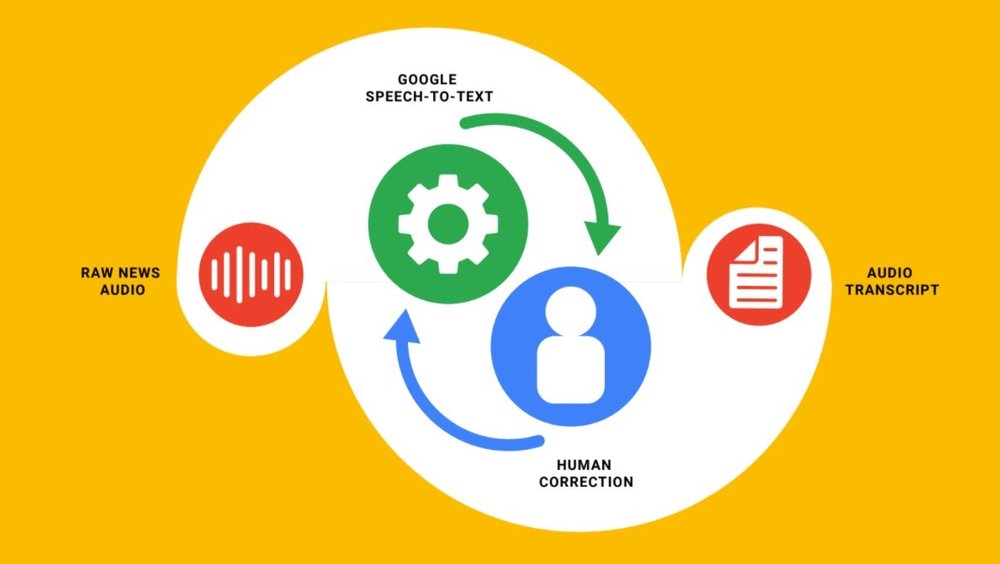
KQED is the most listened to public radio station in the United States, and one of the largest news organizations in the Bay Area. In partnership with Google, KQED and KUNGFU.AI, an AI services provider and leader in applied machine learning, ran a series of tests on KQED’s audio to determine how we might reduce the errors and time to publish our news audio transcripts, and ultimately, make radio news audio more findable.
“One of the pillars of the Google New Initiative is incubating new approaches to difficult problems,” said David Stoller, Partner Lead for News & Publishing at Google “Once complete, this technology and associated best practices will be openly shared, greatly expanding the anticipated impact.”
What makes finding audio so much harder?
In order for news audio to be searched or sorted, the speech must first be converted to text. This added step is trickier than it seems, and currently puts news audio at a disadvantage for being found quickly and accurately. Transcription takes time, effort and bandwidth from newsrooms — not something that is in abundance these days. Even though there have been great advances in speech to text, when it comes to news, the bar for accuracy is very high. As someone who works to make KQED’s reporting widely available, it is frustrating when KQED’s audio isn’t prominent in search engines and news aggregators.
The challenge of correctly identifying who, what and where
For our tests, KQED and KUNGFU.AI, applied the latest speech-to-text tools to a collection of KQED’s news audio. News stories try to address the “five Ws:” who, what, when, where and why. Unfortunately, because AI typically lacks the context in which the speech was made (i.e. identity of the speaker, location of the story), one of the most difficult challenges of automated speech-to-text is correctly identifying these types of proper nouns, known as named entities. KQED’s local news audio is rich in references of named entities related to topics, people, places, and organizations that are contextual to the Bay Area region. Speakers use acronyms like “CHP” for California Highway Patrol and “the Peninsula” for the area spanning San Francisco to San Jose. These are more difficult for artificial intelligence to identify.
When named entities aren’t understood, machine learning models make their best estimation of what was said. For example, in our test, “The Asia Foundation” was incorrectly transcribed as “age of Foundations” and “misgendered” was incorrectly transcribed as “Miss Gendered.” For news publishers, these are not just transcription errors, but editorial problems that change the meaning of a topic and can cause embarrassment for the news outlet. This means people have to go in and correct these transcriptions, which is expensive to do for every audio segment. Without transcriptions, search engines can’t find these stories, limiting the amount of quality local news people can find online.
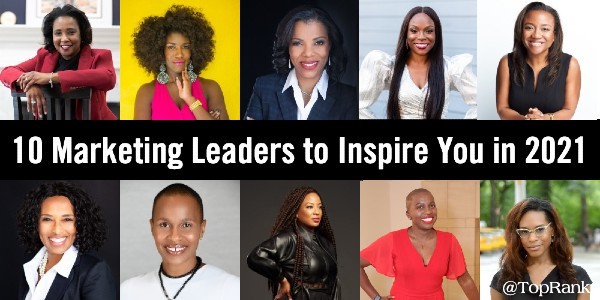
10 Marketing and Communications Leaders to Inspire You in 2021
Even the best of marketers can be challenged in times like those we’ve all experienced over the past 12 months. But it is those who rise above those challenges that fuel the inspiration we all need to succeed in our industry.
On this blog, we’ve made a point to highlight inspirational marketing voices with lists of top marketers by discipline (B2B marketing, social media marketing, content marketing) and our famous lists of Women Who Rock in Marketing since 2010. Over the past few years, we’ve tried (not hard enough) to be more inclusive in these lists to represent women and people of color.
During Black History month, many brands have made efforts to shine a light on contributions made in the world by individuals the black community. But why should honoring such contributions be limited to one month? For our small part, how we represent marketers of color in the content on our blog, on social networks and in marketing content as well as the influencers we work with has changed significantly over the past few years. It’s not enough, but we’re continuing to learn and grow our awareness, understanding and action when it comes to the importance of diversity and inclusion.
As I reflect on those who inspire me on a daily basis to be more, to be better as a marketer and marketing leader, the following list of women of color stand out. I encourage you to learn more about their backgrounds, achievements and to pay attention to the contributions they are making to the world of marketing and communications in both B2C and B2B.
Beverly Jackson @BevJack – in/beverlyjackson/
Vice President Global Brand and Consumer Marketing at Twitter
With past experience working at The GRAMMY Awards, Yahoo!, MGM Resorts and Activision Blizzard, Beverly now serves as Vice President of Global Brand and Consumer Marketing at Twitter. Beverly is a dynamic, senior marketing executive adept at building, mentoring and managing high performance entertainment and digital marketing teams while establishing long-term strategic relationships to drive revenue.
Beverly has extensive agency and in-house experience launching brand extensions and new products, utilizing metrics to analyze growth, developing innovative digital strategies to drive brand loyalty and awareness via social media, mobile and community engagement. We’ve interviewed Beverly in the past and recognized her several times on our lists of top marketers over the years. She joined Twitter as VP in January 2021.

Bozoma Saint John @badassboz – in/bozoma-saint-john/
Chief Marketing Officer at Netflix
Boz got her start in marketing at Spike Lee’s advertising agency, Spike DDB. She then went on to manage brands within the PepsiCo beverages portfolio, before becoming Head of Music and Entertainment Marketing at the CPG giant; followed by Head of Global Consumer Marketing at Apple Music & iTunes; then went on to serve as Chief Brand Officer at Uber; before taking on the CMO role for Endeavor (including WME, IMG, UFC, Miss Universe, 160over90 etc).
Boz launched a podcast alongside award-winning journalist Katie Couric, “Back to Biz with Katie and Boz,” which explores the ways thought leaders, CEOs and innovators are responding to the societal shifts that have been ushered in by the coronavirus pandemic. Boz’s philanthropic efforts include representing Pencils of Promise as a Global Ambassador to Ghana and serving on the boards of Girls Who Code and Vital Voices. With such contributions, Boz was an easy pick to recognize in our Women Who Rock in Marketing list. She took on the CMO role at Netflix in June 2020.
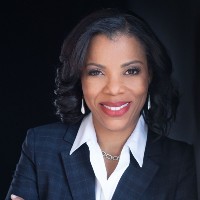
Dr. Candace Steele Flippin @CSteeleFlippin – in/candacesteeleflippin/
Senior Vice President and Chief Communications Officer at Acuity Brands
Candace has 20+ years serving B2B and B2C domestic and international companies in the financial services, medical device, biopharmaceuticals and pharmaceuticals industries before taking on the role as SVP and Chief Communications Officer at Acuity Brands.
Candace is a globally recognized multigenerational workplace scholar, TEDx speaker, industry thought leader and author that specializes in development and implementation of Corporate Communication and Public Relations strategies that support business growth, navigate change and mitigate crises. She has a Doctorate in Management from and is also a Research Fellow at the Weatherhead School of Management at Case Western Reserve University. Candace took on the SVP role at Acuity Brands in November 2020.

Dara Treseder @daratreseder – in/daratreseder/
SVP, Head of Global Marketing & Communications at Peloton Interactive
A veteran Chief Marketing Officer, Dara was previously the CMO of Carbon and the CMO of GE Business Innovations & GE Ventures. Earlier in her career, she led marketing and growth efforts at Apple and Goldman Sachs. A champion of public health, women’s issues, and diversity initiatives, Dara is the Vice Chair of the board of the Public Health Institute (PHI). Dara also serves on the board of PG&E.
Dara graduated cum laude from Harvard University with highest honors in field and holds an MBA from Stanford University. We were happy to recognize Dara in our 10 year anniversary list of women who rock in marketing. She joined Peleton as SVP and Head of Global Marketing and Communications in August 2020.

Deirdre Findlay @deirdre_findlay – in/deirdre-findlay/
Global Chief Marketing Officer & Consumer Revenue at Condé Nast
As a former Google, Stitch Fix and eBay marketing executive, Deirdre is a passionate marketer with progressive experience in integrated marketing – brand, product, customer relationship marketing, loyalty, offline and online direct marketing, business to consumer, and business to business.
Deirdre serves on the boards at Sonos, Olaplex and Effie Worldwide and has an MBA from Dartmouth. She joined Condé Nast as CMO in January 2020.

Gail Moody-Byrd @gailmoody – in/gailmoodybyrd/
Chief Marketing Officer at Noodle.ai
Gail’s experience at McKinsey & Company, The World Bank, Levi Strauss, and over 10 years at SAP lead her to the CMO role at Noodle.ai. There, she is responsible for delivering awesome brand, demand, digital marketing, events, sales enablement, product marketing and AR/PR by motivating her team to let the world know how great a company Noodle.ai is.
An MBA graduate of Harvard Business School, Gail serves on the Board of Directors at Juma Ventures. focused on empowering low-income youth to transcend challenging circumstances, fulfill their inherent potential, and positively impact their communities. Gail appeared in our 2020 list of Women Who Rock in Marketing. She joined Noodle.ai as CMO in November 2018.

Jeanine Liburd @JeanineLiburd – in/jeanine-liburd/
Chief Social Impact and Communications Officer at BET Networks
Previously serving as VP Communications at MTV, SVP of Corporate Communications at Viacom and Chief Marketing & Communications Officer at BET Networks, Jeanine is now Chief Social Impact and Communications Officer at BET Networks where her responsibilities include leading and elevating a portfolio of multi-platform social change initiatives that empower BET Networks’ audiences to have an impact on the critical issues facing the black community today.
Her current role also focuses on utilizing content as a catalyst to create awareness and build action oriented impact campaigns globally. She also oversees strategic partnerships and community engagement at the local and national levels. Jeanine has been recognized in our annual list as a Women Who Rocks in Marketing. She has been in her current position at BET Networks since September 2019.

Leah Frazier @TheLeahFrazier – in/theleahfrazier/
President at Think Three Media
Leah is an experienced Publicist, Content and Influencer Marketing Consultant with a demonstrated history of working with brands in the fashion, apparel, beauty and lifestyle industries.
As a 2X Emmy Award-Winner, Best Selling Author, TEDx Speaker, and publisher of a top 30 Podcast In Marketing, she is skilled in Media Outreach and Relations, Entrepreneurship, Public Relations, Influencer Campaigns, Strategic Planning, and Marketing Strategy. She is also a strong business development professional with a Juris Doctor (J.D.) focused in Law from Texas Wesleyan University School of Law. Leah has been president of Think Three Media since June 2016.

Lisa Maxwell @LisaMaxwe11 – in/itslisamaxwell/
Vice President Marketing, Data & Services at Mastercard
Lisa Maxwell has a proven track record of reinventing and reinvigorating brands through business turnarounds and creating business reinventions grounded in consumer insights. Lisa orchestrated the successful turnaround, from negative to sustainable double digit growth, on recognizable brands like Nicorette, NicoDerm CQ, Abreva and K-Y brand. She has created several innovating and long lasting omni-channel campaigns that included TV, public relations, electronic consumer relationship marketing (ECRM), social media, digital and shopper marketing. In her current role at Mastercard, she develops integrated campaigns that highlight Mastercard Data & Services solutions across Loyalty & Engagement and Advisor offerings.
Lisa is a recipient of the 2012 Tribute to Women in Industry (TWIN) Award, an alumnae W.O.M.E.N. in America and a Committee of 200 Scholar. She currently serves on the Board of Directors of GrassROOTS Community Foundation. Lisa was promoted to her VP of Marketing role at Mastercard in April 2020.

Tyrona (Ty) Heath @tyrona – in/tyronaheath/
Director, Market Engagement, The B2B Institute at LinkedIn
With more than 17 years of experience in digital and product marketing education at Google Inc, consulting within IBM as a social business manager and leading a B2B agency consulting practice, Ty now serves as the Global Lead for the B2B Institute @ LinkedIn where she delivers thought leadership to help marketers stay on top of the latest in B2B marketing strategy through research, teaching and writing about B2B marketing, social selling as well as leadership, diversity and inclusion.
Ty is also the former President of LinkedIn’s Black Inclusion Group (BIG), Co-Founder of LinkedIn’s annual TransformHER conferences, author of “Marketers of Tomorrow: A Step by Step Toolkit for Inbound Marketing” and a two time Olympic Trials qualifier in track and field. Ty has made numerous appearances on our blog through interviews, covering her industry presentations and recognition on our lists of Women Who Rock in Marketing. She joined the B2B Institute at LinkedIn in September 2020. (LinkedIn is a client of TopRank Marketing)
I am fortunate to call several of these top marketers friends and I appreciate their direct and indirect influence on my efforts to be a better marketer myself. Above all, I hope that this list provides both recognition for their contributions as well as inspiration to our readers when it comes to marketing leadership, best practices and achievement.
Who would you add to this list? Please share in the comments or post a reply to us on Twitter, LinkedIn or Facebook.
The post 10 Marketing and Communications Leaders to Inspire You in 2021 appeared first on B2B Marketing Blog – TopRank®.