
Explore the Cradle of Creativity on Google Arts & Culture
Creativity in Africa is not something new — it dates back thousands of years and continues into the present day. In fact, some of the earliest paintings by humans were found engraved in a cave in South Africa 20,000 years ago. The Cradle of Creativity, a new project on Google Arts & Culture, explores how creativity evolved in Africa from rock art to contemporary brush strokes. In collaboration with the Yemisi Shyllon Museum of Art (YSMA) in Nigeria and the Origins Centre in South Africa, you can now explore 50 expertly-curated stories, featuring over 60 high-resolution Gigapixel images of artworks digitized using the Google Art Camera, 17 Street View virtual tours and, for teachers and students, a dedicatedlesson plan.
Here are 4 fun ways to get you started on a journey of creativity in Africa:
Early human inventions
Ochre, paint and the past
There is evidence that humans became culturally modern, or cognitively complex, around 100,000 years ago and the beginnings of creativity this brought about originated in Africa. It is also possible that the world’s first artists and their workshops can be found in Africa, with evidence of art and ochre production found in the Blombos Cave in South Africa, Porc Epic in Ethiopia, Sibudu in South Africa and Twin Rivers in Zambia.

NOK Head
How sculptures evolved
Did you know that in Yoruba Philosophy, the head is seen as the shell that houses the essence of an individual? Or that the occupational and political status of the deceased determined the material that was used in making bronze heads? You can now explore these and more interesting facts about Nok, Benin, and Ife art. You can also walk around the YSMA and explore the evolution of sculptures using Google Street View.

Bruce Onobrakpeya, Panel of 5: Oshare Me jevwe, Omote kporovwe, Adje Ewenvwe kpo, Igurube, Eyame Jevwe.
Storytelling through art
People across the continent have explored different methods to pass on their stories and express themselves through art and creativity for thousands of years. Whether it is to tell stories of the spirit world through the communal trance dance of the San People, or to raise awareness about urgent issues and arguing for change today, Africans continue to find creative ways to tell their story.

Nike Davies-Okundaye, Cycle of Life
Learning from the brushstrokes
Paintings can hold so much meaning and symbolism behind colors, figures, style and brushstrokes. Thanks to the experts at the YSMA and the giga-pixel resolution images captured by Art Camera, you can now learn more about the masterpieces of renowned artists like Ben Enwonwu, Bruce Onobrakpeya and Nike Davies-Okundaye. Zoom into the details to spot the onlookers in Uche Okeke’s ‘The Conflict’, and explore how Ben Osaghae depicts spiritual contradictions in his painting ‘Miracle for Sale‘.
Are you a student or a teacher? We have also created a dedicatedlesson plan for you. Visit g.co/google4africa21 if you want to continue your exploration, or download Google Arts & Culture’s Android or iOS app to further immerse yourself in the cradle of creativity!
Aiutare le persone a fare scelte più sostenibili con Google

Viaggiare e fare acquisti in modo più sostenibile
Spostarsi in auto in modo più sostenibile
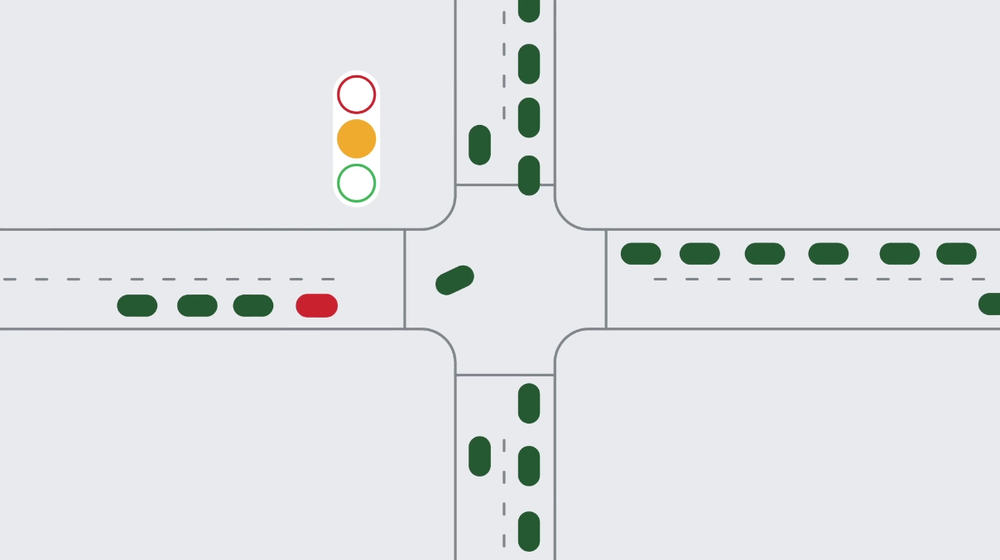
L’AI per rendere i semafori più efficienti
Più sostenibili con Google
Nokia annuncia il tablet Nokia T20: ecco tagli, prezzo e info.

Google annuncia nuove funzioni a favore della sostenibilità

Nest Cam con cavo di 2° generazione disponibile in Italia
Find flights with lower carbon emissions
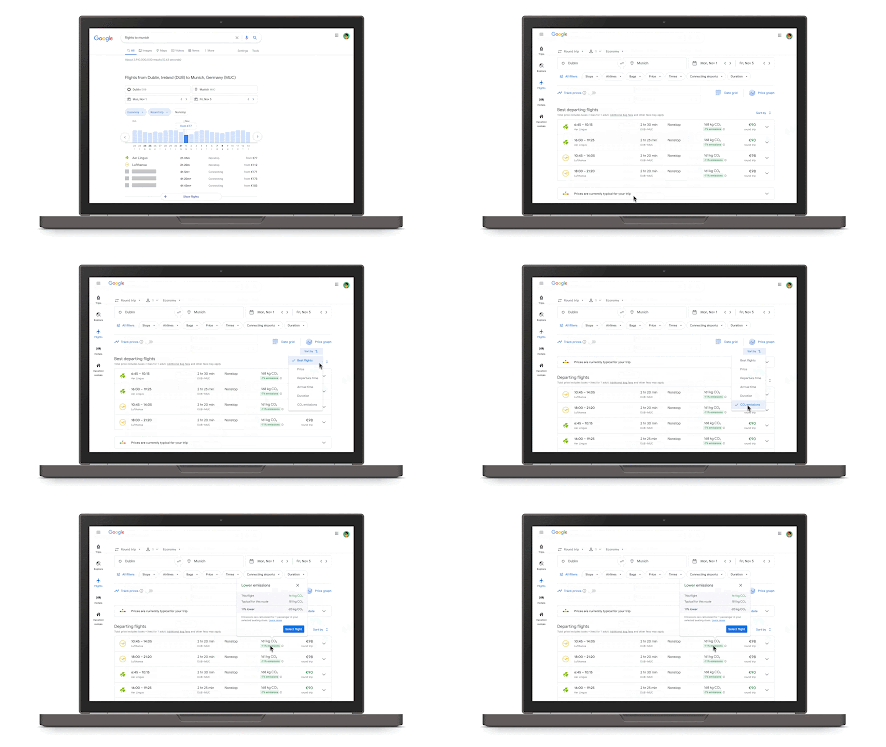
Last month, we shared new sustainability initiatives from our travel team, including ways you can find eco-certified hotels on Google. Now, we’re bringing information on carbon emissions directly into Google Flights.
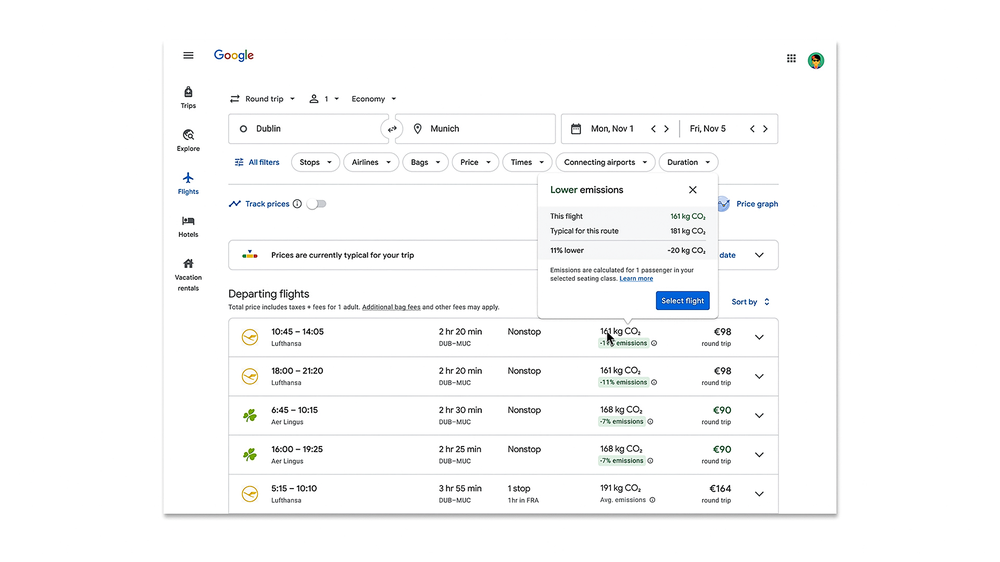
Beginning today, you’ll see a carbon emissions estimate for nearly every flight in the search results — right next to the price and duration of the flight. So when you’re choosing among flights of similar cost or timing, you can also factor carbon emissions into your decision.
Google Flights shows estimated carbon emissions in the search results.
These emissions estimates are flight-specific as well as seat-specific. For instance, newer aircraft are generally less polluting than older aircraft, and emissions increase for premium economy and first-class seats because they take up more space and account for a larger share of total emissions.
To put these estimates in context, flights with significantly lower emissions will be labeled with a green badge. And if you want to prioritize carbon impact, you can sort all of the results to bring the greenest flights to the top of the list.
You can sort results by carbon emissions and see how each flight compares to the average.
To produce these estimates, we’re combining data from the European Environmental Agency with the flight-specific information we get from airlines and other providers such as aircraft type, trip distance and the number of seats in each seating class. To learn more on how we estimate emissions, visit our Help Center.
It’s critical that people can find consistent and accurate carbon emissions estimates no matter where they want to research or book their trip. That’s why we recently joined the Travalyst coalition, where we’ll help develop an open model for calculating carbon emissions from air travel and promote standardization across the travel industry using this framework.
This update to Google Flights is just one of the many ways we’re helping people make sustainable choices in their everyday lives. Read the latest in this post from Sundar Pichai.
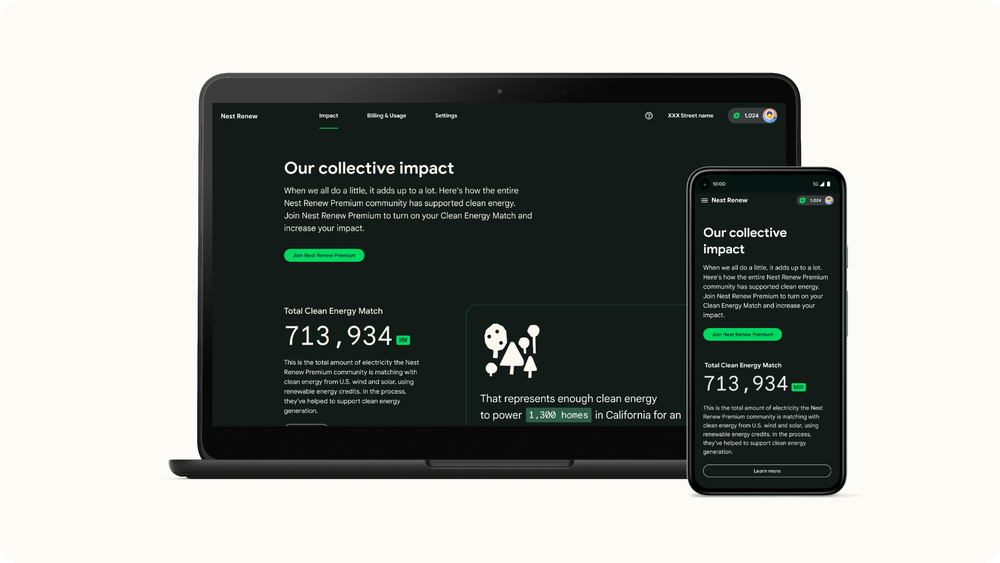
Support clean energy right from home with Nest Renew
Many people are eager to live more sustainably and help address one of our generation’s most profound challenges: climate change. At Nest, we believe taking small, simple actions every day is a great way to start. Homes are some of the largest consumers of energy in the U.S., and over the past decade, Nest thermostats have helped people save over 80 billion kWh of energy at home — enough to power 23 million electric cars for a year.
But we know people want to do even more at home to help our planet. The problem is that it can be hard to know where to start and whether you’re making a real difference.
That’s why today we’re announcing Nest Renew — a service for your Nest thermostat that makes it easy to support a clean energy future, right from home.
Support clean energy with your Nest thermostat
Nest thermostats have always helped you heat and cool your home more efficiently, while also keeping you comfortable. They can now do even more with a Nest Renew feature called Energy Shift.
The electricity that powers our homes comes from different energy sources that vary based on the time of day — often a mix of clean energy (like solar and wind farms) and not-so-clean, fossil fuel-based energy (like gas and coal). Energy Shift works with your thermostat to help you automatically shift your heating and cooling electricity usage to times when your grid is cleaner, without sacrificing comfort. It can also adjust your thermostat’s schedule to run even more efficiently in both summer and winter.
Some electricity providers have time-of-use rates, where costs vary by time of day. If you’re on a plan like that, Energy Shift can help you save by automatically shifting usage to less expensive energy times.
We make these shifts while maintaining the comfort in your home — but you always have the ability to adjust your thermostat directly.
See your impact and your power
Nest Renew comes with monthly impact reports, so you can track the difference you and the Nest Renew community are making. It also shows you when the electricity coming into your home is cleaner and when it’s not so clean throughout the day, so you can make more informed choices — like running the washing machine a little earlier or later, when your grid is cleaner.
How we’re partnering with the energy industry on Nest Renew
Today, Google announced Nest Renew — a service built on the premise that to address climate change, we need a more flexible electricity grid. And that grid should be integrated with a wide range of distributed energy resources, like those found in smart homes.
But we can’t accomplish this without engaged consumers and a broad coalition of both local and national partners working together. That’s why today, we’re partnering with a number of energy providers and nonprofits that are committed to collaborating to create a clean energy future.
How we’re partnering with energy providers
To start, we’re partnering with AES, Consumers Energy, Duke Energy, NRG, Portland General Electric, Southern California Edison and Southern Company — some of the most innovative energy providers in the country that are committed to the Nest Renew vision and a carbon-free, resilient energy grid. These partners have provided invaluable insight and feedback as we’ve defined the Nest Renew service.
Through Nest Renew, energy providers will have new opportunities to engage consumers with time-of-use rates, increase demand response program participation and facilitate consumer support for renewable energy. For customers, it will be an opportunity to better understand and control their energy usage and prioritize the use of carbon-free energy.
Nest Renew also will increase enrollments in energy provider-sponsored Rush Hour Rewards programs, which let customers earn rewards for using less when energy consumption is high and make it easier for utilities to manage the grid during times of peak demand. We’re already working with a number of partners to deliver these programs in over 80 utility territories and wholesale markets, covering more than 40% of consumers in the U.S.
We’re also partnering with Uplight to make it easier in the future for customers to link their utility accounts to unlock personalized energy savings insights, program recommendations and device rebates. Together, we aim to help customers and utilities reach their load management goals.
This is just the start of our collaboration on Nest Renew. We’re always looking to partner with more energy providers on our work towards decarbonization.
How we’re partnering on Clean Energy Match
We’re also working with partners to support the growth of clean energy with Nest Renew Premium’s Clean Energy Match. During early preview, we will source Nest Renew’s renewable energy credits from the Southern Company Bethel Wind plant in Castro County, Texas. In 2023, they will also come from the future Roseland Solar project in Falls County, TX. These plants will both help meet Google’s ongoing commitment to match 100% of its global annual electricity use with renewable energy and support its goal to operate entirely on24/7 carbon-free energy by 2030. You can learn more about Clean Energy Match in our deep dive article.
We’re also partnering with AES and NRG to identify or develop the wind and solar that can generate RECs for Clean Energy Match, as well as collaborating with Consumers and SCE with the aim of supporting their renewable deployment efforts.
How we’re partnering with nonprofits
Through the Energy Impact Program, customers earn Leafs by actively using Nest Renew and taking actions at home that can save energy and help the environment. As they reach certain Leaf milestones, in certain states they can vote to direct Nest Renew funds to their choice of nonprofits from our list of partners across the U.S. Our founding nonprofit partners are GRID Alternatives and Elevate. We’ll work with them to understand how Nest Renew can have the most impact.
And we’re always looking to collaborate with more local partners to expand the reach of the Energy Impact Program.
Learn more
You can learn more about Nest Renew in our blog post, as well as our deep dive into the service. You can also read a white paper by RMI, formerly the Rocky Mountain Institute, which concludes that products like Nest Renew could significantly reduce the carbon emissions associated with household energy use.
According to RMI, if 10 million households participate, Nest Renew could address approximately 7% of the gap between today’s level of household emissions and a 50% reduction in line with the current overall U.S. policy target. That’s the equivalent of powering about 50 million EVs with a cleaner grid each year, as opposed to today’s fossil-fuel heavy grid.
Giving you more sustainable choices with Google
Climate change is no longer a distant threat — it’s increasingly local and personal. Around the world, wildfires, flooding and other extreme weather continue to affect our health, our economies and our future together on our planet. We need urgent and meaningful solutions to address this pressing challenge. That’s why last year we committed to bold action to run our data centers and campuses on 24/7 carbon-free energy by 2030.
Companies aren’t the only ones asking what more we can do to help the planet — increasingly people are asking themselves those questions, too. So today we’re sharing several new ways people can use Google’s products to make sustainable choices. Among them, we’re introducing new features to book flights or purchase appliances that have lower carbon footprints, a Nest program to support clean energy from home, and eco-friendly routing on Google Maps — which is rolling out today. And when people come to Google Search with questions about climate change, we’ll show authoritative information from sources like the United Nations, in addition to the existing news sources that we currently raise up in the carousel. It’s all part of our goal to help one billion people make more sustainable choices by 2022.
You can now see carbon emissions per seat for every flight in Google Flights.
Travel and shop more sustainably
We’re adding new features to help make decisions about travel — from what flights to book to where to stay. Launching globally today, we’re bringing carbon emissions information to Google Flights. You’ll be able to see associated carbon emissions per seat for every flight, and quickly find lower-carbon options. And when you search for hotels, you’ll see information on their sustainability efforts, from waste reduction and water conservation measures to whether they’re Green Key or EarthCheck certified.
We’re also helping people make more sustainable choices when they shop, starting with home appliances. When you search for energy-intensive products like furnaces, dishwashers or water heaters, suggestions in the Shopping tab will help narrow your search to cost-effective and sustainable options.
Supporting clean energy from home
For over a decade, Nest thermostats have helped people save energy at home. Today we are taking these efforts a step further with a new service called Nest Renew. Using a feature called Energy Shift, compatible Nest thermostats can help users automatically shift electricity usage for heating and cooling to times when energy is cleaner or less expensive. For those who want to do more to help support the growth of clean energy, we will offer a paid subscription option, Renew Premium, that will match your fossil fuel electricity at home with high-quality renewable energy credits generated from the same projects in Google’s energy portfolio.
Getting around more sustainably
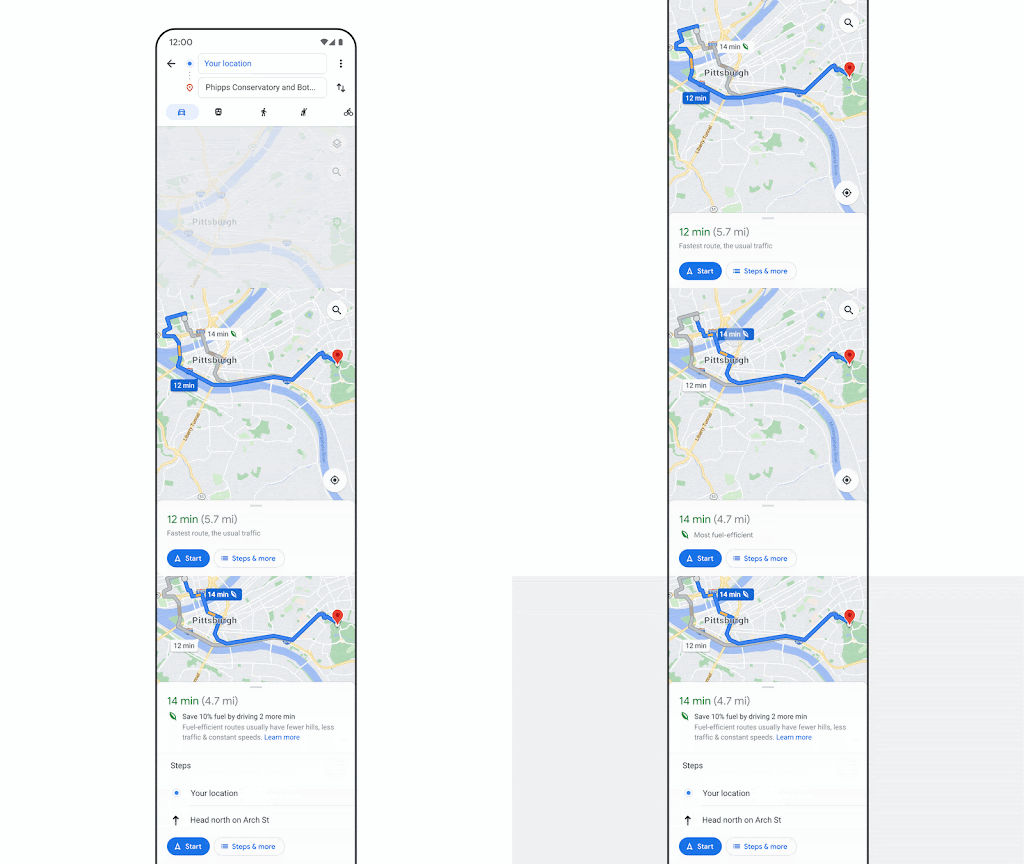
Traveling by car is one of the more carbon-intensive choices people make on a daily basis. Starting today in the U.S., and in Europe in 2022, Google Maps will let you choose the most fuel-efficient route if it isn’t already the fastest one. We estimate that this could save over one million tons of carbon emissions per year — the equivalent of removing over 200,000 cars from the road — and save you money by reducing fuel consumption.
You can choose the most eco-friendly route in Google Maps.
We’re also working to make sure the cars that remain on the road are eco-friendly. On Search, we’re making it easier to see hybrid and electric vehicle options, compare them against gas-powered models, and find rebates so you know the true cost before you buy. These features will start to roll out in the U.S. this year, with more to come in 2022.
Of course, the most sustainable choice often doesn’t involve a car at all. That’s why we’re introducing lite navigation for cyclists on Maps, and making it simpler to find bikes and scooter shares in over 300 cities around the world.
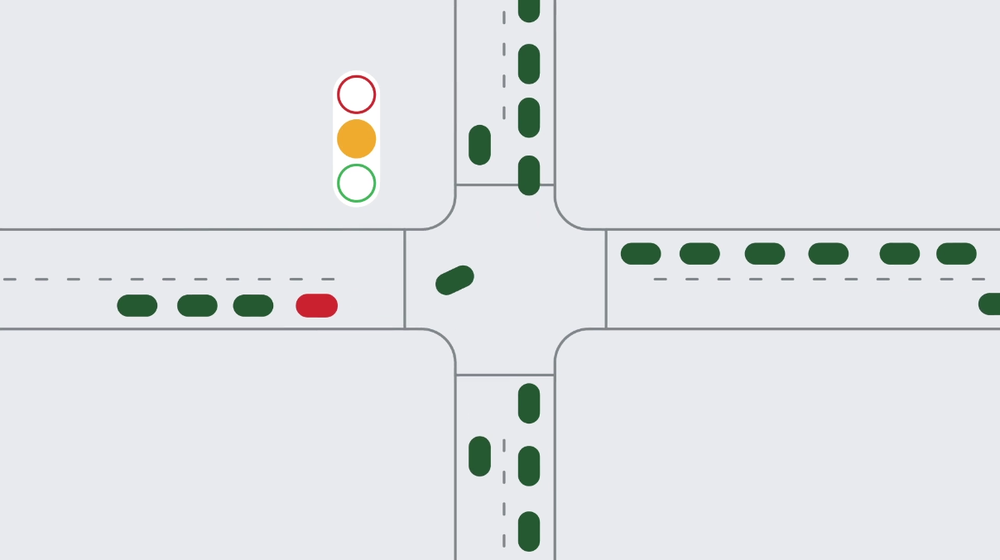
AI for more efficient traffic lights
Te ofrecemos más opciones sustentables con Google
El cambio climático ya no es una amenaza lejana, sino algo cada vez más local y personal. En todo el mundo, los incendios forestales, las inundaciones y otras condiciones climáticas afectan nuestra salud, nuestras economías y nuestro futuro juntos en el planeta. Necesitamos soluciones urgentes y significativas para abordar este desafío apremiante. Es por eso que el año pasado nos comprometimos a alcanzar, para el año 2030, el ambicioso objetivo de operar nuestros campus y centros de datos con energía libre de carbono de forma permanente.
Las empresas no son las únicas que se preguntan qué más podemos hacer para ayudar al planeta; cada vez más, las personas también se hacen esas preguntas. Por eso, hoy compartimos varias maneras nuevas en las que las personas pueden usar los productos de Google para tomar decisiones sustentables. Entre ellas, presentamos nuevas funciones para reservar vuelos o comprar electrodomésticos que tienen una huella de carbono más baja, un programa de Nest para apoyar la energía limpia en el hogar y nuevas rutas ecológicas en Google Maps, que comienzan a implementarse hoy. Y cuando las personas acudan a la Búsqueda de Google con preguntas sobre el cambio climático, mostraremos información fidedigna de fuentes como las Naciones Unidas, además de las fuentes de noticias existentes que actualmente presentamos en los resultados. Estos esfuerzos forman parte de nuestro objetivo de ayudar a mil millones de personas a tomar decisiones más sustentables para 2022.
Ahora se podrán ver las emisiones de carbono por asiento para cada vuelo en Google Flights.
Viaja y compra de manera más sustentable
Estamos agregando nuevas herramientas para ayudar a tomar decisiones sobre viajes: desde qué vuelos reservar hasta dónde hospedarse. Con un lanzamiento global, ahora incluímos información sobre emisiones de carbono en Google Flights. Podrás ver las emisiones de carbono asociadas por asiento a cada vuelo y encontrar al instante opciones con menos emisiones. Y cuando busques hoteles, verás información sobre los esfuerzos de sustentabilidad, desde la reducción de desechos y las medidas de conservación del agua hasta las certificaciones Green Key o EarthCheck obtenidas.
También ayudamos a las personas a tomar decisiones más sustentables cuando compran, comenzando por los electrodomésticos. Cuando busques productos que consuman mucha energía, como hornos, lavavajillas o calentadores de agua, las sugerencias en la pestaña Compras te ayudarán a limitar la búsqueda a opciones rentables y sustentables.
Apoyando la energía limpia en el hogar
Desde hace más de una década, los termostatos Nest ayudan a ahorrar energía en casa. Hoy damos un paso más conun nuevo servicio llamado Nest Renew. Con una función llamada Energy Shift, los termostatos Nest compatibles pueden ayudar a los usuarios a cambiar automáticamente el uso de electricidad para calefacción y enfriamiento a los momentos en los que la energía es más limpia o menos costosa. Para aquellos que quieran ayudar más a apoyar el crecimiento de la energía limpia, ofrecemos una opción de suscripción paga, Renew Premium, que igualará el consumo estimado de electricidad de combustibles fósiles de los usuarios en el hogar con créditos de energía renovable generados a partir de plantas solares y eólicas de EE.UU.
Nos movemos con mayor sustentabilidad
Viajar en auto es una de las decisiones con mayor generación de carbono que las personas toman a diario. A partir de hoy en EE.UU., y en Europa en 2022, Google Maps te permitirá elegir la ruta con menor cantidad de emisiones de carbono, en el caso que no sea la ruta más rápida. Estimamos que esto podría ahorrar más de un millón de toneladas de emisiones de carbono por año, el equivalente a retirar más de 200,000 automóviles de la carretera, además de permitir a los usuarios ahorrar dinero gracias a la reducción del consumo de combustible.
Puedes escoger la ruta con menor emisiones de carbono en Google Maps.
También estamos trabajando para asegurarnos que los autos que permanezcan en la carretera sean ecológicos. En la Búsqueda de Google, estamos haciendo que sea más sencillo ver las opciones de vehículos híbridos y eléctricos, compararlas con los modelos a gasolina y encontrar descuentos para que sepas el costo real antes de comprar. Estas funciones se lanzarán en EE.UU. este año, y habrá más en 2022.
Por supuesto que, a menudo, la opción más sustentable simplemente no involucra al automóvil. Es por eso que presentamos funciones de navegación más sencillas para los ciclistas en Maps y facilitamos la búsqueda de bicicletas y scooters compartidos en más de 300 ciudades de todo el mundo.
Inteligencia artificial para semáforos más eficientes

OPPO lancia la nuova ColorOS 12 basata su Android 12
Meet your marketing objectives with the new Google Analytics
A year ago, weintroduced the new Google Analytics to help you meet the challenges of an evolving measurement landscape and get better ROI from your marketing for the long term. Google Analytics 4 properties offer privacy-safe solutions to measure the customer journey, machine learning to predict outcomes and automate the discovery of insights, and easy activation of those insights in Google’s advertising platforms to enhance your marketing performance.
Since then, we’ve introduced features like improved advertising reporting and support for user consent choices that help you achieve your marketing objectives without compromising user privacy.
Now, we’re launching additional capabilities, including an improved Search integration and smarter attribution to give you the insights you need to optimize performance across all of your marketing channels. We’re also introducing new modeling features that will close gaps in your data and help you future-proof your measurement.
With these additional capabilities, we encourage you to use the new Google Analytics as your primary web and app analytics solution going forward.
Easily access Search insights
Search Console provides detailed information about your website’s organic Search performance, including the site’s rank in Search results, queries that led to clicks, and post-click data like engaged sessions and conversions. With the new Search Console integration, you’ll be able to understand the role that organic Search plays in driving traffic to and engagement on your site relative to other marketing channels like Search ads, email, or social.
Get more value with data-driven attribution
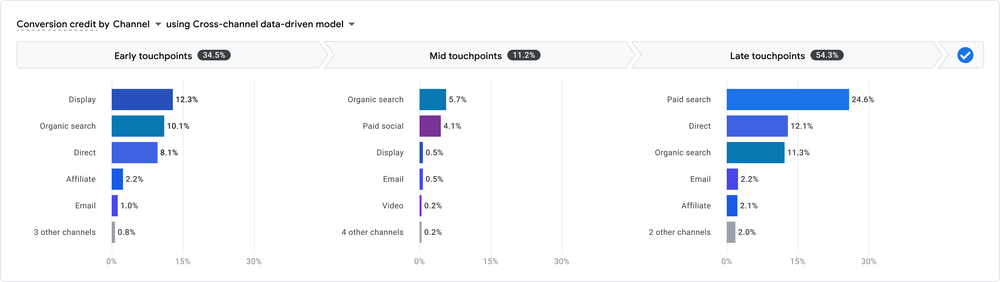
Building on the two attribution reports, Conversion paths and Model comparison, we announced earlier this year, we are introducing data-driven attribution – without minimum threshold requirements – to Google Analytics 4 properties.
Google’s data-driven attribution models give you a better understanding of how all of your marketing activities collectively influence your conversions, so you don’t over or undervalue a single channel. Unlike last-click attribution, where 100% of the credit goes to the final interaction, data-driven attribution distributes credit to each marketing touchpoint based on how much impact the touchpoint had on driving a conversion.
A new way publishers can stay financially sustainable
The news landscape is undergoing a constant state of change, resulting in closures and consolidations of existing players and the emergence of hundreds of mission-driven new enterprises. Many of these early-stage digital newsrooms are resource-strapped, especially when it comes to technology and product development. With support from the Google News Initiative, theNews Revenue Hub aims to correct this.
The nonprofit organization is building a team of engineers, product specialists and data scientists to fill gaps and spark growth and sustainability in newsrooms, assembling a first-of-its kind technology team dedicated to meeting the needs of next-generation digital newsrooms.
As a nonprofit providing critical infrastructure and consulting service to newsrooms, the News Revenue Hub has helped more than 70 local, regional and national organizations crowdfund over $42 million since 2016. Last year, Hub newsrooms averaged a 55% increase in member revenue and a 23% increase in email subscribers.
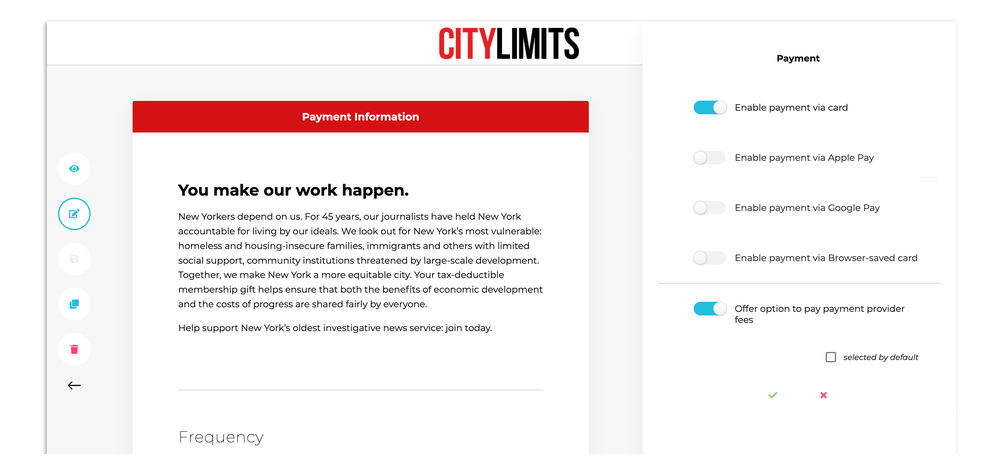
The first product this new GNI-backed team is building will be a streamlined, simple-to use contribution management system called the News Revenue Engine. This product, set to be released in early 2022, will make it easier than ever for mission-driven digital news outlets to steward and convert casual readers into sustaining donors.

Boosting B2B Marketing Credibility with Social Proof and Influencers: 4 Tips
This is gonna be the greatest blog post EVER.
Did you believe me there? You probably didn’t.
Sure, I might think it’s an awesome piece of content. But I’m not exactly an objective source. Now, if you were to come across a post on social media from someone you know and trust, linking to this blog post and saying it’s the best thing they’ve read all year? That’s a different story.
Therein lies the immense value of social proof, which is only growing more impactful as businesses and society evolve into a new era. A survey from Kantar Media last year found that 93% of people trust brand recommendations from family and friends, while only 38% trust information from advertisers. Meanwhile, 84% of people say they trust online reviews as much as their friends.
As a marketer, accepting this reality may cause some discomfort: We can’t control what people say! That’s why a great product and customer experience are table stakes. But when those pieces are in place, today’s marketers can take plenty of steps to strategically encourage and elevate social proof and influencer content.
Building Credibility for Your Brand the Right Way: 4 Key Steps
Going above and beyond with transparency, highlighting third-party voices, portraying influencer authenticity, and creating buzzworthy experiences are among the best ways to build credibility in our current business landscape. A closer look at each:
#1: Embrace Radical Transparency
In business, the term “radical transparency” is usually evoked as an internal management philosophy — keeping employees looped into everything that’s going on, good or bad, to increase engagement and investment. I feel the concept can also be applied externally.
Heightened business transparency is largely happening on its own, in a digital environment where customers and communities can keep a closer eye on a company’s activities and positions.
Why not lean into this transparency? When you proactively put everything out there for people to see, it fuels a perception that you’re not trying to hide anything. That’s a huge credibility booster.
A few examples of transparency that might be considered “radical” but should really start to become the norm:
- Openly acknowledge and address negative reviews instead of burying them
- Share product/service pricing upfront instead of obscuring these important details
- Own the mistakes you make as a company, and share what you learn from them
- Recognize the relative strengths of your competitors in marketing materials, rather than playing up only their weaknesses
- Be forthright about who your product or service is NOT a fit for
If there’s one thing business buyers don’t like, it’s surprises. Given the stakes, nobody wants to find out down the line that there’s an unexpected cost, or unmentioned implementation complexities, or unspoken functional limitations.
Radical transparency helps eliminate surprises and can dramatically increase buyer confidence.
#2: Put Third-Party Reviews and Analysis Forward
As noted earlier, customers tend to be more interested in hearing what other people say about your solutions than what you say about them. That’s not to say a company can’t toot its own horn, but this should be balanced by objective third-party voices.
Think about ways you can incorporate these trusted, unbiased perspectives into your own content. Highlight research from authoritative market analysis firms (e.g. studies from Gartner, Forrester, Nielsen) that helps establish a need for what you offer. Let trends and statistics do the talking. Build out authentic case studies that are more focused on illustrating your solution’s impact in a customer’s organization rather than just heaping lavish praise.
And of course: Point prospective customers to user review sites so they can see for themselves how people describe experiences with your brand. A recent article at Forbes shares tips on getting more reviews and leveraging them effectively.
[bctt tweet=”“Customers tend to be more interested in hearing what other people say about your solutions than what you say about them.” — Nick Nelson @NickNelsonMN” username=”toprank”]#3: Aim for Authenticity in Influencer Partnerships
Influencer associations can be excellent sources of credibility for your brand … provided they are handled the right way. From our view at TopRank Marketing, that means taking a relationship-based approach more so than a transactional one.
Influencers who are recognized, respected, and trusted in a particular industry or niche can be tremendously valuable advocates. But when your association with them is superficial, that value is lost. Customers will see through it. Nobody’s putting a lot of stock into the genuine sentiments behind a glowing social media post that has an #ad hashtag at the end.
However, when you’re building long-term relationships with these influencers, to the point where they speak positively about your brand unprompted? When their audiences see them engaging with your people and co-creating impactful content? This is where the true credibility-boosting power of B2B influencer marketing lies.
Helping forge these kinds of authentic influencer ecosystems is an area where our agency specializes, so feel free to give us a shout if you want to learn more.
[bctt tweet=”“Influencers who are recognized, respected, and trusted in a particular industry or niche can be tremendously valuable advocates.” — Nick Nelson @NickNelsonMN” username=”toprank”]#4: Give People Something to Talk About
Increasingly, this is the primary task of the new-age digital marketer: It’s not so much about coming up with different ways to say great things about your brand — it’s about coming up with different ways to get other people to say great things about your brand.
How is this done? There are many ways, including:
- Creation of compelling thought leadership that counters conventional wisdom and gets people talking.
- Virtual events that bring together like-minded people around shared passions and interests pertinent to your industry.
- Delivering notable customer experiences or content experiences that generate buzz on their own.
- Providing exceptional employee experiences that compel team members to openly share how much they enjoy the company and culture.
- Running polls, conversation-starters, and hashtags on social media that expand your brand’s relevant reach and connect it to key topics on your target audience’s mind.
Meanwhile, the type of radical transparency cited in Tip #1 can itself be a means to generate positive chatter about your brand and its credibility. In an older but still highly pertinent article for WIRED about the see-through CEO, Clive Thompson summarized why this is really the only way to go:
“Here’s the interesting paradox: The reputation economy creates an incentive to be more open, not less. Since Internet commentary is inescapable, the only way to influence it is to be part of it. Being transparent, opening up, posting interesting material frequently and often is the only way to amass positive links to yourself and thus to directly influence your Googleable reputation. Putting out more evasion or PR puffery won’t work, because people will either ignore it and not link to it – or worse, pick the spin apart and enshrine those criticisms high on your Google list of life.”
Be part of the commentary. Take the lead in key conversations. Engage with leaders in your space. Act in a way that inspires other people to speak highly of your brand.
Credibility isn’t given; it’s earned. That’s a directive to which everyone across an organization must contribute. But marketers play a key role in earning and showcasing credibility for the brand, and I’d argue that it’s increasingly becoming our most critical job duty. Social proof and influencer marketing are vital cornerstones to doing it well.
Looking for specific guidance on advancing brand credibility through your marketing strategy? Check out my post from last year featuring six tips for infusing credibility into B2B content.
The post Boosting B2B Marketing Credibility with Social Proof and Influencers: 4 Tips appeared first on B2B Marketing Blog – TopRank®.

Meet the health startups joining Accelerator: Europe
The pandemic accelerated a global movement towards digital health and wellbeing services, and startups across Europe are using technology to solve some of the biggest challenges in this space. This trend is reflected in how investors view this sector: since 2016, the combined value of healthtech startups in Europe increased from €6.8 billion to €35 billion and in 2020 the sector saw a €644m increase in funding.
As more entrepreneurs address the growing need for more accessible healthcare with their technology, we announced a special health and wellbeing-focused edition of Google for Startups Accelerator: Europe earlier this year.
Meet the 15 startups selected for our class
-
Alike Health (Israel): A healthcare solution that taps into the power of medical records by utilizing proprietary AI, crowdsourcing, and big data.
-
BIOTTS (Poland): A company developing proprietary drug delivery technologies and formulas in the fields of diabetology, oncology, and dermatology.
-
Braive (Norway): A psychotherapy platform that gives people access to tools to help tackle life’s challenges.
-
Cuideo (Spain): A home care solution for the elderly, using an advanced matching algorithm to bring together caregivers and users.
-
dermanostic: (Germany): An online dermatology practice where patients can be treated digitally and receive prescriptions via an app.
-
goodsleeper (Poland): A digital self-help solution to treating chronic insomnia, based on scientifically-proven and drug-free methods.
-
Happy Bob (Finland): A personal digital health assistant that reduces the stress of diabetes data overload and helps achieve better glycemic control.
-
Hyperhuman (Romania): An AI-powered platform that helps you transform your video workouts into reusable fitness content.
-
LactApp (Spain): A mobile app that gives new mothers customized expert answers to breastfeeding and maternity questions, powered by AI technology.
-
MedApp (Poland): A startup developing technologies to support diagnostic imaging and next-gen digital medicine, specializing in AI, 3D imaging, and big data analysis.
-
MESI Medical (Slovenia): A diagnostics company developing medical devices and providing clinicians with tools for predictive medical assessment.
-
Mindly (Ukraine): An online marketplace for mental health specialists and their clients. Using tech and AI, they are making psychology accessible to everyone.
-
myAGE.health (Czech Republic): A functional age monitoring system that measures the rate of aging and provides effective lifestyle recommendations to improve patients’ health.
-
Nye Health (United Kingdom): A patient-facing app making it simpler for people to manage their medical data and improve their health.
-
Regimen (Germany): A digital program for erectile dysfunction, fighting the stigma around men’s intimate health.
Google for Startups Accelerator is designed to bring the best of Google’s products, people, and technology to startups. In addition to mentorship and technical project support, the program also includes workshops focused on product design, customer acquisition, and leadership development for founders.
Key challenges, according to the founders
It’s important for startups to have specific goals for the program, so we talked to founders about the biggest challenges they hope to tackle with Google support.
MedApp
MedApp wants to expand internationally. Krzysztof Mędrala, MedApp’s CEO, hopes that mentorship will help support in “scaling the business to other countries and optimizing the development process, covering all activities related to its introduction to the market such as marketing and communication with new business partners, investors and key opinion leaders.”