How machine learning revived long lost masterpieces by Klimt
Few artists enjoy such worldwide fame as Gustav Klimt. The new Google Arts & Culture online retrospective “Klimt vs. Klimt – The Man of Contradictions” puts the spotlight on the artist’s eclectic work and life. A Machine Learning experiment recolored photographs of lost Klimt paintings, while a “Pocket Gallery” brings some of his most iconic works into your living room in augmented reality and 3D. Together with more than 120 stories about his art and personality, a virtual tour of his studio, and many more highlights from the collections of over 30 cultural institutions around the world, “Klimt vs. Klimt” forms one of the most comprehensive online experiences about the artist.
Klimt’s legacy poses many unsolved questions, not least due to the fact that approximately 20% of his artworks were lost over the course of history. Among the most prominent and painful losses are the so-called Faculty Paintings, created on behalf of the University of Vienna and rejected by the latter for being overly critical towards science. In 1945, only days before the Second World War ended, the paintings were lost to a fire at Immendorf Castle in Austria. What these major works looked like could only be guessed at from black and white photographs taken in the early 1900s, unable were they to convey the magic that makes Klimt’s artworks so captivating — the bold colours, the revolutionary approach to textures, the shocking directness of his figures. Until today.
Using the opportunities offered by machine learning, enhanced by the knowledge of internationally renowned Klimt expert and curator at the Belvedere, Dr. Franz Smola, the team at the Google Arts & Culture Lab was able to reconstruct the colours that Klimt might have used for the Faculty Paintings, thus restoring them to their fully colored beauty. For the first time in 70 years, people can experience his artworks in the colors he might have used.
Experience the art of Klimt in new ways online
The paintings are the true centerpiece of “Klimt vs. Klimt”. The retrospective brings together more than 120 of the artist’s most famous masterpieces, as well as lesser known works, and assembles an expertly curated selection in an immersive Pocket Gallery that you can experience in augmented reality on mobile or in 3D on web. This was made possible thanks to a collaboration between Google Arts & Culture and over 30 partners and institutions – with the Belvedere, the Albertina, the Klimt Foundation, the Neue Galerie New York and the Metropolitan Museum of Arts among them. Over 60 masterworks by Klimt have also been captured in ultra high resolution with Google’s Art Camera. Come in closer to see “The Kiss” like never before!

Fire TV Stick 4K Max da oggi disponibile su Amazon.it

Amazon sta lavorando a un frigorifero intelligente?

Netflix, 5 serie TV da vedere se ti è piaciuta Squid Game

CONTRACT MANAGER. CULTURA E MANAGEMENT: LA BATTAGLIA DI TEUTOBURGO
Perché un direttore commerciale dovrebbe conoscere le ragioni della sconfitta romana a Teutoburgo nel 9 d.c.? Di Paolo Brambilla La formazione dei manager della nostra azienda: qui l’innovativa prospettiva offerta da Contract…
L’articolo CONTRACT MANAGER. CULTURA E MANAGEMENT: LA BATTAGLIA DI TEUTOBURGO scritto da Paolo Brambilla proviene da Assodigitale.

Raspberrypi.com: un nuovo sito Web per Raspberry Pi
The ML Glossary: Five years of new language
Over guacamole and corn chips at a party, a friend mentions that her favorite phone game uses augmented reality. Another friend points her phone at the host and shouts, “Watch out—a t-rex is sneaking up behind you.” Eager to join the conversation, you blurt, “My blender has an augmented reality setting.“
If only you had looked up augmented reality in Google’s Machine Learning Glossary, which defines over 460 terms related to artificial intelligence, you’d know what the heck your friends are talking about. If you’ve ever wondered what a neural network is, or if you chronically confuse the negative class with the positive class at the doctor’s office (“Wait, the negative class means I’m healthy?”), the Glossary has you covered.
AI is increasingly intertwined with our future, and as the language of AI sneaks its way into household conversation, learning AI’s specialized vocabulary could be helpful to understanding many key technological advances — or what’s being said at a guacamole party.
A team of technical writers and AI experts produces the definitions. Sure, the definitions have to be technically accurate, but they also have to be as clear as possible. Clarity is rare in a field as notoriously complicated as artificial intelligence, which is why we created Google’s Machine Learning glossary in 2016. Since then, we’ve published nine full revisions, providing almost 300 additional terms.
Good glossaries are quicksand for the curious. You’ll come for the accuracy, stay for the class-imbalanced datasets, and then find yourself an hour later embedded in overfitting. It’s fun, educational, and blessedly blender free.
A journey across Argentina’s culinary culture
Argentina’s table is a journey through Argentina, an atlas of diverse recipes and ingredients with ancient and modern origins, following the many journeys of the immigrants who have brought so many influences and flavors to this special cuisine.
In collaboration with five cultural institutions including Gustar — an initiative of the Ministry of Culture, ArgenINTA Foundation, the Ministry of Agriculture and the Ministry of Tourism and Sports of Argentina — Google Arts & Culture’s latest project brings together all that Argentina’s gastronomic scene has to offer, from traditional fare to contemporary culinary trends.
Few gastronomic cultures in the world have as many globally-recognizable landmarks as Argentine cuisine: from “asado,” with its amazing high-quality beef and flame grilling techniques, or “empanadas,” a true icon that come in so many different recipes across the country to “yerba mate,” a ritual originated from an indigenous plant.
European influences and majestic landscapes
This multicultural country is a melting pot of flavors with surprising culinary encounters, made of traditional native dishes and delectable European influences, like the family favorites pizza and pasta. Over the years, immigrants have shaped Argentine food culture into the diverse field it is today.
But food is also an integral part of the incredible Argentinian landscapes: For example, the astonishingly beautiful views of Patagonia are home to mountains and icebergs, where seafood, lamb, fruit and chocolate are produced. In Argentina’s capital people find the rhythm of tango and the chatter from the cafes of Buenos Aires embedded in the food.
Regional fare
Google Arts and Culture’s latest project not only dives into the lively food scene of Argentina, it also explores the richness of its people. The country is in fact a producer of high quality products that serve as the basis for its notable dishes. See, for example, oranges in the Littoral region, cassava flour in Misiones province in the northeast or honey in Santiago del Estero.
Today, the world has the opportunity to sit down at Argentina’s table, a place for celebrations, gathering and integration of diversity.
I sincerely hope you enjoy it. Bon appetit!
Hybrid Workspace secondo Logitech: audio di qualità e usabilità al top

Come scegliere il Kindle: la guida all’acquisto

Quicksave: Celebrating two years of Play Pass
Play Pass launched two years ago to offer a new way to experience Google Play. Subscribers have enjoyed all-you-can-play access to hundreds of games and apps, completely free of ads or in-app purchases, with new titles added monthly. And we’ve been pretty busy since then. Play Pass is now available in 90+ countries and after launching with 350+ titles, we’ve added nearly 600 more to make your subscription even better with new content to discover every month. This includes 100+ teacher-approved titles, giving parents and kids access to great games and learning apps completely free of ads or in-app purchases.
To celebrate the past two years, we’re highlighting 10 titles we think best show what Play Pass has to offer. If you want to keep the party going, you can dive into our full catalog of 950+ titles, and check out the new additions every month.
10 titles we ❤️
Adidas e Microsoft insieme per le prime sneakers ufficiali Xbox
HMD Global lancia il tablet Nokia T20: ecco tagli, prezzo e info
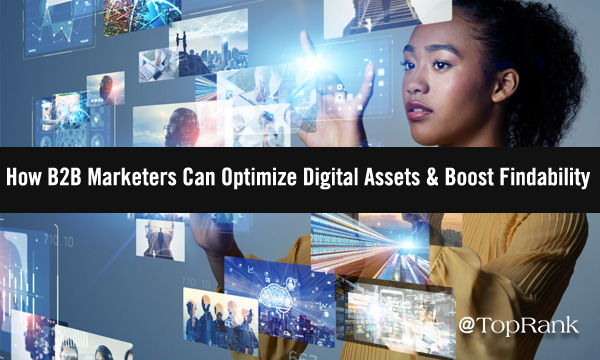
Optimizing Digital Assets: How B2B Marketers Can Combine the Best of External & Internal Search Findability
How can B2B marketers optimize a digital asset workflow that combines best practices for search findability both externally and within your organization?
With the global Digital Asset Management (DAM) market valued at $3.4 billion in 2019, and expected to reach $8.5 billion by 2025, according to study data from IMARC, it’s little wonder that more B2B marketers are looking at and utilizing solutions that help with search findability. Another recent report shows that the global DAM market size is expected to climb to $10.2 billion by 2027, representing a rise of 18.3 percent from 2021 levels.
From better external search engine findability to increased internal search efficiency, let’s take a look at just what digital assets are, and explore some of the solutions B2B marketers are using to manage ever-expanding digital content.
What Are Digital Assets In B2B Marketing
Just what is a digital asset, anyhow?
As we first explored in Why B2B Marketers Should Give a DAM: Top Tips on Digital Asset Management, digital assets are simply any computer files, stored anywhere — whether on your phone, tablet, desktop, network, or in the cloud.
Digital Asset Management — known as DAM, is a category of software that runs either on a local computer network or in the cloud, and is built to ingest and make it easy to organize an unlimited number of files — all those digital assets that business marketers create and use daily.
The more complex your marketing strategies and brand or business are, the greater the benefits of DAM will be, especially when accumulated over time.
The pandemic has also brought to light certain weaknesses for some businesses, as remote workers have placed additional strains on internal systems not necessarily designed for unified online access to digital asset libraries.
So how does DAM technology help with getting your content found?
Better Search Findability Externally
Most of the same signals search engines use to determine which online content is the best for solving the questions people are asking also help organizations with internal findability efforts, which means that well-optimized content successfully serves both purposes.
This dual power makes optimizing content and the individual elements that make up digital assets a smart choice for B2B marketers.
When potential customers can find your content through search, digital asset optimization has more often than not played an important role in ranking well within search engine result pages (SERPs).
Search marketers also benefit from a powerful and properly optimized DAM system, being able to systematically find internal search campaign assets, analytics data contained in spreadsheets or other formats, in ways that help make more data-informed search marketing efforts easier.
In many ways, the so-called findability of search marketing goes naturally well with a smart DAM solution, as both are centered around finding things — whether in the form of search engine query answers or finding a file you know you have but haven’t been able to quickly find until the arrival of a DAM system.
Better Findability For Your Organization
If your organization is like most others in the digital technology and B2B marketing sector today, you’re faced with more data in more locations than ever before — information that is likely ripe for optimization using digital asset management best-practices and techniques.
By nature B2B marketing involves large quantities of content in all its various digital forms, and a powerful DAM system enhances marketing by making it easy to find all the digital assets a business has ever created, both for current campaigns and when gathering past performance and return on investment (ROI) data.
DAM helps businesses elegantly and efficiently keep track of the entirety of their digital assets going back to their earliest files, preserving digital histories, and allowing teams to:
- Organize in multiple ways using many different views, such as timelines and maps
- Perform advanced searches such as “show me all photos from 2018 taken in winter that contain both our old spokesperson and our new one, and which contain a blue car and which were taken at night using a Canon camera older than 2015, which we haven’t yet used in a public campaign.”
Trying to do this could take ages to do manually, but a good DAM can make the task a snap, and ends up saving a great deal of time in the long run.
[bctt tweet=”“The more complex your marketing strategies and organization are, the greater the benefits of digital asset management (DAM) will be, especially over time.” — Lane R. Ellis @lanerellis” username=”toprank”]Bringing It All Together With A Digital Asset Management Solution
It’s entirely possible to implement and consistently use your own digital asset management plan, making use of your organization’s existing software and processes, however this approach will have a hard time matching the efficiency and effectiveness of making the jump to a dedicated and purpose-built digital asset management solution.
I took a look at over 30 of the leading players in the DAM world in our Why Digital Asset Management Matters in B2B Marketing, with solutions running the gamut from popular photo-centric consumer-oriented packages such as Adobe Lightroom, to enterprise workflow DAM systems including Canto and Adobe Experience Manager Assets.
That list was only a sampling of the many DAM solutions available, and with new or revised DAM providers entering the market regularly, such as Pics.io, if you’re searching for the ideal DAM match it can pay off to test both the established players and newcomers.
Jump Through The Digital Looking Glass
It doesn’t take a fairy-tale mirror to create your own digital adventures in wonderland, just the proper planning, implementation, and consistent use of your own DAM system.
We hope the digital asset optimization areas we’ve touched on here will help guide you as you move ahead into 2022 and beyond, to a future that’s more findable than ever.
No matter how you slice it, creating award-winning B2B marketing takes considerable time and effort, which is why many firms choose to work with a top digital marketing agency such as TopRank Marketing. Contact us today to learn how we can help, as we’ve done for businesses ranging from LinkedIn, Dell and 3M to Adobe, Oracle, monday.com and others.
The post Optimizing Digital Assets: How B2B Marketers Can Combine the Best of External & Internal Search Findability appeared first on B2B Marketing Blog – TopRank®.
Our $1 billion investment in Africa’s digital transformation
Editor’s note: Today at Google for Africa, Google CEO Sundar Pichai announced a $1 billion investment in Africa over five years to cover a range of initiatives, from improved connectivity to investments in startups. Below is an edited transcript of his remarks. Watch the full event above or on YouTube.
There is so much momentum happening across Africa, and we’re excited to showcase it at our first Google for Africa event.
Of course, there are also significant challenges. The pandemic continues to deeply impact communities across the continent and around the world. I hope everyone is taking care during these difficult times.
One thing we’ve seen is how technology can be a lifeline, whether you are a parent seeking information to keep your family healthy, a student learning virtually or an entrepreneur connecting with new customers and markets. Being helpful in these moments is at the core of our mission: to organize the world’s information and make it universally accessible and useful.
Expanding opportunity through technology is deeply personal to me. That’s because I grew up without much access to it. Every new technology — from the rotary phone to the television — changed my family’s life for the better. That’s why I’m a technology optimist. I believe in how people can harness it for good.
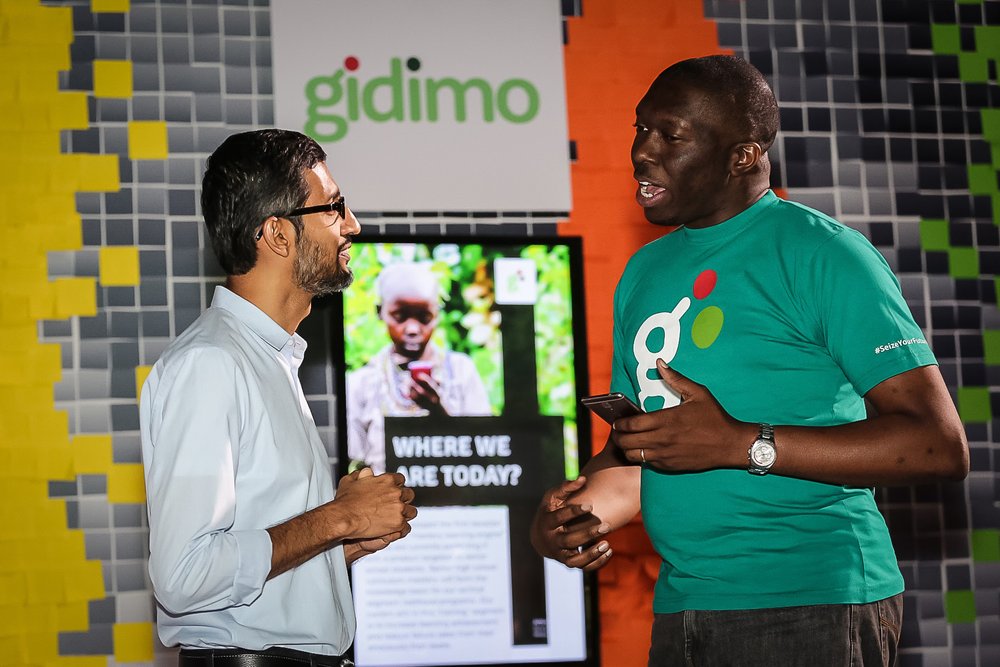
I see so many examples across Africa today, whether it’s startups like Tambua Health that are using machine learning to help doctors diagnose and treat diseases, or entrepreneurs like Tunji, whom I had the chance to meet when I was in Lagos in 2017. His company, Gidi Mobile, is helping low-income students in Nigeria access online learning.
Sundar Pichai and Gidi Mobile’s Tunji Adegbesan at Google for Nigeria in 2017
Increasingly we are seeing innovation begin in Africa, and then spread throughout the world. For example, people in Africa were among the first to access the internet through a phone rather than a computer. And mobile money was ubiquitous in Kenya before it was adopted by the world.
This momentum will only increase as 300 million people come online in Africa over the next five years. Many of them are young, creative and entrepreneurial, and they’re ready to drive new innovation and opportunity across the region.
It’s been incredible to see the rapid pace of change in a short amount of time, and be a partner on that journey. Since we opened our first offices in Africa, we’ve enabled 100 million Africans to access the internet for the first time and empowered millions of businesses and creators with digital tools.
A big focus has been on expanding opportunity through digital skills. In 2017, we committed to help 10 million Africans get the digital skills they need to grow their careers and businesses. So far, we’ve trained six million people. We’ve also trained 80,000 developers from every country in Africa and supported more than 80 startups to raise global venture capital funding, creating thousands of jobs.
In 2018, we opened an artificial intelligence research center in Accra. The team is focused on solving challenges relevant to Africa and the world, like using AI to map buildings that are hard to detect using traditional tools and adding 200,000 kilometers of roads on Google Maps.
And we continue to build for Africa’s unique needs. Products like Android Go and Files Go ensure that everyone can have a great smartphone experience. On YouTube, we are supporting Black creators and artists with our Black Voices Fund.
These are just a few examples of how we’re investing in, and building for, Africa. We know there’s more we can do to help bring the benefits of technology to more Africans.
So today I’m excited to announce that we plan to invest one billion dollars in Africa over five years. It will cover a range of initiatives, from improving connectivity to investing in startups.
These investments will support the continent’s digital transformation in four key areas:
- Enabling affordable access and building products for every kind of African user.
- Helping businesses with their digital transformation.
- Investing in entrepreneurs to spur next-generation technologies.
- Supporting nonprofits working to improve lives across Africa.
As we make these investments, we know we can’t do this alone. We look forward to partnering with African governments, policymakers, educators, entrepreneurs and businesses. We have so much opportunity ahead as Africans shape the next wave of innovation. Thank you for the chance to be a part of it.