Data Commons: Making sustainability data accessible
At Google, we believe that giving everyone easy access to data can be revolutionary — especially when it comes to solving the world’s most pressing problems like climate change.
Take Google Maps for example. Before Google Maps, information — like satellite imagery, maps of roads and information about businesses — was found in different places. Google Maps brings all this helpful information together, so people can use it not only to navigate and explore the world with ease, but also to find solutions to problems facing their communities. We’ve seen people use Google Maps to help do everything from giving communities access to emergency food services to fighting the opioid crisis by highlighting drug drop-off centers.
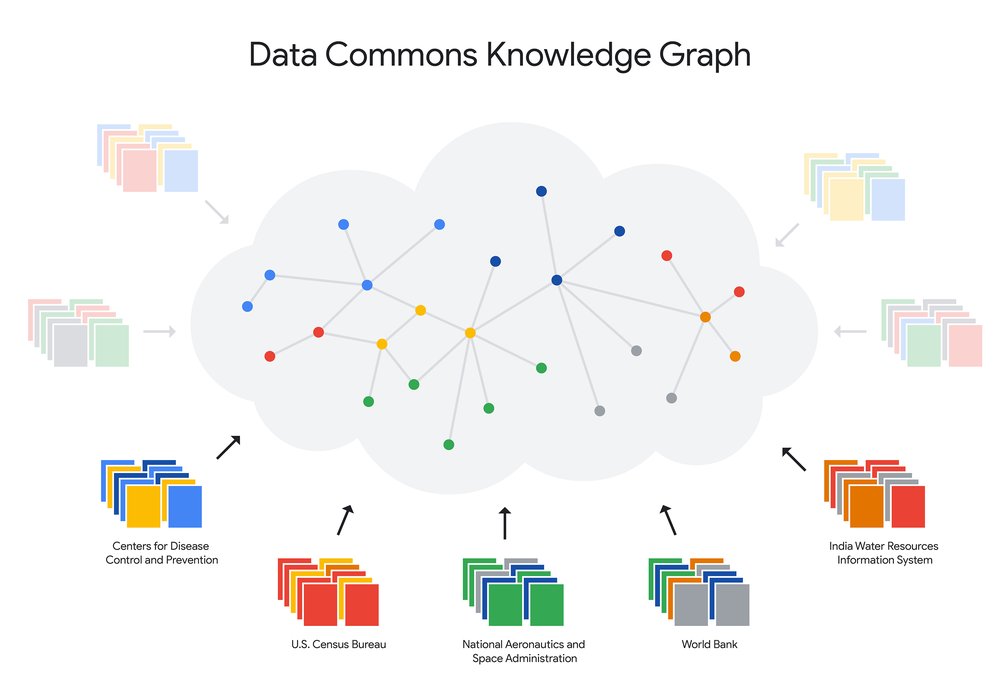
Despite the critical urgency to combat the effects of climate change, finding data around sustainability is where mapping data was 15 years ago. It’s fragmented across thousands of silos, in a cacophony of schemas, and across a multitude of databases. In 2017, we started the Data Commons project to organize all this data to create standardized, universal access for consumers, journalists, policymakers and researchers. Today, Data Commons is one of the world’s largest Knowledge Graphs on sustainability, spanning more than 100 new sources of data about climate, health, food, crops, shelter, emissions and more.
The graph contains nearly 3 billion time series across over 100,000 variables about 2.9 million places. Anyone can access, explore and understand this data using Google Search or our free dashboards and visualization tools. Or they can use our open and free APIs to build new tools based on this data. For enterprise customers, this data is available via Data Commons on the BigQuery Analytics Hub.
The Data Commons Knowledge Graph is a single knowledge graph that includes more than 100 sources of sustainability data and more.
Connecting the dots on climate data
The effects of climate change are going to worsen food insecurity, health outcomes, economic inequities and other social issues. There is a dire need to create data-driven solutions that can mitigate these effects so we can take collective action. We’re working closely with the broader community — including universities, nonprofits and researchers — to use Data Commons to uncover insights and create solutions. Take a look at some of the work being done:
- Temperature and health: Professor Arun Majumdar of Stanford University, who was also the Founding Director of the Advanced Research Projects Agency-Energy (ARPA-E), is using Data Commons to look at the intersection of temperature and human health. When humidity and temperature reach a critical threshold, the human body can no longer regulate its temperature. Arun and his team are identifying which places will reach this critical threshold first. With this information, local governments can take proactive steps to mitigate these effects, like building infrastructure that provides cooling to communities.
- Water for everyone: Professor Balaraman Ravindran of the Indian Institute of Technology Madras is working with Data Commons to add India-based data on water quality. With this data, communities can get a better understanding of water use, quality, availability and more.
- Understanding food scarcity challenges: Feeding America is a nationwide network of 200 member food banks serving tens of millions of people in need in the United States. Data from their annual Map the Meal Gap studyis accessible in Feeding America Data Commons so anyone can explore food security and how it intersects with variables like health, climate and education. For Feeding America, this data allows them to quickly identify U.S. locations where food insecurity is most exacerbated by other root causes of disparities and hardship.
Our quest to organize the world’s sustainability information
Climate change is a defining crisis of our time, but together we have the potential to curb its effects. At Google one of the ways we can continue to contribute to solving it is through our mission to organize information and make it easily accessible. Data Commons’ data and code is open source so anyone can use it, and it’s built collaboratively with the global community. Join us in using Data Commons to tackle climate change, and see other progress we’ve made toward the sustainability commitments we made as part of our third decade of climate action.

Lenovo Yoga Smart Tab Tablet: non farti scappare l’offerta del mese su Amazon
Resilience tips from a Google expert
At Google, we define resilience as your ability to respond to and recover from stress. There’s maybe no time where this is more relevant than during a pandemic. Lauren Whitt, Google’s Head of Resilience, and her team spend their days helping Googlers perform at their best.
This week, to help even more people build their resilience, Lauren and her team launched a new podcast series that anyone can listen to and learn from. The series helps uncover the science behind resilience and high performance, and contains strategies from a wide array of experts to help listeners with whatever challenges they may be facing. We chatted with Lauren about her role, the podcast and expert tips for staying resilient during times of uncertainty.
How would you describe your job at a dinner party?
I lead Google’s Global Resilience program. Our team, including coaches based around the world, are focused on helping Googlers reach peak mental performance, maintain their wellbeing and cope with work-related stress. Some ways we do this are through internal speaker series, individual consultations and training programs.
What’s one thing that you want people to know about stress and resilience?
Stress is an inevitable aspect of our lives. Extreme levels of stress can lead us to feel overwhelmed and exhausted, but when managed appropriately, moderate stress can actually motivate us to perform at our best.. There are easy ways we can manage stress more effectively. For example, we know that self-awareness is the foundation of behavior change, so one thing we created on our team is what we call the “T.E.A check-in” — as a way for individuals and teams to reflect on their thoughts (T), energy (E) and attention (A).
How do you deal with stress in your own life?
For me, enjoying the outdoors plays a huge role in stress management. When the pandemic first started, my family and I relocated to a condo in a Florida Panhandle beach town. It has really provided me with a fresh perspective. Many days, my mornings begin with a walk on the beach listening to a podcast and taking in fresh air. In the evenings, when my husband arrives home from work, we close our laptops and shift to family time. We’ll end our days with a walk on the beach or by watching the sunset.
You just launched a new podcast on resilience. What can you tell us about it?
This project has been in the works for a while, and we’re thrilled to finally share it with the world. We’ve paired leading neuroscientists and psychologists with mental performance coaches to uncover the science behind resilience and high performance. Each episode — there are four in total — is filled with strategies that listeners can put into place right now to help them with whatever challenges they may be facing.
What are some of your favorite tips from the podcast?
There are so many! One I really love is about how fresh starts are one of the best times for setting new goals. This one is particularly timely as many Googlers just started their hybrid work weeks earlier this month. Many people naturally think about this on January 1 and create resolutions each year, but there are many other moments that provide a fresh start – such as the start of a new week, the start of a new month, the celebration of a birthday or the start of a season. Because we don’t think about time linearly, we create these chapters in our life stories. And when we feel we’re closing one chapter and opening another, we feel a renewed optimism about what we can achieve.
What are you hoping listeners take away?
I hope the podcast helps spark new conversations about how to prepare for and thrive in a hybrid work environment. As we move forward in our own hybrid workplace, there are new skills we need to put in place to manage the next era of workplace success. The podcast combines experts discussing the science and coaches who share the practical applications of these initiatives.

Google Pixel Watch, un leak svela la UI del nuovo smartwatch?

Astro A40 TR + MixAmp Pro: perché è il miglior headset per i giocatori

iPhone 16: display full-screen senza notch e fori

Vivo: ecco il nuovo chipset per imaging V1+

iPhone 14 Pro: ci sarà una super porta Lightning 3.0

Digitale terrestre, OFFERTA LAMPO FOLLE di Amazon: decoder a 16€
Ubuntu 22.04 LTS: ecco tutte le differenze con Ubuntu 20.04

Twitch, per la Giornata Internazionale del Libro i consigli di lettura dai BookTwitch

WhatsApp, come trasferire le chat da iOS ad Android

Meta Quest Gaming Showcase, ecco tutti gli annunci: c’è anche Ghostbusters VR

Very 4,99 BTL, l’offerta con 30 Giga a 4,99€ al mese è ora anche online