
WordPress: creare un sito vetrina

WordPress: comprendere la Dashboard

Ubuntu 22.04 LTS rilasciata: ecco tutte le nuove funzionalità

SSD Kingston da 240 GB con tecnologia 3D Nand ad un prezzo SUPER su Amazon

7-Zip: grave vulnerabilità su Windows

Notepad Next: il fork di Notepad++ con il supporto a Linux

Nuove possibilità di scelta dei cookie in Europa
Se avete visitato un sito web in Europa, è probabile che vi siate imbattuti in un banner in cui vi si chiede il consenso per l’utilizzo dei cookie. Grazie ai cookie i siti possono mantenere le informazioni riguardanti la vostra navigazione, così da permettere di avere diverse funzionalità, tra cui visualizzare il testo nella propria lingua preferita, assicurarsi che a visitare il sito sia un utente reale e non un fastidioso bot, o valutare se una campagna pubblicitaria stia funzionando o meno.
Nell’ultimo anno, le autorità di regolamentazione che applicano le leggi europee e che richiedono questi banner, comprese le autorità per la protezione dei dati in Francia, Germania, Irlanda, Italia, Spagna e Regno Unito, hanno aggiornato le loro linee guida di conformità. Pertanto, ci impegniamo ad adottare questi nuovi standard, che sono frutto anche della collaborazione con le autorità locali di alcuni di questi paesi.
Sulla base di questi confronti e delle specifiche indicazioni della Commission Nationale de l’Informatique et des Libertés (CNIL) francese, abbiamo riprogettato completamente il nostro approccio alla gestione dei cookie, modificando anche l’infrastruttura che utilizziamo per gestirli.
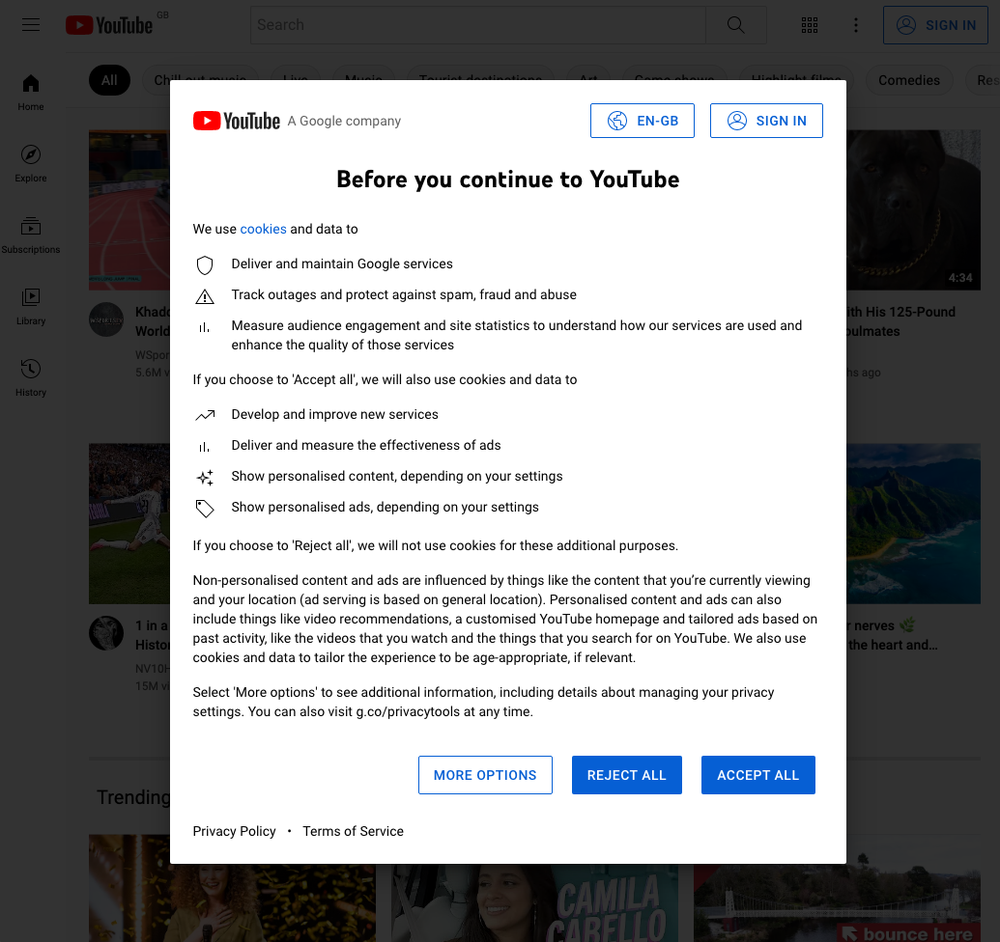
Presto, visitando la pagina di Ricerca Google e YouTube in Europa senza aver effettuato il login o in incognito, gli utenti potranno visualizzare una nuova opzione consenso ai cookie. Questo aggiornamento, che ha cominciato a essere rilanciato all’inizio di questo mese su YouTube, renderà disponibili i pulsanti “Rifiuta tutto” e “Accetta tutto” nella homepage, localizzati nella lingua prescelta. (È anche possibile personalizzare la scelta con “Altre opzioni”).
Abbiamo iniziato in Francia e estenderemo questa opzione nel resto dello Spazio Economico Europeo, nel Regno Unito e in Svizzera. A breve, gli utenti in Europa avranno la possibilità di scegliere i cookie, accettandoli o rifiutandoli con un solo clic.
Più di un altro pulsante
Questo aggiornamento ha reso necessaria una completa riprogettazione del modo in cui i cookie funzionano sui siti di Google, alla luce delle profonde modifiche necessarie all’interno dell’infrastruttura basilare di Google stessa. Inoltre, sapevamo che questi cambiamenti avrebbero avuto un impatto non solo sulla Ricerca e su YouTube, ma anche sui siti e sui creator che ne fanno uso per far crescere le loro attività e avere un ritorno economico.
Riteniamo che questo aggiornamento risponda a linee guida normative rinnovate e sia in linea con il nostro più ampio obiettivo di aiutare a costruire un futuro più sostenibile per il web. Per lo stesso motivo, nell’ambito di Privacy Sandbox ci siamo impegnati a creare nuove tecnologie per la tutela della privacy. Crediamo fortemente che sia possibile proteggere la privacy delle persone online garantendo allo stesso tempo alle aziende e agli sviluppatori strumenti per creare attività digitali di successo.
New cookie choices in Europe
If you’ve visited a website in Europe, chances are you’ve seen a cookie consent banner. Cookies help sites remember information about your visit, so they can do things like display text in your preferred language, make sure you’re a real user and not a pesky bot, or estimate whether or not an ad campaign is working.
In the past year, regulators who interpret European laws requiring these banners, including data protection authorities in France, Germany, Ireland, Italy, Spain and the U.K., have updated their guidance for compliance. We’re committed to meeting the standards of that updated guidance and have been working with a number of these authorities.
Based on these conversations and specific direction from France’s Commission Nationale de l’Informatique et des Libertés (CNIL), we have now completed a full redesign of our approach, including changes to the infrastructure we use to handle cookies.
Our new cookie banners began rolling out earlier this month on YouTube in France and will soon be coming to all Google users in Europe
Soon, anyone visiting Search and YouTube in Europe while signed out or in Incognito Mode will see a new cookie consent choice. This update, which began rolling out earlier this month on YouTube, will provide you with equal “Reject all” and “Accept all” buttons on the first screen in your preferred language. (You can also still choose to customize your choice in more detail with “More options.”)
We’ve kicked off the launch in France and will be extending this experience across the rest of the European Economic Area, the U.K. and Switzerland. Before long, users in the region will have a new cookie choice — one that can be accepted or rejected with a single click.
Not just a new button
This update meant we needed to re-engineer the way cookies work on Google sites, and to make deep, coordinated changes to critical Google infrastructure. Moreover, we knew that these changes would impact not only Search and YouTube, but also the sites and content creators who use them to help grow their businesses and make a living.
We believe this update responds to updated regulatory guidance and is aligned with our broader goal of helping build a more sustainable future for the web. We’ve committed to building new privacy-preserving technologies in the Privacy Sandbox for the same reason. We believe it is possible both to protect people’s privacy online and to give companies and developers tools to build thriving digital businesses.

Netflix potrebbe far pagare di più gli account condivisi

Lenovo Notebook, su Ebay MAI a un PREZZO così BASSO

PREZZI PAZZI Amazon: l’SSD NVMe Blue WD da 500GB costa solo 49€

iPhone 14 sempre più “Made in China”: ecco perché

Proteggi la tua privacy con AtlasVPN: 81% di sconto sulla VPN

Samsung Galaxy Z Fold4: fotocamera al top, ma niente vano per S Pen
For Earth Day, an update on our commitments
In 2020, as part of our third decade of climate action, we established a bold set of goals to help build a carbon-free future for everyone. For Earth Day, we’re sharing recent progress we’ve made including new investments to help partners address climate change, product updates that allow everyone to make sustainable choices and highlights from our journey to net zero.
Helping our partners address climate change
To provide deeper insights into climate change data — like increased food insecurity, the nexus of health and climate and extreme weather events — we need to enable everyone to create solutions. We’ve continued to provide organizations, policymakers, researchers and more with the data, technology and resources they need to address climate change. Today we announced that Data Commons — our open-source platform built to organize public data and enable standardized, universal access to anyone — is now one of the world’s largest knowledge graphs on sustainability. Data Commons has grown to include more than 100 data sources about the climate, health, food, crops, shelter, emissions and more.
Other initiatives we’ve recently announced to help partners include:
- A Google.org Sustainability Seed Fund in Asia Pacific: This new $6 million fund provides organizations in areas experiencing the brunt of climate change with additional resources to address issues like air quality, water preservation and renewable energy access.
- Our research shows, 75% of companies think technology will play a key role in their ability to reach sustainability goals: Our recent Google Cloud survey of nearly 1,500 executives across 16 countries found that sustainability tops business priorities, but few business leaders know how to begin or measure impact.
- Helping build a free carbon calculator for businesses: For small and medium-sized enterprises (SMEs) finding the resources to measure and manage emissions is challenging. We partnered with the Sweden-based company Normative to provide funding and support to develop a free Business Carbon Calculator that is now available through the UN Race to Zero backed SME Climate Hub.
Helping everyone make more sustainable choices
Individuals are also looking for ways to take care of the planet. We’ve been looking at building more ways for our products to give people access to the information and tools needed to make more sustainable choices.
Today, when you go to Google.com, you’ll see timelapse imagery from Google Earth Timelapse and other environmental organizations that illustrates the effects of climate change. This is part of our ongoing efforts to spotlight the impact of climate disasters and help people learn what actions they can take to minimize the effects. Last October, we partnered with the United Nations to make it easier for people to find climate change information. When you search for ‘climate change’ in certain languages, you’ll see information panels and visuals on the causes and effects of climate change and individual actions they can take to live more sustainably. This was already available in English, French and Spanish, and today we expanded to include Arabic, Chinese, Indonesian, Italian, Japanese, Portuguese, Russian, Thai and Vietnamese.
Here are more ways our products are helping people make sustainable choices:
- Saving energy with Nest: Since Nest launched its first smart thermostat over ten years ago, it has helped people save nearly 100 billion kilowatt-hours of energy — that’s enough energy to light up the entire planet for ten days! Now compatible Nest thermostats can do even more with Nest Renew, a thermostat service announced last year in the U.S. When Nest Renew customers take actions at home that save energy, they earn ‘Leafs’. Once customers reach Leaf milestones, they can vote to direct funds to one of our Energy Impact Program partners, Elevate and GRID Alternatives. These funds have gone toward energy-efficient upgrades to affordable housing in Chicago and the expansion of solar installation programs in California. Nest Renew is currently available in early preview, sign up to join the waitlist.
- More sustainable transportation options: Over ten years ago, cycling directions came to Google Maps. Today, it’s available in over 30 countries. In 2021 alone we added over 170,000 kilometers of bike lanes and bikeable roads, bringing more options to people looking for sustainable transportation alternatives.
Building a carbon-free future at Google
Lastly, we’ve always believed that to enable others we need to be leaders in the way we address our impact on the planet. In October, we set a goal to achieve net-zero emissions across all of our operations and value chain, including our consumer hardware products, by 2030. We aim to reduce the majority of our emissions (versus our 2019 baseline) before 2030, and plan to invest in nature-based and technology-based carbon removal solutions to neutralize our remaining emissions.
We’ve recently shared more on how we’re driving toward net zero:
- 24/7 carbon-free energy priorities: For emissions associated with powering our data centers and offices, we have an ambitious goal to operate on 24/7 carbon-free energy by 2030. This will require new technology to help with grid decarbonization, like our first-ever battery-based system for backup power at a hyperscale data center that is now operational in Belgium. Additionally, governments will need policies that speed up the transition to clean energy. Last week, we published a roadmap outlining policy priorities that accelerate the decarbonization of electricity grids across the world and our commitment to advancing them.
- Investing in carbon removals and carbon markets innovation: Beyond our value chain, we’ll build on our leadership in high-impact methane reduction and destruction projects. We’ll also invest in emerging companies developing technology-based and nature-based carbon removal solutions, like our recent $200 million limited partnership in Frontier. And we will help strengthen carbon markets through our Google.org contribution to Gold Standard’s digitization efforts and our $2 million contribution to the Integrity Council for the Voluntary Carbon Markets.
We all have to act now and act together if we’re going to avert the worst effects of climate change. At Google, one of the most powerful things we can do is build technology that allows us, partners and individuals to take meaningful action. We plan to continue this critical work and do what we can to protect the planet.