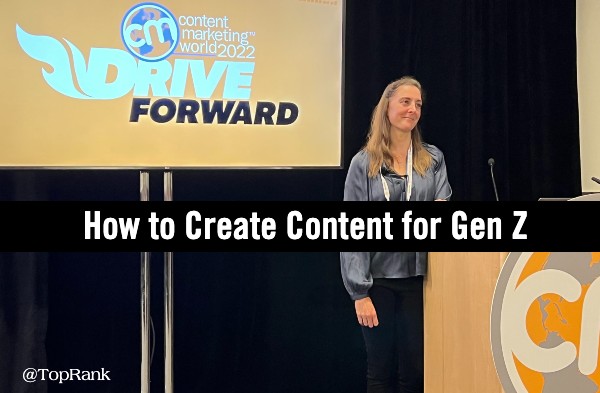
Semrush on How to Create B2B Content for Generation Z
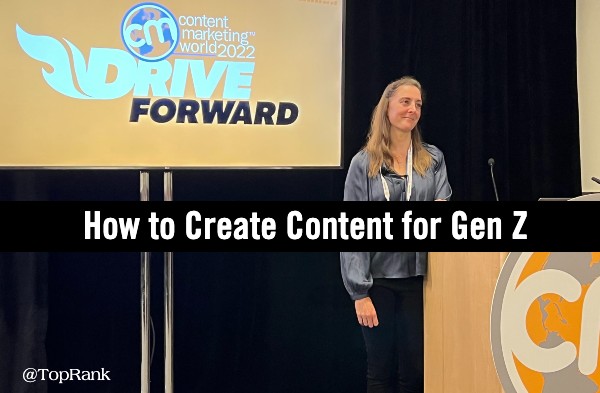
While many B2B marketers are focused on Boomer and Millennial age senior marketing executives, what are B2B brands doing to connect with the next Generation of buyers? You know, those junior marketing pros born after 1997 aka Gen Z? Content Director at Semrush, @LenoxPowell, shared useful insights about connecting this up and coming group of customers that includes buyers of B2B products and services.
First, you should know that GenZ is a large cohort – 32% of the global population, with massive spending power.
Second, you should know that GenZ are definitely not Millennials 2.0.
While Millennials are aspirational, idealistic and adapted to tech, their brand expectations are about storytelling On the other hand, Gen Z are authentic, pragmatic, and visual first about technology with brand expectations are about storyliving.
Don’t worry, I had to look up “storyliving” too. Jeff Fromm describes it as, “StoryLiving™ is about what companies do, not just what they say. It is not just being unique, but also meaningful and acting in the interests of many stakeholders.”
Ahh, that makes sense. However, I don’t think GenZ has the market cornered on a trend towards consumers caring more about companies acting authentically and meaningfully in the interests of their customers.
So, what’s the marketing opportunity for Gen Z?
1. A whole new mindset
2. New opportunity to be creative
3. New loyal customer
4. New advocates for your brand
There are important shifts in social platforms with Gen Z: they are not on Facebook or Pinterest.
For Gen Z, TikTok is the new Facebook. TikTok is about fun, unpolished content which Gen Z loves. TikTok is expected to be the 3rd most popular social network by the end of 2022 and potentially displace Facebook and Twitter.
Some forward thinking businesses are starting to take Gen Z opportunities seriously and doing things like hiring Chief TikTok Officers. (Personally I think that’s just a gimmick – no one hired Chief Facebook Officers or Chief LinkedIn Officers – why should they do that with TikTok?)
How do you go viral on TikTok?
- Speak right away. 1 in 3 viral TikTok videos focused on a person speaking within the first 3 seconds.
- Let the music play – More than half of viral TikTok videos used music as their primary background sound in the first 3 seconds.
- One to one – 60% of viral videos featured one person visible on the screen
- Keep it real – Create videos that portray real people with real lives
Is TikTok the new search? Younger users search on TikTok more than Google. TikTok surpassed Google as the most visited domain in 2021. “Gen Z “hates searching Google because crappy SEO blogs bury the answers they are looking for underneath keyword stuffed garbage”.
A study by Fractl found that Gen Z loves long tail search. The length of their search queries are much longer than Millennials and other generations.
Words to consider in your content for Gen Z include – “best”, “cheap”, “how to”, “top”.
Content doesn’t always need to be literal and how to do this or that. Some of the most popular content amongst Gen Z is ASMR or other entertaining content that then opens the door to point to more practical content.
Research from Clover Letter found that brands should not talk down to Gen Z. 52% want to be informed. 35% say media talks down to them, 37% hate clickbait.
Tone of voice is important for Gen Z. They tend to lean towards informal, friendly types of communications.
Marketing disruptors that are shaking things up. Web 3.0 is influencing how we are online and engaging. Gen Z will likely adopt these elements and marketers need to be prepared:
- Blockchain
- Crypto
- NFT
- Metaverse
Web 1 was disorganized and overwhelming
Web 2 Was the rise of Facebook, Amazon, Google and amased a lot of power
Web 3 is about taking some of that power back
Think about this shift as you are planning your content topically and from a distribution standpoint. Gen Z is all about taking power back from corporations.
The emergence of Web 3 is fueled by Gen Z to decentralize apps and financial components to “take the power back”.
Where does Metaverse play with Millennials? Parallel to the physical world, metaverse is a place where people can experience life digitally but can also include augmented reality as a hybrid of virtual and real world.
What does this look like? Gucci has a store where users can buy products for their avatar. Lowes has an augmented reality option to try out power tools virtually. Adidas has a NFT community with limited access to merchandise.
What does this mean to us as marketers? There’s still a lot to be figured out. A lot of it is theoretical and experimental but it’s taking off with Gen Z. If your team can experiment and test things out you’ll be ahead of the game. Big brands are doing it and so should you.
For a related post that digs even deeper into how to prepare for future B2B customers, be sure to read my coverage of LinkedIn’s Allyson Hugley on What’s Next: Connecting with Future Buyers.
The post Semrush on How to Create B2B Content for Generation Z appeared first on B2B Marketing Blog – TopRank®.
Amazon.it si conferma e-commerce ufficiale di Lucca Comics Games 2022
The Last of Us Parte I per PlayStation 5, il prezzo scende del 20%: da comprare subito
A message about Stadia and our long term streaming strategy
For many years, Google has invested across multiple aspects of the gaming industry. We help developers build and distribute gaming apps on Google Play and Google Play Games. Gaming creators are reaching audiences around the world on YouTube through videos, live streaming and Shorts. And our cloud streaming technology delivers immersive gameplay at massive scale.
A few years ago, we also launched a consumer gaming service, Stadia. And while Stadia’s approach to streaming games for consumers was built on a strong technology foundation, it hasn’t gained the traction with users that we expected so we’ve made the difficult decision to begin winding down our Stadia streaming service.
We’re grateful to the dedicated Stadia players that have been with us from the start. We will be refunding all Stadia hardware purchases made through the Google Store, and all game and add-on content purchases made through the Stadia store. Players will continue to have access to their games library and play through January 18, 2023 so they can complete final play sessions. We expect to have the majority of refunds completed by mid-January, 2023. We have more details for players on this process on our Help Center.
The underlying technology platform that powers Stadia has been proven at scale and transcends gaming. We see clear opportunities to apply this technology across other parts of Google like YouTube, Google Play, and our Augmented Reality (AR) efforts — as well as make it available to our industry partners, which aligns with where we see the future of gaming headed. We remain deeply committed to gaming, and we will continue to invest in new tools, technologies and platforms that power the success of developers, industry partners, cloud customers and creators.
For the Stadia team, building and supporting Stadia from the ground up has been fueled by the same passion for games that our players have. Many of the Stadia team members will be carrying this work forward in other parts of the company. We’re so grateful for the groundbreaking work of the team and we look forward to continuing to have an impact across gaming and other industries using the foundational Stadia streaming technology.
Amazfit GTR 4 e Amazfit GTS 4 in Italia: c’è Alexa integrata. Prezzi e disponibilità
Malware: scoperto Chaos, attacca Windows e Linux via DDoS
I ricercatori di sicurezza informatica hanno scoperto un nuovo malware denominato Chaos che attacca i dispositivi Windows e Linux via DDoS.
Leggi Malware: scoperto Chaos, attacca Windows e Linux via DDoS
Portafoglio RFID in pelle e carbonio: con appena 19€ ADDIO alle truffe
One researcher’s take on Google’s mentorship program
As a sophomore at Howard University, Leslie Coney discovered what would soon become her “superpower” while she and a friend were washing their hands in the bathroom. Attempting to use the hand dryer, they noticed it worked without issue for Leslie, but not for her friend, who had darker skin. Leslie shared this experience with a professor, who introduced her to the field of Human-Computer Interaction (HCI), the study of how humans interact with technology.
Leslie started questioning who was actually considered when designing, building and testing technologies. This kicked off her computer science (CS) research journey in Human Centered Design and Engineering, specifically exploring how Black people can influence and are impacted by technology.
Today, Leslie is a PhD student at the University of Washington with a focus on Black maternal health. She’s also a recent graduate of Google’s CS Research Mentorship Program (CSRMP). Through mentorship and peer-to-peer networking, CSRMP supports undergraduate and graduate students from historically marginalized groups pursuing computing research. The program aims to increase the diversity of PhD graduates in computing-related fields and ensure the broader community of CS researchers includes the experiences, perspectives and concerns of people worldwide. Since 2018, CSRMP has hosted more than 730 students across more than 230 institutions. And our next class of nearly 300 students starts in just a few weeks.
Reflecting on her CSRMP experience, Leslie shared more about its impact on her career and her advice for future participants.
How did you get into the research field?
I focused on building community, seeking guidance from my professors and taking advantage of as many resources as possible both on and off-campus. For example, I received funding through Google’s Conference Scholarships program to attend conferences like Tapia and Grace Hopper Celebration, where I connected with other Black women researchers.
How did CSRMP prepare you for the next step in your research career?
My mentor helped me think critically about my research interests and what makes a program and advisor a good fit for me. He encouraged me to ask the tough questions when figuring out where I could be most successful in graduate school. He also helped me better understand what rigorous research looks like in academia and what to expect as a PhD student.
Were there any challenges you had to overcome during your time in CSRMP?
I wasn’t the most comfortable in my pod at first, given that I was the only Black woman in the group. My experience at a Historically Black University influenced me to focus my research efforts on the Black community — which was something I was proud of but nervous to share with folks who aren’t Black. There is an unnecessary pressure placed on researchers from marginalized groups to validate why centering marginalized experiences is sufficient and valuable. However, my CSRMP mentor and podmates reaffirmed this decision and supported my pursuit. Also, there are very nuanced experiences in academia that are specific to Black women, and while my mentor couldn’t fully prepare me for them, he still encouraged me to seek relationships that could close that gap.
You just published your first piece! Tell us about it.
Yes, I did! My article, “Why you being WEIRD to me?: reflections of a black researcher on WEIRD-ness in HCI,” started out as a final assignment last fall. I was tasked with writing about common threads throughout readings on diversity, or the lack thereof, in HCI. Afterward, a peer and fellow Black woman researcher invited me to write something for the next edition of the Association for Computing Machinery XRDS series. Writing the paper was so much fun — I got to exercise my critical thinking muscles, incorporate cultural references and prioritize accessibility so people outside academia could engage, too.
What advice do you have for students who are underrepresented in CS research and getting started in this field?
More likely than not, you gravitate toward your lived experiences. So be confident in your identities and take advantage of programs like CSRMP to help you back up those lived experiences with practical knowledge. Next, treat the graduate school application process like dating — once you’re accepted, the ball is in your court to decide whether or not that program is a good fit for you. You have to be sure that you will feel safe and supported being yourself and conducting your research. Lastly, pace yourself and have fun! A PhD is a long commitment, so be sure to find a balance between work and play.
Congratulations to all the students who graduated from CSRMP in the first half of 2022. We look forward to supporting future students like Leslie, who are taking charge in computing research. Applications are now open for the January 2023 mentorship cycle — spread the word and apply by October 26, 2022.
14 fun details I noticed in my first 14 days with a Pixel
After nearly three years of working at Google, I’ve definitely leaned into all kinds of “Googley” things. I got doogler bandanas for my dogs. I’ve become a bit of a Chrome OS power user (no brag). And you’ll never be able to pry my Pixel Buds from me (unless it’s because I’m upgrading them…more on that later). But there’s one area where I’ve held out from joining in: the Pixel phone.
Until now! Two weeks ago, I made the switch to a Pixel 6a. And yes, I have been loving some of the biggest Pixel features, like Night Sight, Magic Eraser and Live Translate. But I’ve enjoyed the small, delightful things, too — tiny details and thoughtful touches that I knew about in theory but didn’t fully appreciate before joining the club.
Without further ado, here are 14 things, big and small, that I ended up loving in my first 14 days with Pixel.
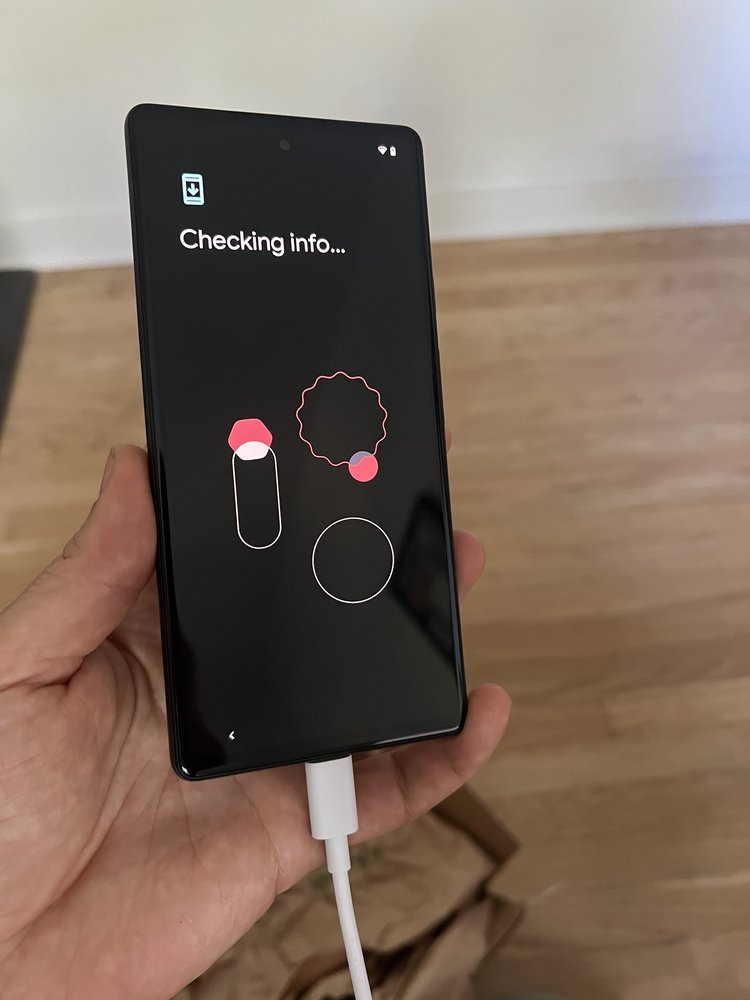
1. Setting up my Pixel was easy.
The worst part of getting a new phone is the setup and transfer from your old device to the new — and that’s honestly been a major part of what’s held me back! But I quickly learned that being a general Google user made this so much easier an experience than when I’ve changed devices in the past. Because I’ve had a Gmail account for years (from long before I was a Googler), logging into my new Pixel with my account meant that all the things I needed — my email, my documents, my photos — were immediately there. I was even able to transfer my messages with the help of the Pixel guidebook on transferring data. It was definitely my easiest and swiftest transfer experience.
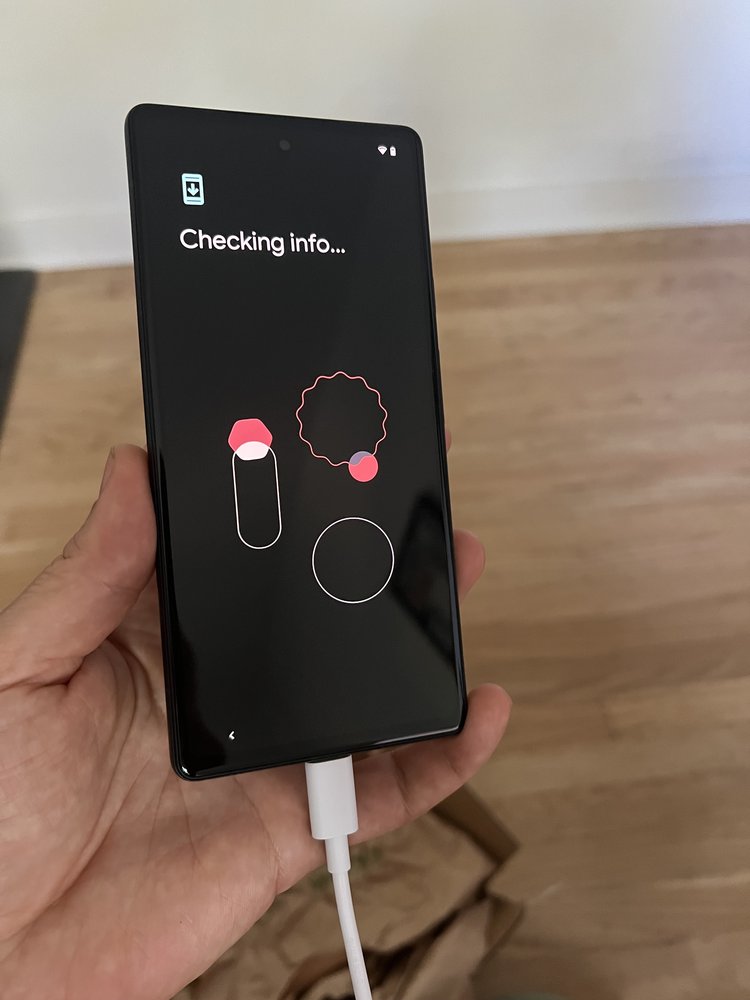
I was set up in no time.
2. I’m into the look and feel of the new Pixel cases.
Aesthetics matter! I love the color combo of the case and the device, and because the cases are semi-translucent, there’s tons of mix-and-match potential. The slightly rubbery feel of the case (which is made of plastic with an inner layer of 75% recycled materials) is extremely satisfying, too.
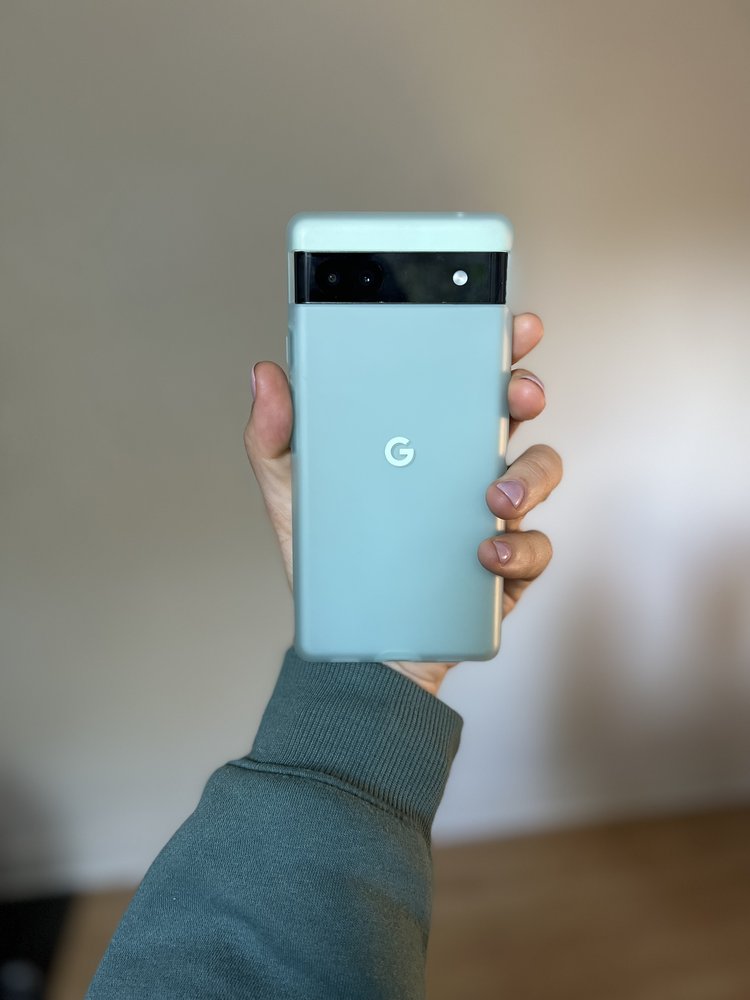
Yes, I have a thing for blues and greens, why do you ask?
3. The Pixel 6a feels light in my hand.
There’s nothing bulky about it. It weighs about 6.3 ounces — which is about the same as six pencils! I’ve always had metal phones, and the Pixel’s light tactile alloy frame is something I didn’t think I would notice, but definitely do.
4. The haptic feedback feel is satisfying.
Every device has its own unique haptic feel — that slight vibration that signals a notification — and I really enjoy how the haptic feedback feels on the Pixel 6a. That’s because the technology powering this mechanism was upgraded with the Pixel 6 family, resulting in tighter, more precise vibrations.
5. My Pixel’s lock screen looks lovely every time.
When my phone is asleep and I unlock it from the blank screen, the thumbprint icon lights up and illuminates the screen, and it’s really beautiful. It’s little things like this that caught my eye when I booted up my Pixel for the first time.
6. I’m also a big fan of the charging screen.
When my Pixel is turned off and charging, the screen displays a cool light-up effect showing how much charge it has. It’s a fun visual, and it’s also nice to see immediately how much battery my Pixel 6a has left.
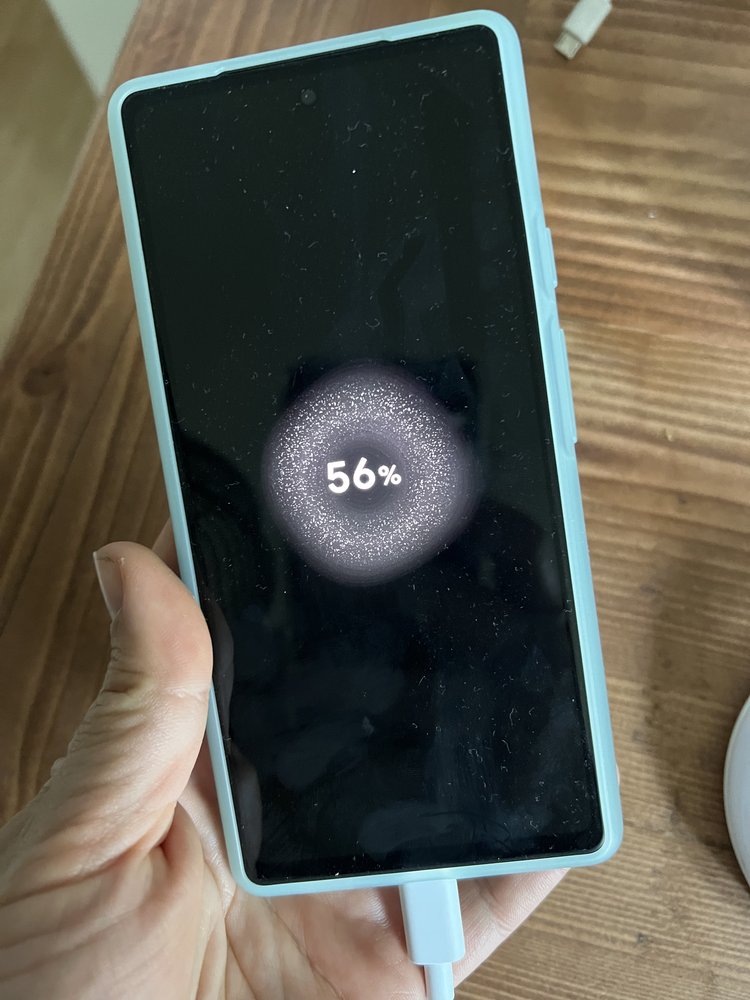
When it’s turned off and plugged in, the Pixel 6a shows you a nifty charging screen.
7. Oh, and the battery just keeps going and going.
I’m certainly not the first one to notice it, but the battery life is incredible — it can easily last for 24 hours and up to 72 if I use Extreme Battery Saver
8. I can say goodbye to shaky panoramas.
I could go on and on about the Pixel camera. My photos look brighter and crisper compared to my old phone, and the camera bar is very slick. Specifically, my panoramas benefitted; I don’t feel like I have shaky hands until I see some of the panoramic shots I try to grab — but the frame icon that moves along with me as I move the phone makes for a much better end result.
9. And my landscape photos aren’t tilted!
One of my biggest photography pet peeves is posting a landscape photo and seeing a slanted line on the horizon. I want that nice, level photo, and I would prefer not to fix it in editing and perhaps lose details as they fall out of frame. The Pixel camera includes that level on screen, so while I’m taking a photo I already know it’s straight. That same “straightener,” as I think of it, also shows up when I’m taking a photo from up above something; when I point the camera down, it will show up to make sure I’m centered.
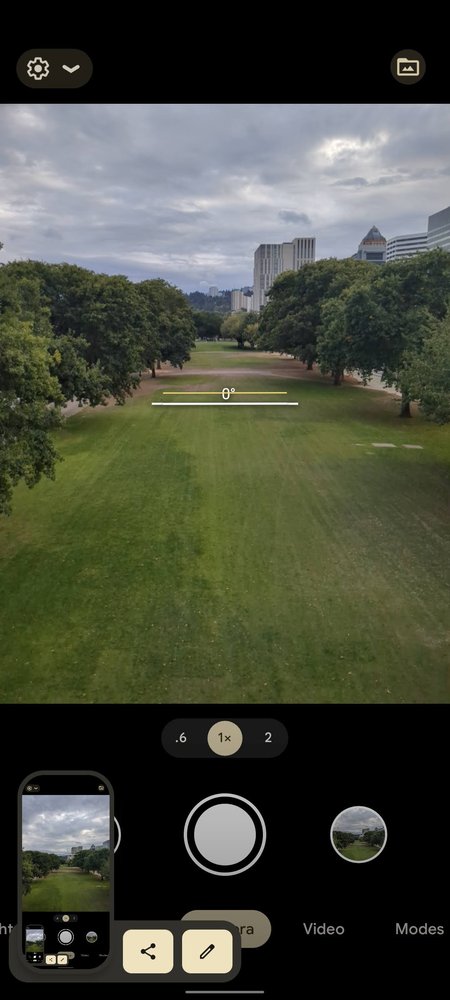
The leveling feature is one of my favorites.
10. Google Photos calls out photo dump duplicates.
I’m an “I need five photos of the same thing” type of photographer. Now, when I open Google Photos, the storage manager will automatically prompt me about things like blurry photos and doubles. I don’t miss scrambling to delete photos from my phone when I get the notification that my storage is dwindling.
11. My Pixel can read my screenshots to me.
I’m also a screenshot fiend (and a big fan of using the Quick Tap screenshot gesture), and I often take screenshots of cooking directions. I don’t know if everyone uses Lens for this purpose, but I rely on it to read directions on my phone out loud to me while meal prepping.
12. I love choosing custom colors for my wallpaper.
I found this setting particularly fun: You can head to your wallpaper settings and customize it so that all of the app icons complement your wallpaper photo. Now the colors of my app icons and other elements, like the time, match the background of my screen. Which is very cute, if I may say so.
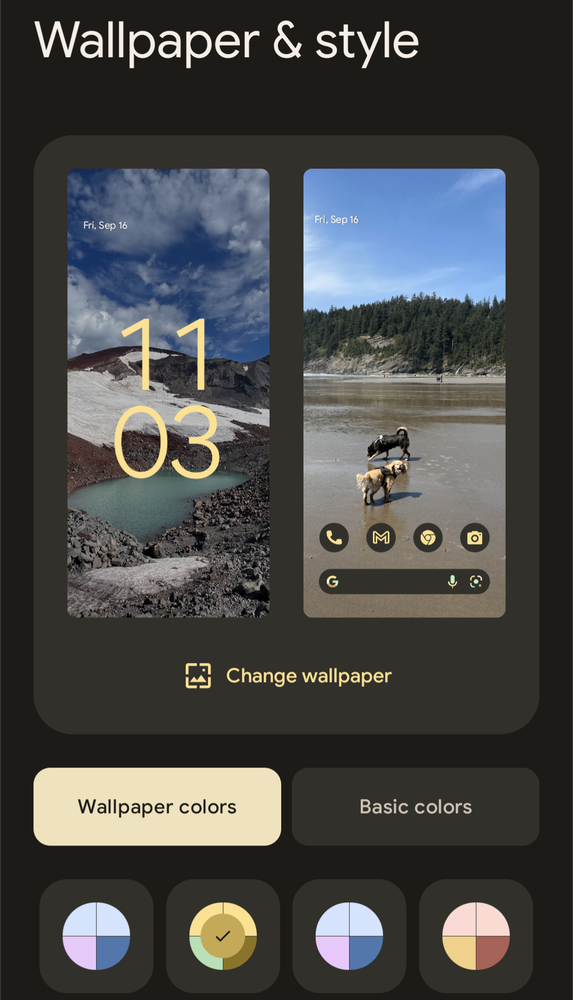
Good dogs deserve custom wallpaper colors.
13. I can customize my time-lapse videos, too.
I take a lot of time-lapse videos — I just feel so accomplished when I watch back my baking endeavors or home renovation projects from start to finish. With Pixel, I can toggle between x1, x10, x30 or x120 speeds. Plus, my phone tells me what these mega-speedy functions might be good for — for example, x30 is great for busy street shots.
14. And my Pixel can help me keep track of my Buds.
When I connected my (new) Pixel Buds
Cloudflare: ecco la prima SIM Zero Trust al mondo
Cloudflare ha presentato la prima SIM Zero Trust al mondo, permette di ridurre gli attacchi alle aziende dagli smartphone dei dipendenti.
Caricabatterie Anker 65W, tre porte USB C: per Mac, iPhone e Android, minimo storico
Video HDR, rilevazione movimento 3D, vista dall’alto: Ring Spotlight Cam Pro è una bomba
Adobe lancia Photoshop Elements e Premiere Elements 2023
Adobe lancia Photoshop Elements 2023 e Premiere Elements 2023 con nuove funzionalità basate sull’Intelligenza Artificiale
Leggi Adobe lancia Photoshop Elements e Premiere Elements 2023