
Cuffie wireless on-ear di Sony: SOUND PERFETTO con 31€
Cuffie wireless on-ear compatibili con Google Assistant e Siri, batteria fino a 35 ore col 36% di sconto: affarone su Amazon.
Leggi Cuffie wireless on-ear di Sony: SOUND PERFETTO con 31€

A bigger piece of the pi: Finding the 100-trillionth digit
The 100-trillionth decimal place of π (pi) is 0. A few months ago, on an average Tuesday morning in March, I sat down with my coffee to check on the program that had been running a calculation from my home office for 157 days. It was finally time — I was going to be the first and only person to ever see the number. The results were in and it was a new record: We’d calculated the most digits of π ever — 100 trillion to be exact.
Calculating π — or finding as many digits of it as possible — is a project that mathematicians, scientists and engineers around the world have worked on for thousands of years, myself included. The well-known approximation 3.14 is believed to have been found by Archimedes around the year 250 BCE. Computer scientist Donald Knuth wrote “human progress in calculation has traditionally been measured by the number of decimal digits of π” in his book “The Art of Computer Programming” (Dr. Knuth even wrote about me in the book). In the past, people would manually — meaning without calculators or computers — determine the digits of pi. Today, we use computers to do this calculation, which helps us learn how much faster they’ve become. It’s one of the few ways to measure how much progress we’re making across centuries, including before the invention of electronic computers.
As a developer advocate at Google Cloud, part of my job is to create demos and run experiments that show the cool things developers can do with our platform; one of those things, you guessed it, is using a program to calculate digits of pi. Breaking the record of π was my childhood dream, so a few years ago I decided to try using Google Cloud to take on this project. I also wanted to see how much data processing these computers could handle. In 2019, I became the third woman tobreak this world record, with a π calculation of 31.4 trillion digits.
But I couldn’t stop there, and I decided to try again. And now we have a new record of 100 trillion decimal places. This shows us, again, just how far computers have come: In three years, the computers have calculated three times as many numbers. What’s more, in 2019, it took the computers 121 days to get to 31.4 million digits. This time, it took them 157 days to get to 100 trillion — more than twice as fast as the first project.
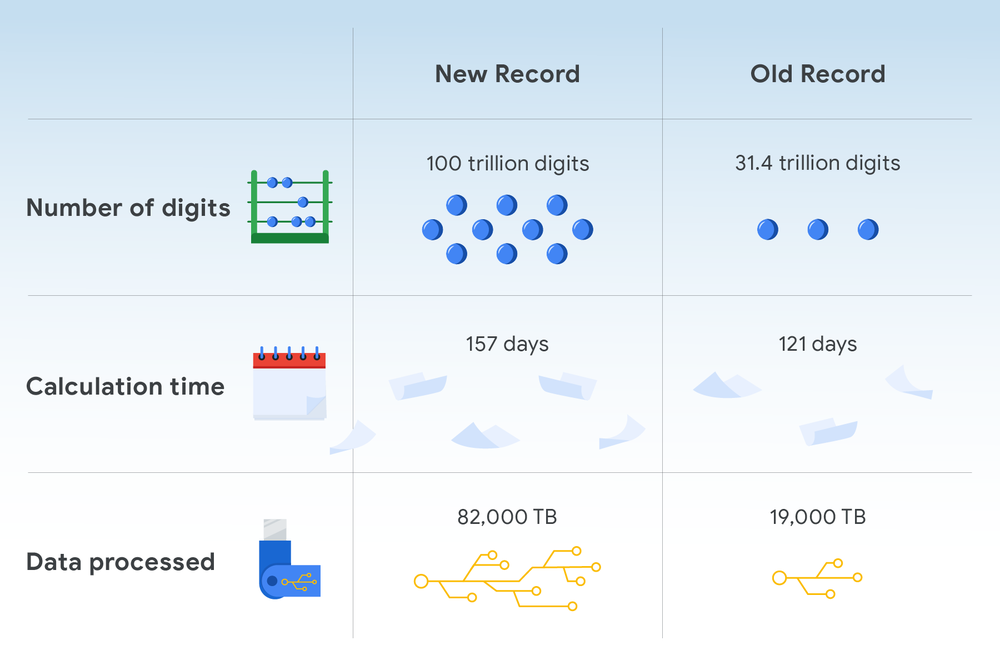
But let’s look back farther than my 2019 record: The first world record of computing π with an electronic computer was in 1949, which calculated 2,037 decimal places. It took humans thousands of years to reach the two-thousandth place, and we’ve reached the 100 trillionth decimal just 73 years later. Not only are we adding more digits than all the numbers in the past combined, but we’re spending less and less time hitting new milestones.
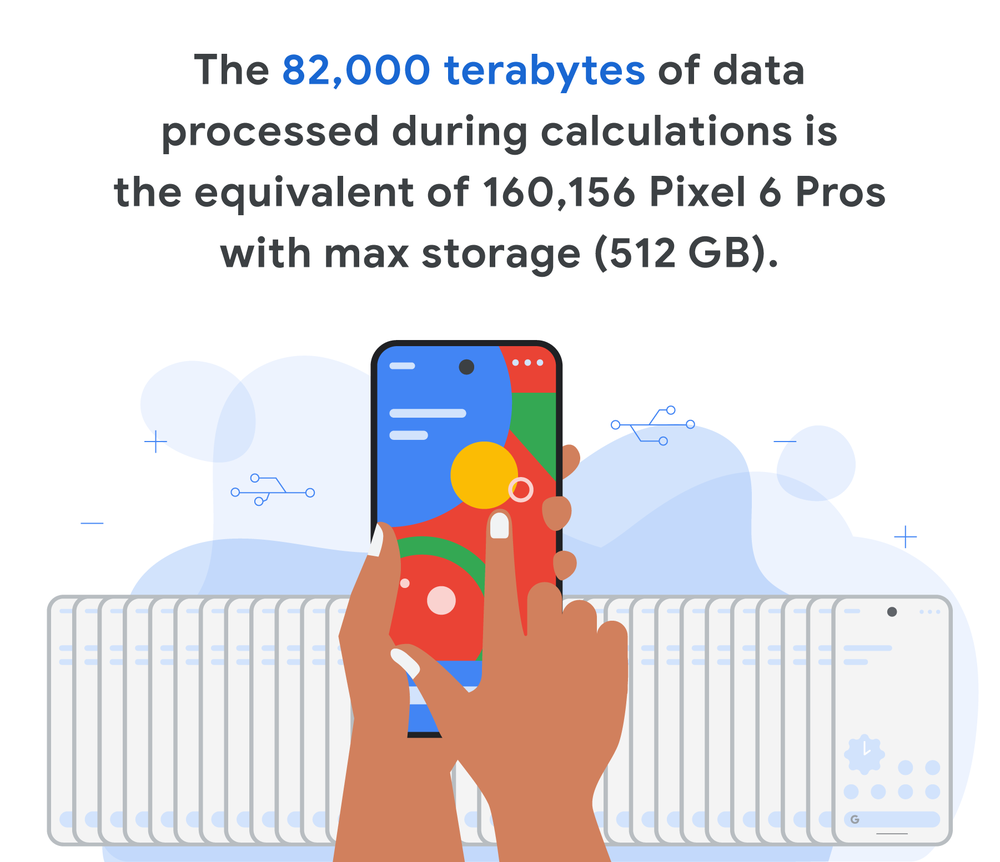
I used the same tools and techniques as I did in 2019 (for more details, we have a technical explanation in the Google Cloud blog), but I was able to hit the new number more quickly thanks to Google Cloud’s infrastructure improvements in compute, storage and networking. One of the most remarkable phenomena in computer science is that every year we have made incremental progress, and in return we have reaped exponentially faster compute speeds. This is what’s made a lot of the recent computer-assisted research possible in areas like climate science and astronomy.
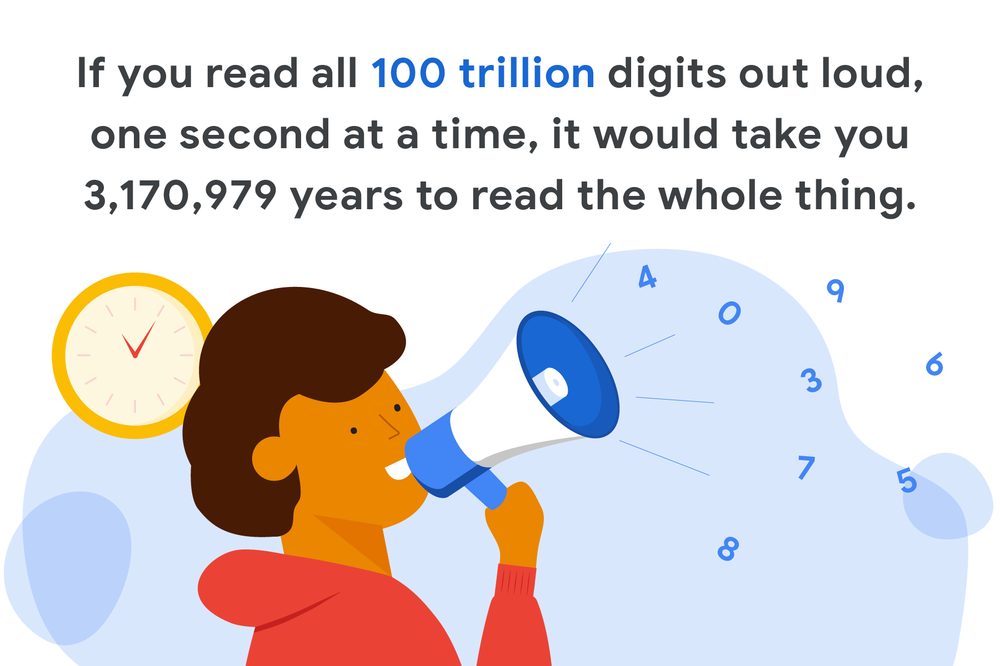
Back when I hit that record in 2019 — and again now — many people asked “what’s next?” And I’m happy to say that the scientific community just keeps counting. There’s no end to π, it’s a transcendental number, meaning it can’t be written as a finite polynomial. Plus, we don’t see an end to the evolution of computing. Like the introduction of electronic computers in the 1940s and discovery of faster algorithms in the 1960-80s, we could still see another fundamental shift that keeps the momentum going.
So, like I said: I’ll just keep counting.
Mini PC con 8 GB di RAM DDR4 e CPU Intel a meno di 200 euro su Amazon
Questo mini PC di NipoGi è una delle migliori soluzioni desktop sul mercato considerando il prezzo a cui è venduto, ora in promo su Amazon
Leggi Mini PC con 8 GB di RAM DDR4 e CPU Intel a meno di 200 euro su Amazon
Malware: SVCReady si diffonde tramite Word
I ricercatori di sicurezza hanno scovato un nuovo malware identificato come SVCReady che si diffonde tramite macro di Word.

Follina: Windows ha una falla critica, ma Microsoft non reagisce
Tutti le versioni di Windows sono affette dalla vulnerabilità Follina, ma non si sa ancora se e quando Microsoft rilascerà il correttivo.
Leggi Follina: Windows ha una falla critica, ma Microsoft non reagisce

realme presenta la nuova serie flagship GT NEO 3 in Europa

OPPO presenta Reno8 Lite 5G: medio gamma stiloso e con scatti incredibili
Appena annunciato lo smartphone è già in offerta su Amazon insieme a OPPO Enco Air2 ad un prezzo esclusivo.
Leggi OPPO presenta Reno8 Lite 5G: medio gamma stiloso e con scatti incredibili

OPPO lancia Reno8 Lite 5G subito con un’offerta SHOCK su Amazon

Keliweb: hosting professionale con il 50% di sconto

Windows 11 22H2: Microsoft rilascia la Relase Preview
Microsoft ha rilasciato la build 22621 di Windows 11 nel canale Release Preview, si tratta della versione RTM dell’update 22H2 dell’OS.

Creative Tips For Better Virtual Brainstorming in B2B Marketing
For the most part, we’ve all adapted to remote work pretty well. As we got used to working separately, we tended to find ways to transition, transform, or replace most of our old work routines to make sure everything keeps getting done. But most — as every remote work naysayer is quick to point out — is not all.
If there’s one big element of the in-person work process still missing from your new reality, it’s the big, impromptu “throw-it-all-at-the-wall” brainstorming session.
Sessions like those probably led to some of your team’s biggest and brightest ideas… and they’re also the kind of thing you may think simply can’t happen remotely. Well, as you’ve probably surmised from the title of this blog post, that’s what we’re here to prove wrong.
The truth is, not only can you still conduct the kind of brainstorming sessions you threw together in person remotely, but there’s evidence they could be even more effective. That is, if you do it right. Here’s why remote brainstorming is still well worth making the time for, along with how (and how NOT) to do it right:
1 — Remote brainstorming helps prevent “The Dominators”
You know the ones we’re talking about. They’re the kids in class whose hands always shot up first when the teacher asked a question… but all grown up.
During traditional, in-person brainstorming sessions, you’ve probably noticed that a few people tend to dominate the conversation. They present their idea, and then before you know it, the rest of the session is spent discussing this idea… rather than necessarily hearing anyone else’s.
This is not just a function of a couple of outspoken people on your team. In fact, it happens in almost all in-person brainstorming thanks to a phenomenon called production blocking. The more extroverted, forward members (our “Dominators”) tend to lead, and everyone else follows. The larger the group the worse this issue tends to get, which makes it a particular problem for in-person office brainstorming.
This is one area where virtual brainstorming actually has a serious advantage over in-person. Production blocking doesn’t happen nearly as frequently in virtual meetings. In fact, there’s even a positive relationship between group size and performance that continues to scale, even to large sizes.
Taking it further: Use muting etiquette and the “raised hand” feature provided by most teleconferencing applications to further moderate and democratize the brainstorming process, ensuring everyone can speak in turn and whenever they have something to add.
Avoid: Designating “leaders” of the brainstorming session or devoting the entirety of a session to discussing the particularities of a single idea. Instead, find ways to encourage everyone to speak up, such as assigning each individual or small groups particular topics to focus on.
[bctt tweet=”“Find ways to encourage everyone to speak up, such as assigning each individual or small groups particular topics to focus on.” — Harry Mackin @Shiitakeharry” username=”toprank”]2 — It helps everybody else speak up
Virtual brainstorming doesn’t just help dampen the blocking effect of the dominators, either; it also actually helps everybody else speak up, too. According to the research, virtual brainstorming helps impart a sense of anonymity in participants — even if they can see each other.
As the Harvard Business Review notes, when brainstorming participants feel more anonymous, they suffer from less “evaluation apprehension,” which is the anxiety that they or their ideas will be judged because of who they are rather than for their idea (we are all, no doubt, aware of this phenomenon).
The less evaluation apprehension your participants feel, the more likely they are to speak up when they have an idea, even if they might not in an in-person brainstorming environment.
Taking it further: During brainstorming, encourage all of your participants to turn off their webcams. This will increase the feeling of anonymity and give participants a chance to voice ideas without feeling like they’re caught in the spotlight.
Avoid: Disengagement by a few or even most of the participants. Try to keep brainstorming sessions relatively short, and focus on a particular objective. Then, encourage everyone to speak up and facilitate back-and-forth conversation whenever possible.
3 — It creates a wider variety of ideas
You’ve probably already derived this benefit out of the first two, but it’s worth focusing on anyway. When you:
A: Get more people talking and sharing new ideas equally
B: Encourage people who may not normally speak up to join the conversation
You end up with a much greater variety of ideas. Even more importantly, the ideas your team puts together will be fresher and, in all likelihood, quite a bit different from the type of ideas you would find yourself normally generating in person. This happens precisely because they are coming from people who often go unheard.
Taking it further: Studies have shown that individual brainstorming often encourages participants to offer a wider variety of ideas when those ideas are shared with a group. Virtual brainstorming provides a natural way to facilitate this.
Schedule breaks into your virtual brainstorming sessions for having each member individually focus on a topic that comes up during the session. Have them write out their own notes on that topic for a pre-set period of time, and then when you come back together, have everyone share their thoughts.
You could also break the brainstorming session into a few small groups of people during these pre-set breaks. These people could collaborate on their note-writing, and then present their ideas together when they return to the main session. We do this kind of collaborative brainstorming at TopRank Marketing all the time, and it always proves more heads are better than one.
Avoid: Letting your brainstorming sessions become a series of presentations. It may sound counterintuitive, but you should avoid getting your participants too much “homework” to bring into the brainstorming session.
You want the ideas to be generated during the session itself, not prepared beforehand and then recited to a tuned-out audience. It’s OK to let the participants know what you want to brainstorm about beforehand, of course, but try to encourage positive collaboration instead of over-preparation.
TopRank Marketing’s team have been working remotely for quite a while now, but we’ve never stopped believing in the power of brainstorming — and our virtual brainstorming sessions have really paid off. If your team has been hitting a wall or feeling uninspired lately, try virtual brainstorming. You might be surprised what you think up.
And, of course, if you’d ever like to brainstorm about how you can make your B2B marketing more relevant, authentic, and impactful than ever, we’d be thrilled to join you. Get in touch with the team at TopRank today to brainstorm about how we can help take your brand to the next level.
The post Creative Tips For Better Virtual Brainstorming in B2B Marketing appeared first on B2B Marketing Blog – TopRank®.

La tua casa più sicura con il videocitofono Blink Video Doorbell, da oggi in Italia
Blink Video Doorbell offre un’installazione con cavo o senza, video in HD giorno e notte, audio bidirezionale e notifiche sullo smartphone.
Leggi La tua casa più sicura con il videocitofono Blink Video Doorbell, da oggi in Italia

realme GT Neo 3 150W, GT Neo 3 e GT Neo 3T: anteprima, video, prezzi e disponibilità

Blink Video Doorbell, il primo videocitofono Amazon Blink, da oggi disponibile in Italia