
Stop al caro bollette elettriche con questo kit fotovoltaico
20 mascherine FFP2 certificate a soli 7€: FOLLIA Amazon

Cuffie wireless on-ear di Sony: delizia e tue orecchie con 31€

Sky, 5 serie TV da non perdere a giugno 2022
AirPods Pro di Apple, le strepitose cuffie true wireless a prezzo WOW
Google News Showcase launches in Romania
Journalists and news publishers play a key role in helping us understand important topics as they unfold. Access to trustworthy information is important to all of us, and at Google we’re dedicated to supporting the reporters and publishers who work tirelessly to deliver us news.
Through Google News, Top Stories on Search and more, we help people find links to stories, and help publishers find readers. Beyond this, we invest in products, funding and programs to support the news industry with the Google News Initiative. That includes supporting 16 Romanian publishers through the Digital News Innovation Fund with 1.8M EUR in funding and providing emergency financial support to more than 50 publishers through the Journalism Emergency Relief Fund during the COVID-19 pandemic. Since 2015, we’ve also provided training to close to 900 journalists in Romania to help them research, verify and visualize their stories.
Today we’re announcing our latest initiative to support journalism in Romania by rolling out Google News Showcase, our product and licensing program for news publishers.
Google has signed partnerships with 16 national Romanian publications, including broadcasters and newswires, which provide important news coverage to people all over the country. The titles include Adevarul.ro, Agerpres, Descopera.ro, Digi24, Edupedu.ro, G4Media.ro, Gandul, HotNews.ro, iDevice, Mobilissimo.ro, News.ro, Profit.ro, Newsweek, StartupCafe.ro, StirileProTV.ro and Wall-Street.ro. We’ll continue to work with other news partners in the country to add more content in the future.
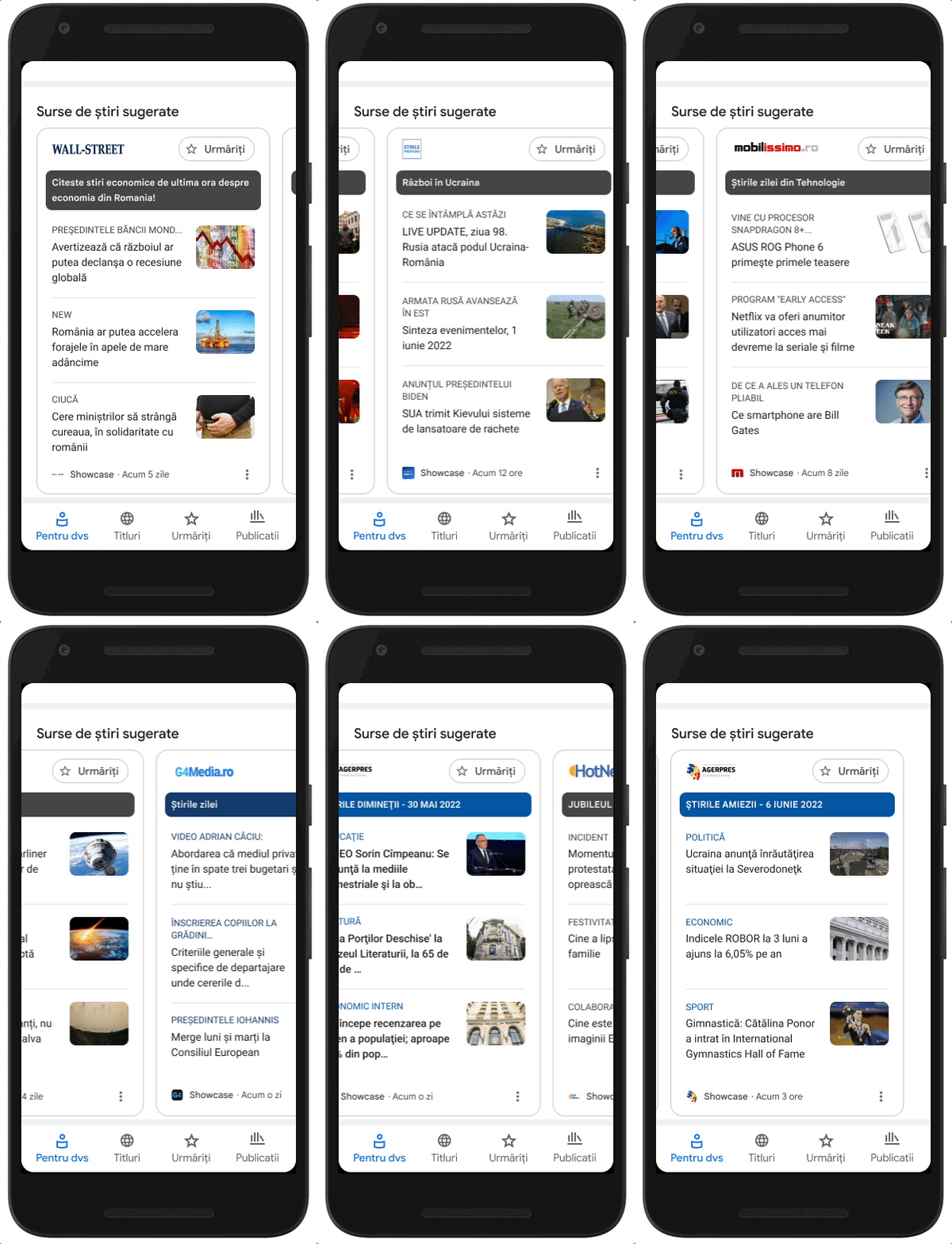
An example of how News Showcase can look for some of our partners in Romania.
With this new experience, we give publishers a variety of News Showcase panel templates to use to give additional context to stories and add related articles, timelines and more. The panels give news publishers more direct control of their presentation and branding, helping them be more visible to their dedicated readers and to those who are just discovering them.
News Showcase panels can appear on Google News and Discover, and direct readers to the full articles on publishers’ websites, helping them deepen their relationships with readers. In addition to the revenue that comes directly from these more engaged readers, participating publishers will receive monthly licensing payments from Google.
“We are glad to sign this partnership for Google News Showcase as a new way to deliver trustworthy, fact-checked and original content to the public,” says Andrei Bereanda, Head of Digital, ProTV, the Romanian television station whose news website stirileprotv.ro offers national and global news. “ProTV Digital salutes and encourages any type of investment in quality mass media and we remain dedicated to helping readers and viewers get verified information easily and clearly, and on as many platforms as possible. Investing in trustworthy information for the general public is one of the best long-term investments in this day and age.”
“We are delighted to share our expertise and editorial voice through a modern visual experience such as Google News Showcase,” says Alina Gheorghiescu, Digital Marketing Manager, Wall-Street, a national business news company. “Wall-Street.ro is glad to be part of this product launch in Romania and proud to be selected as one of the first Romanian news outlets to deliver our quality content daily. We expect Google News Showcase to drive high-value traffic directly to our website, increase engagement with our users and help us develop a closer connection with our readers.”
Since we launched News Showcase in October 2020, we’ve signed deals with more than 1,500 news publications around the world and have launched in 16 countries: India, Japan, Germany, Portugal, Brazil, Austria, the U.K., Australia, Czechia, Italy, Colombia, Argentina, Canada, Ireland, Slovakia, Poland and now Romania, bringing more in-depth, essential news coverage to Google News and Discover users.
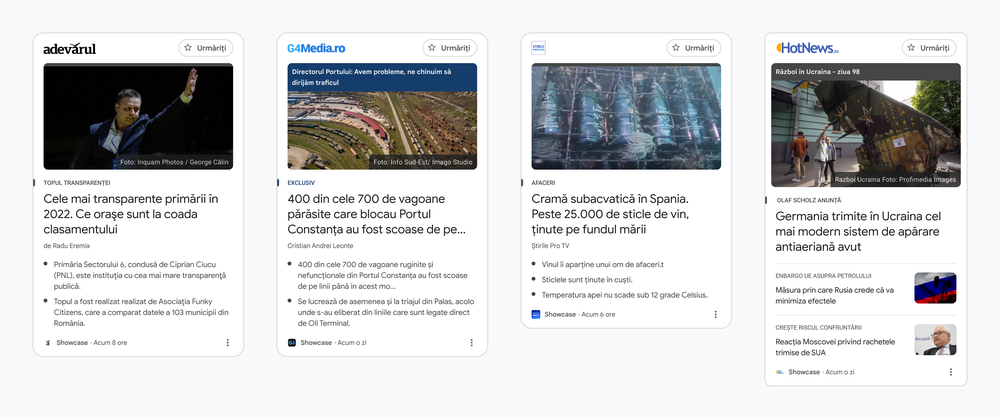
An example of how News Showcase panels will look with some of our partners in Romania.
”We are very happy to use News Showcase for two editorial projects: Hotnews.ro, our flagship news website, and StartupCafe.ro, the entrepreneurial education website,” says Clarice Dinu, editor-in-chief of Hotnews, a nationwide online media publisher. “Although the websites are different in terms of traffic and audience, we found the idea of using a dedicated news distribution channel — Google News — on mobile devices to deliver certain stories curated by our daily incharge editors very useful.”
Google News Showcase is one of the many ways we invest in journalism, continuing years of support through our products and programs to help people access diverse information and enable publishers to thrive in a digital world.
Lessons from the first GNI Startups Lab Europe
How many early-stage media startups in Europe can you name? Probably not that many. And while Europe is a promising environment for new journalism outlets, the reality can be tough. Across the continent, media entrepreneurs face a fractured market with myriad different languages, cultures and media landscapes.
Luckily, plenty of entrepreneurs out there have the courage and stamina to venture into uncharted territory to tell the stories and serve the audiences that have been overlooked by traditional media.
Over the past six months, and as part of the GNI Startups Lab Europe, 10 media organizations have been exploring new ways of monetizing their work and learning how to make their news businesses financially sustainable. The program, which included training, funding and networking, was designed by the Google News Initiative (GNI) in partnership with Media Lab Bayern and the European Journalism Centre.
The first GNI Startups Lab Europe cohort came in with a wide variety of target audiences, such as catering to Arabic speakers in Spain, the Hungarian diaspora in Transylvania or the deaf community in France. The projects developed through this program ranged from investigative reporting on YouTube to a news app for children. The journalism startups are covering news deserts, improving media literacy and revealing new ways to meet the information needs of readers.
A road map for media visionaries
The journey of this first edition of GNI Startups Lab Europe has been documented in our Lab Recap Report. It provides background on how the Lab and its curriculum were designed, and on lessons — both successes and flops — shared by the media organizations that took part.
The report reveals the challenges that media entrepreneurs across Europe have in common, as well as their individual responses, their perseverance and their creativity. The insights are a valuable road map for other media visionaries trying to build sustainable businesses and provide inspiration for people supporting the future and resilience of the European media scene.
That said, the GNI Startups Lab Europe program has not found the magic formula for subscriber growth, nor does it claim to be the holy grail of online media monetisation.
Audience, subscription and revenue growth
While innovative media projects are succeeding, especially when paired with a solid business model, the startups still face the challenge of converting a loyal audience into a paying one.
A major focus of the program has been to improve these organizations’ understanding of their audience through surveys, interviews and dedicated strategy sessions — for short and long-term audience engagement. Some startups experimented with partnerships and events, while others adjusted the balance between free and premium content.
Recorder, an independent video journalism platform in Romania, worked on its monetization strategy for YouTube, which helped double its revenue. Mensagem de Lisboa, the only digital media catering to residents of the Portuguese capital, found an untapped audience in the city’s affluent expats and is planning to expand to other metropolitan areas. Časoris, an award-winning online newspaper for children in Slovenia, has focused on TikTok, with videos regularly going viral and leading to a 27% increase in audience size during the Lab.
These examples corroborate the report’s conclusion that the Lab gave participants the opportunity to go back to the drawing board, question their decisions and re-evaluate what made sense for the business side of journalism. They also learned to embrace experimentation without the fear of failing, plus a real support network was created among journalists who no longer dread talk of KPIs or funnels.
Huawei Watch GT 3, smartwatch PREMIUM e di design a prezzo REGALO
Realme GT 2, smartphone top di gamma ECCEZIONALE a prezzo SHOCK
Land cover data just got real-time
Our planet is changing dramatically in ways that are visible even from space. These changes are in part because of climate change amplifying environmental disturbances, like wildfires and floods, and human activity, like deforestation and urban development. Detailed information about these changes and their impact on people, the climate, and ecosystems can help governments and researchers develop helpful solutions and minimize their effects on issues like climate change, food insecurity and loss of biodiversity.
Historically, it’s been difficult to access detailed, up-to-date land cover data which documents how much of a region is covered with different land and water types such as wetlands, forests, agricultural crops, trees, urban development and more.
To help turn satellite imagery into more useful information for quantifying change, we worked with the World Resources Institute (WRI) to create Dynamic World. Powered by Google Earth Engine and AI Platform, Dynamic World provides global, near real-time land cover data at a ten-meter resolution, giving an unprecedented level of detail about what’s on the land and how it’s being used — whether it’s forests in the Amazon, agriculture in Asia, urban development in Europe or seasonal water resources in North America. With this information, people — like scientists and policymakers — can monitor and understand land and ecosystems so they can make more accurate predictions and effective plans to protect our planet in the future.
A more detailed understanding of earth’s land than ever before
Currently, most existing datasets assign a single land cover type to an area of land — like trees, built-up, crops or snow — based on what’s most prominent in a satellite image combined with an expert’s determination of the land cover. So current datasets might classify a satellite image of a city as ‘built-up,’ but visit any city and you’ll see our world is far more dynamic. While you might see lots of buildings, you’ll also see trees or even snow on the ground from a recent storm.
To create a more accurate understanding of land cover with Dynamic World, our partners at WRI identified the nine most critical land cover types we wanted to classify: water, flooded vegetation, built-up areas, trees, crops, bare ground, grass, shrub/scrub, and snow/ice. Dynamic World uses our AI and cloud computing to detect combinations of different land cover types and make conclusions about how likely it is for each of the nine types to be present in every pixel (about 1,100 square feet of land) of a satellite image.
This level of insight into how land is being used can help public, private and non-profit decision makers better understand what’s happening to the world’s land. With this knowledge, they can develop plans to protect, manage and restore land, and monitor the effectiveness of those plans using alert systems to notify when unforeseen land changes are taking place.
As Craig Hanson, Vice President of Food, Forests, Water and the Ocean at the World Resources Institute, explains: “The global land squeeze pressures us to find smarter, efficient, and more sustainable ways to use land. If the world is to produce what is needed from land, protect the nature that remains and restore some of what has been lost, we need trusted, near real-time monitoring of every hectare of the planet.”
A near real time, regularly updating dataset
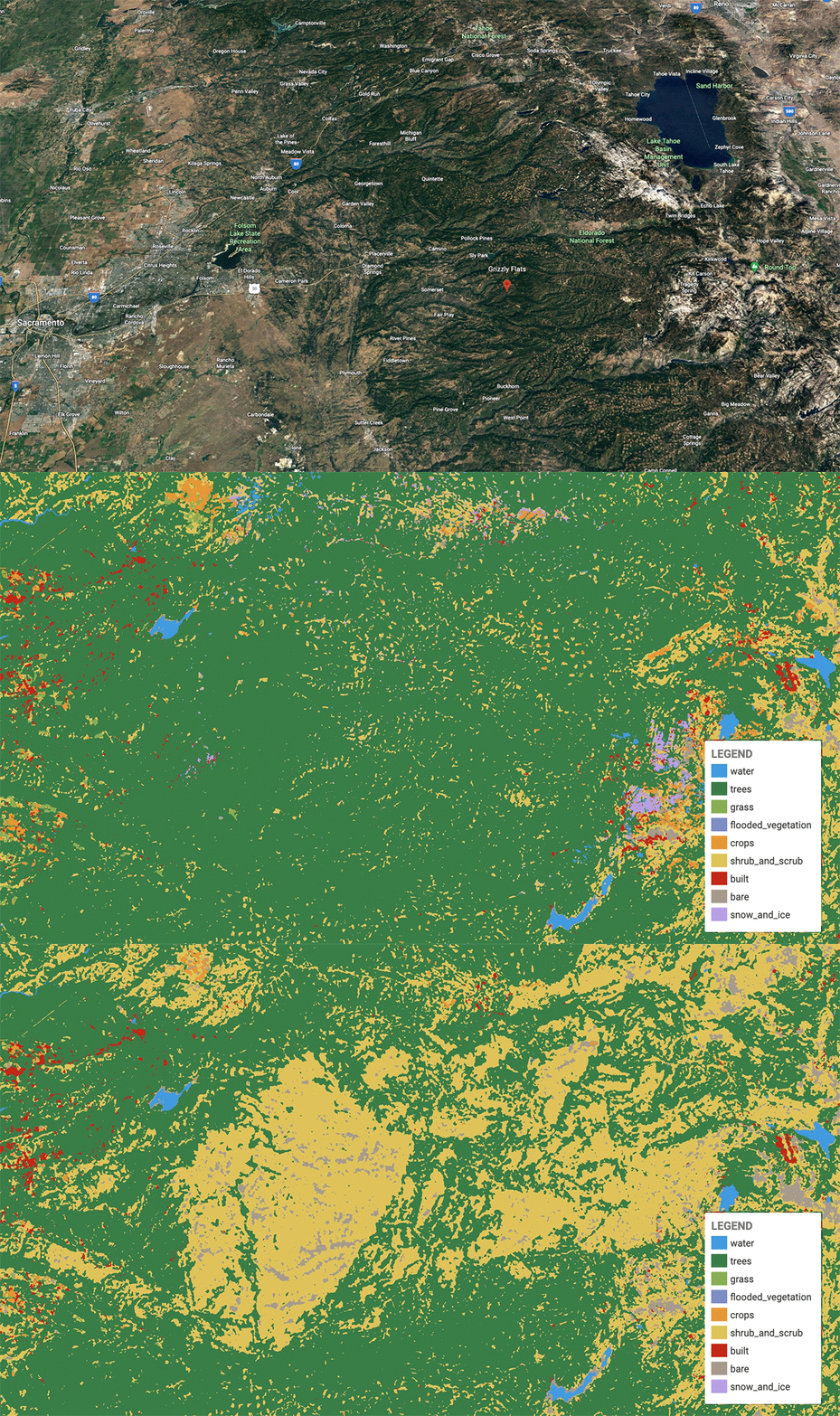
Not only is our world more dynamic than individual land types, it’s also constantly changing. Current global land cover maps can take months to produce, and typically only provide land cover data on a monthly or annual basis. With our AI model analyzing Copernicus Sentinel-2 satellite images as they become available, over 5,000 Dynamic World images are produced every day, providing land cover data dating back to June 2015 to as recently as two days ago.
This means that not only is the land cover information in Dynamic World more detailed, but it’s also more timely within any given day, week or month than existing datasets. This level of detail allows scientists and policymakers to detect and quantify the extent of recent events anywhere on the globe — such as snowstorms, wildfires or volcanic eruptions — within days.
Satellite imagery translated into Dynamic World imagery showing land in El Dorado County, California changing from trees, indicated in green, to shrub/scrub, indicated in yellow, days after the Caldor Fire burned 221,775 acres of land beginning August 14, 2021.
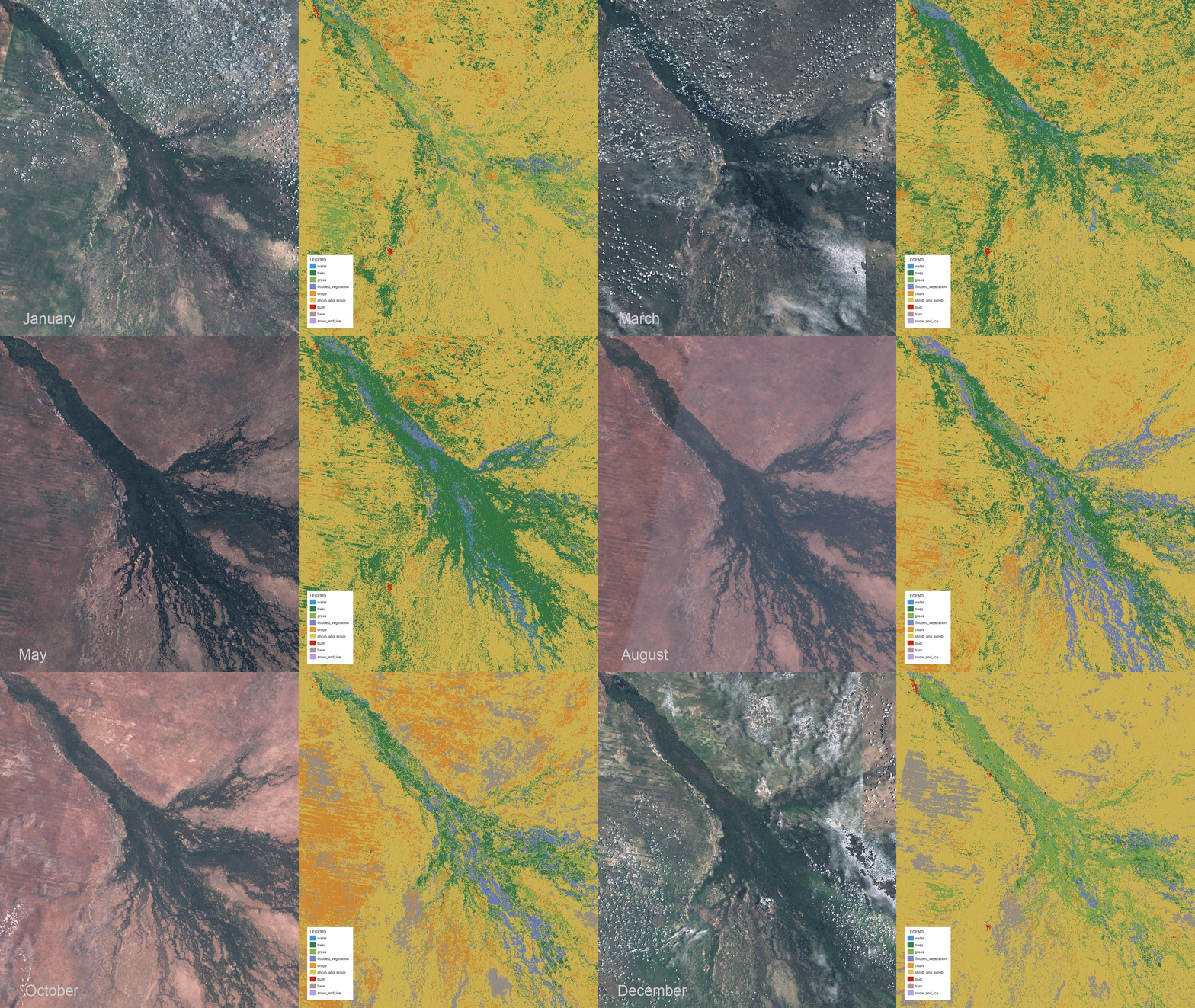
Sentinel-2 satellite imagery (left) and Dynamic World dataset (right) show typical seasonal changes in the Okavango Delta in Botswana.
Dynamic World allows researchers to build their own maps based on the outputs of our machine learning model, a major advancement in mapmaking. Researchers can combine local information with the data from Dynamic World to produce a new map, for example a map that analyzes crop harvests between particular dates. Dynamic World is also useful for understanding longer-term trends of seasonal ecosystem change, as seen in the Okavango Delta, an area that attracts thirsty wildlife when it floods in July and August and then dries from September to October.
We’re excited to put this open, freely available dataset and the methodology behind it into the hands of scientists, researchers, governments and companies. Together, we can make wiser decisions to protect, manage and restore our forests, nature and ecosystems.
Dynamic World is one of the largest global-scale land cover datasets produced to date, and is the first of its kind at 10 meter resolution in near real-time. A peer-reviewed paper about Dynamic World was published today in Nature Scientific Data. Explore the data at dynamicworld.app and access Dynamic World in Google Earth Engine and on Resource Watch.

Corsi gratis, tanti sconti: sono arrivati i Domestika Days
Sono arrivati i Domestika Days: un’intera settimana di corsi, lezioni e contenuti gratis, ma anche di sconti dedicati a tutti gli iscritti.
Leggi Corsi gratis, tanti sconti: sono arrivati i Domestika Days
Get some fresh air outdoors with Google
As temperatures heat up and summer officially begins across the United States, many of us are taking the opportunity to explore the great outdoors. If you have an adventure on the horizon, here are two ways you can use Google tools to stay safe and healthy during your summer activities.
Check the air quality before you head out
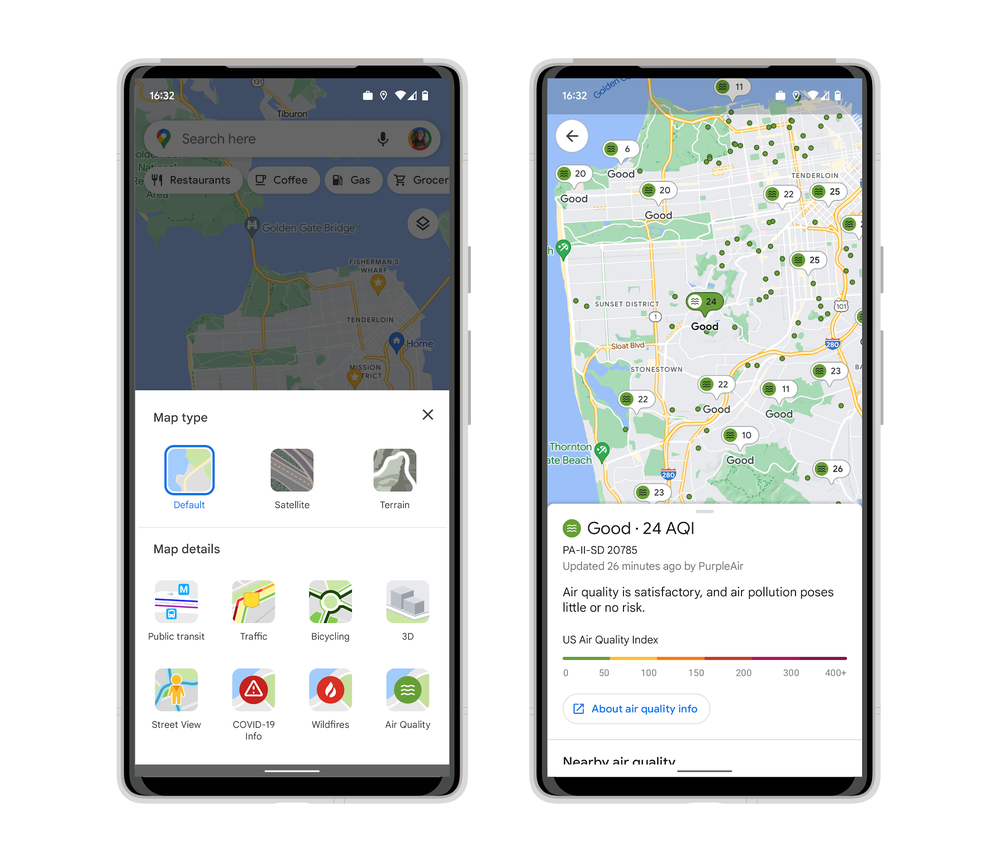
When you’re visiting a new place or planning outdoor activities, it can be helpful to know the air quality conditions — like whether it’s unusually smoggy. Check out the air quality layer on Google Maps for both Android and iOS, to help you make more informed decisions about whether it’s safe to go on a hike or other outdoor adventures. You’ll see Air Quality Index (AQI), a measure of how healthy (or unhealthy) the air is, along with guidance for outdoor activities, when the information was last updated, and links to learn more.
The air quality layer shows trusted data from government agencies, including theEnvironmental Protection Agency in the U.S. We are also showing air quality information fromPurpleAir, a low-cost sensor network which gives a more hyperlocal view of conditions. To add the air quality layer to your map, simply tap on the button in the top right corner of your screen, then select Air Quality under Map details.
You can also view air quality information from PurpleAir on Nest displays and speakers. The broad coverage of PurpleAir sensors means significantly more people in the U.S. will be able to access vital air quality information directly from their Nest devices.
Be prepared during wildfire season
In recent years, wildfires have intensified and increased across the United States and around the world. Google Search interest in “Best air filters for wildfire smoke” and “Best mask for wildfire smoke” has doubled over the past year in the U.S. As wildfire season approaches, these Google features can help you safely navigate wildfires.
Before you head out, turn on the wildfire layer in Google Maps to see more details about active fires in the area thanks to our partnership with the National Interagency Fire Center (NIFC). Or, for larger wildfires, you can use Search to look up “wildfires near me”, and we’ll surface associated air quality information along with useful information about the fire. In the coming months, we’re also adding smoke data across the U.S. from the National Oceanic and Atmospheric Administration (NOAA) to our air quality information on Google Search.
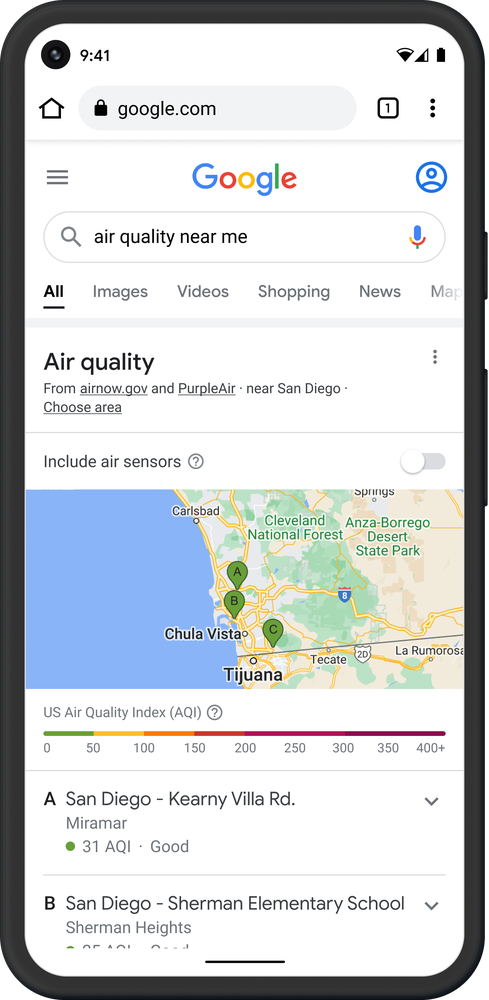
We collaborate closely with partners in the weather and air quality space to surface helpful and authoritative information when you need it most. As you head out on hikes, camping trips and other outdoor adventures, we hope these tools help you feel safe and informed so you can enjoy the summer.

Corsi ad accesso libero, contenuti gratis e sconti: ecco i Domestika Days
How this engineer got the career boost she needed
Saskia Bobinska was excited when she came across the application for the Women Developers Academy (WDA) program in Europe. After spending two years in isolation, thanks to the pandemic and having multiple back surgeries, she was looking for a way to advance her career in tech. She thought the WDA — a global program run by Women Techmakers to help technical women become better speakers and bring more diversity to tech stages — would be a great first step towards this goal.
One of the first assignments was to write her own speaker bio. As a self-taught frontend developer who uses JavaScript, NextJS and React, she felt a bit hesitant to share her story. “To be honest, I thought that my story was not important enough,” she tells us. But after a few WDA training sessions and encouragement from her mentors, business strategist Kamila Wosińska, Dart and Flutter Google Developer Expert (GDE) Majid Hajian and Web Technologies GDE Anuradha Kumarii, Saskia’s confidence was boosted. She excitedly set out to write a LinkedIn post about a mobile app on which she had been working.
Not long after the post went live, Saskia was approached by one of the companies she had mentioned. A few meetings lead to interviews and within a few months, Saskia was offered a job on their team. “I never would’ve thought that this was possible when I started coding three years ago,” Saskia says.
Looking back on the experience, Saskia is positively surprised by the speed with which she was able to transition her career from social media to engineering. “I’d have given myself two years before applying to Sanity, but WDA accelerated that,” she says. “I found my voice within the tech industry because of the community and WDA, which gave me a push toward it.”
Going through the WDA also helped Saskia realize that her “soft” skills — communication, leadership and confidence — are just as important as her hard skills for excelling in tech. “Having the ability to go out and speak gave me an approach to finding a more intermediate-level engineering role,” she says. “I have hard skills, but my soft skills are what brought me to this company that shares my priorities, because they knew who I was.”
She also recognized the importance of having a supportive community. During the WDA, she was excited to see women supporting each other so enthusiastically within the male-dominated tech industry. “Emotional support and empathy, especially in a professional environment, help you stay in balance and enable you to do your best,” she says. “Always help and support others, because safe communities are not just found, they are made.”
Learn more about Women Techmakersand become a member to stay up to date on all our initiatives including the Women Developers Academy.
CodeMirror: code editor in JavaScript per il Web
CodeMirror è un code editor Open Source scritto al 100% in JavaScript e pensato per l’inclusione all’interno della pagine dei siti Internet