
<div>vivo V23 5G: selfie ‘Illuminati’ a 50 megapixel, ma non solo. Eccolo in anteprima</div>
How we’re supporting the 2022 U.S. midterm elections
In 2022, voters will be heading to the polls in many countries around the world. We are committed to helping them find the latest election information on our services, equipping campaigns and election workers with the best-in-class security tools, and protecting our platforms from abuse.
This work builds on our longstanding support of elections across the globe, including most recently in Japan, Germany, Canada, and South Korea. And we are continuing these efforts in Australia, Brazil, France, the Philippines, and elsewhere to help people navigate the democratic process.
Today, we are providing an update on our work to support the 2022 U.S. midterm elections.
Connecting voters to election information
Whether you’re registering to vote for the first time, looking for your local polling place, or learning how to vote absentee, we make reliable information easily available with helpful product features that show data from trusted, nonpartisan organizations.
- Google Search: We’re partnering with Ballotpedia, a digital encyclopedia for federal, state, and local politics and elections in the U.S., to help voters quickly find authoritative information about upcoming elections on Google Search. In the coming weeks, when people search for queries like “when are the Ohio primaries,” we’ll show statewide primary election dates right at the top of Search results.
- YouTube: Our systems prominently surface authoritative voices such as news sources in search results and “watch next” panels for election-related news and information, while at the same time limiting the spread of election misinformation.
- Supporting developers: The Google Civic Information API makes it easier for third-party developers to create useful applications to connect users with official election information sourced from the nonpartisan Voting Information Project, a partnership between Democracy Works and state and local election administrators.
Helping campaigns enhance their security
People working on campaigns and elections are higher targets for cybersecurity threats. In a recent study we commissioned with YouGov, 85% of high-risk professionals working in politics and journalism in the U.S. say they need stronger cybersecurity protections, while 83% feel cyber threats against their professions have increased in the last two years alone. We understand these concerns and are working hard to help high-risk users, such as campaigns and election officials, enhance their security and educate them on how to use our products and services.
- Security tools for campaign and election workers: We’re continuing our partnership with organizations like Defending Digital Campaigns (DDC) to provide qualifying U.S. federal campaigns with free Titan Security Keys—distributing over 10,500 keys to date. To ensure the strongest form of account security against targeted online attacks for both personal and Google Workspace accounts, we’re enrolling high-risk users in our free Advanced Protection Program. And our free service Project Shield provides unlimited protection against Distributed Denial of Service attacks for election monitoring sites and political organizations.
- More protection for high-risk users: To train candidates and campaign workers on how to stay safe online, last month we launched the Campaign Security Project by teaming up with organizations across the political spectrum. This initiative builds on our ongoing work with the USC Election Cybersecurity Initiative, Cybersecurity for State Leaders, and DDC. And globally, to help enhance the security of campaigns and affiliated high-risk users, we’re working with organizations like the International Foundation for Electoral Systems.
- Helpful resources for campaigns: To help campaigns and civic groups learn how to effectively use our products and services—like claiming knowledge panels on Google Search and getting verified on YouTube—we offer a range of free tools and resources on our Google Civics Training Center.
Protecting our platforms from abuse
Over the years, we’ve introduced new policies, enhanced our enforcement systems, and continued to invest in our teams and operations to better secure our products and prevent abuse on our platforms.
- Tackling threats: We constantly monitor and disrupt account hijackings, inauthentic activity, coordinated influence operations, and other forms of abuse on our platforms—providing quarterly updates and meeting regularly with government officials and other technology companies to share threat information around suspected election interference.
- Election policies: We have strict policies prohibiting election-related abuse on our products and services, such as demonstrably false claims about polling hours or ballot eligibility. For example, YouTube’s Community Guidelines don’t allow videos that mislead viewers on how to vote or encourage interference in the democratic process. And it has established elections misinformation policies that prohibit, for example, content that advances false claims that widespread fraud, errors, or glitches changed the outcome of any past U.S. presidential election. As always, we will continue to enforce our policies in a neutral and apolitical manner.
- Political Ads: We require all advertisers who wish to runelection ads on our platforms to go through a verification process and have an in-ad disclosure that clearly shows who paid for the ad. These ads are also compiled in our Political Advertising Transparency Report where anyone can look up information about any given election ad. And in the coming months, we will launch an updated version of our report, featuring a new user-interface and tools for accessing and sorting information about election ads and advertisers. This update will include a more granular breakdown of advertiser data—giving users greater insight into ad spending and impressions—as well as new visualization features for filtering data around targeting, location, and ad formats.
We also enforce strict ads policies, such as limiting the way advertisers can target election ads and prohibiting demonstrably false claims that could significantly undermine trust in elections. We apply these policies consistently to every advertiser.
We will continue to provide updates on our work to support the 2022 U.S. midterm elections and other elections around the world in the months ahead.

Google News bannato dalla Russia per disinformazione

Sincrotrone Elettra di Trieste: quando la tecnologia è al servizio della scienza

Ad appena 28€ sono queste le cuffie wireless che DEVI avere (Amazon)
Rischio Asteroide 2022 AE1: cosa c’è da sapere

Soundbar Panasonic da 80W con audio POTENTE a prezzo shock (Amazon)

Instagram migliora il feed grazie alle opzioni Preferiti e Seguiti

Microsoft conferma la violazione di Lapsus$

Realme Narzo 50A Prime è il nuovo battery phone definitivo?

Ucraina, Amazon apre un nuovo hub per gli aiuti ai rifugiati
<div>How Ben’s love for technology led him to Google</div>
Welcome to the latest edition of “My Path to Google,” where we talk to Googlers, interns, apprentices and alumni about how they got to Google, what their roles are like and even some tips on how to prepare for interviews.
Today’s post is all about Ben Miles, a Technical Solutions Engineer for Google Cloud who’s based in our London office.
What’s your current role at Google?
I’m a Technical Solutions Engineer for Google Cloud. I work specifically on Apigee, Google Cloud’s API management platform. In my role, I help Google Cloud’s customers fix technical issues through a mix of troubleshooting, debugging, software development and system administration. I enjoy the entire process, from reporting an issue to finding a resolution. It always feels great to help our customers and learn something new along the way.
When did you first get interested in technology?
I always had a passion for technology when I was growing up — I would play endless amounts of video games and take apart my parents’ desktop computer for fun. Flash forward to today, I still spend a lot of time teaching myself new programming languages and researching areas like space exploration (watching a live SpaceX rocket launch is on my bucket list).
But I didn’t study anything even remotely technical in school. In fact, I’ve never been very academic — I didn’t attend university or get a degree, and my grades in high school were never that strong. So I thought my chances of working in the tech industry were over before I had even started. That’s why Google’s apprenticeship program was a great stepping stone into tech for me. I was able to learn on the job and even get certified through formal training connected to the program.
What made you decide to apply to Google?
Like many Googlers, I never thought I would get a job here. I was terrified to apply, because I didn’t think I’d stand a chance. Once I realized I had nothing to lose, I ultimately took the leap and applied. You can’t achieve anything if you don’t try.
I got accepted into Google’s digital marketing apprenticeship program when I was 18. I spent one year there before applying to another apprenticeship focused on IT engineering. In that IT role, I helped other Googlers solve technical problems, like fixing their laptops and debugging software issues. Taking on two apprenticeships back to back is rare — I’m actually the only Google apprentice who’s ever done it! — and I learned a lot from both experiences.
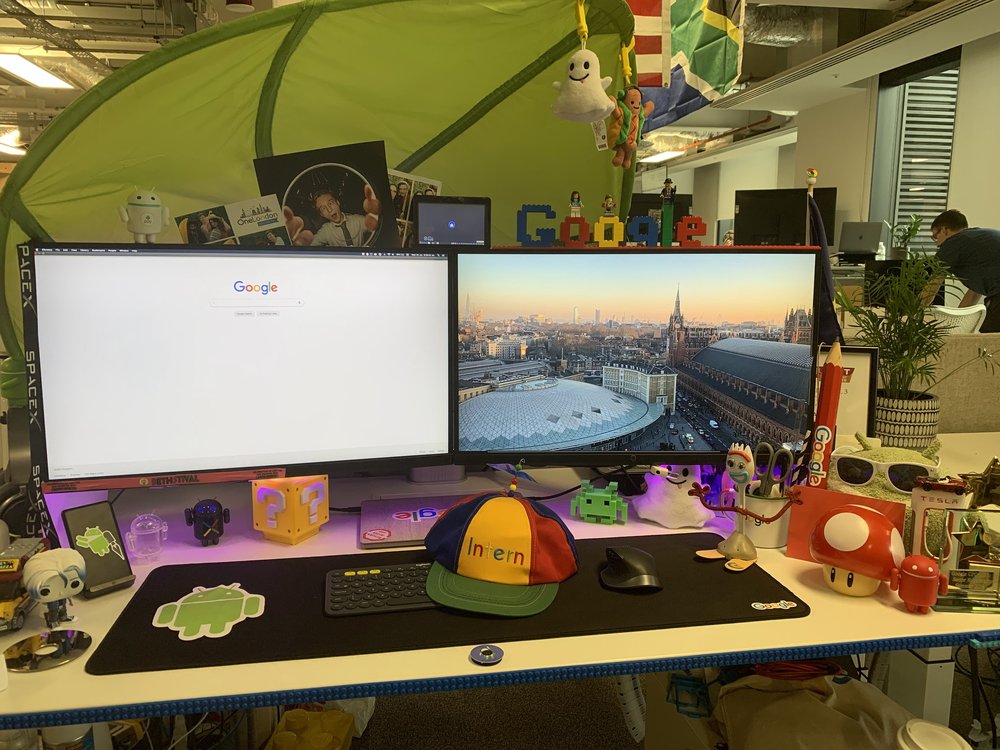
Ben’s desk at the Google London office.
How did the recruitment process go for you?
I’ve been through many recruiting processes at Google, both as an internal and external applicant, and every experience has been rewarding. Applying to the Technical Solutions Engineer role was especially challenging, but I felt supported every step of the way. My recruiter talked me through each part of the process and what to expect, and the interviewers were all extremely kind.
What resources did you use to prepare for your interview?
Since I didn’t have specialized education or training, I prepared entirely using the internet and free resources. I watched YouTube videos to learn more about specific topics, and used forums like Reddit to research and ask questions. Reading books was another good way to absorb a lot of information at once. If you can’t find a specific book for free online, it’s probably available in your local library!
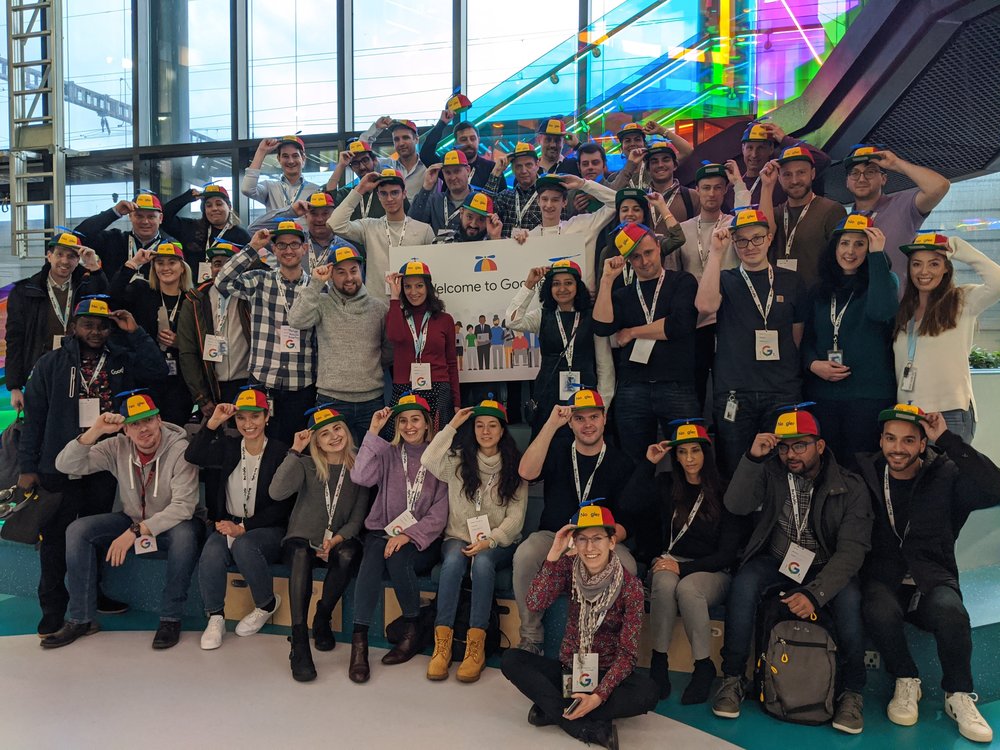
Ben at “Noogler” (new Googler) orientation. He’s wearing a white sweatshirt and holding the “Welcome to Google” sign on the right.
Any tips for aspiring Googlers?
There is no one “type” of person Google hires. I have an unconventional background and still managed to reach my goal of working here. I still can’t believe that I’m writing this now. Thinking back to a few years ago when I was in high school, a job at Google seemed completely unrealistic. Now, I get to do what I love every day and work with some of the largest companies in the world on services that millions of people use. I am so grateful that Google saw potential in me, and I can’t wait to see where the future takes me.

Manga Out of the Box: the story of a Japanese art form
With its gripping storylines and vivid illustrations, manga is one of Japan’s most beloved art forms. From Doraemon the cat-shaped robot to Astro Boy the android, it has left us with some unforgettable characters. Once considered a ‘subculture’, manga has gone mainstream – and global.
In Manga Out Of The Box – a new collaboration between the Japanese Ministry of Economy, Trade and Industry, 12 cultural institutions across Japan, and Google Arts & Culture – we take a closer look at this dynamic art form. Through detailed stories, interactive exhibits and exclusive experiments and videos, you’ll be able to immerse yourself in the world of manga. Here are five things you can do as part of this virtual exhibit.
1. Learn manga history
The origins of manga, as we know it today, are disputed. In Manga Out of the Box, you’ll be able to dig into this history. Are the 12th-century Chōjū Giga scrolls the first examples of manga? Or is this a case of searching too hard for the present in the distant past? Did manga’s true history begin in the 19th century – with the meeting of Western caricature and Japanese drawing? Find out in these beautifully illustrated stories.
A part of “Chōjū Giga” first screen, dating from the 12th century
2. Create your own manga with the help of machine learning
With Giga Manga, you’ll be able to create your own manga-style ink drawings with the help of machine learning. In this unique experiment, all you need to do is sketch a few simple lines and add some splashes of color – then let machine learning fill in the rest. You can also draw freeform to personalize your creation further. And when you’re done, the tool will help you discover manga similar to the one you’ve drawn.

3. Discover influential figures
It’s impossible to imagine Japanese manga without Osamu Tezuka. In works likeAstro Boy and Black Jack, Tezuka stakes a claim as ‘the grandfather’ of modern manga. With his multilayered narratives, sci-fi themes and dark sensibility, he influenced generations of later artists. One of those, Fujiko F. Fujio, went on to define 20th-century manga in his own way. In Doraemon, the friendly cat-shaped robot, Fujio created a cultural icon recognized around the world.

Jungle Emperor Leo was created by Tezuka Osamu

Doraemon, the famous character from Fujiko F. Fujio
4. Visit the editor’s desk
While we rightly celebrate the work of great manga artists, they aren’t the only ones responsible for bringing manga to our shelves. Without dedicated editors, none of this would be possible. Through the story of Naoko Yamauchi, the editor of the popular manga serialSleepeeer Hit!, you’ll learn just how crucial the role of a manga editor is – in this case, Yamauchi and her team provide inspiration for the characters themselves. And, as you’ll learn, it’s not only the editors – there are the platesetters, the marketers, the booksellers and many more who toil into the small hours to bring manga to us.
5. Stay contemporary
Manga’s influence reaches far and wide – touching fashion, internet culture, video games and contemporary art. Indeed, it can be seen in the work of one of Japan’s leading contemporary artists, Takashi Murakami. In Manga Out of the Box, you can explore his ongoing project, Doraemon x Takashi Murakami – an expression of his lifelong fondness for Fujiko F. Fujio’s manga classic.
In the 21st century, manga continues to find new fans across the globe. As it evolves and occupies the digital space, it’s worth reflecting on its roots. They provide an insight into its lasting appeal. Reflecting on the playful, humane Doraemon, Takashi Murakami observes: “I think manga is art. I think it’s also a rare, original culture that was brought into the world by postwar Japan.” More acutely, he notes: “Manga is a culture of healing…” Whether you’re a devout manga fan or discovering it for the first time, Manga Out of the Box offers a window into that culture.
Discover more on g.co/manga online or through the Google Arts & Culture mobile app on iOS and Android.

Caricatore multiplo: 4 porte, ricarica rapida e SICUREZZA elevata