
Incrementare la risoluzione delle immagini tramite l’intelligenza artificiale di Google

The tale of the Dutch bookstore, the pivot and the Golden Pin
Bookstore Dominicanen can be found in a former Dominican church in the city of Maastricht, a thriving cultural hub and one of the oldest cities in The Netherlands. Before COVID, the bookstore welcomed almost one million visitors a year. They mostly relied on customers visiting in person to shop for a good read or to enjoy a coffee while admiring the store’s vault paintings and the unique 14th century fresco depicting scenes from Thomas Aquinas’ life. And then the pandemic hit.
The Covid-19 pandemic has had a major impact on businesses worldwide but it also sparked creativity and accelerated many businesses’ use of digital tools. In The Netherlands for example, 81% of Dutch SMEs made more use of digital tools to stay in touch with their customers during the lockdown and inform them about changes in their services.
Dominicanen was one such business to respond to the continuously changing circumstances, something that was recognised by Google with the awarding of the Golden Pin Award.
What are the Golden Pin Awards?
In summer 2021, the Google Netherlands team awarded Golden Pin Awards to twelve inspiring entrepreneurs across the country who managed to continue their services during the pandemic with creativity and the smart use of digital resources whilst receiving high user reviews on their Business Profiles on Google Maps and Search. The list of winners was diverse: from agame store to aknife sharpener, and from a fair fashion clothing shop to a brewery cafe.
The winners all demonstrated creativity in continuing to offer their services both online and offline, ranging from pop up drive-through restaurants to online tastings and fitting sessions for women’s clothing on YouTube.
Bookstore owner Ton Harmes with his Golden Pin
How did Bookstore Dominicanen pivot?
For the owner, Ton Harmes, the key was perseverance. With the store having to close during the busiest weeks of the year – right in the middle of the holiday season – they had to adapt to survive. Their staff and volunteers immediately started delivering books by foot, bicycle and car. They also set up a takeout counter (offering click and collect online) and when numbers of visitors were limited, they decided to launch a pop-up store: Do(mini)canen.
Online, they invested heavily in their visibility on Google and in their social channels to keep in touch with their customers. Prioritising keeping their Business Profile on Google Maps and Search up to date, they were always able to indicate the changes in shopping times and services. Every change was immediately visible for their customers. They also started streaming book presentations and interviews with writers live on YouTube and communicated a lot more through all social media to keep customers informed.
Ton is convinced that the internet will continue to play a role in their business operations now they have reopened. Speaking to The Keyword he said, ‘We realized that with a million visitors a year, it seems like you don’t really need these ‘modern developments’. But when we closed it was suddenly dead quiet in the store. Then we realized how vulnerable we are if we rely solely on in-person customers and that we have to develop our digital channels faster. We now see online, even after corona, playing an increasingly important role in our contacts with customers – for both engagement and actually finding us. Our YouTube channel has received a boost and we keep reaching out to customers through our social channels. The crisis has really caused a change in our mindset.’
The Golden Pin Award has been given a special place in the store and serves as a reminder for the perseverance and pivoting that had to be done. Their ability to continue to conduct business through the worst of it is down to what Ton refers to as ‘Haw Pin’: Hold on.

Nasce Fan Factory, il sito di e-commerce di Koch Media Italia
50 years of film with NFTS and Google Arts & Culture
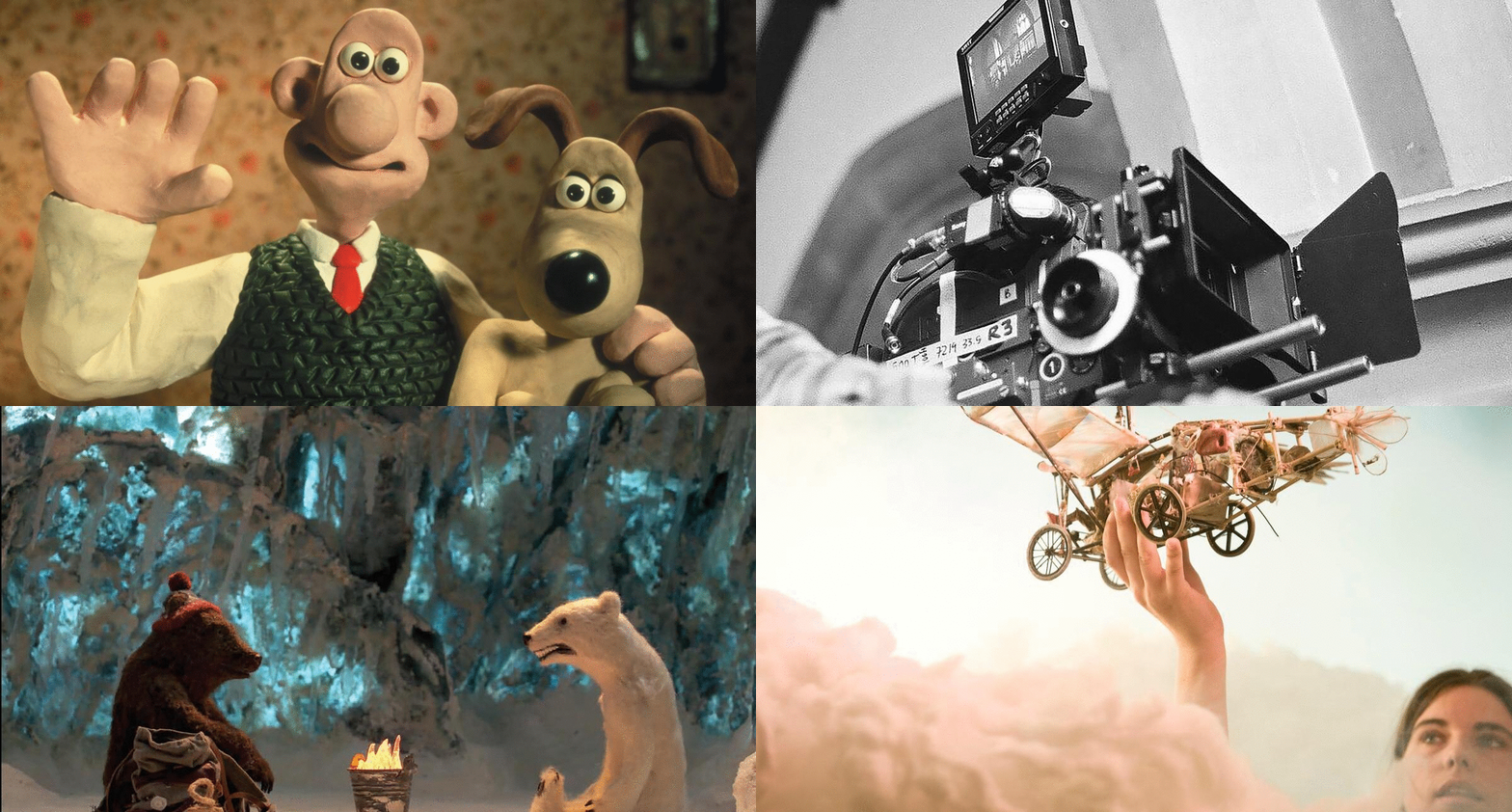
What do Wallace and Gromit, Blade Runner and We Need to Talk About Kevin all have in common? Answer: they were each made possible by alumni from the prestigious National Film and Television School based in Beaconsfield, UK.
The National Film and Television School (NFTS) is an internationally respected institution for education and creativity, launching the careers of many directors, producers, cinematographers, animators and more. Many of whom have gone on to become household names, and earn multipleBAFTAs and Oscars, makingNFTS the most awarded film school globally. To celebrate their 50th anniversary, for the first time in the school’s history, online audiences will be able to explore a new digital archive of over 200 graduate films from alumni of the school.
Alongside the films, audiences can explore a series of stories, curated playlists and articles. As well as newer films are creations from names such as: Nick Park (Wallace and Gromit), Lynne Ramsay (We Need to Talk About Kevin), and Fantastic Beasts director David Yates.

Stasera sono a Padova al CICAPFest

Stasera sarò ospite del CICAPFest 2021, che si tiene dal 3 al 5 settembre.
La mia conferenza di pre-apertura del CICAPFest, dedicata agli errori di previsione del futuro da parte di scienziati ed esperti, si terrà oggi alle 21 al Centro Culturale Altinate e sarà visibile in diretta su Youtube qui:
Al CICAPFest parlerò anche di incertezze nell’esplorazione spaziale e parteciperò alla sfida Star Trek vs Star Wars. Il programma completo è sul sito CicapFest.it. Spero di vedervi!

Amazon come Clubhouse punta su podcast ed eventi audio live?

Alexa parlerà più forte quando rileverà molti rumori
This Googler’s team is making shopping more inclusive
There’s a lot to love about online shopping: It’s fast, it’s easy and there are a ton of options to choose from. But there’s one obvious challenge — you can’t try anything on. This is something Google product manager Debbie Biswas noticed, as a tech industry veteran and startup founder herself. “Historically, the fashion industry only celebrates people of a certain size and skin color,” she says. “This was something I wanted to change.”
Debbie grew up in India and moved to the U.S. after she graduated college. “I started a company in the women’s apparel space, where I learned to solve user pain points around shopping for clothes, sizing and styling.” While working on her startup, Debbie realized how hard shopping was for women, including herself — the models in the images didn’t show her how something would look on her.
“When I got an opportunity to work at Google Shopping, I realized I could solve so many of these problems at scale using the best AI/ML tech in the industry,” she says. “As a woman of color, and someone who doesn’t conform to the ‘traditional beautiful size,’ I feel very motivated to solve apparel shopping problems for people like me.”
A look at Style AI in action.
This was what Debbie and her team wanted to accomplish with Style AI. Style AI is a Shopping feature that helps people see how a product looks on various types of body styles and offers styling advice. Style AI works by using a machine learning algorithm to look at a specific product and visually understand it. “So if someone searches ‘gingham long sleeve shirt,’ Style AI will look at images of long-sleeved gingham shirts, apply our vision recognition technology and understand things like the pattern and the sleeve length and show users fashions that might interest them.” In order to make sure Style AI was inclusive of all different types of shapes, sizes and skin tones Debbie consulted with Google’s Product Fairness, or ProFair, team. ProFair helps teams at Google apply the AI Principles by investigating fairness issues. Together, they find ways to build inclusive services, strengthen equity in data labels and promote fairness and combat bias in AI.
ProFair held sessions where everyone involved in the project could look for “fairness issues,” which helped Debbie’s team adjust how they designed Style AI. And there was much to consider. “First, we need to be careful of what data we train a model on. If you tell a machine that a certain size and skin color is what it needs to look for, it will,” Debbie explains. “So as responsible product owners, we need to make sure we train it the right way. Even after this, a machine can make many mistakes unknowingly — for example, not realizing that a certain style can be very offensive in one culture and be totally cool in another.”
For instance, before launching in countries like India and Brazil, ProFair held local focus groups in collaboration with Google’s Product Inclusion team. Debbie says this helped her team find diverse images and clothing for these specific demographics. Debbie’s — and the entire team’s — ultimate goal is that shoppers will feel like they’re seeing themselves when they look for clothing. “Looking at stock product images does not help you decide on your purchase,” she says. “We just always think about what people told us while we were building Style AI: ‘I want to see the product on someone like me!’”
Fuel Your Passion for B2B Marketing with These Famous Baseball Quotes
A few weeks ago, Major League Baseball enjoyed a historic moment with its Field of Dreams Game, played at the cornfield-surrounded site in Iowa where the legendary movie was based.
Naturally, this event brought on waves of nostalgia among those who cherish the 1989 classic and its many memorable quotes.
“If you build it, he will come.”
“Hey dad, you wanna have a catch?”
“This field, this game: it’s a part of our past, Ray. It reminds us of all that once was good and it could be again.”
Baseball is a complex and strategically sophisticated game that has evoked many wise and thought-provoking words over the years — often with applicability beyond the ballpark. I’ve noted in the past baseball’s parallels to marketing: methodical and rhythmic pursuits driven by patience, sequencing, and learning from failure.
As the MLB season enters its stretch run and the summer fades away, I thought it might be fun to run through some of my all-time favorite baseball quotes and extract insights about the current world of B2B marketing.
7 Baseball Quotes that Offer Sage B2B Marketing Insight
“The key to winning baseball games is pitching, fundamentals, and three-run homers.” — Earl Weaver
This is one of my favorite baseball quotes, courtesy of an iconic manager and Hall of Famer. Weaver is essentially speaking to the underlying randomness of baseball — the juxtaposition of controllable and uncontrollable factors.
You can develop good pitching. You can teach good fundamentals. You can even build a lineup full of sluggers. But that game-changing three-run homer (or better yet, grand slam) is ultimately a matter of chance and timely circumstance. Which is not to say you can’t improve your odds by taking good at-bats, getting on base consistently, and doing the little things well.
In our world, a fitting corollary for Weaver’s quote might be, “The key to winning in B2B marketing is engagement, trust, and landing a multi-million deal.”
“There may be people that have more talent than you, but there is no excuse for anyone to work harder than you do.” — Derek Jeter
Swap out “talent” for “budget” and you’ve got a good guiding mantra for any small business or lean marketing team. It is a plain reality that certain organizations and teams are equipped with fewer resources than the big fish, but that doesn’t mean they can’t compete on the same field. They just need to work hard, think outside the box, and create their own advantages.
“You can observe a lot by watching.” — Yogi Berra
Yogi was the king of quintessential quotes, so it was difficult to pick just one from him. This selection, like many from Mr. Berra, is a seemingly benign and obvious remark that is actually rather insightful.
Baseball fans and players alike know how much more can be perceived and understood with a keenly attentive eye: the outfielder playing too shallow, the pitcher tipping his changeup, or flags in the stadium indicating a favorable wind channel.
The same could be said for tracking marketing activities or gathering customer insight. Marketers can observe a lot by closely watching their campaign metrics, their audience behaviors, and the many other data points pertaining to their activities.
“No matter how good you are, you’re going to lose one-third of your games. No matter how bad you are, you’re going to win one-third of your games. It’s the other third that makes the difference.” — Tommy Lasorda
This quote from another Hall of Fame manager in Lasorda, who sadly just passed earlier this year, offers great perspective on the big-picture mentality needed for a marathon baseball season. No team is ever going to go 162-0 and no marketer is ever going to convert 100% of potential prospects. Some will find their own way to your product or service, others will never even seriously consider it. It’s what we do with that third bucket — the customers who might be interested but haven’t discovered your brand, or the ones who are weighing options but undecided — where marketing makes an impact and shows its indispensable value.
“Every strike brings me closer to the next home run.” — Babe Ruth
To be successful in baseball, one needs to accept and even embrace failure, as the Bambino exemplifies here. You can record an out in seven of every 10 at-bats and still be a great hitter. Ruth himself made more than 5,000 outs over the course of his career. But he didn’t let that get him down, or stop him from achieving incredible feats that easily overshadowed the negative outcomes.
Marketers are wise to adopt a similar mindset. The average clickthrough rate for a Google Ad is less than 2%. Even the highest-performing landing pages have conversion rates around 10%. Not every piece of content is going to hit home or drive direct revenue. But if you’re taking the right approach, and optimizing continually as you go, every failure will bring you closer to your next big success.
“To not look at the data is foolish, but to look at the data as having all the answers is even more foolish. It is a collision of new-school statistics and statisticians against old-school managers, coaches, and instructors. Neither side is right, neither is wrong; there is so much to be gained from listening to both sides.” — Tim Kurkjian
An analytical revolution is taking place in baseball, and as the seasoned ESPN baseball analyst Kurkjian alludes to here, it can be divisive.
No one can deny that completely ignoring data capable of informing and improving your performance is irresponsible, especially with the abundance of insight now at our fingertips. At the same time, there’s still a place for intuition, instinct, and experience to play an important role.
Compared to our B2C counterparts, B2B marketers can be especially susceptible to getting caught up in the cold, calculated, rational dimensions of decision making and strategy. But at the end of the day, we’re humans, and so are our customers. Data should always support our efforts but creativity, emotion, and empathy must lead the way.
“It’s unbelievable how much you don’t know about the game you’ve been playing your whole life.” — Mickey Mantle
In my mind, the greatest marketers are defined by their endless curiosity, and ability to challenge what they think they know. Even if they’ve been in the game for decades.
In fact, that’s more or less a requisite for success in this field. There’s always something new to learn, or a false assumption to dismantle. What works today might not work tomorrow. The changing sentiments of customers and the ever-shifting mechanisms of commerce keep us on our toes. It’s one of the foremost challenges of our discipline, and also one of the biggest thrills.
Cover Your B2B Marketing Bases
Unlike baseball, B2B marketing has no offseason. Our learning and growth takes place year-round. Along this journey, it’s always helpful to absorb nuggets of wisdom and enlightenment wherever we can find them — be it a respected influencer, an inspiring colleague, or a Hall of Fame baseball player.
Looking for more quotes that can alter your perspective and energize your marketing efforts? Check out Lane Ellis’ post from last year highlighting 10 wise quotes to inspire your influencer marketing.
The post Fuel Your Passion for B2B Marketing with These Famous Baseball Quotes appeared first on B2B Marketing Blog – TopRank®.
South African Googlers get moving for good
Throughout the pandemic, many of us have spent too much time on the sofa — but Artwell Nwaila changed that for himself and some of his colleagues. Artwell is the Head of Creative and co-lead on Google’s Disability Alliance in South Africa. This week The Keyword spoke to Artwell about getting Googlers moving for a great cause — the Nappy Run — over the next few months. For those looking to inspire their own organizations with creative, competitive ways to fundraise, do try this at home.
First, what’s the Nappy Run?
The National Council for People with Disabilities (NCPD) based in South Africa hosts a few major initiatives in the country to promote and protect equalization of opportunities and realization of human rights for people with disabilities. One of the main annual events they host is the Nappy Run, an initiative to raise money and ongoing awareness for children with disabilities who are in need of essential nappies — known elsewhere in the world as diapers. When the world was open, people would gather in November to run, walk, wheel or stroll to raise funds. This year will look different — with a virtual event — but we’re hoping to give them a big head start with Googlers running through September and October to raise money for stacks of good quality nappies.
How did you get involved?
I sit on Google’s Disability Alliance in South Africa with my co-lead Stephan Schoeman, and came across the Nappy Run last year. There are many ways to give back at Google but this was an area where I really wanted to have an impact. We chose to work with NCPD to get their guidance in the area and make sure we were respectful to what people actually need and where we can meaningfully help. The Nappy Run resonated with me — not least because I have kids and can’t imagine them in a situation where they didn’t have access to nappies. This is the initiative we are working hardest to get attention for. We pitched them the idea of our group holding an internal event, using their name and getting together enough money so that by the time they start the Nappy Run, they have a good baseline to fire things up.
How are you raising the money?
From September 1 to the end of October we’re asking Googlers to rack up kilometers traveled, with a suggested donation of $16 or 250 rand per 10 kilometers. That’s the cost of a good pack of nappies in South Africa so it’s a nice way to understand how much they have contributed. We’re using the Strava app, so people will join the group, wrack up their kilometers and see how everyone else is doing. One of our Googlers is an ultramarathon runner so there’s no way we are pushing the competition element too hard. For those who can’t do something active, they can just donate directly and Google is going to match the donations dollar for dollar.
What’s next for the Disability Alliance in Sub-Saharan Africa?
After our first sign language class last year, we’re now working on a series of sign language classes for Googlers to make our region more inclusive. We’re partnering with an organization in the U.S. to find region-specific teachers, since sign language differs in Kenya versus South Africa for example. And Google is paying for employees’ classes for employees. It’s a six class course to get an entry level amount, with the option to proceed to advanced levels afterwards, which I’m hoping some will do!

Amazon Prime Wardrobe: 7 giorni per provare gratis gli abiti. Ecco come funziona

Stasera a Forlì parlo di gabinetti nello spazio

In occasione della scuola di preparazione alle competizioni delle Olimpiadi della Fisica, sono stato incautamente invitato a tenere stasera alle 21.15 una conferenza-spettacolo presso l’Aula 1 del Teaching Hub del Campus di Forlì.
Il tema è la fisica e la tecnologia dei gabinetti spaziali, in versione aggiornata per tenere conto delle recenti novità nel settore introdotte da SpaceX e dalla NASA per realizzare questo elemento indispensabile dell’equipaggiamento spaziale. Senza una toilette funzionante, su Marte non si va, in tutti i sensi.
Ovviamente l’argomento è serio ma non troppo, per cui la conferenza è indicata anche per i bambini, che di solito si divertono quanto e più dei grandi.
Per tutte le informazioni, potete rivolgervi a info.fisicaescuola@gmail.com, ma al momento i posti sono completamente esauriti, stando alla pagina di prenotazione.

Stretta del governo cinese sui videogiochi online per i minori

Motorola RAZR 5G in offerta con ben 600 euro di sconto!