Transit trends: the road ahead for commuters
I’ve lived in major cities around the world, from Johannesburg to Shanghai to the San Francisco Bay Area. That means public transportation has played a big role in my daily life.
That changed last spring, when, like many people, I traded in my daily commute on the public bus for a much shorter trip to my dining room table. I wasn’t the only one transforming my kitchen into an office — transit ridership plummeted across the globe.
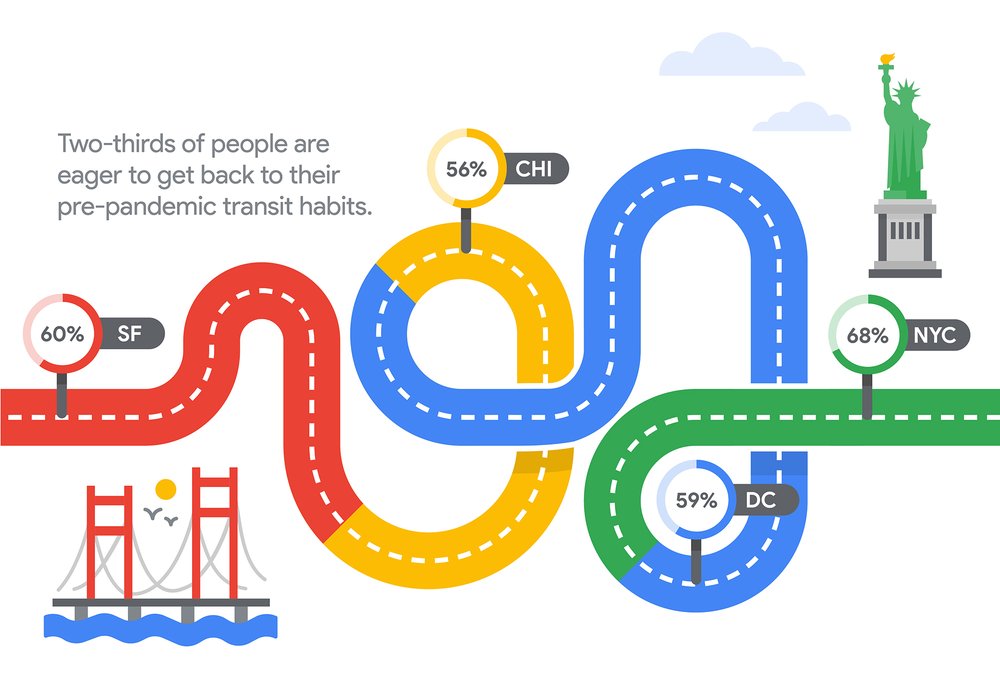
While we are still far from a return to normal, we wanted to understand how people feel about returning to public transit. So we surveyed 2,000 commuters across New York City, San Francisco, Washington, D.C. and Chicago to find out. Here’s what we learned:
5 Olympic Lessons for Marketing Project Managers
Shattered world records. Nail-biting competition. Limitless sportsmanship. The Olympic Games are a sight to behold.
While we had to wait a little longer for the 2020 Tokyo Olympics, they’re still captivating audiences with competition that pushes the limits of athletes and of humans.
As a long-time spectator of the games, however, I’ve found that some of the most memorable Olympic moments hold real-life lessons and even happen outside of the competition floor. Already at these Olympic Games, I’ve taken note of several moments that are unforgettable in life and in work. Especially as a marketing project manager, where we often have to coach our team members, I’ve learned several lessons from the first week of competition. To learn what those lessons are and how they can impact your marketing projects, read on.
Lesson #1 — It’s okay to say, “no.”
Simone Biles, the GOAT ?, shocked the world when she pulled out of the women’s artistic gymnastics team final. And shocked us again when she pulled out of the women’s individual all around.
But when you learn the reason why, wanting to avoid personal injury due to the “twisties” and to focus on her mental health, it’s easy to see why she withdrew. In fact, it makes complete sense. There are times where saying, “no” is the best, most brave thing you can do.
In marketing, business, and even in life, it’s really hard to say, “no.” When clients or execs come to you with requests, it’s only natural to want to say yes. We want to please and delight those that we work with. But there are times where saying, “yes” could lead your team to become stretched too thin, stressed, and overworked. “No” can be a powerful term in those situations and can help safeguard your team against unnecessary crunch. I would also advise that “but” can be a very useful word here as well. “Yes, we can service your request, but it means your other deliverables may be delayed.” With a small “but,” you’re able to make room for the new request while still safeguarding your team.
Lesson #2 – Celebrate the victories, big and small.
When Australia’s Ariarne Titmus won the gold in the women’s 400 meter freestyle, I don’t think anyone was more excited than her coach, Dean Boxall:
It was an epic celebration that went viral shortly after. It’s hard to watch that and not feel the excitement, the hype.
Energy like that is infectious. As a marketing project manager, you want that energy among your team. You want morale to be high so team members are engaged in the work and motivated to achieve success. And this Olympic moment is a good reminder to celebrate your project’s success, both big and small. Those wins can do wonders for your team morale and energy.
Lesson #3 – Persevere.
This Olympics, Hidilyn Diaz won the first ever gold medal for the Philippines. And it came in women’s weightlifting.
View this post on Instagram
But what I find so inspiring about Hidilyn’s story is when you look at her history in this sport. In 2008 in Beijing at the age of 17, she finished second to last. In London in 2012, she missed all of her clean and jerk attempts, resulting in a DNF (did not finish). But she shook it off and persevered. In Rio in 2016, she took home the silver medal becoming the first Filipino woman to win an Olympic medal. And even then she wasn’t satisfied, competing and training for another five years to compete in Tokyo, where she took home the gold and made history yet again. That’s amazing dedication, determination, and perseverance.
Perseverance is a great quality to have as a marketing project manager, and Hidilyn’s story is a great reminder of that. It’s not uncommon for marketing projects — or any projects or work for that matter — to experience setbacks. But it’s important that when setbacks happen, we forge ahead. We pivot. We adapt. And who knows, if we persevere long enough, we may break records and barriers not unlike Hidilyn.
Lesson #4 – Experience isn’t everything.
Watching the women’s skateboarding street finals was a trip! I could not believe the ages of these young athletes. The gold and silver medalists were both just 13 years old and the bronze medalist wasn’t much older at the age of 16.
View this post on Instagram
And in watching them perform, I couldn’t help but be reminded that age is just a number. In work environments, it can be easy to judge someone based on their age or level of experience. After all, reviewing one’s experience is how we determine one’s role on the team and the work they can make the greatest impact on. These skateboarders just go to show that excellence can come from anywhere and anyone. All we need to do as project managers is give individuals the tools and resources to get there. Experience isn’t the end-all be-all we sometimes think it is.
Lesson #5 – Diversity breeds success.
206 countries. Over 11,000 athletes. 309 medals up for grabs in 33 sports. It’s the most diverse gathering of athletes in terms of sport, race, and nationality. I also think it’s the perfect case study for why diversity drives excellence and innovation.
Just take a look at the current medal count and imagine if only certain countries could compete. While those countries would go home with more medals, it might be a hollow victory. An athlete that might not have been on the podium or even in the final heat, is suddenly a medal winner. Current Olympic and world records might stand when they would have been shattered otherwise. It’s the wide range of international competition that continues to push athletes to their limits.
When it comes to forming the teams for your marketing projects, make sure they are diverse ones. The more perspectives you have, the better your project will be in the long run and the more success you’ll find.
Take Your Team to Olympic Heights
Project management and people management are one in the same. For our projects to be successful, we have to effectively manage people in the process. Watching the Olympics, it’s clear to me that there are a lot of people management lessons we can learn from Olympians, their coaches, and their actions.
For your own marketing projects, use the advice above to keep the people on your teams motivated, happy, and successful. In need of more marketing project management advice? Learn about the common barriers to marketing project management and how to overcome them.
The post 5 Olympic Lessons for Marketing Project Managers appeared first on B2B Marketing Blog – TopRank®.

Google svela in anteprima Pixel 6 e Pixel 6 Pro

Telegram si aggiorna con videochiamate fino a mille utenti

FIFA 22, le differenze tra la Standard e la Ultimate Edition

Tom Clancy’s Rainbow Six Siege svela l’evento Containment

Android App: nuove policy sui linguaggi interpretati

Cheer on the finalists of our Indie Games Festival
On September 4, we’re celebrating some of the best indie talent on Google Play during the Indie Games Festival finals for Europe, Japan and South Korea. This year the three festivals are virtual, so you can join us to discover the games, meet the developers who created them, cheer them on and be the first to hear who the winners are.
In June we kicked off the Indie Games Festival – a competition to celebrate the innovation and creativity that indie developers bring to Google Play. We received thousands of submissions, showing our judges how unique and diverse our games developer community is.
The panel of judges have now selected 20 games in each region – listed below – to go forward to the finals on September 4. Each finalist receives exclusive promotions and prizes that give their games the recognition they deserve.
So, don’t miss out. Expect plenty of fun and some very special surprises. Sign up now to virtually attend the festivals for Europe, Japan and South Korea. The events are free to attend and will all take place in the same space, so sign up to one and you will be able to teleport to all events!

Google Tensor debuts on the new Pixel 6 this fall
In 2016, we launched the first Pixel. Our goal was to give people a more helpful, smarter phone. Over the years, we introduced features like HDR+ andNight Sight, which used artificial intelligence (AI) to create beautiful images with computational photography. In later years, we applied powerful speech recognition models to build Recorder, which can record, transcribe and search for audio clips, all on device.
AI is the future of our innovation work, but the problem is we’ve run into computing limitations that prevented us from fully pursuing our mission. So we set about building a technology platform built for mobile that enabled us to bring our most innovative AI and machine learning (ML) to our Pixel users. We set out to make our own System on a Chip (SoC) to power Pixel 6. And now, years later, it’s almost here.
Tensor is our first custom-built SoC specifically for Pixel phones, and it will power the Pixel 6 and Pixel 6 Pro later this fall.

7 Questions B2B Marketers Need to Answer About Influencer Marketing
Diminishing organic social reach, distrust of brand marketing and information overload makes reaching and engaging today’s B2B buyer harder than ever. On top of that, the major changes brought by the pandemic have created new challenges and opportunities for B2B companies to better attract and engage customers in meaningful ways.
Out of the pandemic and the shift to digital first go-to-market approaches for B2B companies, Influencer Marketing has emerged as one of the most effective ways to connect with customers to create better experiences. Despite substantial growth in the discipline from best practices to software, many B2B brands are still experimenting or simply don’t know how to identify, engage and activate influencers.
As I’ve talked with prospective clients and my own team, many B2B marketers see the value in working with influencers to drive credible conversations and content about topics that customers care about. They simply don’t have enough information or experience to execute.
Evolving from this tentative stage to one of driving profitable marketing requires answers to several important questions:
How do you identify the right influencers?
Capturing the value of working with influencers doesn’t start by picking the most popular people in your industry to work with. There has to be a reason for them to do so and that purpose comes from a solid marketing strategy that identifies the topics, narratives and hooks that the marketing will use to engage customers. Those same marketing campaign elements will be used to then identify the people that have influence about the topics your customers care about.
Once topics of influence have been determined, there are a mix of ways to practically identify influencers from interviewing your key executives and customers to leveraging influencer marketing software which acts like an influencer search engine.
The important thing to understand about influencer identification in B2B is that not everyone who influences your customers thinks of themselves as an influencer. In turn, not everyone that identifies as a B2B influencer actually has influence. They might be better at creating engaging media and promotion than getting customers to buy.
The key is that there is tremendous value in working with both ends of the B2B influencer spectrum by matching them to the right kinds of content collaboration and activations.
How can you engage influencers and bring them onboard?
Many B2B marketers want to hit the ground running with influencers as if it were an advertising campaign and for the most part, that is simply not how influencer engagement works. More so than in B2C, B2B influencer marketing is a relationship business. Relationships take time to develop – you don’t simply “turn them on” by asking influencers to join your campaign or even to pay them to create content.
Most great relationships start with some romance where there are efforts to understand what’s important to the influencer and create value before getting any in return. Paying influencers to create content off the bat will get you a content deliverable, but it won’t make the influencer care about your brand. But if they do care, they will share and evangelize your brand, products and people organically.
Once you understand what motivates an influencer (sometimes you simply have to ask them) then you have context to invite them to participate in your marketing effort. Whether they are focused on advocating and growing a certain discipline in the industry or they are already a fan of your brand, you can put together the right kind of invitation to work with your brand to create mutual value and achieve mutual goals.
How do you engage with paid influencers vs organically?
Paying influencers for content deliverables or services has increased substantially in the past 2-3 years. And that is a good thing because it represents a growth in the number of professional influencers in B2B industries that understand how their role as an influencer can contribute to helping brands achieve marketing and business goals.
Typically, B2B influencers are paid for specific deliverables or for a commitment to deliver content over a defined period of time to specifications.
Organic influencer engagement is more about inspiring the influencer to be a part of the movement the brand is advocating. The purpose of the engagement is to join forces to achieve mutual goals and the influencer receives value in the exposure from being a part of the program, access to information, people and/or experiences from the brand.
Most mature B2B influencer marketing programs use a combination of organic engagement and paid. Always-On influencer engagement would typically be relationship building and organic. Asking 10 influencers to create 2 blog posts each or 2 videos each about defined topics to certain criteria would be something the brand would pay for.
Which collaboration efforts have a significant impact?
While content format trends in B2B are definitely leaning towards video, the best B2B influencer collaborations are those that align with customer content preferences. Once you understand how your customers prefer to consume content – most likely a mix of formats – then the task is to find influencers with specific skills or talents using those media formats.
In some cases the influencer can be a turnkey solution and produce content whether it’s a research report, webinar, podcast or video and deliver it to the brand for publishing. In other cases, the influencer is better as “on air talent” and can be the personality representing the brand engaging with internal and external influential voices – on a podcast, video series, webinar or a virtual / in-person event.
How can you integrate influencers with content marketing?
The topics of influence mentioned earlier help B2B brands match the people who are most influential about topics that drive the marketing narrative. Those same topics help guide the actual content influencers provide to the brand for use in content marketing.
Influencer content can be used to “optimize” brand content to be more credible, as in the use of influencer quotes in articles, research reports or as participants in webinars and events. Whatever topic the influencer is most credible about is matched with the corresponding content marketing asset.
Virtually any content marketing effort can benefit from including internal or external expert citations or contributions to give expertise and credibility to the messages intended for customers. Additionally, influencers that have the attention of customers that the brand is trying to reach can assist in promoting the content and reaching those customers.
How do you measure influencer effectiveness?
Marketing measurement has everything to do with the goals for the marketing so thought leadership is measured differently than a lead generation campaign. The same goes for influencer marketing.
When content is involved with an influencer marketing effort, all of the same KPIs are involved as with any other content marketing program. Is the content attracting the right audience, are they engaging with the content and is it converting?
With influencers it’s also important to measure the effectiveness of the influencers using tracking URLs to see how well their content resonates with audiences on delivering the above KPIs.
If a defined group of industry experts are engaged then it’s important to measure things like the brand’s share of voice within that group of influencers.
If the brand could get the most influential people in the industry talking about their brand in a positive way, that could have a significant warming effect if not direct impact on the marketing consideration of their products/services. Mentions and advocacy can be measured from benchmark to ongoing progress.
The trend in those influencer mentions can be overlaid with analytics tracking changes in more direct marketing KPIs to see if there is a correlation between increased influencer brand advocacy and lift in commercial content consumption, brand interest, leads and sales.
How does influencer marketing software help optimize marketing?
The influencer martech industry has grown substantially over the past 9 years TopRank Marketing has been involved with B2B influencer marketing. There are a variety of tools from specialty applications that are only used to identify Twitter influencers to enterprise level platforms that can handle everything from influencer identification to CRM to program measurement.
Picking influencers should be a data informed decision and influencer marketing software can comb through vast amounts of data to identify those individuals with the right mix of relevance, resonance and reach for your marketing program.
Communicating with influencers from initial social engagement to invitations to collaborate to contract management and deliverables management are all essential and best handled by software.
Monitoring your influencers and surfacing activation opportunities is essential for an Always-On program.
Measuring campaign performance as well as the share of voice and sentiment a group of influencers has about your brand is most effectively handled by influencer marketing software.
Influencer Marketing programs that work with 10, 20 or 100 different influencers simply cannot scale with any quality using a spreadsheet. Influencer Marketing software helps add both quality and efficiency to a program. That means more relevant influencers are identified, communications are more timely and effective and the performance measurement that you need is there for program optimization.
I will be digging into the details of each of these questions during a 3 hour workshop at the Pubcon conference tomorrow: How to Develop a B2B Influencer Marketing Program That Actually Works. Of course if you have any questions of your own, feel free to connect with our team at TopRank Marketing.
The post 7 Questions B2B Marketers Need to Answer About Influencer Marketing appeared first on B2B Marketing Blog – TopRank®.

Attacco hacker alla Regione Lazio: chiesto un riscatto?

Green Pass: il Ministero attiva funzione recupero dell’Authcode

Fino al 58% di sconto sui prodotti audio di JBL su Amazon

Port Royale 4 su PS5 e Xbox Series X|S il 10 settembre

New program helps regional journalists develop digital skills
Today, we’re pleased to announce an initiative that helps support regional news publishers by providing vital digital skills training and new opportunities for young journalists.
Introducing the Digital News Academy
The Digital News Academy is a new program created by Google and News Corp Australia that will provide training in the latest digital skills to 750 local and regional news professionals from a range of outlets across the country, including Australian Community Media and several others.
The program, run over three years, will provide comprehensive tuition in skills including digital journalism, video and audio production, data journalism, audience measurement, reader revenue, digital business models and marketing.
In addition to enabling crucial digital capabilities, the Digital News Academy will also create opportunities for young journalists, funding 60 new 12-month journalism traineeships in regional Australia over the next three years.
This is a significant investment in training and skills for local news in Australia, and builds on the work we’ve been doing for years in support of regional publishers. We’ve long partnered with the news industry in Australia, and this new initiative will benefit and support hundreds of journalists from across the Australian news industry.