Give it up for the woman who helps Googlers give back
Over the past month, Googlers around the world have virtually volunteered in their communities — from mentoring students to reviewing resumes for job seekers. It’s all a part of GoogleServe, our month-long campaign that encourages Googlers to lend their time and expertise to others. GoogleServe is just one of many opportunities employees have to give back, and one of the projects that Megan Colla Wheeler is responsible for running.
As the lead for Google.org’s global employee giving and volunteering campaigns, Megan’s role is to create and run programs like GoogleServe and connect the nearly 150,000 Googlers around the world to them. Ultimately, her job is to help Googlers dedicate their time, money or expertise to their communities. How’s that for paying it forward?
With more than ten years of experience at Google, we wanted to hear more about how she ended up in this job, her advice to others and all the ways volunteering at Google has changed — particularly this past year.
How do you explain your job to friends?
My goal is to create meaningful ways for Googlers to contribute to their communities — by offering their time, expertise or money — and help connect them to those opportunities.
When did you realize you were interested in philanthropy and volunteering?
I was a Kinesiology major in college. Toward the end of my sophomore year, I took a course on social justice and it struck a chord in me. Though I loved sports, I realized I wanted my career to be about something bigger, something meaningful. I wanted to lend my skills for good. So even though I graduated with a kinesiology major, I focused my job search on the nonprofit sector and got a job working for a nonprofit legal organization.
How did you go from there to leading volunteer programs for Google.org?
I never knew that the job I have now was even possible. I left my nonprofit job to become a recruiting coordinator at Google. My plan was to do it for a year, diversify my skills, then go back to the nonprofit world.
I remember going to my first GoogleServe event. We helped paint and organize a senior citizen community center — all during the workday! It blew me away that Google placed such an importance on volunteering. Coming from the nonprofit world, it felt meaningful seeing a company that cares deeply about these things and encourages employees to get involved. So I stayed at Google and kept finding ways to work on these programs.
Fast forward 10 years and you’re one of the masterminds behind these events. How has employee volunteering and giving at Google changed over the years?
So many of the things that Google has created, like Gmail, came out of grassroots ideas that then grew as the company did. The same is true of our work to help Googlers get involved in their communities.
Take GoogleServe for example. In 2008, a Googler came up with the idea to create a company day of service. Over a decade later that campaign has gone from a day-long event to a month of service that encourages over 25,000 employees to volunteer in over 90 offices around the world. And it all started with one Googler saying, “This would be a cool idea.” Along the way, more Googlers have come up with ideas to get involved in the communities where we live and work through giving and volunteering. Although the programs have grown and evolved over the years, we’ve maintained the sentiment that inspired those campaigns in the first place.
We’ve also been focused on connecting Googlers to opportunities that use their distinct skills, like coding or data analysis. For example, a team of Googlers – including software engineers, program managers, and UX designers – are currently working with the City of Detroit to help build a mobile-friendly search tool to help people find affordable housing.
How has it changed in the past year?
At the core, these programs are about giving back, but they’re also culturally iconic moments at Google. They’re a chance for teams to connect and do something together that’s more than just your average team-building activity. You’re building a shared experience and meeting people from completely different roles and departments. They’re also a chance for teams to learn and grow from people outside of Google and to bring that perspective back to their job.
Over the past year, people have felt generally disconnected. So even though our volunteering has become virtual, it’s still a chance to interact and contribute. Virtual or not, it really does create a positive work culture.
What advice would you give to people who have a day job in one area and a passion in another?
Be willing to work hard and get your core job done and carve out time to keep doing what you’re passionate about. When you are working on projects that you love, it keeps you engaged in a really special way. And you never know when those passion projects will intersect with your core work, or when they’ll turn into something bigger.
Explore the undeciphered writing of the Incas
Issac Newton once said, “If I have seen further it is by standing on the shoulders of giants.” By adopting this age-old phrase, he acknowledged that all “new” discoveries depend on all that preceded them.
At Google, we firmly believe that history has much to teach us. For me personally, as a Latin American, I have no doubt that the native peoples who inhabited our beautiful, diverse and inspiring region left us countless treasures — many of which still patiently wait to be discovered.
The MALI Collection on Google Arts & Culture
That is why I am so pleased and proud to present the new online exhibition The Khipu Keepers on Google Arts & Culture.
“Khipus,” which means “knots” in the Quechua language, are the colorful, intricate cords made by the Incas, who inhabited some parts of South America before the Spanish colonization of the Americas. These knotted strings are still an enigma waiting to be unraveled. What secrets are hidden in these colorful knots dating back centuries? What messages from the Incas echo in these intricate cords? Could the ancestral knowledge they hold inform us about our future?
Currently, there are about 1,400 surviving khipus in private collections and museums around the world. While approximately 85% of these contain knots representing numbers, the remaining 15% are believed to be an ancient form of writing without written words on paper or stone. Researchers are still working to decipher the meanings of these coded messages.
With the exhibition launching online today, the Lima Art Museum (MALI) and Google Arts & Culture are opening a window into one of the greatest mysteries the Inca people left behind.
By putting the centuries-old khipus on display online for the first time, this exhibition will let people from across the world engage with the fantastic legacy of the Inca civilization. Yet even more importantly, by creating a digital record of these enigmatic treasures that still have stories to tell, we are also preserving them forever. In this sense, The Khipu Keepers is also a first step of a promising journey for researchers to find new opportunities thanks to the power of technologies such as digitization.
Track down the history of khipus to Latin America’s first empire in the words of anthropologist Dr. Sabine Hyland, and listen to St. Andrews researcher Manny Medrano as he answers the most pressing questions about what we know of khipus. Watch an intro to the basic components of a khipu and what experts have discovered so far, or explore the Attendance Board that provides a rare connection between words and cords. Zoom into a large double khipu and learn about what it takes to conserve the khipus from the Temple Radicati collection.
Seven interesting facts about the enigmatic khipus
- The Quechua word “khipu” means knot.
- The pre-Columbian khipus were made of camelid hair or cotton fiber.
- The Incas used three types of knots: single, long and figure-eight.
- The colors of the khipu cords have different meanings.
- The distance between the knots also has a meaning and conveys a message.
- A cord without knots represents the number zero.
- Of all the known khipus, 85% convey numerical values and the remaining 15% are believed to tell stories.
From Latin America to the world
For the “The Khipu Keepers,” researchers are once again the ones entrusted with “untangling” this chapter of our past and providing us with answers. They now know that they are not alone in this endeavor and that Google technologies can help them delve deeper into elements of history.

Fake news: WhatsApp blocca due milioni di account in India

G20: Tavola Rotonda Italia-Canada sull’attuazione delle strategie sull’idrogeno
L’Ambasciata del Canada in Italia, in collaborazione con la Camera di Commercio Internazionale (ICC) – Comitato Italiano, il Centro Studi Italia-Canada (CSIC) e lo Studio Legale Nctm, ospita una tavola…
L’articolo G20: Tavola Rotonda Italia-Canada sull’attuazione delle strategie sull’idrogeno scritto da MercurPress proviene da Assodigitale.

Cybersecurity: Mediatech per Milano Serravalle – Milano Tangenziali
Il Gruppo Relatech con Mediatech si aggiudica la gara in ambito cybersecurity indetta da Milano Serravalle – Milano Tangenziali spa Relatech S.p.A., Digital Enabler Solution knowledge (D.E.S.K.) e PMI innovativa…
L’articolo Cybersecurity: Mediatech per Milano Serravalle – Milano Tangenziali scritto da Paolo Brambilla proviene da Assodigitale.

ASUS ROG Zephyrus M16 è il notebook gaming dallo schermo molto particolare
Share Your Expertise in the 2021 State of B2B Influencer Marketing Survey
The past year or more has taught B2B marketer many lessons, especially the importance of creating digital first experiences that are credible, authentic and relevant to specific buyers. As part of the digital transformation of marketing, many B2B companies have adjusted their go-to-market approach to satisfy the changing customer expectations that have evolved during the pandemic.
One of those adjustments in B2B marketing has been the increasing role of influence in delivering credible, authentic and relevant digital experiences. Our initial B2B Influencer Marketing research from 2020 showed that going into the pandemic, confidence in working with B2B influencers was very high as were expectations of outcomes.
Despite the growing confidence in working with B2B influencers over the past year, today there are important questions to be answered as more B2B brands enter the realm of influence and grow more sophisticated with the practice.
Much of B2B influencer marketing has emphasized working with industry experts external to the organization, but what about growing influence from within? How does influencer marketing work across departments? How do employee advocacy, growing executive influence and working with industry influencers intersect to deliver better customer experiences and marketing performance?
At TopRank Marketing we are proud to work on influencer content marketing and executive social programs for some of the biggest B2B brands in the world. We also know that our blog community represent a wealth and depth of B2B marketing experience. We invite you to share that expertise in our 2021 State of B2B Influencer Marketing Survey.
Your insights will help elevate the practice of B2B Influencer Marketing and help the industry see what’s working, what’s not and where the future of influence is in 2021 and beyond.
For the 2021 report, we’ll be collecting data on all aspects of influencer marketing for B2B brands as well as insights from practitioners like you.

In the 45 page 2020 report we featured key findings and statistics about strategy, tactics, budgets and measurement as well as B2B influencer marketing case studies from SAP, LinkedIn, Cherwell Software and Monday.com. We also highlighted influencer marketing insights from B2B executives at Adobe, AT&T Business, IBM, MarketingProfs, Salesforce, SAP, Traackr, Treasure Data and more.
For the 2021 report, we’ll be sharing insights on growing marketing momentum with influence, the next level of Always-On influence, new best practices, budgets, technology and measurement plus all new case studies and insights from B2B marketing professionals. We’ve also been working on a fresh list of the most influential voices in the B2B world on the topic of influence in marketing and their predictions for the future.
If you have worked with influencers in the past year, then you’ll have valuable insights to share. You can also enter our giveaway of five $100 Amazon gift cards and early access to the findings of the report.
The survey takes just a few minutes and that investment in time will go a long way towards helping answer some of the key questions about working with internal and external influencers.
Optimizing marketing experiences with influence represents one of the most important digital growth strategies in 2021 and beyond. Take the 2021 survey today and join us in helping B2B marketers at all levels of influencer marketing experience level up their strategy, best practices and operations to build momentum in 2021 and beyond.
The post Share Your Expertise in the 2021 State of B2B Influencer Marketing Survey appeared first on B2B Marketing Blog – TopRank®.

PoliMI sviluppa chip ottico che indirizza i dati della banda larga

FAQ del Garante su GDPR e certificazione trattamento dati

15 euro di sconto per Infinity+ per sei mesi su Amazon

I problemi dell’ufologia, spiegati con un quiz
Ieri ho lanciato un quizzello su Twitter:
Test per ufologi: date la spiegazione corretta per questa foto. pic.twitter.com/NRUJSAkiUr
— Paolo Attivissimo (@disinformatico) July 17, 2021
Molti di coloro che hanno risposto hanno teorizzato macchie sull’obiettivo oppure oggetti sul vetro della finestra attraverso la quale sarebbe stata scattata la foto; altri hanno ipotizzato droni o semplicemente fotoritocchi. Alcuni si sono lasciati distrarre dal bianco e nero e hanno pensato a una foto d’epoca. Altri ancora hanno pensato che si trattasse di una nave sul mare. Insomma, le ipotesi non sono mancate.
Ma come avevo preannunciato, in realtà la foto contiene tutti gli elementi necessari per la sua spiegazione.
Primo, la località. In basso a sinistra si nota il profilo molto particolare del Duomo di Pavia. Per cui la città è Pavia.
Conoscendo la storia della città, è abbastanza facile dedurre che non può trattarsi di una foto d’epoca perché manca la Torre Civica accanto al Duomo. La Torre, infatti, crollò nel 1989; la notizia fece grande scalpore.
Bisogna infatti fare attenzione agli automatismi mentali che usiamo quando guardiamo una foto. Se è in bianco e nero, facilmente ci viene da pensare che sia una foto antica; viceversa, se è a colori diamo per scontato che sia recente.
Per esempio, direste mai che la foto qui sotto risale a oltre cento anni fa? È del 1915 (grazie a pol per la segnalazione).

Alcuni hanno teorizzato un oggetto in realtà altamente improbabile: un dirigibile. L’idea che un dirigibile sorvoli Pavia in tempi recenti sembra assurda, ma in realtà è successo proprio ieri: un dirigibile marchiato Goodyear sta infatti sorvolando buona parte del nord Italia.
Però questa è una notizia che molti ieri non hanno visto; immaginate quanto sarà difficile sapere questo dettaglio fra dieci o vent’anni, quando questa foto sarà ancora in giro. Questo è uno dei problemi fondamentali dell’ufologia: la mancanza di dati, spesso irrimediabile, che permetterebbe spiegazioni e demistificazioni.
C’è poi da considerare che in ufologia gioca un ruolo importante anche la manipolazione intenzionale. Molti “ufologi” sono ciarlatani che fabbricano foto false. Anche la foto del quiz è un “falso”: infatti l’originale in realtà è a colori ed è una porzione volutamente sfocata di un video.

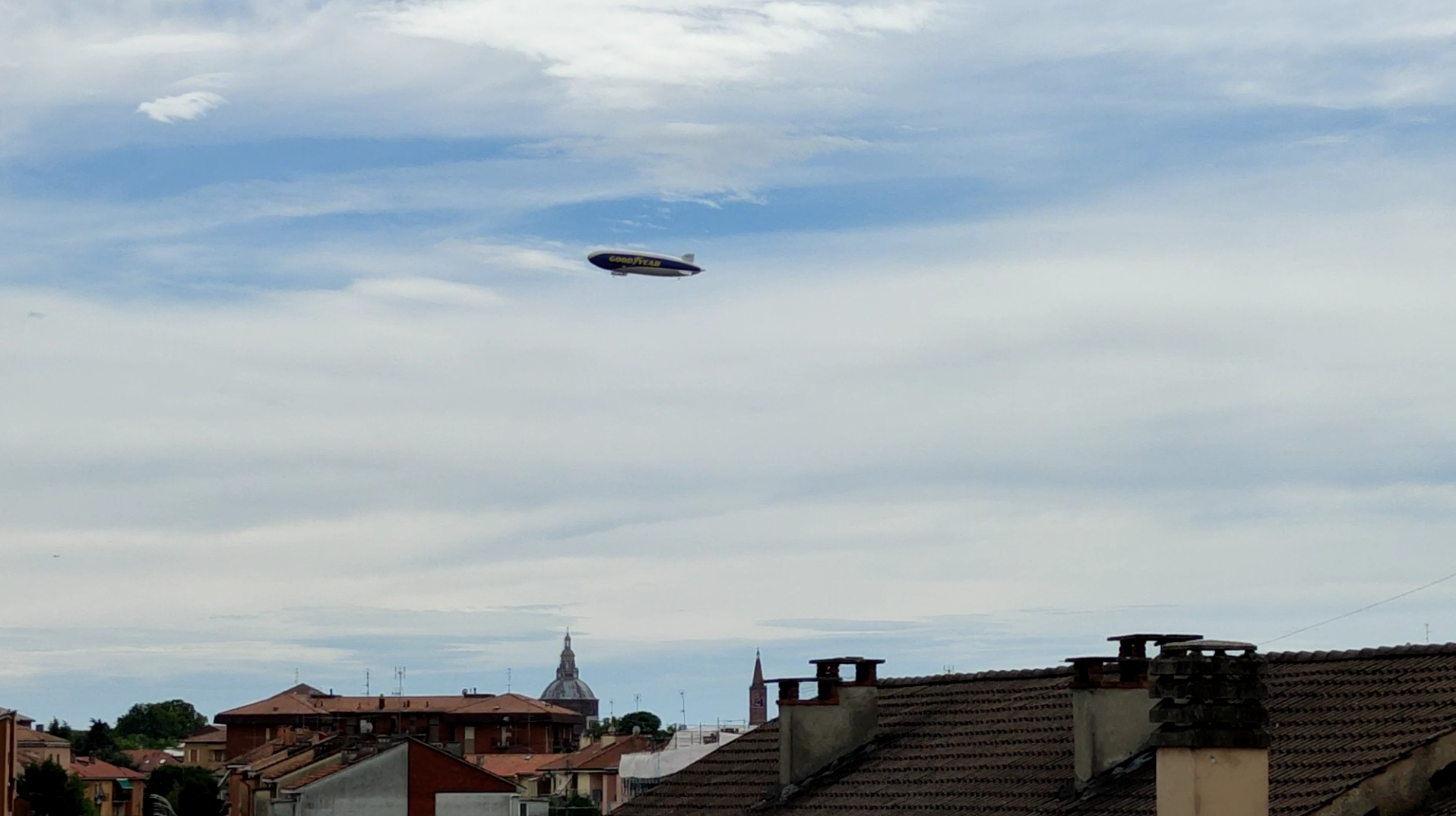
Per questo è importantissimo esigere che chi ha fatto la foto o il video renda disponibile l’originale e ci si deve rifiutare di fare qualunque analisi su copie di copie di copie. Il fatto stesso di non mettere a disposizione l’originale va considerato sintomo di probabile ciarlataneria. Nel caso che presento qui, se io avessi pubblicato direttamente il video originale il mistero non sarebbe neanche nato.
Questo piccolo esperimento mostra quanto è facile creare una foto ufologica senza neppure ricorrere a fotomontaggi, e quanto lavoro di informazione e deduzione occorre per scoprire la spiegazione di una singola foto.
È per questo motivo che non è giusto dire “ah, ma questa non l’hai spiegata, quindi il fenomeno è reale”. No. Semplicemente in tantissimi casi mancano tempo e informazioni sufficienti a spiegare, per cui non si può affermare nulla. Non si può dare una spiegazione certa, ma allo stesso tempo e per lo stesso motivo non si può dire “è un veicolo alieno”.
Ed è per lo stesso motivo che non si può perdere tempo a investigare approfonditamente ogni singola foto sgranata e priva di contesto che viene segnalata: si finirebbe per essere sommersi dalla fuffa.
Grazie a tutti per aver partecipato: spero che vi siate divertiti. Ringrazio anche mio figlio Simone che ha registrato il video.
Questo articolo vi arriva gratuitamente e senza pubblicità grazie alle donazioni dei lettori. Se vi è piaciuto, potete incoraggiarmi a scrivere ancora facendo una donazione anche voi, tramite Paypal (paypal.me/disinformatico) o altri metodi.

PlayStation 5, come funziona PS Remote Play
Attacchi ai dispositivi IoT aumentati del 700% in 2 anni

Oggi è la Giornata Internazionale delle Emoji