
Social Significance: Why B2B Brands Value Social CX & Are Spending More
Why are B2B brands placing greater value on social media, and why are they willing to spend more than ever before on social customer experience (CX)?
New digital marketing research reveals why B2B brands are finding a renewed passion for the expanding benefits of social media, and why they are becoming more willing than ever to spend more for the competitive advantages that social CX offers.
Let’s take a look at some of the latest report and survey data, and see how B2B brands are changing their social media strategies and outlook.
1 — Social Helps B2B Brands Meet Customer Expectations
A new report from Sprout Social reveals how customer expectations have evolved for the brands that they follow on social media.
Examining insight from over 1,000 U.S. consumers and the same number of U.S. marketers, along with 782 million public social messages, the recently-released “Sprout Social Index, Edition XVII: Accelerate” report showed that 90 percent of consumers will purchase from brands they follow on social media.
“For marketers, this is an opportunity to demonstrate how social positively influences all parts of the business and why a brand’s competitive advantage lives on social,” the report suggested.
55 percent of marketers said they used social data for understanding their target audience, while 48 percent used it to develop creative content, and 39 percent for supporting other departments, the report showed.
Only 26 percent of marketers said they used social data to foster connections with customers, however, and just 10 percent said they used the data to inform business decisions.
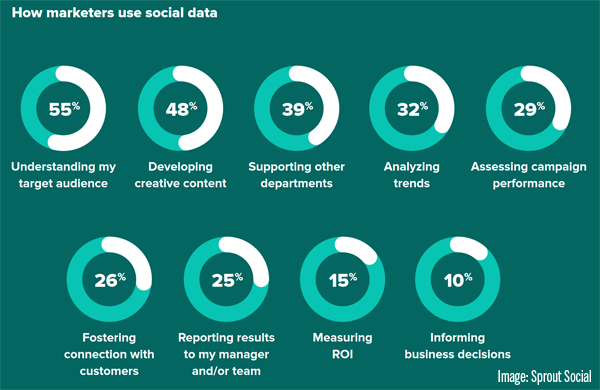
“88 percent of marketers agree their social strategy positively influences their bottom line,” the research concludes.
The value of social data has generally increased over time, and the new Sprout Social study bears this out, revealing that 47 percent of marketers consider social a resource that influences strategy for multiple organizational teams, while 46 still see it as strictly a marketing resource, with eight percent viewing it as an organization-wide resource for business intelligence.
Something as seemingly simple as responding quickly to customer questions can be very important in brand purchase decisions. 47 percent of consumers said that responding to customer service questions in a timely manner was the top way brands could get them to buy and forgo competitors.
Nearly as important among consumers were brands that demonstrate an understanding of what consumers want and need.
“Nine out of 10 consumers will buy from brands they follow on social, while 86% will choose that brand over a competitor,” the Sprout Social report data showed.
Given the importance customers place on speedy response times from brands, it’s easy to see how the new Sprout Social data indicated that “78 percent of consumers agree that social media is the fastest and most direct way to connect with a brand — and consumers want their voices heard.”
When it comes to sharing feedback about a product or service, after social media, consumers turn to e-mail and a brand’s website (18 percent for each), followed closely by review websites, and just 11 percent prefer calling a brand’s customer service phone number, according to the report data.
Even for reaching brands about customer service issues or questions, most consumers (33 percent) prefer social media, followed by customer service (24 percent), e-mail (23 percent), and just nine percent prefer using a company’s website for such questions.
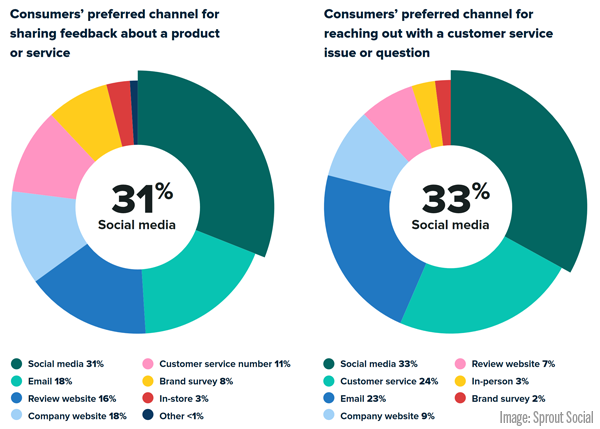
“44 percent of consumers will unfollow a brand on social because of poor service, putting a damper on brands’ growth goals,” the report warned.
The Sprout Social study surfaces a fascinating distinction between what consumers and marketers believe makes for best-in-class social media performance.
The most important factor among consumers — at 47 percent — was brands that offer strong customer service, while that was only the sixth most important factor to marketers, at 35 percent.
2 — Social Will Drive Post-Pandemic B2B Customer Engagement
According to Ascend2 and Wpromote’s newly-released 2021 State of B2B Digital Marketing report, the number one digital marketing trend B2B brands are prioritizing is the utilization of new social platforms.
42 percent said new social platforms represented their top trend priority, followed by 34 percent who said virtual events, and 30 percent who noted that influencer marketing was a priority trend.
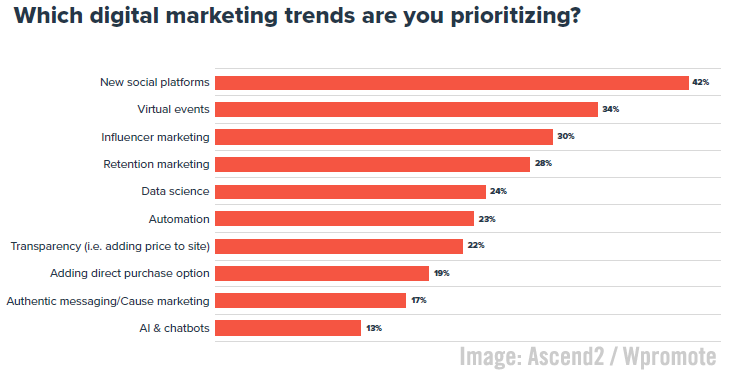
“Brands embraced new social platforms, virtual events, and influencer marketing strategies that can open the door to new opportunities to drive brand awareness and grow new audiences,” the report suggested.
A robust 68 percent of B2B marketers said they expected their digital marketing budgets to increase during the forthcoming year, with 26 percent seeing a significant budget increase ahead, according to the report data.
When it comes to driving revenue, 57 percent of B2B marketers saw social media as the most effective digital marketing channel, followed by content marketing and email, each at 47 percent.
Reinforcing the notion supported by the other research we’ve examined, the Ascend2 and Wpromote data showed that social media was the area of digital customer experience that had the most impact on overall strategic success, according to 57 percent of respondents — ahead of website optimization’s 47 percent and paid advertising’s 42 percent.
“Whatever social platforms you use as a B2B marketer, if you prioritize the time and resources to add new social platforms to your mix, you increase the opportunity to build new audiences and further engage with your existing audience,” Todd Lebo, CEO at Ascend2 told me. “Newer platforms that B2B should consider are TikTok, Clubhouse, and Twitter Spaces,” Lebo added.
We’ve taken a look at how B2B marketers can utilize Twitter Spaces in “On-Target: What’s New With Twitter For B2B Marketers In 2021,” Clubhouse in “How B2B Brands Can Boost Confidence in Livestream Video, Podcast and Clubhouse Marketing,” and other new social platforms in “How B2B Marketing Influencers Are Finding Success On New Social Channels.”
The most successful B2B marketers have also tended to inform their CX strategy by including other departments — a structure that less successful marketers don’t tend to utilize.
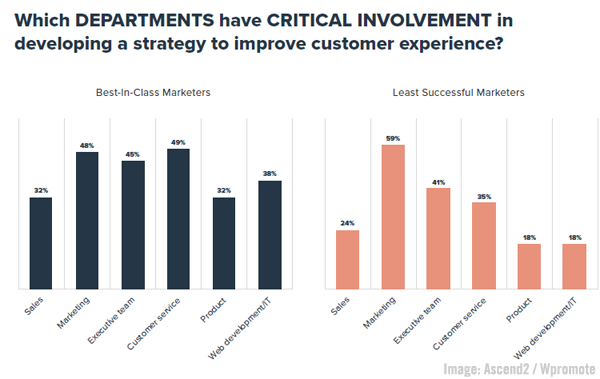
Bringing many of these trends and tactics together, account-based marketing (ABM) — or even account based experiences (ABX), as our CEO Lee Odden recently explored in “Is ABX the Next Evolution of B2B Marketing?” — is increasingly used by the most successful B2B marketers.
43 percent of the most successful B2B marketers already have a working ABM strategy in place, and 30 percent are actively implementing one, the Ascend2 and Wpromote data showed.
[bctt tweet=”“To do ABM well, you need to bend the sales odds in your favor. The best way to bend the odds is to utilize customer data you collect over time and deliver a seamless customer experience (CX).” — Ruth Stevens @RuthPSteven” username=”toprank”]3 — Social Drives B2B Customer Experience Personalization
B2B brands are increasing finding success in delivering more personalized CX through social channels.
The digital experiences customers crave can be crucial for building brand affinity, as some 80 percent of respondents in a survey conducted by Salesforce said that these experiences are every bit as important as a firm’s actual products or services.
Brand storytelling helps build more memorable digital experiences, as Microsoft’s Miri Rodriguez has explored, which I outlined earlier this year in “Microsoft’s Miri Rodriguez on How B2B Marketers Are Embracing Empathy For Better Customer Storytelling.”
[bctt tweet=”“Storytelling isn’t the mere telling of story, it’s the intentional design of story structure, attributes and elements that conjure emotion, drive inclusion and lead with empathy.” — Miri Rodriguez @MiriRod” username=”toprank”]Some 68 percent of businesses in the Salesforce survey said that they expected brands to demonstrate empathy, but only 37 percent said that they were experiencing it — a sentiment Rodriguez shared when she noted that, “Brands want to transact with people who are showing high levels of empathy.”
Ryan Higginson, vice president and UK/ROI Country Leader at Pitney Bowes, sees a future that includes better customer experiences that go beyond the mere algorithmic.
“B2B decision makers want humanized, personalized, helpful and relevant experiences to reduce complexity and save them time,”Higginson recently noted. “They want businesses to anticipate their requirements beyond the ‘You liked that, now try this’ algorithm. The more B2B organizations get to know their clients at a personal level, the better the relationship becomes and the greater the customer experience,” he added.
A McKinsey study revealed that 97 percent of B2B buyers said that they would use an end-to-end self-serve digital model to make a purchase, with most being comfortable doing so while spending $50K or more.
The pandemic has brought about a shift among B2B buyers, who have grown more comfortable with digital self-service and omni-channel interactions.
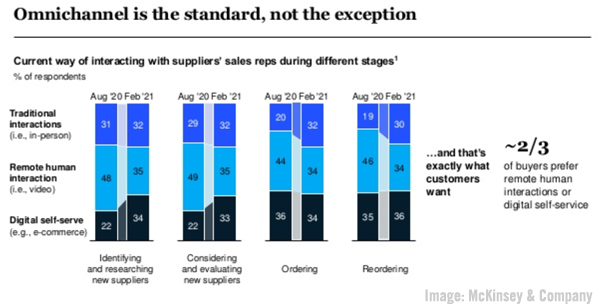
LinkedIn’s* State of Sales Report 2021 noted that trust in a brand’s product or service was consistently a top factor in influencing purchases among buyers, and the 2020 version of the report showed that some 75 percent of B2B buyers were particularly influenced by social media, with 84 percent of senior executives utilizing social media to support buying decisions.
We dug into the shift to executive influence in B2B marketing in “Brandfluence – Why Growing Executive Influence is Essential for B2B Marketing,” and also shared 20 tips for driving executive credibility efforts in “20 Ways to Build B2B Executive Credibility and Thought Leadership.”
[bctt tweet=”Social engagement with prospects along with publishing credible thought leadership content warms prospects for conversations that lead to conversion.” — Lee Odden @LeeOdden” username=”toprank”]Reach New B2B Marketing Heights With A Social & CX Mix
There’s no need to make a leap of faith when you have data-backed research informing your digital marketing strategy.
By using social media to drive customer experience personalization and to help B2B brands meet rising customer expectations, B2B marketers will achieve greater levels of post-pandemic B2B customer engagement.
We hope that our look at recent report and survey data will help inform your own B2B marketing efforts as we move ahead towards 2022.
Crafting award-winning B2B marketing with a creative mixture of social media, influence, and memorable digital customer experiences takes considerable time and effort, which is why many firms choose to work with a top digital marketing agency such as TopRank Marketing. Contact us today and let us know how we can help, as we’ve done for businesses ranging from LinkedIn, Dell and 3M to Adobe, Oracle, monday.com and others.
* LinkedIn is a TopRank Marketing client.
The post Social Significance: Why B2B Brands Value Social CX & Are Spending More appeared first on B2B Marketing Blog – TopRank®.

Zoom consente di aggiungere i pronomi di genere

Cos’è il trading di criptovalute?
Il trading di criptovalute consiste nel fare trading sui movimenti di prezzo di una criptovaluta attraverso un conto di trading su CFD, o nell’acquisto e vendita della valuta tramite una…
L’articolo Cos’è il trading di criptovalute? scritto da YOUR_DIGITAL_VOICE! proviene da Assodigitale.

Facebook porta Shops anche sulle altre sue app

A Challenge to understand the needs of local readers
How can local news publishers create the next generation of news products without knowing what their readers need? And how can they flourish without understanding the needs of the larger majority of community residents who do not read their work?
These are crucial questions, and we want to encourage local publishers to explore them in greater depth. Starting today, we are launching the third Google News Initiative Innovation Challenge in North America to help local publishers to think about new ways to understand, enhance and serve the needs of their communities.
We’re inviting publishers to submit ideas for projects that will generate research approaches to better understand these local audiences in order to rethink product and overall strategy.
Since 2019,Google News Initiative Innovation Challenges have supported 67 projects in Canada and the U.S. with over $11 million in funding. Past recipients include projects to tackle big challenges in local news and in diversity, equity and inclusion. California Independent Television Service (ITVS) producedan interactive survey tool designed to allow viewers to share feedback and interact in real time with fellow audience members. Save the Black Press, a project from Black Voice News, is building an open site to allow news organizations to access datasets about the Black population to produce more powerful stories and generate higher engagement with a more informed public.

Portafoglio di criptovaluta Uniswap – Che cos’è?
Uniswap è una nuova piattaforma di scambio online. Il creatore di questo scambio è Hayden Adams, che è stato ispirato dalle idee di Vitalik Buterin, il fondatore della criptovaluta Ether…
L’articolo Portafoglio di criptovaluta Uniswap – Che cos’è? scritto da YOUR_DIGITAL_VOICE! proviene da Assodigitale.

UE e Google, ancora scontro: aperta indagine antitrust

Olympic Games Tokyo 2020 di SEGA è nei negozi

Facebook dà il via ufficiale alle Live Audio Rooms
Chromebooks get new updates for the hybrid classroom
We’ve seen Chromebooks being used in so many ways, from virtual classrooms to entertainment hubs this year. Chromebooks have become the number-one device in K-12 education around the world because they are powerfully simple: opening a world of possibilities for every student and teacher, whether they’re at school, at home or anywhere in between.
We’ve seen a huge transition to schools assigning devices for every individual student, giving them a real sense of ownership over their Chromebooks. As a result, we’re making changes to support schools as they send Chromebooks home. These changes will also help students connect and participate in hybrid classrooms, while creating and sharing their ideas with a wide range of learning tools from podcasting to screencasting.
Easy to use
With Chromebooks, it’s easy to set up the right environment for your school from wherever you are. With over 40 new devices for education in 2021 alone, and Chrome Education Upgrade, admins can enable more than 500 policies in Google Admin Console. And with policies like Zero Touch Enrollment, IT admins can drop ship devices to any location and have the device be ready to go – without ever having physically touch the device.
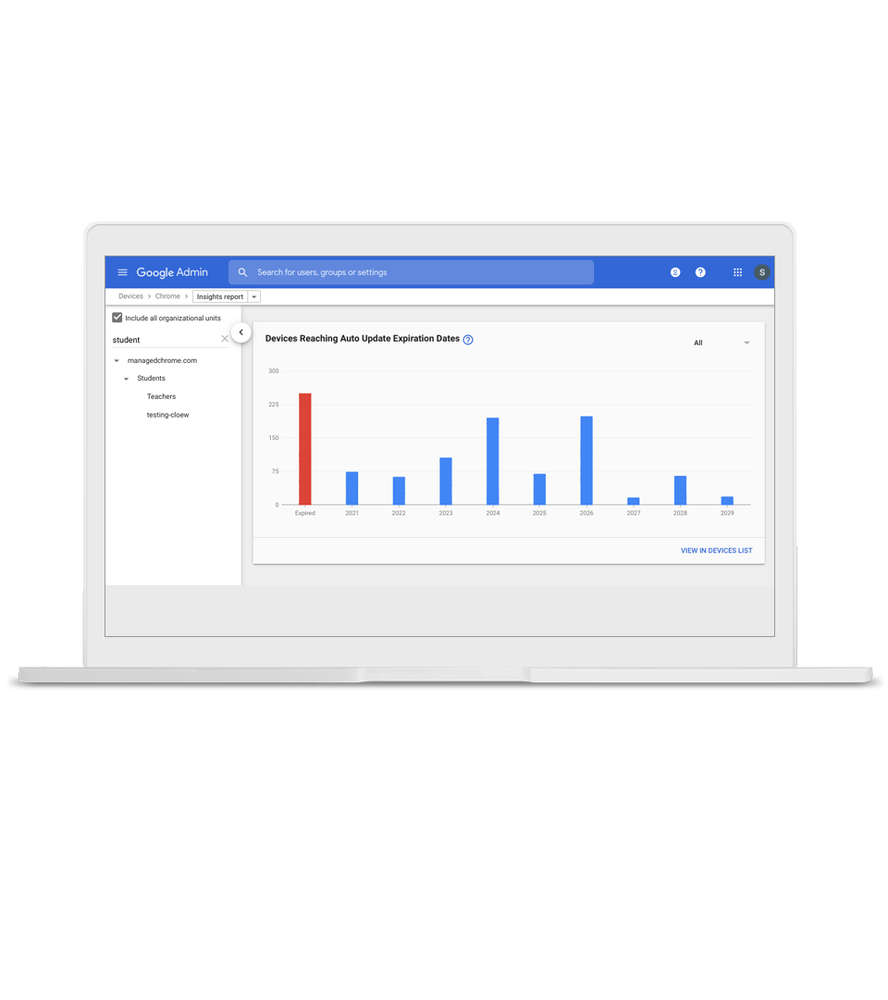
Automatic updates for up to eight years on devices keep them safe and secure – and with all of the latest and greatest security updates and new features. But it can be challenging to know when devices are reaching their Automatic Update Expiration date. Last year, we updated the Devices page of Google Admin Console to show when devices reach their AUE — and now, we’re adding a new page in Admin Console that enables admins to view Chrome Insights Reports. The first report will be a view of AUE dates of the device fleet, which helps you understand when and how many devices have reached, or are going to reach, their AUE dates. These reports will help you prepare for when you should be thinking about purchasing new devices, and how often.
Collaboration and security in Google Workspace for Education
Google Workspace for Education, previously known as G Suite for Education, offers simple and flexible tools so your school community can better collaborate, manage classes and create safe learning environments. Our latest updates include improved collaboration across our products and security improvements for all Google Workspace for Education customers.
The next evolution of collaboration
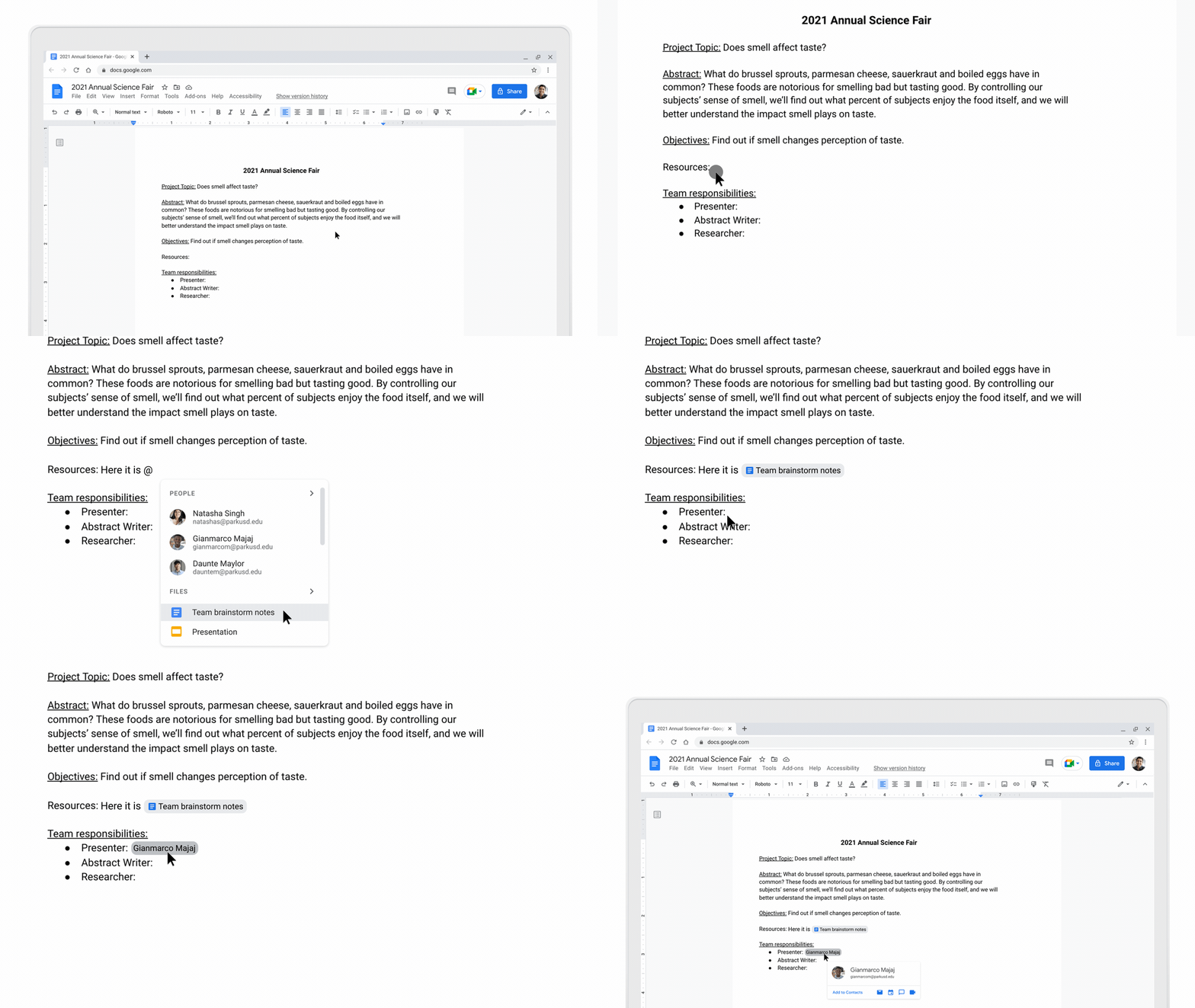
Last month we announced smart canvas, a new experience that enhances collaboration in the tools that you use every day — like Docs, Sheets and Slides—by making them even more interactive and intelligent.
One new feature of this experience is smart chips, which allows you to pull in helpful information from other Google Workspace products while working in a document. For example, if you’re a student working on a group project, you can quickly embed files from Drive or tag other students in your group right into your document by typing the ‘@’ sign. Once people are tagged, just hover over their name to quickly chat, email or set up a meeting.

Google Meet is more secure, easy to use and engaging
Over the past year, video conferencing became essential for teaching, learning and staying connected. Whether you’re still teaching remotely, in a hybrid setting or have returned to in-person instruction, Meet provides an easy, reliable and secure way for your school community to connect. Today, we’re announcing new features to Meet to continue supporting the evolving needs of school communities.
Secure by design
Meetings initiated from Google Classroom will soon be safer and more secure by design, with these updates coming in the next few months:
- Every teacher and co-teacher in a Classroom class will be meeting hosts in Meet by default, so multiple teachers can share the load of managing a class.
- Once a teacher is present, students who are on the Classroom roster will be automatically admitted to the meeting. Students will be placed into a “waiting room” and won’t be able to see or communicate with other participants until a teacher is present.
- Anyone who’s not on the Classroom roster will have to “ask to join” and only the teacher(s) can allow them into the meeting.
All meetings, including those started from Meet or Calendar, will get the following additional security updates in the coming months:
- When a host ends breakout rooms, participants will get a warning and then will be forced back into the main meeting.
- Hosts can match the breakout room safety settings with the safety settings from the main meeting.
- To quickly prevent distractions, hosts will be able to turn off everyone’s video at once with “video lock.”
- For hosts using tablets and mobile phones, we’re adding important meeting safety controls, like the ability to end meetings for everyone on the call and mute everyone at once.
Classroom adapts for the future of learning and teaching
Over the last year, the use of education technology skyrocketed as schools hustled to keep students learning. As some students return to their classrooms and others continue learning from home, we’re optimistic about the role education technology can play to help teachers and school leaders as they make up for lost time.
We saw Classroom become a center for teaching and learning for millions of teachers and students this year, with many schools now using Classroom as their learning management system (LMS). This was only possible thanks to the support and feedback of teachers around the world. We were amazed by how quickly they learned the tools and put them into practice.
Change in education is inevitable. As the needs of institutions evolve, Classroom will keep pace. Today, we’re sharing some important updates to features we previously shared on our roadmap as well as some new ones we developed with input from teachers and education leaders:
Roster import:Starting this summer, U.S. districts with Google Workspace for Education Plus will be able to automatically set up classes and keep rosters in sync with their Student Information System, powered by Clever. IT admins will be able to create and populate classes via Clever, saving teachers valuable prep time.
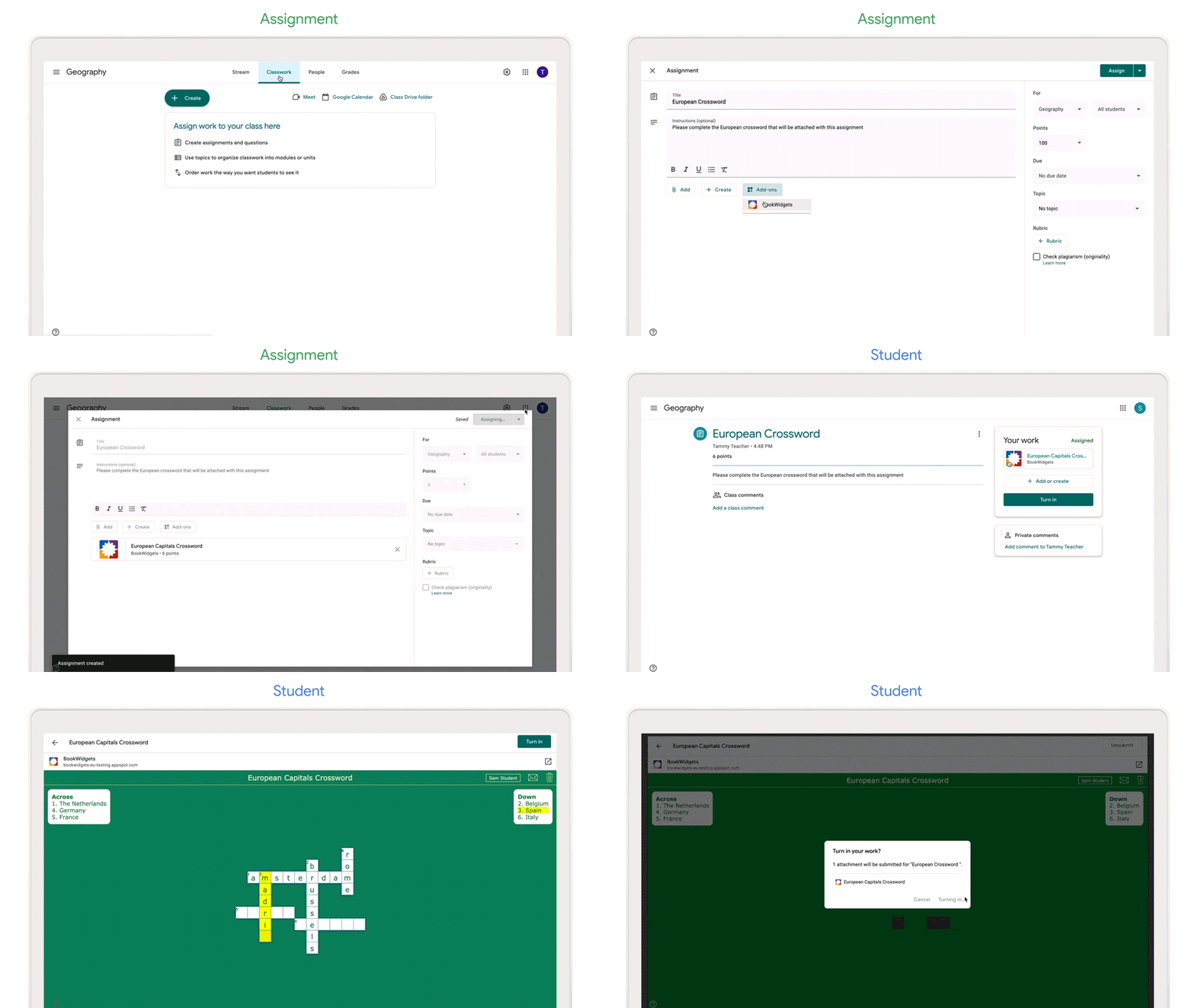
Classroom add-ons:Coming to beta later this year for districts with the Teaching and Learning Upgrade or Education Plus, Classroom add-ons allow you to bring your favorite content and activities from top edtech tools right inside Classroom. Admins will be able to pre-install add-ons for multiple teachers or groups at once.
We’re starting with nine partners including Adobe Spark for Education, BookWidgets, CK-12 Foundation, Edpuzzle, IXL, Kahoot!, Nearpod, Newsela and SAFARI Montage, with plans to expand to many more. Here’s an example of how Bookwidgets is using add-ons to make it easier for teachers to assign an activity and students to complete it, without ever leaving Classroom.

Helping schools prepare for what’s next in education
Today at The Anywhere School, we shared great new ways to use Google Classroom, Google Workspace for Education, Google Meet, and Chrome OS – all focused on helping teachers and school leaders continue to do the amazing work they do.
Classroom is adapting for the future of learning and teaching
Classroom strives to be the simplest, easiest to use learning platform, but we’re continuously making improvements to make it even better. Roster Import will enable admins to set up classes at scale (and save a significant amount of time!) while Classroom add-ons will give educators a simple way to integrate their favorite content and activities. And the new student activity dashboard, the ability to schedule assignments across multiple classes and improvements to the Meet and Classroom integration will make it far easier to engage with students. Learn more in the Classroom blog.
Google Workspace for Education improves collaboration and security
Smart canvas makes Docs, Sheets and Slides more interactive and intelligent. With features like smart chips, checklists, table templates and assisted analysis, smart canvas enables stronger collaboration with anyone, from anywhere. We’re also strengthening the security of all Google Workspace for Education editions with Drive security improvements and additional advanced security for Education Plus and Education Standard customers. Learn more in the Workspace blog.
Google Meet is getting more secure, easy to use and engaging
Google Meet is adding features to continue supporting the evolving needs of school communities. Moderators and admins will have new controls, like the ability to force breakout room participants back into the main meeting and end any meeting from the investigation tool. Meet will also be easier to use now that it supports multiple moderators and the ability to pin multiple presenters at the same time. Video calls will be more engaging and inclusive with public live streaming to YouTube, hand-raising improvements and live translated captions. Learn more in the Meet blog.
Chromebooks get more personalized
As schools transition from shared Chromebook carts to assigned devices, they are also getting much easier to use and manage. Signing in securely is now a breeze with PIN logins. Admins can now easily see when Automatic Update Expiration dates are reached across their fleet with Chrome Insights Reports. And with new built-in accessibility features like Point Scanning mode with Switch Access, and the new panning method for the full-screen magnifier, teachers and students alike can present and access information in a way that works for them. Learn more in the Chromebook blog.
We are constantly humbled by the amazing ways educators use our tools to better collaborate, manage classes, and create safe learning environments. Whether you’re about to wrap up your school year or still have a few months left, we hope that by sharing these updates now, we can help you be better prepared to use these tools in your institution. To get regular product updates, please sign up for our newsletter and follow us on Twitter.

Easy data protection with Android Enterprise Essentials
Mobility is critical to how businesses keep their teams connected, especially in a hybrid world where so many of us can work from anywhere. This trend is great for team productivity, and it gives businesses the tools they need to digitize their work and serve customers.
Yet these businesses must be ever mindful of threats to device security — 47% of companies have seen an increase in cyberattacks since the work from home shift began.
Security breaches can be devastating for any organization, especially with mobile devices being linked to a company’s sensitive data. But unfortunately small to medium-sized businesses (SMBs) are less able to absorb the high costs of these security breaches. According to a National Cyber Security Alliance survey, after experiencing a breach, 10% of SMBs file for bankruptcy and 25% go out of business.
With limited budgets and IT resources, most SMBs must choose between management products that are costly and overly complex for their needs, or no protection at all.
At Google, we take a security-first approach to our products, and are committed to helping businesses of all sizes keep their data safe and secure. That is why we built Android Enterprise Essentials — an automatic and affordable security service for businesses with simpler needs. Essentials is designed and built by the Android team at Google, guided by our deep experience creating secure and helpful solutions for organizations. We’ve put the needs and realities of SMBs first to create a streamlined set of security and management defaults at an affordable price.
Available in more markets
After offering early access to Essentials through our launch partners, it is now generally available through additional partners in the U.S., the U.K, Japan, France and Germany, with more countries coming soon.
Essentials makes securing and managing devices a breeze. Devices with Essentials are automatically enabled with critical features enabled like remote wiping lost or stolen devices and enforcing a screen lock or preventing sideloading of applications. You can send devices directly to your employees, who can automatically set them up and put them to use right away with no training required. If you ever need to take action, you can view and manage devices via an easy-to-use, streamlined portal. And it all comes at an affordable price, with no additional IT investment required.
Essentials also works for larger organizations that wish to extend core protections to devices that don’t need advanced device management. Essentials can serve as a starting point for customers who want to try out simple management at first, and consider upgrading to more sophisticated management solutions in the future.
Simple solutions for customers
National Services for Health Improvement (NSHI) is a U.K.-based organization focused on improving patient outcomes for its network of global healthcare clients. Essentials provided a quick method to mobilize its teams without a complex setup process.
Having Essentials applied to devices out of the box means we don’t need to worry about training employees or having to spend time setting it up.
Morris & Perry, an asphalt and concrete supplier that has been in operation in the U.K. since 1928, wanted to help its drivers stay connected and access important data throughout the day. Essentials offered them a simple path to select devices and quickly get them into employees’ hands with security features like remote wipe and PIN reset automatically enabled.
“Setting up our devices with Android Enterprise Essentials was fast and easy,” says Will Vincent, financial controller with Morris & Perry. “It significantly helped our operations, as we can remotely reset PIN codes while meeting our security guidelines.”
Get started today
Essentials is now available through a wider network of resellers. We’re pleased to welcome The Barcode Warehouse and Telserve in the U.K.; LDLC Pro, DAMS and Saphelec in France; Brodos and Everphone in Germany; Synnex in Japan and Vox Mobile in the U.S.
Essentials brings much needed tools that help make mobility more secure and accessible for businesses. Check out our Essentials website to learn more. And if you’re interested in becoming an Essentials partner, please visit the Android Enterprise Partner Portal to register for our partner community.