
Buono sconto da 6 euro su Amazon grazie al servizio Ricarica. Tutti i dettagli

Google citata in giudizio negli USA per abusi nel Play Store

La crescita di Edge e il declino di Firefox
Caso JEDI, cos’è successo e cosa cambia per Microsoft e Amazon?

100 euro per tutti: ecco come funziona il nuovo Bonus TV
Launching the AI Academy for small newsrooms
As people searched for the latest information on COVID-19 last year, including school reopenings and travel restrictions, the BBC recognized they needed to find new ways of bringing their journalism to their audiences. They released a new online tool, the BBC Corona Bot, which uses artificial intelligence to draw on BBC News’ explanatory journalism. It responds with an answer to a reader’s specific question where possible, or points to health authorities’ websites when appropriate. AI technology allowed BBC News to reach new audiences and drive more traffic to their stories and explainers.
This is one example of how AI can help newsrooms. AI can help build new audiences and automate tasks, freeing up time for journalists to work on the more creative aspects of news production and leaving tedious and repetitive tasks to machines. However, newsrooms around the world have told researchers they worry that access to AI technology is unequal. They fear big publishers likely will benefit most from artificial intelligence, while smaller news organizations could get left behind.
To help bridge this gap, the Google News Initiative is partnering with Polis, the London School of Economics and Political Science’s journalism think tank, to launch a training academy for 20 media professionals to learn how AI can be used to support their journalism.
The AI Academy for Small Newsrooms is a six-week long, free online program taught by industry-leading journalists and researchers who work at the intersection of journalism and AI. It will start in September 2021 and will welcome journalists and developers from small news organizations in the Europe, Middle East, and Africa (EMEA) region.
By the end of the course, participants will have a practical understanding of the challenges and opportunities of AI technologies. They will learn examples of how to use AI to automate repetitive tasks, such as interview transcription or image search, as well as how to optimize newsroom processes by getting insights on what content is most engaging.
For example, other newsrooms using AI technology in the region include Schibsted, a Nordic news outlet that developed an innovative model to reduce gender bias in news coverage, while in Spain, El Pais uses an AI-based tool to moderate toxic comments.
Most importantly, participants will create action plans to guide the development of AI projects within their news organizations. JournalismAI will share these plans openly to help other publishers around the world.
This pilot program — which we plan to launch in other regions in 2022 — is part of a broader training effort over the last three years by JournalismAI, a partnership between the GNI and Polis to forester AI literacy in newsrooms globally. More than 110,000 participants have already taken the online training modules available on the Google News Initiative Training Center.
This year, JournalismAI will also create an AI Journalism Starter Pack to make the information about AI in journalism more accessible to small and local publishers. It will include examples of AI tools that can solve small and local publishers’ basic needs such as tagging or transcribing.
Find more detailed information on the AI Academy for Small Newsrooms and how to apply on the JournalismAI website. The deadline for applications is 11:59 PM GMT on August 1, 2021.

Donald Trump fa causa a Facebook, Twitter e Google!

Kick like a pro with Footy Skills Lab
When I was growing up in Brisbane, Aussie Rules football wasn’t offered as a school sport – and there weren’t any professional female role models to look up to and learn from. Despite these limitations, we got resourceful. We organized football games in our lunch breaks with friends, using soccer or rugby goal posts and adding sticks or cones to serve as point posts. We practised accuracy using rubbish bins as targets.
A decade later, women have truly made their mark in the AFL. There are, however, many barriers still facing aspiring footy players — including access, cost, mobility and, more recently, lockdown restrictions. We still have to be resourceful to keep active and hone our skills.
Three years ago, the AFL and Google first teamed up to help footy fans better connect with the games and players they love. Since then, we’ve been thinking about ways we could improve access to Aussie Rules coaching and community participation – regardless of ability, gender, location, culture or socio-economic background.
3 ways automation can help publishers succeed
For publishers, constantly adapting to change is just part of the job. In a relatively short timespan, we’ve seen the industry make huge strides in building efficiencies and transforming the way it drives revenue. But even in an environment where change is the norm, some years bring more challenges than others. The pandemic has brought fundamental disruptions to publishers’ businesses, not to mention new regulations and a move to remote collaboration.
In other words, publishers are changing the way they work — and to do it, they’re increasingly looking for insights into their ads business. From May 2020 to May 2021, we’ve seen a 48% increase in reports created in Data Studio for Google Ad Manager. That’s why we’ve been working on new ways to help our partners solve complex problems with machine learning, and help them save precious time and resources. As you navigate your own process, here are three ways Ad Manager can help you create value with automation.
1. Earn more with less effort
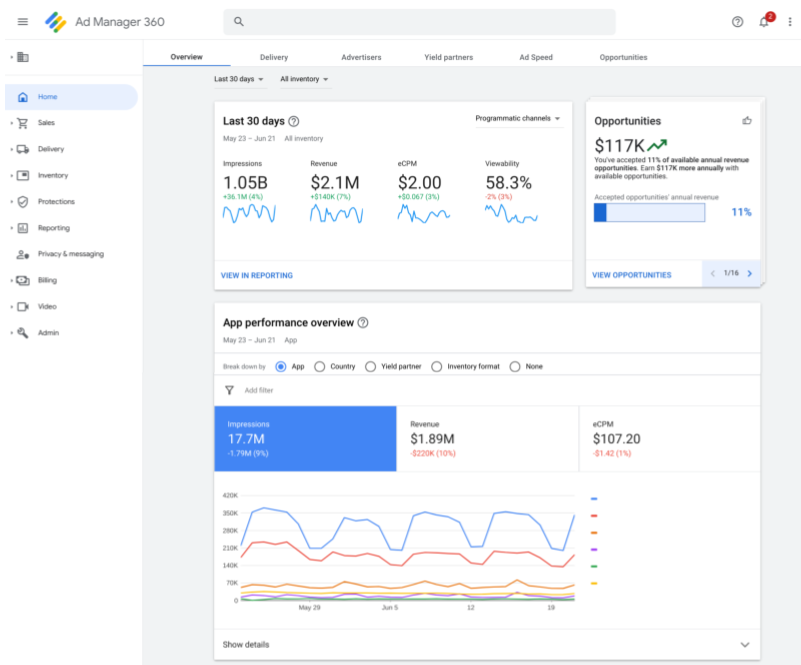
To help you uncover more value from your existing inventory, Ad Manager puts machine learning to work and automatically surfaces new opportunities to maximize revenue. Then our solutions let you quickly implement or easily run an experiment to test before you commit to the change.
For example, the Opportunities & Experiments feature estimates the opportunity created if you were to change a certain pricing rule or setting, then helps you run an experiment to validate the estimate, and finally activate the opportunity — all in one place. As a result, you’ll better understand the effect it has on your business, and can run a real-time experiment to verify it.
2. Identify issues and opportunities
Today, it’s harder than ever to monitor performance and identify issues and opportunities in your ad business operations. To help, Ad Manager both automatically surfaces opportunities for you as well as provides the tools to access the data to power your own insights and learning.
Ask a Techspert: What’s a neural network?
Back in the day, there was a surefire way to tell humans and computers apart: You’d present a picture of a four-legged friend and ask if it was a cat or dog. A computer couldn’t identify felines from canines, but we humans could answer with doggone confidence.
That all changed about a decade ago thanks to leaps in computer vision and machine learning – specifically, major advancements in neural networks, which can train computers to learn in a way similar to humans. Today, if you give a computer enough images of cats and dogs and label which is which, it can learn to tell them apart purr-fectly.
But how exactly do neural networks help computers do this? And what else can — or can’t — they do? To answer these questions and more, I sat down with Google Research’s Maithra Raghu, a research scientist who spends her days helping computer scientists better understand neural networks. Her research helped the Google Health team discover new ways to apply deep learning to assist doctors and their patients.
So, the big question: What’s a neural network?
To understand neural networks, we need to first go back to the basics and understand how they fit into the bigger picture of artificial intelligence (AI). Imagine a Russian nesting doll, Maithra explains. AI would be the largest doll, then within that, there’s machine learning (ML), and within that, neural networks (… and within that, deep neural networks, but we’ll get there soon!).
If you think of AI as the science of making things smart, ML is the subfield of AI focused on making computers smarter by teaching them to learn, instead of hard-coding them. Within that, neural networks are an advanced technique for ML, where you teach computers to learn with algorithms that take inspiration from the human brain.
Your brain fires off groups of neurons that communicate with each other. In an artificial neural network, (the computer type), a “neuron” (which you can think of as a computational unit) is grouped with a bunch of other “neurons” into a layer, and those layers stack on top of each other. Between each of those layers are connections. The more layers a neural network has, the “deeper” it is. That’s where the idea of “deep learning” comes from. “Neural networks depart from neuroscience because you have a mathematical element to it,” Maithra explains, “Connections between neurons are numerical values represented by matrices, and training the neural network uses gradient-based algorithms.”
This might seem complex, but you probably interact with neural networks fairly often — like when you’re scrolling through personalized movie recommendations or chatting with a customer service bot.
So once you’ve set up a neural network, is it ready to go?
Not quite. The next step is training. That’s where the model becomes much more sophisticated. Similar to people, neural networks learn from feedback. If you go back to the cat and dog example, your neural network would look at pictures and start by randomly guessing. You’d label the training data (for example, telling the computer if each picture features a cat or dog), and those labels would provide feedback, telling the neural network when it’s right or wrong. Throughout this process, the neural network’s parameters adjust, and the neural network transitions from not knowing to learning how to identify between cats and dogs.
Why don’t we use neural networks all the time?
“Though neural networks are based on our brains, the way they learn is actually very different from humans,” Maithra says. “Neural networks are usually quite specialized and narrow. This can be useful because, for example, it means a neural network might be able to process medical scans much quicker than a doctor, or spot patterns a trained expert might not even notice.”
But because neural networks learn differently from people, there’s still a lot that computer scientists don’t know about how they work. Let’s go back to cats versus dogs: If your neural network gives you all the right answers, you might think it’s behaving as intended. But Maithra cautions that neural networks can work in mysterious ways.
“Perhaps your neural network isn’t able to identify between cats and dogs at all – maybe it’s only able to identify between sofas and grass, and all of your pictures of cats happen to be on couches, and all your pictures of dogs are in parks,” she says. “Then, it might seem like it knows the difference when it actually doesn’t.”
That’s why Maithra and other researchers are diving into the internals of neural networks, going deep into their layers and connections, to better understand them – and come up with ways to make them more helpful.
“Neural networks have been transformative for so many industries,” Maithra says, “and I’m excited that we’re going to realize even more profound applications for them moving forward.”

How to keep content coming
As writers, photographers, and artists, we have so much to do, but limited time to get it all done. With people online around the world and around the clock, there is pressure to turn out content frequently and across a growing number of platforms. So how can you keep up? Four creators we spoke to share their tips for optimizing the time you spend creating content so you can keep it coming — and keep it fun — while staying efficient and organized.
Block time on your calendar
It can be difficult to find the time every day to write a posts and promote them across channels. One strategy is to pick a routine time to create content and stick with it. Musician, entertainer, and lifestyle blogger Rigel Gemini recommends producing content on a weekly basis for at least one channel and keeping it fun. “If content becomes a chore or becomes too much work, you will start to dread it. So just figure out something that you can write about or photograph or talk about every week and dive in,” Rigel says.

11 Ways Top B2B Marketers Are Breaking Free of Boring B2B
How can B2B marketers in 2021 break free from conventional and oftentimes boring B2B efforts?
We’re fortunate to have 11 takes on this important topic from some of the top subject matter experts in B2B marketing, with a wide range of insight on how marketers can smash through traditional boring-to-boring marketing.
Our third season of the Break Free B2B Marketing series of video interviews has given us a new group of experts, influencers, and future-thinkers all gathered for one purpose: sharing the ways they’ve broken free and how you can do the same for yourself, your brand, and your business.
Let’s jump right in and see how 11 influential voices in B2B marketing go about breaking through, with actionable tactics you can implement in your own marketing efforts as we head toward 2022.
Minda Harts of The Memo on Having Courageous Conversations
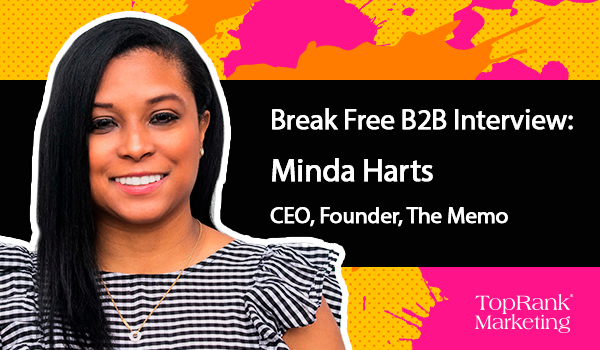
Minda Harts
CEO and Founder, The Memo
“I think in order to break free, it starts with ourselves,” Minda said.
“We have to be willing to have those courageous conversations and we have to be willing to be courageous listeners, and once we’ve had some time to sit with ourselves and educate ourselves, then I think we allow ourselves to break free,” Minda added.
[bctt tweet=”“We have to be willing to have those courageous conversations and be courageous listeners. Once we’ve had some time to sit with ourselves and educate ourselves, then I think we allow ourselves to break free.” — Minda Harts @MindaHarts” username=”toprank”]Watch, listen to or read the full interview by checking our the full blog post “Break Free B2B Marketing: Minda Harts of The Memo on Having Courageous Conversations.”
Keith Townsend of The CTO Advisor on Bringing Value Through Friction
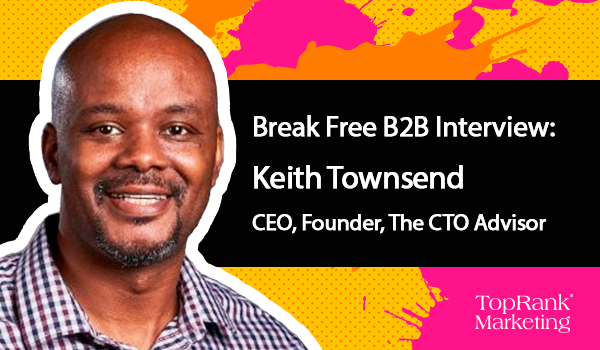
Keith Townsend
Co-Founder, The CTO Advisory
“One of the toughest things as a leader in my own organization — what helped me break free is when I’m willing to have the difficult conversations,” Keith noted.
“Things that we say are difficult conversations, because we’re fearful of the outcome — I’m a big believer that friction brings value at the end of the day. When — you not necessarily inject — friction, but not avoid friction, it usually brings pretty good value.”
“When I’m willing to tell one of my employees or one of my contributors that, ‘You know what, the piece of work that you brought me just isn’t up to our standard.’ None of them just go away and don’t bring me back a revised piece of work. They usually come back with work that impresses me. Because we engage them for a reason and hire them for a reason.”
“To stand out, don’t avoid those difficult conversations.”
[bctt tweet=”“I’m a big believer that friction brings value at the end of the day. When — you not necessarily inject — friction, but not avoid friction, it usually brings pretty good value.” — Keith Townsend @CTOAdvisor” username=”toprank”]Watch, listen to or read the full interview by checking our the full blog post “Break Free B2B Marketing: Keith Townsend of The CTO Advisor on Bringing Value Through Friction”
Dez Blanchfield of Sociaall on Joining the Conversation
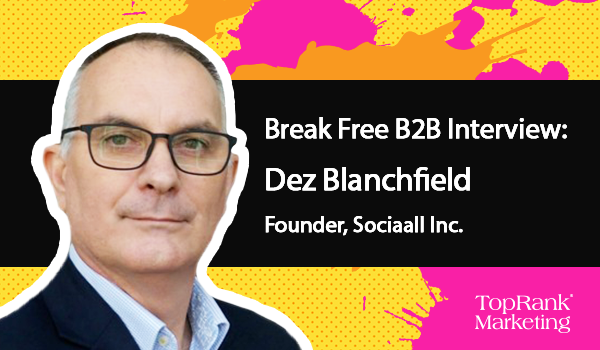
Dez Blanchfield
Founder, Sociaall Inc.
“My only ask is that people join the conversation. That’s all I want people to do. I think that if there was one phrase that if I was going to be buried and put in the grave, on my tombstone would be ‘Just join the conversation. If and when it suits you,’” Dez said.
“The advice I’ve been giving people in the last three to five years is that it was a time when you could do it all yourself. If you were an airline, or a bank, or if you were in health care, or wealth management, if you’re a telco, there was a time when you could do it all, you could run your own telephone systems, run your own technology, stack your own email servers, your own domain name servers. But the complexity is so great now and the speed at which we have to move, is so rapid, and so short, and you know that the demand is for reduced time to market,” Dez added.
“The advice I’m giving people now is: find the best partner choice. In each of the segments, you need to be able to address problems. So if you’re a bank, be a bank, focus on being the best bank, you can, and look for things that are going to disrupt you. But don’t try to be a phone company. Don’t run your own PBX, don’t run your voice systems. If you own a website, don’t become a hosting company. Don’t waste your time running web services,” Dez explained.
[bctt tweet=”“If you’re a bank, be a bank, focus on being the best bank you can, and look for things that are going to disrupt you. But don’t try to be a phone company.” — Dez Blanchfield @dez_blanchfield” username=”toprank”]Watch, listen to or read the full interview by checking our the full blog post “Break Free B2B Marketing: Dez Blanchfield of Sociaall on Joining the Conversation.”
Tamara McCleary of Thulium on Visions of the Future and Doing No Harm
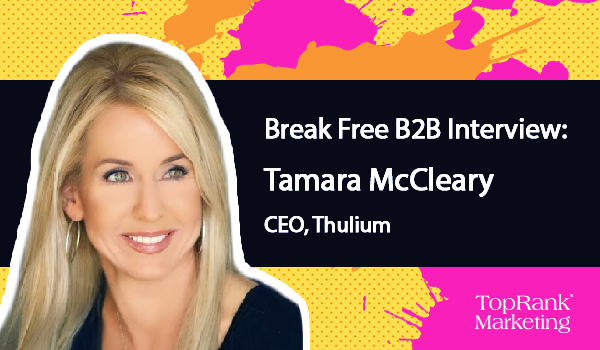
Tamara McCleary
CEO, Thulium
“It’s tough right now for B2B leaders, and I have a heart for B2B leaders. I have a huge heart for B2B marketing leadership, because marketing budgets are being hacked away — with COVID, 2020 was a huge shake-up, we didn’t even have those live events anymore — think of all the marketing dollars that were going around big events,” Tamara shared.
“It’s always been difficult for the B2B enterprise — whether you were in marketing, sales, IT, or HR — it doesn’t matter. What you’ve been tasked with is, ‘Hurry up and digitally transform yourself to meet the future,’ but you have limited resources to do that, and oh, by the way, continue doing everything you were already doing, under budget.’”
“Be gentle and kind to yourself, because all the stress and pressure you’re under right now — you’re not alone. It’s a new world for all of us, where the paradigm has shifted, and although you have to be mindful of this particular quarter that you’re in, don’t become myopic and focus your thinking only about this quarter. You absolutely owe it to yourself — you’re worth it — to be able to think, ‘What do I need to do to learn how to stay ahead in this technologically advanced world?’ Where in the very near future brands will not own the relationship with the customer — platforms will.”
How are we creating an ecosystem of partners with platforms out there — whether that’s the Googles, the Amazons, or the Microsofts of the world — how are we creating partnerships so that our products and services are offered through those intermediary digital assistants that will become the primary person functioning and giving all the information? Your digital assistant — your little Echo or any other device you would like to use, is going to become more sophisticated very soon, and that is going to be what your customer — your human — is going to for information and to handle all of its mundane tasks.”
“If you don’t have relationships with the platforms that house these digital assistant devices, you’re out.”
[bctt tweet=”“Be gentle and kind to yourself, because all the stress and pressure you’re under right now — you’re not alone. It’s a new world for all of us, where the paradigm has shifted.” — @TamaraMcCleary” username=”toprank”]Watch, listen to or read the full interview by checking our the full blog post “Break Free B2B Marketing: Tamara McCleary of Thulium on Visions of the Future and Doing No Harm.”
Nicole Brady of SAHM Reviews on the Importance of Empathy in Reaching Your Niche
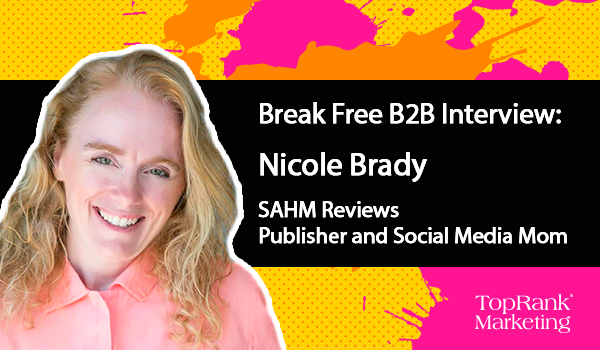
Nicole Brady
Publisher, SAHM Reviews
“Think outside the box — if you see your competitors doing something, don’t do it — do something else,” Nicole said.
“You have to really make a name for yourself — whatever it is — whether it’s sharing your flaws, creating interviews, asking for real feedback from the people who are your consumers, whether it is on a B2B or B2C basis — the people who are utilizing your product or service, and talking to them to find out why they’re dealing with you and why they’re buying your product or using your service instead of somebody else’s.”
“Find out what makes you different and what makes people want to talk to you, and then leverage it. Share those details, and create content around those details. As more and more people are on social media, being able to find those out-of-the-box environmental things that make you tick — that you might not have known — showing them off, that’s the way to do it.”
[bctt tweet=”“Find out what makes you different and what makes people want to talk to you, and then leverage it. Share those details, and create content around those details.” — Nicole Brady @SahmReviews” username=”toprank”]Watch, listen to or read the full interview by checking our the full blog post “Break Free B2B Marketing: Nicole Brady of SAHM Reviews on the Importance of Empathy in Reaching Your Niche.”
Eric Vanderburg of TCDI on The Changing Cybersecurity Landscape

Eric Vanderburg
Vice President of Cybersecurity, TCDI
“Stop looking at security as something that’s going to hold you back, or as this big cost factor, and start looking at it as something that will free you. When you talk about breaking free — many companies are held back right now, because of fear,” Eric urged.
“They may not enter that market or do business in this space, or they may not collect this private information, because they’re afraid that it may be exposed — that they may subject themselves to additional liability, and all these other fears — rather than looking at this and saying, ‘OK, I want to do this business.’”
“Certainly it comes at a cost, right — I need to invest in so many different ways, and security is another way to invest. Invest in that and now it allows me to move forward with confidence, rather than shoring up my defenses and only doing what I’m comfortable with.”
[bctt tweet=”“Stop looking at security as something that’s going to hold you back, or as this big cost factor, and start looking at it as something that will free you.” — Eric Vanberburg @vtamethodman” username=”toprank”]Watch, listen to or read the full interview by checking our the full blog post “Break Free B2B Marketing: Eric Vanderburg of TCDI on The Changing Cybersecurity Landscape.”
Sarah Barnes-Humphrey of Shipz and The Art of Consistent Change
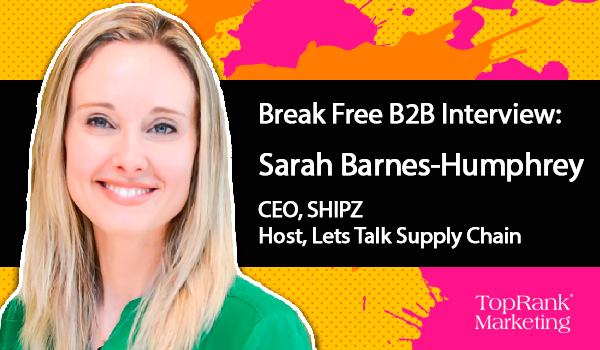
Sarah Barnes-Humphrey
CEO, SHIPZ
“Lean into your teams and allow them to really shine from a social media perspective. I say that from a LinkedIn perspective, because I think we need more voices on a platform like LinkedIn — interacting, sharing thoughts, and really supporting teams, and being able to share those thoughts,” Sarah noted.
“I also think that teams are handling a lot of things right now — there are a lot of things coming at them — they’re handling a lot of emotions when it comes to their teams. I want to make sure that supply chain leaders and marketing leaders are taking time for themselves and making sure that they are not only checking in on their teams, but checking on each other and themselves as well.”
[bctt tweet=”“I want to make sure that supply chain leaders and marketing leaders are taking time for themselves and making sure that they are not only checking in on their teams, but checking on each other and themselves as well.” @bevictoryus” username=”toprank”]Watch, listen to or read the full interview by checking our the full blog post “Break Free B2B Marketing: Sarah Barnes-Humphrey of Shipz and The Art of Consistent Change.”
Liam McIvor Martin of Time Doctor on The Revolutionary Power of Remote Work
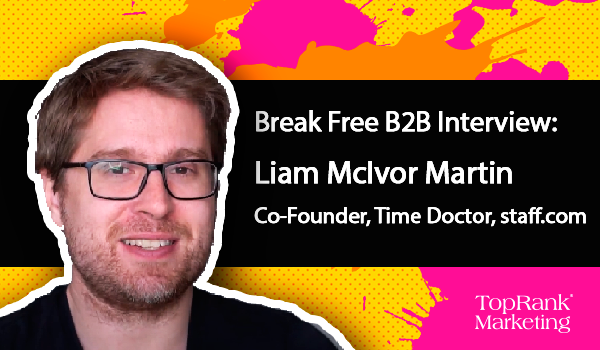
Liam McIvor Martin
Co-Founder, Time Doctor
When it comes to remote and hybrid work, Liam has years of experience and plenty of helpful advice.
“Do it. Try it. Pre-COVID I would have told everyone, ‘Hey, you know what — why don’t you make a couple people remote?’ Or why don’t you make a department remote? You can’t do that right now — you have to jump in full-on. If you’re not already remote, you’re probably not going to do that, because of how long we’ve already been in COVID — but fundamentally, measure your metrics, create very clear documentation of all of your processes, and communicate effectively with your team,” Liam said.
“If you can do those three things, and people can continuously report metrics to you, regardless of whether you’re using a tool like Time Doctor or even if you’re using an Excel spreadsheet — defining those metrics and saying, ‘I got X amount of leads today, and this is on target for my Q3 goal.’ That’s going to be great — you’re going to be doing better than 90 percent of people.”
“Even if you choose to go back inside of an office, those things that you’ve done are fundamentally going to make your company run faster.”
[bctt tweet=”“My estimate is that after COVID is over, we’re probably going to float to around 50% of the US workforce working remotely.” — Liam McIvor Martin @vtamethodman” username=”toprank”]Watch, listen to or read the full interview by checking our the full blog post “Break Free B2B Marketing: Liam McIvor Martin of Time Doctor on The Revolutionary Power of Remote Work.”
Oliver Christie on Making Life Better With AI
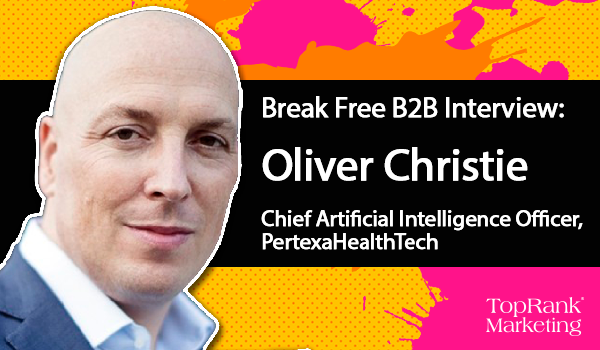
Oliver Christie
Chief Artificial Intelligence Officer, PertexaHealthTech
“I think it’s about asking a big question, and some of it is quite challenging — where could your company or industry go if you have a blank slate? We need that big question. We need leadership to get the artificial intelligence (AI), the tools, and the data — that’s all secondary — but what is that big question? I think that’s the best that any leader could ask,” Oliver noted.
[bctt tweet=”“I think that the next big leap is going to be our products and services are going to be much more reactive to who we are.” — Oliver Christie @OliverChristie” username=”toprank”]Watch, listen to or read the full interview by checking our the full blog post “Break Free B2B Marketing: Oliver Christie on Making Life Better With AI.”
Tim Crawford of AVOA on The New Normal
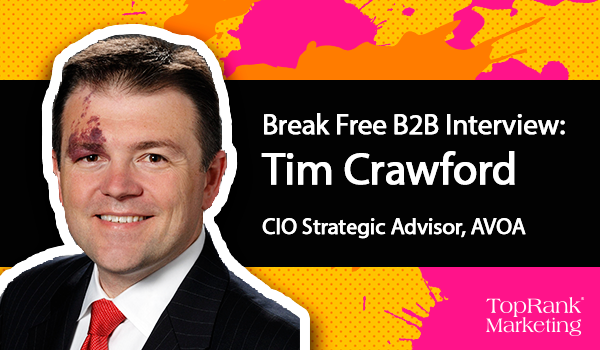
Tim Crawford
CIO Strategic Advisor, AVOA
“The big thing is understanding your customer and their customer. Once you understand that second degree of separation — not just the first degree — it really puts you in a differentiated position,” Tim explained.
“Understand what’s in your wheelhouse and what’s not, but never, ever forget to always look at it from the customer’s lens. Don’t just look at it from your lens of ‘Hey, this is what we do. This is what we sell. Our product can do X for you.’ That’s a bad place to start.”
“A better place to start, and a place I look for as a customer is, ‘Who are you in the relationship for?’ If you start with understanding me, and have shown you’ve done a little bit of homework, that’s going to take my wall down a little bit, and start to build trust.”
“Building that trust in those relationships is key to success moving forward. Authenticity, experience — add it to the list.”
[bctt tweet=”“The big thing is understanding your customer and their customer. Once you understand that second degree of separation — not just the first degree — it really puts you in a differentiated position.” — Tim Crawford @tcrawford” username=”toprank”]Watch, listen to or read the full interview by checking our the full blog post “Break Free B2B Marketing: Tim Crawford of AVOA on The New Normal.”
Kevin L. Jackson of GC GlobalNet on the Future of Cloud Computing
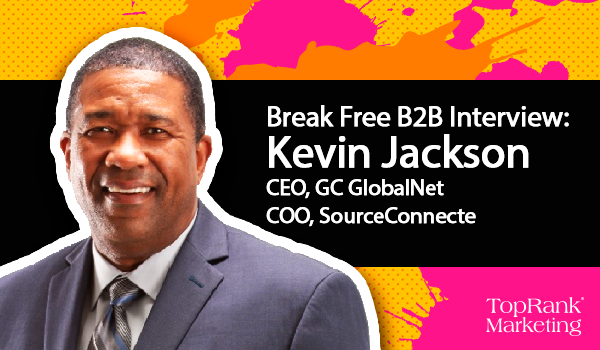
Kevin Jackson
CEO, GC GlobalNet
“You operate in a global and interconnected industry. Realize that you contribute most to your industry when you build and contribute to that global network,” Kevin observed.
“You really break free through collaboration and open dialogue with your colleagues and partners.”
[bctt tweet=”“You operate in a global and interconnected industry. Realize that you contribute most to your industry when you build and contribute to that global network.” — Kevin Jackson @Kevin_Jackson” username=”toprank”]Watch, listen to or read the full interview by checking our the full blog post “Break Free B2B Marketing: Kevin Jackson of GC GlobalNet on Cloud Computing.”
Smash Through Boring B2B Marketing
We hope you’ve found the tactics, insights, and tips from Kevin, Tim, Oliver, Liam, Sarah, Eric, Nicole, Tamara, Dez, Keith and Minda to be eye-opening as you plan your own B2B marketing in the lead-up to 2022.
For even more insight from leading B2B marketers, be sure to also check out our Inside B2B Influence series of video interviews and podcasts, including the latest featuring Justin Levy of Demandbase (client), in “Inside B2B Influence: Justin Levy of Demandbase on Optimizing B2B Marketing with Influence.”
Creating award-winning B2B marketing with an artful mixture of influence takes considerable time and effort, which is why many firms choose to work with a top digital marketing agency such as TopRank Marketing. Contact us today and let us know how we can help, as we’ve done for businesses ranging from LinkedIn, Dell and 3M to Adobe, Oracle, monday.com and others.
The post 11 Ways Top B2B Marketers Are Breaking Free of Boring B2B appeared first on B2B Marketing Blog – TopRank®.

AppsUP 2021: Huawei Mobile Services lancia il concorso per l’innovazione mobile

Jeff Bezos è l’uomo più ricco della storia