
Oggi al CICAPFest parlo di incertezze nell’esplorazione spaziale e discuteremo di Star Wars contro Star Trek

Anche oggi sarò ospite del CICAPFest 2021 a Padova: sarò a Palazzo Bo alle 17 per una chiacchierata sull’incertezza nell’esplorazione spaziale, e sarò al Centro Culturale Altinate alle 19.15 per difendere Star Trek nel dibattito Star Trek vs Star Wars.
Per sapere quali delle tante conferenze del CICAPFest sono disponibili anche in streaming video su YouTube, tenete d’occhio il canale YouTube del CICAP.

TikTok, 5 nuovi consigli per i genitori sviluppati con gli adolescenti

Spotify lancia Blend, playlist per condividere le affinità musicali

Netflix, 5 serie TV da non perdere a settembre 2021

WhatsApp multa da €225m per violazione leggi privacy UE
Country Press Australia titles to join Google News Showcase
For decades, Google has been a proud supporter of the Australian media industry, providing hundreds of millions of dollars to media organisations through our products and services, training programs, partnerships and assistance with digital transformation.
Earlier this year, we introduced our biggest investment to support the news industry yet – News Showcase and have signed more than 100 titles from across Australia with talks continuing with dozens more outlets of all sizes.
Today, we’re pleased to announce that we’ve significantly expanded the number of regional outlets on Showcase, having reached a new in-principle agreement with Country Press Australia.
Dozens of regional media outlets across Australia join Google News Showcase
Country Press Australia represents almost 180 independently owned regional and local newspapers and online platforms across Australia.
Under the agreement, it’s expected that Google will welcome over 70 regional Country Press Australia news publications to Google News Showcase – a product and licensing program that pays publishers to curate content and build deeper relationships with readers.
Kate Beddoe, Google’s Director of News Partnerships APAC, said the agreement would support many titles that have operated in their local communities for decades, providing vital news and information to their regions. “We are very pleased to reach this agreement and welcome Country Press Australia outlets to Google News Showcase,” Ms Beddoe said. “We are also working with Country Press Australia to support the ongoing digital transformation of its members, helping with the sustainability of these news businesses.”
“We’ve helped support the news industry for two decades and Showcase is our biggest investment yet. We look forward to continuing to build on this important work in partnership with the Australian news industry,” Ms Beddoe said.
Andrew Manuel, President of Country Press Australia, said the agreement recognises the vital importance of local news media to their communities. “Country Press Australia member newspapers provide an essential service to local communities and are vital to the local democracies being able to assist in holding those responsible to account,” Mr Manuel said.
“Local newspapers are often the only source of local news and provide a platform for informed public debate. This agreement will help sustain public interest journalism across regional Australia well into the future with a monetary exchange, innovation changes as well as enabling a sustainable online model for traditional newspaper publishers,” Country Press Australia President Andrew Manuel said.The CPA members bring the total number of publications on Showcase globally to nearly 1000.
Lessons from our first Community News Summit
“It’s hard being tiny on the internet,” S. Mitra Kalita,URL Media founder and former CNN Digital vice president, said during the inaugural Google News Initiative Community News Summit. “What it takes for me to get a dollar on local news versus a dollar in national news [is] so different.”
Google was thrilled to bring together such a diverse and insightful group of community news leaders from the U.S. and Canada many of whom echoed this sentiment from Mitra during the two-day event (Aug. 17 – 18), which focused on the challenges and opportunities local publishers face when growing and monetizing their audiences.
“Local news is where the rubber meets the road,” said summit host and GNI director Olivia Ma, in her opening remarks to a virtual audience of 495 publishers. “Those of us working on news here at Google take our responsibility to help people find trusted, authoritative local journalism very seriously.”
The COVID-19 pandemic accelerated the need for community news outlets to diversify revenue streams and innovate to find sustainable business models. “The reality was, I needed to get on the digital game plan or die,” Sonny Giles, CEO of the Houston Defender Network, said during a session on mythbusting digital advertising.
Rebekah Monson, the co-founder of Letterhead and Where.by.us, built on that thought in a conversation about entrepreneurial strategies for maximizing audiences. She noted that local news entrepreneurs have to rally limited resources to succeed. “I don’t know any news orgs that hustle and embrace innovation change and interaction faster or more totally than local news outlets,” Monson said.
Over the two days, publishers also talked about the wins and lessons learned from connecting with their audiences. While figuring out pricing structures for The Juggernaut, founder Snigda Sur said she was so afraid to charge a subscription fee at first and when she did, priced it too low. “What I wish I had known is (to) ask and ask for more,” Sur said. “Some of your earliest users are your biggest champions and your biggest ambassadors.”

eFootball 2022, data di lancio ufficiale e nuovi dettagli sul gioco

Cambio offerta per Iliad: ecco come avere 120 GB in 5G
Small gestures, big impact: Google ATAP’s latest work
Google is dedicated to making tech accessible for everyone, and our hardware innovation division, Google ATAP, is working on this as well. As part of a Jacquard (a connected apparel platform) research project, we at ATAP worked closely with members and advocates of the disability community to understand how advanced wearable technologies, like smart textiles, gesture interfaces and on-device AI can help more people.
Earlier this year, we worked with members of Champions Place, a shared living residence for young adults with disabilities, to better understand why existing technologies sometimes fall short of meeting the full needs of people with mobility and dexterity disabilities.
This research inspired us to use Jacquard technology to create a soft, interactive patch or sleeve that allows people to access digital, health and security services with simple gestures. This woven technology can be worn or positioned on a variety of surfaces and locations, adjusting to the needs of each individual.
We teamed up with Garrison Redd, a Para powerlifter and advocate in the disability community, to test this new idea.
Garrison’s feedback has been invaluable, and he’s shared some of his favorite functions. “The selfie option is helpful as far as creativity,” Garrison says. “If I’m in the gym and have the armband on I can capture images from a proper angle for my coach and the training staff, without having to wheel into position, which isn’t ideal. So that does increase my independence, which is important for individuals who have disabilities.” He also pointed out areas where we could improve. “It’s important that the surface can be sensitive to one or two fingers for people who may have more needs than I have.”
We hugely benefited from Garrison’s background and expertise, and implemented his feedback into our work. For example, we’re now developing machine learning models for gesture recognition that adapt over time to each person’s unique dexterity. This will allow people with different levels of motor disabilities to use simple gestures to do things like call someone, or order a rideshare service. These might seem like incremental steps forward, but as Garrison says, “It’s the small things that make a difference between being dependent and independent.”

Twitter lancia ufficialmente Super Follows, per contenuti a pagamento

Incrementare la risoluzione delle immagini tramite l’intelligenza artificiale di Google
The tale of the Dutch bookstore, the pivot and the Golden Pin
Bookstore Dominicanen can be found in a former Dominican church in the city of Maastricht, a thriving cultural hub and one of the oldest cities in The Netherlands. Before COVID, the bookstore welcomed almost one million visitors a year. They mostly relied on customers visiting in person to shop for a good read or to enjoy a coffee while admiring the store’s vault paintings and the unique 14th century fresco depicting scenes from Thomas Aquinas’ life. And then the pandemic hit.
The Covid-19 pandemic has had a major impact on businesses worldwide but it also sparked creativity and accelerated many businesses’ use of digital tools. In The Netherlands for example, 81% of Dutch SMEs made more use of digital tools to stay in touch with their customers during the lockdown and inform them about changes in their services.
Dominicanen was one such business to respond to the continuously changing circumstances, something that was recognised by Google with the awarding of the Golden Pin Award.
What are the Golden Pin Awards?
In summer 2021, the Google Netherlands team awarded Golden Pin Awards to twelve inspiring entrepreneurs across the country who managed to continue their services during the pandemic with creativity and the smart use of digital resources whilst receiving high user reviews on their Business Profiles on Google Maps and Search. The list of winners was diverse: from agame store to aknife sharpener, and from a fair fashion clothing shop to a brewery cafe.
The winners all demonstrated creativity in continuing to offer their services both online and offline, ranging from pop up drive-through restaurants to online tastings and fitting sessions for women’s clothing on YouTube.
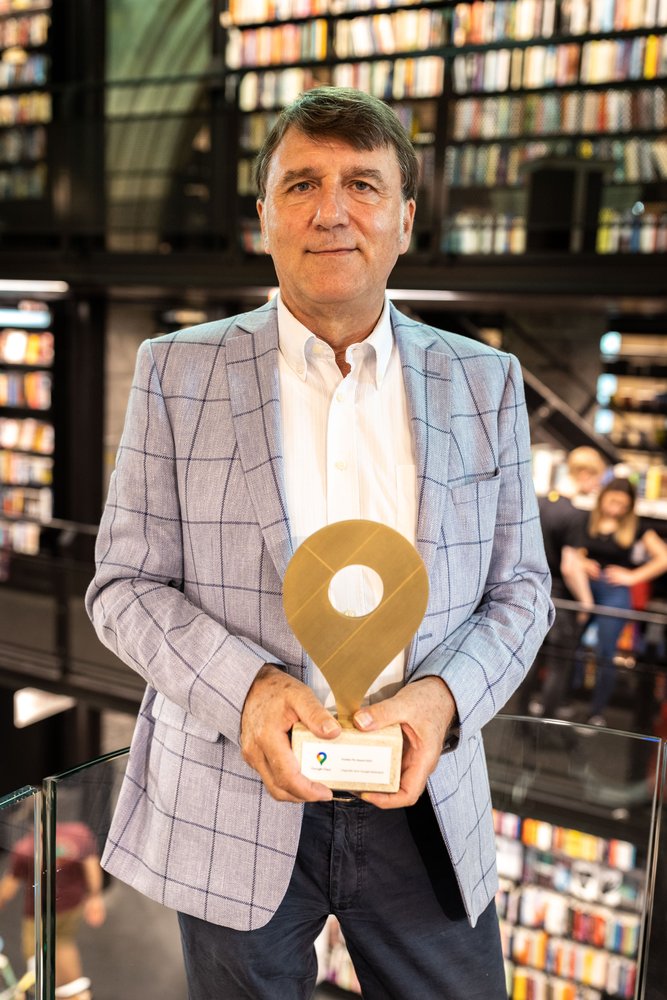
Bookstore owner Ton Harmes with his Golden Pin
How did Bookstore Dominicanen pivot?
For the owner, Ton Harmes, the key was perseverance. With the store having to close during the busiest weeks of the year – right in the middle of the holiday season – they had to adapt to survive. Their staff and volunteers immediately started delivering books by foot, bicycle and car. They also set up a takeout counter (offering click and collect online) and when numbers of visitors were limited, they decided to launch a pop-up store: Do(mini)canen.
Online, they invested heavily in their visibility on Google and in their social channels to keep in touch with their customers. Prioritising keeping their Business Profile on Google Maps and Search up to date, they were always able to indicate the changes in shopping times and services. Every change was immediately visible for their customers. They also started streaming book presentations and interviews with writers live on YouTube and communicated a lot more through all social media to keep customers informed.
Ton is convinced that the internet will continue to play a role in their business operations now they have reopened. Speaking to The Keyword he said, ‘We realized that with a million visitors a year, it seems like you don’t really need these ‘modern developments’. But when we closed it was suddenly dead quiet in the store. Then we realized how vulnerable we are if we rely solely on in-person customers and that we have to develop our digital channels faster. We now see online, even after corona, playing an increasingly important role in our contacts with customers – for both engagement and actually finding us. Our YouTube channel has received a boost and we keep reaching out to customers through our social channels. The crisis has really caused a change in our mindset.’
The Golden Pin Award has been given a special place in the store and serves as a reminder for the perseverance and pivoting that had to be done. Their ability to continue to conduct business through the worst of it is down to what Ton refers to as ‘Haw Pin’: Hold on.
Nasce Fan Factory, il sito di e-commerce di Koch Media Italia

50 years of film with NFTS and Google Arts & Culture
What do Wallace and Gromit, Blade Runner and We Need to Talk About Kevin all have in common? Answer: they were each made possible by alumni from the prestigious National Film and Television School based in Beaconsfield, UK.
The National Film and Television School (NFTS) is an internationally respected institution for education and creativity, launching the careers of many directors, producers, cinematographers, animators and more. Many of whom have gone on to become household names, and earn multipleBAFTAs and Oscars, makingNFTS the most awarded film school globally. To celebrate their 50th anniversary, for the first time in the school’s history, online audiences will be able to explore a new digital archive of over 200 graduate films from alumni of the school.
Alongside the films, audiences can explore a series of stories, curated playlists and articles. As well as newer films are creations from names such as: Nick Park (Wallace and Gromit), Lynne Ramsay (We Need to Talk About Kevin), and Fantastic Beasts director David Yates.