
Benvenuta, Fiat 500 Family Hey Google
 |
| Il badge Hey Google fa il suo debutto automobilistico sui modelli 500, 500X e 500L, accanto agli elementi grafici ispirati ai colori di Google sulle porte e negli interni. |


Google Maps più funzionale grazie all’intelligenza artificiale
Google Maps sempre più intelligente e per questo funzionale e preciso. E’ quanto si propone di realizzare presto Google grazie a un miglioramento dell’intelligenza artificiale del servizio. In quest’ottica l’azienda americana ha presentato alcuni nuovi strumenti che serviranno a rendere più efficace l’app e ad aiutare gli utenti a raggiungere più facilmente la loro destinazione.

Android, attenti al falso update di sistema che nasconde un virus
Nuovo allarme virus per gli utenti Android. Il malware è stato individuato dai ricercatori di sicurezza dei Zimperium zLabs in un’app chiamata “System Update”, che fortunatamente non è presente sul Play Store di Google, ma è scaricabile solo da siti di terze parti, pertanto può essere installato solo attraverso l’azione dell’utente.
Google’s €25 million contribution to media literacy
While navigating the uncertainty and challenges of the last year, it has proven more important than ever for people to access accurate information, and sort facts from fiction. That’s why Google is contributing €25 million to help launch the European Media and Information Fund to strengthen media literacy skills, fight misinformation and support fact checking. Our goal is to ensure that you and your family get the information you want, the answers you need and the accuracy you deserve.
Our five-year commitment will support the work of the European University Institute, the European Digital Media Observatory and the Calouste Gulbenkian Foundation to fund organizations seeking to address key challenges:
- Help adults and young people strengthen their media literacy skills
- Support and scale the critical work of fact-checkers
- Strengthen the expertise, research and resources to help fight misinformation
As the first to contribute to the European Media and Information Fund, we welcome and encourage other organizations to follow our lead and support this important work. It is clear there is an unmet demand for funding and research, with fewer than one in 10 Europeans having participated in any form of online media literacy training, according to a recent report.
In the coming weeks, the Fund will open for proposals from academics, nonprofits and publishers based in the European Union, Iceland, Liechtenstein, Norway, Switzerland and the United Kingdom. Independent committees made up of industry experts will select the winning ideas and Google won’t be involved in any decision making related to the Fund.
Our commitment today builds on our previous grants to fact checkers and nonprofits, including those related to the COVID-19 pandemic and vaccines, and our work to tackle misinformation in the run up to other major events, such as elections. Since 2015, we’ve provided funding and technical support to organizations focused on misinformation, including innovative new models like CrossCheck in France, and provided digital verification training to 90,000 European journalists, receiving over 400,000 visits to our training website.
And we’re of course continuing our other efforts to support media literacy for young people, with Be Internet Legends and Be Internet Citizens providing digital skills to help schoolchildren and teenagers verify and fact-check. Through our philanthropic arm, Google.org, we’ve provided €3.2 million in funding since 2018 to programs like Newswise, The Student View and Weitklick, and through the Google News Initiative additional funding to support Students for President and Zeit für Lehrer.
If you represent an organization with an idea, you can learn more about the Fund and find out when applications open by registering on this website.

TAG Bulletin: Q1 2021
This bulletin includes coordinated influence operation campaigns terminated on our platforms in Q1 2021. It was last updated on March 30, 2021.
January
-
We terminated 4 YouTube channels and 1 advertising account as part of our ongoing investigation into coordinated influence operations linked to Ukraine. This campaign uploaded content in Russian pertaining to current events in Kazakhstan and critical of European Union policies toward Moldova.
-
We terminated 5 blogs as part of our investigation into coordinated influence operations linked to Morocco. This campaign uploaded content in Arabic that was critical of the Algerian government. This campaign was consistent with similar findings reported by Facebook.
-
We terminated 5 YouTube channels as part of our investigation into coordinated influence operations linked to Brazil. This campaign was linked to a PR firm named AP Exata Intelligence and uploaded content in Portuguese expressing support for several mayoral candidates in Brazil. This campaign was consistent with similar findings reported by Facebook.
-
We terminated 6 YouTube channels as part of our investigation into coordinated influence operations linked to Kyrgyzstan. The campaign uploaded content in Kyrgyz critical of the former President Almazbek Atambayev and the opposition leader Adakhan Madumarov. This campaign was consistent with similar findings reported by Facebook.
-
We terminated 3 advertising accounts as part of our investigation into coordinated influence operations linked to Egypt. This campaign was linked to a PR firm named Mubashier and uploaded content in Arabic supportive of the Russian government across several countries in the Middle East.
-
We terminated 1 YouTube channel as part of our ongoing investigation into coordinated influence operations linked to Russia. This campaign uploaded content in Russian on current events in Ukraine.
-
We terminated 1 YouTube channel, 2 advertising accounts and 1 mobile developer account as part of our ongoing investigation into coordinated influence operations linked to Russia. This campaign uploaded content in Russian on such topics as the U.S. election and the poisoning of Alexei Navalny.
-
We terminated 5 YouTube channels as part of our ongoing investigation into coordinated influence operations linked to Russia. This campaign uploaded content in Russian on such topics as the annexation of Crimea and the Syrian civil war.
-
We terminated 2 YouTube channels and 1 advertising account as part of our ongoing investigation into coordinated influence operations linked to Russia. This campaign uploaded content in Russian on historical events in Afghanistan, Armenia and Ukraine.
-
We terminated 2 YouTube channels as part of our ongoing investigation into coordinated influence operations linked to Russia. This campaign uploaded content in Russian on such topics as the U.S. current events and Alexei Navalny political rallies.
-
We terminated 3 YouTube channels as part of our ongoing investigation into coordinated influence operations linked to Iran. This campaign uploaded content in English and was amplifying narratives on regional topics such as Israel, the Nagorno Karabakh conflict, and the war in Yemen. We received leads from FireEye that supported us in this investigation.
- We terminated 2,946 YouTube channels as part of our ongoing investigation into coordinated influence operations linked to China. These channels mostly uploaded spammy content in Chinese about music, entertainment, and lifestyle. A very small subset uploaded content in Chinese and English about the U.S. response to COVID-19 and growing U.S. political divisions. We received leads from Graphika that supported us in this investigation. These findings are consistent with our previous reports in the Q3 and Q4 TAG bulletins.
February
- We terminated 5 YouTube channels as part of our ongoing investigation into coordinated influence operations linked to Iran. This campaign uploaded content in English, Farsi, and Bahasa Indonesian on several topics including criticism of Israel and the U.S. election. This campaign was consistent with similar findings reported by Twitter.
- We terminated 5 YouTube channels as part of our ongoing investigation into coordinated influence operations linked to Russia. This campaign uploaded content in Russian specific to narratives around the Russian military. This campaign was consistent with similar findings reported by Twitter.
- We terminated 938 YouTube channels as part of our ongoing investigation into coordinated influence operations linked to China. These channels mostly uploaded spammy content in Chinese about music, entertainment, and lifestyle. A very small subset uploaded content in Chinese and English about the U.S. COVID-19 vaccine rollout and current events. We received leads from FireEye and Graphika that supported us in this investigation. These findings are consistent with our previous reports in the Q3 and Q4 TAG bulletins.

Privacy, sustainability and the importance of “and”
When other browsers started blocking third-party cookies by default, we were excited about the direction, but worried about the immediate impact. Excited because we absolutely need a more private web, and we know third-party cookies aren’t the long-term answer. Worried because today many publishers rely on cookie-based advertising to support their content efforts, and we had seen that cookie blocking was already spawning privacy-invasive workarounds (such as fingerprinting) that were even worse for user privacy. Overall, we felt that blocking third-party cookies outright without viable alternatives for the ecosystem was irresponsible, and even harmful, to the free and open web we all enjoy.
Since 2019, we’ve been working on a collaborative open-source effort — the Privacy Sandbox — to develop a set of new privacy-preserving technologies that make third-party cookies obsolete and enable publishers to keep growing their businesses and keep the web sustainable, with universal access to content. It’s a polarity to balance, but one we think is critical to keep the web open, accessible and thriving for everyone.
Today, a new piece of web technology — Federated Learning of Cohorts (FLoC) — will start to roll out as a developer origin trial in Chrome. Keeping in mind the importance of “and,” FLoC is a new approach to interest-based advertising that both improves privacy and gives publishers a tool they need for viable advertising business models. FLoC is still in development and we expect it to evolve based on input from the web community and learnings from this initial trial.
Here’s a bit more information on how FLoC currently protects your privacy:
- You’re part of a crowd.FLoC allows you to remain anonymous as you browse across websites and also improves privacy by allowing publishers to present relevant ads to large groups (called cohorts). Cohorts are defined by similarities in browsing history, but they’re not based on who you are individually. In fact, which cohort you are in frequently changes as your browsing history changes. Of course, when you want an individual experience, you can still sign into websites and share the personal information you choose.
- FLoC doesn’t share your browsing history with Google or anyone. With FLoC, your browser determines which cohort corresponds most closely to your recent web browsing history, grouping you with thousands of other people who have similar browsing histories. The identification number of the cohort is the only thing provided when requested by a site. This is different from third-party cookies, which allow companies to follow you individually across different sites. FLoC works on your device without your browsing history being shared. Importantly, everyone in the ads ecosystem, including Google’s own advertising products, will have the same access to FLoC.
- Chrome browser won’t create groups that it deems sensitive. Before a cohort becomes eligible, Chrome analyzes it to see if the cohort is visiting pages with sensitive topics, such as medical websites or websites with political or religious content, at a high rate. If so, Chrome ensures that the cohort isn’t used, without learning which sensitive topics users were interested in. We have created a detailed technical paper on how this works. And of course, sites can also opt out of FLoC, meaning the browser will not include visits to that site when determining a cohort.
The initial testing of FLoC is taking place with a small percentage of users in Australia, Brazil, Canada, India, Indonesia, Japan, Mexico, New Zealand, Philippines and the U.S. We’ll expand to other regions as the trial expands globally. If you’ve chosen to block third-party cookies with the current version of Chrome, you won’t be included in these origin trials. In April, we’ll introduce a control in Chrome Settings that you can use to opt out of inclusion in FLoC and other Privacy Sandbox proposals.
To help support this important milestone we’re also launching a new site, privacysandbox.com, dedicated to our Privacy Sandbox proposals where you can find an overview of this effort, FAQs on FLoC and links to additional resources, with more content to come over time. We’ll continue to share updates as we collaborate with the broader web ecosystem. And we welcome Privacy Sandbox contributions from publishers, ad tech companies, advertisers and developers.

La ricerca di Excellence Consulting/ I giovani vogliono risparmiare e investire, ma chiedono più app e fintech alle banche
I giovani esprimono una forte propensione al risparmio, ma vorrebbero essere più assecondati dalle banche attraverso strumenti come carte di credito e app dedicate all’investimento. La maggioranza predilige pagamenti digitali con punte dell’80% al Nord e la metà risparmia almeno il 30% del proprio reddito. Il 40% ha ad oggi già investito e oltre il 70% rappresenta un bacino potenziale di clienti per proposte di investimento nei prossimi due anni. Buona la propensione al rischio:…
L’articolo La ricerca di Excellence Consulting/ I giovani vogliono risparmiare e investire, ma chiedono più app e fintech alle banche scritto da YOUR_DIGITAL_VOICE! proviene da Assodigitale.

Blockchain : il Ticino collabora con Zurigo e la Crypto Valley
Ticino Blockchain Technologies Association e Trust Square stabiliscono una partnership di collaborazione per promuovere il mondo della blockchain a nord e a sud delle alpi Con questa partnership strategica, le due organizzazioni attraversano le Alpi per collegare il mondo della blockchain ticinese con la comunità zurighese di Trust Square. L’obiettivo è quello di attivare nuove collaborazioni e accelerare l’innovazione in Ticino e nella Crypto Valley. Nell’ambito di questa collaborazione TBTA e Trust Square offriranno iniziative…
L’articolo Blockchain : il Ticino collabora con Zurigo e la Crypto Valley scritto da YOUR_DIGITAL_VOICE! proviene da Assodigitale.

PHP: un attacco contro il server git

Find the right Certified Publishing Partner for your monetization needs
Building a sustainable business from a website or app can take time away from the work publishers love the most, creating great content to connect with their audiences. Our Google Certified Publishing Partners are here to help you earn more, find opportunities, and grow your audience.
To help you select the right partner for your needs, we recently relaunched the Find a Partner page on the Google Certified Publishing Partner website. The new page includes a more detailed list of services that partners offer and more detailed full-page profiles of each company. You can learn more about what a partner specializes in, read publisher success stories and find other useful information to make the right decision.
How Certified Partners can help
Our Certified Partners are experts on Google monetization products and provide innovative solutions and services to support over 50,000 publishers worldwide across all sizes and verticals including news, lifestyle, fashion, gaming and food, among other content categories. Our partners are highly trained and aware of the different challenges that publishers in different verticals face.
Monetization services
The core solutions that our partners provide are around helping publishers monetize their site or app content to reach their highest potential, using Google Ad Manager, AdMob, or AdSense along with custom products and solutions. This includes ad set-up, trafficking and optimization, programmatic solutions and technical support on a day-to-day basis.
Many partners also provide focused monetization support in areas like video, mobile apps and custom ad formats. Our partners are here to support you in every step of the monetization process, regardless of your expertise or experience.
Complementary services
Beyond monetization, Certified Partners also offer a wide range of additional services to help you grow your business. This includes user acquisition services, content management, page speed optimization, mobile app and website analytics and more.
You can find the full list of services and definitions here. Certified Publishing Partners may offer additional products and services on their own websites.
Look for the badge
To become certified, service providers are carefully reviewed by Google and must demonstrate product expertise through annual product exams. The official badge also shows that the partner has met quality requirements to ensure their performance and value in the online and apps publishing ecosystem.
Organize your documents effortlessly with Stack
Have you ever lost a receipt you needed for a refund? Or misplaced an important tax document? Or forgot a bill and incurred a fine? I’ve done all three. (More than once!)
As we go through life, we come across many documents that we might need in the future. Organizing these documents takes time and effort. So, if you’re anything like me, you might end up with piles of papers lying around your house (or PDFs scattered across your computer desktop). And good luck finding them when you actually need them.
I joined Google a couple of years ago when my education startup, Socratic, was acquired. At Socratic, we used Google’s computer vision and language understanding to make learning easier for high school students. I wondered if we could apply the same technologies to make organizing documents easier.
To experiment with this idea, my colleague Mathew Cowan and I joined Area 120, Google’s in-house incubator. We worked with DocAI, a team in Google Cloud whose artificial intelligence has helped companies analyze billions of documents. We found that by applying DocAI’s enterprise technology to personal documents, we could help people get organized.

Creating B2B Podcasts That Rise Above The Noise
It’s never impressive to hear someone say they have a podcast. Making a podcast is easy! I have one that’s nearly a decade old and 400 episodes strong.
The hard part is getting people to listen. My personal podcast has maybe 200 monthly listeners and brings in just enough in donations to pay for our web host. And at that, we have 198 more listeners than a lot of podcasts out there.
The barrier to entry is low… but if you’re a B2B brand looking to engage with potential buyers, you’re going to want to aim higher.
How do you make a B2B podcast that actually gets listened to? One that inspires people to subscribe and tell their friends about it?
It’s simple:
1) Use everything you know about content marketing to create and promote it, and
2) Make sure it’s polished, professional, unique and engaging
So simple!
Here’s how to make a B2B podcast that rises above the noise.
B2B Podcasting Tips for Creation, Promotion and Beyond
It’s tempting to jump into podcasting the easy way: Interview some employees and executives, record to an MP3, and post away. But creating a successful business podcast requires more strategy and production than your average hobbyist would do.
#1: Create a Content Strategy
You wouldn’t write a single blog post without doing research and strategizing (right? Don’t tell me if you would). And that’s to say nothing of an entire series of blog posts that takes hours of time to write and edit. Finding the right subject matter and understanding your audience are fundamental, foundational layers for content marketing.
The same due diligence that marketers do for content should apply to podcasting. Before you record a single word, you should know:
- Who your audience is. How can you personalize your content to appeal to the job title, experience level, vertical and personal experience of that audience?
- What your audience wants to know. Use tools like SEMrush, Answer the Public, and BuzzSumo to see what people are searching for and what terms they’re using to search for it.
- What burning questions you can answer. Your sales and customer service teams can be key for this one. Find out where deals are getting stuck for sales, and what frequently asked questions your customer service folks are encountering.
At the end of all that research, you should have a good idea of the topics to put in your podcast editorial calendar. As a bonus, when you create content around your podcast (more on that later), it will have all these keywords and topic clusters already built in.
#2: Plan for Promotion
Promoting a new podcast can be a substantial challenge. There are thousands of podcasts out there, and very little in the way of standardized search or SEO opportunities within the major podcast directories. You can start by making sure your podcast is listed on Google Podcasts, to show up in regular searches, but a lot of podcast promotion happens outside of the podcast itself.
Cross-promotion is one way for your podcast to find listeners. Reach out to other podcasts in a similar niche and offer to swap guest spots to promote each other. Remember, podcasting is not a zero sum game; people who listen to one podcast are more likely, not less, to listen to more.
Creating content around your podcast can boost visibility, too. Make each episode into a blog post with key takeaways and a full transcript. And, of course, include the podcast links in your social media and newsletter posts.
Paid advertising is an essential component, too. You can advertise on podcasts with a similar audience, sponsor social media posts, and even experiment with paid search.
Finally, don’t forget to market the podcast to your employees, too. Podcast directories use early listenership as a signal to make your podcast more visible. If you’re at an enterprise with thousands of employees, it should be easy to get enough critical mass to earn that extra boost.
[bctt tweet=”“Remember, podcasting is not a zero sum game; people who listen to one podcast are more likely, not less, to listen to more.” — Joshua Nite @NiteWrites” username=”toprank”]#3: Make It Professional
Plenty of podcasts — including some extremely popular ones — are completely DIY. The exquisite Welcome to Nightvale, for example, started with one $80 microphone and free recording software. But for B2B, you’re not competing against those passion projects — your audience is likely used to professionally-packaged programs like All Things Considered and Radiolab.
To make sure your podcast sounds professional, start with a modest investment in recording equipment. You don’t need a $1,500 microphone to record a podcast, but you do need something better than the built-in mic on a laptop. A couple of good-quality microphones and a simple mixing board should get you going for less than $500.
If you plan to do remote interviews of guests, a tool like Zencastr can help you capture high-quality audio that’s not dependent on the speed of your internet connection.
Instead of high-end audio equipment, save your budget for outsourcing post-production. Let a professional edit out the umms and ahhs, mitigate background noise, and properly level your audio.
#4: Keep It Interesting
Now let’s talk about the final touches that make a podcast engaging for your audience. This is where a little extra effort can really elevate the final product.
First and foremost: EDIT. Editing is a gift that you give to your audience. It’s easy to have a 2-hour conversation with an influencer or executive, mix it down and upload it. But how much more powerful would a 20-30 minute highlight reel be? Judicious, merciless editing is a key component of a polished podcast.
[bctt tweet=”“It’s easy to have a 2-hour conversation, mix it down and upload it. But how much more powerful would a 20-30 minute highlight reel be? Judicious, merciless editing is a key component of a polished podcast.” — Joshua Nite @NiteWrites” username=”toprank”]Even better, go beyond the simple interview format and think about a more topic-driven style. Rather than a single Q&A with one guest, capture audio from a few different experts on a topic (influencers, employees, customers) and weave them together with the help of an engaging host — more on that in a second. Listen to how it works in this episode of the SAP Tech Unknown podcast*:
Did you notice the sound effects and music cues in that episode? If not, it’s worth a listen — you’ll hear everything from squawking seagulls to tractors and roosters. All of those sounds were created in post-production — but they all serve to bring the listener further into the narrative.
Another key ingredient that you’ll hear in the podcast above is finding a charismatic, professional-sounding host. The right host can liven up potentially dull material, put your guests at ease, and steer conversations to interesting new places. Now, I’m not saying you need to hire a voiceover artist to be the host — in fact, you’re better off with an industry expert or someone in your organization. But make sure they have the gift of gab (Shoutout to the inimitable Tamara McCleary).
Please Cast Responsibly
The barrier for entry to podcasting is low — but the barrier to creating a B2B podcast that people will listen to is a little higher. The first step is to make sure your podcast will have relevant, interesting, unique content for your audience. Then it’s important to strategize your creation and promotion plan to help your podcast find an audience. Finally, it’s taking the steps to make sure your podcast is edited and produced to be a lean, no-filler, immersive experience.
Need help creating a memorable B2B podcast? Let’s talk.
*SAP Is a TopRank Marketing client
The post Creating B2B Podcasts That Rise Above The Noise appeared first on B2B Marketing Blog – TopRank®.

Ridefiniamo ciò che una mappa può fare grazie a nuove informazioni e all’Intelligenza Artificiale
Orientarsi negli ambienti interni grazie a Live View
Pianificate in anticipo grazie alle informazioni su meteo e qualità dell’aria
Risparmiate tempo grazie al ritiro all’esterno della spesa su Maps
Redefining what a map can be with new information and AI
Sixteen years ago, many of us held a printout of directions in one hand and the steering wheel in the other to get around— without information about the traffic along your route or details about when your favorite restaurant was open. Since then, we’ve been pushing the boundaries of what a map can do, propelled by the latest machine learning. This year, we’re on track to bring over 100 AI-powered improvements to Google Maps so you can get the most accurate, up-to-date information about the world, exactly when you need it. Here’s a snapshot of how we’re using AI to make Maps work better for you with a number of updates coming this year.
Navigate indoors with Live View
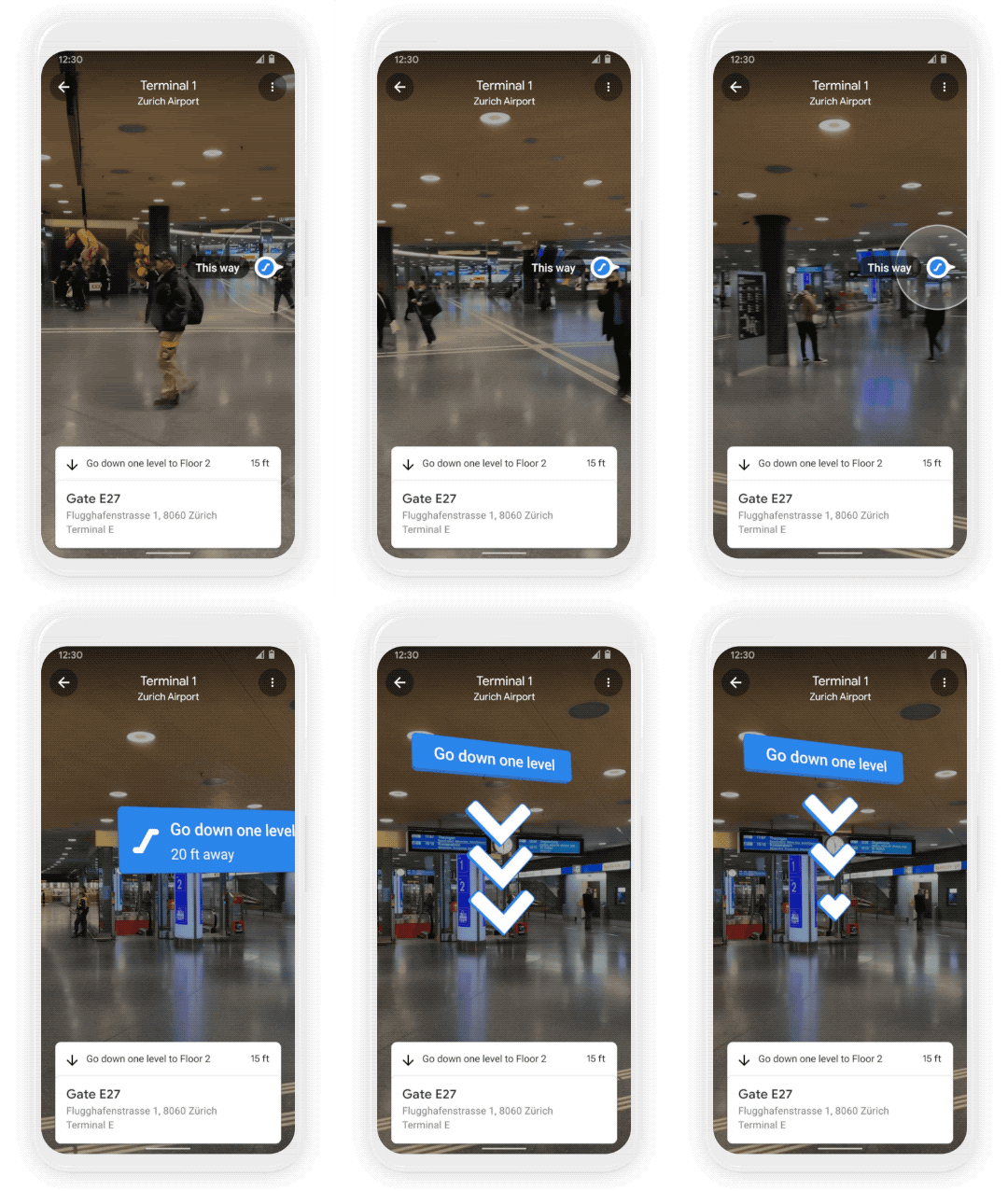
We all know that awkward moment when you’re walking in the opposite direction of where you want to go — Live View uses AR cues to avoid just that. Live View is powered by a technology called global localization, which uses AI to scan tens of billions of Street View images to understand your orientation. Thanks to new advancements that help us understand the precise altitude and placement of objects inside a building, we’re now able to bring Live View to some of the trickiest-to-navigate places indoors: airports, transit stations and malls.
If you’re catching a plane or train, Live View can help you find the nearest elevator and escalators, your gate, platform, baggage claim, check-in counters, ticket office, restrooms, ATMs and more. Arrows and accompanying directions will point you the right way. And if you need to pick something up from the mall, use Live View to see what floor a store is on and how to get there so you can get in and out in a snap. Indoor Live View is live now on Android and iOS in a number of malls in Chicago, Long Island, Los Angeles, Newark, San Francisco, San Jose, and Seattle. It starts rolling out in the coming months in select airports, malls, and transit stations in Tokyo and Zurich, with more cities on the way.

eSports, parte oggi la eSerie A TIM – eFootball PES 2021
Sarà il derby S.S. Lazio eSports-AS Roma Esports (oggi alle ore 13:00) a dare il via al nuovo torneo di eSerie A TIM – eFootball PES 2021. La partita inaugurale sarà quindi un’apertura col botto con l’accesa sfida tutta capitolina, cui seguiranno Juventus-Spezia Calcio Esports e l’ingresso in scena del Parma Esports. Dopo una serie di eventi correlati, comprese le qualificazioni di novembre e dicembre scorso, e il draft di febbraio 2021, il primo campionato Esports della Lega Serie A comincia a entrare nel vivo.