
A new Android smartphone and 5G partnership with Jio
Editor’s note: Today, we announced the next steps in our partnership with Jio Platforms, including a new, affordable Jio smartphone built with an optimized version of Android OS and a new 5G collaboration powered by Google Cloud. The following is adapted from remarks delivered by Sundar Pichai, CEO of Google and Alphabet, at Reliance Industries’ Annual General Meeting today.
Thank you to everyone at Reliance Industries for all you do for India — from investing in infrastructure and technology to creating jobs and expanding opportunity to supporting communities in need, especially in this difficult moment for the country.
It’s been devastating to see the country hit so hard by COVID-19. Yet it’s heartening to see how Reliance has stepped up to contribute to the national response and get support to the communities that need it most. On behalf of all of us at Google: We hope you are taking care and we are wishing for better days ahead.
For Google, the past year has brought renewed purpose and greater urgency to our mission to organize the world’s information and make it universally accessible and useful. At a time when so many aspects of our lives and work are moving online, it’s even more important to make technology accessible and helpful for everyone.
This goal is at the heart of our partnership with Reliance Jio. I was proud to help launch this partnership last year. It was the first and biggest equity investment from the ₹75,000 crore ($10 billion) Google for India Digitization Fund.
Our vision was to bring affordable access to information for Indians in their own language, to build new products and services for India’s unique needs, and to empower businesses with technology.
I’m excited that today, we can announce the next steps in this vision, starting with a new, affordable Jio smartphone, created with Google. Our teams have optimized a version of our Android OS especially for this device. It will offer language and translation features, a great camera, and support for the latest Android updates.
It is built for India and it will open up new possibilities for millions of new users who will experience the internet for the very first time. And we can’t wait to show you the device later this year.
I’m also proud to announce that we are taking our collaboration further with a new 5G partnership between Google Cloud and Jio.
It will help more than a billion Indians connect to a faster and better internet, support businesses in their digital transformation, and help Jio build new services in sectors like health, education and more — laying a foundation for the next phase of India’s digitization.
As part of this collaboration, Reliance will also shift its core retail businesses to Google Cloud’s infrastructure. They will be able take advantage of Google’s AI and machine learning, e-commerce, and demand forecasting offerings. Harnessing the reliability and performance of Google Cloud will enable these businesses to scale up as needed to respond to customer demand.
Empowering businesses as they embark on their digital transformation is a key part of our mission in India, and I’m excited for the innovations this partnership will help unleash. We are proud to play a part in India’s next wave of technological innovation.
Helping to connect 1.3 billion Indians to the opportunities the internet creates is meaningful to all of us at Google — and certainly to me personally. I know that with greater access to smartphones and improved connectivity, there’s no limit to what India’s people can do.
We look forward to getting technology into the hands of more people and to exploring what more we can achieve together in the years ahead.

Un aggiornamento sulle tempistiche di Privacy Sandbox
L’iniziativa Privacy Sandbox mira a creare tecnologie web che proteggano la privacy delle persone online e offrano alle aziende e agli sviluppatori nuovi strumenti digitali per sostenere le proprie attività commerciali, rendendo così possibile l’esistenza di un web libero, aperto e con contenuti disponibili gratuitamente, sia oggi che in futuro. Per far sì che ciò accada, crediamo che sia fondamentale lavorare insieme per sviluppare una serie di standard aperti che migliorino la privacy sul web, offrendo alle persone maggiore trasparenza e maggiore controllo su come vengono utilizzati i loro dati.
È un obiettivo importante che richiede un progresso condiviso e un ritmo responsabile. Questo significa avere un tempo adeguato da dedicare al dibattito pubblico su quelle che saranno le soluzioni corrette, un impegno continuativo con le autorità di regolamentazione, e le giuste condizioni per permettere all’industria pubblicitaria e ai publisher, ovvero i siti che ospitano annunci, di migrare i propri servizi. È importante che questa trasformazione non comprometta i modelli di business dei publisher che offrono contenuti disponibili liberamente grazie alla pubblicità. Inoltre, una tecnologia che protegge la privacy permetterà di evitare che i cookie vengano sostituiti da altre forme di tracciamento individuale, scoraggiando così l’aumento di approcci invasivi come il fingerprinting.
Vogliamo continuare a lavorare con la comunità web per creare approcci più rispettosi della privacy su alcuni temi chiave, tra cui la misurazione degli annunci, l’offerta di annunci e contenuti rilevanti e l’individuazione delle frodi. Fino a oggi, Chrome e altre realtà hanno messo in campo più di 30 proposte, di cui quattro sono disponibili in origin trial. Per quanto riguarda Chrome, l’obiettivo è che le tecnologie principali siano pronte per la distribuzione entro la fine del 2022, affinché la comunità degli sviluppatori possa iniziare ad adottarle. Seguendo il nostro impegno con l’Autorità per la concorrenza e i mercati del Regno Unito (CMA) e in linea con gli impegni che abbiamo offerto a livello globale, Chrome potrebbe quindi eliminare gradualmente i cookie di terze parti nell’arco di un periodo di tre mesi, cominciando verso metà del 2023 e fino alla fine dell’anno.
Ogni proposta passerà attraverso un rigoroso processo di sviluppo pubblico in più fasi, che include ampie discussioni e periodi di test, coerentemente con il modo in cui vengono sviluppate generalmente le API aperte e altre tecnologie web:
- Fase di discussione: le tecnologie e i relativi prototipi vengono discussi in forum come GitHub o gruppi W3C.
- Fase di test: le tecnologie vengono rigorosamente testate in Chrome attraverso una serie di origin trial, in modo trasparente e con possibilità di feedback durante il processo. Per esempio, durante l’origin trial per la prima versione di FLoC abbiamo ricevuto importanti commenti dalla comunità web: prevediamo di concludere questa fase nelle prossime settimane e di incorporare gli input prima di passare a ulteriori test sull’ecosistema.
- Fase di adozione: completato il processo di sviluppo, le tecnologie selezionate saranno pronte per l’utilizzo su ampia scala. Saranno lanciate su Chrome in modo da essere disponibili sul web.
Dopo questo processo di sviluppo pubblico, e in accordo con il nostro impegno con il CMA, il nostro piano per Chrome è eliminare gradualmente il supporto per i cookie di terze parti. Prevediamo due fasi:
- Fase 1 (a partire dalla fine del 2022): la Fase 1 verrà annunciata una volta completati i test e lanciate le API in Chrome. Questa fase è necessaria per dare ai publisher e agli investitori pubblicitari il tempo per migrare i loro servizi. Ci aspettiamo una durata complessiva di nove mesi per la Fase 1, durante i quali monitoreremo attentamente l’adozione dei nuovi strumenti e raccoglieremo i feedback prima di passare alla Fase 2.
- Fase 2 (a partire dalla metà del 2023): Chrome eliminerà gradualmente il supporto ai cookie di terze parti nell’arco di un periodo di tre mesi che terminerà alla fine del 2023.
Presto forniremo un programma più dettagliato su privacysandbox.com, che verrà aggiornato regolarmente per fornire maggiore chiarezza e garantire che sviluppatori e publisher possano pianificare i periodi di test e di migrazione.
Insieme ai progressi nello sviluppo di alternative ai cookie di terze parti, continuiamo a promuovere un altro obiettivo chiave di Privacy Sandbox, cioè il contrasto a forme di tracciamento nascosto come il fingerprinting. Per fare un esempio, il mese scorso abbiamo pubblicato un aggiornamento sui nostri piani per ridurre la possibilità che i dati degli user agent vengano utilizzati a scopo di fingerprinting o per tracciare gli utenti sul web.
Crediamo che Privacy Sandbox offrirà le migliori protezioni sulla privacy a vantaggio di tutti. Fare in modo che le attività commerciali sul web prosperino senza tracciare le persone significa garantire che l’accesso gratuito ai contenuti online resti possibile, oggi come in futuro. E data l’importanza di questo risultato, dobbiamo avere il tempo per valutare le nuove tecnologie, raccogliere i feedback e riflettere sui processi, per assicurarci di soddisfare sia i nostri obiettivi sulla privacy che quelli sull’efficacia degli strumenti, oltre a offrire a tutti gli sviluppatori un ritmo adeguato lungo il percorso verso un web più rispettoso della privacy e sostenibile.

An updated timeline for Privacy Sandbox milestones
Today, we’re sharing the latest on the Privacy Sandbox initiative including a timeline for Chrome’s plan to phase out support for third-party cookies. While there’s considerable progress with this initiative, it’s become clear that more time is needed across the ecosystem to get this right.
The Privacy Sandbox initiative aims to create web technologies that both protect people’s privacy online and give companies and developers the tools to build thriving digital businesses to keep the web open and accessible to everyone, now, and for the future. To make this happen, we believe the web community needs to come together to develop a set of open standards to fundamentally enhance privacy on the web, giving people more transparency and greater control over how their data is used.
In order to do this, we need to move at a responsible pace. This will allow sufficient time for public discussion on the right solutions, continued engagement with regulators, and for publishers and the advertising industry to migrate their services. This is important to avoid jeopardizing the business models of many web publishers which support freely available content. And by providing privacy-preserving technology, we as an industry can help ensure that cookies are not replaced with alternative forms of individual tracking, and discourage the rise of covert approaches like fingerprinting.
We plan to continue to work with the web community to create more private approaches to key areas, including ad measurement, delivering relevant ads and content, and fraud detection. Today, Chrome and others have offered more than 30 proposals, and four of those proposals are available in origin trials. For Chrome, specifically, our goal is to have the key technologies deployed by late 2022 for the developer community to start adopting them. Subject to our engagement with the United Kingdom’s Competition and Markets Authority (CMA) and in line with the commitments we have offered, Chrome could then phase out third-party cookies over a three month period, starting in mid-2023 and ending in late 2023.
Each proposal goes through a rigorous, multi-phased public development process, including extensive discussion and testing periods. This is consistent with how other open APIs and web technologies get developed:
- Discussion: The technologies and their prototypes are discussed in forums like GitHub or W3C groups.
- Testing: The technologies are rigorously tested in Chrome through potentially numerous origin trials, allowing for transparency and feedback throughout. For example, we received substantial feedback from the web community during the origin trial for the first version of FLoC. We plan to conclude this origin trial in the coming weeks and incorporate input, before advancing to further ecosystem testing.
- Ready for adoption: Once the development process is complete, the successful technologies are ready to be used at scale. They will be launched in Chrome and ready for scaled use across the web.
After this public development process, and subject to our engagement with the CMA, our plan for Chrome is to phase out support for third party cookies in two stages:
- Stage 1 (Starting late-2022): Once testing is complete and APIs are launched in Chrome, we will announce the start of stage 1. During stage 1, publishers and the advertising industry will have time to migrate their services. We expect this stage to last for nine months, and we will monitor adoption and feedback carefully before moving to stage 2.
- Stage 2 (Starting mid-2023):Chrome will phase out support for third-party cookies over a three month period finishing in late 2023.
Soon we will provide a more detailed schedule on privacysandbox.com, where it will be updated regularly to provide greater clarity and ensure that developers and publishers can plan their testing and migration schedules.
Along with progress on developing alternatives to third-party cookies, we continue to advance another key Privacy Sandbox goal to combat covert tracking like device fingerprinting. For instance, last month we published an update on our plans for User Agent string reduction, a project which aims to reduce the possibility of using this data to fingerprint and track users across the web.
We believe that the Privacy Sandbox will provide the best privacy protections for everyone. By ensuring that the ecosystem can support their businesses without tracking individuals across the web, we can all ensure that free access to content continues. And because of the importance of this mission, we must take time to evaluate the new technologies, gather feedback and iterate to ensure they meet our goals for both privacy and performance, and give all developers time to follow the best path for privacy.

Windows 11, oggi la presentazione ufficiale. Come seguire l’evento

John McAfee trovato morto in carcere: fu padre degli antivirus

Google lancia un tool per le stime salariali dello smart working

Come trasferire un eBook sul Kindle

Space Jam 2 diventa un gioco rétro: ecco il trailer

Leggi Antitrust USA: si mobilitano Tim Cook e la lobby Hi-Tech

Il programma completo del CicapFest. Si torna in presenza!

Il CicapFest 2021 si terrà, di nuovo in presenza dopo l’edizione virtuale dell’anno scorso, a Padova da 3 al 5 settembre.
Gli ospiti e relatori sono tantissimi: troppi per citarli uno per uno, e comunque l’ha già fatto egregiamente PadovaOggi, al quale vi rimando per i dettagli, che trovate anche sul sito del CICAP. Molte altre informazioni sono nel sito Cicapfest.it.
Io avrò l’onore di presentare la serata di benvenuto, giovedì 2 settembre alle ore 21, presso l’Agorà del Centro Culturale San Gaetano, con una conferenza-chiacchierata intitolata È difficile fare previsioni, specialmente per il futuro.
Ci ritroveremo anche per parlare di vita extraterrestre e di fantascienza, con un dibattito semiserio ma senza esclusione di colpi sul tema Star Wars o Star Trek? Io rappresenterò il Team Star Trek, mentre l’astrofisico e divulgatore Luca Perri rappresenterà il Team Star Wars insieme ad Alesso Vissani e Giovanni Zaccaria, con la moderazione di Michele Bellone. Se potete venire in costume, per un team o per l’altro, avvisatemi!
Per gli elettrocuriosi: sì, verrò con TESS. Spero di potervela presentare per bene.

Twitter, al via le funzioni per proporre contenuti a pagamento
We’re expanding our support of news in Canada
Access to trustworthy information is important to all of us, and it’s vital for society to continue supporting the reporters who work tirelessly to deliver us news. That’s why today we are announcing new investments to continue our support of Canadian newsrooms and journalists across the country.
Support for Canadian journalism through News Showcase
We have signed agreements with a number of Canadian publishers for Google News Showcase, a product and licensing program that provides a space for newsrooms to curate their content for readers across Google News and Discover. These deals will help support Canadian newsrooms that provide comprehensive general-interest news to the communities they serve. This long-term investment will support news organizations in producing, distributing and explaining essential information to readers. The first Canadian partners for News Showcase are Black Press Media, Glacier Media, The Globe and Mail, Métro Média, Narcity Media, SaltWire Network, Village Media and Winnipeg Free Press.
Together, these eight publishers represent national, regional and local news that touches communities in both official languages from coast-to-coast-to-coast in Canada. Today’s announcement builds on News Showcase deals signed by nearly 800 news publications around the world. More than 90% of these publications represent local or regional news.
Logos of our current News Showcase news partners in Canada
As part of our licensing deals, we’re also paying news organizations for access to select paywalled content, giving Canadians access to a wide range of news content. We work closely with news outlets to determine the right amount of content to share to help drive subscriptions as users experience the benefits of subscribing to authoritative news outlets.
There will be more partnerships to come as we continue to engage in active negotiations with publishers across Canada. We look forward to launching News Showcase here soon.
What publishers are saying about News Showcase
Expanded support through Google News Initiative
News Showcase is just one part of our longstanding, overall commitment to the Canadian news industry. Today we are also announcing additional investments through our Google News Initiative, a global effort to help journalism thrive in the digital age:
Training journalists in digital skills:Over the next three years we’ll train 5,000 Canadian journalists and journalism students on strengthening digital skills in newsrooms – a five-times increase from the 1,000 journalists we’ve already trained to date.
Supporting business sustainability: We’ll expand our business-oriented workshops for small and mid-sized news organizations on topics including audience development, reader revenue and advertising revenue. The 10 sessions will be delivered in French and English and build upon our award winning News Consumer Insights tools.
We are introducing our first custom designed GNI Startups Boot Camp dedicated exclusively to aspiring Canadian news entrepreneurs starting a business or non-profit journalism project in Canada. Applications open in the fall.
Promoting news innovation: We are announcing our third North American Google News Initiative Innovation Challenge to fund selected projects focused on helping local publishers think about new ways to understand, enhance and serve the needs of their communities. Applications are now open.
“When the Halifax Examiner joined GNI Startup Labs, I was cautiously optimistic that it would be of value. But the actual experience has been beyond anything I could have dreamed of,” says Tim Bousquet, editor and publisher of the Halifax Examiner. “Thanks to speaking with other media operators struggling to make sense of our industry, and especially thanks to working hand-in-hand with a coach who walked us through our challenges, the Examiner now has a deeper and more fruitful understanding of our business model, the approach to revenue, and how to prepare for the future and grow.”
These new and expanded programs build on our long-term support for Canadian news organizations of all sizes. In 2019 alone, Google sent five billion clicks to Canadian news sites, for free (an estimated half billion dollars in value, according to Deloitte). During the COVID-19 pandemic, our Journalism Emergency Relief Fund directly supported more than 200 different newsrooms across Canada to keep journalists working and Canadians informed.
Today’s news represents a shared goal that Google and news publishers in Canada are focused on – long-term success for journalism in Canada. That’s why Google is committed to playing a constructive role alongside publishers to enable a sustainable future for news that Canadians can depend on for years to come.

Facebook potenzia Shops e lo porta anche sulle altre sue app

Amazon Advertising genera rendimenti più elevati rispetto a Facebook ADS o Google ADS?

Social Significance: Why B2B Brands Value Social CX & Are Spending More
Why are B2B brands placing greater value on social media, and why are they willing to spend more than ever before on social customer experience (CX)?
New digital marketing research reveals why B2B brands are finding a renewed passion for the expanding benefits of social media, and why they are becoming more willing than ever to spend more for the competitive advantages that social CX offers.
Let’s take a look at some of the latest report and survey data, and see how B2B brands are changing their social media strategies and outlook.
1 — Social Helps B2B Brands Meet Customer Expectations
A new report from Sprout Social reveals how customer expectations have evolved for the brands that they follow on social media.
Examining insight from over 1,000 U.S. consumers and the same number of U.S. marketers, along with 782 million public social messages, the recently-released “Sprout Social Index, Edition XVII: Accelerate” report showed that 90 percent of consumers will purchase from brands they follow on social media.
“For marketers, this is an opportunity to demonstrate how social positively influences all parts of the business and why a brand’s competitive advantage lives on social,” the report suggested.
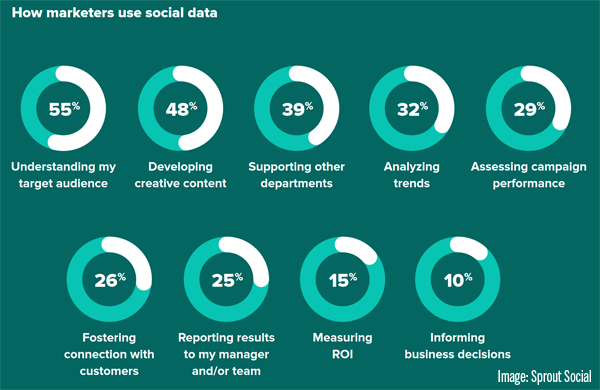
55 percent of marketers said they used social data for understanding their target audience, while 48 percent used it to develop creative content, and 39 percent for supporting other departments, the report showed.
Only 26 percent of marketers said they used social data to foster connections with customers, however, and just 10 percent said they used the data to inform business decisions.
“88 percent of marketers agree their social strategy positively influences their bottom line,” the research concludes.
The value of social data has generally increased over time, and the new Sprout Social study bears this out, revealing that 47 percent of marketers consider social a resource that influences strategy for multiple organizational teams, while 46 still see it as strictly a marketing resource, with eight percent viewing it as an organization-wide resource for business intelligence.
Something as seemingly simple as responding quickly to customer questions can be very important in brand purchase decisions. 47 percent of consumers said that responding to customer service questions in a timely manner was the top way brands could get them to buy and forgo competitors.
Nearly as important among consumers were brands that demonstrate an understanding of what consumers want and need.
“Nine out of 10 consumers will buy from brands they follow on social, while 86% will choose that brand over a competitor,” the Sprout Social report data showed.
Given the importance customers place on speedy response times from brands, it’s easy to see how the new Sprout Social data indicated that “78 percent of consumers agree that social media is the fastest and most direct way to connect with a brand — and consumers want their voices heard.”
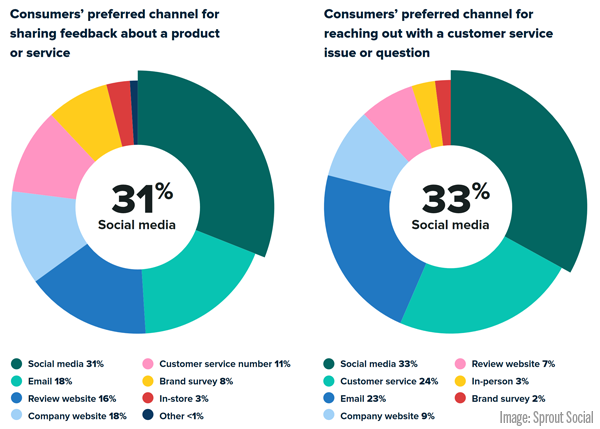
When it comes to sharing feedback about a product or service, after social media, consumers turn to e-mail and a brand’s website (18 percent for each), followed closely by review websites, and just 11 percent prefer calling a brand’s customer service phone number, according to the report data.
Even for reaching brands about customer service issues or questions, most consumers (33 percent) prefer social media, followed by customer service (24 percent), e-mail (23 percent), and just nine percent prefer using a company’s website for such questions.
“44 percent of consumers will unfollow a brand on social because of poor service, putting a damper on brands’ growth goals,” the report warned.
The Sprout Social study surfaces a fascinating distinction between what consumers and marketers believe makes for best-in-class social media performance.
The most important factor among consumers — at 47 percent — was brands that offer strong customer service, while that was only the sixth most important factor to marketers, at 35 percent.
2 — Social Will Drive Post-Pandemic B2B Customer Engagement
According to Ascend2 and Wpromote’s newly-released 2021 State of B2B Digital Marketing report, the number one digital marketing trend B2B brands are prioritizing is the utilization of new social platforms.
42 percent said new social platforms represented their top trend priority, followed by 34 percent who said virtual events, and 30 percent who noted that influencer marketing was a priority trend.
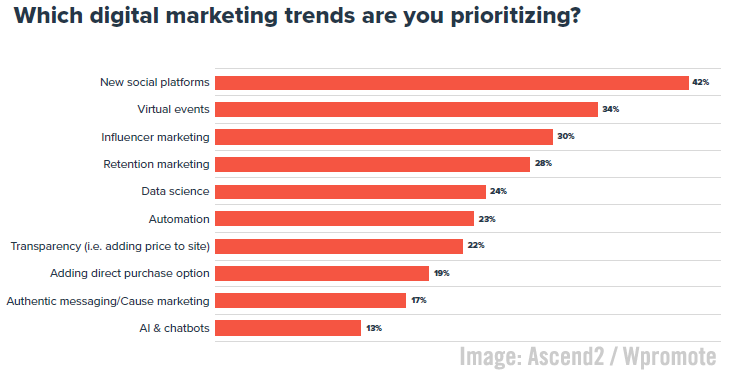
“Brands embraced new social platforms, virtual events, and influencer marketing strategies that can open the door to new opportunities to drive brand awareness and grow new audiences,” the report suggested.
A robust 68 percent of B2B marketers said they expected their digital marketing budgets to increase during the forthcoming year, with 26 percent seeing a significant budget increase ahead, according to the report data.
When it comes to driving revenue, 57 percent of B2B marketers saw social media as the most effective digital marketing channel, followed by content marketing and email, each at 47 percent.
Reinforcing the notion supported by the other research we’ve examined, the Ascend2 and Wpromote data showed that social media was the area of digital customer experience that had the most impact on overall strategic success, according to 57 percent of respondents — ahead of website optimization’s 47 percent and paid advertising’s 42 percent.
“Whatever social platforms you use as a B2B marketer, if you prioritize the time and resources to add new social platforms to your mix, you increase the opportunity to build new audiences and further engage with your existing audience,” Todd Lebo, CEO at Ascend2 told me. “Newer platforms that B2B should consider are TikTok, Clubhouse, and Twitter Spaces,” Lebo added.
We’ve taken a look at how B2B marketers can utilize Twitter Spaces in “On-Target: What’s New With Twitter For B2B Marketers In 2021,” Clubhouse in “How B2B Brands Can Boost Confidence in Livestream Video, Podcast and Clubhouse Marketing,” and other new social platforms in “How B2B Marketing Influencers Are Finding Success On New Social Channels.”
The most successful B2B marketers have also tended to inform their CX strategy by including other departments — a structure that less successful marketers don’t tend to utilize.
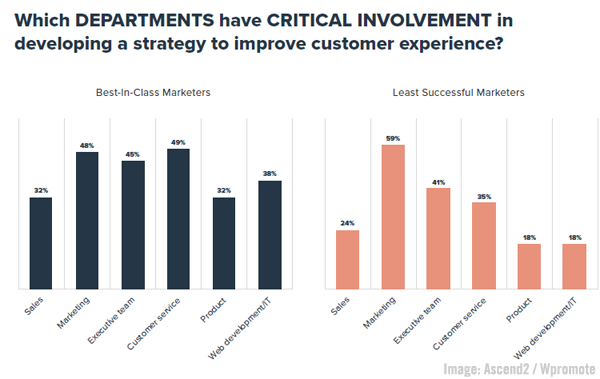
Bringing many of these trends and tactics together, account-based marketing (ABM) — or even account based experiences (ABX), as our CEO Lee Odden recently explored in “Is ABX the Next Evolution of B2B Marketing?” — is increasingly used by the most successful B2B marketers.
43 percent of the most successful B2B marketers already have a working ABM strategy in place, and 30 percent are actively implementing one, the Ascend2 and Wpromote data showed.
[bctt tweet=”“To do ABM well, you need to bend the sales odds in your favor. The best way to bend the odds is to utilize customer data you collect over time and deliver a seamless customer experience (CX).” — Ruth Stevens @RuthPSteven” username=”toprank”]3 — Social Drives B2B Customer Experience Personalization
B2B brands are increasing finding success in delivering more personalized CX through social channels.
The digital experiences customers crave can be crucial for building brand affinity, as some 80 percent of respondents in a survey conducted by Salesforce said that these experiences are every bit as important as a firm’s actual products or services.
Brand storytelling helps build more memorable digital experiences, as Microsoft’s Miri Rodriguez has explored, which I outlined earlier this year in “Microsoft’s Miri Rodriguez on How B2B Marketers Are Embracing Empathy For Better Customer Storytelling.”
[bctt tweet=”“Storytelling isn’t the mere telling of story, it’s the intentional design of story structure, attributes and elements that conjure emotion, drive inclusion and lead with empathy.” — Miri Rodriguez @MiriRod” username=”toprank”]Some 68 percent of businesses in the Salesforce survey said that they expected brands to demonstrate empathy, but only 37 percent said that they were experiencing it — a sentiment Rodriguez shared when she noted that, “Brands want to transact with people who are showing high levels of empathy.”
Ryan Higginson, vice president and UK/ROI Country Leader at Pitney Bowes, sees a future that includes better customer experiences that go beyond the mere algorithmic.
“B2B decision makers want humanized, personalized, helpful and relevant experiences to reduce complexity and save them time,”Higginson recently noted. “They want businesses to anticipate their requirements beyond the ‘You liked that, now try this’ algorithm. The more B2B organizations get to know their clients at a personal level, the better the relationship becomes and the greater the customer experience,” he added.
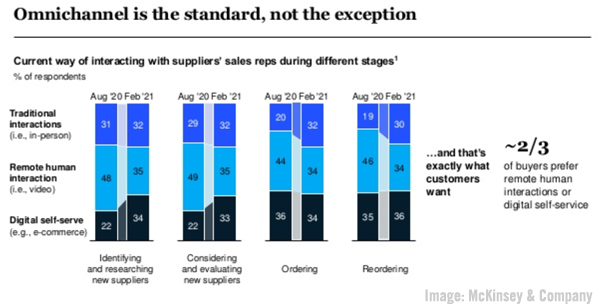
A McKinsey study revealed that 97 percent of B2B buyers said that they would use an end-to-end self-serve digital model to make a purchase, with most being comfortable doing so while spending $50K or more.
The pandemic has brought about a shift among B2B buyers, who have grown more comfortable with digital self-service and omni-channel interactions.
LinkedIn’s* State of Sales Report 2021 noted that trust in a brand’s product or service was consistently a top factor in influencing purchases among buyers, and the 2020 version of the report showed that some 75 percent of B2B buyers were particularly influenced by social media, with 84 percent of senior executives utilizing social media to support buying decisions.
We dug into the shift to executive influence in B2B marketing in “Brandfluence – Why Growing Executive Influence is Essential for B2B Marketing,” and also shared 20 tips for driving executive credibility efforts in “20 Ways to Build B2B Executive Credibility and Thought Leadership.”
[bctt tweet=”Social engagement with prospects along with publishing credible thought leadership content warms prospects for conversations that lead to conversion.” — Lee Odden @LeeOdden” username=”toprank”]Reach New B2B Marketing Heights With A Social & CX Mix
There’s no need to make a leap of faith when you have data-backed research informing your digital marketing strategy.
By using social media to drive customer experience personalization and to help B2B brands meet rising customer expectations, B2B marketers will achieve greater levels of post-pandemic B2B customer engagement.
We hope that our look at recent report and survey data will help inform your own B2B marketing efforts as we move ahead towards 2022.
Crafting award-winning B2B marketing with a creative mixture of social media, influence, and memorable digital customer experiences takes considerable time and effort, which is why many firms choose to work with a top digital marketing agency such as TopRank Marketing. Contact us today and let us know how we can help, as we’ve done for businesses ranging from LinkedIn, Dell and 3M to Adobe, Oracle, monday.com and others.
* LinkedIn is a TopRank Marketing client.
The post Social Significance: Why B2B Brands Value Social CX & Are Spending More appeared first on B2B Marketing Blog – TopRank®.