
How this travel blogger pivoted during the pandemic
Gabby Beckford is an expert planner, even when things don’t work out as expected. Shortly after graduating from college and getting her first job in engineering, she realized that working in an office wasn’t for her. But this didn’t throw her off course, it presented an opportunity. Over the next two years, she used savings from her job to become a full-time travel blogger. On her website Packs Light, Gabby writes travel tips for Gen Z, offers influencer guides and services and runs occasional partnerships with travel brands and companies.
In February 2020, Gabby planned to go to Bali for a month. But just a week later, the lockdown took hold and airports started to shut down. True to form, she decided to turn things around. “When the pandemic hit, I was in a reactive state anyway,” she says. “It was actually a benefit because I could pivot kind of easily.”
Luckily, she could live at her mom’s house and had a consistent, if small, income from the blog. Even though she (and everyone else) was stuck at home, she doubled down on travel writing — but now, she was pitching publications.
Gabby is happily traveling the world again, and now incorporates guidance on doing so responsibly during the ongoing pandemic. She has some tips for how creators can pivot in the face of unexpected challenges, and even uncover new prospects for growth and success.
Don’t quit, adapt
Gabby noticed that many travel bloggers shifted their focus to topics like beauty or fitness, but she decided to stay true to her core mission. “I knew that no matter how long this pandemic lasts, there would be a travel reboot eventually,” she says. “So it was an investment in myself to stay in this industry and continue building when the competition was low.”
Sticking to her mission while pivoting to evergreen topics, like how to apply for a passport or travel as a full-time student, also aligned with what her followers were interested in. “Just because people stopped traveling doesn’t mean all 10,000 of my Instagram followers stopped caring about what I did, or about travel in general,” she points out. This continued focus cemented her reputation as a dedicated travel blogger.
Gabby posts about evergreen topics in addition to travel destinations.
Be ready to jump on opportunities
In the corporate world, Gabby was used to planning things a year in advance. But the uncertainty of the pandemic forced her to think just a few months ahead. “Every three months, we were reassessing,” she says.
Luckily, growing up in a military family that moved around a lot prepared her to react quickly. She started proactively reaching out to write content. “In the beginning, brands were screaming, ‘Someone give us an idea, our content schedule is out the window,’” she remembers. “It was a very unique opportunity to partner with brands I probably would never have partnered with before.”
Focus on community building
Sharing opportunities with other creators helped promote her brand and expand her network. “[On] Patreon, I’ll share if a brand comes to me for an opportunity and I can’t take it because the rate isn’t right or it’s not my brand,” she says. She also posts paid travel opportunities on her site.
Building a community grounded in generosity was essential not just for business, but for Gabby’s mental health during the early months of the pandemic. “You want to make sure you’re on the same page as everyone,” she says. “Is everyone feeling the same way I am? Is anyone else still indoors?”

Gabby is writing about travel again, with a special focus on responsibility in the age of COVID-19.
Trust yourself
In difficult times, it’s natural to second-guess your choices. But indulging in doubt can be damaging. “You don’t have to have everything figured out, but you have to have the confidence and trust in yourself that you can figure it out,” she says.
You’re cordially invited to use my hybrid holiday party tips
Eight cousins. Six aunts and uncles. A couple of toddlers (both mine). Two (adorable) felines. Some of us will be together, while others will be staying home for the holidays this year.
Sound familiar? Thankfully, many of us have learned a thing or two about “hybrid” gatherings over the past two years. I figured if it could work for…well, work, why not for the holidays?
I’ll be using Google tools to help me host with ease no matter where my friends and family are this year, and I’ve come up with a list of tips so you can, too.
Ready to soirée? Follow these four steps to fête across technical devices and state lines.
Step 1: Draft up a pun-heavy holiday invitation in Gmail. Tailor it for your party and include a Google Calendar invite and link to the Google Meet in the invite. And if you want to keep things extra organized as responses come in, you can make a group and label it “Holiday Party 2021.” Pro tip: Set up an automated reminder to go out to your guests 24 hours before the party.
Step 2: Ahead of party time, send a note to guests attending via Google Meet about the itinerary and let them know what they’ll need to participate. For instance, if you’re hosting a cookie-making party, send the recipe ahead of time. Or if you’re going to vote on ugly sweaters, let them know about Meet’s hand raise feature and polling features so they can be sure to get their vote in (available with Google Workspace Individual).
Step 3: Make everyone feel like they’re together. Whether you host the Google Meet call from your laptop, Pixel or Google Nest Hub Max, you can cast the party to your TV using Chromecast so everyone who’s there IRL can get a good view. Ahead of party time, scope out a good spot for the device that’s hosting the meeting so those on the other end of the call can see and hear everyone. (And so your virtual guests feel present, include the instructions for casting a call to a TV in the note you send before the big day, too.)
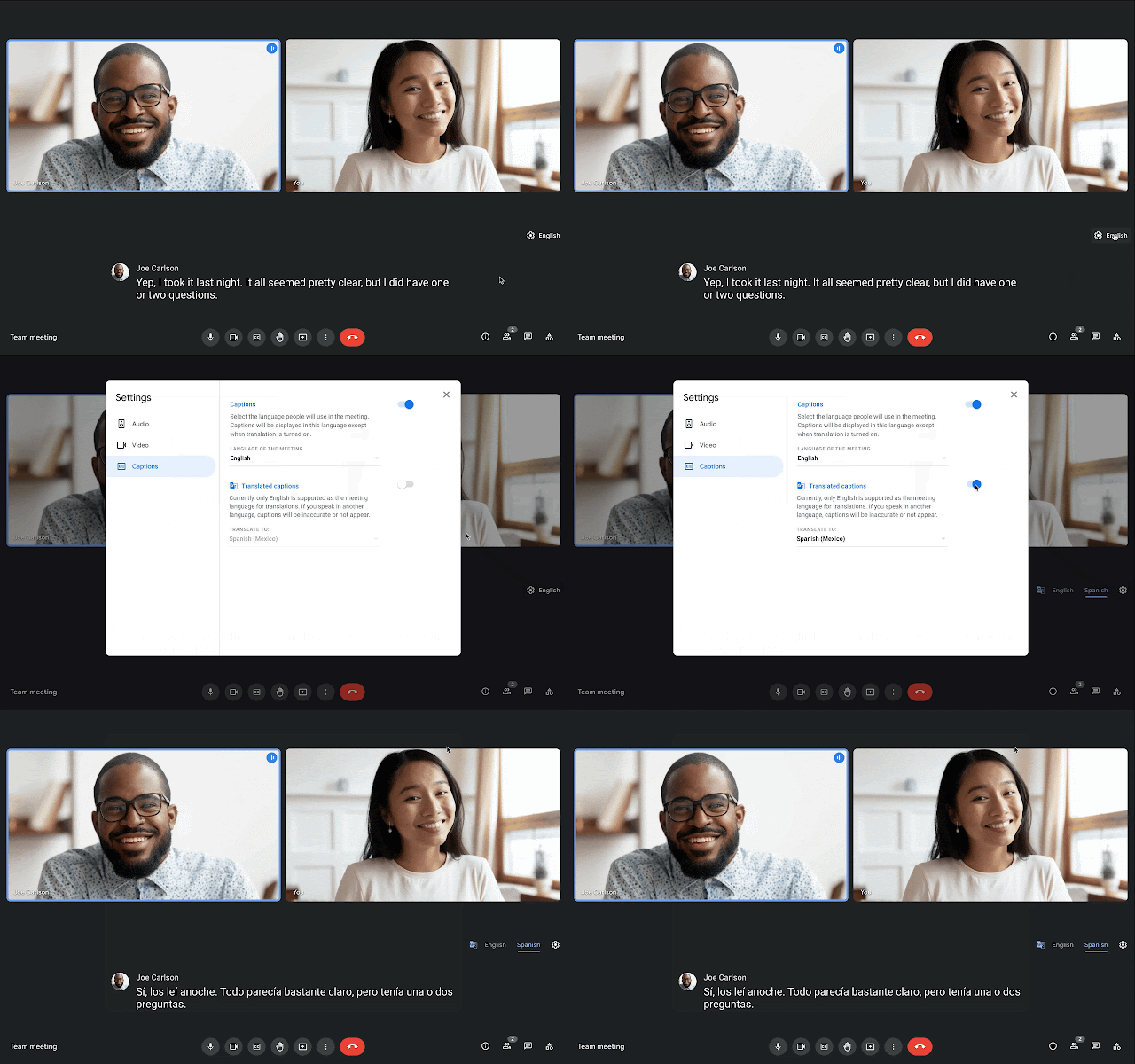
Adding captions to your hybrid get-together is an inclusive, and easy, step.
Step 4: Welcome your guests and make room for all. With Google Workspace Individual, you can show off the hand raise feature so everyone gets a turn to tell a story or joke, enable live captions so all guests can follow the conversation flow easily, and cut out background sounds (like noisy pets!) to reduce distractions. Kindly point out where the mute button is at the start of the party, too. Distracted by the mirror image of yourself on the video call screen? Turn it off with a few clicks! Use the Layout feature so everyone is on the screen at once — no matter where they are.
Step 5: Make it fun! Tap your much cooler niece to create a party playlist on YouTube, and then screen share the tab open to your YouTube playlist for the party. (You can let your guests know they can unpin the shared tile so it doesn’t take up the whole screen.) You and your guests can also use a virtual background (you could even upload a festive backdrop like your favorite photo memories!) You can use Google Jamboard — a free-to-use, virtual whiteboard —and play an IRL-meets-online edition of Pictionary.
Step 6: Give thanks. Send a thank you email after the party wraps. If you have a Google Workspace Individual account, you can record the party for your loved ones who couldn’t attend live — just make sure to let attendees know ahead of time.
Hope you enjoyed this crash course in hybrid holiday hosting.

L’intrattenimento di RaiPlay arriva su Google TV
RaiPlay prima in Italia a ricevere l’integrazione a Chromecast con Google TV
Oggi, disponiamo di una crescente offerta di contenuti, distribuiti in una varietà di app in continua espansione il che può rendere difficile scegliere cosa guardare. E’ stata questa l’ispirazione che anni fa spinse Google a ripensare alla modalità di fruizione dei contenuti sulla propria TV e da qui nasce l’interfaccia utente Google TV. A questo, nel 2020 si è aggiunta Chromecast con Google TV, ultima generazione del dispositivo che permette di trasformare la TV in smart TV, che offre a sempre più persone la possibilità di vivere un mondo di intrattenimento.
A partire dal 16 dicembre, RaiPlay, la piattaforma OTT della Rai, entra nel gruppo delle app presenti su Google TV, forte di numeri in costante crescita sia nella fascia under 45 – nel solo mese di novembre ha raggiunto il 51% degli utenti registrati – sia nella fascia più giovane, under 25. Risultati raggiunti grazie alla bontà dell’offerta presente in piattaforma che include un ampio catalogo di programmi rivolto ad ogni genere di pubblico. Film, fiction, serie originali, docu serie, programmi televisivi della Rai, ma anche tanti contenuti per bambini e programmi sportivi, tra i quali la prossima coppa del Mondo FIFA Qatar 2022, di cui Rai è l’unico broadcaster ufficiale per l’Italia.
Grazie a questo accordo, i contenuti di RaiPlay saranno presenti anche dalla semplice Ricerca Google; su Watch Actions e su “Cosa guardare”. Con un semplice click; si potranno vedere i film ed i programmi preferiti offerti in piattaforma, oltre a ricevere consigli sui titoli disponibili, mentre si cercano contenuti online.
L’utente potrà usufruire del sistema di raccomandazione che lo aiuterà a scoprire nuovi film in base a specifiche richieste, scegliendo sia tra i contenuti RaiPlay, che di altre app quali Netflix, Disney+ e Prime Video. Inoltre potrà interagire con Assistente Google presente sul Chromecast con Google TV, per completare la propria ricerca, chiedere di rivedere un determinato film, mettere in pausa o riprendere la visione dello stesso e molte altre interazioni che gli permetteranno di migliorare la fruizione dei propri contenuti preferiti.
La presenza dell’app RaiPlay su Google TV, rispecchia sia l’obiettivo di RaiPlay di essere all’interno delle maggiori piattaforme di content delivery in Italia, sia l’impegno costante di Google di mettere la propria tecnologia a supporto dei produttori di contenuti in tutto il mondo.

Why Americas publishers are prioritizing first-party data
In this post, we’re sharing top insights from a research report commissioned by Google and published by Deloitte. The report focuses on how publishers in the Americas are turning to first-party data to prepare for the future. We also recently studiedthe evolving ads privacy landscape through the lens of European publishers.
90% of the North and South American publishers surveyed for our new research believe that online privacy changes are either overdue or coming at the right time. At the same time, as the industry shifts away from third-party cookies to honor people’s increasing preference towards privacy, McKinsey is projecting a meaningful reduction in publishers’ collective ad revenues. To offset their potential losses, many of the publishers we spoke with are turning to first-party data because it offers a privacy-forward way to deliver more relevant and engaging ad experiences for their audiences, which are valuable to their advertiser clients.
To help our partners prepare for a privacy-centric future, we worked with Deloitte to interview and survey 35 market-leading publishing, broadcast, e-commerce and telecommunication companies (all referred to here as “publishers”) across the Americas. The findings show how top publishers are prioritizing first-party data to better connect with media buyers and maintain their competitive edge. Below are a few insights from the report.
Setting up for success
80% of the publishers we interviewed claim at least a certain degree of confidence in their ability to source the first-party data they’ll need to thrive in the future. Here’s how they’re doing it.
Grow first-party audiences by adding value
Before gathering first-party data, publishers note that it’s important to get the value exchange right. “We can’t just collect people’s information or say, ‘Come visit our site and sign over your data,’” said one U.S. publisher. “We need to re-legitimize the value exchange and improve the quality of signals gathered from direct interactions with users.”
Creating value starts by delivering the most relevant and compelling content possible for audiences. From there, publishers that have developed strong relationships with their audiences are enticing them to create accounts in exchange for premium content or additional functionality, like sharing, commenting or making purchases.
Manage your audience data more effectively
When discussing how they store user data, several participants mention that they’re turning away from traditional third-party Data Management Platforms (DMPs) and investing in owned and operated Customer Data Platforms (CDPs). “I think that it has almost become a necessity to own the relationship with the customer, own your consumer data platform and own the ways that you connect with third parties,” a U.S. publisher shared.
Our report also uncovered that many publishers are creating first-party identifiers — IDs set by publishers using first-party cookies or users’ login data — across their sites or apps. This helps them gain greater insights from each customer touchpoint, and improve the content and ad experience.
Connecting audiences with media buyers
The majority of publishers surveyed are optimistic about how privacy changes will impact their relationships with media buyers. 75% believe these changes will shift power from media buyers to media sellers, who have long, established relationships with people who visit their sites and apps.
According to the report, publishers are activating their first-party data with media buyers in a variety of ways. They’re selling audience segments based on contextual signals in exchanges. They’re creating encrypted identifiers specific to their sites, and using those to reach individuals either through the programmatic auction or direct deals. Some publishers are also using data clean rooms, where both the publisher and advertiser provide identifiers to match a set of users that meet the advertiser’s needs.
But before you activate your data, it’s important to first understand your privacy approach. How publishers sell their inventory in the future will depend on key things like their level of access to first-party data, the sophistication of their data technology and how much they trust a third party with their first-party data.
Achieving results with first-party data
According to the report, 70% of publishers believe that first-party data will provide a significant advantage in the future. Keeping in mind that the benefits of first-party data extend into marketing and management decision-making, the research identified a few ways leading partners are using first-party data to maintain a competitive ads business.
Build more accurate audiences
Most publishers shared that they are focused on using first-party data and machine learning to build audience cohorts based on the content users consume across their sites.
Establish more direct relationships
More than 60% of the players Deloitte surveyed describe a move away from the programmatic auction to more direct forms of trading — like Programmatic Guaranteed — to drive yield.
Discover new sources of revenue
First-party data can serve as the foundation for entirely new businesses — especially for publishers who benefit from an inherent advantage in capturing first-party data, like telcos and commerce players. Some of the examples shared include loyalty programs and even a credit card offering.
Navigating the road ahead, together
The landscapes across both advertising technology and legislation are shifting daily. To help make sense of the changes and take advantage of emerging opportunities, 50% of the publishers surveyed are partnering closely with technology providers. And while many are forming a privacy-first strategy to thrive in today’s market, savvy publishers are building adaptable plans to succeed in tomorrow’s.
These are just a sample of the insights available in our new study. To learn more, download the full report or watch the webinar presented by the report’s lead author, Patrick Ugeux, Associate Partner at Deloitte.

New European research on the privacy-focused future
In this post, we’re sharing top insights from a research report commissioned by Google and published by Deloitte. The report focuses on the evolving ads privacy landscape through the lens of European publishers. We also recently studiedhow publishers in the Americas are turning to first-party data to prepare for the future.
As new privacy regulations emerge, publishers are rethinking their digital ad strategies. To better understand how industry leaders are navigating the shifting landscape and investing in first-party data, Google partnered with Deloitte to speak to 30 publishers and broadcasters across Europe. Today, we’re sharing an overview of what the full report uncovered, including the impact of recent privacy changes on publishers and guidance for a future-proof, privacy-first path forward.
A more private internet
According to industry research, there’s been a steep decline in user trust on the internet — steep enough to spur action. In a recent Ipsos report, 80% of people are concerned about the potential misuse of personal information online, prompting 73% to delete cookies and clear their browsing history and 70% to switch geolocation off when they’re not using it. Regulators and governments around the world are moving online privacy to the top of their agendas, causing leading technology and internet businesses to double down on preparing for a more private web.
Our research also indicates that publishers are generally in support of the new privacy regulations, since it helps them establish a trust-based relationship with customers. But while the industry adjusts to the deprecation of third-party cookies, survey respondents are questioning the impact to open-market programmatic trading.
Lessons from industry leaders
The main lessons in re-strategizing for the new era of online privacy fall into three categories:
Get started on a first-party data journey
Currently, 80% of users give publishers permission to capture and use their information for analytics, marketing and site optimization. But top publishers aren’t looking to gain consent at all costs, especially not at the cost of consumer trust. Instead, they focus on clear communication and transparency about what they’re requesting and why, helping customers make an informed decision.
For 72% of publishers, their biggest worry about using first-party data is privacy legislation. While European privacy compliance efforts are mostly driven at the country level, resulting in varied approaches, a few patterns became apparent during our conversations with publishers. Many publishers are installing better data governance, rolling out privacy-first processes, installing privacy tools or auditing suppliers, among other activities — more can be found on page six of the report.
Build data maturity
Seeing data as a living asset that can be developed through machine learning, as opposed to a static source of insight, is key to achieving data maturity and could help publishers pull ahead. Leaders are also prioritizing access to secure, verified data (often received during the user registration process) and valuable second-party data. Second-party data refers to other organizations’ first-party data bought directly from the source, which can be used to validate an organization’s own first-party data.
Engage with the buy-side
To reach premium cost per thousand (CPMs) and drive higher demand, most publishers create bespoke audiences to trade programmatically, with some publishers achieving results 15 times higher than campaigns without audiences.
Engaging with the buy-side is critical. Many publishers are proactively initiating conversations with agencies and brands, where relevant, to test the impact of third-party cookieless trading on CPM or yield, the effectiveness of their first-party solution and their interest in joint planning for a privacy-centric world. However, publishers feel that parts of the sector aren’t properly preparing for the upcoming privacy changes. This supports recent IAB research, where 40% of marketers claim they aren’t ready.
A privacy-focused future
This is only the beginning of internet regulation, and policies are expected to become even more complex. According to Gartner, 65% of the world will have personal data covered under modern privacy regulation by 2023, up from 10% in 2020.
In light of these regulatory changes, successful publishers are looking for ways to share data across the ecosystem through clean rooms or other privacy-friendly means. Publishers that use first-party and second-party data effectively, and with privacy top of mind, will be able to offer a better, broader set of products to advertisers. This will allow them to invest in content that helps broaden and deepen their relationship with audiences.
To learn more, download the full report or watch the webinar presented by the report’s lead author, Patrick Ugeux, Associate Partner at Deloitte.

From rural India to the world: These women make the news
Editor’s note from Ludovic Blecher, Head of Google News Initiative Innovation: The GNI Innovation Challengeprogram is designed to stimulate forward-thinking ideas for the news industry. The story below by Harshita Verma, outreach and comms lead for Khabar Lahariya, is part of an innovator seriessharing inspiring stories and lessons from funded projects.
Worldwide, people in major cities faced shortages of luxury provisions such as meat and alcohol due to supply chain disruption caused by the pandemic, but some in India’s rural areas couldn’t even get the basics and were sending desperate messages across social media about not eating for days.
At Khabar Lahariya, we have been embedded in rural areas for close to 20 years, so this ‘hunger pandemic’ was an important story for us and the communities we cover. Our team of mostly young women live and breathe our work in the thick of the community of Northern India that we serve.
We’ve created ways for international organizations, such as universities and NGOs, to subscribe to our content on a ‘bulk’ basis, where organizations purchase a subscription for their employees, students or partners. This is helping us solidify our revenues and give our work a profile on national and global platforms. Our journalism is clearly resonating more widely – to date, we’ve sold 125 of these “corporate” subscription plans.
Simultaneously, we have revamped the subscription package at Khabar Lahariya so that it offers more than just in-depth multimedia stories. Our material focused on young people — including girls, caste minorities, gender minorities and LGBTQI — and quickly increased our subscriber base by just over 10%. Plus we have accumulated over 13,000 followers on Instagram.
We are also gaining recognition for our work in other areas of the media where it has been featured in the award-winning documentary Writing with Fire, described by the Washington Post as “the most inspiring journalism movie – maybe ever.”

We’ve nurtured a loyal audience base from the rural north, of which 60-70% is between 18-34 years old, and we’re planning campaigns to convert more of these young people into subscribers.
These results continue to give us confidence in our dream and vision. For our next steps, we intend to provide training resources so that our readers can improve their skills to wield digital and social media effectively, and thus become more engaged citizens.

CAST ENTRA NEL PROGRAMMA AMAZON WEB SERVICES (AWS) MIGRATION AND MODERNIZATION COMPETENCY
Per una Migrazione delle applicazioni e una modernizzazione più rapide verso AWS Questo riconoscimento conferma la competenza tecnica di CAST supportata dal successo ottenuto sul campo nell’accelerare la migrazione delle applicazioni dei…
L’articolo CAST ENTRA NEL PROGRAMMA AMAZON WEB SERVICES (AWS) MIGRATION AND MODERNIZATION COMPETENCY scritto da Paolo Brambilla proviene da Assodigitale.

Log4j: disponibile un aggiornamento di sicurezza

Facebook sta testando l’assistenza utenti dal vivo via chat

Sony annuncia le cover ufficiali per PlayStation 5

Google invita tutti a prenotare il vaccino anti-COVID

Creator Labs artists take on the Pixel 6
“As humans we are constantly trying to understand ourselves … this is a universal experience, both socially and culturally. I find myself currently in a state of asking questions relating to my own sense of self.” This was what photographer MaryV was thinking while she was working on her latest project with Creator Labs.
Photography by MaryV
Following the launch of Google Pixel 6 Pro in October, MaryV and 12 other lens-based artists were tasked with exploring the idea of “For All You Are,” a prompt referencing why we started the Creator Labs program: We want to give artists the tools to tell their own stories, in their own unique voices.
This year, Creator Labs artists were also able to use Real Tone on Google Pixel 6, a multi-year mission to make best-in-class smartphone cameras that photograph skin more equitably. As part of this initiative, the Pixel team made a suite of improvements and changes across how Pixel’s camera and supporting imagery products work to highlight the nuances of different skin tones beautifully and authentically.
One theme we saw multiple artists focus on was “ancestry,” both from the perspective of honoring traditions and redefining what constitutes family. Anthony Prince Leslie reimagined African Folklore with his piece “Spyda,” which in his words, showcases “the resilience of the Black diaspora and the importance of storytelling as a method of preserving history.” Texas Isaiah paid homage to his childhood home in East New York, Brooklyn. As the first-generation of his family born in the U.S., he never spent time with his extended family. So as a child, his home was filled with native Canadian and South American photographs, souvenirs and other materials his family had collected over more than 30 years.
Myles Loftin challenged the “traditional” family structures with his piece by documenting and honoring his chosen family in New York City. This is an extension of a larger body of work called “In The Life” which centers on Black Queer life.

Photography by Myles Loftin
While each artists’ work is unique, they all invite us to reflect and be vulnerable.
Other Creator Labs artists include Mayan Toledano, Pegah Farahmand, Kennedi Carter, Aidan Cullen, Andre Wagner, Tim Kellner, Natalia Mantini, Josh Goldenberg (glassface) and June Canedo. You can see examples of their work and more from the artists above onthe Pixel Instagram page.

Ventole, l’importanza di raffreddare il PC: tipologie e dove montarle

Amazon.it annuncia i prodotti bestseller del 2021
Apply now for the Google for Startups Founders Academy
Starting today, Google for Startups is accepting applications for the third cohort of our Founders Academy, which focuses on supporting Black, Latinx and veteran founders across the US. If you’re interested in joining this virtual, four-month program, apply here by January 10, 2022.
Founders Academy equips founders with the tools, best practices and community needed to raise capital and grow their startups. Googlers and industry experts lead weekly sessions that cover topics like fundraising, hiring and product development. All participants are paired with a Google mentor who helps set clear business goals for the program and connect founders to people who can help them achieve these ambitions. Additionally, participants are provided access to investor office hours, PR support, and mental health coaches at no cost.
Hear what a few of this year’s Founders Academy alumni have to say about what this experience has meant for their startups.
Edna Martinson, Founder of Boddle Learningin Tulsa, Oklahoma
“Boddle had begun raising a round of funding when we started the Founders Academy. The timing was fortuitous because it allowed us to take advantage of the program’s investor-in-residence. Tony was instrumental in helping us crystallize our pitch to VCs and gain better insights on negotiating for the $1.45M funding round that we eventually raised.
We also worked closely with Google mentors throughout the program. When we ran our first TV ad, Google marketing employees provided valuable feedback on the commercial and on our overall brand strategy. Our assigned Google mentor, Jacob, helped us develop quarterly and annual company goals which has given us much needed structure as we continue to rapidly grow (80,000+ new students now sign up every week!). It’s been several months since we’ve completed the program and we still regularly keep in touch with our Googler friends.”
Luis Suarez, Founder of Sanaraiin Chicago, Illinois
“As a founder working in the mental health space, it’s my job to be on the lookout for the emotional and psychological well-being of my employees, my customers and myself. The Founders Academy provided me with a mental health coach, and I worked closely with them every week. Being able to come to this program with a clear mind — thanks in part to that therapist — made the Founders Academy experience that much better for me and my business. The programming, combined with an amazing community of fellow founders, was an incredible experience for our team.”
Janice Omadeke, Founder of The Mentor Methodin Austin, Texas
“With the changing work environment during the shutdown, I knew there was an opportunity to scale The Mentor Method, and wanted guidance on how to iterate our customer acquisition strategy to match the expanding market. I found exactly what I was looking for during the sales and storytelling portion of the program which was led by a team who trains Google’s own salespeople. This part of the program was my favorite because it showed me the importance of being my company’s best advocate and gave me new tools to effectively communicate my business to prospective investors, customers, and strategic partners.
Over the past year, my startup has doubled its revenue, more than quadrupled its employees, and raised over $1.5M in funding. I’ve been thrilled to achieve this sort of growth for the business, but I’d be lying if I said it’s been all smiles. Mid-program I experienced the loss of my mother, and, almost immediately, my program mental health coach Genie stepped in to help me balance my mind and my business during such a difficult time. I’m so grateful to her and to the Founders Academy community for the opportunity as well as the ongoing support.”
Interested founders can apply here by January 10th, 2022.