Hollyland Lark M1: il kit di microfoni compatti, portatili e di qualità. Recensione
Node.js 19 con Keep-Alive attivo di default
Gli sviluppatori di Node.js hanno rilasciato la versione 19, ecco tutte le principali feature della nuova release
Il potente Mini PC BMAX è al minimo storico: a questo prezzo è un affare
Mini PC B2S N4000 BMAX: basso costo, grandi prestazioni, GENIALATA su Amazon per gli appassionati di streaming e contenuti multimediali.
Leggi Il potente Mini PC BMAX è al minimo storico: a questo prezzo è un affare
Friggitrice ad aria 10 litri, PREZZO in picchiata: la miglior offerta di oggi
Oral-B Advance Power: lo spazzolino elettrico che costa quanto una Margherita

B2B Content Marketing: Making Small Budgets Do Big Things

The latest B2B Content Marketing Benchmarks, Budgets and Trends Report found that 67% respondents are being asked to do more with the same resources compared to a year ago.
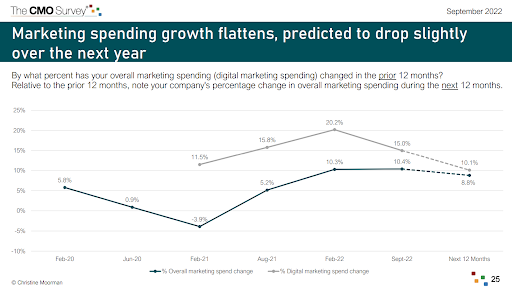
Many teams will keep being pressed to work under constraints in the coming year as economic uncertainty affects planning and budgets. In the latest CMO Survey, released in September, results showed that marketers “generally expect the growth of their marketing spending to slow or be flat in the coming year,” with waning optimism around the economic outlook likely a central factor.
The most reliable way to drive marketing results is to (smartly) invest more. This can lead to more ambitious campaigns and more robust promotion, among other things. But when a big budget isn’t available, B2B marketers can still do big things.
Whether your company is facing a crunch and scaling back, or you’re a small business marketer looking to drive growth with limited resources, here are some tips for maximizing the bang for your buck in today’s environment.
5 Ways to Maximize the Impact of Your Marketing Budget
#1: Gain ground by investing in brand.
When under pressure to show the impact of marketing efforts, there’s a natural compulsion to lean into lower-funnel, sales activation campaigns aimed at quick wins. But research has shown that doing so at the expense of brand-building investment is misguided, for two reasons:
- If your budget is down because of challenging economic conditions, there’s a good chance your buyer audience is also pulling back on spending. This means conversion-focused content is less likely to resonate and deliver ROI. Even the best lead gen ads won’t compel someone to make a purchase when they’re simply unable to do so.
- Moreover, since many of your competitors are likely reducing brand investments during such times, there is a greater advantage to be gained by bucking that trend and tapping into the heightened opportunity. “The companies who don’t make knee-jerk reactions are positioned well to catapult out of tough times,” wrote Metadata.io’s Jason Widup recently, “because everyone around them is pulling back, which creates more space in the areas you’re advertising in to get in front of the right people at a lower cost.”
Marketing academic Peter Field explained this concept more thoroughly in a piece last year for the LinkedIn Ads Blog* on advertising in a recession: “The good news for businesses that defend their brands is – because some advertisers will pull budgets thus reducing category ad spend – maintaining SOV (share of voice) is likely to be cheaper than in normal times.”
As Field illustrated, brands can even go beyond defending their SOV by pursuing ESOV (Excess Share of Voice), which essentially refers to the imprint of your brand in its category relative to its market share. A study of the 2008 recession found that “the brands that invest in ESOV saw 5 times as many very large business effects (such as profit, pricing, share, penetration etc.) and 4.5 times the annual market share growth.”
#2: Ground your creative risks and experimentation within data-informed guidelines.
Strong brand-building campaigns are inherently fueled by creatively effective approaches. By definition, creativity requires a certain level of experimentation and risk-taking. This leads budget-conscious marketers to a conundrum: how can we afford to take these risks?
The answer: by minimizing them. Today’s leading data-driven marketers are bringing structure to creativity by embedding platform-specific guidelines, which can often be informed by the platform providers themselves.
For example, YouTube offers a set of guidelines called the ABCDs (Attention, Branding, Connection, Direction), which provide a dependable framework for video advertising effectiveness – following them has been shown to produce a 30% lift in short-term sales likelihood and a 17% lift in long-term brand attribution.
LinkedIn recently shared a set of creative best practices for advertising on their platform, including specific tips for each format.
Our clients at CreativeX have built a platform designed to measure and leverage creative data in powerful and advanced ways. I highly recommend checking out their content to learn more about the science behind this movement. Michael Murray’s blog post on When efficient = effective is a great place to start.
“Efficiency doesn’t have to be a bad thing, nor a dirty word,” he wrote. “A highly effective brand, one that has invested heavily in creating future demand and that successfully balances the Long and the Short, can also be efficient at driving sustained sales volume in the short term.”
#3: Spend wisely on marketing technology.
A new report shows that martech spending is expected to break $20 billion this year. This 14.3% increase would be a step back from last year’s $20.9 spike, but still it’s clear that marketers are racing to equip themselves with a winning tech stack. Marketing technology is consistently one of the biggest sources of budget allocation for CMOs.
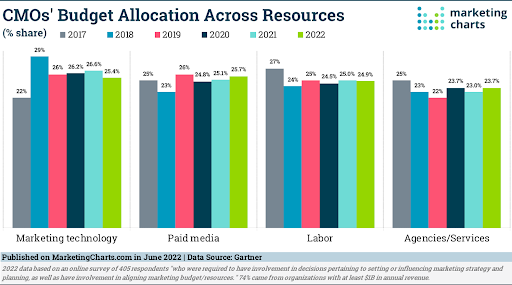
Investing in technology is important, and critical to the efficiency of your operation. But when scrutinizing a tight budget, it’s always worth revisiting your tool set in search of opportunities to cut or consolidate.
In a recent interview with Martech Series, Canto CMO Erica Gunn offered a simple piece of advice: “Don’t do too many things at once, and make sure the investments you make will actually have an impact on how you run marketing as a business.”
Last year, Harvard Business Review offered a three-step model for creating a top-down marketing tech stack:
- Deconstruct your customer journey
- Decompose your marketing strategy into tactics
- Design your martech stack accordingly
#4: Focus more on post-sale customer engagement.
As we’ve already established, it doesn’t make a ton of sense to invest heavily in directly acquiring new customers when economic conditions are suppressing purchase activity. It does, however, make all the more sense to double-down on your existing customers in efforts to shore up loyalty and secure growth opportunities.
Forrester recently shared at Forbes that “34% of marketing decision-makers who have management authority of customer engagement, plan to increase the budget for customer engagement headcount by 10% or more. The primary focus being tied between increasing the value of post-sale engagement programs by sharing customer experiences and demonstrating the impact of customer advocacy and references.”
New research by Alloy found that while “73% of B2B software companies have accelerated existing customer revenue goals over the past 12 months,” and that “41% of these brands are decreasing their emphasis on net new sales due to the prioritization of up- and cross-selling initiatives.” They’ve got the right idea.
#5: Find the right partners and support.
Even with the right processes and practices in place, you still need people to do the work. That’s a prime challenge for today’s marketing leaders, because according to Gartner, 58% of CMOs report that their teams lack the capabilities needed to execute on their strategy.
Reduced budgets can make it nearly impossible to bring in the requisite full-time talent. In this environment, experienced agency partners can be invaluable. Not only can the right partner help fill resource gaps, but they can also help bring efficiency to your efforts through expertise and strategic consultation.
Make Every Marketing Dollar Count
The threat of an economic downturn can understandably cause a lot of apprehension for anyone who is held accountable for business growth. As a marketing leader, the best thing you can do is view moments like these as opportunities. Recognize that you can control only what you can control, align your approach to changing customer circumstances, and make the most out of what you’ve got.
You don’t need a big budget to do big things.
* LinkedIn is a TopRank Marketing client
The post B2B Content Marketing: Making Small Budgets Do Big Things appeared first on B2B Marketing Blog – TopRank®.
Il prezzo delle Xiaomi Redmi Buds 3 Lite va in picchiata: ormai costano un NIENTE

10 years of insights from Think with Google
The year is 2012. You and a record-setting 8 million people are watching live as skydiver Felix Baumgartner breaks the speed of sound with his 24-mile fall to Earth. In another tab, PSY’s “Gangnam Style” plays for the umpteenth time. Later in the year, it will become the first YouTube video to hit 1 billion views. You’re doing all of this, of course, on your desktop, a device that still accounts for more than 90% of web traffic globally.
That same year, we introduced Think with Google to give readers insights into behavioral and cultural trends based on Google data.
So much has changed in the decade since. For one, there’s a much higher chance you’re reading this article on mobile, which now makes up almost 60% of global web traffic. In that time, Think with Google has charted the evolution of consumer behavior as new digital technologies have emerged.
To mark the 10-year anniversary of Think with Google, here’s a selection of insights that tell that story.
2012: The shift from TV to online video begins
The opening ceremony for the 2012 Olympics drew a global TV audience of 900 million. By the time the Games were over, NBC declared it the most-watched television event in U.S. history.
But an important change was underway: As broadband access increased, people were ditching TV programs and heading online. In a 2012 Think with Google study, 44% of 13-to 24-year-olds said they spent more time watching online video than TV.

Source: Ipsos/Google, 2012 Teens and Twenty-Somethings research study, 2012.
2014: Multi-screen behavior moves mainstream
In 2010, when sports fans tuned into the World Cup, they were so glued to their TV screens that online searches, which tended to take place on desktop, plummeted.
Ahead of the 2014 World Cup, we drew on data from the Union of European Football Associations Champions League to make a prediction: “Second screening,” where fans tune into an event on a big screen while following along on mobile, was going mainstream. That prediction held up. In 2018, research revealed that 70% of adults looked at a second screen while watching TV.
2015: Micro-moments emerge
By 2015, long gone were the days where shoppers had to write a list before heading to the store. Instead, people were turning to their smartphones the second they wanted to do something, discover something or buy something.
We called these “micro-moments,” and they were becoming increasingly widespread. That year, 82% of smartphone users consulted their phone while in a store.
2017: Mobile speed becomes critical to success
In 2017, it took, on average, 22 seconds for a mobile webpage to load.
That might not sound like much, but according to Google research that year, it was enough to sink an online business. The research, which analyzed the landing pages of 900,000 mobile ads, found that as page load time went from one second to 10 seconds, the probability of a mobile visitor bouncing increased 123%.
2018: Video gets interactive
We’ve all seen people with their heads buried in their phones, unaware of what’s happening around them. Maybe that’s why the internet has long had an unfair reputation as an isolating experience.
But YouTube data from 2018 revealed an emerging trend that would explode just a few years later: the rise of video as an interactive, social experience. For example, we saw a huge interest in videos that encouraged viewers to do something — study, clean, read — at the same time as a YouTube creator and their followers.

2020: Online resources become a lifeline
No amount of Search data could have predicted what would happen in 2020, as the coronavirus pandemic shuttered offices, stores and schools.
Many people used the stay-at-home mandates to develop new skills. YouTube data revealed that globally, videos with variations of “beginner” in the title earned more than 7 billion views.
2021: Virtual experiences stay put
If anyone thought the changes brought on by the pandemic were temporary, Search data from 2021 suggested otherwise.
While people were understandably eager to go back to IRL experiences, virtual social events never fully went away. Around the world in 2021, we saw a 90% year-on-year increase in searches containing the term “watch party.”
2022: What’s coming next
Now, here we are in 2022. We’re continuing to crunch the numbers and share trends. We’re shedding light on evolving consumer behavior. And we’re sharing the lessons Google is learning, in real time, on topics ranging from inclusion to privacy. In an industry that has changed so much over the past decade, and will continue to do so, insights like these are crucial — and we’ll be here to keep sharing them.
Windows: una falla 0-Day fa eseguire JavaScript malevoli
I ricercatori di HP hanno trovato una nuova falla 0-Day su Windows che permette di sfruttare i file JavaScript per diffondere malware.
Leggi Windows: una falla 0-Day fa eseguire JavaScript malevoli
Segnale WiFi debole? Nessun problema col ripetitore Xiaomi: prezzo incredibile (18€)
iPhone 13 (128GB) 5G, eBay la tocca piano e fa GOL: 100€ di sconto e via
Realme Pad Mini, lo sconto è di quelli che ti invoglia a comprare: prezzo imperdibile
Apple iPad Air (64GB), eccola l’occasione che stavi aspettando per comprarlo
Realme 9i, il medio gamma che SPACCA crolla di nuovo su Amazon
Android: adware sul Play Store con oltre 20 milioni di download
I ricercatori di di McAfee hanno scoperto 16 app per Android sul Play Store contenenti adware e aventi più di 20 milioni di download.
Leggi Android: adware sul Play Store con oltre 20 milioni di download