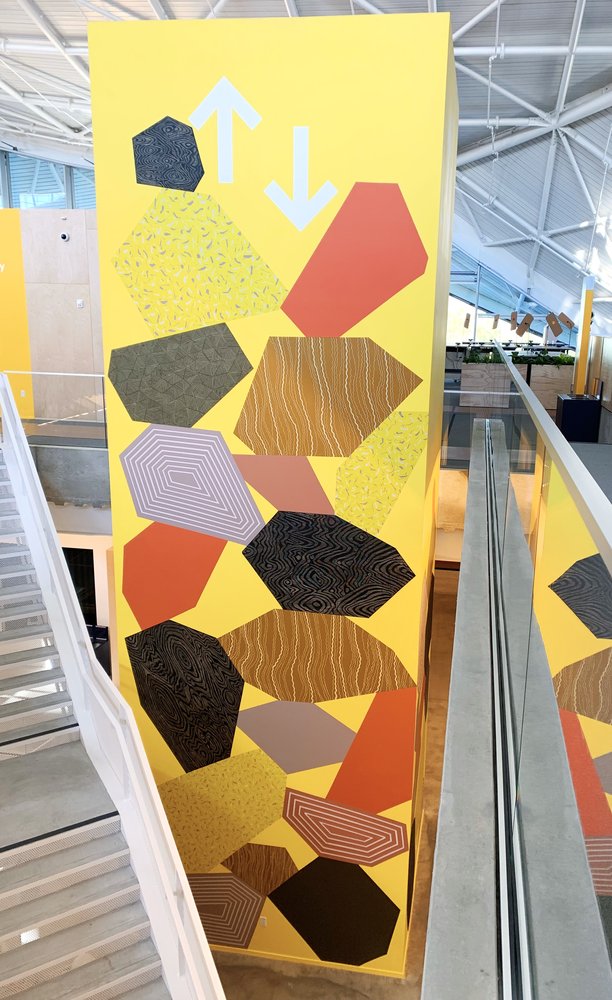
See how artists turned the elevators into art at Bay View
There’s a lot to take in when you visit Google’s Bay View campus. There are the dragonscale solar panels, the grassy wetlands surrounding the building and…the elevators. Yes, the elevators.
Bay View is a three-building campus composed of large, pavilion-like canopy structures, the highest point of which stands at 126 feet. Inside the two office buildings, there are multiple free-standing elevators that take Googlers to the upper floors designed for team focus. Nine of these elevators aren’t just elevators; they’re also works of art.
Google’s Artist in Residence program worked with local artists to commission work in Google spaces and turn the side panels of the elevators into giant murals. “Bay View is one of our larger projects,” says Josette Melchor, who’s part of Google’s Real Estate and Workplace Services team and oversees the Artist in Residence program’s efforts. “The idea was to create these inner courtyards throughout Bay View that reflect the ecology of the area.” The elevator shafts, which each stand between 32 and 37 feet high, are part of this; mural artists were given five “biomes,” or biological themes, to work with — grasslands, scrubs, dunes, oak savanna and tidal/marsh. The biomes also form courtyards that naturally help visitors find their way around Bay View.
Josette says from start to finish — from the concept stage to the final brushstrokes — the process of working with the mural artists took about a year and a half. “There’s a lot that goes into it that people might not think about,” says Andrea Ceseña, the project producer and curator who worked with the Bay View artists. For instance, all of the artists had to become scissor lift-certified so they could be lifted up to paint the entirety of the elevators. Artists also worked on their murals while occasionally surrounded by the people who would be seeing them everyday — Googlers who work in the Bay View building. People who were working on finishing Bay View also took in the art, Andrea says, which was rather unusual for an art project at Google. “It was about expanded the audience that artists normally have when they’re working on something,” Andrea says. “Everyone was so excited to see the artwork while it was in production.”
But instead of just telling you about these impressive projects, let’s take a quick tour of them — and meet the artists behind them.
Mural title: Untitled
Artist: Brett Flanigan
Theme: Dunes
When you first walk into Bay View’s main entrance and make it through the front lobby area, you’ll notice Brett Flanigan’s elevator shaft mural to your left. Brett is a self-taught artist who says his degree in biology influences his work. “I first consider the initial conditions, including the surface and shape of the wall,” Brett says. “These inform the rules and algorithms I then use to create patterns, as geological events create the specific conditions for the formation of sand dunes.”
Mural title: “Megalith”
Artist: Carmen McNall
Theme: Oak savanna
Continuing around the space clockwise, you’ll next run into Carmen McNall’s mural, which uses carved wood grain patterns and various neutral shades to suggest the feeling of looking up the trunk of a tree. “I was excited to create a piece that was so vertical and wrapped around the structure,” Carmen says. “I thought about it as a sculptural piece in a way, because it would be seen from many different angles.”
She tried to bring her biome theme — oak savanna, a sparsely forested grassland — to life by incorporating structure into the mural. “I thought about the oak savanna and how all the elements in this environment are so delicately balanced, yet they withstand and regrow despite the threat of fire,” she says. “I decided to incorporate hand carved pieces of wood, which represent the textures and patterns of the oak savanna.”
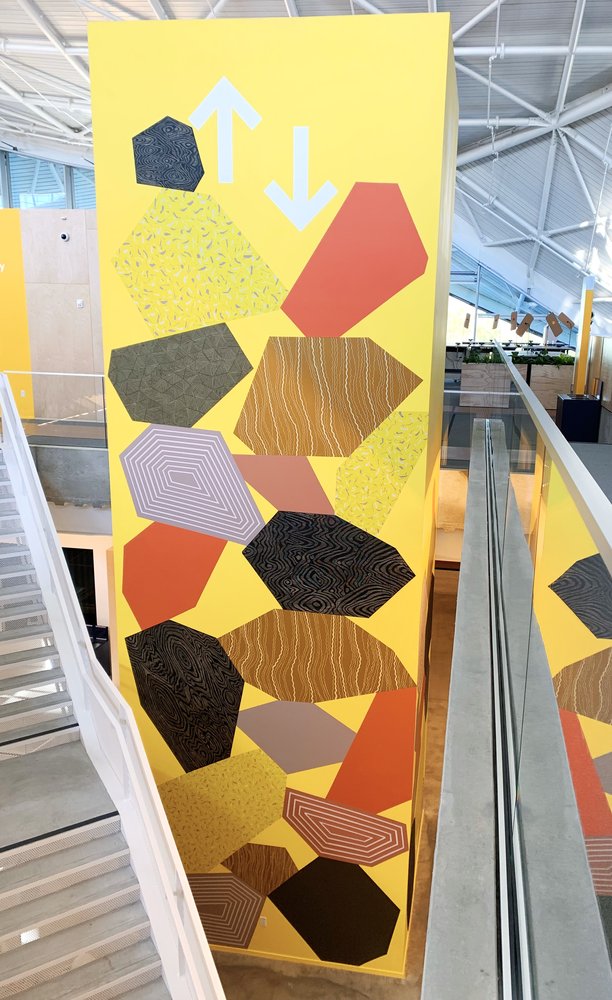
This was the largest piece Carmen had worked on, both literally and in a project management sense. “Working on a 30-foot tall piece was a really empowering experience and I can’t wait to do more projects at this scale — or larger!” she says.
Mural title: “Tidal Moves”
Artist: Rachel Kaye
Theme: Tidal/marsh
After making your way through the first building, you’re on to the next. Here you’ll spot Rachel Kaye’s mural. “I did some research on plant forms in tidal habitats and played around with their shapes until I got a composition that flowed and played around the elevator shaft,” Rachel says of her mural, which was her largest to date and took her two full weeks to paint. She used interior house paint for the mural, as well. “Nothing fancy.” Rachel’s mural took inspiration from the tidal/marsh theme, though she hopes people who see it can interpret it however they like. “I try not to steer the viewer in one direction of thinking. I like my work to feel open-ended.”
Mural title: “Coastline”
Artist: Tess Rubinstein
Theme: Tidal/marsh
Next comes Tess Rubinstein’s work. “Initially I had a hard time conceptualizing what the elevator shaft would look like,” Tess says. “It’s such a new format, painting a multi-dimensional space instead of a flat wall. It wasn’t until I visited the site that I fully grasped the shape and size of the project.” Tess’s mural was assigned the tidal theme, which was perfect for the artist. “I had just received my California naturalist training and had been learning all about seaweed and how vital it is for the health of our oceans,” she says. “I also live near the coast and spend a good deal of time at the beach, drawing the seaweed and shells that wash ashore.”
Tess focused on the seaweed in her mural because she wanted to pay homage to something that’s incredibly important to the ocean, but often overlooked. “I hope that people feel soothed by the color palette and forms,” she says. “Beyond that, I hope that it provides a moment of reflection on the beauty and value of our surrounding ecosystems.”
Mural title: “Saltgrass”
Artist: Laurel Picklum
Theme: Tidal/marsh
Closely following Tess’s tidal mural is Laurel Picklum’s, also based on the same biological theme. She used Bay View’s surrounding marshes as inspiration, and her upbringing and career path certainly show up in her work. Laurel was raised by nature-loving scientists and completed the Natural Science Illustration program from the University of Washington. “There are lots of wonderful, precious species living in the Bay Area’s tidal marshes, but saltgrass caught my eye because it looks like plain grass when you’re walking by it,” Laurel says. “But crouch down to take a closer look and you see the intricacies and delicate nature of the plant and its salt jewelry. I wanted to celebrate this little plant and bring the viewer down into that space where it becomes something magnificent.” She calls saltgrass a “testament to adaptability.”
Laurel freehanded the layout of the mural onto the wall rather than projecting or gridding out parts of it. “I had to change the final layout from my mockup a bit because of the location of the arrows at the top of the elevator shaft and because I couldn’t reach part of the upper wall,” she explains. “I ended up free handing the grass shapes onto the wall with chalk. I wouldn’t have done it this way if it was a more complex composition, but it worked out well with the saltgrass imagery.”
Mural title: “Natural Attraction”
Artist: Amandalynn
Theme: Grasslands
In the center of the building, you’ll spot Amandalynn’s mural. She typically works on projects of this size, though there were some unique aspects to this particular mural. “The challenge for me was more the fact that it was indoor with a lot more rules around movement and timing,” she says. The Grasslands’ theme was perfect for Amandalynn, who says she enjoys incorporating the local ecology into her work. “I also almost always try to paint on a bright green background, so when I was asked to paint the Grasslands area with the theme color of green, the design came quickly.” It took Amandalynn about five days to paint her mural; she began with a charcoal outline of her piece then used all water-based acrylic paints in thin washes. “I’ve found this technique creates a nice sense of fine art within my murals and it uses less material, which lessens the environmental impact of the final product.”
Mural title: “Mothership Mountain and the Many Moons”
Artist: Victoria Wagner
Theme: Scrubs
On to elevator number seven, featuring Victoria Wagner’s work. Victoria was inspired by the rolling lavender fields of California and other native plants, like yellow yarrow and tumbleweed. “Growing up in the high desert at the foot of the Sierras, it wasn’t a stretch for me to envision the mountains, blooming yellow sage flowers and the sharp light of my youth in that high elevation landscape.”
She uses that idea of elevation in her work. “You cannot help but look up at Bay View! The gift of looking skyward, pausing and allowing your posture to draw up and your chest to fill with air, is a subtle invitation to be at one with the vibration of land, sea and heavens,” Victoria says. “My hope is that the murals invite this kind of engagement and reverie.”
Mural title: “Clouds on Earth”
Artist: Mariangela Le Thanh
Theme: Scrubs
The next mural belongs to Mariangela Le Thanh. “I’ve painted some murals in the past but I’ve never worked on anything this large before — most of my paintings are around 10-by-10 inches,” Mariangela says. She said this bigger scale required more planning, and was a learning experience. She took inspiration from her home to create the mural. “I really wanted to paint the landscape that surrounds my home in Northern California. Since the image wraps around itself, I was inspired to paint lives immersed in cycles of clouds and flowers,” Mariangela says. “I hope people are reminded of a nice summer afternoon from their childhood when they look at my mural.”
Mural title: “Love Story of Hummingbirds and Ancestors”
Artist: Adrian Arias
Theme: Scrubs
And mural number nine is by Adrian Arias. He was inspired by a hummingbird that visited his window one day and, surprisingly, settled for a moment. “My connection with hummingbirds is ancestral; it is part of my culture,” Adrian says. “Hummingbirds are sacred messengers between life and death, between what must be transformed to stay alive.” Adrian completed his mural in about four days, and he enjoyed it when construction workers who were working on the building would ask him questions or talk to him while he was painting.
Like many of the artists, Adrian hopes that his mural leaves visitors with a sense of wonder. “I hope they have the feeling of wanting to know more about the images they see.”
Echo Dot 3, se non lo compri oggi, quando? Solo per oggi col 60% di sconto
Elegante e raffinato, Amazfit GTR 3 PRO per la prima volta al MINIMO storico su Amazon
A look at the Responsible Innovation Fellowship
Responsible AI is an emerging field. While AI enables us to solve problems in exciting new ways, the scale of its impact raises new challenges. As a result, it’s important to develop AI responsibly so that it can empower and be helpful to everyone.
As the next generation of technologists prepares to enter the field, the demands of education are changing accordingly. Computer science education has historically been synonymous with learning to code. But today, as advanced technology and AI begin to impact almost every facet of our lives — from college admissions, medical diagnosis, social media, to credit limits — it’s necessary for technologists to be educated and prepared to not only understand the societal impacts of technology, but also do so from a diverse set of perspectives, cultures and communities.
The Responsible Innovation Fellowship (RIF) program was designed by Google’s Responsible Innovation team members Cherish Molezion and Kendra Schultz to contribute to this progress. The fellowship supports career exploration and equips students with the knowledge and skills they need to enter the field of responsible innovation. RIF encourages students from currently underrepresented backgrounds — including students from Minority Serving Institutions, such as Historically Black Colleges & Universities (HBCUs), Hispanic-Serving Institutions (HSIs), and Historically Women’s Colleges (HWCs) — to apply. Additionally, the program fosters collaboration between technical and non-technical fields, demonstrating the need for both perspectives in technology. RIF welcomes applications from humanities and social sciences students as well as computer science students.
As Cherish explains, RIF aims to “provide equitable opportunity and community for budding technologists to exercise their ethical imaginations. Through diversifying the makeup of the responsible technology landscape by expanding across all regions, we can truly uphold our mission to build for everyone.”
This spring, the RIF team welcomed the inaugural cohort, engaging 20 students during the 5-week fellowship. The program covered topics from human and social ethics in AI, socio-technical harms, and synthetic media, and ended in a final capstone presentation where students applied the methods they learned to assess ethical considerations for a hypothetical AI application of their choosing. “My team and I are inspired by the students’ ingenuity,” says Jen Gennai, Google’s Director of Responsible Innovation. “We learned from their distinct lived experiences and perspectives.”
The students are now bringing their learnings back to their schools and communities. April LaGrone, a public health student at Western Michigan University, plans to apply her responsible AI learnings in the health field. “I’m passionate about equitable research, ensuring research study participants have control, power and a voice,” she says.” In the same way that AI literacy is important, we need to focus on health literacy so people understand what their rights are, become educated on their health care options, and are able to advocate for themselves. Explainability and health literacy go hand-in-hand.”
José C. Sánchez Curet, a student at the University of Puerto Rico, Río Piedras, hopes to share his learnings with other students. José is working with leaders in his university’s computer science department. “I hope to teach seminars about AI ethics and foster conversations where we can collaborate on possible improvements to responsible technology development.”
Christina Carpenter, an elementary education student at Bay Path University – and a mom – hopes to apply RIF insights to her career and also everyday life. “We’re creating the next generation of innovators, and I hope to teach little minds how to be responsible with technology and the negative impacts of certain types of technology use.” With her son heading off to middle school soon, Christina is mindful that “he’s grown up with electronics his whole life, and this is when he needs to learn how to be responsible with technology.”
To celebrate the lessons learned and accomplishments of the entire cohort, we’ve put together a Responsible Innovation Fellowship Yearbook, where you can read about all of the Fellows and how they plan on applying what they learned to their careers.
The Responsible Innovation Fellowship program will soon be accepting applications for future cohorts — join the mailing list.
Massaggiatore multifunzione: elimina le occhiaie e dona lucentezza al tuo volto con 16€
Cavo HDMI con supporto al 4K, robusto e MAGICO ad appena 5€
Elegante, portatile e resistente, il T7 Shield SSD di Samsung è una BOMBA a -24%
SSD Kingston A400 da 240GB: super prestazioni a soli 26€
Mouse wireless HP, sia Bluetooth che 2.4Ghz con 4000DPI

Our ongoing work to support the 2022 U.S. midterm elections
In the last few months, voters have participated in elections around the world, including recently in France, Kenya, Colombia, Australia and primaries across the U.S. Our products and services have helped people find election information and protect the accounts of campaigns and election officials. We are continuing these efforts in Brazil, the U.S. general election and other elections globally.
Today, we’re sharing an update on our ongoing work related to the U.S. midterms. Our work is centered around connecting voters to the latest election information, helping campaigns and people working on elections improve their cybersecurity and protecting our users and platforms from abuse.
Making election information easily accessible
In the lead-up to elections, voters search for useful and relevant information to help them navigate the electoral process. That’s why we build features that show data from nonpartisan organizations to make it easier for people to get helpful election information.
As we’ve done for many previous elections, we’re rolling out features on Google Search to connect voters with accurate information about voter registration and how to vote. In the coming weeks, when people search for “how to vote” in both English and Spanish they’ll find election information panels sourced from Democracy Works, a nonpartisan and nonprofit data provider, which works directly with state election administrators to aggregate information about how they can vote in their state, along with key dates and deadlines, and guidance for options like voting early, in-person or by mail. The information panels will also link to state government official websites, which provide more information. And as with previous U.S. elections, we’re working with The Associated Press to present authoritative election results on Google.

We’re also making it easier to find authoritative news coverage on local elections from a range of sources. In addition to helping people find election news from their own communities, we’re launching a new feature that will help readers discover local and regional news from different states so they can better understand the election coverage of races they most care about. The feature will be launched in the coming weeks.
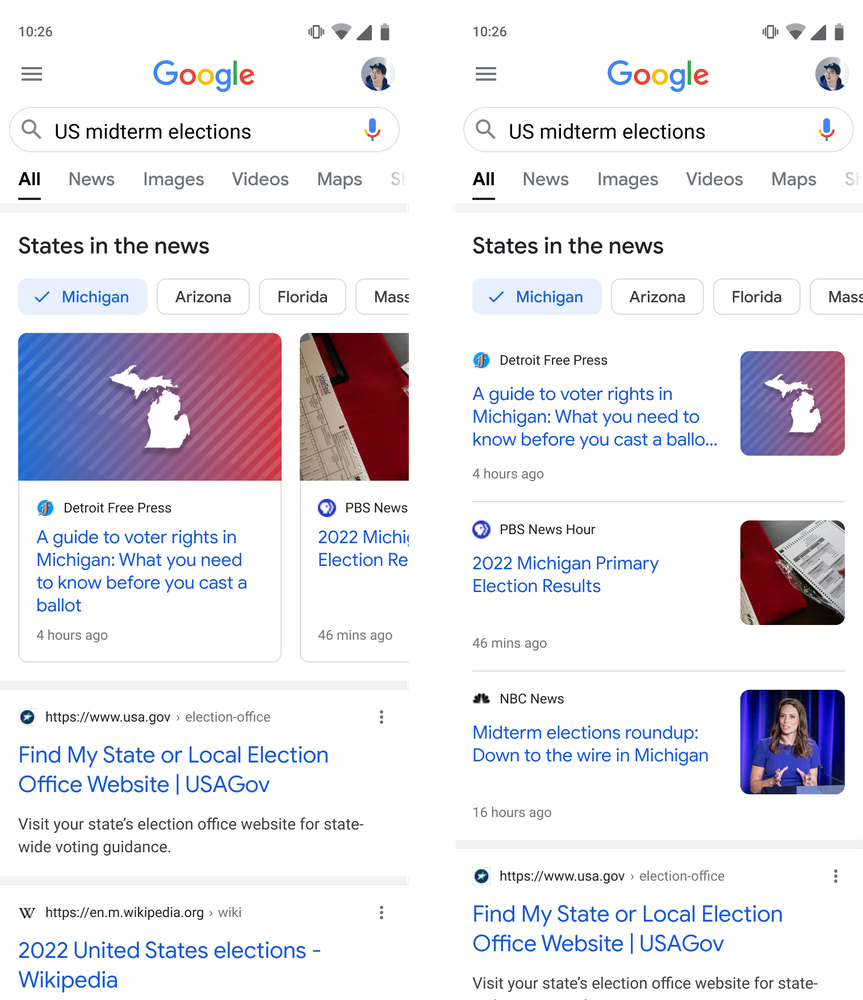
An example of how our new feature will show local and regional news from different states. Depending on the amount of coverage, readers may see a carousel or list of articles.
On YouTube, our systems are prominently recommending content from authoritative news sources, while limiting the spread of harmful election misinformation. We’ll also be showing relevant election information panels at the top of YouTube search results and underneath videos about the midterms to provide people with additional context about elections. Learn more about how YouTube is supporting the U.S. midterms here.
Supporting election security and training
Every election comes with increased cybersecurity risks. In fact, a recent survey shows that more than 41% of people working in politics and journalism had their digital accounts hacked or accessed without their permission in 2021. We understand this reality and are offering these high-risk users best-in-class security tools and resources.
To train and protect the security of people working on elections, we’ve been partnering with organizations like Defending Digital Campaigns, which has provided free security keys to over 300 national committees, state parties and political campaigns in all 50 states. To ensure the strongest account and site-level protections, we offer our free Advanced Protection Program and free Project Shield service to safeguard against digital attacks. Through our Campaign Security Project, we’ve teamed up with organizations across the political spectrum to train over 4,000 campaign and election officials on security best practices, including products and tools they can use to stay safe online.
Additionally, the Google News Initiative has continued to support a number of election-related trainings for journalists and newsrooms on identifying and combating misinformation. This year, in a partnership with the National Association of Black Journalists, we are helping to train over 700 journalists from publications across the country by the end of 2022. And we’re working with Poynter to provide additional tools and resources for hundreds of Spanish-speaking reporters and other news outlets as they prepare to cover the midterms.
Protecting our users and platforms
Preventing abuse on our platforms — such as account hijackings, phishing attempts or orchestrated disinformation campaigns — is always a top priority, especially during sensitive times like elections. Our Trust and Safety teams and Threat Analysis Group are working around the clock to monitor and stop these kinds of digital threats, and we’ve continued to make significant investments in our global operations to ensure our products remain safe and secure.
We also have longstanding policies that prohibit election-related abuse on our platforms. This continues to include policies to combat the spread of election misinformation and demonstrably false claims that could significantly undermine participation or trust in the electoral process, such as false information about polling locations, means of voting, candidate eligibility or election results. As always, we will continue to apply these policies in a neutral and apolitical way.
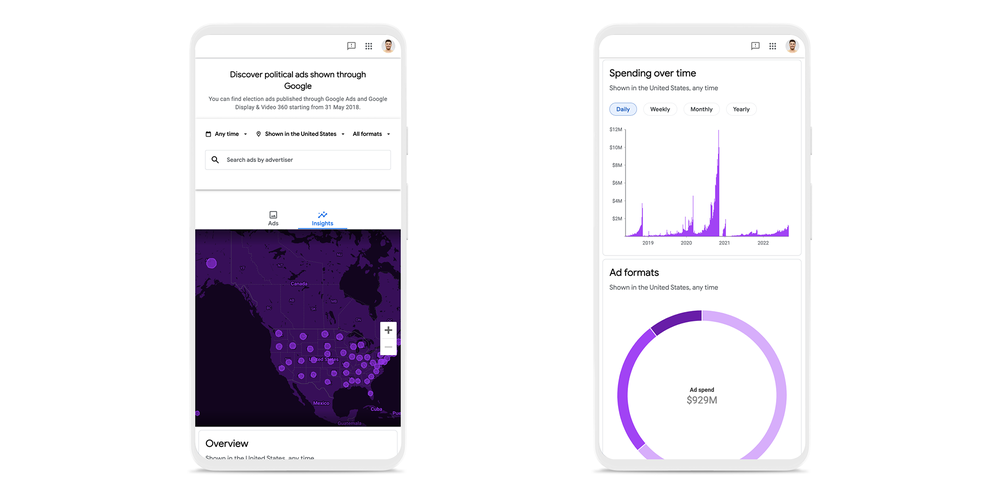
When it comes to election advertising, we want to make sure voters have confidence in the ads content they may see on our platforms. That’s why we require all advertisers to complete averification process and enforce strict ads policies, such as limiting the way advertisers can target election ads. We’ve also made significant investments in enhancing transparency around election advertising. In fact, earlier this year we updated our Political Ads Transparency Report, creating a new user interface and adding new tools for accessing and filtering information about targeting, location and formats for specific election ads and advertisers. The new report also includes a more granular breakdown of advertiser data — giving users and researchers greater insight into ad spending and impressions based on the latest Congressional redistricting information. And globally, we’re expanding our election ads verification policies and transparency tools to more countries, including Argentina and Brazil.
We’re committed to helping people navigate the electoral process around the world, and we will continue to share updates about our ongoing work.
Bringing computer science education to 11 million students
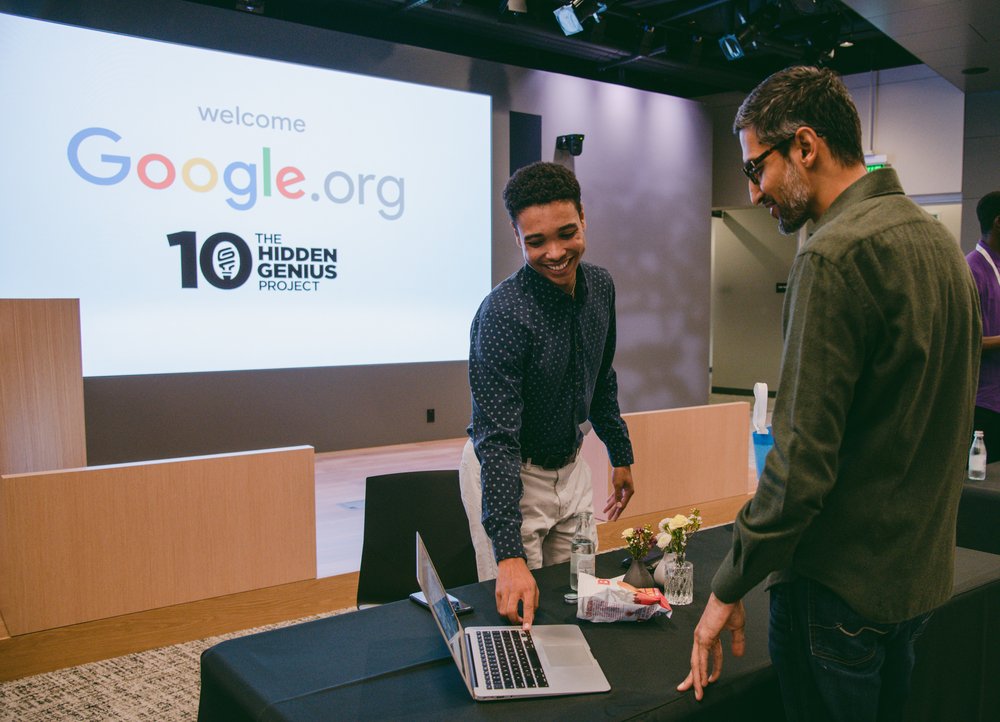
Earlier this summer, I had the chance to meet alumni of The Hidden Genius Project, an Oakland-based international nonprofit that provides Black male youth with training and mentoring in technology, entrepreneurship and leadership. Many of these graduates had no formal computer science education in their curriculum before joining the organization. Thanks to the technical and coding skills they learned through The Hidden Genius Project, they are now using technology to build their own businesses. One graduate, James, learned how to wire frame, which he’s using to launch an app-based shoe restoration business. Another graduate, Jeremiah, is using the digital skills he learned to increase his company’s online presence and reach more customers for his cleaning services company.
For these young men and for so many other students, computer science (CS) education is providing a foundation in the skills they’ll need for their future careers. Yet there remain deep opportunity gaps in education that prevent everyone from accessing those skills equally.
At Google, we believe educational opportunities should be available regardless of socioeconomic status, background, race or geography. So today, we’re building on our long-time support for nonprofits with an additional $20 million commitment to expand CS education access to more than 11 million students across the U.S. — including more support for The Hidden Genius Project. This brings our total commitment to CS education to more than $240 million since 2004.
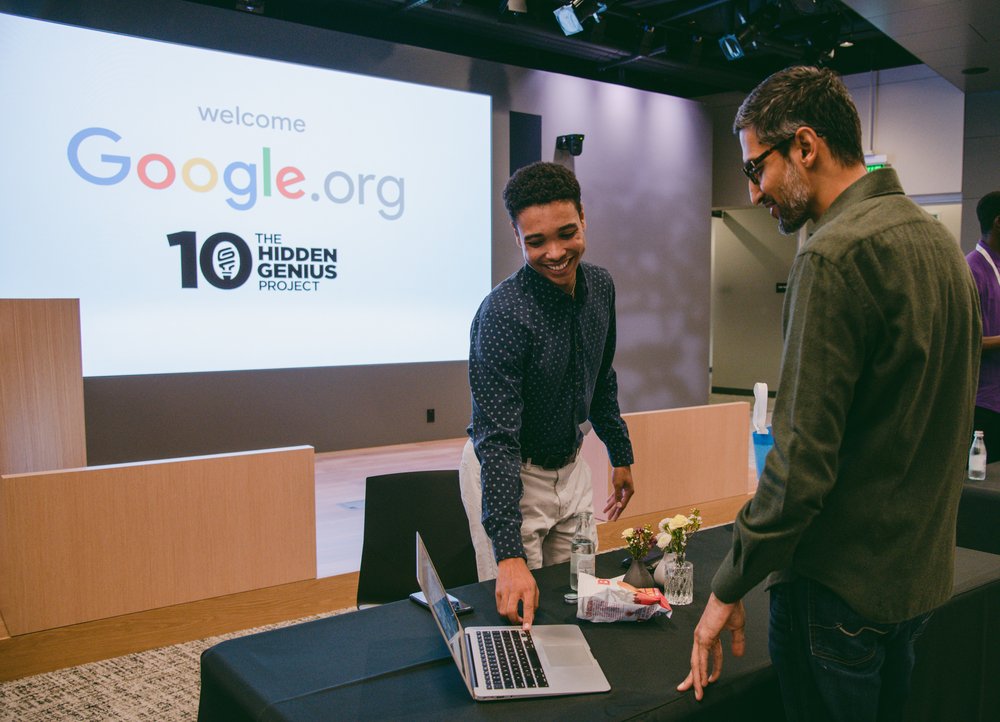
Sundar talks with The Hidden Genius Project alum Ian Bundy-Weiss during the program’s visit to Mountain View in June 2022. Ian founded My Drip, a platform for fashion designers.
We’ll focus our efforts on supporting national and local organizations who reach underserved students in major urban centers and rural communities, and who help governments and educators implement CS education plans nationwide.
In addition to The Hidden Genius Project, we’ll provide support for local nonprofits across the country, with a focus on Atlanta, Chicago, New York, Washington D.C. and Los Angeles. We’re looking forward to helping advance programs like the Computing Integrated Teacher Education project at the City University of New York, to incorporate CS education into the curriculum for new teachers, and supporting CodePath in Chicago and Atlanta, to help students from underrepresented communities work towards tech-based careers.
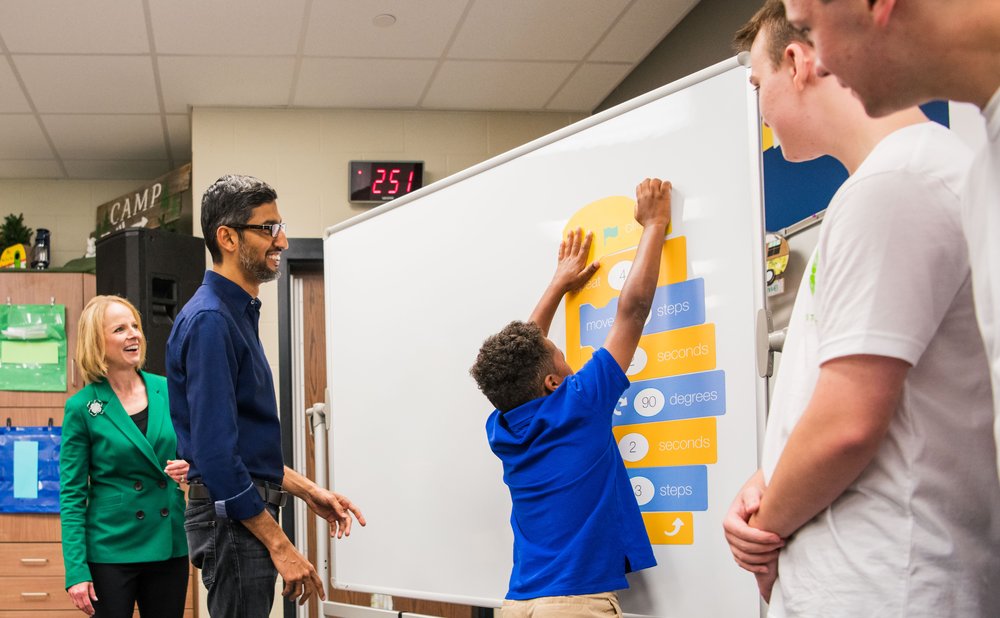
Sundar Pichai and 4-H President and CEO Jennifer Sirangelo join students in a coding activity at a 4-H computer science education event in Mayes County, Oklahoma, in 2019.
To widen access to CS education for students in rural and under-resourced communities, we’re extending our commitment to4-H. With our support, since 2019, 4-H has introduced1.4 million students to CS education pathways, 65% of them in rural communities. The new grant we’re providing will support 4-Hers throughCooperative Extension’s programs and resources, helping 6 million young people and more than 3,500 educators.
Finally, we’ll provide funding to the Expanding Computing Education Pathways (ECEP) Alliance, a national network coordinated by the Texas Advanced Computing Center at The University of Texas at Austin, which aims to increase participation in CS education through state-level reforms. This funding will enable ECEP to partner with policymakers, educators and others on systemic changes that will help more students from a wider range of backgrounds pursue computing-related degrees. It will also support the addition of five new states to the ECEP Alliance, laying the foundation for a national framework.
Today’s announcement is part of our Grow with Google initiative and includes funding from Google.org. It builds on a lot of other good work underway. Earlier this year, Google partnered with the American Farm Bureau Foundation for Agriculture to train 2,000 teachers on digital skills, enabling them to reach 200,000 rural students by the end of the 2023 school year. And this summer, I joined other CEOs to send a message in support of making computer science a basic part of every K-12 classroom.
Of course, access to computing skills and digital knowledge is important for adults, too. More than 9 million people in the U.S. have already learned new skills through Grow with Google — including Google Career Certificates, which prepare people for jobs in growing fields. We’re building new financing models to extend these programs to more people and drive wage gains for workers. And we’ll continue to partner with organizations to provide local training opportunities, especially in marginalized communities.
We believe Google and other companies have a responsibility to help people get the skills they need to get a good job, start a new business, and provide a solid foundation for their families — no matter what their age or where they live. Computer science education is an important piece of this, and we look forward to working with our partners to unleash the talent and drive of millions of people in communities across the U.S.
What Google’s grant means for The Hidden Genius Project
Editor’s note:Today’s post is authored by Brandon Nicholson, PhD, an Oakland, California native and the founding Executive Director of The Hidden Genius Project, a Google.org grantee. Brandon has dedicated his life to promoting equity in the public realm, particularly in the education space.
The mission of The Hidden Genius Project is to train and mentor Black male youth in technology creation, entrepreneurship and leadership skills to transform their lives and communities. Our vision is to be a global leader in this work and an incubator of dynamic young technologists (who we call Geniuses). Through our comprehensive support model, starting with our 15-month Intensive Immersion Program, The Hidden Genius Project works to bolster both workforce development as well as youth-driven leadership, resulting in stronger economies and more equitable communities.
Today, The Hidden Genius Project received a $3 million Google.org grant to expand our program to two additional cities and reveal hundreds of more Geniuses. This will afford us the resources to join arms with a broader array of communities to support and elevate the potential of our Black boys and young men.
We first connected with Google.org in 2015, when we were a finalist for the Google.org Bay Area Impact Challenge. I thought it was a long shot, but taking the risk of applying has opened up many pathways for us. After we found out we received funding, we partnered with TEAM Inc. to create the Tech Slam series, a program that introduces youth to the intersection of sports and technology. We have since hosted a dozen Tech Slam events across three continents.
Fast forward seven years and nearly 8,500 young people served globally, the impact of our work became clear when some of our Genius alumni recently visited Google’s Bay Area campus. These young men first visited Google as high school students, where they were closely coached through the experience. This time, they were confident, rising entrepreneurs capable of commanding a room.
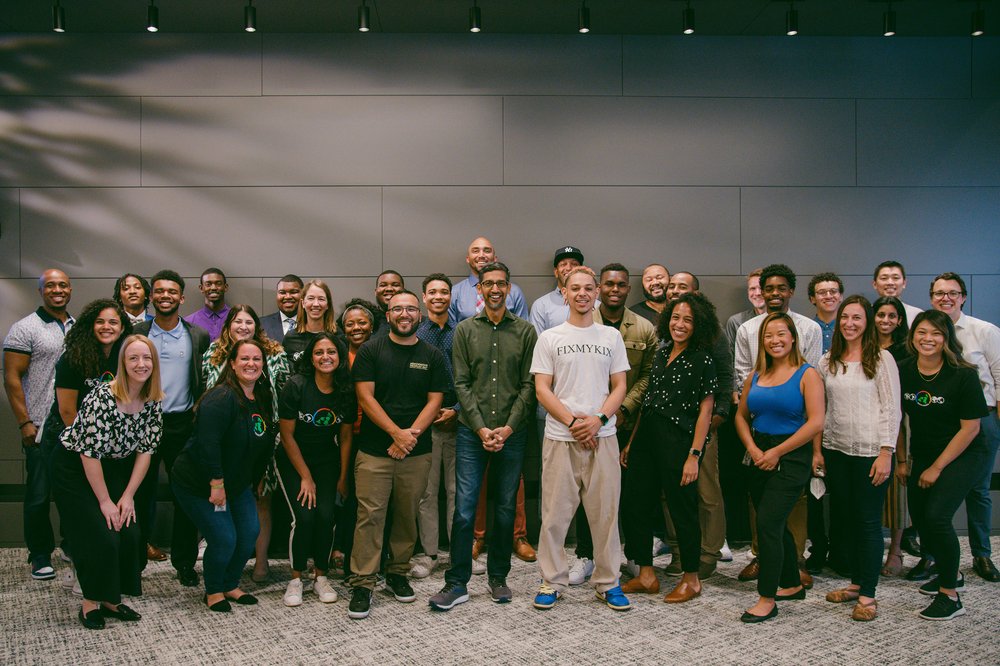
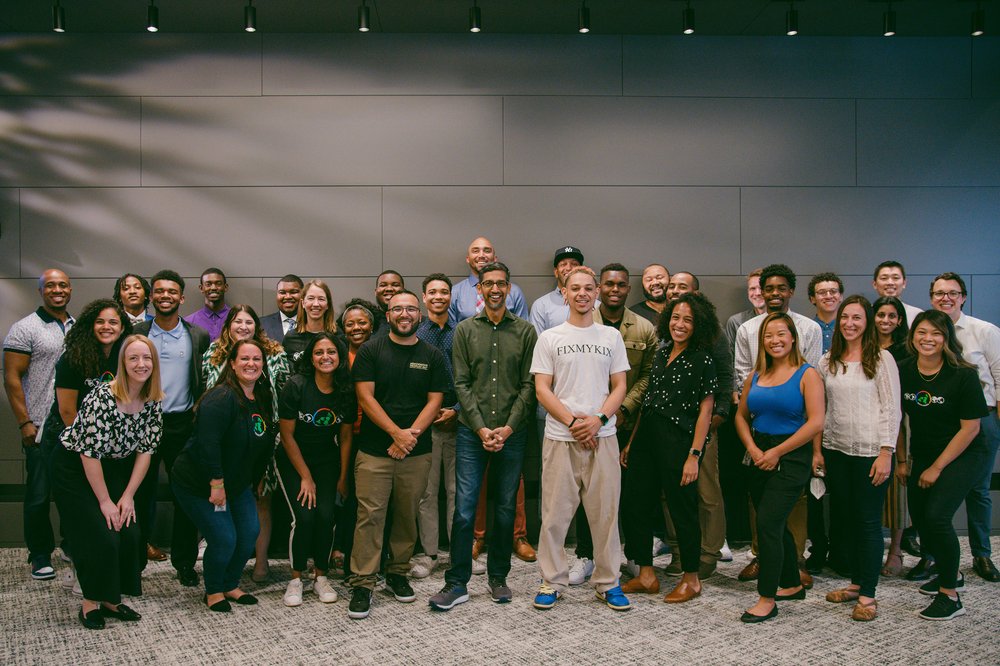
Alumni and staff from The Hidden Genius Project met with Googlers during a recent event.
Young men like Sir McMillan (from our inaugural Los Angeles cohort) pitched their business ideas to Google CEO Sundar Pichai. Sir bounced marketing ideas for his business off Google CMO Lorraine Twohill, and he and his Genius brothers shared their thoughts on Android OS with Hiroshi Lockheimer, Senior Vice President of Platforms & Ecosystems. The experience signaled the richness of our progress over the past decade. We’re so excited to see where we go next.
Our alumni will continue to drive our organization forward — not only through their accomplishments, but also through their direct contributions as educators, mentors and ambassadors. For example, our alumni have served as the primary content facilitators for all our Tech Slam events, regularly inspiring others around the world, including each other. Kyron Loggins (from our fourth Oakland, California cohort) shares, “From student to alumni to employee, it’s just great to be able to experience this growing and scaling because it’s such a positive thing for the community of Black people everywhere.”
Looking ahead, and as we celebrate our 10-year anniversary, we now have the opportunity to expand to new communities. And we are fortunate to be able to lean on a wide range of supporters — including our alumni and funders — to ensure our success.

Perseverance led this engineer to Google on his second try
Welcome to the latest edition of “My Path to Google,” where we talk to Googlers, interns, apprentices and alumni about how they got to Google, what their roles are like and even some tips on how to prepare for interviews.
Today’s post is all about Kevin Lozandier, a user experience engineer (UXE) based in San Francisco who has overcome personal obstacles and made it to Google on his second try.
How would you describe your role?
As a UX engineer on the Responsible Innovation team, I have a background in design and programming. This helps me work with designers and engineers so they can better understand each other. I can clarify the intent of a design to an engineer or explain technical constraints of an idea to a designer. But my main responsibility is advocating for our users. My role requires me to think through every way a person might use a product so we can make it better.

Kevin takes a selfie while holding up a peace sign
Can you tell us a bit more about your background?
I grew up as a child of first-generation Haitian immigrants in Denver but by high school was designated an independent student. While at times I felt isolated waking up in foster homes and even a homeless shelter, I found comfort in surrounding myself with good people to keep me motivated. My troubled youth encouraged me to take a “no stone unturned” approach to life, creating every opportunity I could for myself.
In elementary school, Denver’s Gifted and Talented program provided tutoring sessions with a web developer that taught me to code and helped me discover my passion for programming. Then, the summer before sixth grade, I was part of a tech education program that taught me the basics of building a desktop and allowed me to keep the computer afterward. I didn’t otherwise have access to a computer at home, so this enabled me to build my web and UX skills throughout my youth. In college, I focused on learning how people interact with products through classes on consumer behavior, sociology, digital entrepreneurship, web technologies and psychology. But I also worked on my web development skills and taught others to web develop through two coding communities. Beyond that, I attended conferences where I met mentors who shared helpful industry insights. These mentors also provided me with invaluable freelancing and consulting experience.
Did you plan on getting a bit more work experience after college before you applied to Google?
No, I actually applied to Google in the middle of college as a front-end software engineer. But I didn’t make it past the application stage. My first year and a half after college was difficult. I surfed couches while I waited for my first gig in tech. Thankfully, I finally got a break working for a web design agency that helped businesses improve their products through extensive user research and their popular front-end framework library. Although I was barely making ends meet, I was able to learn about modern user interface (UI) concepts and network with web developers who helped me get referred to Google the second time I applied.

Kevin in a gray hoodie at his home
What encouraged you to apply to Google again, and what was the experience like?
A Googler I met at a conference introduced me to the UXE role and later, referred me for it. During the interview, my experience working at agencies had well prepared me for the questions. The modern UI and programming techniques I learned even allowed me to teach my interviewer something new. I knew I aced the interview, but it wasn’t until I finally got the offer letter that I felt a sense of relief. I had become a Googler at 26, only one year later than I ambitiously planned.
Any tips for aspiring Googlers?
In any role, prioritize empathizing with users so you can advocate for them. As a UXE specifically, being curious and open-minded as I collaborate with people has been so rewarding. I constantly remind myself that the hardest problems require a solution focused on people rather than technology — the people I work with and the people I’m doing my best to provide with a delightful user experience.
Finally, embrace continuous learning and evolving. My life is a prime example that it doesn’t matter where you begin, but where you end up.