Nuovo Kindle 2022: schermo a 300ppi, porta USB-C e archiviazione raddoppiata
Amazon: ecco il nuovo Kindle, preordini aperti ADESSO
Amazon ha presentato il nuovo Kindle con schermo ad alta risoluzione da 300 ppi, ricarica USB-C e doppia archiviazione. Preorder aperti.
ASUS Chromebook C425: l’offerta su Amazon è strepitosa con 190€ di sconto
How 3 engineers found careers and community at Google
Grace Hopper Celebration of Women in Computing (GHC) is the world’s largest annual gathering of women technologists, bringing together thousands of students and industry professionals to build their careers and communities. This year’s conference is taking place in person — in Orlando, Florida — for the first time since 2019.
Ahead of #GHC22, I spoke with three Googlers attending the conference — Elena Escalas, Faith Carter and Sabrina Hong — about their paths to engineering and the importance of community.
Tell us a little bit about yourself.
Elena: I grew up in Nashville, Tennessee and studied computer science (CS) at the University of California, Los Angeles (UCLA) as a Division 1 swimmer. I’m a software engineer on the Google TV team, where I work on smart home capabilities. My typical work day includes fixing bugs, prototyping new features, reviewing code and writing design documents.
Faith: I grew up in Houston and studied petroleum engineering, which is the study of extracting and producing oil and natural gas, at the University of Texas at Austin. I’m currently a product manager on the Payments Platform team at Google, where I build payments and identity management systems to help merchants grow their businesses. My typical day begins with an espresso macchiato from the amazing baristas working in my office building. After that, every day is different — but most of my time is spent working with engineers and designers across the company.
Sabrina: I was born in Seoul, South Korea and immigrated to the Los Angeles area when I was two years old, eventually studying astrophysics at UCLA. While a lot of my peers went off to graduate school, I needed to find a job right away. So I became an instructor at a year-round outdoor science education camp. A year later, I joined the quantum computing industry. Now, I’m a hardware engineer on Google Research’s Quantum AI team, where I conduct research and development toward building a useful quantum computer and improving the quality of our quantum processors.
How did you get into engineering?
Elena: I wanted to challenge myself to do something difficult. And even though I had no coding experience, I loved the technology and software I used in my day-to-day life and wanted to help create these products. It was difficult to catch up to my classmates who had been coding since they were much younger, but my experience at my first-ever Grace Hopper Celebration — where I met so many women in tech and landed my first internship — helped me stay motivated.
Faith: I was fortunate enough to grow up in an amazing community of Black women engineers who helped me understand the different career paths available in the industry. Watching them create technology that fundamentally improved people’s lives gave me the confidence to know I could do the same. I pivoted into tech, and specifically commerce technology, after traveling throughout Latin America and West Africa. I saw how heavily reliant those economies were on informal commerce, like street vendors and home-run businesses, and the challenges merchants faced as a result. Those experiences piqued my interest in improving and making commerce technology more accessible.
Sabrina: My affinity for the sciences started when I was a kid. I always had a lot of questions that were grounded in science: How do clouds form? How do instruments make their sound? On top of that, I was enamored with all things NASA and the space race, and I dreamed of either becoming an astronaut, or a scientist or engineer at the forefront of a technology. All of that led me to study astrophysics, which introduced me to quantum computing.
Do you participate in any employee resource groups (ERGs) at Google? If so, what does that community mean to you?
Elena: Although it’s not an official ERG, I created a community group for newly graduated Nooglers (“Nooglers” are what we call new hires). “Noograds” hosts social events for recent graduates, and it’s helped me discover a passion for event planning, introduced me to lifelong friends and built a community of over 7,000 Googlers around the world. I’m excited to meet some of our newest members who are attending the Grace Hopper Celebration this year.
Faith: I’m part of the Black Googler Network (BGN), a community for Black Googlers around the world, which has played an important role in helping me feel welcome at Google. BGN has also given me access to incredible learning and mentorship opportunities.
Sabrina: I’m an active member of the Women@Google ERG, a global community for women at Google. Some of my colleagues in Quantum AI and I even started an informal community for women in our organization. I’m grateful to have a community I can lean on for career development advice and support as I navigate this field.
Dai sfogo al Maneskin che è in te… ma solo sotto la doccia: cassa-microfono da bagno
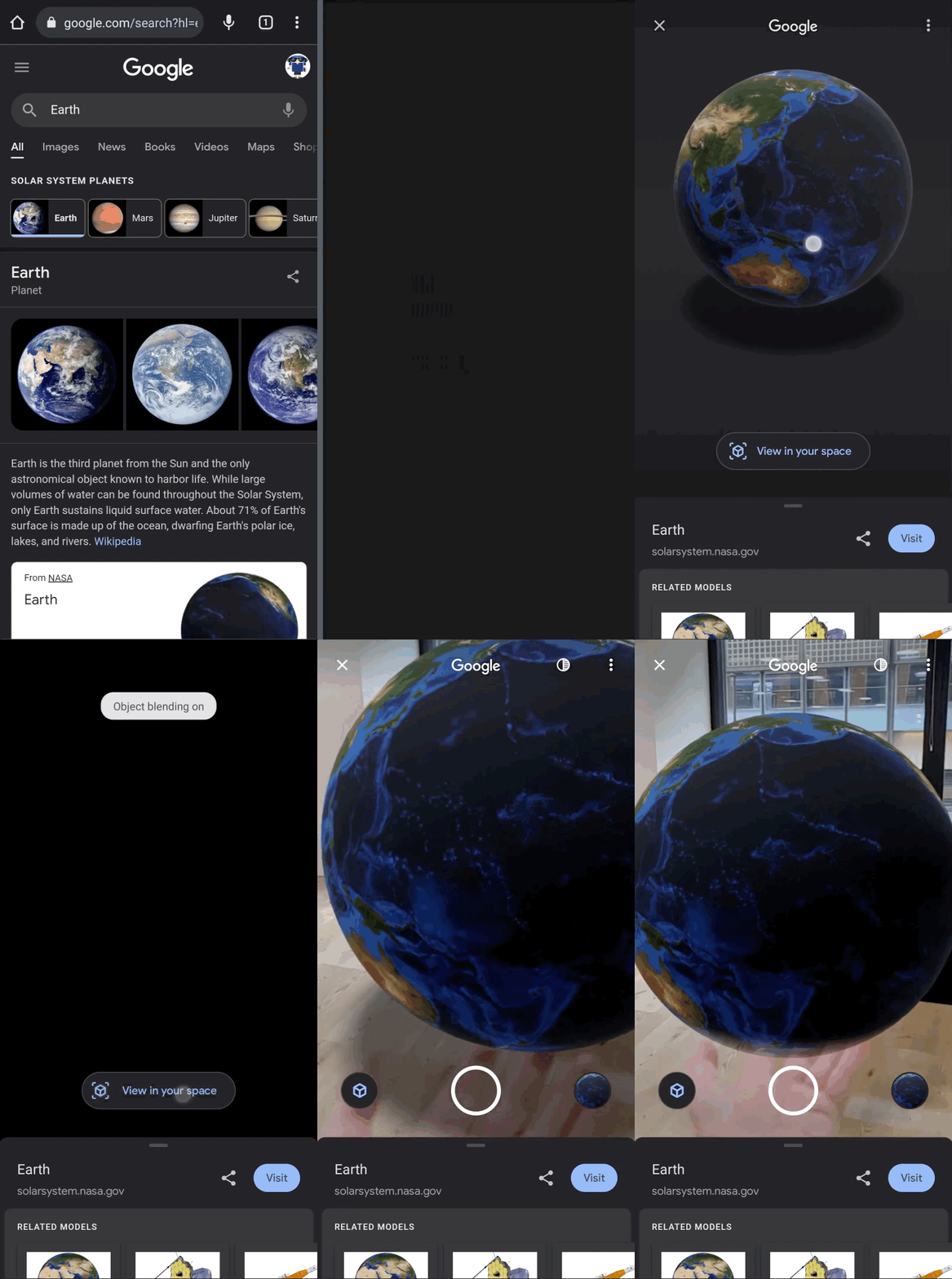
Bringing the solar system to life in 3D with NASA
The solar system has always been “teaching” us. You can see it in the drawings of the constellations in the Lascaux Caves and the astronomy of the ancient world — all the way up to now, when NASA is helping people around the world to get a closer look at the universe through explorations like the Artemis moon mission or the new James Webb Space images. Starting today, you can learn even more from the solar system with new experiences on Google Search and Google Arts & Culture, thanks to NASA.
NASA and Google Arts & Culture have partnered to bring more than 60 3D models of planets, moons and NASA spacecraft to Google Search. When you use Google Search to learn about these topics, just click on the View in 3D button to understand the different elements of what you’re looking at even better. These 3D annotations will also be available for cells, biological concepts (like skeletal systems), and other educational models on Search.
And, when you are on your mobile phone, you can even use Augmented Reality to project these models into your space.
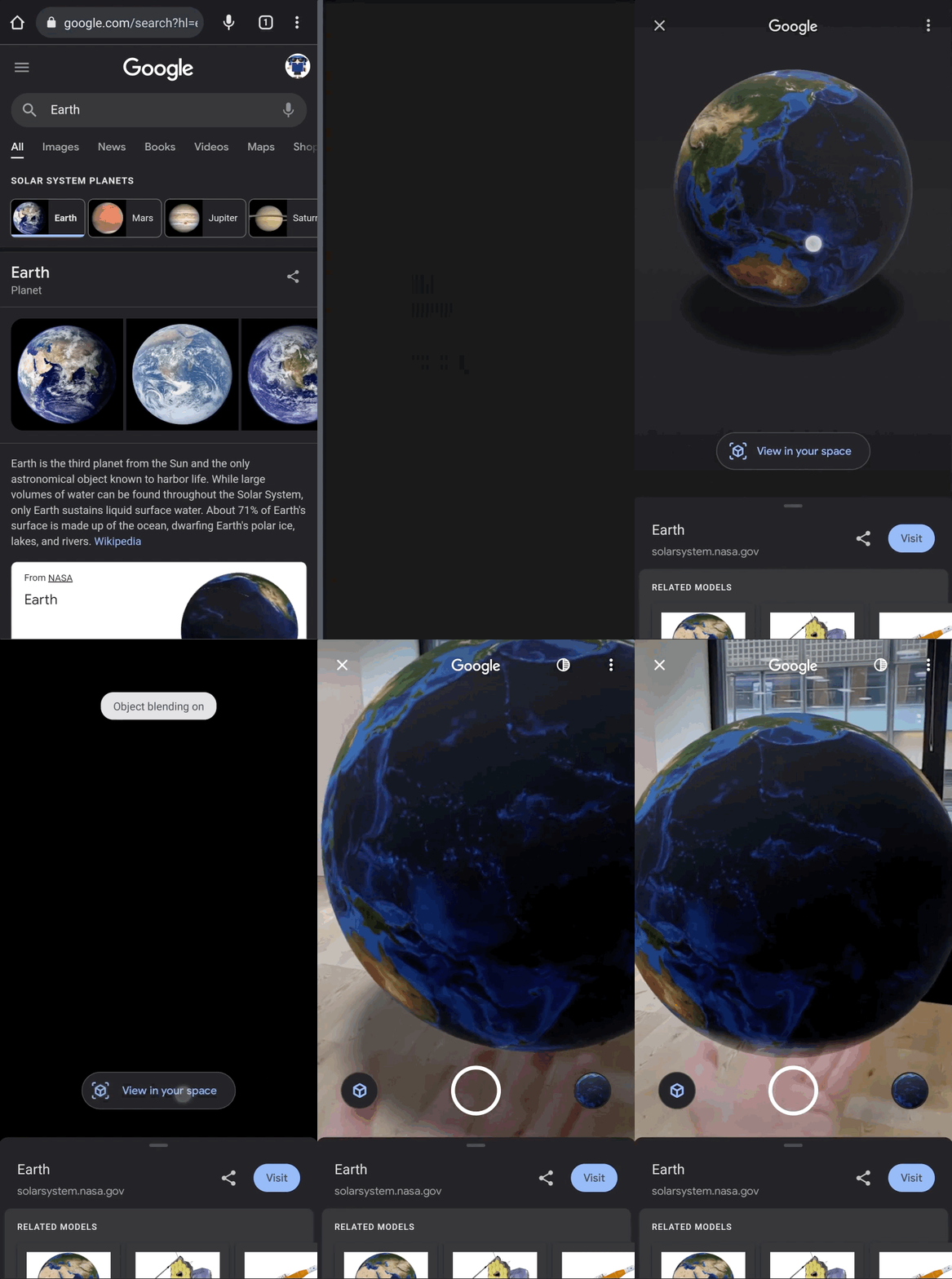
See the Earth and other planets in your space.
You can also dive deeper into these celestial bodies and learn about the scientific instruments NASA uses to study them. A new Google Arts & Culture project lets you explore the solar system, with stories about diamond rain on Neptune, gas giants and dwarf planets, Saturn’s moons, and NASA missions like the Parker Solar Probe or Landsat. NASA will even take you on a tour of the Hubble Telescope’s greatest images, show you what makes the International Space Station so extraordinary, and help you discover how the Mars Perseverance Rover is revealing our place in the universe.
The experience is also a way of helping inspire future students who may be considering careers as our next generation of explorers. As Kris Brown, NASA’s Deputy Associate Administrator for STEM Engagement notes, “Our nation’s future in air and space starts with inspiring students and igniting a spark of curiosity in STEM in today’s classrooms. The ability to see our solar system and join missions like the James Webb Space Telescope in 3D will give students a unique perspective of space and, hopefully, engage them in expanding their understanding of our home planet and our place in the universe. We hope these students will begin a journey of learning on STEM pathways toward building our next generation of explorers.”
So whether you’re a student learning about the solar system, or just want to get up close to the moon, we are thrilled to help NASA put the planets in the palm of your hand.
Helping AAPI-owned businesses stay safe
When I first moved to New York City, an extraordinarily diverse community, I immediately felt a sense of belonging — especially as a Korean who immigrated to this country for a better life. But over the past two years, things have changed. The spread of misinformation during the pandemic has led to an increase in violence against the Asian American and Pacific Islander (AAPI) community across the U.S. And now it’s part of every conversation I have with my family and AAPI friends, whether we’re sharing our own experiences or checking in to make sure everyone has gotten home safely. Last year, an Asian-owned bodega in my neighborhood was vandalized, and when I spoke to the owners, they told me they were now scared to stay open late and work shifts alone. As the Senior Creative for Google Nest Marketing, I knew we had the products to help — so anyone can operate a business without fear of violence or hate.
Nest has teamed up with The National Asian/Pacific Islander American Chamber of Commerce and Entrepreneurship (National ACE) and the Asian American Federation to provide security devices and resources to AAPI-owned small businesses. The AAPISTRONG Nest Cam Kit — which includes three indoor Nest cameras, a 12-month subscription to Nest Aware and professional installation services — is intended to help these business owners better protect their storefronts and get peace of mind, both during business hours and after closing time.
During our pilot program, which included more than 20 businesses in New York, one business owner shared, “The AAPISTRONG Nest Cam Kit has added an additional layer of protection and security for our staff and restaurant. We are using the Nest Cameras to accurately report and submit footage to our local precinct and council members for problematic encounters.”
Starting today, small businesses in Atlanta, Chicago, the greater DC Area and Houston can apply for the AAPISTRONG Nest Cam Kit. To be eligible, you must be a U.S.-based business with a brick and mortar storefront; have no more than three store locations; not be part of a chain or franchise; and be majority-owned, 51% or more, by someone who is from the AAPI community. If your business fits this description, apply by October 31.
Samsung Galaxy Z Fold4, SCONTO PAZZO su eBay: risparmia oltre 500 euro!
Con questo decoder vedi il digitale terrestre anche sulla tua vecchia TV
3 mesi di Revolut Premium gratis per i nuovi iscritti
Qual è l’alternativa alle carte di credito ma senza il rischio debiti?
Nokia C2 2nd Edition, FINALMENTE in sconto il low cost di CLASSE
New ways for publishers to manage first-party data
People’s expectations for online privacy have changed, making it essential that digital advertising evolves to better meet their needs. That’s why we’ve been investing in durable solutions to help publishers of all sizes grow their businesses in privacy-forward ways. To help our partners prepare for the future, we’re sharing details on new and updated features that give publishers added control of their first-party data and how they can share it with their advertising partners.
Make your first-party data more accessible to programmatic buyers
Publishers have always had the most relevant insights about the audiences visiting their sites and apps, along with information about the content they consume. But there hasn’t been an easy way for publishers to make use of this information with programmatic buyers outside of direct reservations.
We’re introducing publisher provided signals to help you categorize your first-party data into consistent audience or contextual segments and then share these signals with programmatic buyers. These signals make it easier for programmatic buyers to find and purchase audiences based on things like demographics, content interests or purchase intent across multiple sites and apps without tracking people’s activity in apps or across the web.
To help publishers and buyers find value and easily use these new first-party signals, we are working to incorporate industry standards. As a first step, we are integrating the IAB Tech Lab’s Seller Defined Audiences into this solution. Publishers can use the IAB’s Audience Taxonomy and Content Taxonomy to share signals with Google Ads and Display & Video 360 as part of our beta testing. In the future, we’ll roll out publisher provided signals to more publishers and Authorized Buyers and Open Bidders. We look forward to incorporating their feedback into the product development.
“Seller Defined Audiences was created by the advertising industry via Project Rearc, to help advertisers and publishers responsibly and reliably share first-party data at scale without the need for user identifiers. It’s a great step forward to have Google Ad Manager adopt these new standards for their publisher partners, and help advance a new system for addressability and accountability that meets user privacy expectations.”
– Anthony Katsur, CEO IAB Tech Lab
Share secure signals with your trusted partners
We’ve also been working with publishers to improve a feature that allows them to securely share signals with their trusted third-party buying partners – Authorized Buyers and Open Bidders. During our beta testing, we heard feedback from publishers and third-party buyers that you’d like more flexibility with this feature. That’s why we’re adding new controls and renaming the tool from encrypted signals to secure signals to better reflect how you can choose to implement its functionality.
Currently, publishers work with third parties to set up code on their websites and apps to activate this feature. This new expanded functionality will let publishers use their own code, making it easier for them to create and send data, like first-party identifiers, to trusted partners.
Secure signals still gives publishers full control over what data is collected and who can receive the signals. When passed through Google Ad Manager, the data is required to be obfuscated, meaning Google cannot read or use the signals. Ad Manager only acts as an intermediary on behalf of the publisher to pass the signals to their chosen third-party bidders.
We understand that you work directly with many third parties to maximize the value of your content. That’s why we will continue to support these trusted, direct relationships and build solutions to help you monetize your inventory in the best way for your business.
Deliver more relevant app ads with same app key
The growing desire for privacy isn’t unique to the web. Any publisher who has an app should also be exploring privacy-preserving solutions to increase the value of its app inventory as well. That’s why in the coming months we’ll update a feature called same app key to help publishers using Ad Manager serve relevant ads on iOS without tracking users across third-party apps.
Same app key uses first-party data collected from your apps, such as information about how users interact with ads inside your app. It can’t be used to link user activity from your apps to third-party apps.
Get up to speed on ads privacy and our privacy safe solutions
In addition to the new capabilities we shared above, we’re committed to helping publishers of all sizes navigate the evolving privacy environment. You’ll find new resources below to help you learn about industry-wide privacy changes, develop new privacy-forward strategies for using data and decide which Google solutions are right for you.
- Publisher Privacy Playbook – Learn about the digital ads ecosystem, get practical strategies for improving your ads privacy and an overview of Google’s solutions for publishers.
- See how other publishers are preparing for the future of privacy. Working with Deloitte, we commissioned new studies to better understand how top European publishers are adapting to the ads privacy landscape and how North American publishers are turning to first-party data to prepare for the future.
- Learn how to use key values to earn more from your first-party data in this series on the Ad Manager YouTube channel.
- Level up your knowledge of Ad Manager’s first-party data solutions and earn an award on our Skillshop learning platform by completing the Privacy-forward Solutions for Publishers learning path.
- Lastly, learn more about the privacy forward solutions available in Google Ad Manager, like Publisher Provided Identifiers by watching webinars at PublishersOnAir.withGoogle.com.