Supporting fact-checking communities with Nobel laureate Maria Ressa
Editor’s note: Maria Ressa’s keynote speech at the APAC Trusted Media Summit 2022 below. Filipino-American journalist and author, Ressa is the co-founder and CEO of Rappler, who received the Nobel Peace Prize in 2021 for her “efforts to safeguard freedom of expression, which is a precondition for democracy and lasting peace.” Excerpts from her speech have been edited for length and clarity. To watch Ressa’s keynote and other talks from 2022 and previous years, go to the APAC Trusted Media Summit website.
Our biggest problem all around the world is this basic question: How can we as journalists on the front lines rebuild trust?
When we created Rappler a decade ago, it was with the idea that we build communities of action, and the food we feed our communities is journalism. How does that food get to our community? Technology.
It’s a fact that lies are spreading faster than facts. A 2018 study done by Massachusetts Institute of Technology (MIT) showed that lies are spreading at least six times more than these really boring facts that we journalists use. We journalists spend our entire careers learning how to make facts interesting, to tell good stories, but we just can’t compete against the lies.
In the Philippines, we did this with the help of Meedan, a San Francisco-based startup, and with the Google News initiative, we collectively formed #FactsFirstPH.
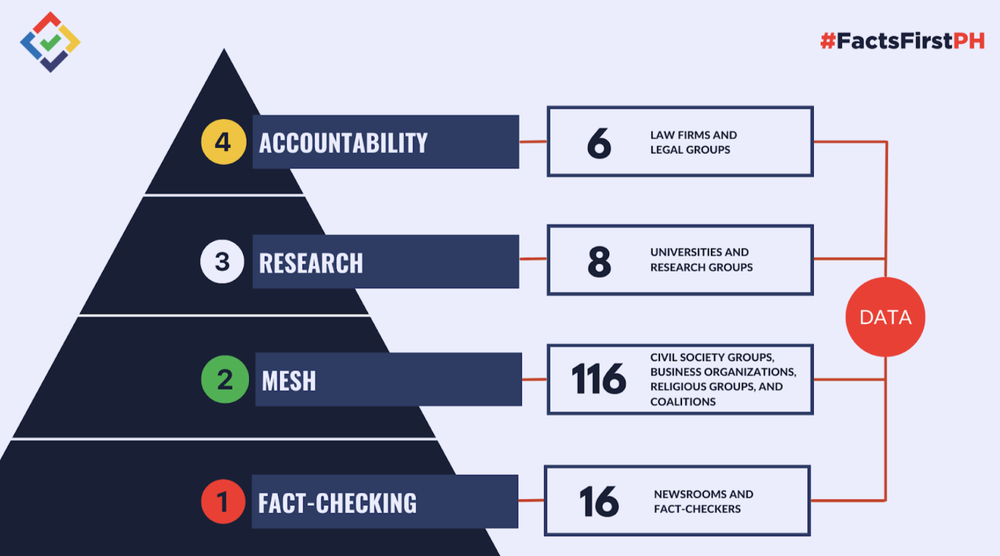
For the first time, 16 news organizations in the Philippines (both national and hyperlocal) in different regional areas began to collaborate – small and large working together! Partly enabled again by the Google News Initiative, every content piece we created was like the Creative Commons license. Each news group called on our communities to send what they wanted to fact check. Then, all of us could see the same data pipeline, regardless of where they were submitted. We worked along with our partners from 116 civil society groups and businesses.
Moving to the second layer, for the very first time, we built a collective network of truth-tellers – a mesh of truth-tellers who shared the fact-checks with emotions. The organizations amplified by our communities created a network effect that helped push the facts – really boring facts – through the algorithms.
The third layer is research – the first time 8 independent research groups accessed the same data and created meaning, found the big picture. Most of the time, everything is atomized. Meaning is atomized on social media, journalism is atomized on social media. We worked with eight universities and research groups, including Rappler, to take the data that we had collectively pulled together and to do weekly reports to the public that we serve.
And then finally, that last layer is the law. Impunity online is impunity offline. So these lawyers, our legal group, filed more than 20 cases that protected the journalists and the fact checkers, and the integrity of our elections. Tactical and strategic litigation.
Elections in the Philippines became emblematic of the role disinformation can play in changing history. Milan Kundera said this, “The struggle of man against power, is the struggle of memory against forgetting.” Well, this is how it’s changed.
The network produced thousands of fact-checking content across social media platforms. And what we saw was a ripple of facts. Since we started in January 2022, Rappler and the #FFPH coalition have created nearly 11,000 posts on Facebook, but then others took those posts and amplified them. More than 15,000 additional posts came from random users who saw the #FactsFirstPH posts and shared. We’ve had nearly 9 million interactions on Facebook since we started the project in January.
The facts with this system actually rippled.
I wish we had built #FactsFirstPH earlier – years earlier – to be able to collaborate against the onslaught of lies, to win the battle for facts. It’s an existential moment for all of us. Journalists are at the front line.
We need to be able to collaborate, to work together. I hope as you walk into elections in your country, that we not only work domestically, but also work together globally.
If you’re interested in setting up a Fact-checking coalition in your country, please reach out to newslabsupport@google.com.
Samsung Galaxy A52s 5G: con lo sconto Amazon il prezzo precipita
Huawei Watch GT 2: COLPO GOBBO con lo SCONTO ESAGERATO su Amazon
New Chromebooks built with sustainability in mind
The technology we use has a meaningful impact on the environment. And given how much people rely on laptops in both their work and personal lives, we’ve teamed up with our partners to build some more sustainable options. These new Chromebooks are made with recycled materials and are easy to customize, repair and upgrade.
New devices built with the planet in mind
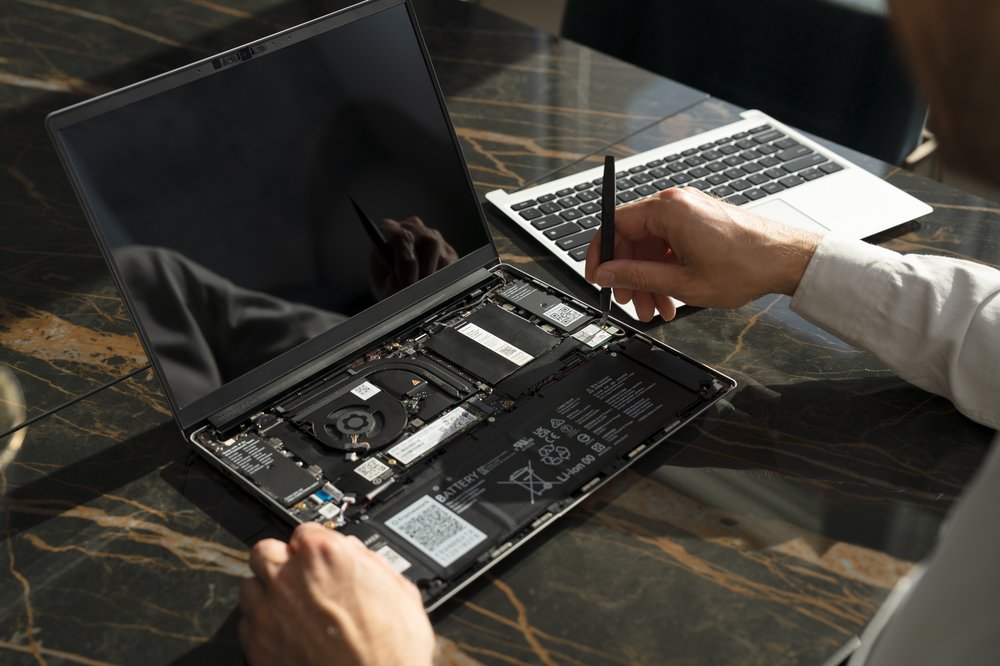
The new Framework Laptop Chromebook Edition, made of 50% post-consumer recycled aluminum, is the most customizable Chromebook yet. It’s durable, powerful, thin, light and designed to last. You can upgrade the laptop’s memory and storage and replace key parts like the screen, battery and webcam without needing to replace your entire laptop. And if you ever want to switch up your Framework Laptop’s look, simply swap out the bezel with different colors. You can pre-order this device starting today.
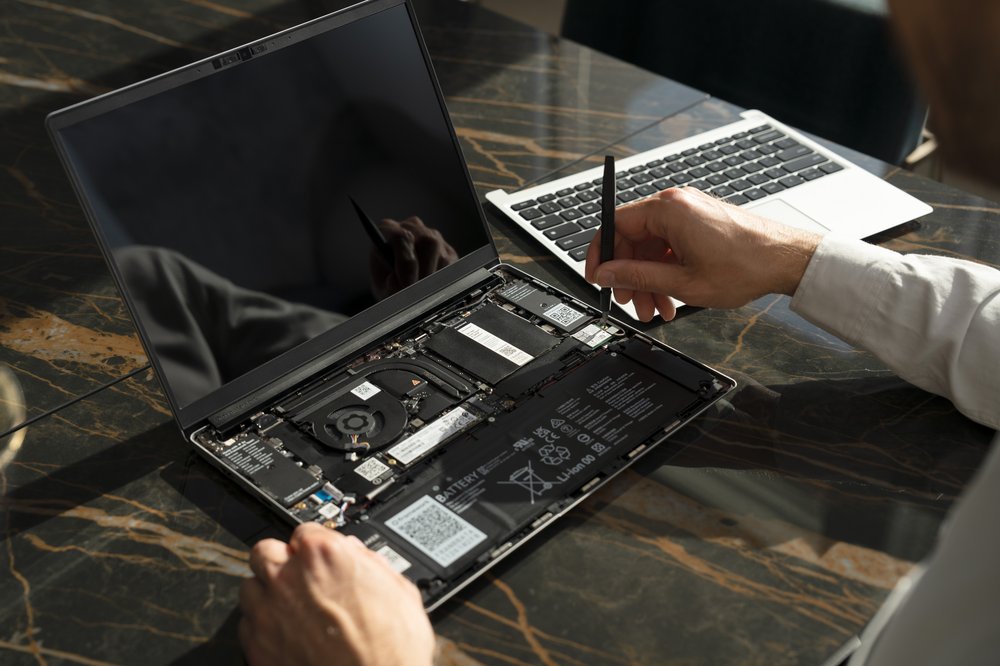
The Framework Laptop Chromebook Edition is easy to upgrade and repair.
We also recently announced the Acer Chromebook Vero 514, which incorporates post-consumer recycled plastic into its design, including recycled ocean-bound plastic in its internal fan housing and touchpad. It’s durable and comes with molded pulp packaging made with recycled paper, cardboard and other natural fibers. The packaging can also be reused as a laptop stand.
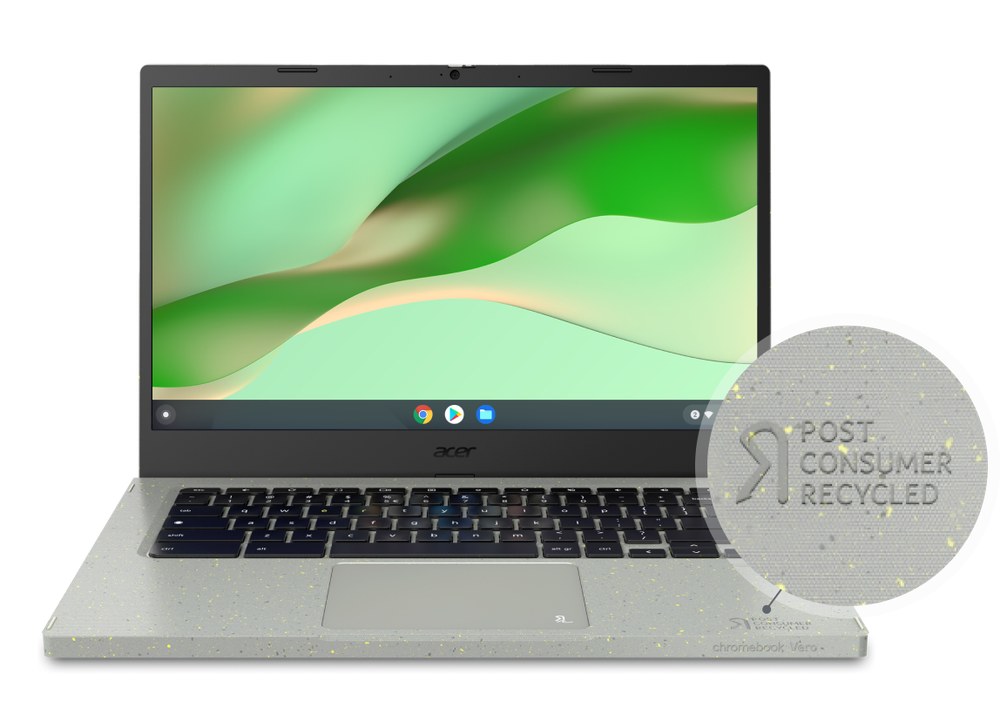
The Acer Chromebook Vero 514 incorporates post-consumer recycled plastic.
Earlier this year, we launched the high-performance HP Elite Dragonfly Chromebook that brings together powerful capabilities and sustainable design. It uses recycled materials throughout its body, including recycled magnesium in the top, recycled aluminum in the bottom and recycled plastic in the keyboard’s keycaps.
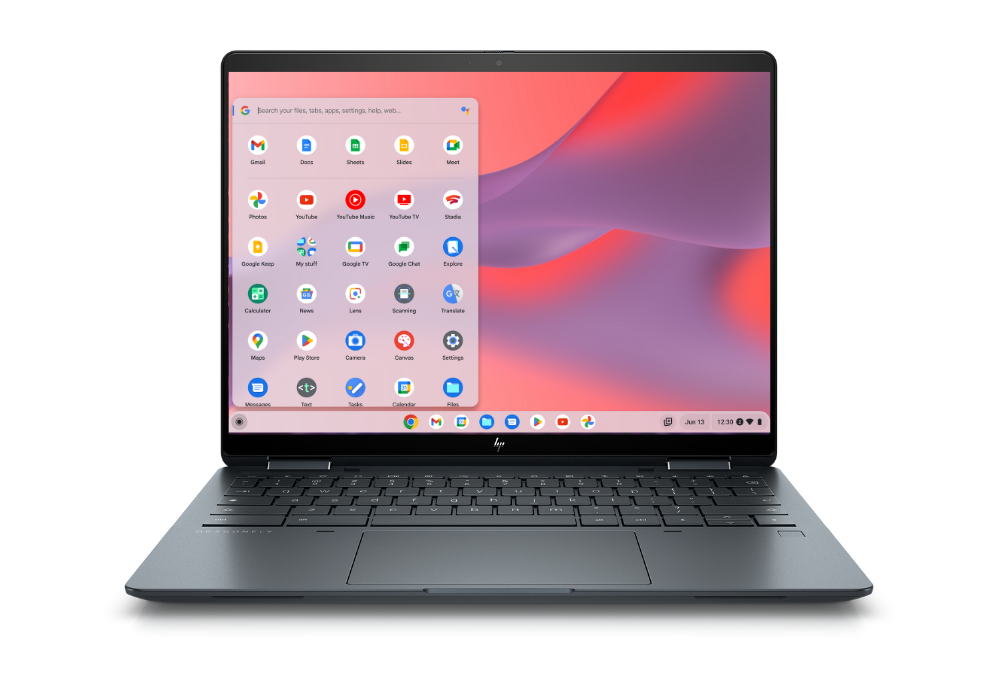
The HP Elite Dragonfly Chromebook.
More ways to stay sustainable with Chromebooks
Chromebooks are power efficient, providing up to 12 hours of battery life on a full charge. They’re also designed to last, with automatic updates for up to eight years that keep it running fast and secure. And all the Google apps that run on it — like Drive, Photos and Gmail — operate on Google Cloud, the cleanest cloud in the industry.
It’s also easy to share a Chromebook with multiple family members so you can limit the number of devices in your household. You can add multiple profiles on one Chromebook — which keeps each person’s files, apps and settings separate — to personalize your device the way you like it, even when it’s shared.
Don’t have a Chromebook yet? Modernize your existing device with ChromeOS Flex. The cloud-first, fast and secure operating system for PCs and Macs gives you the sustainability-focused benefits of ChromeOS at no cost.
And when you’re ready to let go of your old Chromebook, we’ve made it easier to safely recycle them. Simply search for “electronics recycling near me” on Google to find verified services that can recycle your laptop for you.

Google Search can help you find electronics recycling locations near you.
From launching sustainable devices with our partners to helping educational institutions repair their old Chromebooks (from Lenovo, Acer, and now, CTL), we’ll continue working toward a more sustainable future.
Samsung Galaxy M13: super batteria e tripla cam ad appena 159€ (-16%)
Huawei MatePad 11: il tablet dei tuoi sogni lo paghi POCHISSIMO (-23%)
What we learned from launching a hyperlocal news brand
In early 2020, a small team within Grupo AM – the leading news company in the Bajío region of Mexico – set out to build a brand new hyperlocal news product. With CodigoPostal.com they aimed to provide trusted independent local news from a variety of sources in one place.
To do this, the CodigoPostal.com content management system (CMS) was to be different from off-the-shelf products, in that it was centered around geographic location (postal codes) as a way of organizing information. It enabled the creation of what we called CoPos, subsections of the main news website that served specific communities within large urban centers.
CoPos, which was a recipient of the 2019 Google News Initiative Latin America Innovation Challenge, contained not only original content, but also aggregated articles from traditional news sources – including Grupo AM’s brands – combined with useful local information such as COVID-related data, weather, business listings and events.
The culmination of this initial phase of the project’s efforts came in 2021 when our team published 140 original pieces and several daily newsletters each week. This entailed aggregating over 600 local news articles using human-assisted Artificial Intelligence (AI) sorting (i.e. matching content to postal code using machine learning and swipe-based user experience), and creating over 200 machine-generated articles in three different subject matters. The CMS also delivered automated email newsletters based on users’ postal codes.
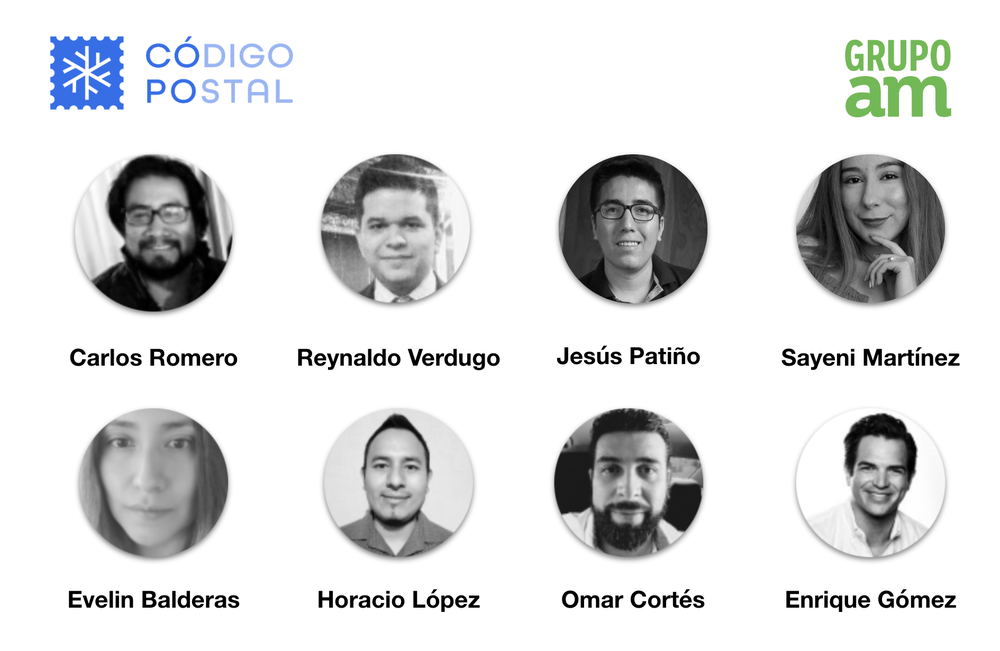
Thinking back through the CodigoPostal.com journey, it’s surprising how different it all looks today versus when we started. It was both surprisingly manageable to develop this project in a fully-remote setup, and also, incredibly hard to focus and communicate when everyone was working from home. We were able to do a great deal in a very small period of time (and in the middle of a global pandemic), a reflection of the work and dedication of our core team of five developers, a handful of full-time journalists and a bunch of interns.
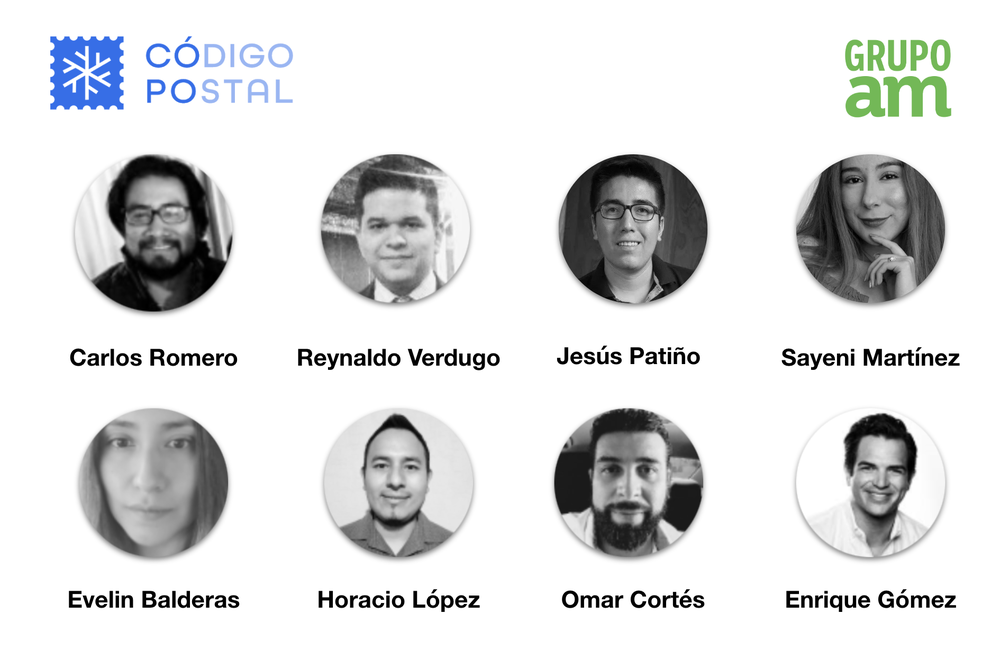
These are some of the CodigoPostal team.
Many of the things we thought would be difficult and complex – technical product development, algorithms, machine learning – turned out to be fairly straightforward. What we thought was in our wheelhouse – launching a news brand and growing audiences across geographies – became the real challenge. And we learned a few lessons along the way
Top Five Lessons
- The most important thing in a news startup is to understand how your product will meet consumers’ needs as quickly as possible. We placed too much trust in tech to be our key differentiator. While it did enable us to reach dozens of communities very quickly, it didn’t guarantee that users in those communities would stay and engage with our brand.
- Because of #1, buy vs. build is a moot point. Off-the-shelf tools can be adapted to fit most editorial and business needs. Invest in audience development and editorial experimentation first, and as your audience grows, explore if a custom tech solution is the right investment to accelerate growth.
- The product development approaches work for editorial teams too. Finding ways to best serve audiences at scale forced us to experiment with content types, topics, and formats. We learned that methodologies used by the product team could work on the editorial side. The biweekly sprint and user story tools helped us develop, launch and measure new content ideas quickly.
- Algorithms and humans make a great team in service journalism. When we combined the powers of both the AI and our staff around the topics of jobs and employment, it became possible to personalize and tailor content to each CoPo. Human editors published content focused on skill-building for job searchers, which we published next to machine-generated articles with aggregated listings from other recruitment sites. This helped us reach a scale we wouldn’t have been able to otherwise.
- Editorial and product teams can learn a lot from each other. We focused on cross-pollination of skills, with short, daily data-focused meetings to review progress and share lessons among the web editors, and gaining a broader understanding of how user and product data plays into content creation and editorial strategies, especially in soft news.
Measurable outcomes
The legacy of CodigoPostal.com at Grupo AM is that our very first product and editorial laboratory has measurable outcomes: we grew our audience from scratch in July 2020 to more than 400,000 users today, with a peak of nearly 100,000 monthly active users in January 2021.
We were able to apply the tools we developed for this project to our main site, AM.com.mx. The user registration system we built for CodigoPostal.com became the foundation for AM’s registration wall, which allowed us to grow our database of known users from about 25,000 (which took two years to grow) to over 50,000 users in just six months, exceeding our expectations.
Ultimately, creating CodigoPostal.com led us to apply some best practices from the product world to our constantly evolving journalistic workflows, and taught us to not be afraid to leverage technology to make it easier and faster to better serve our growing audience.
Our participation in GNI’s Innovation Challenge led Grupo AM to flex new tech muscles. We not only built a news brand from scratch, we also created tools that make it easier for local journalists to serve their communities.
Continuing to support Ukrainians in challenging times
In February 2022, Vira taught Ukrainian language and literature at a local school and lived with her family in Kyiv. When the war started, Vira and her family had to leave their home in search of safety – first elsewhere in Ukraine, and then in Spain. Vira’s story is not unique – more than 7 million displaced people have left Ukraine since February 2022, according to the UNHCR.
Throughout the war, we’ve been committed to doing all we can to help. Through Google.org and our employees, we have committed over $40 million in cash donations, plus $5 million of in-kind support for humanitarian relief efforts, and three Google.org Fellowships. Across all our platforms, our teams have been working around the clock to support those affected, provide trustworthy information and promote cybersecurity.
Helping global refugees access critical information faster
For a person who has fled their home, access to information can be as important as water, food, medicine or shelter. It can save lives and livelihoods. But finding authoritative information and trusted services can be challenging and time-consuming.
Back in the summer of 2015, when thousands of refugees poured into the Greek islands in hope of refuge in Western Europe, the International Rescue Committee (IRC) and Mercy Corps worked alongside Google engineers to provide new arrivals with a trustworthy source of critical information. The team realised that those who flee their homes in times of need often bought a smartphone with them as one of few personal items – so they created the Signpost Project: a global technology platform that aims to provide critical information services to people affected by crisis and conflict.
When the war in Ukraine started, the IRC partnered with the United for Ukraine Association to build out unitedforukraine.org, an information website and civil society effort. The latest instance of The Signpost Project, unitedforukraine.org spans a network of 400 legal experts and psychological support professionals from more than 30 countries, and provides displaced people with critical information and support to find housing, legal aid and psychological help.
To support this work, Google provided the IRC with a $1.5 million grant along with a team of 15 Google.org Fellows to work full time and pro-bono for six months on the project.
In the six months since the war in Ukraine started, United for Ukraine has reached more than 210,000 unique visitors and helped 10,000 people access free temporary housing in collaboration with airbnb.org. Among those 10,000 people is Vira. Having secured a job in Torrevieja, Spain, Vira urgently needed accommodation, but didn’t know anyone local or have a way to rent an apartment. She reached out to United for Ukraine, who immediately offered her three temporary housing options to choose from. Vira chose a cosy apartment two minutes walk from her new job.
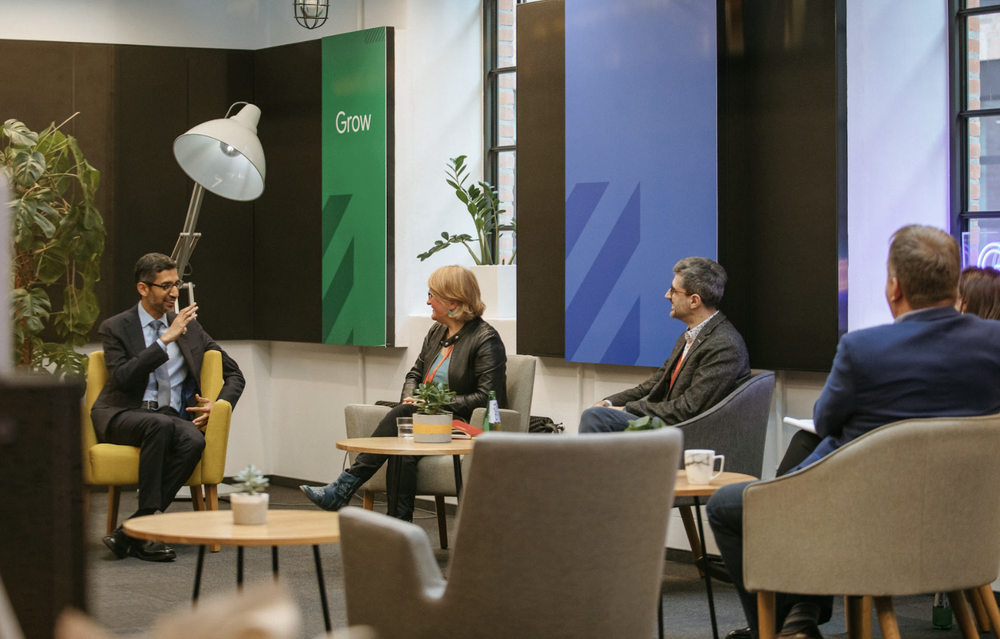
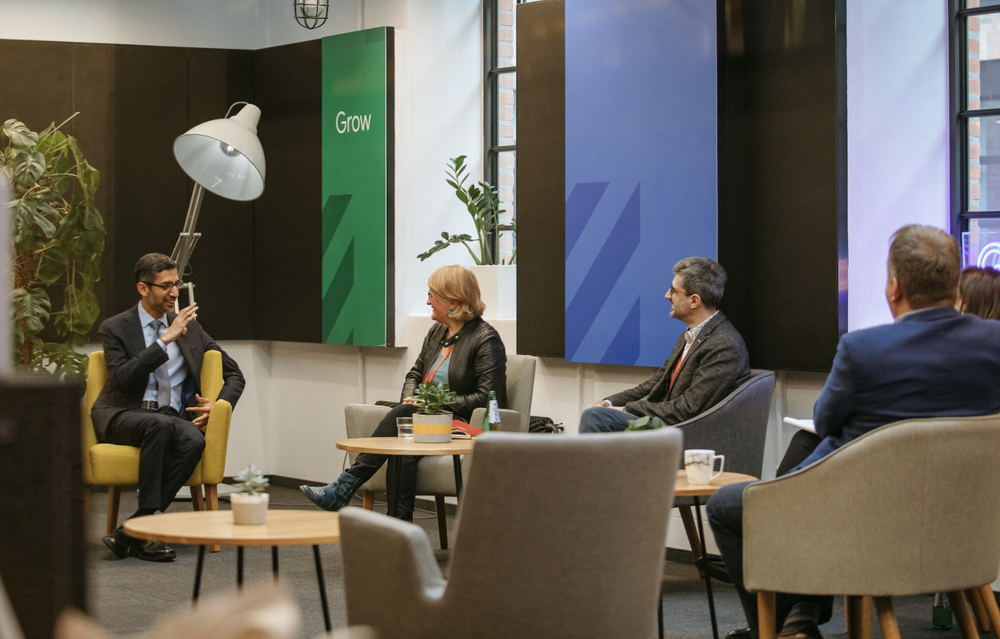
Sundar Pichai meeting with NGOs supporting refugees at the Google Campus in Warsaw
Offering Google Career Certificates to Ukrainian people & businesses
As time passes, we see that the needs of those impacted by the war are changing – with more focus on education, upskilling and employment opportunities. To support Ukrainians whose jobs and livelihoods have been affected by the ongoing war, today we are launching Google Career Certificates in Ukraine. Google Career Certificates provide training focused on job-ready skills, and are designed to create a path to in-demand jobs in high paying sectors. By launching them in Ukrainian, we hope to support at-risk Ukrainians to develop practical skills, find new jobs and grow their businesses.
To reach those who have lost, or are at risk of losing, their jobs because of the war in Ukraine, Google.org has provided INCO – a global organisation that provides training and support – with more than €3 million in grant funding. This funding will enable INCO, in partnership with local NGO partners Prometheus, PRJCTR and VUM, to provide up to 5,000 people in Ukraine with access to Google Career Certificates at no cost, along with wrap-around support such as socio-psychological and work-readiness assistance.
In addition, to support small and medium Ukrainian businesses at this difficult time, Google is partnering with the Ukrainian Ministry of Digital Transformation and the Union of Ukrainian Entrepreneurs to offer Google Career Certificates to 1,000 Ukrainian small and medium-sized organizations. We hope this will fuel future opportunities by allowing people to grow their skills, careers and businesses.
As Ukraine embarks upon the biggest recovery challenge in recent history, technology must help everyone, regardless of their location, age or education level. We hope that with these new efforts and the support of our public sector partners, even more people will be able to fuel this recovery.
Making our tools and technology as helpful as possible
Earlier this year, we were honoured to receive the first ever “Peace Prize” award introduced by the President of Ukraine, Volodymyr Zelenskyy, for our work to support those affected. Throughout the war, we’ve been trying to make our tools and technology as helpful as possible, including by:
- Providing trusted news and information
Across Google platforms, we’re elevating trusted news sources in response to searches about the war, including in Russia. Our breaking news and top news shelves on our YouTube homepage have been viewed more than 40 million times in Ukraine. - Protecting users from harmful disinformation
Earlier this year, we committed an additional $10 million to fight misinformation, and since the war started, we’ve removed 9,000 channels and 70,000 videos on YouTube for violating our content policies – including those pertaining to misinformation, hate speech and graphic violence. - Protecting cybersecurity in Ukraine and globally
We’ve increased account security protections for people in the region, and our Advanced Protection Programme – the highest form of account security we offer – is protecting hundreds of high-risk users on the ground in Ukraine against a wide variety of online threats. Project Shield, our free website protection service, is defending the sites of over 200 news and humanitarian organisations in Ukraine from online attacks. On top of this, Google’s Threat Analysis Group (TAG) has been closely monitoring cyber security activity in Eastern Europe, providing regular updates and sharing information to help others detect and respond to activity. - Providing humanitarian assistance and supporting the region more broadly
As part of our $45 million in cash donations and in-kind support from Google.org and Googlers, in Poland we’ve committed $10 million to local organisations helping refugees, and using Google’s spaces and resources to support those affected. In Ukraine, we’ve worked closely with the government to send rapid air raid alerts to Android mobile phones in endangered areas, and feature information on shelter and aid points in Search and Maps for local users. We also recently donated 43,000 Chromebooks to Ukrainian teachers to help them connect with their students – wherever they are now based.
We will continue to do all we can to help those impacted by the war in Ukraine, and to make sure our tools, technology and resources are as helpful as they can be during this time. We join the international community in expressing sincere hope for a return to a peaceful and sovereign Ukraine.
Realme 8: il medio gamma più AMATO a prezzo FOLLE su eBay
NordVPN: 3 mesi gratis con il piano da 2 anni
Java 19 con sette macro-novità
Oracle rilascia Java 19 con sette macro-novità che migliorano produttività, linguaggio, stabilità, sicurezza e performance della piattaforma
Logitech K400 Plus a meno di 30 euro su Amazon
Acquista ora su Amazon la tastiera Logitech K400 Plus ad un prezzo incredibile: non lasciarti scappare questa grande offerta
Questo NON è il solito supporto per auto: solido ed elegante a 4€ è da provare
Amazon presenta il nuovo tablet Fire HD 8: più veloce, sottile e per l’intrattenimento
Fire HD 8 è dotato di uno schermo HD da 8”, prestazioni più veloci del 30% e una batteria fino a 13 ore di autonomia con ricarica via USB-C.
Leggi Amazon presenta il nuovo tablet Fire HD 8: più veloce, sottile e per l’intrattenimento