Siti Web: troppo codice di terze parti e basse performance
Quali sono le cattive pratiche che oggi rallentano maggiormente i siti Web? Le indicazioni del Web Almanac 2022 di HTTP Archive
Leggi Siti Web: troppo codice di terze parti e basse performance

Podcast RSI – WhatsApp da aggiornare; intelligenze artificiali scatenate, fra Star Wars, K-Pop e truffatori
È disponibile subito il podcast di oggi de Il Disinformatico della Radiotelevisione Svizzera, scritto, montato e condotto dal sottoscritto: lo trovate presso www.rsi.ch/ildisinformatico (link diretto) e qui sotto.
Le puntate del Disinformatico sono ascoltabili anche tramite feed RSS, iTunes, Google Podcasts e Spotify.
Buon ascolto, e se vi interessano i testi e i link alle fonti di questa puntata, sono qui sotto.
—
- Aggiornate subito WhatsApp per chiudere due falle critiche
- Intelligenza artificiale per il riconoscimento di voci in ambienti rumorosi: Whisper
- Darth Vader diventa immortale. O perlomeno lo diventa la sua voce
- Il truffator truffato: intelligenza artificiale contro stupidità naturale
- DALL-E diventa libero e gratuito: immagini sintetiche per tutti
<div>iPhone 14: migliora dove serviva. È l’iPhone per tutti? La recensione</div>
Proton Drive: implementata la piena end-to-end encryption
Il team di coder Proton ha lanciato il suo nuovo servizio di storage dei file sul cloud chiamato Proton Drive
Leggi Proton Drive: implementata la piena end-to-end encryption
Wolfi: la distro Linux per la Software Supply Chain Security
Wolfi: la distribuzione Linux container-focused dedicata alla Software Supply Chain Security
Leggi Wolfi: la distro Linux per la Software Supply Chain Security

Bite-size skills training for Brits short on time
Digital skills are a key part of many jobs and are crucial for helping small businesses grow. But with the hustle of daily life, many of us struggle to find the time to learn valuable new skills that could help with landing a new job, earning more money or growing a business.
That’s why we’ve asked for advice from four people who’ve done this before: presenter and former footballer Ian Wright, entrepreneur and Dragon’s Den investor Steven Bartlett, finance professional turned YouTuber Patricia Bright, and founder of notonthehighstreet.co.uk Holly Tucker. Based on their experiences with switching careers or starting a business by learning a new skill, they’ve helped us create Skills to Go, a free, bitesize digital skills training programme.

You can complete the short training sessions, which range from five to 20 minutes, as and when you have time — while commuting, over a coffee break or in between appointments. Our Skills to Go site suggests relevant topics — including CV writing, changing careers and growing a business online — based on how much time you have to spare.
We’ve built this programme in response to new data from YouGov that reveals that lack of time is the number one barrier stopping people from learning skills that could take their careers and businesses to the next level. And it’s a very real need: in the UK, more than 90% of people are online, yet fewer than half of businesses have a website. Businesses struggle to recruit people with digital skills; the digital skills gap accounts for 30% of unfilled vacancies, and costs the UK economy £63 billion per year.
Our new Skills to Go campaign is just one of the ways that we’re working to help address the nation’s skills shortage. Since launching our first digital skills training programme in Leeds in 2015, we’ve visited more than 500 locations up and down the country, and have provided digital skills training to more than 800,000 people in the UK. We offer individuals and business owners opportunities to, for example, take part in one-to-one mentoring sessions or learn about digital marketing to help them advance their careers or boost their businesses. This year, we’re visiting more than 30 locations, such as Newport and Cambridgeshire, to help people learn new skills and get Britain growing.
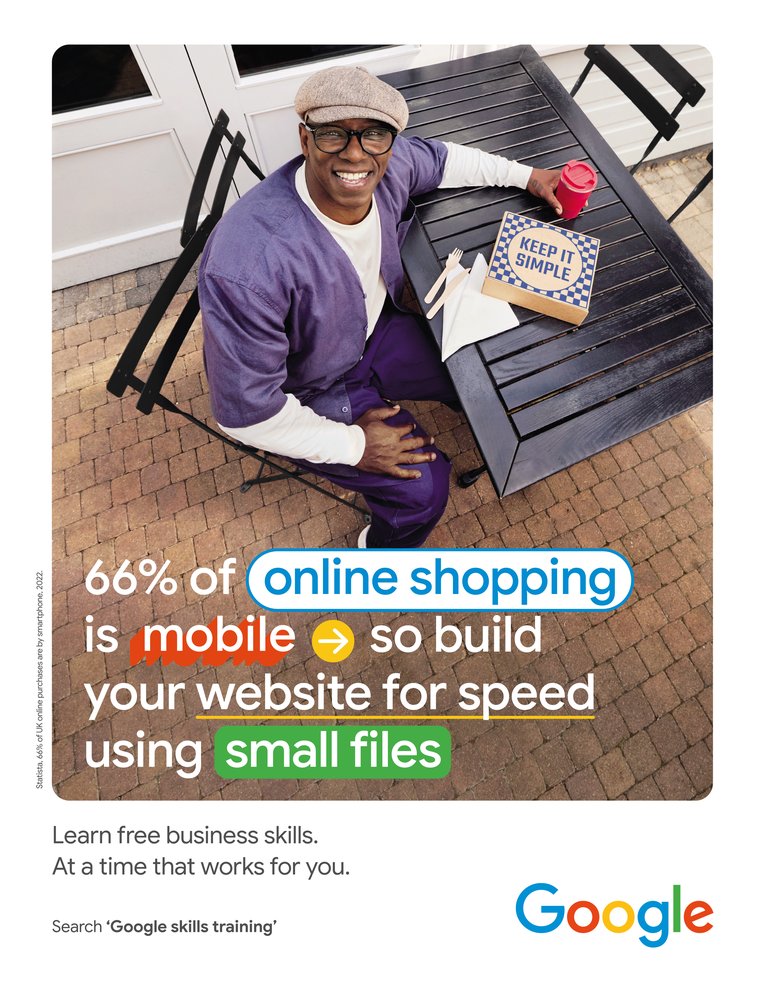
Of course, we can’t do this alone. Earlier this year, alongside a number of top UK employers including the BBC, BT Group, Deloitte, John Lewis Partnership and NatWest, we announced our Employer Consortium, which recognises Google Career Certificates when recruiting for much-needed tech roles, providing an accessible path for Brits into high-growth, well-paid tech jobs.
Everyone should have the opportunity to gain digital skills regardless of their location, race, age, gender or education level. That’s why we’re supporting Good Things Foundation’s work with 1,500 community organisations across the UK, which supports up to 25,000 people from underrepresented communities to get online and learn essential digital skills.
These are all part of our efforts to make it easier than ever for you to gain new skills, wherever you’re at in your career. So the next time you have a spare five minutes, search ‘Google Skills Training’ to learn from business experts like Stephen, Holly and Patricia and boost your business or career.

Intelligenza artificiale per il riconoscimento di voci in ambienti rumorosi: Whisper

Il riconoscimento vocale oggigiorno funziona piuttosto bene quando la voce è scandita chiaramente e non c’è rumore di sottofondo, ma fallisce miseramente se chi parla si mangia un po’ le parole, ha un accento molto marcato oppure si trova in un ambiente rumoroso. Se poi si tratta di una voce che canta, accompagnata e magari coperta da tanti strumenti, non c’è niente da fare.
Ma pochi giorni fa la società OpenAI, già nota per altri prodotti di intelligenza artificiale di cui ho parlato in questo blog, come DALL-E per la generazione di immagini, ha rilasciato Whisper, che è un software di intelligenza artificiale capace di superare queste limitazioni, diventando abile quanto una persona nel decifrare le parole di una conversazione anche in contesti rumorosi.
Per esempio, Whisper è in grado di riconoscere le parole pronunciate in varie lingue, dette a grandissima velocità e registrate con bassa qualità, cantate in una canzone K-Pop o dette con un forte accento, come negli esempi che trovate sul sito di Whisper.
L’azienda ha addestrato Whisper alimentandolo con 680.000 ore di audio abbinato alle trascrizioni corrispondenti in 98 lingue differenti. Oltre a riconoscere il parlato in condizioni difficili, è anche in grado di fornirne una traduzione in inglese abbastanza dignitosa.
Whisper è stato rilasciato come prodotto open source, libero e gratuito, per cui chiunque lo può scaricare e installare liberamente e lo può anche modificare. Richiede un computer piuttosto potente, e i suoi creatori avvisano che il modo in cui Whisper analizza il parlato può a volte fargli “riconoscere” parole che in realtà non ci sono, per cui è sempre necessaria una revisione attenta da parte di una persona. Ma lo sviluppo esplosivo di questi software di intelligenza artificiale dovrebbe far riflettere molto attentamente chiunque faccia trascrizioni per lavoro. Forse dovrà cominciare a pensare a come riorganizzare il proprio lavoro per diventare revisore esperto anziché dattilografo.
Ci sono anche implicazioni più profonde e rivoluzionarie, che è necessario considerare ogni volta che un procedimento che prima era oneroso diventa semplice e automatizzato: se diventa possibile trascrivere enormi quantità di parlato a costo praticamente nullo e il costo dei supporti di registrazione è altrettanto trascurabile, diventa possibile per esempio automatizzare la sorveglianza di massa.
Diventa possibile registrare l’audio di tutte le telefonate di un intero paese e trascriverle tutte integralmente, per poi cercare eventuali nomi o parole di interesse o per riconoscere le singole voci, anche a distanza di tempo. C’è chi sospetta che alcuni governi abbiano già questo tipo di capacità, ma con Whisper potrebbe averle anche uno staterello relativamente squattrinato.
Pensando ad applicazioni meno controverse, invece, un riconoscimento vocale automatizzato con le capacità di Whisper permetterebbe di trasformare in testo, a costi ben più abbordabili di quelli attuali, gli enormi archivi dei programmi radiofonici e televisivi storici e renderli accessibili anche a chi ha difficoltà di udito oltre che ai linguisti, agli storici o a chiunque abbia semplicemente il desiderio di ritrovare una battuta o una dichiarazione fatta da qualcuno magari qualche decennio fa.
E queste sono solo le possibilità che vengono in mente adesso; chissà quali verranno inventate quando questa tecnologia sarà diventata normale.
Fonti aggiuntive: Ars Technica, Slashdot.
Soundbar Sony HT-G700 a 3.1 canali: quasi 200 euro di sconto su Amazon
Webcam Logitech C270 HD a meno di 25 euro su Amazon
SSD Crucial X6 da 2TB ad un prezzo FOLLE su Amazon
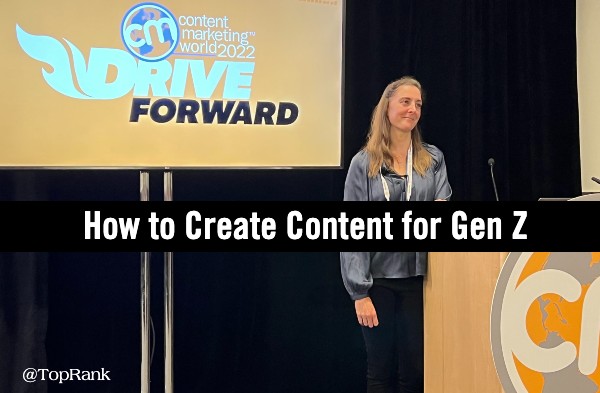
Semrush on How to Create B2B Content for Generation Z
While many B2B marketers are focused on Boomer and Millennial age senior marketing executives, what are B2B brands doing to connect with the next Generation of buyers? You know, those junior marketing pros born after 1997 aka Gen Z? Content Director at Semrush, @LenoxPowell, shared useful insights about connecting this up and coming group of customers that includes buyers of B2B products and services.
First, you should know that GenZ is a large cohort – 32% of the global population, with massive spending power.
Second, you should know that GenZ are definitely not Millennials 2.0.
While Millennials are aspirational, idealistic and adapted to tech, their brand expectations are about storytelling On the other hand, Gen Z are authentic, pragmatic, and visual first about technology with brand expectations are about storyliving.
Don’t worry, I had to look up “storyliving” too. Jeff Fromm describes it as, “StoryLiving™ is about what companies do, not just what they say. It is not just being unique, but also meaningful and acting in the interests of many stakeholders.”
Ahh, that makes sense. However, I don’t think GenZ has the market cornered on a trend towards consumers caring more about companies acting authentically and meaningfully in the interests of their customers.
So, what’s the marketing opportunity for Gen Z?
1. A whole new mindset
2. New opportunity to be creative
3. New loyal customer
4. New advocates for your brand
There are important shifts in social platforms with Gen Z: they are not on Facebook or Pinterest.
For Gen Z, TikTok is the new Facebook. TikTok is about fun, unpolished content which Gen Z loves. TikTok is expected to be the 3rd most popular social network by the end of 2022 and potentially displace Facebook and Twitter.
Some forward thinking businesses are starting to take Gen Z opportunities seriously and doing things like hiring Chief TikTok Officers. (Personally I think that’s just a gimmick – no one hired Chief Facebook Officers or Chief LinkedIn Officers – why should they do that with TikTok?)
How do you go viral on TikTok?
- Speak right away. 1 in 3 viral TikTok videos focused on a person speaking within the first 3 seconds.
- Let the music play – More than half of viral TikTok videos used music as their primary background sound in the first 3 seconds.
- One to one – 60% of viral videos featured one person visible on the screen
- Keep it real – Create videos that portray real people with real lives
Is TikTok the new search? Younger users search on TikTok more than Google. TikTok surpassed Google as the most visited domain in 2021. “Gen Z “hates searching Google because crappy SEO blogs bury the answers they are looking for underneath keyword stuffed garbage”.
A study by Fractl found that Gen Z loves long tail search. The length of their search queries are much longer than Millennials and other generations.
Words to consider in your content for Gen Z include – “best”, “cheap”, “how to”, “top”.
Content doesn’t always need to be literal and how to do this or that. Some of the most popular content amongst Gen Z is ASMR or other entertaining content that then opens the door to point to more practical content.
Research from Clover Letter found that brands should not talk down to Gen Z. 52% want to be informed. 35% say media talks down to them, 37% hate clickbait.
Tone of voice is important for Gen Z. They tend to lean towards informal, friendly types of communications.
Marketing disruptors that are shaking things up. Web 3.0 is influencing how we are online and engaging. Gen Z will likely adopt these elements and marketers need to be prepared:
- Blockchain
- Crypto
- NFT
- Metaverse
Web 1 was disorganized and overwhelming
Web 2 Was the rise of Facebook, Amazon, Google and amased a lot of power
Web 3 is about taking some of that power back
Think about this shift as you are planning your content topically and from a distribution standpoint. Gen Z is all about taking power back from corporations.
The emergence of Web 3 is fueled by Gen Z to decentralize apps and financial components to “take the power back”.
Where does Metaverse play with Millennials? Parallel to the physical world, metaverse is a place where people can experience life digitally but can also include augmented reality as a hybrid of virtual and real world.
What does this look like? Gucci has a store where users can buy products for their avatar. Lowes has an augmented reality option to try out power tools virtually. Adidas has a NFT community with limited access to merchandise.
What does this mean to us as marketers? There’s still a lot to be figured out. A lot of it is theoretical and experimental but it’s taking off with Gen Z. If your team can experiment and test things out you’ll be ahead of the game. Big brands are doing it and so should you.
For a related post that digs even deeper into how to prepare for future B2B customers, be sure to read my coverage of LinkedIn’s Allyson Hugley on What’s Next: Connecting with Future Buyers.
The post Semrush on How to Create B2B Content for Generation Z appeared first on B2B Marketing Blog – TopRank®.
Amazon.it si conferma e-commerce ufficiale di Lucca Comics Games 2022
The Last of Us Parte I per PlayStation 5, il prezzo scende del 20%: da comprare subito
A message about Stadia and our long term streaming strategy
For many years, Google has invested across multiple aspects of the gaming industry. We help developers build and distribute gaming apps on Google Play and Google Play Games. Gaming creators are reaching audiences around the world on YouTube through videos, live streaming and Shorts. And our cloud streaming technology delivers immersive gameplay at massive scale.
A few years ago, we also launched a consumer gaming service, Stadia. And while Stadia’s approach to streaming games for consumers was built on a strong technology foundation, it hasn’t gained the traction with users that we expected so we’ve made the difficult decision to begin winding down our Stadia streaming service.
We’re grateful to the dedicated Stadia players that have been with us from the start. We will be refunding all Stadia hardware purchases made through the Google Store, and all game and add-on content purchases made through the Stadia store. Players will continue to have access to their games library and play through January 18, 2023 so they can complete final play sessions. We expect to have the majority of refunds completed by mid-January, 2023. We have more details for players on this process on our Help Center.
The underlying technology platform that powers Stadia has been proven at scale and transcends gaming. We see clear opportunities to apply this technology across other parts of Google like YouTube, Google Play, and our Augmented Reality (AR) efforts — as well as make it available to our industry partners, which aligns with where we see the future of gaming headed. We remain deeply committed to gaming, and we will continue to invest in new tools, technologies and platforms that power the success of developers, industry partners, cloud customers and creators.
For the Stadia team, building and supporting Stadia from the ground up has been fueled by the same passion for games that our players have. Many of the Stadia team members will be carrying this work forward in other parts of the company. We’re so grateful for the groundbreaking work of the team and we look forward to continuing to have an impact across gaming and other industries using the foundational Stadia streaming technology.