Alla Radio Svizzera abbiamo parlato di Artemis
La puntata di stamattina del programma Millevoci della Rete Uno della Radiotelevisione Svizzera, condotta dal collega Nicola Colotti, è stata dedicata al tentativo di lancio di debutto del vettore gigante SLS Sono intervenuti Piero Bianucci, giornalista, scrittore, divulgatore scientifico, docente al Master di Comunicazione scientifica all’Università di Padova; Cristina Lorenzetti, direttrice dei Programmi Operativi di Beyond Gravity; e Bruno Storni, ingegnere elettronico, docente all’EPFL, esperto di tecnologia spaziale.
Se volete, potete scaricarla o ascoltarla in streaming qui:
OnePlus 9 Pro 5G (256GB) sconto ALLUCINANTE di 333€: basta sbavare, corri a comprarlo!
Mini condizionatore Xiaomi, piccolo ma incredibile: rinfresca a soli 59€
Con circa 59€ su Amazon trovi questo incredibile mini condizionatore Xiaomi capace di rinfrescare l’ambiente in pochi minuti.
Leggi Mini condizionatore Xiaomi, piccolo ma incredibile: rinfresca a soli 59€

Learn how we fine-tune the Nest doorbell ringtones
When you think of a doorbell, a particular sound probably comes to mind — for me, it’s the classic “ding dong.” When we launched Nest Doorbell (wired) in 2018, formerly known as Nest Hello, we introduced a new take on the quintessential doorbell sound with a single chime. And it got us thinking — what if we created even more options? And ones that would add a bit more magic around the house?
So we started creating doorbell ringtones you can download seasonally through the Google Home app, like a ghost or witch’s voice for Halloween or a beloved carol for Christmas. There are also options available year-round, like everyday chimes and a birthday tune.
We feature a handful of ringtones every Halloween, like this witch’s cackle to spook trick-or-treaters.
This year, we’re adding even more to our seasonal collection, with ringtones for Lunar New Year, Diwali and other global celebrations coming soon. A new ringtone for Oktoberfest is up next, which will be available from September 5 to October 5.
But how exactly do you create a doorbell ringtone? As an audio designer on the Google Nest team, it’s my job to figure that out. Today, I’m taking you behind the scenes to show you exactly how I do it — from researching different sounds to composing the final ringtone you download in your Google Home app.
Hit the right note
A lot of teams work together to decide new doorbell ringtone themes for the year. Our goal is always to create themes that are inclusive, meaningful and entertaining to people around the world.
To do that, there are a few factors we need to consider. First off, ringtones need to be pretty short — our rule is no more than 10 seconds — so your visitors don’t get impatient waiting at the door. And to be universally accessible and understandable, they can’t have any speech or lyrics. We can also only use musical pieces that are either original compositions or in the public domain (meaning, they were composed before 1926).
From there, we typically design ringtones in one of two ways. We either base it off a short musical riff, like “Jingle Bells” for Christmas. Or, if there aren’t many musical options for the occasion, we’ll create a version of the “ding-dong” sound with a sound effect. For example, in our Thanksgiving ringtone, you’ll hear the traditional “ding dong” followed by a turkey gobble.
Greet your hungry Thanksgiving guests at the door with a turkey gobble.
Put a ring on it
Once we’ve landed on a moment and overall design, we’re ready to create our ringtone. Let’s take a look at how we made the new one for Oktoberfest.
The first step? Research. I listened to and analyzed the musical arrangements and styles of a variety of traditional polka songs.

My home recording studio, where I do all my composing and audio editing.
Then, I composed a simple, original melody on the piano (at a rather slow tempo), along with separate harmony and bass lines. Using audio production software, I replaced each of the piano tracks with a digital sample of a traditional German accordion, and sped up the tempo so it was doorbell-friendly.
Our new Oktoberfest ringtone, which features a short, original composition arranged for an accordion.
In some cases, like the Oktoberfest ringtone, I can use traditional instruments. Other ringtones require some more… creative solutions. Take the Thanksgiving ringtone. Because many recordings of turkey gobbles aren’t very clear (real turkey sounds are pretty muddy and outdoor sounds mixed in can make them even harder to hear), I recorded them using my own voice. I now know way too much about the intricacies of a turkey gobble.
Once I compose, edit (and edit some more), I share the ringtone with different teams for feedback and test how it sounds on the Nest doorbell speaker. After making any final changes, we name the ringtone and post it so people can easily download it from the Google Home app.
Since we started creating these doorbell ringtones, they’ve been a nice surprise for Nest users and a fun project for our team. There are a lot more ringtones in the works, so keep an eye out for announcements. In the meantime, I hope this new ringtone whisks you away, even just for a moment, to an Oktoberfest celebration somewhere in Germany!
OPPO Reno 8 5G, appena rilasciato e già disponibile su Amazon
Apple Watch Serie 7, la formula perfetta con Vodafone Infinito
Leggero e potente, ecco OPPO Pad Air, il primo tablet europeo dell’azienda. C’è anche OPPO BAND 2
OPPO annuncia il lancio in Europa della Serie Reno8, fortemente votata all’imaging
Samsung Galaxy Tab S7 FE: Amazon sgancia la BOMBA e lo sconta SUBITO di 227€
ASUS lancia il primo laptop OLED pieghevole da 17,3″, lo Zenbook 17 Fold OLED
L’esclusivo Zenbook 17 Fold OLED sarà disponibile in tutto il mondo a partire dal quarto trimestre del 2022 a partire da 3.299€.
Leggi ASUS lancia il primo laptop OLED pieghevole da 17,3″, lo Zenbook 17 Fold OLED
OPPO Reno8 Pro 5G: tanta sostanza ma con stile! La recensione
ASUS lancia lo Zenbook 17 Fold OLED, il primo laptop OLED pieghevole da 17,3″
<div>Visualizing Google Search interest in Brazil’s 2022 presidential debate</div>
The democratic process is one of the foundations of our society, and people around the world turn to Google to ask important questions about election candidates and their positions on various topics. We’ve built products and programs to help journalists and voters engage with democratic processes in several elections, including the U.S., Germany, U.K., and others.
Google partnered up with Brazilian broadcaster Band TV to bring Search trends to the first presidential debate for the 2022 elections in Brazil. To support this effort, we have looked into Google Trends data on search interest to help inform the electorate on regional trends for presidential candidates and themes.
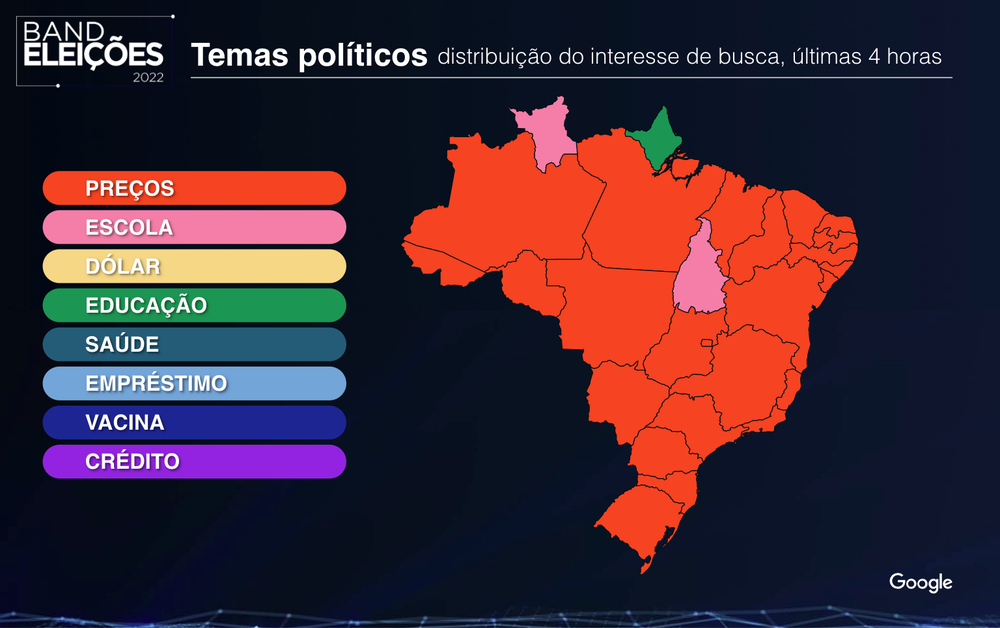
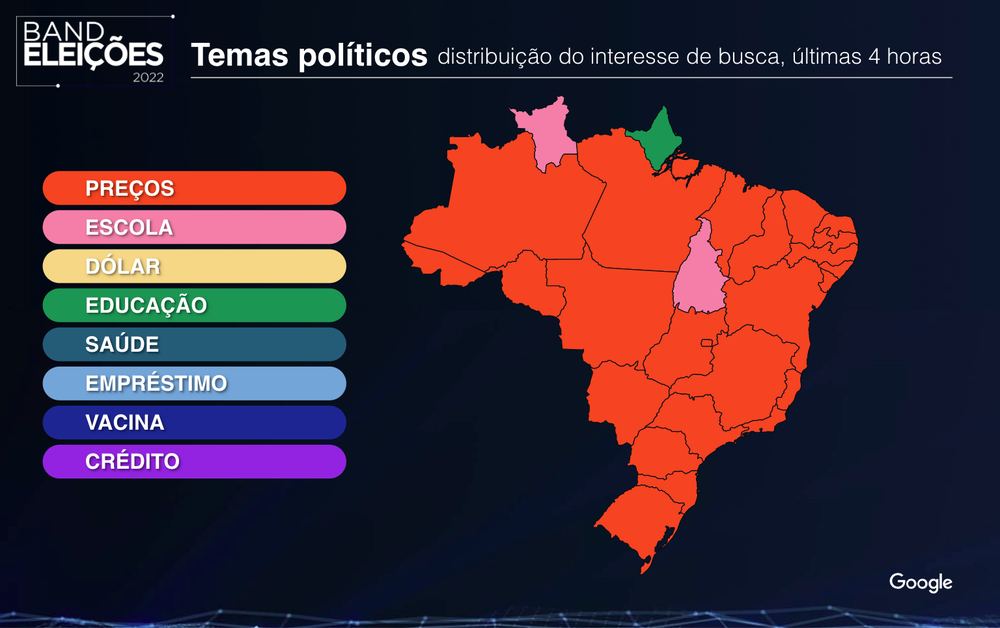
This map shows Search interest in Brazil for the most relevant topics in the 2022 elections.
The partnership is part of the Google News Initiative, Google’s effort to help journalism thrive in the digital age. We’ve worked with multiple teams to bring real-time insights from Google Trends during the debate through tailor-made visualizations for TV, and an online data hub that users can use as a second screen.
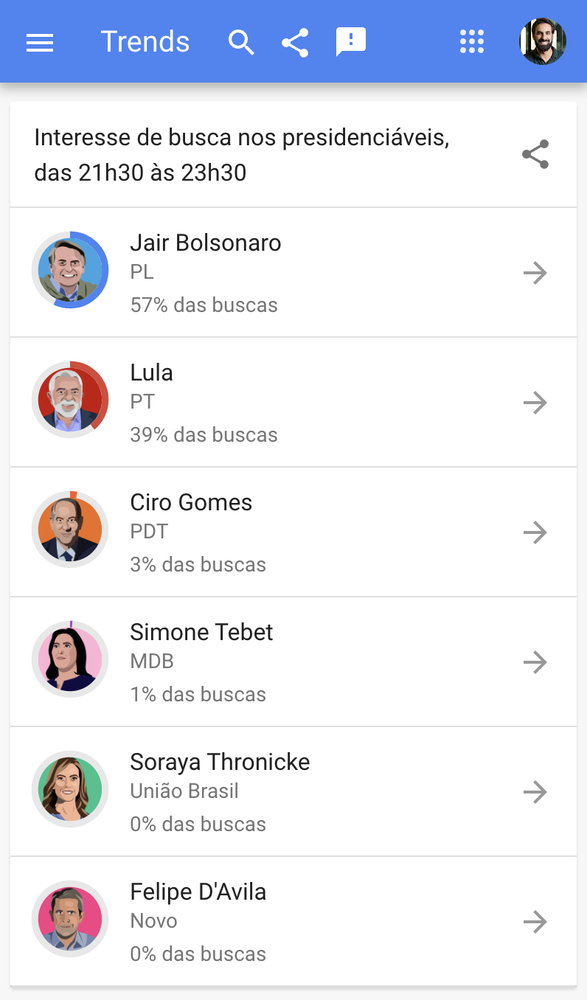
This list shows Google Search interest in Brazil presidential candidates.
One of the highlighted features of the online hub is a pre-debate dashboard with information about each candidate, topics of interest, and region trends. The dashboard was built focused on mobile screens using Google Data Studio and Google Trends data.
Our goal with the pre-debate dashboard is to allow journalists to interact with the data to find interesting trends for specific candidates and themes throughout 2022. But we also want to give context into how the debate will alter the trends.
With those goals in mind, we built a dashboard that allows journalists and the public in general to see trends about the candidates since the beginning of the year, and breakdowns per region and themes, which can be viewed through the data studio interface.
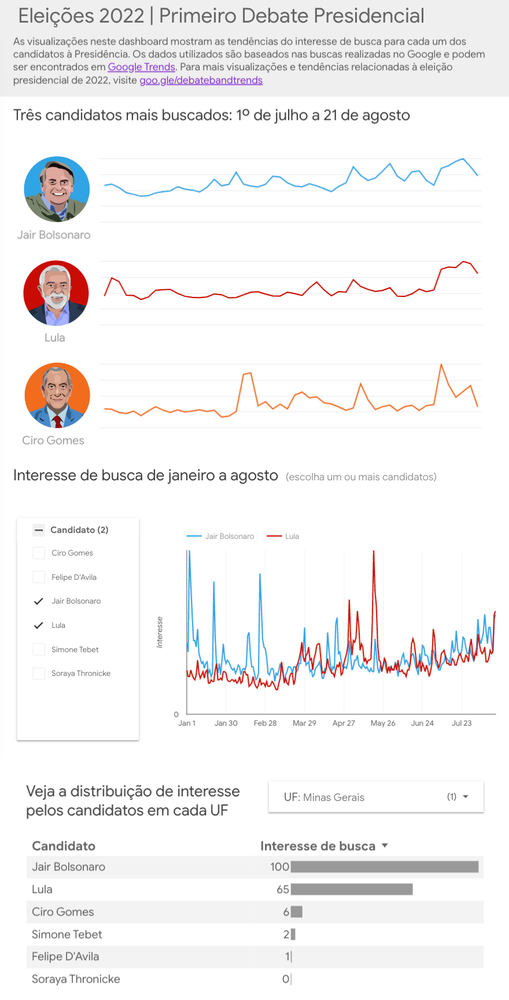
This dashboard shows the most relevant metrics comparing the candidates participating in the 2022 presidential debate in Brazil.
In addition, we also launched aTrends hub with real-time data on the electoral cycle, providing Search trends around presidential candidates, parties and top questions on topics related to the campaign.
By making data more accessible through Google Data Studio and Google Trends initiatives, we hope to help journalists and voters engage with the democratic process in Brazil.
How to find the best deal on your next flight
Holiday travel is just around the corner, and for many people, affordability is top of mind. From April to August this year, searches for “cheapest airline tickets” surged more than 240% in the U.S. During this same period, the top-searched questions related to air travel included “when is the best time to book a flight?” and “how to find cheap flights?”.
To answer these questions and more, the Google Flights team analyzed five years’ worth of historical airfare data to look for any reliable patterns in the data
Cheapest days to fly
Historically, it’s been cheaper to fly in the middle of the week than on the weekend — especially Sundays. On average, flights that depart on Monday, Tuesday, or Wednesday have been 12% cheaper than weekend departures. If you exclude international destinations, the potential savings jump even higher to 20%.
Nonstop flight versus taking a layover
Willingness to take a layover is one of your best bets to save money when you fly. On average, nonstop fares have been 20% higher than a flight with stops.
Best day of the week to book your plane tickets
There isn’t much value in purchasing your tickets on a certain day of the week — sorry, Tuesday! If you shop for flights on Tuesdays, Wednesdays, or Thursdays instead of Saturdays or Sundays, prices have only been 1.9% cheaper on average over the past five years. So if your trip is just a couple of weeks away, don’t wait for Tuesday to roll around — book your flight now in case the price goes up.
The ideal number of days before departure to book a flight
For U.S. domestic flights, prices have usually been their lowest 21-60 days out, with average prices bottoming out 44 days before departure. But keep in mind that these patterns may not hold true for your specific route, so planning and booking early is usually a good idea (this also applies to the other scenarios listed below).
Best time to book flights for Thanksgiving or Christmas. For domestic Thanksgiving travel, you’ll want to plan a bit further ahead. In the past, the lowest prices have usually been found 36-74 days before departure, hitting their lowest point 52 days out.
For domestic trips around Christmas, the lowest average prices have been 22 days before departure, but that may be cutting it close. Prices have tended to drop anywhere between 20 and 88 days before departure.
Best time to buy spring break flights. Ready for some fun after the winter doldrums? For domestic trips beginning in March or April, prices have typically been lowest 23-59 days before departure, and 38 days out is when they’ve hit their low point.
Best time to book flights for summer vacation. School’s out and summer’s in. For domestic trips beginning in July or August, prices have been lower 14-44 days before departure, and the lowest average prices are usually 21 days out.
Best time to book a flight from the U.S. to Europe. For trips to Europe from the U.S., prior trends suggest you’ll want to book on the earlier side. The best deals were usually found 129 days before departure and prices tend to be lower anywhere between 50 and 179 days out.
Best time to book flights from the U.S. to Mexico or the Caribbean. In prior years, average airfares from the U.S. to Mexico or the Caribbean have been lowest between 37 and 87 days before departure, and 59 days out is when they’ve hit their lowest point.
3 more ways Google Flights can help you find a good deal
See if today’s prices are low, typical or high. Search for your origin and destination and you’ll see price insights to let you know whether the current price is a good deal, compared to prices we’ve cataloged over the past 12 months for similar flights. On select searches, we’ll also let you know if prices are predicted to change significantly in the future.
Turn on price tracking so you don’t miss out. Toggle on tracking for your destination and dates of travel, and we’ll email you if prices change substantially. Or, if you’re more flexible on when to travel, you can turn on tracking for ‘Any dates’ to get notified of price drops for flights departing in the next 3 to 6 months.
Use the calendar view, date grid and price graph to see how fares change. The calendar view and date grid let you see how much you can save if you’re flexible on your departure and return dates. The price graph shows you what prices look like for an ‘X day’ long trip, depending on the departure date.