
Tablet da 10 pollici al MINIMO SINDACABILE: su Amazon l’affare
Eurovision 2022, ecco come vederlo in streaming gratis
Echo Dot di 4ª generazione, smart speaker con Alexa è in offerta con 30€ di sconto

I migliori Smart TV

20 mascherine FFP2 certificate a sole 4€: BOMBA Amazon
Supporting small businesses in a hybrid world
As we all moved online during the pandemic, businesses learnt how to adapt quickly to stay connected to customers and employees.
We grew accustomed to using QR codes in place of queueing, online workouts instead of visiting the gym and video calls replacing real-life conversations. It’s estimated that in 2020, the use of technology leapt forward five years in about five months.
Now, as we make the switch to hybrid working and welcome the return of face-to-face experiences, businesses — including Google — are having to adapt again. New research we commissioned shows 60% of the UK’s small and medium-sized enterprises (SME) owners believe they are operating in a post-pandemic “new normal,” with customer and employee expectations dramatically altered.
And while there has been much focus on post-pandemic return-to-office for big businesses, 60% of SME leaders say they need more support to help adapt to the permanent changes brought about over the past two years.
Over a third (35%) of SMEs say they have changed their business radically, and 63% say that digital skills and tools are now more important than they were pre-pandemic, as they look to grow in a hybrid and more digitally mature world.
In spite of that, a majority of SME leaders find that it’s harder now to recruit staff with the right digital skills. They are eager for the next phase of digital skills that will support them: almost three quarters (72%) of businesses say they would be interested in government or third party funded digital skills training, and in incentives for providing training (68%). But many of them don’t know where to get help.
That’s why today, with Chancellor Rishi Sunak, we’re launching the next phase of our in-person digital skills training, along with new support via Google Career Certificates to help small businesses adapt to this post-pandemic ‘new normal.’
Delivering in-person digital skills training nationwide
Starting today in Ipswich, Suffolk, our in-person Google Digital Garage team will be visiting towns and cities nationwide, making stops in places like Leeds, Lincolnshire, Salisbury and Glasgow, to teach small businesses and individuals digital skills that can help them maximize their potential. As well as classes on topics like ‘How to write a CV’, ‘Digital Marketing Strategy’ or ‘Coding,’ we’re offering one-to-one mentoring with digital experts.
Small businesses are at the heart of our economy – creating jobs and prosperity across the UK. It’s been fantastic to meet so many SMEs in Suffolk today and to see Google’s digital workshop in action which is giving them the tools to grow.
High-impact tech skills with Google Career Certificates
We’re also working alongside the Federation of Small Businesses to offer up to 500 Google Career Certificate Scholarships to SMEs, worth up to £87,000 per business, to help them grow and develop high-impact tech skills. The programmes, which are available on Coursera, offer flexible online training in high-demand areas such as project management, IT support, data analytics, UX design and digital marketing. We’re proud these certificates are giving learners the opportunity to gain entry-level digital skills in competitive fields and helping businesses across the UK to fill their skills gaps.
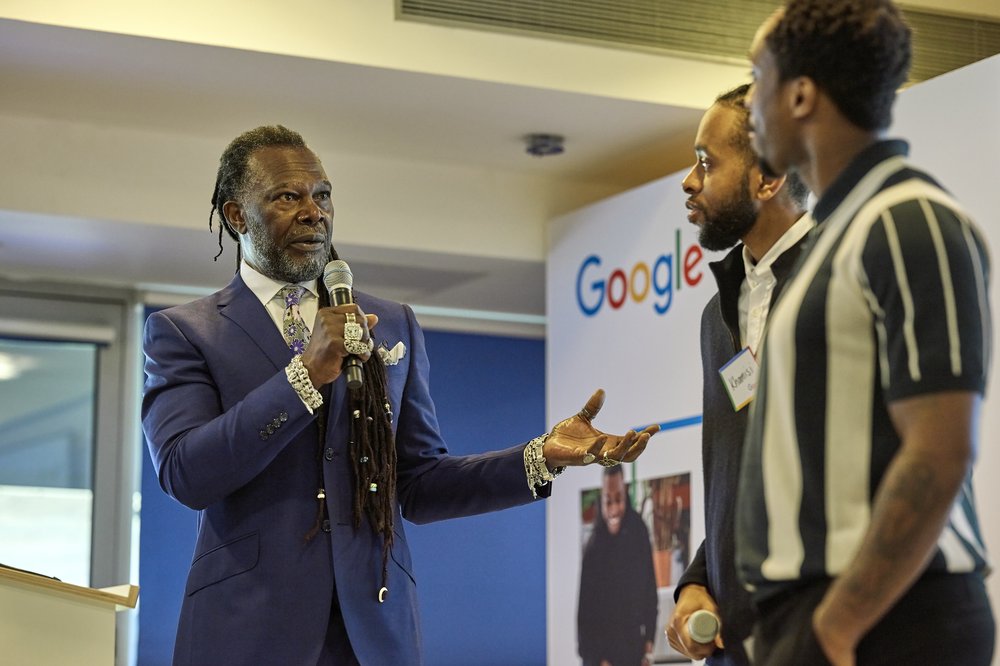
Entrepreneur Levi Roots on stage with two small business founders at today’s Google Digital Garage skills training event
When work moved from offices and studios to online, no one knew how we’d adapt to such sudden change. But adapt we did. Small businesses leaders looked for creative ways to bring their offline services online and many saw how powerful that could be. Like Zoe Chapman, founder of Kiddiwhizz, who used digital tools like online advertising and social media to supercharge growth, build brand awareness and increase profitability.
Going digital helped me to grow my new business at an incredible rate, despite launching mid-pandemic. Opportunities that may have otherwise taken years to materialise are already in the works.
Zoe added that, “Having access to a Google Digital Garage mentor was like having a hand to hold whilst learning.”
The UK’s growing digital economy has created opportunities for record numbers of British small businesses to thrive. We’re committed to helping more businesses, and their employees, make the most of that opportunity to maximize their growth.

Metti al polso un vero e proprio assistente digitale con questo clone dell’Apple Watch
Connecting more Americans to in-demand digital skills
America’s employers are starting to look at the world differently as they look for talent to fill their growing needs. Many businesses are moving beyond narrowly defined degree requirements. They’re seeking employees who may have acquired skills through alternative routes, which may include career experiences and targeted training programs.
Since only 36% of American adults have four-year college degrees, requiring that piece of paper automatically screens out 70% of rural workers, almost 70% of African-American workers and 80% of Latino workers.
When employers hire for relevant skills, rather than screening for degrees, we get access to a talent pool that is qualified, ready to work, and significantly more diverse. But for employers to hire people with the requisite skills, people must have successful avenues to acquire those skills.
Today in the U.S., the reported number of unemployed people is 5.9 million. That number grows dramatically when we include people who are underemployed, are earning low wages or have stopped looking for work. At the same time, there are more than 11 million unfilled jobs, many open because employers say that they can’t find the people with the requisite skills.
By all indications, this is a skills gap problem that’s only going to get worse. By some estimates, 80% of “middle-skill” U.S. jobs now require digital skills. And the World Economic Forum estimates that up to 50% of workers will need to add new skills to keep up with the requirements of in-demand careers.
Fortunately, innovative initiatives are equipping people to gain relevant expertise. Since 2017, Google and Goodwill have partnered to bring digital skills to local communities and help people get good jobs that don’t require a degree.
Which brings us to some news we’re sharing today: Google.org is announcing a $14 million reinvestment in the Goodwill Digital Career Accelerator. This includes grants and in-kind support to help Goodwill continue to provide digital training pathways and support job placement for people seeking jobs.
Google’s expanded support includes $7 million in Google.org grants and $7 million in donated Search ads, which will help Goodwill reach more than 200,000 people across the U.S. and Canada with digital skills and career training so they gain economic mobility. The funds support infrastructure development and expansion like tracking systems for hiring and training that will improve the reach and effectiveness of Goodwill’s services at the local level. Finally, through the Google.org Fellowship, ten Google employees are working full-time pro bono to help Goodwill better reach job seekers online so they can connect with local Goodwill career coaches and work toward brighter futures.
With support from Google.org, Goodwill has helped more than a million people gain digital awareness and new digital skills, and placed more than 300,000 overlooked job seekers in digital economy jobs.
There have been some valuable lessons learned along the way:
- Meet learners where they are. Many people don’t know that Goodwill places more people in jobs than any other non-government, nonprofit in America. Over the years, Goodwill teams have found access is one of the biggest barriers for people who want to gain digital skills. Goodwill makes training readily available and convenient at Goodwill locations within communities across the U.S. and Canada. More than 70% of the U.S. population lives within a 20-mile radius of a Goodwill mission services location.
- Remove barriers to learning with enhanced support. There are dozens of reasons why people might drop out of a learning program or not sign up in the first place. Living stipends, connectivity support, transportation credits, career navigators and other resources make it possible for people to participate in and complete training so that they can earn career certificates.
- Commit to creating pathways to upward mobility. Digital skilling must lead to real jobs with opportunities for growth. Close employer relationships are essential to connect graduates with hands-on internships, apprenticeships, and other learn-and-earn options. An example is Kara Isreal Gooch, a Google Career Certificate graduate who landed a job at Accenture with help from Goodwill and our consortium of employers who have agreed to consider Google Career Certificate graduates for jobs.
Through collaborations like the one between Goodwill and Google, we’re learning what works and what doesn’t. By aligning the right resources, we can build the systems and capacity needed to close the digital skills gap and connect Americans with the skills and support they need to compete in the 21st century economy. In every community, we need talent equipped and participating in our rapidly changing labor market.
Interested in learning more about ongoing initiatives to promote workforce development and connect job seekers with careers and resources? Join Goodwill’s Steve Preston, Google’s Kent Walker and experts from across the labor field today at the Rising Together Action Summit. The live-streamed event kicks off with a fireside chat at 10am EST/ 7am PST.

HONOR 50, il PREZZO CROLLA su Amazon (-46%)
The Business Case for Awesome B2B Content
Have you seen Everything Everywhere All at Once? It’s a must-watch for everyone, but especially B2B marketers.
The movie tells a simple story about healing generational trauma. But it does so using multiverse travel, kung fu fighting, a truckload of googly eyes, and much more.
Simply put, it’s awesome. You have to admire the bravery of both the filmmakers and the financiers, who read this script and went, “Yup, that seems reasonable.”
Marketers could use a healthy dose of that kind of courage. Awesome content doesn’t overwhelm the story you’re telling the audience — in fact, it makes your message more likely to stick.
The Business Case for Awesome B2B Content
Here are a few great examples of awesome B2B content smartly amplified to get amazing results. If you’re having trouble convincing the higher-ups that creative content makes good business sense, let these help you make the case.
Smartsheet’s Efforts Bear Fruit
Productivity solution Smartsheet partnered with TopRank Marketing to raise awareness of their platform’s Microsoft Teams integration. We settled on a campaign that would allow for amazing influencer content, stunning visuals, and a hook to get the audience involved in creating their own content.
The #FruitfulWork campaign started by categorizing work styles as five different types of fruit:

Then we asked productivity and collaboration experts to share their workstyle and how they collaborate best with other types. The result: fun, lively video and static content that people love to share.
Due to the awesomeness of this content, and the strategic influencer amplification we built in, this campaign saw:
-
- Over 10,000 pageviews on campaign content
- Benchmark-beating engagement on LinkedIn and Twitter
- A 30% increase in Microsoft Teams integration activation
MailChimp Mangles Its Own Name
What do you do when a podcast host mispronounces your company name in a paid ad? If you’re MailChimp, you lean into it with a creative campaign that revolves around words that kind of sound like your brand name.
The “Did you mean MailChimp” campaign pushed the boundaries of awesome, encompassing surreal short films, a bold new fashion statement, a snack food, a musical app, and more:
All of it was designed to get people talking about, and searching for, these strange word combinations (WhaleSynth? KaleLimp?). Thanks to some savvy SEO, each phrase would prompt Google to say, “Did you mean MailChimp?”
This campaign earned free press in everything from Rolling Stone magazine to Buzzfeed, ultimately garnering:
- Twice the industry average for time per engagement
- 67 million organic searches
- $3.25 million worth of earned media coverage
Mondi Brings in a Human Touch
How do you sell the virtue of physical media in a digital world? When their new graphic design paper, Pergraphica, struggled to find a market, Mondi faced that dilemma head on.
The “Catching Feels” campaign highlights how the experience of holding a tangible object can affect our emotions — in other words, how feeling leads to feelings.
The campaign included partnering with Adobe Stock to create a beautiful book of digital art made physical. The book featured six different artists, presenting not just their artwork but also the stories underlying each piece’s creation.
By combining wordplay, a beautiful physical object, and compelling stories, Mondi was able to realize a 35% increase in sales.
Demandbase Sees Heroic Engagement
Cloud-based marketing solution Demandbase wanted to make a big impression with their brand relaunch. They had partnered with three other martech solutions to create the ultimate Smarter GTM™ platform. Now, all they needed was a hero or two to grab the public’s attention.
TopRank Marketing worked with the brand to create an interactive, animated comic book based on the brand’s new mascot, DeeBee. Together, we recruited some of the giants of the industry to lend their advice — and be transformed into superheroes.
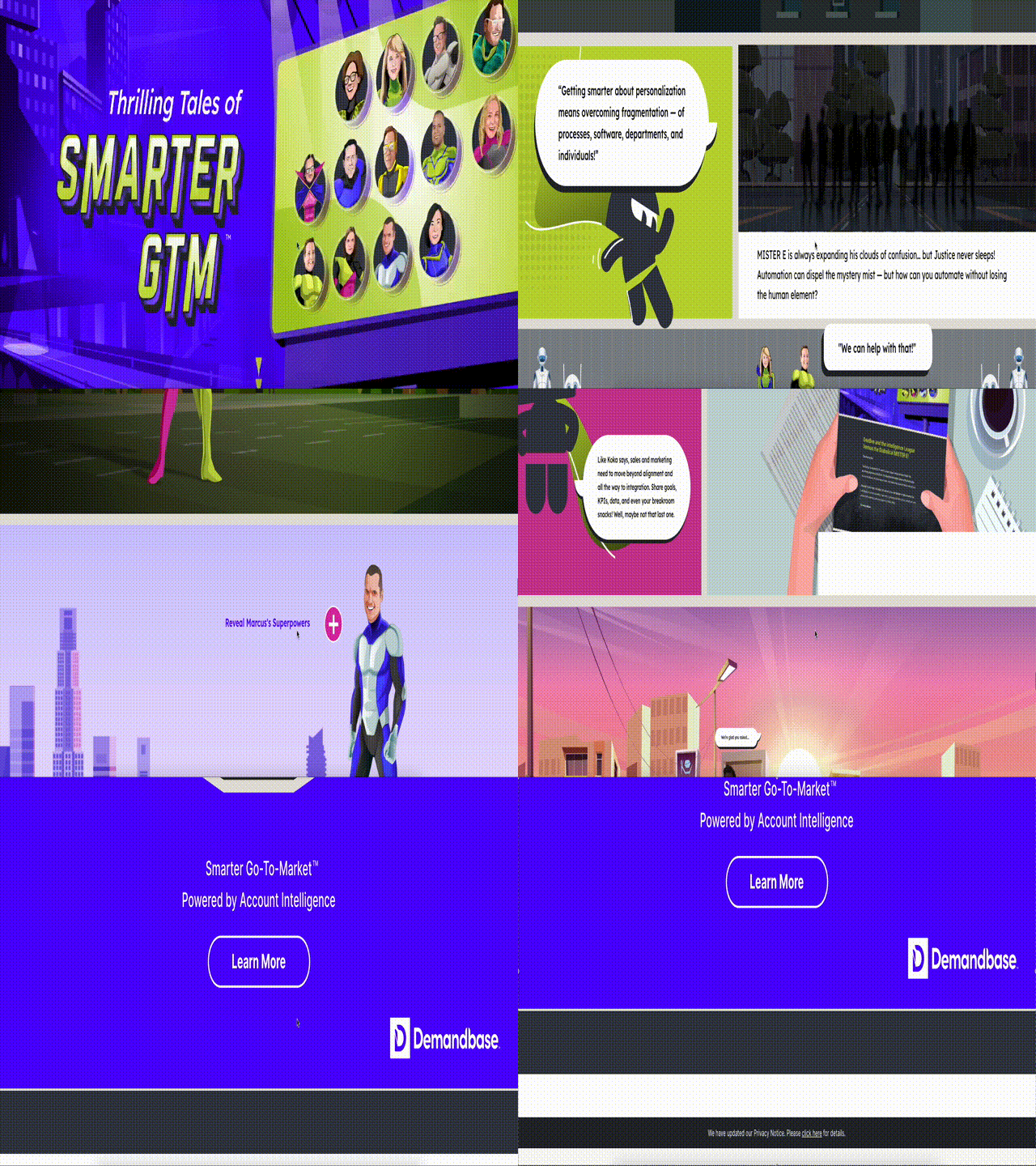
We supported the launch with blog and social first content from our influencers, as well as social images and pre-written messages to make sharing easy.
Once the project was launched, the larger marketing influencer community took notice. We saw organic re-sharing from 19 influencers who were not included in the asset, with a potential audience of over eight million.
This heroic tale of smarter marketing ultimately earned:
- Over 13,000 views of the asset
- 8.4 million in potential reach
- Pageviews at 800% of our benchmark
Awesome B2B Content Gets Results
There are many strategic and tactical elements that make for a successful piece of B2B content, of course. There’s influencer co-creation, paid and organic amplification, supporting content, and beyond. But all of that promotional effort works a whole lot better for content that is undeniably awesome.
It’s one thing to earn attention — anyone can shout, “Hey! Look over here!” It’s quite another to reward that attention in a way that sparks engagement and inspires re-sharing. That’s where awesome content comes in. In the all-out battle royale for audience attention, to the awesome go the spoils.
Want to up your awesomeness quotient? Let’s talk.
And seriously, go watch Everything Everywhere All At Once. Trust me.
The post The Business Case for Awesome B2B Content appeared first on B2B Marketing Blog – TopRank®.

Norton 360 Deluxe: antivirus scontato del 68%

5€ per ricaricarti e stare in forma? Sì con l’integratore Post Fludec (12 bustine)
WhatsApp, quando l’app trascriverà i messaggi audio in automatico?

Custodie Apple Watch, ne cambi una al giorno con appena 11€