
Video pornografico irrompe in convegno Zoom al Senato italiano: password pubblicata dagli organizzatori

L’occasione è molto seria: un convegno sul tema della pubblica amministrazione trasparente e del recepimento della direttiva UE Public Sector Information, organizzato online su Zoom da un movimento politico italiano e trasmesso dalla Web TV del Senato in diretta il 17 gennaio scorso. Fra gli ospiti c’è anche il premio Nobel 2021 per la fisica Giorgio Parisi.
A un certo punto del convegno, sullo schermo dell’austera Sala dei Presidenti di Palazzo Giustiniani e sui monitor dei relatori collegati via Zoom e del pubblico che sta seguendo il convegno tramite Internet compare un video molto esplicito: un’animazione digitale che mostra le attività intime di un personaggio che molti gamer avranno riconosciuto immediatamente: è Tifa Lockhart di Final Fantasy VII.
Le immagini rimangono sullo schermo per un’interminabile manciata di secondi nel silenzio e nel gelo dei partecipanti, intanto che la regia del convegno tenta disperatamente di eliminare dallo schermo il video, nel quale gli osservatori più attenti e impassibili noteranno l’indirizzo del suo creatore, l’animatore digitale juicyneko. La regia cerca di rimuovere dalla sessione Zoom l’intruso, anzi gli intrusi che sono entrati nella riunione e hanno sommerso la relatrice non solo con immagini poco pertinenti ma anche con grida in lingua straniera fortemente distorte (se qualcuno riesce a decifrarle, me lo segnali nei commenti) e poi con un video musicale tratto da YouTube.
L’intero incidente è stato immortalato sul sito di Radio Radicale qui (dal minuto 26 in poi; immagini ovviamente non adatte a un pubblico sensibile).
La senatrice Maria Laura Mantovani, che ha aperto il convegno, ha dichiarato che si è trattato di “un episodio gravissimo, un vero e proprio attacco” e ha annunciato che avrebbe sporto denuncia alla polizia postale.
Può sembrare strano e preoccupante che degli intrusi riescano a violare la sicurezza di un sito istituzionale e irrompere in una riunione politica, ma c’è un dettaglio che potrebbe ridimensionare parecchio la vicenda.
L’informatico Andrea Lazzarotto ha infatti notato che il link per collegarsi al convegno tramite Zoom era stato pubblicato alcuni giorni prima sui social network dalla senatrice stessa (e, notano altri, anche da un suo collega, il senatore Mario Turco), con tanto di passcode, ossia il codice numerico necessario per accedere a una riunione Zoom. Il link era https://us02web.zoom.us/84618000732 e il passcode era 631228.
Durante un convegno, la senatrice #M5S Maria Laura Mantovani ha lamentato l’accesso di un tale che ha riprodotto un porno in computer grafica.
Ma come avrà fatto l’ignoto a introdursi nella videoconferenza #Zoom? L’immagine suggerisce un’ipotesi… https://t.co/L5IpzbTDAT pic.twitter.com/RAorFRcYre
— Andrea Lazzarotto (@thelazza) January 19, 2022
Con questo link e questo passcode e senza le opportune impostazioni restrittive di Zoom, irrompere nel convegno sarebbe stata solo questione di cliccare sul link e digitare il codice. La dinamica dettagliata dell’incursione non è stata resa nota, ma sulla base di quello che si sa fin qui non sembra che si sia trattato di un attacco particolarmente sofisticato dal punto di vista tecnico.
Si tratterebbe insomma di un semplice caso molto visibile di zoombombing: vandali che entrano in videoconferenze i cui codici di accesso sono stati incautamente pubblicati dagli organizzatori.
Ma come si fa a evitare questo tipo di incidente? Ci sono alcune precauzioni fondamentali, che conviene ripassare a chiunque abbia intenzione di organizzare videoconferenze con qualunque piattaforma, da Zoom a Teams.
Se si tratta di una riunione chiusa, nella quale tutti i partecipanti devono poter parlare e condividere il proprio video e delle immagini, come avviene per esempio nelle lezioni scolastiche a distanza, le coordinate della riunione non vanno assolutamente pubblicate ma vanno date in privato soltanto a quei partecipanti, con la raccomandazione di non condividerli con nessuno al di fuori dei partecipanti.
Se invece la videoconferenza prevede un certo numero di partecipanti che parlano e condividono video e immagini e un numero più ampio di persone che possono soltanto assistere senza poter intervenire, allora ci sono due soluzioni: usare l’apposita modalità webinar di Zoom oppure diffondere in streaming la videoconferenza su Facebook, Twitch o Youtube, e dare al pubblico soltanto il link che porta allo streaming.
Se si usa la modalità webinar di Zoom, il link può essere pubblicato tranquillamente, perché soltanto chi entra nella videoconferenza con gli specifici account Zoom preventivamente impostati dalla regia come relatori può apparire in video e condividere immagini.
Gli strumenti per fare videoriunioni in sicurezza e senza interruzioni imbarazzanti ci sono, insomma: basta usarli e farli usare.

Echo Show 15, preordine su Amazon: lusso, design e potenza con Alexa

The Crew 2, disponibile ora l’ultimo aggiornamento

25 mascherine FFP2 CE made in Italy a 10€: PREZZONE Amazon

Cavo di Rete CAT 5e da un metro, REGALATO su Amazon a 0,60€

L’Amazon SEGRETO: questi 5 gadget tech costano 0,01€

TIM Ricarica Automatica: 100 Giga al mese in omaggio

It’s time for a new EU-US data transfer framework
If you rely on an open, global internet, you’ll want the European Union and the U.S. government to agree soon on a new data framework to keep the services you use up and running. People increasingly rely on data flows for everything from online shopping, travel, and shipping, to office collaboration, customer management, and security operations. The ability to share information underpins global economies and powers a range of services like high-value manufacturing, media, and information services. And over the next decade, these services will contribute hundreds of billion euros to Europe’s economy alone.
But those data flows, that convenience, and those economic benefits are more and more at risk. Last week, Austria’s data protection authority ruled that a local web publisher’s implementation of Google Analytics did not provide an adequate level of protection, on the grounds that U.S. national security agencies have a theoretical ability to access user data. But Google has offered Analytics-related services to global businesses for more than 15 years and in all that time has never once received the type of demand the DPA speculated about. And we don’t expect to receive one because such a demand would be unlikely to fall within the narrow scope of the relevant law.
The European Court of Justice’s July 2020 ruling did not impose an inflexible standard under which the mere possibility of exposure of data to another government required stopping the global movement of data. We are convinced that the extensive supplementary measures we offer to our customers ensure the practical and effective protection of data to any reasonable standard.
While this decision directly affects only one particular publisher and its specific circumstances, it may portend broader challenges. If a theoretical risk of data access were enough to block data flows, that would pose a risk for many publishers and small businesses who use the web, andhighlight the lack of legal stability for international data flows facing the entire European and American business ecosystem.
In 15 years of offering Analytics services, Google has never received the type of demand…speculated about
Businesses in both Europe and the U.S. are looking to the European Commission and the U.S. Department of Commerce to quickly finalize a successor agreement to the Privacy Shield that will resolve these issues. Both companies and civil society have been supporting reforms based on an evidence-based approach. The stakes are too high — and international trade between Europe and the U.S. too important to the livelihoods of millions of people — to fail at finding a prompt solution to this imminent problem.
A durable framework — one that provides stability for companies offering valuable services in Europe — will help everyone, at a critical moment for our economies. A new framework will bolster the transatlantic relationship, ensure the stability of transatlantic commerce, help businesses of all sizes to participate in the global digital economy, and avoid potentially serious disruptions of supply chains and transatlantic trade. And it will assure continued protection of people’s right to privacy on both sides of the Atlantic.
We strongly support an accord, and have for many years supported reasonable rules governing government access to user data. We have long advocated for government transparency, lawful processes, and surveillance reform. We were the first major company to create a Transparency Report on government requests for user data, were founding members of the Global Network Initiative and the Reform Government Surveillance coalition, and support the OECD’s workstream on government access to data. At this juncture, we urge both governments to take a flexible and aligned approach to resolving this important issue.
As the governments finalize an agreement, we remain committed to upholding the highest standards of data protection in all our products, and are focused on meeting the needs of our customers as we wait for a revised agreement. But we urge quick action to restore a practical framework that both protects privacy and promotes prosperity.

Microsoft acquista Activision Blizzard: come cambia il mercato

Demon’s Souls, capolavoro PS5 SUPER SCONTATO su Amazon
B2B Marketers: It’s Time to Make Inclusive Language a Priority. Here’s How.
If you’re in the business of marketing, I don’t need to tell you that words have power.
They have the power to influence. The power to endear. The power to alienate.
If you’re in the business of marketing, I don’t need to tell you how undesirable that last effect is.
It’s the risk today’s brands are running if they fail to make inclusive language a priority. The words used in content and communications speak volumes about a company’s values.
Following a few simple guiding principles can make a big difference in projecting a brand culture and community that are welcoming to all, both externally and internally.
Defining “Inclusive Language” in Marketing
Inclusive language, as defined by our friends and clients at LinkedIn, is language that “does not exclude or stereotype people based on race, sexual orientation, age, gender identity, ability, socioeconomic status, or any other characteristic.”
Examples of inclusive language cover a wide range of visible and invisible forms. There’s no set playbook to follow, because the recommended guidelines and best practices are fluid, just as language is.
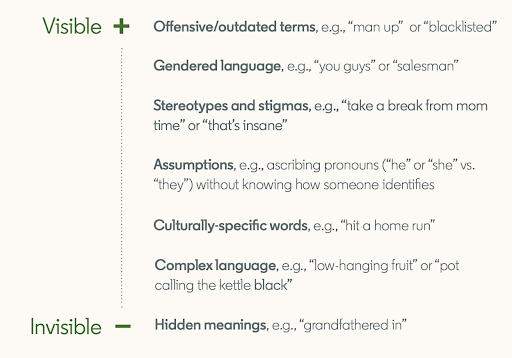
(Source: LinkedIn’s guide to Inclusive Language for Marketers)
Inclusive culture is a journey, not a destination. But it’s an extremely important one for B2B organizations to undertake. Emerging generations are more diverse than any before, and the modern world is more globally interconnected. Your future customers and employees want to see themselves reflected in your brand’s marketing. The stakes are high.
“The ability to communicate with all audiences is a sign of respect and demonstrates to prospective connections what to expect from your company,” says Rachel Douglas, Influencer Marketer. “Inclusive language can deepen relationships and leading brands understand the need to have an authentic, inclusive voice as part of their core identity.”
Why There’s “So Much Work to Be Done”
Last year, the AI-powered software company Creative X conducted an analysis of more than 3,500 image and video ads in the U.S. across popular CPG, beauty and alcohol brands, assessing representations of age, gender, skin tone and setting.
The study produced some stark findings:
- Although more than half (55%) of ads feature female characters, male characters were 1.5x more likely to be shown in professional settings.
- Characters with light to medium skin tones were shown twice as often in professional environments. Characters with darker skin tones were featured roughly half as frequently as their lighter-skinned counterparts — 18% compared to 8%.
- Only 1% of ads included people over 60, and of those, less than 2% were featured in physical settings (i.e. offices).
“Female characters are historically four to six times more sexualized and less depicted as leaders,” according to Madeline Di Nonno, president and CEO of the Geena Davis Institute on Gender in Media, in the aforementioned article. “And marginalized communities, LGBTQIA+, people with disabilities, they’re not even anywhere near the baseline population. There has been progress, but there’s so much work to be done.”
B2B brands and marketers have a key role to play in this work.
Taking the Journey Toward an Inclusive Culture
The single most important step marketing leaders can take today is to openly make inclusive language a priority.
Talk about it frequently in team meetings. Build it into your creative process. Seek different viewpoints on how a message or piece of content will be received by different audiences.
Moreover, here are some specific actions that will help embed inclusive language into your B2B marketing strategy:
- Create an inclusive language style guide, highlighting words and phrases to avoid as well as recommended alternatives. To get you started, the American Psychological Association has a lengthy list of guidelines. Ideally, your guide should be tailored to your company and its specific values; it should also be a living, breathing document that evolves continuously over time.
- Make diversity a focal point in hiring, across a variety of identity traits. Authentically infusing different worldviews and experiences into the creation of your marketing is the best way to make it resonate with diverse audiences.
- Set the standard from up top. When executives and leaders make a point of using inclusive language and calling out opportunities to do so, it sets an example for others to follow. Consider providing managers with free trainings on inclusive language and its principles.
- Review and evaluate past copy and content. Find instances of non-inclusive language from past content or ads (from your brand or others) and, as a team, identify better alternatives that could have been used. It’s helpful to see concrete, real-life examples to demonstrate more inclusive thinking.
- Maintain open and honest communication. As we said earlier, inclusive language is fluid and ever-changing. That’s why it should never be a set-and-forget initiative. Encourage team members to speak up and share ideas about how your guidelines can and should change over time.
What Message Are You Sending?
Seemingly small word choices and linguistic decisions can have a dramatic impact on how their source is perceived by readers or listeners. Keep in mind that nobody is expected to be perfect, and your audience will likely be forgiving of missteps if the intentions are clear and genuine.
The journey is well worth taking. As Maysa Akbar, Chief Diversity Officer for the APA, explains: “By embracing inclusive language and encouraging others to do the same, we firmly believe that we will not only communicate effectively with more people, but also better adapt to a diversifying society and globe.”
There’s work to be done, but B2B marketers are uniquely equipped to help their companies accomplish it. If you’re ready to make inclusive language a priority in your strategy, but unsure where to start, here are some valuable resources:
- Last year, LinkedIn not only created a pocket guide, but also a full learning course covering key marketing-focused elements like making a business case for inclusive language.
- This inclusive marketing resources roundup from Search Engine Land includes links to a bevy of useful materials, such as Harvard’s Implicit Association Test to evaluate your own biases, and guidance around website accessibility.
TopRank Marketing CEO Lee Odden wrote on our blog about how marketers can become more inclusive with content and influencers.
The post B2B Marketers: It’s Time to Make Inclusive Language a Priority. Here’s How. appeared first on B2B Marketing Blog – TopRank®.

I telefoni Android non hanno grande valore, secondo Apple

Radeon RX 6500 XT recensione: una scheda video con dei limiti evidenti

Surfacing Women in Science with the Smithsonian
Women have always been on the forefront of science. From Ada Lovelace designing the first computer programs, to Rosalind Franklin decoding the structure of DNA, to Katherine Johnson figuring out the physics for mankind to reach the moon, the history of science has been driven by the contributions of women. However, they have often not received proper credit or acknowledgement for their essential work.
This is why today we are thrilled to announce a new phase in our long-term collaboration between the Smithsonian and Google Arts & Culture. Together, we’ve developed new machine learning tools for use by curators at the Smithsonian American Women’s History Initiative as we dive into the institution’s archives to help uncover and highlight the many roles women have played in science over more than 174 years of history.
Through this first of its kind collaboration with Google Arts & Culture, our lead partner on the Smithsonian Open Access initiative, it is now easier than ever to surface the work of women in Smithsonian history. This project builds on Google Arts & Culture’s previous work, which made over 2.8 million 2D and 3D images from the museum collections available to the public for the very first time in 2020.
Powered by machine-learning, these new tools enable three types of research in the Smithsonian’s archives: comparing records across history by connecting different “nodes” in the metadata, identifying the names of women even when they haven’t been explicit (such as by the use of a husband’s name instead), and analyzing image records to cluster and group together similarities to facilitate comparison.
Results are already promising. Through analyzing collections relating to Mary Jane Rathbun, likely the first woman curator at the Smithsonian, for example, we have been able to find taxonomy cards in Smithsonian records that detail a collecting trip she took with Serena Katherine “Violet” Dandridge, a scientific illustrator who worked alongside Rathbun in the Department of Marine Invertebrates in 1911, and gain a better understanding of early collaborations between women. In fact, the taxonomy cards reveal that a third colleague, Dr. Harriet Richardson Searle, identified some of the specimens that Rathbun and Dandridge brought back to the Smithsonian. Though this experiment is only just beginning, it is clear that technology can play a key role in facilitating further research and help to recover stories of women in science.