
Capire la finanza. Perché non si riesce a guadagnare?
Capire la finanza, di Alessandro Pedone, Presidente Tekta Società di Consulenza Finanziaria Indipendente Alessandro Pedone ci spiega tutto quello che i venditori della finanza non possono dirvi che cosa impedisce…
L’articolo Capire la finanza. Perché non si riesce a guadagnare? scritto da REDAZIONE TRENDIEST proviene da Assodigitale.

LEXIA ASSISTE CRYPTOSMART NELL’AVVIO DELLA PROPRIA PIATTAFORMA FINTECH
Lexia Avvocati ha assistito Cryptosmart nella costituzione e nell’avvio della propria piattaforma fintech dedicata all’offerta di servizi di compravendita di criptovalute e di portafoglio digitale. Cryptosmart è il nuovoexchange di…
L’articolo LEXIA ASSISTE CRYPTOSMART NELL’AVVIO DELLA PROPRIA PIATTAFORMA FINTECH scritto da YOUR_DIGITAL_VOICE! proviene da Assodigitale.

PAOLO BRAMBILLA ALL’ORDINE DEI GIORNALISTI DI LOMBARDIA PER I PUBBLICISTI.
Con Paolo Brambilla si candidano come consiglieri dell’OdG Lombardia anche Francesco Caroprese e Roberto Di Sanzo.Come revisore Angela Battaglia. Al Consiglio nazionale Angelo Luigi Baiguini Coraggio, innovazione, solidarietà: per costruire il giornalismo del futuro Ecco,…
L’articolo PAOLO BRAMBILLA ALL’ORDINE DEI GIORNALISTI DI LOMBARDIA PER I PUBBLICISTI. scritto da Paolo Brambilla proviene da Assodigitale.

Fabrizio Capaccioli, Company Director di ASACERT, parla del progetto AWorld
Tre grandi temi: Ambiente, Sociale e Governance. L’innovativa app del progetto AWorld “La crisi pandemica è stata il culmine di un sistema che non poteva più funzionare, mettendo in evidenza…
L’articolo Fabrizio Capaccioli, Company Director di ASACERT, parla del progetto AWorld scritto da Paolo Brambilla proviene da Assodigitale.

Ci vediamo online al CICAP Fest EDU, dal 25 al 31 ottobre?
Il CICAP sta organizzando il CICAP Fest EDU, una settimana di incontri gratuiti e aperti in streaming, dedicati a scuole e docenti, per promuovere la diffusione di una cultura critica, razionale e scientifica, da lunedì 25 a domenica 31 ottobre, con relatori come Daniela Ovadia, Luca Perri, Massimo Polidoro e tanti altri, compreso il sottoscritto.
Se volete saperne di più e/o partecipare oppure segnalare gli incontri in programma, date un’occhiata a www.cicapfest.it/edu e leggete questa introduzione.
Qui sotto trovate un video in cui Massimo Polidoro ed io chiacchieriamo del Cicap Fest EDU e dei contenuti dei miei due incontri, che si terranno su Zoom il 26/10 alle 11 (per gli studenti) e il 30/10 alle 14 (per i docenti).

Huawei: le reti 5G devono diventare sempre più sostenibili

Open Source e recruiting: il Cloud supera Linux

Oggi è lo Steve Jobs Day, in memoria del papà di Apple
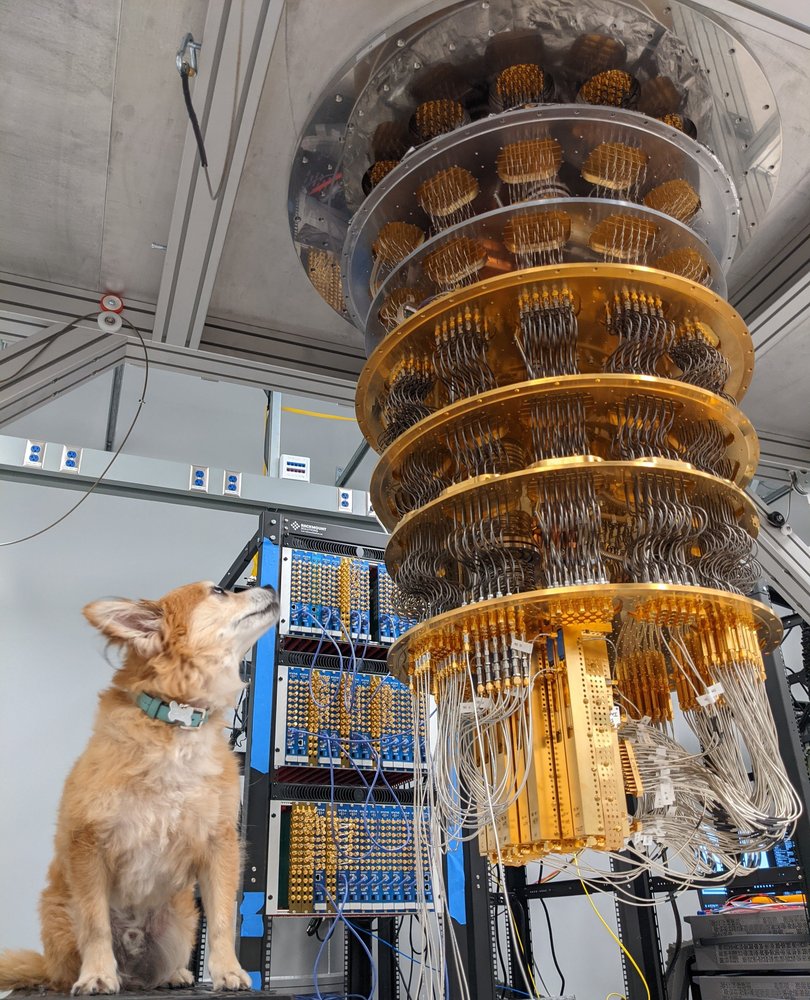
Qubit the dog on the big questions in quantum computing
This week we sat down for an interview with Qubit the dog, whose human Julian Kelly is one of our lead Research Scientists with Google Quantum AI. Qubit was born in 2012, right when Julian and team were first designing the qubits that now underlie Google’s quantum computers. He nearly received the honor of pressing the submit button for the team’s beyond-classical result published in Nature, but he was narrowly edged out by a human.
Qubit has never been interviewed before on such a range of technical and philosophical topics, so it was a privilege to have the opportunity — a transcript of the discussion follows.
Thank you for taking the time to sit down for this, Qubit. Given the complexity and depth of the topic, I was hoping we could jump right in. I first wanted to ask — where do you think we are in the “hype cycle” of quantum computing? Is this analogous to earlier hype cycles around ecommerce, AI, mobile technology or other major shifts where the hype may have led to “winters” for some time before the technology caught up and eventually surpassed the initial expectations about the significance of its impact on users and society, especially in terms on unexpected applications and feedback dynamics?
Ruff!
Okay, that makes sense, there does seem to be a certain unavoidable nature to that cycle that resolves itself naturally. But how should we consider investment in alternate veins of quantum computing research and development — for example, while there appears to be a viable roadmap for superconducting qubits, with evidence that error suppression can scale and enable a fully fault-tolerant large-scale quantum computer within the decade, does it make sense to also explore more speculative approaches such as photonics or spin qubits?
Granted, that may all shake out in time as these technical milestones prove out. What, if I may ask, has led to Google being able to publish the series of verified empirical demonstrations that it has? We’ve seen a number of exciting firsts — the first demonstration of a beyond-classical computation of any kind on a quantum computer in 2019, the most impressive chemistry simulation on a quantum computer earlier in 2021, and most recently the first demonstration that errors can be exponentially suppressed with the number qubits. What about Google’s team or particular approach allows for this pace of breakthroughs?
Qubit inspecting a dilution refrigerator for proper signal routing
Maybe that confidence is warranted. Of course, even if the technical path is reasonable, there are a lot of open questions about the eventual applications of quantum computing. Google’s group includes “AI” in its name — Google Quantum AI — so I assume you think quantum computing could eventually lead to more effective forms of machine learning? Or are you more excited about applications such as simulating chemical reactions and exotic materials, so we might develop better batteries and solar panels, or achieve efficient nitrogen fixation for farming fertilizer and save 2% of the world’s carbon emissions?
Yap, yap!
And do you subscribe to the “many worlds” hypothesis, and the notion that quantum computers’ power will come from essentially processing information in other parallel universes, or is this perhaps too far-fetched and unnecessary for understanding where the double exponential speedup, that is, “Neven’s Law,” comes from? Is a more conventional understanding all we need to grasp the implications of this new regime of compute space?
Rup [burps].
Thank you so much. One last question, and then I’ll let you go — what’s the deal with time crystals?
B2B Marketing News: B2B Tech Spending Rises, Twitter’s New Ad Features, Marketers See Diversity Progress, & New B2B Content Marketing Study
New Research: 86% Of B2B Software Buyers Rely On Third-Party Reviews When Making A Purchase Decision
55 percent of B2B buyers have said that their technology spending will rise during 2022, while some 86 percent of buyers look to online peer-review sites before making purchase decisions — two of several statistics of interest to digital marketers contained in recently-released survey data. Demand Gen Report
The future of events: B2B marketers weigh in-person vs. virtual attendance
73 percent of B2B marketers who are primarily focusing on physical events also plan to still attend virtual ones, with some 55 percent noting that in-person events will play a large role in their strategy, according to newly-released report data. SmartBrief
Oracle and Microsoft Introduce Enhanced AI Capabilities for Customer Data Platforms
New personalization and data gathering technology that come in the form of digital streaming are part of the latest addition from Oracle’s CX Unity customer data platform (CDP), while Microsoft’s Dynamics 365 Customer Insights platform is slated to gain new insights from a combination of client website, mobile app, and other data, the firms recently announced . Chief Marketer
Twitter to sell mobile ad unit MoPub for $1 bln
Twitter will sell its MoPub mobile advertising company, which it acquired in 2013 for some $350 million, to AppLovin Corp for more than $1 billion, as Twitter places greater emphasis on new products aimed at doubling its revenue by 2023, the firm recently announced. Reuters
YouTube Tests New ‘Engagement Graph’ Insights on Videos, Adds New Member Acknowledgement Feature
Google’s YouTube video platform is set to give live streamers an array of new tools for recognizing long-standing channel subscribers, along with additional options for viewing user engagement data and more, in its latest update, YouTube recently announced. Social Media Today
Global marketers are making headway with improving diversity in campaigns
Some 63 percent of global marketers have said that advertising campaigns featuring diverse people played a significant role in content decisions, with 34 percent having noted that an accurate representation of the world we live in was the most important objective for marketing campaign content — two of several statistics of interest to online marketers contained in recently-released survey data. The Drum
Twitter debuts new ad features, revamped algorithm ahead of ecommerce push
Twitter has launched a variety of new advertising options for digital marketers, including slide-show ads capable of linking to multiple destination landing pages or websites, along with updating how it matches relevant ads with users of the social platform, Twitter recently announced. Reuters
Snap Has More Advertisers On The Platform Than Ever Before
Snapchat has launched new features targeted at brands and advertisers utilizing the platform, along with a new augmented reality (AR) partnership, both part of Snap’s focus on attracting additional new advertising to the social destination. B&T
Instagram Adds Reels Ads into its Marketing API
Facebook-owned Instagram has launched features that will ease the process brands go through to incorporate advertising within its Reels short-form vertical video format, with the roll-out of a new Instagram Marketing API, the firm recently announced. Social Media Today
B2B Content Marketing Insights for 2022: More Budget, More Work, More Empathy [Research]
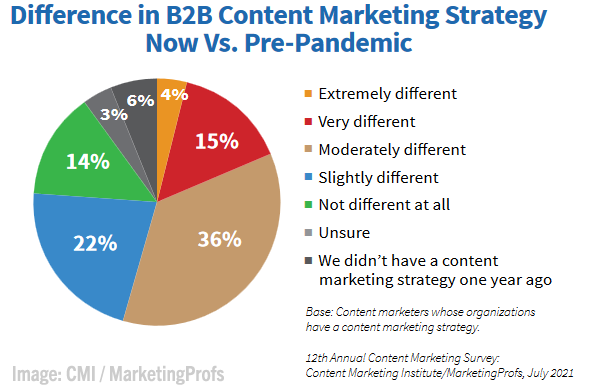
69 percent of B2B content marketers said that they view video as a top area of 2022 investment, while some 77 percent said that their B2B content marketing strategy was different now compared to how it was prior to the pandemic — two of numerous statistics of interest to B2B marketers contained in newly-released study data. Content Marketing Institute
ON THE LIGHTER SIDE:
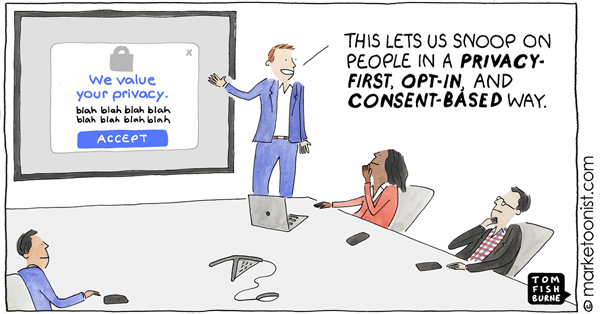
A lighthearted look at the “we value your privacy” by Marketoonist Tom Fishburne — Marketoonist
Earth’s Unicorn Population Is Exploding — Wired
TOPRANK MARKETING & CLIENTS IN THE NEWS:
- Lane R. Ellis — 10 Tips for Stretching Your Budget When Growing a Small Business — Small Business Trends
- TopRank Marketing — Leading Influencer Marketing Agencies for 2021 (Updated) — Influencer Marketing Hub
- Boomi — Boomi Positioned as a Leader in the 2021 Gartner Magic Quadrant for Enterprise iPaaS for the Eighth Year — Boomi (client)
Have you found your own favorite B2B marketing news item from the past week of industry news? Please drop us a line in the comments below.
Thank you for joining us for this week’s TopRank Marketing B2B marketing news, and we hope that you’ll return next Friday for more of the week’s most relevant B2B and digital marketing industry news. In the meantime, you can follow us on our LinkedIn page, or at @toprank on Twitter for even more timely daily news.
The post B2B Marketing News: B2B Tech Spending Rises, Twitter’s New Ad Features, Marketers See Diversity Progress, & New B2B Content Marketing Study appeared first on B2B Marketing Blog – TopRank®.

iPad mini 6 contro iPad 9: il più piccolo contro il più economico. La recensione

Podcast del Disinformatico RSI 2021/10/15: Uscire dai social senza perdite, sito Bittorrent ficcanaso, sondaggio sulle password, computer antibatterici

Il podcast del Disinformatico della Rete Tre della Radiotelevisione Svizzera ha un paio di novità: da oggi esce in leggero anticipo rispetto al passato, alle 9 del mattino del venerdì, e prossimamente (dal 5 novembre) sarà regolarmente in versione Story, ossia dedicata a un singolo argomento approfondito, come già fatto sperimentalmente quest’estate con ottimi risultati di ascolto. Se avete un argomento da proporre o una storia informatica che vorreste sentirmi raccontare, i commenti sono a vostra disposizione.
La puntata di oggi, condotta da me insieme ad Alessio Arigoni, copre i seguenti argomenti, con i link ai rispettivi articoli di approfondimento:
- Come uscire dai social network e salvare i propri dati
- Il sito che sa che cosa hai scaricato
- Sondaggio Bitdefender: un utente su due usa la stessa password ovunque
- Il personal computer antibatterico?
Il podcast di oggi, insieme a quelli delle puntate precedenti, è a vostra disposizione presso www.rsi.ch/ildisinformatico (link diretto) ed è ascoltabile anche tramite feed RSS, iTunes, Google Podcasts e Spotify.
Buon ascolto!

Il personal computer antibatterico?
In un mercato di computer superficialmente tutti uguali è difficile distinguersi, soprattutto agli occhi del consumatore medio. Acer ci prova con una trovata decisamente insolita: il PC antibatterico o antimicrobico.
L’annuncio del completamento di un’intera gamma di computer fissi, monitor laptop, tablet e ibridi laptop/tablet dotati di un trattamento antimicrobico a base di ioni d’argento è ovviamente molto accattivante in epoca di mascherine, gel disinfettante e pandemia, e Acer cita documentazioni e riferimenti ISO molto seri, ma The Register ha notato la precisazione in caratteri minuscoli in fondo alla pagina descrittiva della gamma antimicrobica Acer:

Disney+, film e serie da vedere a Halloween 2021