Microsoft’s Miri Rodriguez on How B2B Marketers Are Embracing Empathy For Better Customer Storytelling #B2BMX
How do B2B marketers who fully embrace empathy build stronger relationships?
Miri Rodriguez, storyteller and internship program head at Microsoft, recently presented the opening keynote at the 2021 B2B Marketing Exchange Experience virtual conference, and asked this important question.
Although this pandemic year at #B2BMX won’t see B2B marketers gathered in the event’s usual sunny Scottsdale, Arizona location, plenty of new attendee opportunities were on tap virtually.
Refresh, renew, remix has been the conference’s theme this year, and to help ease the lack of physical networking #B2BMX included a Spotify music playlist, live music performances, and even various charitable elements.
Miri began by looking back at the history of empathy in B2B marketing, to when empathy was new to the B2B space, especially the practice of considering it a leading component of the digital experience.
Storytelling Uses Empathy to Move Past Numbers and Facts
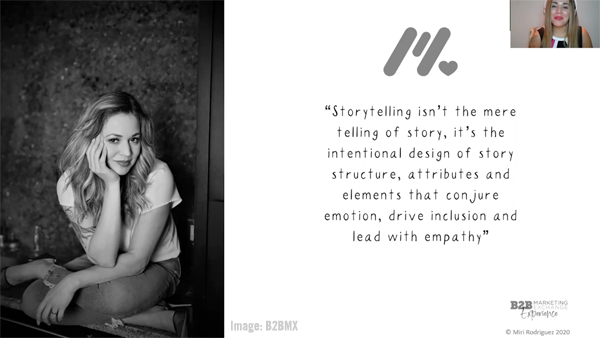
Storytelling is not just the telling of stories, Miri explained, it’s also a design approach to stories that work on the human-to-human level of business marketing.
Telling stories in such compelling and connected ways that your messages are then also easily and willingly transmitted to your audience’s customers is a goal of B2B marketing that infuses genuine empathy, Miri said, and then began exploring empathy’s important role in brand storytelling.
Miri explained how in her role at Microsoft she began an examination of empathy by looking at what storytelling is not, asking industry brand professionals at many different levels for their insight.
Storytelling isn’t so much information, data, facts, or numbers, but the emotional transfer of that information using memorable characters, plots, and conclusions which all foster empathy, she noted.
The emotional transaction is the glue that binds customers to a brand’s message, making them feel connected at the most human level, Miri explained, and mentioned LinkedIn’s January 2020 report which found that empathy was the platform’s top 2019 theme — one that offers strength to both brands and customers.
“Brands want to transact with people who are showing high levels of empathy,” Miri noted.
[bctt tweet=”“Brands want to transact with people who are showing high levels of empathy.” — Miri Rodriguez @MiriRod #B2BMX” username=”toprank”]Since the pandemic began, empathy has only increased in its importance for B2B brands, and increasingly employees want to work for brands that include high levels of empathy, she noted.
How can you begin leading with empathy?
Miri mentioned the oft-used Bill Gates “content is king” adage as a jumping off point for all that exists beyond content for today’s B2B marketers seeking to infuse greater empathy in their brand storytelling efforts.
One key is finding a universal truth, especially when it’s an actionable emotion that your brand lives by, and Miri suggested that these types of truths often derive from a brand’s mission statement.
What Feeling Is Your Brand Story Sparking?
During her #B2BMX opening keynote Miri also put out the question, “What feeling is my brand story seeking to spark?”
Sometimes examining or even rethinking a brand’s mission can help B2B marketers find these key feelings, she suggested.
In her example from Microsoft, Miri shared how the firm came up with empowerment as its new mission several years back — a feeling that CEO Satya Nadella and the organization have embraced in many ways since.
Miri then asked, “Is your brand leading with a feeling that they can share with their customers?”
She urged B2B marketers to make brand stories easy to consume, which in turn will make them convenient for customers to pass on to their own associates and customers.
Miri also explored cognitive empathy, and the importance of seeing your customer first and foremost as a human. She urged B2B marketers to always keep in mind that there is a human on the other side of the screen, the other side of every email, in a physical room, or wherever you communicate with a customer.
It’s important for B2B marketers to allow themselves to recognize the type of emotional empathy that reaches out and makes connections on a more human level, and Miri shared how marketers can benefit when they retrain their brain to think about your humans instead of your customers.
Having conversations that go beyond the mere facts about a product or service and its features, to instead form deeper and more empathetic connections, will build the kind of trust that makes business transaction elements more meaningful, Miri observed.
She also looked at the type of compassionate empathy that can begin when B2B marketers take the time to assess themselves introspectively, examining personal vulnerabilities.
Empathize by being cognizant of the experiences your customers are going through, and recognize that especially those in the GenZ and millennial demographics frequently make connections that are more on the emotional side with the brands they do business with, Miri noted, and explained that these younger customers also aren’t necessarily buying a product merely for the product alone.
Often they are looking at a brand’s mission before deciding to do business with them, and some will even refuse to work with a brand that defaults to having no public mission or stance on social and other important issues, she said.
Seeing The Humans Behind The Brand
Miri spoke about the importance of allowing B2B customers to see the humans behind the brand, and urged marketers to pay attention to who they’re delivering a B2B brand’s story to, being mindful of the fact that an audience isn’t just your customer in B2B, but also the audiences of those customers.
Miri then asked several key questions:
- Why should your end-user care about your story?
- What insight does your content include?
- Does it educate and otherwise help your customers, beyond simply helping with a particular feature of a product or service?
For every B2B marketing story you set out to tell, Miri recommends first asking yourself who the story is dedicated to, how it can help them, and how it will hopefully make them feel, especially when the story is tied in to one of your brand’s universal truths.
Showing the origin of your brand’s story is important, Miri said, as is reminding your customer why your brand is important to them.
An ideation phase includes finding the solutions your customers want in the formats they prefer, and Miri shared an example from Microsoft in which customers pointed out that they preferred blog content written not so much by marketers but by people directly involved a particular area of expertise.
Low-cost and low-effort story prototyping can also be a great way to test a variety of creative concepts, Miri noted, before moving on to the testing and implementation stages.
Making Genuine Audience Connections That Evoke Emotion
Are your brand storytelling efforts evoking the type of emotion you want to foster with your content? Miri explained that reach and engagement are both helpful in determining which efforts are making genuine connections with your audience.
Miri concluded her insightful and energetic #B2BMX keynote presentation by reinforcing the notion that genuine B2B brand stories always contain a character, plot, story, and conclusion, and that powerful storytelling only happens in the B2B space when marketers tell their stories for their audiences, and not to them — ideally with empathy, creativity, authenticity, and heart.
Empathy in B2B marketing is a topic near and dear to our team at TopRank Marketing, and to learn more about bringing it to life in your own marketing efforts, contact us, and check out the following five recent resources we’ve published:
- 5 Ways to Humanize Your B2B Content Marketing – And Why It Matters
- 28 B2B Marketing Insights To Energize & Humanize Your 2021
- Boosting and Deepening Engagement through Empathy in B2B Marketing
- 5 Ways to Humanize B2B Content Marketing
- Your Guide to Effective Storytelling in B2B Content Marketing
The post Microsoft’s Miri Rodriguez on How B2B Marketers Are Embracing Empathy For Better Customer Storytelling #B2BMX appeared first on B2B Marketing Blog – TopRank®.
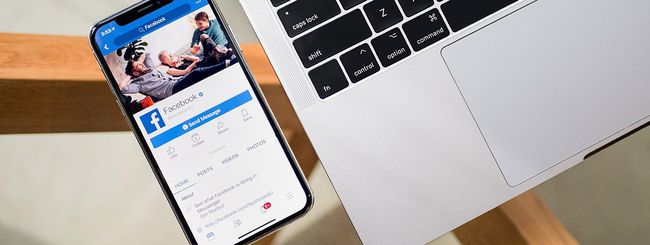
Facebook, nuovi tool per tutelare i bambini
Facebook afferma che sta testando diversi strumenti per impedire alle persone di condividere contenuti molesti con raffiguranti i bambini. Uno è un pop-up che dovrebbe apparire alle persone che utilizzano termini di ricerca collegati ai minori, e descriverà in dettaglio le conseguenze della visualizzazione di tali contenuti.
Una nuova opzione per i genitori di preadolescenti e adolescenti su YouTube
Esperienze supervisionate su YouTube
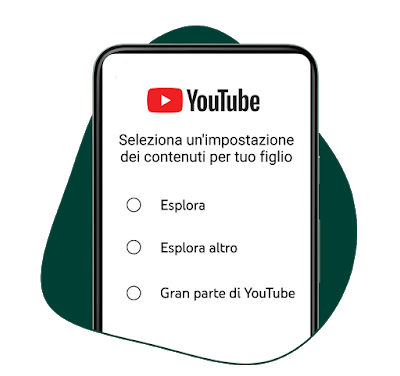
Per i genitori, diverse opzioni di contenuto su YouTube
- Esplora: pensata per i bambini che sono pronti ad abbandonare YouTube Kids ed esplorare contenuti su YouTube, questa impostazione prevede un’ampia gamma di video in genere adatti agli spettatori dai 9 anni in su, ad esempio vlog, tutorial, video di gaming, clip musicali, notizie, contenuti didattici e altro ancora.
- Esplora altro: con contenuti in genere adatti agli spettatori dai 13 anni in su, questa impostazione include un insieme più ampio di video, ma anche live streaming, nelle stesse categorie disponibili per “Esplora”.
- Gran parte di YouTube: questa impostazione comprende la quasi totalità di video su YouTube, ad eccezione di quelli con contenuti soggetti a limiti di età, e include argomenti sensibili che potrebbero essere adatti solamente a un pubblico di adolescenti più grandi.

Nuove funzionalità per le famiglie
L’investimento su YouTube Kids

Videoconferenze: semplicità e sicurezza con Barco ClickShare Conference
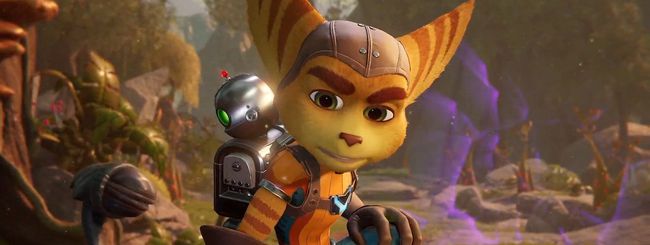
Ratchet & Clank per PS4 gratis: ecco da quando
Ratchet & Clank per PS4 potrà presto essere scaricato gratuitamente grazie alla rinnovata iniziativa Play At Home di Sony. Già la scorsa primavera, infatti, la società nipponica aveva offerto giochi a costo zero agli utenti, per intrattenerli durante la pandemia in corso. E dal momento che il coronavirus è ancora lì in agguato, l’azienda ha deciso di incoraggiare il distanziamento sociale regalando nuovi titoli tra marzo e giugno: dal 1 marzo 2021, quindi, i possessori di PS4 potranno effettuare il download gratuito di Ratchet & Clank, anche qualora non fossero abbonati al PlayStation Plus.
Storie di Scienza: le strane ali del signor Lanchester

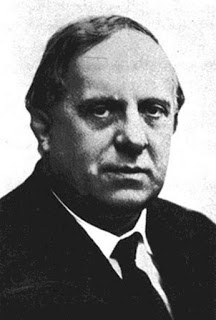
Il signor Frederick William Lanchester, quello nella foto qui accanto, vi fa risparmiare su ogni volo aereo che prendete e su ogni pacco spedito per posta aerea che ricevete. No, non è il proprietario segreto della Ryanair o di Amazon. Anche perché è morto, povero in canna, nel 1946. Frederick William Lanchester era un ingegnere britannico, classe 1868.
L’ingegner Lanchester era il tipo di persona che affrontava un problema quando il resto del mondo nemmeno sapeva dell’esistenza del problema. Nel 1897, a ventinove anni, stava già risolvendo i problemi dell’efficienza aerodinamica dei velivoli ancora prima dello storico, primo volo a motore dei fratelli Wright nel 1903.
Nel 1897, Frederick Lanchester concepì e brevettò le winglet. Avete presente quelle strane pinne triangolari alle estremità delle ali degli aerei moderni? Quelle. Sono dell’Ottocento. Il brevetto è il British Patent No. 3608, Improvements in and relating to Aerial Machines.
Lanchester aveva già intuito che l’incontro fra il flusso d’aria che passa sopra l’ala e quello che le passa sotto genera invisibili vortici di estremità, che creano resistenza. Aveva anche capito che un piano verticale collocato a queste estremità avrebbe ridotto i vortici e migliorato l’efficienza del velivolo: lo stesso principio per cui le auto da corsa hanno pareti verticali agli estremi degli alettoni.
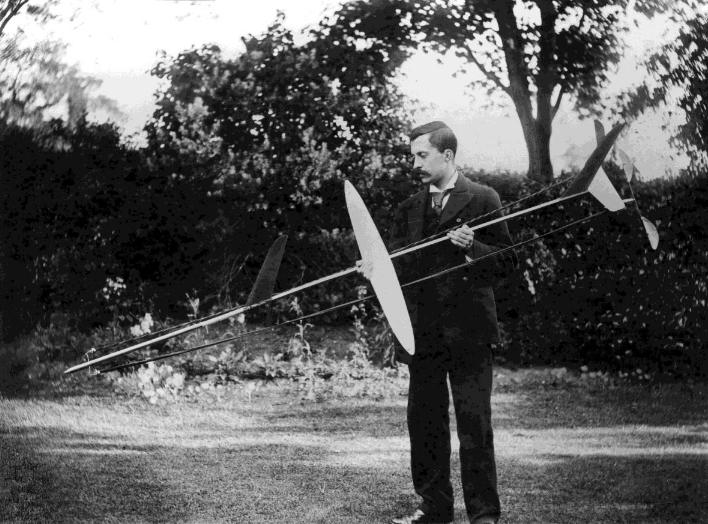
Questo è Lanchester nel 1894, alle prese con uno dei suoi eleganti modelli di aereo a eliche spingenti:
E questo è uno dei disegni del brevetto di Lanchester, in cui si vede l’ala troncata e dotata di un capping plane o piano terminale (dettaglio e di Figura 12):
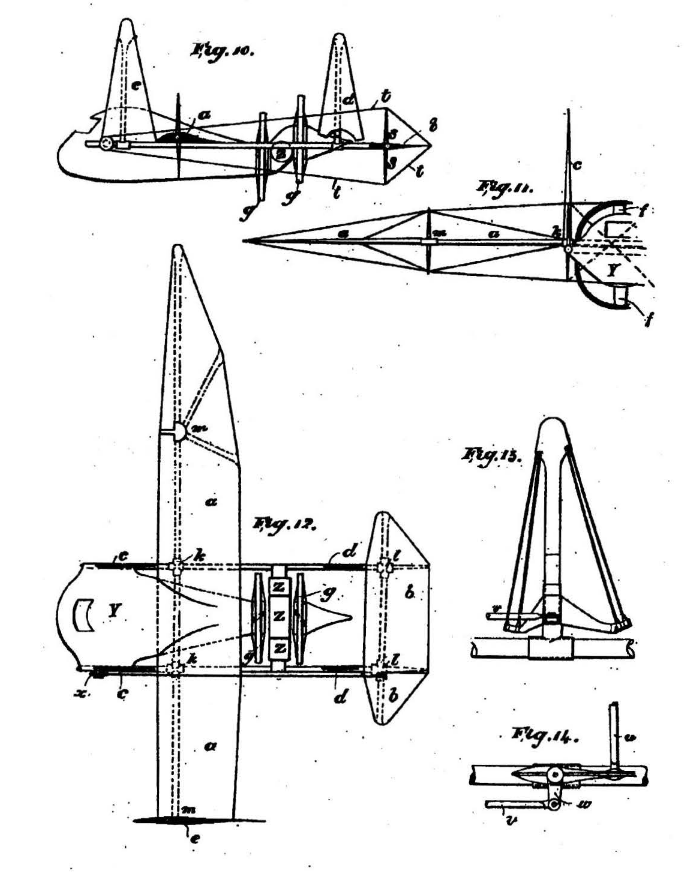
Nel suo brevetto, Lanchester parla specificamente di applicare questi piani terminali “allo scopo di minimizzare la dissipazione laterale dell’onda portante.”

Non è che Lanchester avesse già in mente eleganti Jumbo Jet per andare alle Maldive spendendo meno: a quell’epoca il velivolo da ottimizzare e brevettare era un aliante-bomba, da usare in guerra, una sorta di siluro dell’aria. Anzi, a fine Ottocento l’aviazione civile era ritenuta tecnicamente impossibile, visto che mancava un motore sufficientemente leggero. Fra l’altro, Lanchester propose anche di progettarne e costruirne uno, ma gli fu detto che nessuno lo avrebbe preso sul serio e così si dedicò a fabbricare automobili. I fratelli Wright non furono avvisati che quel motore era impossibile e lo costruirono, e il resto è storia.
Lanchester aveva anche definito i concetti fondamentali di portanza, stallo e resistenza aerodinamica, ma le riviste scientifiche britanniche dell’epoca snobbarono e respinsero i suoi scritti. Pochi anni più tardi arrivò la conferma scientifica delle sue intuizioni da parte del tedesco Ludwig Prandtl, padre della meccanica dei fluidi, ma l’apporto di Lanchester all’aviazione fu riconosciuto pubblicamente solo verso la fine della sua vita. Nel 1931 ricevette la Daniel Guggenheim Medal per il suo contributo alla teoria fondamentale dell’aerodinamica.
Frederick Lanchester morì senza un quattrino, fiaccato dal morbo di Parkinson e dalla perdita della vista, poco dopo la fine di una guerra mondiale nella quale i frutti delle sue idee “impossibili” avevano dominato i cieli e deciso le sorti di intere nazioni.
Le sue alette finirono sostanzialmente nel dimenticatoio per settant’anni: provò a riprenderle un altro pioniere tedesco, Sighard Hoerner, negli anni Cinquanta, ma le compagnie aeree erano in piena espansione, il carburante costava poco, si progettavano aerei di linea supersonici e a nessuno interessava risparmiare. Fino alla crisi petrolifera del 1973, che cambiò tutto.
Quell’improvviso ed enorme aumento dei prezzi del carburante spinse la NASA a investire urgentemente in ricerca aerodinamica. Uno dei suoi ingegneri aeronautici, Richard Whitcomb, rispolverò e migliorò le winglet di Lanchester, ispirandosi alle vele delle navi, non solo per risparmiare carburante ma anche per ridurre le pericolose turbolenze lasciate dal passaggio dei grandi aerei di linea.
Questo è un quadrigetto KC-135 dell’aviazione militare statunitense, prestato alla NASA e modificato nel 1979 per valutare gli effetti delle winglet.

Un dettaglio di una di queste winglet:

I risultati furono notevolissimi: oltre il 6% di autonomia in più, corse di decollo ridotte, pause più corte fra il decollo di un aereo e quello del successivo, minor rumore. Le alette furono adottate prontamente dai jet privati e poi dagli aerei di linea in numerose varianti e oggi sono onnipresenti. Questa, per esempio, è una winglet raccordata di un Airbus A350 (credit: Julian Herzog/Wikipedia):


Dietro quel piccolo dettaglio che scorgiamo dal finestrino del nostro volo vacanziero low-cost, insomma, c’è un secolo di storia, ci sono drammi di talenti incompresi e miopi ottusità, e c’è tanta scienza che merita di essere raccontata e ricordata. In particolare c’è tanta ricerca di base: quella che si fa senza sapere in anticipo a cosa serve e che nessuno vuole finanziare perché ritenuta “inutile”.
Credits: Wikipedia; NASA; Princeton.edu; F.W. Lanchester and the Great Divide; NASA; The Shadow of the Eagle. Una versione ridotta di questo articolo è comparsa su Le Scienze nel 2017. Questo articolo fa parte delle Storie di Scienza: una serie libera e gratuita, resa possibile dalle donazioni dei lettori. Se volete saperne di più, leggete qui. Se volete fare una donazione, potete cliccare sul pulsante qui sotto. Grazie!

Street Fighter V, iniziata l’ultima stagione
La quinta e ultima stagione di Street Fighter V è ufficialmente iniziata con l’uscita del nuovo personaggio, Dan Hibiki, e di una serie di contenuti gratuiti per tutti i giocatori di PlayStation 4 e Steam. Oltre infatti al “Maestro di Saikyo”, Capcom ha rilasciato una nuova meccanica di battaglia chiamata “V-Shift”, una nuova fase di addestramento e un bilanciamento di battaglia aggiornato per tutti i personaggi giocabili.

SpaceX diventa un laboratorio per le ricerche anti-Covid
SpaceX, la società aerospaziale fondata da Elon Musk, è diventata un laboratorio per le ricerche anti-Covid. I suoi oltre quattromila dipendenti, infatti, si sono messi a disposizione di un team di scienziati già a partire dall’aprile 2020, per eseguire degli esami del sangue mensili relativi a una ricerca sull’immunizzazione.
How anonymized data helps fight against disease
Data has always been a vital tool in understanding and fighting disease — from Florence Nightingale’s 1800s hand drawn illustrations that showed how poor sanitation contributed to preventable diseases to the first open source repository of datadeveloped in response to the 2014 Ebola crisis in West Africa. When the first cases of COVID-19 were reported in Wuhan, data again became one of the most critical tools to combat the pandemic.
A group of researchers, who documented the initial outbreak, quickly joined forces and started collecting data that could help epidemiologists around the world model the trajectory of the novel coronavirus outbreak. The researchers came from University of Oxford, Tsinghua University, Northeastern University and Boston Children’s Hospital, among others.
However, their initial workflow was not designed for the exponential rise in cases. The researchers turned to Google.org for help. As part of Google’s $100 million contribution to COVID relief, Google.org granted $1.25 million in funding and provided a team of 10 fulltime Google.org Fellows and 7 part-time Google volunteers to assist with the project.
Google volunteers worked with the researchers to create Global.health, a scalable and open-access platform that pulls together millions of anonymized COVID-19 cases from over 100 countries. This platform helps epidemiologists around the world model the trajectory of COVID-19, and track its variants and future infectious diseases.
The need for trusted and anonymized case data
When an outbreak occurs, timely access to organized, trustworthy and anonymized data is critical for public health leaders to inform early policy decisions, medical interventions, and allocations of resources — all of which can slow disease spread and save lives. The insights derived from “line-list” data (e.g. anonymized case level information), as opposed to aggregated data such as case counts, are essential for epidemiologists to perform more detailed statistical analyses and model the effectiveness of interventions.
Volunteers at the University of Oxford started manually curating this data, but it was spread over hundreds of websites, in dozens of formats, in multiple languages. The HealthMap team at Boston Children’s Hospital also identified early reports of COVID-19 through automated indexing of news sites and official sources. These two teams joined forces, shared the data, and published peer-reviewed findings to create a trusted resource for the global community.
Enter the Google.org Fellowship
To help the global community of researchers in this meaningful endeavour, Google.org decided to offer the support of 10 Google.org Fellows who spent 6 months working full-time onGlobal.health, in addition to $1.25M in grant funding. Working hand in hand with the University of Oxford and Boston Children’s Hospital, the Google.org team spoke to researchers and public health officials working on the frontline to understand real-life challenges they faced when finding and using high-quality trusted data — a tedious and manual process that often takes hours.
Upholding data privacy is key to the platform’s design. The anonymized data used at Global.health comes from open-access authoritative public health sources, and a panel of data experts rigorously checks it to make sure it meets strict anonymity requirements. The Google.org Fellows assisted the Global.health team to design the data ingestion flow to implement best practices for data verification and quality checks to make sure that no personal data made its way into the platform. (All line-list data added to the platform is stored and hosted in Boston Children’s Hospital’s secure data infrastructure, not Google’s.)
Looking to the future
With the support of Google.org and The Rockefeller Foundation, Global.health has grown into an international consortium of researchers at leading universities curating the most comprehensive line-list COVID-19 database in the world. It includes millions of anonymized records from trusted sources spanning over 100 countries.
Today, Global.health helps researchers across the globe access data in a matter of minutes and a series of clicks. The flexibility of the Global.health platform means that it can be adapted to any infectious disease data and local context as new outbreaks occur. Global.health lays a foundation for researchers and public health officials to access this data no matter their location, be it New York, São Paulo, Munich, Kyoto or Nairobi.

Server bare metal: cos’è, quali caratteristiche e come sceglierlo
Un server bare metal è un tipo di server dedicato che prevede l’affitto di una macchina fisica da un provider da parte di un utente, la quale non viene condivisa con altri soggetti. La principale differenza con i tradizionali servizi condivisi è che i bare metal permettono all’utente il completo controllo dell’infrastruttura, tanto da poter sceglierne anche il sistema operativo. Dunque, il bare metal server si propone come soluzione ideale per chi vuole evitare di…
L’articolo Server bare metal: cos’è, quali caratteristiche e come sceglierlo scritto da YOUR_DIGITAL_VOICE! proviene da Assodigitale.
Query cross-database in SQLite
GameSnacks brings HTML5 games to Google products
Last February we announced GameSnacks, a HTML5 gaming platform from Area 120, Google’s workshop for experimental products. We launched GameSnacks to test whether lightweight, casual games would resonate with people who use the internet via low memory devices on 2G and 3G networks, especially in countries like India and Indonesia.
Since then, millions of people from around the world have played our games. GameSnacks now has more than 100 games built by early game development partners. These games span multiple genres: classics (e.g. Chess), racing games (e.g. Retro Drift), puzzle games (e.g. Element Blocks), and hypercasual games (e.g. Cake Slice Ninja) to list a few. You can check out the full catalog by visiting gamesnacks.com.
Today, we’re sharing how we’ve broadened our efforts by bringing HTML5 games to Google products. We’re also inviting more game developers to join us as we grow the platform.
Finding HTML5 games to play is hard
When I mention HTML5 web gaming to friends and family, they fondly remember Flash gaming sites from 10 or 15 years ago. Web games have come a long way since then. Mobile browsers can now render rich graphics, and engines like Phaser, Construct and Cocos make it easier for developers to build HTML5 games.
HTML5 games tend to be small, enabling them to load quickly in a variety of network conditions, whether on 2G near the outskirts of New Delhi or on an intermittent connection on a New York City subway. Users can play them on any device with a web browser: Android, iOS, and desktop. And across these devices, users don’t need to install anything to play. They simply tap on a link and start playing games immediately.
However, the distribution landscape for HTML5 games is fragmented. Developers have to painstakingly modify their HTML5 games to work across each app they integrate with or web portal they upload to. Discovering HTML5 games to play is often difficult.
We’ve been thinking about how we can make HTML5 game developers’ lives easier to ultimately get more HTML5 games out to more users. Here’s a closer look at how we’re doing this.
A new way to discover HTML5 games across Google products
Back in February 2020, we announced our partnership with Gojek to bring HTML5 games to their users and give developers a new distribution opportunity. Since then, we’ve been bringing the GameSnacks catalog to users across a variety of different Google apps.
First, we’ve made it easy to access GameSnacks games directly from the New Tab page in Chrome, starting with users in India, Indonesia, Nigeria and Kenya. Users can get to gamesnacks.com via the Top Sites icon on Chrome on Android. The Games section is one of the most frequently visited sections of the page.
Your Android is now even safer — and 5 other new features
It wasn’t all that long ago that we introduced Android users to features like Emoji Kitchen and auto-narrated audiobooks. But we like to stay busy, so today we’re highlighting six of the latest Google updates that will make Android phones more secure and convenient — for everyone.
1. Keep your accounts safe with Password Checkup on Android
How one trailblazer uses Maps to explore the outdoors
Lydia Kluge is an active member of the Google Maps Local Guides community, the everyday people passionate about sharing their experiences on Maps. In 2020, she added more than 1,100 contributions on Google Maps in the form of reviews, photos, and places. Coincidentally, Lydia also hiked, ran, and biked 1,100 miles last year. All those adventures earned her the well-deserved Expert Trailblazer and Expert Fact Finder badges on Google Maps.
But Lydia’s journey has been full of adventures long before 2020. Originally from England, Lydia landed in Utah in 2005 for what was meant to be a six-month stint as a ski instructor. She’s been there ever since after falling in love with (and on) the slopes where she met her now-husband.
Over the past fifteen years, the couple traveled to over 30 countries. Along the way, Lydia used Google Maps to find hidden gems — from the best restaurants in Paris to snorkeling spots in Australia.
In 2019, Lydia and her husband welcomed their beautiful baby girl into their family and couldn’t wait to travel with her. But COVID-19 changed their international jet-setting plans. Like many of us, Lydia’s spending more time closer to home. She’s explored Utah’s mountains, deserts, and national and state parks. And, just like in her international travels, Google Maps has been her companion. She’s added and reviewed dozens of nature trails, trailheads, and parks, and created lists of family-friendly activities in Utah. “One thing I’ve missed about working outside of the home is how I can contribute to others and my community,” Lydia said. “Adding these things to Google Maps is a way I can give back.”
Here are Lydia’s tips on how to use Google Maps to explore natural attractions near you:
Find parks and hiking trails on Google Maps
Search outdoor terms like “hiking trails” or “parks near me” to find nearby treks. For most hiking trails, you’ll be able to find ratings, reviews and photos from other hikers. Some may also have useful details like open hours and phone numbers. You can also use the Lists feature on Google Maps to see curated recommendations, like Lydia’s Things to See and Do in St. George and Food and Fun in Park City. Simply search for a town and scroll down to see Featured Lists.
Our all-new TalkBack screen reader
To blind traveling bluesman Joshua Pearson, songwriting is more than just a good melody. “Songwriting gave me a language to talk about my frustrations. And by putting my music out there, I could hopefully let somebody else feel some of what I was feeling.” For Joshua, TalkBack is his main pen and paper for writing songs; it lets him dictate lyrics into his phone and hear them told back to him.
Screen readers, such as Android’s TalkBack, are the primary interface through which Joshua and many other people who are blind or low vision read, write, send emails, share social media, order delivery and even write music. TalkBack speaks the screen aloud, navigates through apps, and facilitates communication with braille, voice and keyboard input. And today we’re releasing an all-new version of TalkBack that includes some of the most highly requested features from the blind and low vision community.
Tap as you please with multi-finger gestures
We’ve added a dozen easy-to-learn and easy-to-use multi-finger gestures that are available with the latest version of TalkBack on Pixel and Samsung Galaxy devices from One UI 3 onwards. These gestures make it easier for you to interact with apps and let you perform common actions, such as selecting and editing text, controlling media and finding help.
We worked closely with people in the blind and low vision community to develop these easy-to-remember gestures and make sure they felt natural. For example, instead of navigating through multiple menus and announcements to start or stop your favorite podcast, it’s now as simple as double tapping the screen with two fingers.
Read or skim with just a swipe
Reading and listening is easier with new controls that help you find the most relevant information. For instance, you can swipe right or left with three fingers to hear only the headlines, listen word-by-word or even character-by-character. And then with a single swipe up or down you can navigate through the text.
Say what? There’s new Voice Commands
Starting with TalkBack 9.1, you can now swipe up and right to use TalkBack’s new voice commands. TalkBack will stop talking and await your instructions. With over 25 different commands, you can say “find” to locate text on the screen or “increase speech rate” to make TalkBack speak more quickly.
Do things your way with more customization and language options
While we put a lot of thought into this redesign, one thing we’ve learned from working with the community is that everyone interacts with their phones in their own way — which makes customization important. You can now add or remove options in the TalkBack menu or reading controls. Additionally, gestures can be assigned or reassigned to scores of settings, actions and navigation controls.
Lastly, we’re adding support for two new languages in TalkBack’s braille keyboard: Arabic and Spanish.
Joining forces for accessibility
The all-new TalkBack is the result of our collaboration with trusted testers and Samsung, who co-developed this release. TalkBack is now the default screen reader on all Samsung Galaxy devices from One UI 3 onwards, making it easier to enjoy a consistent and productive screen reader experience across even more devices.
To help everyone keep up with all the changes, we’ve created an entirely new tutorial to make it easier to make the most of TalkBack — there’s even a test pad to practice new gestures. With these new features and collaborations we hope that more people can find useful and creative ways to use TalkBack. Who knows, you might even find lyrical inspiration like Joshua.