
Spotify dedica uno spazio ai fan di Netflix con Netflix Hub

Microsoft Edge introduce una nuova funzionalità di sicurezza

Windows 11, torna il “vecchio” Clippy (ma come emoji)

MyLugano lancia la sua App 2.0 e si apre al mondo intero
L’innovativa app cittadina MyLugano – che ha raggiunto e superato il traguardo dei 10’000 download – da questo mese si apre al mondo intero grazie all’integrazione della MyLugano Pass (carta…
L’articolo MyLugano lancia la sua App 2.0 e si apre al mondo intero scritto da YOUR_DIGITAL_VOICE! proviene da Assodigitale.

Intel Core i9-12900K, prestazioni con Windows 11 e Windows 10 a confronto

Come funzionano i test COVID-19 in offerta su Amazon

PORTALE INPA: SIGLATO PROTOCOLLO D’INTESA CONFASSOCIAZIONI-FUNZIONE PUBBLICA
Siglato oggi il protocollo d’intesa con il Ministro Renato Brunetta per il Portale del Reclutamento inPA, l’innovativo punto di incontro tra domanda e offerta di lavoro previsto dal PNRR. All’incontro,…
L’articolo PORTALE INPA: SIGLATO PROTOCOLLO D’INTESA CONFASSOCIAZIONI-FUNZIONE PUBBLICA scritto da MercurPress proviene da Assodigitale.
Google e Apple, multa da 20 milioni di euro dall’Antitrust
B2B Marketing News: B2B Marketers Turn To Predictive, Twitter Adds New Analytics, & More Young Marketers Are Buying Via Smartphone
B2B Mobile Mania: Young Staffers Use Smartphones To Buy Business Products
53 percent of B2B buyers in the Gen Z demographic say they use their smartphones when researching and buying for business, and once a purchase has been made 50 percent see brand newsletters as very important — two of several insights of interest to digital marketers contained in recently-released survey data. MediaPost
The Behaviors and Attitudes of U.S. Adults on Twitter [Pew Study]
Some 69 percent of adult U.S. Twitter users say they utilize the platform to stay informed, with 45 percent looking to express their opinion, some of the findings contained in newly-released Pew Research Center study data examining Twitter usage. Pew Research
Twitter Launches Updated Tweet Analytics Card, Providing More Specific Performance Insight
Twitter has rolled out new tweet engagement metric data, including a variety of insights on profile visits, media views, new follower counts, link clicks and more, all featured in the social platform’s latest analytics update, Twitter recently announced. Social Media Today
The Marketing Trends of 2022 [The Ultimate Guide] [HubSpot Report]
Influencer marketing was the leading marketing specialty that marketers plan to invest in during 2022, with 46 percent of those already using influencers saying they plan to increase spending on influencer marketing next year, according to newly-released report data from HubSpot, also showing that 56 percent of marketers who invest in working with influencers work with micro-influencers who have less than 100,000 followers. HubSpot
The New Business Climate for Marketing Agencies in 2021
A majority of agency executives have said that 2021 has provided more new business opportunities than last year, and that business from existing clients has been the most effective way for generating business — two of several statistics of interest to online marketers contained in recently-released survey data. MarketingProfs
App Annie predicts TikTok to reach 1.5 billion active users in 2022
Gen Z mobile app users are expected to increase their financial involvement by 160 percent through the use of financial apps such as Coinbase and Robinhood, according to newly-released forecast data from app ranking firm Ann Annie, which also predicts that 2022 will see TikTok surpassing the 1.5 billion user mark. ZDNet
Instagram adds TikTok-like Text-to-Speech and Voice Effects tools to Reels
Facebook-owned Instagram has brought greater accessibility features to its Reels short-form vertical video format, with the roll-out of new text-to-speech and vocal effect tools, giving marketers additional options for reaching broader audiences with the format, Instagram recently announced. TechCrunch
Brands Say They’ve Recovered From The Pandemic, But Risks Persist, Experian Reports
74 percent of brands have incorporated artificial intelligence (AI) tools, a five percent jump from 2020, and 59 percent of organizations have mostly or completely weathered the pandemic storm, according to recently-released survey data of interest to digital marketers. MediaPost
Consumers Increase Their Video Use While Email Is Flat: Study
60 percent of consumers worldwide have said that they are utilizing more video chatting to communicate with businesses in 2021 than they did last year, while some 47 percent have increased their use of digital communication formats for engaging with organizations, according to newly-released survey data. MediaPost
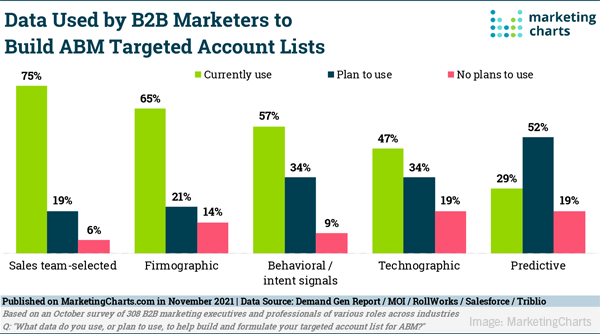
How Are B2B Marketers Going About Building ABM Target Account Lists?
When it comes to how B2B marketers plan to grow their account-based-marketing (ABM) account lists, a leading 52 percent said that predictive data will be tops, followed by technographic, behavioral, and intent-signal data, while sales team-selected and firmographic data top the list of types currently in-use, according to recently-released survey data. MarketingCharts
ON THE LIGHTER SIDE:
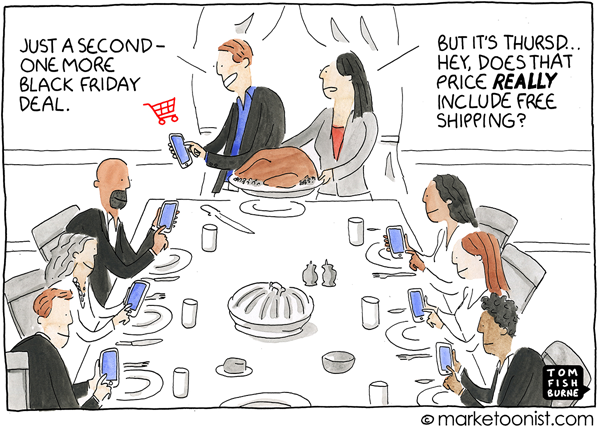
A lighthearted look at the “black friday & holiday shopping” by Marketoonist Tom Fishburne — Marketoonist
Instagram asks suspected bots to verify themselves with video selfies — The Verge
TOPRANK MARKETING & CLIENTS IN THE NEWS:
- Lee Odden — 5 Questions 4: Understanding influencer marketing and why it’s important for B2B companies with Lee Odden — Demandbase
- LEX Markets — A Harlem office building heads to an IPO — Crain’s New York
- Lee Odden — Membership Update Fall 2021 [Digital Marketing Institute] — Digital Marketing Institute
Have you recently found your own top B2B marketing news from the past week? Please drop us a line in the comments below.
Thanks for taking the time to join us for the week’s TopRank Marketing B2B marketing news, and we hope that you’ll return next Friday for more of the week’s most relevant B2B and digital marketing industry news. In the meantime, you can follow us on our LinkedIn page, or at @toprank on Twitter for even more timely daily news.
The post B2B Marketing News: B2B Marketers Turn To Predictive, Twitter Adds New Analytics, & More Young Marketers Are Buying Via Smartphone appeared first on B2B Marketing Blog – TopRank®.

DevSecOps: il futuro del DevOps. Meetup HDG il 29 novembre

An update on our Privacy Sandbox commitments
For further background on this topic, please see our blog from June.
Since we announced our Privacy Sandbox commitments earlier this year, we have continued to work with the UK’s Competition and Markets Authority (CMA) to address feedback that was raised as part of its public consultation process. We have also continued to update and seek feedback from the market and the UK Information Commissioner’s Office (ICO) on our proposals.
We are determined to ensure that the Privacy Sandbox is developed in a way that works for the entire ecosystem and, as part of this process, we have now offered revised commitments, which can be found in full on the CMA’s website.
These revisions underline our commitment to ensuring that the changes we make in Chrome will apply in the same way to Google’s ad tech products as to any third party, and that the Privacy Sandbox APIs will be designed, developed and implemented with regulatory oversight and input from the CMA and the ICO. We also support the objectives set out yesterday in the ICO’s Opinion on Data protection and privacy expectations for online advertising proposals, including the importance of supporting and developing privacy-safe advertising tools that protect people’s privacy and prevent covert tracking.
The revised commitments incorporate a number of changes including:
- Monitoring and reporting. We have offered to appoint an independent Monitoring Trustee who will have the access and technical expertise needed to ensure compliance.
- Testing and consultation. We have offered the CMA more extensive testing commitments, along with a more transparent process to take market feedback on the Privacy Sandbox proposals.
- Further clarity on our use of data. We are underscoring our commitment not to use Google first-party personal data to track users for targeting and measurement of ads shown on non-Google websites. Our commitments would also restrict the use of Chrome browsing history and Analytics data to do this on Google or non-Google websites.
If the CMA accepts these commitments, we will apply them globally.
We continue to appreciate the thoughtful approach and engagement from the CMA and ICO as we develop our Privacy Sandbox proposals. We welcome, and will carefully consider, any comments that people provide during the consultation process.

Podcast RSI – Perché devo sempre dimostrare che non sono un robot? Breve storia dei Captcha
Perché è necessaria questa dichiarazione, e come mai così tanti siti sono così tanto interessati agli autobus e invece discriminano le eventuali forme di vita artificiali che sono online?
Questa è la storia dei captcha: uno dei tormenti moderni ma non troppo di Internet.
[SIGLA]
Nella preistoria di Internet, negli anni Novanta del secolo scorso per intenderci, quando Google non esisteva ancora (sì, è esistita un’epoca in cui Google non c’era), il motore di ricerca più popolare era un altro:
La soluzione sembrava semplice ed elegante e le fu presto però associato un nome molto meno elegante:
L’utente doveva scriverle entrambe: la prima doveva essere trascritta correttamente e serviva a dimostrare che l’utente era davvero un essere umano, mentre la seconda, quella sconosciuta, andava semplicemente tentata. Se tanti utenti davano la stessa risposta alla stessa parola, quella risposta diventava parte del testo digitalizzato del libro o giornale d’epoca. In altre parole, gli utenti contribuivano, parola dopo parola, a digitalizzare tantissimi testi cartacei.
La cosa piacque così tanto che Recaptcha fu comprato da Google e i captcha in generale furono usati per impedire la creazione massiccia e abusiva di account di mail usa e getta da parte dei venditori di spazzatura digitale.
Ma questi spammer non si arresero. Negli anni che erano passati da quei primi, semplici captcha, la tecnologia del riconoscimento delle immagini aveva fatto enormi progressi, soprattutto nel riconoscimento dei testi, per cui cominciarono a usare computer sempre più potenti per decifrare le parole distorte e scavalcare il filtro antispam.
Questo, però, era un metodo costoso, per cui gli spammer ne inventarono presto un altro molto meno tecnologico: subappaltarono il riconoscimento a degli esseri umani che vivevano in paesi a basso reddito. Migliaia di persone venivano pagate una miseria per risolvere un captcha dopo l’altro, per ore di fila. Nacquero addirittura aziende specializzate nella risoluzione dei captcha. Alcune di loro esistono ancora oggi.
Però questi lavoratori, autentici schiavi digitali, andavano comunque pagati, e in un mercato come quello dello spam, dove i margini sono bassissimi, il costo di quella paga era un problema.
Così gli spammer hanno inventato di recente un’altra soluzione: far risolvere i captcha agli utenti normali, senza che se ne rendano conto. Per esempio, basta creare un sito che contiene qualcosa che gli utenti desiderano (immagini, video, musica, film) e chiedere loro di risolvere un captcha prima di poterlo consultare. Il captcha, in realtà, viene preso di peso istantaneamente da un altro sito, quello nel quale gli spammer vogliono entrare superandone il filtro.
È a questo punto che Google ha risposto con la casella che oggi tutti conosciamo, quella che chiede di confermare che non siamo dei robot. Un solo clic su una sola casella, e il captcha è risolto.
[CLIP: Clic di un mouse]
Sembra una cosa troppo facile, che persino un programma automatico sarebbe in grado di fare, ma c’è il trucco. In realtà dietro le quinte questo captcha trasmette moltissimi dati a Google, che permettono all’azienda di discriminare fra una cliccata fatta da un programma automatico e una fatta da un essere umano.
Quali siano questi dati non si sa. Google non vuole rivelarli per non dare aiuti agli spammer. Forse rileva i tempi di reazione o i movimenti del mouse o del dito; forse legge i cookie che Google deposita sui nostri dispositivi, visto che quando si prova a risolvere uno di questi captcha durante la navigazione privata compare puntualmente un secondo test, quello con la griglia di immagini di autobus, gattini o barche da identificare. Immagini che forse servono ad addestrare le future auto a guida autonoma, vista la loro particolare predilezione per le scene stradali complesse.
Esiste anche una versione ulteriore di questo captcha, che ha debuttato alcuni anni fa, nel 2017, ed è ancora più sofisticata: infatti è completamente invisibile. In questo captcha, Google si limita a osservare il comportamento dell’utente, come muove il mouse o il dito, come fa scorrere lo schermo, come digita le informazioni, e poi usa sofisticati sistemi di intelligenza artificiale per decidere se si tratta di un essere umano o di un sistema automatico. Anche qui, bocche cucite: i dettagli del suo funzionamento non sono pubblici.
La rincorsa fra guardie e ladri continua: avrete notato che oggi alcune banche cominciano a chiedere di identificarsi apparendo in video in tempo reale, mostrando il proprio documento d’identità oltre che il proprio volto, e questo sembra un sistema molto difficile da eludere. Neppure i deepfake riescono a falsificare un video in tempo reale.
Resta il problema di tutti coloro che hanno disabilità e quindi sono tagliati fuori da questi sistemi. Non ci vuole molto: anch’io spesso vengo ingannato dai captcha. E resta anche il problema dell’invasività sempre maggiore di questi metodi per distinguere un umano da un robot. Per non parlare della frustrazione e dell’umiliazione di non riuscire a superare un test che dovrebbe, in teoria, essere alla portata di qualunque persona cosiddetta “normale”.
Dove finirà questa rincorsa è difficile da dire. I sistemi di certificazione dell’identità digitale, come l’EIDAS dell’Unione Europea o SwissID, sono una possibile soluzione, ma non sono universali e spesso incontrano resistenze da parte di chi li considera eccessivamente a rischio per la privacy, la sorveglianza governativa e lo sfruttamento commerciale dei dati degli utenti. E in molti paesi semplicemente non esistono o hanno costi e complicazioni che li rendono inavvicinabili per una fetta importante della popolazione.
Nessun vuole Internet divisa in due categorie: cittadini e internauti di serie A e di serie B. E forse dovremo tornare a chiedere di cliccare più spesso su tanti gattini.
Fonti aggiuntive: Tom Scott; Google; Digital.

I prodotti Arlo in offerta fino al 50%: tutti gli sconti

Windows, allarme rosso: scoperta grave vulnerabilità zero-day
New EU political ads law is a step in the right direction
Having access to the right information matters. During a democratic election, it matters more than ever. High-quality information helps people make informed decisions when voting and counteracts abuse by bad actors. Through programs like security training for campaigns, information about polling places and transparency for political ads, Google is committed to helping support the integrity of democratic processes around the world.
Political advertising is an important component of democratic elections — candidates use ads to raise awareness, share information and engage potential voters. Over the last few years, Google has proactively increased transparency around election advertising: we updated our ads policies to require election advertisers to verify their identities and show who’s paying for an ad. We also introduced transparency reporting for online election ads in Europe as well as in the US and other countries around the world, providing a range of data that goes well beyond what’s typically available for TV, radio or print ads.
We have also made real changes to how election advertising works. In 2020, we implemented industry-leading restrictions to limit election ads’ audience targeting to age, gender and general location (at the postal code level), similar to categories candidates would use in deciding where to run ads on TV shows or in print. That same year, we started rolling out identity verification and disclosures for all advertisers, providing even wider transparency about ad sponsors. These improvements, and more, are part of a larger focus on political advertising that helped us navigate elections in the European Union, the United States, India (the largest democratic election in history) and other leading countries.
Google was one of the original signatories of the EU Code of Practice on Disinformation, which has led to constructive actions and change between the industry, policymakers and the expert community on the challenges of addressing disinformation. The Code laid out a model for voluntary action, facilitating work with policymakers on new transparency reporting on political advertising and helping users, governments and academics better understand how online election ads work.
We share the Commission’s goal of increasing the harmonization of Europe’s transparency rules for political advertising and we support today’s introduction of legislation. As we expand our own efforts, we look forward to engaging with the Commission on how best to meet the goals laid out by the Democracy Action Plan and Digital Services Act. This is a complex field, requiring a balance between minimizing misinformation while protecting legitimate political expression. The Commission’s proposal is an important and welcome step and as the European Council and Parliament review it, we offer a few observations based on our experiences over recent election cycles.
- Clear definitions for ‘political’ ads: It’s critical that the law clarifies which actors and what types of content are subject to the obligations regarding political advertising, giving clear examples of what would or would not be in scope. Without clear definitions, different companies will adopt inconsistent and conflicting policies, making for confusion for advertisers and undermining transparency for citizens. The current text could also inadvertently impact a wider range of ads than intended — for example, sweeping in ads from NGOs on issues of public concern or from private citizens speaking out about social questions.
- Clear responsibilities for platforms and advertisers: Protecting elections is a shared responsibility and we all need to play our part to be more transparent. Advertisers are in the best position to validate their identity and best understand the nature and context of their ads. They play a critical role in providing accurate information and (as they do with other media like television) ensuring that their content complies with applicable laws. Advertiser “self-declaration” — whereby political advertisers verify their identities and declare when they are running political ads — would have advertisers due their share to contribute to transparency, making the law work better in practice.
- Flexibility and dialogue: This is a dynamic and fast moving environment and we have seen a lot of changes to both political ads and governing regulations. Continuing discussions with stakeholders will help regulation react to changing contexts or emerging trends that might affect definitions, regulatory provisions or enforcement.
Elections are a fundamental part of democracy, and new regulations can help keep elections open, transparent and accountable. Legal certainty in those regulations will help candidates, campaigns, advertisers, publishers and platforms understand the precise scope of covered advertising and the specific obligations of each actor. In the coming months we look forward to sharing our experiences with the different institutions and bodies working to advance these important topics.