
Il Palazzo del Quirinale come non lo avete mai visto su Google Arts & Culture

Le offerte di Natale 2021, GoPro sconta HERO10 Black

Prime Video, le migliori 5 nuove serie TV del 2021

Podcast RSI – Panico da Log4shell, aggiornamenti Apple anche per Android, matrimonio nel metaverso, simulatore di superoccupazione

È disponibile subito il podcast di oggi de Il Disinformatico della Radiotelevisione Svizzera, scritto e condotto dal sottoscritto: lo trovate presso www.rsi.ch/ildisinformatico (link diretto) e qui sotto.
I podcast del Disinformatico sono ascoltabili anche tramite feed RSS, iTunes, Google Podcasts e Spotify.
Buon ascolto, e se vi interessano il testo e i link alle fonti della storia di oggi, sono qui sotto.
- Panico da Log4Shell: cosa c’è da sapere e da fare
- Aggiornamenti Apple per tutti i dispositivi: non solo funzioni nuove, ma anche molti rattoppi. Anche per Android
- Matrimoni nel Metaverso? Per Facebook si fanno senza niente dalla vita in giù
- Se vi serve una notifica per tirarvi fuori da una riunione o una conversazione: Busy Simulator

Samsung presenta il nuovo Galaxy Tab A8

Fervore festivo, il Natale secondo Call of Duty

Instagram lancia funzione per replicare ai commenti nei Reels
This engineer creates community for Indigenous Googlers
Welcome to the latest edition of “My Path to Google,” where we talk to Googlers, interns and alumni about how they got to Google, what their roles are like and even some tips on how to prepare for interviews.
Today’s post is all about Tamina Pitt, a Google Maps Software Engineer from our Sydney office and a founding member of the Google Aboriginal and Indigenous Network chapter in Australia.
What do you work on at Google?
As a Software Engineer for the Directions Platform team, I build the directions experience on Google Maps. I code for anyone who needs help finding their way. I love working on a feature that benefits so many people every day.
I’m a Wuthathi and Meriam woman, meaning that my ancestors are Aboriginal from Far North Queensland and the Torres Strait Islands in Australia. I was born and grew up on the ancestral lands of the Gadigal and Bidjigal people in Sydney, where I still live today. When I came to Google, I wanted to create a community for Indigenous Googlers like me to come together and build a sense of belonging at work. So I co-founded the Australian chapter of the Google Aboriginal and Indigenous Network (GAIN), an Employee Resource Group (ERG) for Googlers from, or passionate about, Indigenous and Aboriginal people. I also contribute to the Reconciliation Action Plan (RAP), Google’s commitment to empower and create equitable opportunities for Aboriginal and Torres Strait Islander people. As part of this work, I run events featuring Aboriginal and Torres Strait Islander speakers to help Googlers learn more about Indigenous culture.
Why did you apply to Google?
I first applied to Google when I was a student at the University of New South Wales in Sydney. I was in my second year and still unsure about my future in engineering. I hadn’t been applying for internships because I didn’t think I was good enough, but my parents pushed me to apply for one at Google — and it turned out to be one of the best decisions I ever made.
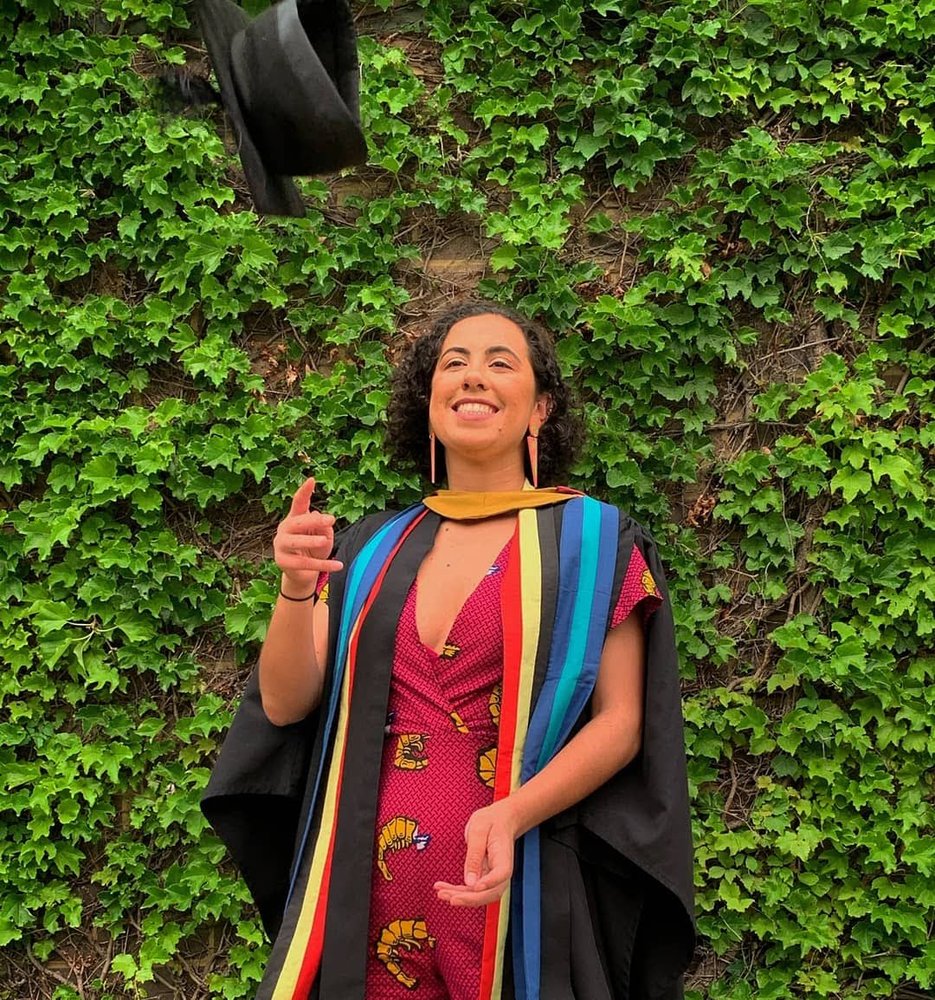
Tamina at her University of New South Wales graduation, wearing sashes representing the colors of the Aboriginal and Torres Strait Islander flags.
Describe your path to your current role.
I studied electrical engineering for a year or so, where I took a computing course that I really enjoyed. I eventually transferred to study computer engineering and discovered that I was interested in the software side.
Interning at Google helped me officially try software engineering out for size. My confidence grew once I got some hands-on experience — and now, I’ve been working at Google for two years as a full-time software engineer.
What inspires you to come in (or log in) every day?
I’m inspired by my community of Indigenous people in and outside of work, including the Indigenous activists and Elders who fought and continue to fight for our rights to be recognized. I’m also inspired by the growing interest I see in young Indigenous people and women to work in science, technology, engineering and mathematics (STEM). It makes me really excited for the future.
I really enjoy working on Google Maps, too. Every time I meet a new person, they share their love of Google Maps or send me feature requests. I like knowing that the product I work on is useful for so many people and that I’m part of the team that can make it even better.
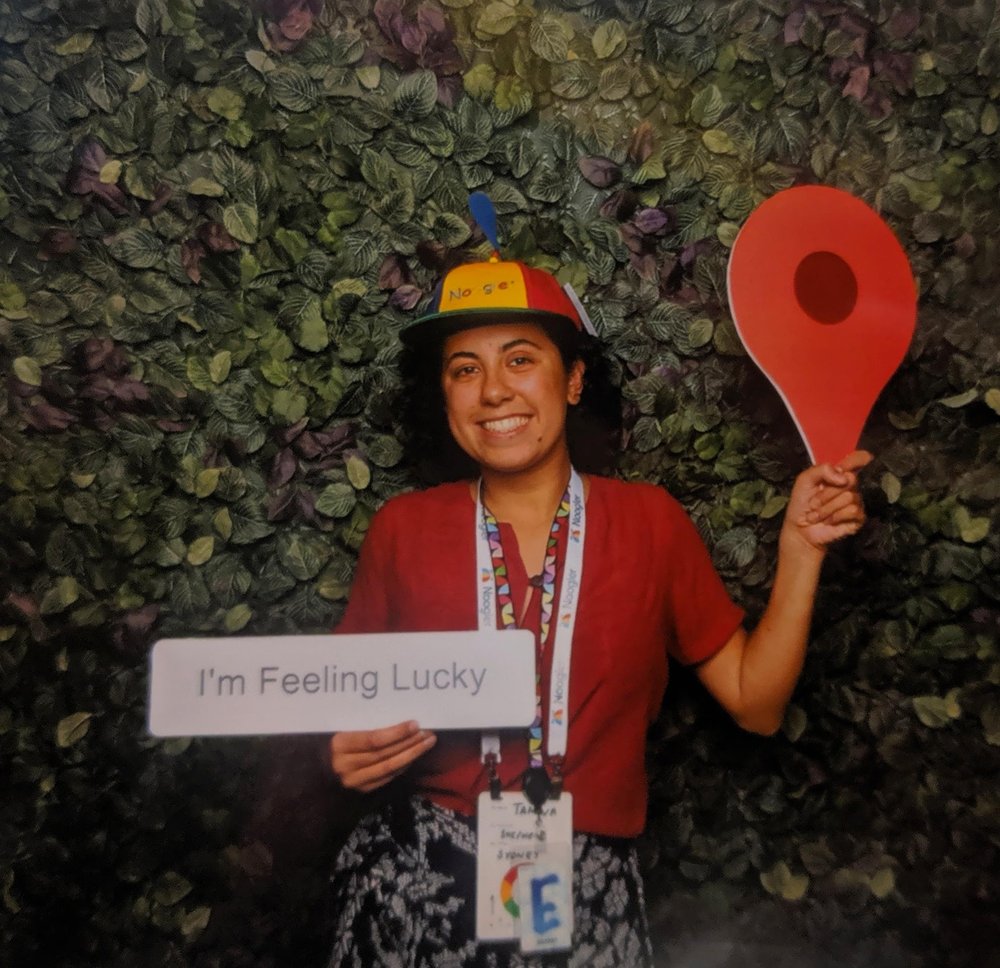
Tamina at her Google orientation in Singapore.
What was your interview experience like?
I was very nervous for each interview, because I felt like I didn’t have enough coding experience. I was surprised by how friendly the interviewers were and even found myself having fun. As a new graduate, I was relieved that they didn’t expect me to perform at the same level as someone who’s been working for many years.
What advice would you share with your past self?
When I was a student, I didn’t feel like I belonged — I was one of few women and the only Indigenous person in my class. Today, I know that so many people feel the same way. I would tell my past self to stay strong in my identity and feel proud of my achievements. I feel so supported by my community and I want to help other women, Indigenous people and anyone historically underrepresented in tech see their potential in this field.

Highlights from Women’s Online Safety Week 2021
In 2020, Google community manager Merve Isler, who lives in Turkey and leads Women Techmakers efforts in Turkey, Central Asia and the Caucasus region, organized the first-ever Women’s Online Safety Hackathon.
“It was the first online safety digital hackathon in the world and was a pilot for everyone,” she says. “We tried it, and it worked well, so we planned a second one, a new version that would be even more inclusive.”
Isler and Women Techmakers ambassadors in Turkey met online almost every day for two months to plan the event.
“I met with UN Turkish activist Zeynep Dilruba Tasdemir right before starting the program planning, and she inspired me to connect the WTM ambassadors with the United Nations Populations Fund (UNFPA),” says Isler.
That led to partnerships with three major nonprofit organizations: the Habitat Association, TurkishWIN and UNFPA Turkey, which provided speakers for the event, mentors for the ideathon and social media marketing support. UNFPA’s youngest ambassador, 19-year-old Selin Özünaldım, spoke at the event.
Twenty-three teams competed in the ideathon, including the jury special award winners, two 12-year-old students. “They were so passionate about solving this important issue,” says Isler.
One project to emerge from the ideathon was BlueX, which uses a text blocker integrated into browsers and social media to read incoming messages, detect harassing or violent language, and block the message.
The event also expanded to an entire week: Women’s Online Safety Week 2021 spanned 10 sessions, held online in Turkish. Attendees had the opportunity to participate in four webinars, two keynotes, four trainings and one ideathon, a hackathon in which teams of women created technical solutions to the problem of violence against women online. More than 2,000 people viewed the online webinars, taught by online security experts from organizations that conduct research on digital security. Facilitators from #IamRemarkable, a Google initiative that empowers women and other underrepresented groups to celebrate their success at work and beyond, also facilitated virtual workshops.
Amid the keynotes and tech talk, Isler says the event also served as a supportive place to share experiences of online harassment and abuse.
“We feel empowered to support each other, and if we see online violence, doxxing, stalking, we should speak up,” she says.
As a champion of developer communities in her professional role, Isler encourages others to find a community that feels like the right place for them.
“At the end of the event, I was doing a final speech, and I said that joining communities to share your experiences is critical, to highlight the issue and get support from each other,” she says. “Joining a community is for career development — and also to feel safe and thrive in technology.”
5 tips to finish your holiday shopping with Chrome
We’re coming down to the wire with holiday shopping, and many of us are frantically searching online for last-minute stocking stuffers. Luckily, a few new features are coming to Chrome that will make these final rounds of shopping easier — helping you keep track of what you want to buy and finally hit “order.”
Here are five ways to use Chrome for a stress-free shopping experience.
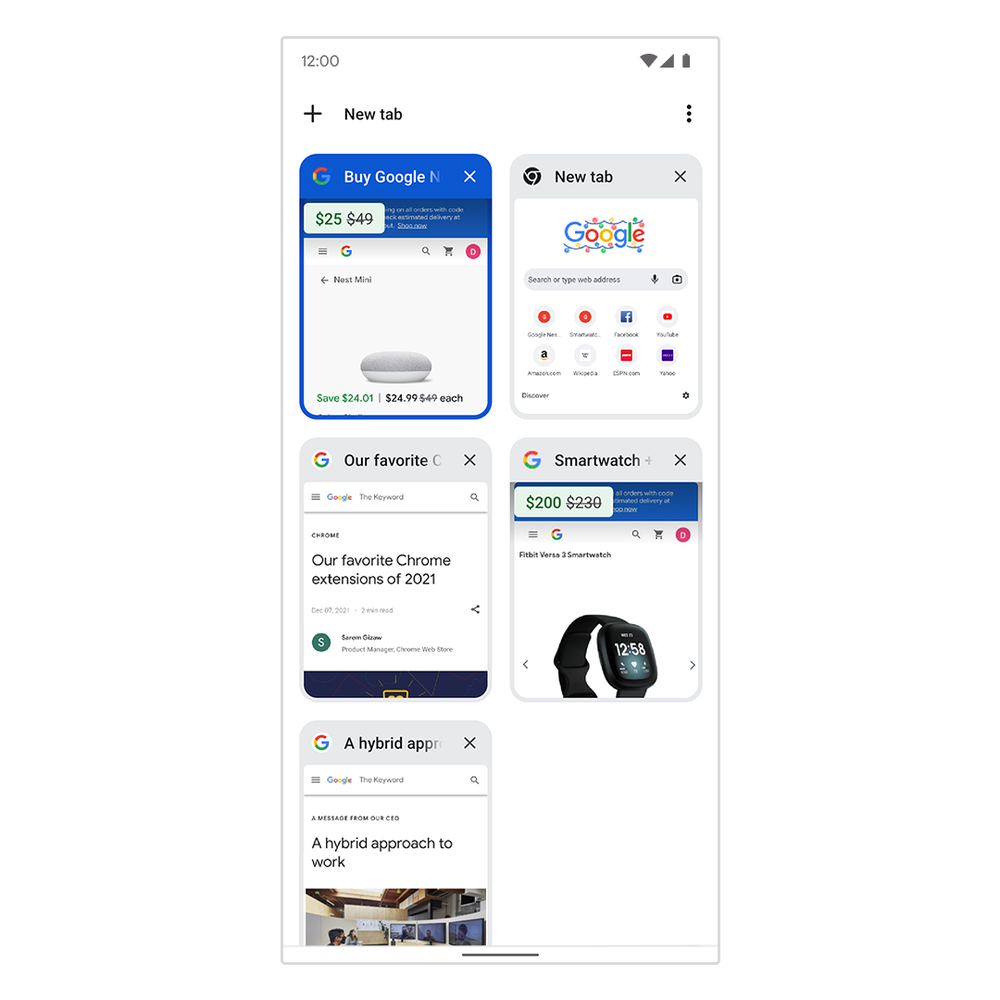
1. Keep track of price drops: Are you waiting for a good deal on that pair of headphones, but don’t have time to constantly refresh the page? A new mobile feature, available this week on Chrome for Android in the U.S., will show an item’s updated price right in your open tabs grid so you can easily see if and when the price has dropped. This same feature will launch on iOS in the coming weeks.
2. Search with a snapshot from the address bar: If something catches your eye while you’re out window shopping, you can now search your surroundings with Google Lens in Chrome for Android. From the address bar, tap the Lens icon and start searching with your camera.
Coming soon, you’ll also be able to use Lens while you’re browsing in Chrome on your desktop. If you come across a product in an image and want to find out what it is, just right-click and select the “Search images with Google Lens” option.
3. Rediscover what’s in your shopping cart: You know you have items in your shopping cart, but you can’t remember where exactly. No need to search all over again. Starting with Chrome on Windows and Mac in the U.S., you can now open up a new tab and scroll to the “Your carts” card to quickly see any site where you’ve added items to a shopping cart. Some retailers, like Zazzle, iHerb, Electronic Express and Homesquare, might even offer a discount when you come back to check out.
4. Get passwords off your plate: Don’t worry about setting up and remembering your account details for your favorite shopping sites. Chrome can help create unique, secure passwords and save your login details for future visits.
5. Simplify the checkout process: By saving your address and payment information with Autofill, Chrome can automatically fill out your billing and shipping details. And when you enter info into a new form, Chrome will ask if you’d like to save it.

Apple AirPods 2, AirPods 3 e AirPods Pro a confronto! Quale scegliere?

Illumina la casa con gli sconti di Natale Govee

Call of Duty: Warzone, disponibile il driver Anti-Cheat

Vodafone mette all’asta come NFT il primo SMS della storia
10 startups strengthening New York City’s comeback
For a city that never sleeps, New York City became eerily quiet when the COVID-19 pandemic hit last year. The city’s unemployment rate jumped from 3.8% to 20% between April and May 2020, leaving more than 570,000 New Yorkers without work. While the unemployment rate has decreased since the pandemic’s peak, at approximately 9.4% it is still nearly three times higher than pre-COVID 19 and nearly twice the national average. Further, employment cuts and new hiring have not been evenly felt across industries; while the tech industry boomed throughout the pandemic, the lights on Broadway remained dark for months and small businesses across the city continued to struggle to stay afloat. New York City needed help.
In the spring of 2021, as New York City was just beginning to vaccinate large segments of its population, Google for Startups, Tech:NYC and my team at Cornell Tech discussed ways to help the city’s economy bounce back. How could we bring our tools to the industries that were struggling the most?
Together, we launched the NYC Recovery Challenge, a new program designed to showcase how we can use tech to help support job creation for New York’s small business and job seeker community. Laser-focused on job creation and retention in New York City, only startups from across the five boroughs were eligible, with a preference for companies building solutions for industries and New Yorkers hit hard by the pandemic. We formed a community advisory committee from across the city to help evaluate the finalists.
More than 170 New York-based startups applied for the NYC Recovery Challenge. Please join me in congratulating the ten companies selected to be NYC Recovery Challenge Fellows:
- Kobina Ansah, Coverr (Queens)
- Byran Dai & Rahul Mahida,Daivergent (Manhattan)
- Su Sanni & Chris Coles,Dollaride (Brooklyn)
- Kelly Ifill, Guava (Manhattan)
- Karen Schoellkopf,Leap Fund (Brooklyn)
- Jason Greenwald & Daniel Langus,Live XYZ (Brooklyn)
- Amina Yamusah,Sector (The Bronx)
- Tracey Hobbs, Shifterr (Brooklyn)
- Tomas Uribe & Kristian Diaz,Stereotheque (Manhattan)
- Tanvir Islam, David Jiang and Bassit Malam, TYCA tech. (Brooklyn)
In addition to mentorship and one-on-one support, the top three finalists also receive up to $100,000 in no-strings-attached funding to accelerate their business. Manhattan-based first-prize winner, Guava, is a banking hub for Black small business owners that connects founders to equitable financial products and a digital community. Runners-up include Long Island City-based startup Coverr, a financial services tool for independent contractors, and Brooklyn-based Shifterr, a digital marketplace connecting hospitality industry employers to independent shift workers seeking gigs.
In addition to the three cash prize winners, the other seven companies selected reflect the distinct opportunities digital technology provides to better connect workers, employers and communities across the city. These startups range from companies that focus on supporting workers with autism and a mobility company dedicated to eliminating transit deserts, to an AI-powered online community marketplace connecting people to bodegas and novel solutions to identify, bridge and ease access to social services and government resources.
All 10 fellows’ companies use digital technology to strengthen a diverse range of formal and informal networks in the city. Strong, dense and diverse networks are the foundation of urban living, constantly fueling creativity, invention and innovation. It’s inspiring to see founders using the power of technology, the strength of our networks and the resiliency of our communities to supercharge New York City’s continued recovery.