
Black Friday, Sconti su Pendrive e SSD SanDisk

Amazon, comincia ora la Settimana del Black Friday
5 smartphone economici in offerta per il Black Friday di Amazon

I migliori hard disk esterni di Western Digital in offerta per il Black Friday
Community and mentorship help women entrepreneurs thrive
EngageRocket co-founder Dorothy Yiu and her husband were eagerly expecting the arrival of their first baby. But as Dorothy was preparing to start her maternity leave, she found herself battling feelings of guilt. She was hesitant to step away from her work responsibilities, her team and the company that she had been pouring her heart into.
EngageRocket — a Singaporean company that helps companies improve their employees’ experiences at work — recently celebrated its fifth anniversary. Dorothy, now pregnant with her second child, says those years have been a time of growth and self discovery for her. Not only has she learned to focus on important things and get rid of her self-inflicted feelings of inadequacy, she has also come to realize how important it is to initiate open conversations about the stigma, insecurity and imposter syndrome so many working women are struggling to overcome.
Today, on Women’s Entrepreneurship Day, stories like Dorothy’s are important reminders that there is still much more work to be done to empower women and girls so they can become confident entrepreneurs and equal participants in business. Promoting diversity and equal opportunities isn’t just the right thing to do – it also has a positive financial impact. Women Will research by Grow with Google notes that closing the entrepreneurial gender gap could boost the global economy by up to $5 trillion.
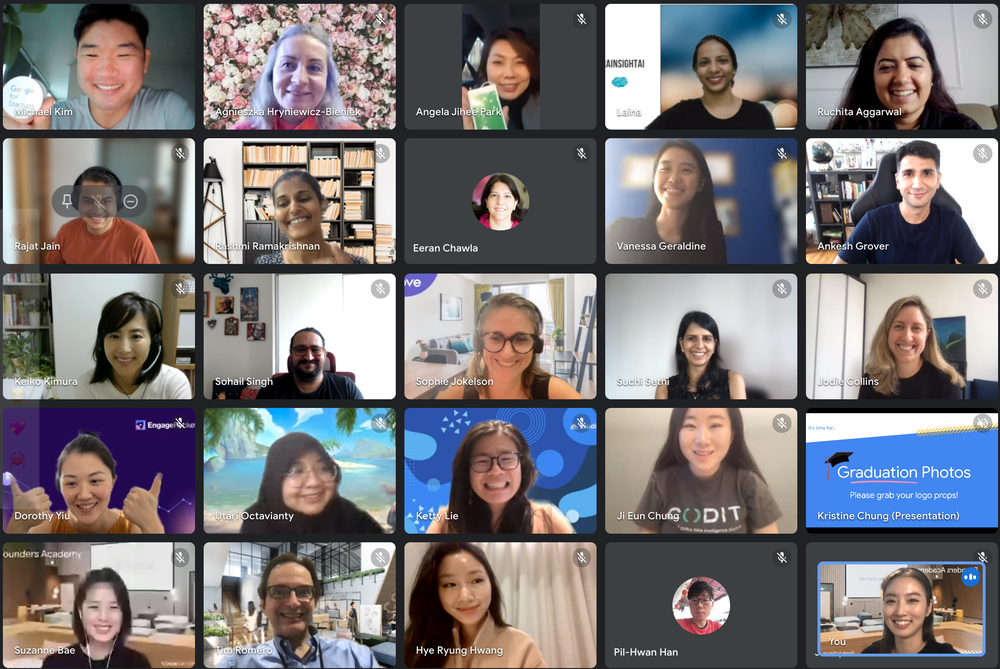
The Women Founders Academy cohort of 2021 recently celebrated their graduation
EngageRocket is one of 10 recent graduates from the APAC Women Founders Academy Program by Google for Startups. During this 12-week program, the founders received training and mentoring from Googlers across the region to help sharpen their leadership skills and address their unique growth needs, including funding. All the participants highlighted the important role of communities and mentors in helping them gain knowledge, overcome mental barriers and build confidence.
Many of them noted that to build true equity, it’s important to look past gender divides and recognise people’s achievements as entrepreneurs and professionals, not only as women. Dorothy wholeheartedly agrees. Today, 50% of EngageRocket’s senior management team are women, all of them working mothers. As a leader, she is determined to build an open, flexible company culture that empowers everyone to balance their priorities – both at work and in their personal lives.
At Google, we’re committed to helping more women like Dorothy grow and thrive in business. We know it’s one of the most powerful steps we can take to create new jobs and opportunities, advance equality, and contribute to an inclusive economic recovery that will benefit us all.
Celebrating news partners in the Asia Pacific
One of the best parts of my role is seeing the great examples of news publishers embracing technology to grow new audiences and build sustainable business models in the Asia-Pacific region.
This week, we heard from news partners at the Google News Initiative (GNI) Global Summit, along with local events in Australia, India, Korea, Japan and Southeast Asia, on the impactful work they are doing.
Supporting a more sustainable, diverse and innovative news ecosystem
Our GNI Impact Report (released during the Summit) features stories from publishers in the Asia-Pacific, including one of our partners DataLEADS, who we worked with to provide verification training for thousands of reporters across India.
We also heard from Indonesia’s Warta Ekonomi on how they improved their website and user experience, and developed their monetization strategy after taking part in the GNILocal News Foundry.
Highlighting APAC leaders in innovation
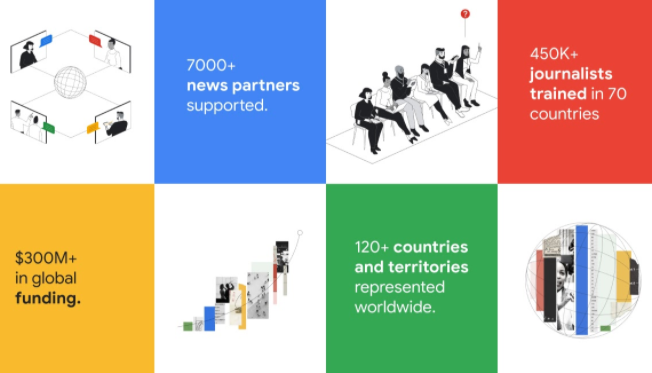
The GNI Innovation Challenge program launched in the Asia Pacific three years ago with a call for applications looking at new ideas to generate reader revenue. Since then, GNI Innovation Challenges have supported more than 200 news organizations around the world — and we heard some of their stories at the Summit.
Kumparan, a media organization in Indonesia, received funding from the GNI Innovation Challenge to help create kumparanDerma, a tool that streamlines the donation process for readers to provide aid during disasters and emergencies.
In India, The News Minute used GNI funding to identify a new, sustainable revenue stream that supplemented their existing advertising model. They used data and insights to launch a membership program and about a year and a half after the project began, they hit 3,000 subscribers. This project helped TNM continue to serve their audience with independent journalism.
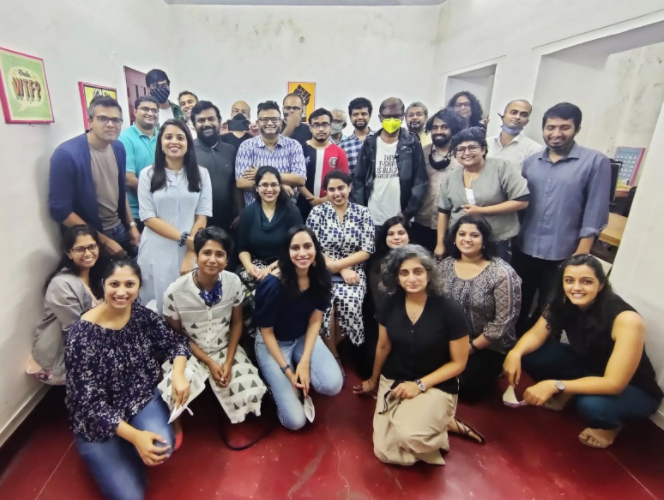
The News Minute team
In Korea, Busan Daily used funding from the Innovation Challenge to improve the way they used data to understand their audience. These are just a few of the great examples we heard on how this program has helped publishers.
Continuing our support for news with new products and tools
The GNI Global Summit featured an update on Google News Showcase, our new product experience and licensing program for news, which aims to help publishers engage more deeply with their readers and to help readers find, follow and support news organizations. Since it launched in October 2020, we’ve signed deals with more than 1,000 news publications around the world, including in India, Japan and Australia.
We also announced new features coming to Google Search that help readers find content from local publishers even more easily than before. We’re expanding a feature that we initially launched for COVID searches, so readers will soon see a carousel of local news stories when Google finds local news coverage relevant to their query. This carousel will be available globally.
There are so many great stories from publishers around the world, as well as updates on our ongoing support for the new ecosystem, in the GNI blog collection.

Fabio Goméz. Esce oggi il nuovo singolo e videoclip “LET ME BE”
Dal 19 novembre in radio e nei digital store “LET ME BE” Il nuovo singolo e videoclip di FABIO GOMEZ Esce oggi “Let Me Be”, il nuovo singolo con cui…
L’articolo Fabio Goméz. Esce oggi il nuovo singolo e videoclip “LET ME BE” scritto da Paolo Brambilla proviene da Assodigitale.

Power your holiday strategy with helpful insights
This year’s holiday shopping season is shaping up to be one of the biggest yet. In fact, 53% of consumers plan to shop online more this year compared to last year.
The Holiday 100 is a great way to help you understand what people are shopping for. The Insights page in Google Ads was designed to keep businesses up to date on similar trends and insights, which is especially useful during the holiday season. In the coming weeks, you’ll see four new features roll out on the Insights page globally to help you drive results this holiday season and beyond.
Demand forecasts (beta): Previously, the Insights page focused on historical performance — trends that explained why your ads performed the way they did. Now, you’ll see more forward-looking trends with demand forecasts (beta). By combining machine learning technology with past seasonal search trends, these forecasts predict emerging search interest over the next six months. These insights are personalized to your business, meaning that you’ll see trends based on the categories where you advertise.
For example, let’s say you’re a beauty retailer. You might see a prediction that search interest in “perfumes & fragrances” will start to trend in the middle of November with an increase of 27%. Interest then peaks to 93% on Black Friday and tapers off in the following weeks. To help you understand this forecast, you’ll see trendlines for predicted search interest, actual search interest, and your clicks (the amount of traffic you’ve already received from this trend).
On the right side of the page, you can view trend details to see the specific searches that are predicted to increase — like “clean perfume” or “sandalwood.” These insights help you better prepare your budgeting, marketing and merchandising plans to meet the rise in consumer demand.
Our clients find strategic value in demand forecasts, especially as we approach Black Friday and Cyber Monday. Some of our clients are even using this data to help inform inventory and product development.
Consumer interest insights (beta): Are you interested in learning how people search for your business? Consumer interest insights (beta) aggregate and anonymize the top-performing search query themes that drive performance in your campaigns. You’ll see the number of people who searched for each theme, its growth, and how it performed in your account.
As that beauty retailer, you might see that the top themes in the “perfumes” category are “affordable” and “floral,” and that your overall impressions for the theme increased by 12%. These themes can be found in the search themes section of the page, and can help you update your marketing and product feed copy to include similar words and phrases.

Audience insights (beta): With audience insights (beta), you can understand more about the interests and affinities of your customers, including what creative resonates the most with them. As the beauty retailer, for example, you might discover that people interested in beauty products prefer the headline “10 must-buy winter fragrances” — and that the audience took part in 57% of the conversions in your campaign.

Change history insights and auction insights (beta): Now, you can find both change history insights and auction insights throughout the Insights page. This can help you understand how shifts in auction competition or changes you made in your account impacted performance.
Many businesses are already using the Insights page to drive growth. Etsy saw an increase in searches for “Sweatshirts & Hoodies” on the Insights page and used that information to help inform their website merchandising, content strategy and ad copy. This contributed to a 49% lift in sales for Google Search and Shopping campaigns in that sub-category.
These updates will launch in the coming weeks at both the campaign and account level. In the meantime, visit the Insights page on Google Ads to check out the latest trends for your business.
A decade in deep learning, and what’s next
Twenty years ago, Google started using machine learning, and 10 years ago, it helped spur rapid progress in AI using deep learning. Jeff Dean and Marian Croak of Google Research take a look at how we’ve innovated on these techniques and applied them in helpful ways, and look ahead to a responsible and inclusive path forward.
Jeff Dean
From research demos to AI that really works
I was first introduced to neural networks — computer systems that roughly imitate how biological brains accomplish tasks — as an undergrad in 1990. I did my senior thesis on using parallel computation to train neural networks. In those early days, I thought if we could 32X more compute power (using 32 processors at the time!), we could get neural networks to do impressive things. I was way off. It turns out we would need about 1 million times as much computational power before neural networks could scale to real-world problems.
A decade later, as an early employee at Google, I became reacquainted with machine learning when the company was still just a startup. In 2001 we used a simpler version of machine learning, statistical ML, to detect spam and suggest better spellings for people’s web searches. But it would be another decade before we had enough computing power to revive a more computationally-intensive machine learning approach called deep learning. Deep learning uses neural networks with multiple layers (thus the “deep”), so it can learn not just simple statistical patterns, but can learn subtler patterns of patterns — such as what’s in an image or what word was spoken in some audio. One of our first publications in 2012 was on a system that could find patterns among millions of frames from YouTube videos. That meant, of course, that it learned to recognize cats.
To get to the helpful features you use every day — searchable photo albums, suggestions on email replies, language translation, flood alerts, and so on — we needed to make years of breakthroughs on top of breakthroughs, tapping into the best of Google Research in collaboration with the broader research community. Let me give you just a couple examples of how we’ve done this.
A big moment for image recognition
In 2012, a paper wowed the research world for making a huge jump in accuracy on image recognition using deep neural networks, leading to a series of rapid advances by researchers outside and within Google. Further advances led to applications like Google Photos in 2015, letting you search photos by what’s in them. We then developed other deep learning models to help you find addresses in Google Maps, make sense of videos on YouTube, and explore the world around you using Google Lens. Beyond our products, we applied these approaches to health-related problems, such as detecting diabetic retinopathy in 2016, and then cancerous cells in 2017, and breast cancer in 2020. Better understanding of aerial imagery through deep learning let us launch flood forecasting in 2018, now expanded to cover more than 360 million people in 2021. It’s been encouraging to see how helpful these advances in image recognition have been.
Similarly, we’ve used deep learning to accelerate language understanding. With sequence-to-sequence learning in 2014, we began looking at how to understand strings of text using deep learning. This led to neural machine translation in Google Translate in 2016, which was a massive leap in quality, particularly for less prevalent languages. We developed neural language models further for Smart Reply in Gmail in 2017, which made it easier and faster for you to knock through your email, especially on mobile. That same year, Google invented Transformers, leading to BERT in 2018, then T5, and in 2021 MUM, which lets you ask Google much more nuanced questions. And with “sparse” models like GShard, we can dramatically improve on tasks like translation while using less energy.
We’ve driven a similar arc in understanding speech. In 2012, Google used deep neural networks to make major improvements to speech recognition on Android. We kept advancing the state of the art with higher-quality, faster, more efficient speech recognition systems. By 2019, we were able to put the entire neural network on-device so you could get accurate speech recognition even without a connection. And in 2021, we launched Live Translate on the Pixel 6 phone, letting you speak and be translated in 48 languages — all on-device, while you’re traveling with no Internet.
More invention ahead
As our research goes forward, we’re balancing more immediately applied research with more exploratory fundamental research. So we’re looking at how, for example, AI can aid scientific discovery, with a project like mapping the brain of a fly, which could one day help better understand and treat mental illness in people. We’re also pursuing quantum computing, which will likely take a decade or longer to reach wide-scale applications. This is why we publish nearly1000 papers a year, including around 200 related to responsible AI, and we’ve given over 6500 grants to external researchers over the past decade and a half.
Looking ahead from 2021 to 2031, I’m excited about the next-generation AI systems we can build, and how much more helpful they’ll be. We’re planting the seeds today with new architectures like Pathways, with more to come.
Marian Croak
Minding the gap(s)
As we develop these lines of research and turn them into useful technologies, we’re mindful of the broader societal impact of AI, and especially that technology has not always had an equitable impact. This is personal for me — I care deeply about ensuring that people from all different backgrounds and circumstances have a good experience.
So we’re increasing the depth and rigor of how we review and evaluate our research to ensure we’re developing it responsibly. We’re also scaling up what we learn by inventing new tools to understand and calibrate critical AI systems across Google’s products. We’re growing our organization to 200 experts in Responsible AI and Human Centered Technology, and working with hundreds of partners in product, privacy, security, and other teams across Google.
As one example of our work on responsible AI, Google Research began exploring the nascent field of ML fairness in 2016. The teams realized that on top of publishing papers, they could have a greater impact by teaching ML practitioners how to build with fairness in mind, as with the course we launched in 2018. We also started building interactive tools that coders and researchers could use, from the What-If Tool in 2018 to the 2019 launch of our Fairness Indicators tool, all the way to Know Your Data in 2021. All of these are concrete ways that AI developers can test their datasets and models to see what kind of biases and gaps there are, and start to work on mitigations to prevent unfair outcomes.
A principled approach
In fact, fairness is one of the key tenets of our AI Principles. We developed these principles in 2017 and published them in 2018, announcing not only the Principles themselves but a set of responsible AI practices with practical organizational and technical advice from what we’ve learned along the way. I was proud to be involved in the AI Principles review process from early on — I’ve seen firsthand how rigorous the teams at Google are on evaluating the technology we’re developing and deciding how best to deploy it in the real world.
Indeed, there are paths we’ve chosen not to go down — the AI Principles describe a number of areas we avoid. In line with our principles, we’ve taken a very cautious approach on face recognition. We recognize how fraught this area is not only in terms of privacy and surveillance concerns, but also its potential for unfair bias and impacts on historically marginalized groups. I’m glad that we’re taking this so thoughtfully and carefully.
We’re also developing technologies that help engineers apply the AI Principles directly — for example, incorporating privacy design principles. We invented Federated Learning in 2017 as a way to train ML models without your personal data leaving your phone. In 2018 we showed how well this works on Gboard, the free keyboard you can download for your phone — it learns to provide you more useful suggestions, while keeping what you type private on your device.
If you’re curious, you can learn more about all these veins of research, product impact, processes, and external engagement in our 2021 AI Principles Progress Update.
AI by everyone, for everyone
As we look to the decade ahead, it’s incredibly important that AI be built in a way that works well for everyone. That means building as inclusive a team as we can ourselves at Google. It also means ensuring the field as a whole increasingly represents the people whose lives it aims to improve.
I’m proud to lead the Black Leadership Advisory Group (BLAG) at Google. We helped craft and drive programs included in Google’s recent update on racial equity work. For example, we paired up new director-level hires with BLAG members, and the feedback has been really positive, with 80% of respondents saying they’d recommend the program. We’re looking at extending this to other groups, including for Lantinx+ and Asian+ Googlers. We’re holding ourselves accountable as leaders too — we now evaluate all VPs and above at Google on progress on diversity, equity, and inclusion. This is crucial if we’re going to have a more representative set of researchers and engineers building future technologies.
For the broader research and computer science communities, we’re providing a wide variety of grants, programs, and collaborations that we hope will welcome a more representative range of researchers. Our Research Scholar Program, begun in 2021, gave grants to more than 50 universities in 15+ countries — and 43% of the principal investigators identify as part of a group that’s been historically marginalized in tech. Similarly, our exploreCSR and CS Research Mentorship programs support thousands of undergrads from marginalized groups. And we’re partnering with groups like the National Science Foundation on their new Institute for Human-AI Collaborations.
We’re doing everything we can to make AI work well for all people. We’ll not only help ensure products across Google are using the latest practices in responsible AI — we’ll also encourage new products and features that serve those who’ve historically missed out on helpful new technologies. One example is Project Relate, which uses machine learning to help people with speech impairments communicate and use technology more easily. Another is Real Tone, which helps our imaging products like our Pixel phone camera and Google Photos more accurately and beautifully represent a diverse range of skin tones. These are just the start.
We’re excited for what’s ahead in AI, for everyone.
Find food and give back with Google
In Google’s early days, around this time every year, a group of us would run to Costco and buy supplies to take to Bay Area food banks and pantries. It was a grassroots effort that was scrappy and meaningful — and it introduced a lot of Googlers to how rewarding giving back can be. It made me want to learn what more we could do to have an even bigger impact.
Inspired by our small and mighty food donation operation, I became a passionate supporter of Second Harvest Food Bank in Silicon Valley. And with guidance from food assistance experts, we established a dedicated team at Google in 2020 to work on tackling issues of food waste and food insecurity. Too many families are having to make difficult decisions no one should be forced to make: paying rent, bills, healthcare costs — or keeping food on their table. These challenges have only been compounded by the COVID-19 crisis, which has left more than 54 million working Americans struggling to find a meal. That’s nearly 16% of the country.
Google co-founder Larry Page once said “people are starving in the world not because we don’t have enough food. It’s because we’re not yet organized to solve that problem.” The United Nations Food and Agriculture Organization (UNFAO) reports that the world produces more than we need to feed every person on this planet. This isn’t a problem of supply, it’s a problem of distribution. And while solving this issue will require work from government, businesses, nonprofits and individuals working together, one way Google can help is to give people easy access to the information they need, when they need it.
Helping people find food pantries
When you look at Google Search trends, you can see that searches for “food bank” and “food pantry” spike during the month of November.
Food banks have always been critical to making sure people have regular access to nutritious food, but the ongoing pandemic has drastically increased their role as a crucial lifeline in so many communities. With the need for their services doubling or even tripling in some areas, we want to make sure that the people who need them most can find them.
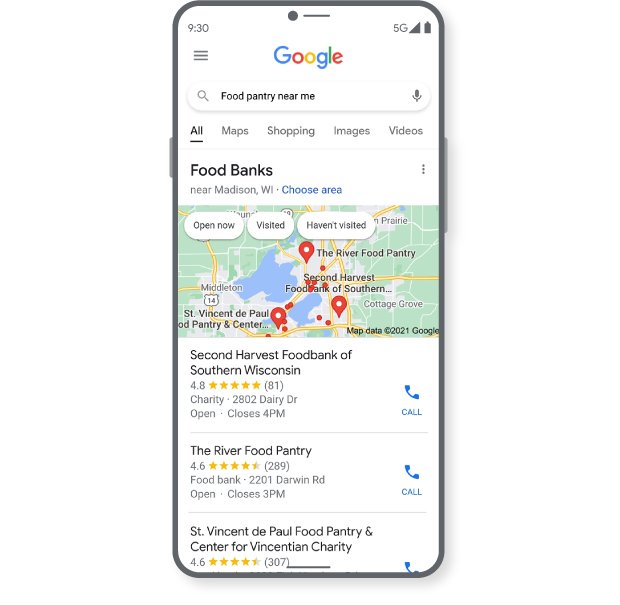
That’s why we’ve launched a new initiative to expand the information about food banks and pantries in Google Search and Maps. We’ve augmented existing coverage with data from two initial nonprofit partners: WhyHunger and Hunger Free America, and we’ve added information to make sure people searching for food support can find what they need. These changes are being made directly in Google Maps so food banks, food pantries and soup kitchens can focus on what matters most — getting people food.
Still, some of these locations don’t yet have websites or phone numbers available on Google. So over the last two months, we’ve worked to update this information in Search and Maps, making 85,000 plus calls to verify local food banks and pantries. These efforts will continue through the holidays.
We’ve also developed new Google Business Profile features specifically for food banks, pantries and soup kitchens. They can now provide details on their profile, like whether an appointment is needed, if there are eligibility requirements to receive food and what languages are spoken. They can also add information about their services, like whether prepared meals are available or if grocery delivery is an option. Additionally, pantries can specify whether they’re accepting new volunteers or soliciting food or monetary donations.
Helping people access benefits
Beyond working with food pantries, we’re also helping people use Search to find out how to get and use food assistance benefits.
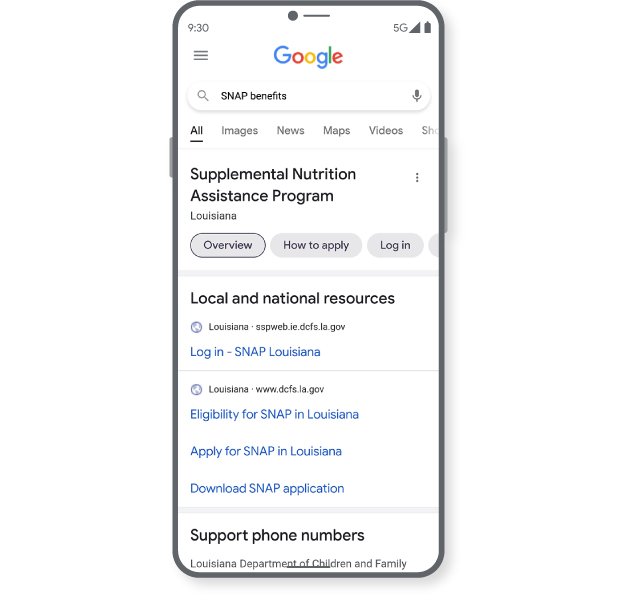
Federal programs like the Supplemental Nutrition and Assistance Program (SNAP) feed more than 40 million Americans each year. We heard from users that information about these programs is often hard to find, especially for people who are using them for the first time. Today, if you search on Google for “SNAP benefits,” or the name of your local SNAP program, you’ll find direct links to each state’s eligibility guidelines and application process, including contact information for local food assistance agencies.
Once approved, many people use Electronic Benefits Transfer cards (also known as EBT) to pay for their groceries. Now, if you search for “grocery stores that accept EBT” you can easily find USDA-approved stores that accept this form of payment — saving time and potential confusion.
Supporting hunger relief organizations – and the communities they serve
I’m also proud to announce that we’re contributing financial support as well. Since the COVID-19 crisis began, Googlers have stepped up – giving more than $22 million in personal donations and company-match to hunger relief organizations in the U.S. Today, Google is contributing an additional $2 million in support ($1 million in cash funding and $1 million in donated ads from Google.org) to 20 food banks, pantries and innovative hunger relief organizations across the country.
There is no easy solution to these large-scale challenges that face our communities, but I’m hopeful that increasing access to information about local food support programs and services can help. Our teams are hard at work and committed to building new tools and features that support economic recovery in the U.S. – and around the world – as we weather the COVID-19 crisis. And I personally am really looking forward to getting back to sorting and distributing food with my family at our local food bank.
You can make an impact by volunteering your time, making a donation, using your voice, or a combination of each — there are a number of ways we can all give back. If you need a place to start, you can donate to the largest national network of food banks, Feeding America. Or you can get involved locally: just search for your nearest food pantry on Google and contact them to see what they need. And if you know someone who might need food assistance, you can simply help by sharing resources. Spreading the word not only about what you’re doing to help, but why can make a huge difference.
Helping nonprofits fundraise this season of giving
In 2020, people in the U.S. donated an estimated $2.5 billion on Giving Tuesday alone. To help connect nonprofits with people who are searching for ways to give their time and resources, Google.org will donate $25 million in ads to nonprofits around the world.
These grants are incremental to the baseline $10,000 per month Ad Grant offering and will go to nonprofits focused on humanitarian response, food insecurity and economic recovery. For example, organizations like Direct Relief may use the incremental Ad Grants to attract more donors who are searching on Google for ways to help vulnerable populations, while SCORE may use the grants to connect people looking for ways to volunteer on Google with an opportunity to sign up to be a small business mentor.
Google.org awards over $1 billion in Ad Grants annually to qualifying nonprofits. Last Giving Season, many organizations that received incremental Ad Grants, like Houston Food Bank, more than doubled the donations they raised as compared to similar organizations receiving the baseline Ad Grant. After receiving incremental Ad Grants in 2020, Houston Food Bank saw a fourfold increase in total donations from their campaigns — raising $130,000 in donations in a single month.
“We’ve had to work with quickness and efficiency to reach out to those who need us most,” said Jessica Dominguez, Annual Giving Manager at Houston Food Bank.“The easiest way for people to donate and find their closest food location is to turn to the web. The Ad Grant gave us the opportunity to reach these people and provide them with the right information.”
In addition to these incremental grants, all eligible organizations may sign up to receive $10,000 per month in Ad Grants and apply for pro bono account support through Google’s Nonprofit Marketing Immersion.
Happy giving!
These Googlers stepped it up for Walktober
Yousuf Fauzan’s mother knew she’d be on the phone a lot this October. Every day during the month, she’d talk to her son for hours as he paced around his home in California. “She would get irritated, she would disconnect the call, then I’d call again 15 minutes later.”
Calling his mom — and pretty much everyone he knows — was how Yousuf, a YouTube software engineer, passed the time while getting his steps in for “Walktober,” Google’s annual employee walking competition. “I don’t talk to people on the phone often, but during October, I call anyone and everyone I’ve ever known.” After spending his workday walking during meetings, Yousuf would lap around the inside of his condo from 7:00 p.m. until 4:00 a.m. to hold his top spot on the leaderboard. By the end of the month, he’d accumulated more than two million steps.
Planning lead Tiffany Bartish-Katz says this is the kind of “fierce but friendly” competition that Walktober attracts. Started in 2011 as a local effort in Google’s Cambridge, Massachusetts office, Walktober quickly went global: This year, more than 26,000 employees across 190 offices joined the competition, putting in over five billion steps. “I’m always a little awestruck by the number of people who engage in this very simple, friendly, fun, grassroots project,” Tiffany says. And the planning team works hard to make sure everyone gets in the spirit — from ultra walkers like Yousuf, to those who are adding just a few more thousand steps to their routines.
Some Walktober participants decided to put their step counts towards a good cause. Last year, Greg Kroleski, a Google Cloud Product Manager, walked for 24 hours straight. As he considered doing another 24-hour challenge this year, a coworker suggested tying it to a fundraiser. “A lot of people paid attention last year. I wanted to direct that attention to something good.” Greg dedicated this year’s challenge, and his team’s entire Walktober effort, to raise awareness for myalgic encephalomyelitis/chronic fatigue syndrome (ME/CF), a chronic disease that causes overwhelming fatigue. He and his colleagues ended up raising $14,000. As for the 24-hour challenge? Greg logged over 204,000 steps that day, breaking a Google Walktober record…for a few hours, at least. “Unfortunately, the next day, someone else broke my record.” All the more reason to give it another go next year. “You might see me again,” he says.
Ziad Reslan, a Product Policy Advisor at Google, also channeled his team’s Walktober efforts towards something good. “I wanted to spend the entire last day of Walktober walking as an ode to the journeys of millions of refugees who have no choice but to walk to get to safety,” he says. To raise awareness for LGBTQ+ refugees in the Middle East in particular, Ziad organized a walk from Google’s San Francisco office to its Mountain View headquarters — a familiar 38.8-mile route for California commuters. He received over $25,000 in pledged donations from fellow Googlers, with a handful joining him throughout the day.
When Ziad and his colleagues reached the Mountain View campus that evening, he was overwhelmed: “I teared up remembering the first time I had ever been [to Mountain View] wishing to become a Googler,” he says. “And now here I was, walking to it surrounded by other Googlers for a good cause.”

PREMIO GIORNALISTICO ROSSELLA MINOTTI 2021 per giornalisti under 35
candidature entro il 30 novembre Possono partecipare giornalisti under 35, professionisti pubblicisti e praticanti, iscritti al sindacato. Tre le sezioni in concorso: carta stampata, quotidiani e periodici; radio e televisioni;…
L’articolo PREMIO GIORNALISTICO ROSSELLA MINOTTI 2021 per giornalisti under 35 scritto da Paolo Brambilla proviene da Assodigitale.